Словари

Словарь английского языка | Значения слов, определения и примеры

adjective
/ˈsiː.naɪl/
слабость, связанная с возрастом (slabost', svyazannaya s vozrastom)

Showing the weaknesses of old age, especially mental decline.

"The old man became senile and forgot familiar faces."

"Старик стал сенильным и забыл знакомые лица." (Starik stal senil'nym i zabyl znakomye litsa.)
noun
/sɪˈnɪləti/
старческое слабоумие (starcheskoye slaboumye)

The state of being old and showing the weaknesses of age, especially mental decline.

"His forgetfulness was attributed to senility."

"Его забывчивость была приписана старческому слабоумию." (Yego zabyvchivost' byla pririsena starcheskomu slaboumiyu.)
adjective
/ˈsɪniər/
старший (starshiy)

having a higher rank or status; older or more experienced

"He is the senior manager in the department."

"Он старший менеджер в отделе." (On starshiy menedzher v otdele.)
noun
/sɛnˈseɪʃən/
сенсация (sensatsiya)

A physical feeling or a strong reaction of excitement and interest.

"The singer became a sensation overnight."

"Певец стал сенсацией за одну ночь." (Pevets stal sensatsiey za odnu noch'.)
adjective
/sɛnˈseɪʃənəl/
сенсационный (sensatsionnyi)

Causing great public interest and excitement; outstanding or impressive.

"The team had a sensational victory in the finals."

"Команда одержала сенсационную победу в финале." (Komanda oderzhala sensatsionnuyu pobedu v finale.)
noun/verb
/sɛns/
чувство (chuvstvo)

A faculty by which the body perceives external stimuli; or to perceive something without being told.

"She had a strong sense of responsibility."

"У неё было сильное чувство ответственности." (U nee bylo sil'noe chuvstvo otvetstvennosti.)
noun
/ˌsɛnsəˈbɪləti/
чувствительность (chuvstvitel'nost')

The ability to appreciate and respond to complex emotional or aesthetic influences; sensitivity.

"Her artistic sensibility impressed everyone."

"Ее художественная чувствительность впечатлила всех." (Eye khudozhestvennaya chuvstvitel'nost' vpechatlila vsekh.)
adjective
/ˈsensəbəl/
разумный; практичный; благоразумный (razumnyy; praktichnyy; blago-razumnyy)

having or showing good sense; practical and reasonable

"It would be sensible to take an umbrella because it might rain."

"Будет разумно взять зонт, так как может пойти дождь." (Budet razumno vzyat' zont, tak kak mozhet pojti dozhd'.)
sensitive definition card — visual illustration of the meaning
adjective
/ˈsɛnsɪtɪv/
чувствительный (chuvstvitel'nyy)

Quick to detect or respond to slight changes, signals, or influences; easily affected emotionally or physically.

"She has very sensitive skin that reacts to most cosmetics."
"У неё очень чувствительная кожа, которая реагирует на большинство косметических средств." (U nee ochen' chuvstvitel'naya kozha, kotoraya reaguet na bol'shinstvo kosmeticheskikh sredstv.)
sensitivity definition card — visual illustration of the meaning
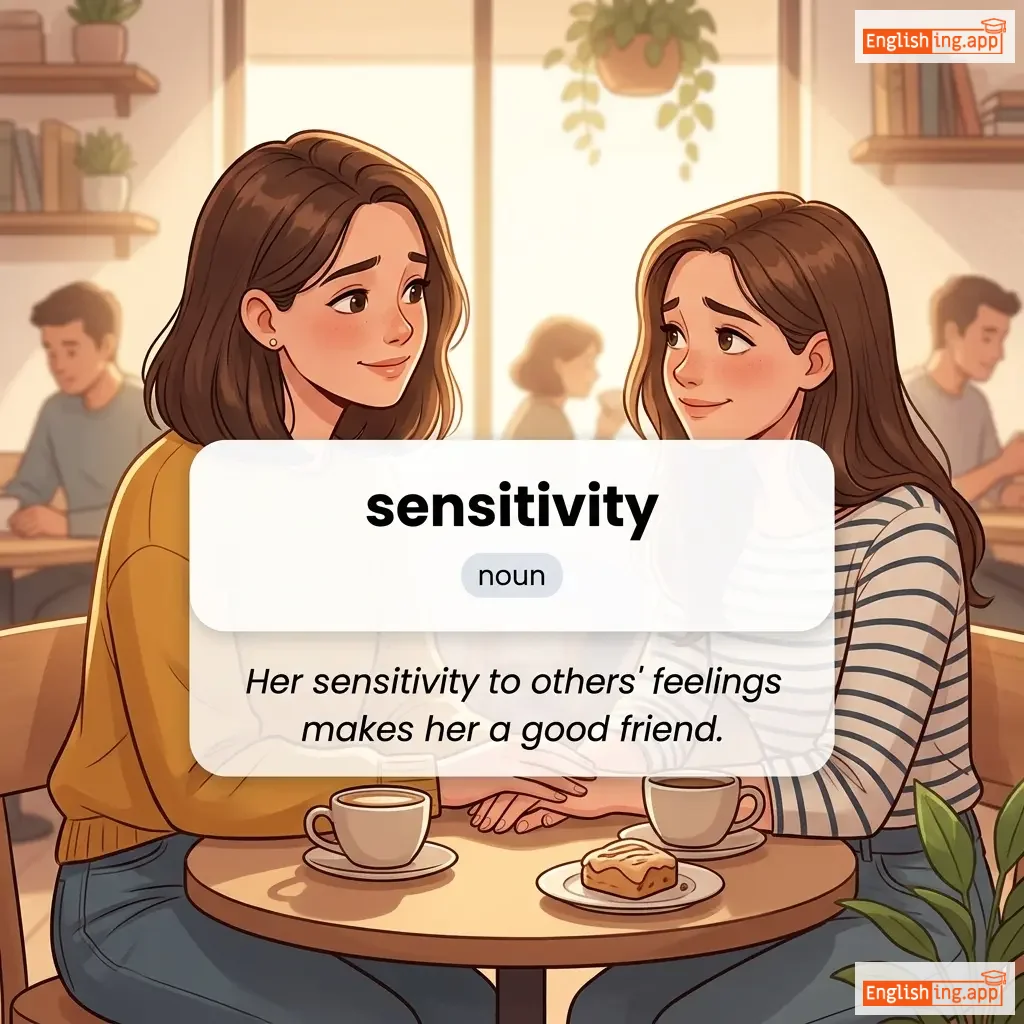
noun
/ˌsɛnsɪˈtɪvɪti/
чувствительность (chuvstvitelnosť)

the quality of being sensitive; ability to detect or respond to slight changes or emotions

"Her sensitivity to others' feelings makes her a good friend."

"Её чувствительность к чувствам других делает её хорошим другом." (Eyo chuvstvitelnosť k chuvstvam drugikh delaet yejo khoroshim drugom.)
noun
/ˌsɛnsɪtaɪˈzeɪʃən/
сенсибилизация (sensibilizatsiya)

The process of becoming sensitive to a substance, situation, or influence.

"The doctor warned about the sensitization caused by repeated exposure to chemicals."
"Врач предупредил о сенсибилизации, вызванной повторным воздействием химических веществ." (Vrach predupredil o sensibillizatsii, vyzvannoy povtornym vozdeystviyem khimicheskikh veshchestv.)
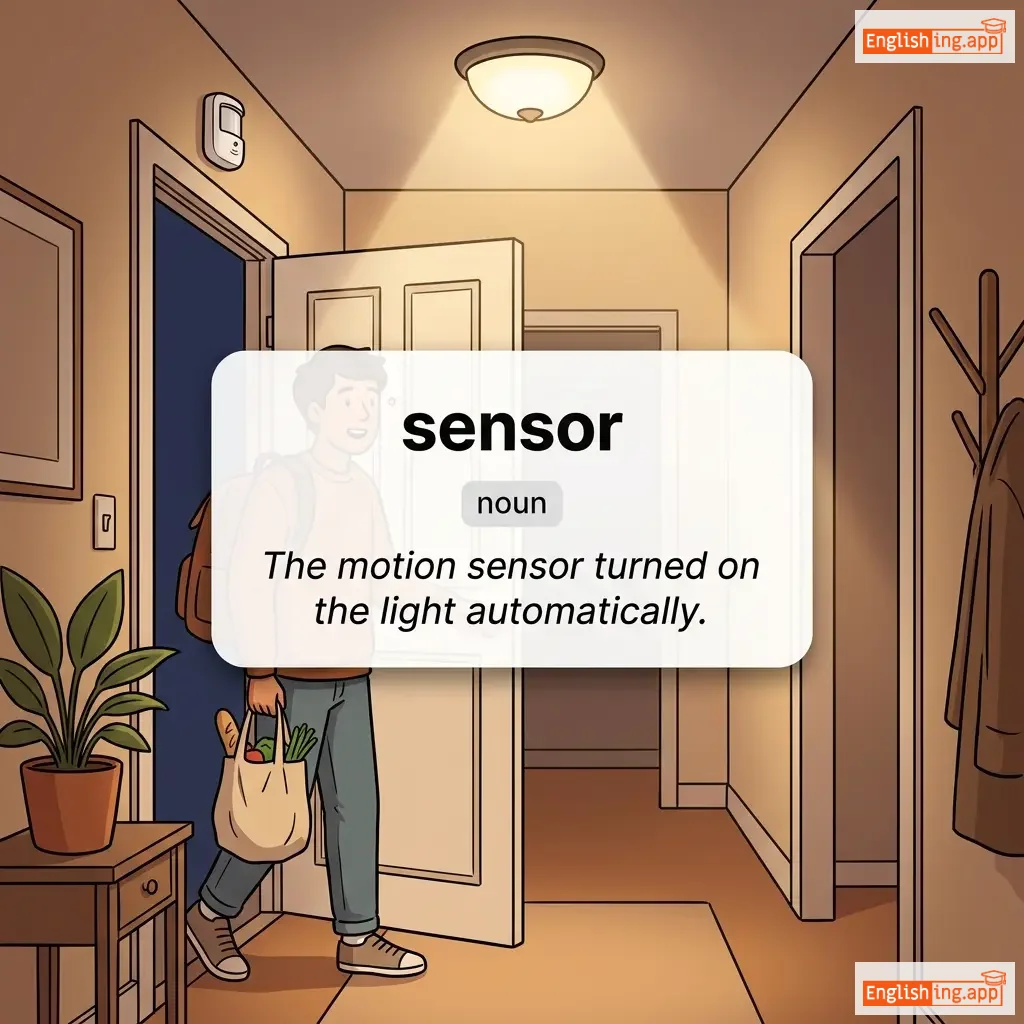
sensor definition card — visual illustration of the meaning
noun
/ˈsɛnsər/
счастье (schast'ye)

a device that detects or measures a physical property and records, indicates, or responds to it

"The motion sensor turned on the light automatically."

"Она не могла скрыть своего счастья, когда получила награду." (Ona ne mogla skryt' svoego schast'ya, kogda poluchila nagradu.)
noun
/sɛnˈsɔːrɪəm/
сенсорный центр (sensorny tsentr)

The part of the brain or mind concerned with the reception and interpretation of sensory stimuli.

"The patient’s sensorium was clouded after the accident."

"Сенсорный центр пациента был затуманен после аварии." (Sensorny tsentr patsiyenta byl zatumanyen posle avarii.)
sensory definition card — visual illustration of the meaning
adjective
/ˈsɛn.sər.i/
сенсорный (sensorny)

Related to the five human senses (sight, hearing, taste, touch, smell).

"Sensory feedback enhances the VR experience."
"Сенсорная обратная связь улучшает опыт виртуальной реальности." (Sensornaya obratnaya svyaz' uluchshaet opyt virtual'noy real'nosti.)
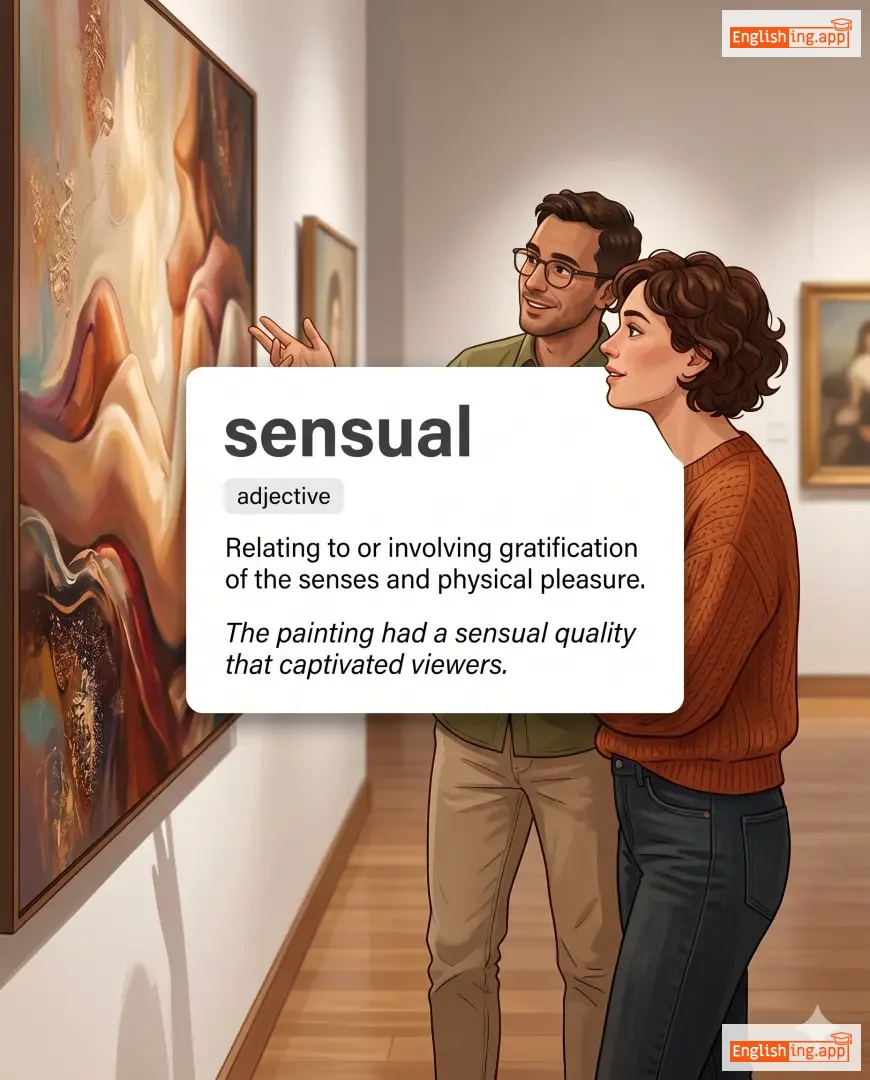
sensual definition card — visual illustration of the meaning
adjective
/ˈsɛnʃuəl/
чувственный (chuvstvennyy)

Relating to or involving gratification of the senses and physical pleasure.

"The painting had a sensual quality that captivated viewers."
"Картина имела чувственную атмосферу, которая захватывала зрителей." (Kartina imela chuvstvennuyu atmosferu, kotoraya zakhvatyvala zritelyey.)
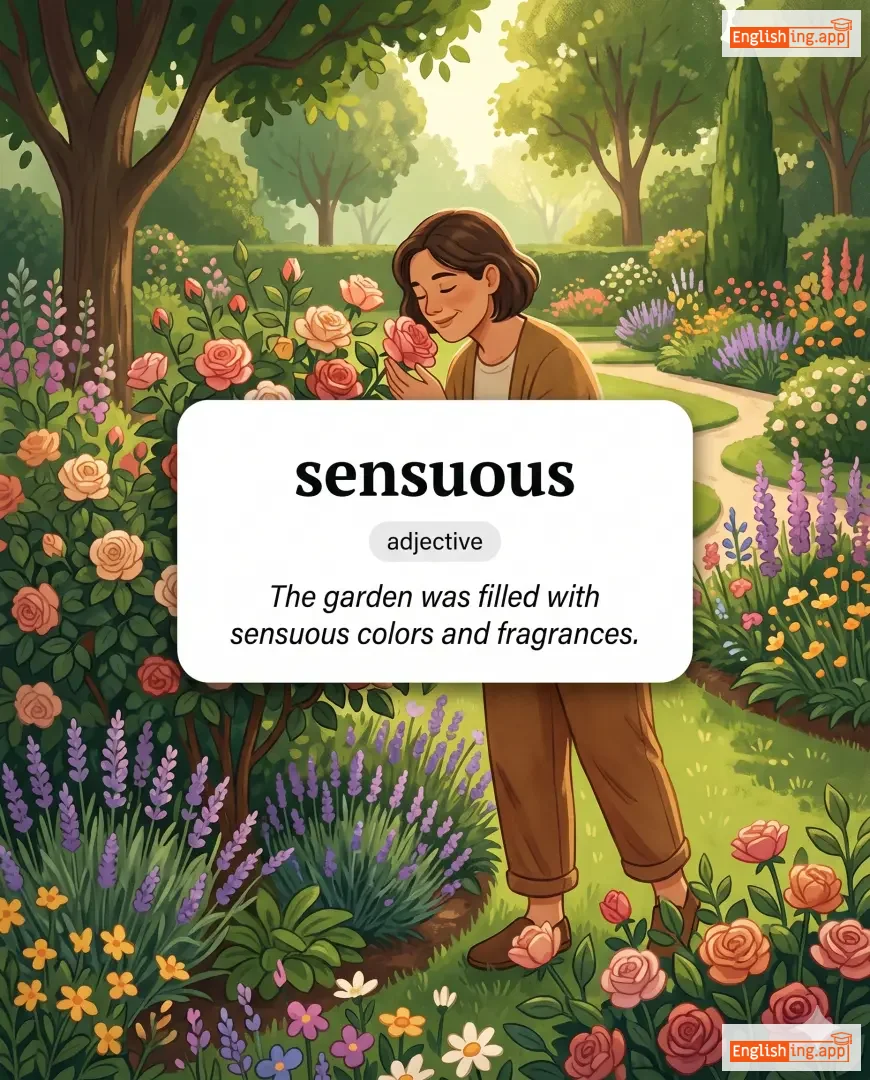
sensuous definition card — visual illustration of the meaning
adjective
/ˈsɛnʃuəs/
чувственный (chuvstvenny)

Relating to or affecting the senses rather than the intellect; pleasing to the senses.

"The garden was filled with sensuous colors and fragrances."

"Сад был наполнен чувственными цветами и ароматами." (Sad byl napolnen chuvstvennymi tsvetami i aromatami.)
noun, verb
/ˈsɛntəns/
predlozhenie; nakazanie (predlozhenie; nakazanie)

A set of words that expresses a complete thought; or a punishment given by a court of law.

"The judge gave him a five-year prison sentence."

"Sudya prisudil yemu pyat' let tyur'my." (Sudya prisudil yemu pyat' let tyur'my.)
adjective
/sɛnˈtɛnʃəs/
морализаторский; нравоучительный (moralizatorskiy; nravouchitel'nyy)

Given to moralizing in a pompous or affected manner.

"His sententious remarks annoyed the audience."

"Его морализаторские замечания разозлили аудиторию." (Yego moralizatorskiye zamechaniya razozyrili auditoriyu.)
noun
/ˈsɛnʃəns/
чувствительность (chuvstvitel'nost')

The capacity to feel, perceive, or experience subjectively.

"Many argue that animals possess sentience."
"Многие утверждают, что животные обладают чувствительностью." (Mnogie utverzhdayut, chto zhivotnye obladayut chuvstvitel'nost'yu.)
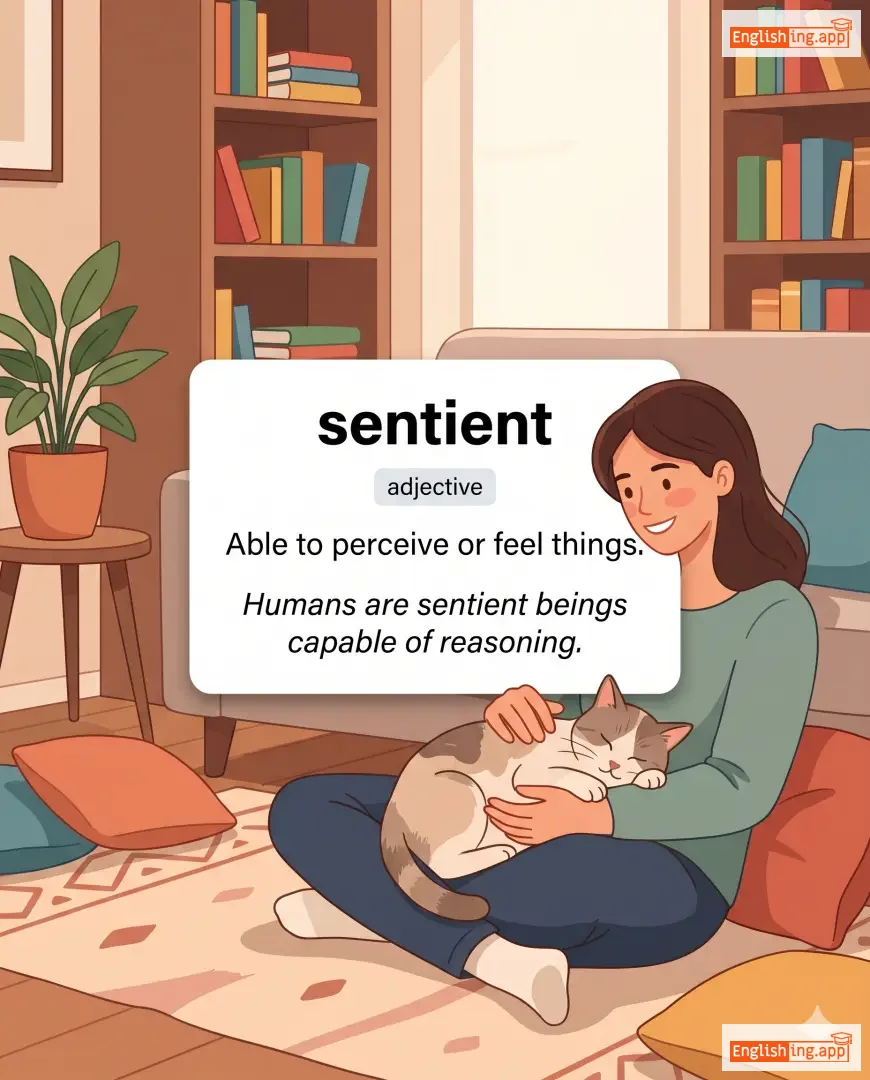
sentient definition card — visual illustration of the meaning
adjective
/ˈsɛnʃənt/
чувствующий (chuvstvuyushchiy)

Able to perceive or feel things.

"Humans are sentient beings capable of reasoning."

"Люди — чувствующие существа, способные рассуждать." (Lyudi — chuvstvuyushchie sushchestva, sposobnye rassuzhdat'.)
noun
/ˈsɛntɪmənt/
чувство (chuvstvo)

a view or opinion that is based on emotion rather than reason

"Public sentiment was against the new law."

"Общественное мнение было против нового закона." (Obshchestvennoe mnenie bylo protiv novogo zakona.)
adjective
/ˌsɛntɪˈmɛntəl/
сентиментальный (sentimental'nyy)

Having or showing tender, emotional feelings, often excessively.

"She kept the old letters for sentimental reasons."

"Она оставила старые письма по сентиментальным причинам." (Ona ostavila staryye pis'ma po sentimental'nym prichinam.)
noun
/ˈsɛntɪnəl/
страж (strazh)

A soldier or guard whose job is to stand and keep watch.

"A sentinel stood at the entrance of the camp."

"Страж стоял у входа в лагерь." (Strazh stoyal u vkhoda v lagery.)
adjective
/ˈsɛpərəbəl/
разделяемый (razdelyayemy)

Capable of being separated or divided.

"The two issues are separable and should be discussed independently."

"Эти два вопроса разделяемы и должны быть обсуждены независимо." (Eti dva voprosa razdelyayemy i dolzhny byt' obsuzhdeny nezavisimo.)
verb
/ˈsɛpəˌreɪt/
отделить (otdelit)

To cause to move or be apart; to divide into distinct elements.

"The teacher separated the students into groups."

"Учитель разделил студентов на группы." (Uchitel' razdelil studentov na gruppy.)
adjective
/ˈsɛpəreɪtɪd/
разделенный (razdelennyy)

divided or disconnected from something else; not together

"They have been living in separated houses since the divorce."

"С момента развода они живут в отдельных домах." (S momenta razvoda oni zhivut v otdelnykh domakh.)
adverb
/ˈsɛp.ər.ət.li/
отдельно (otdelno)

in a way that is apart or individually; not together

"They decided to travel separately to the conference."

"Они решили поехать на конференцию отдельно." (Oni reshil poekhat na konferenciyu otdelno.)
noun
/ˌsɛpəˈreɪʃən/
разделение (razdeleniye)

the act of moving or being moved apart; a division or disconnection

"The separation of the two friends was difficult for both of them."

"Разделение двух друзей было трудно для обоих." (Razdeleniye dvukh druzey bylo trudno dlya oboikh.)
noun
/ˈsɛpərətɪst/
сепаратист (separatist)

A person who supports the separation of a group from a larger body, often for political or cultural independence.

"The separatist group demanded independence from the central government."

"Сепаратистская группа потребовала независимости от центрального правительства." (Separatistskaya gruppa potrebovala nezavisimosti ot tsentral'nogo pravitel'stva.)
noun
/sɛpˈtɛmbər/
сентябрь (sentyabr)

The ninth month of the year in the Gregorian calendar

"My birthday is in September, and I always celebrate it with friends."

"Мой день рождения в сентябре, и я всегда праздную его с друзьями." (Moy den rozhdeniya v sentyabre, i ya vsegda prazdnuyu ego s druz'yami.)
adjective
/sɛpˈtɛnɪəl/
семилетний (semiletniy)

Occurring every seven years.

"The festival is a septennial tradition in the village."

"Этот фестиваль - семилетняя традиция в деревне." (Eto festivál' - semiletnyaya traditsiya v derevne.)
adjective
/ˈsɛptɪk/
инфицированный (infitsirovannyy)

Infected with harmful bacteria; relating to or causing infection.

"The doctor treated the patient's septic wound immediately."

"Врач немедленно обработал септическую рану пациента." (Vrach nemedlenno obrabotal septicheskuyu ranu patsiyenta.)
noun
/ˈsɛpəlkər/
гробница (grobnitsa)

A small room or monument, cut in rock or built of stone, in which a dead person is buried.

"The ancient king was laid to rest in a grand sepulcher."

"Древний король был погребен в великой гробнице." (Drevnij korol' byl pogreben v velikoj grobnitse.)
adjective
/səˈpʌlkrəl/
связанный с могилой, мрачный (svyazannyy s mogiloy, mrachnyy)

Relating to a tomb or burial; gloomy, dismal.

"The abandoned house had a sepulchral silence about it."

"Покинутое здание было охвачено сепулькральной тишиной." (Pokinutoe zdanie bylo okhvacheno sepul'kral'noy tishinoy.)
noun
/ˈsɛpəlˌtʃər/
гробница; могила; (grobnitsa; mogila)

the act of burying a dead body; burial; a grave or tomb

"The ancient king's sepulture was discovered by archaeologists."

"Сепулькре древнего короля было обнаружено археологами." (Sepul'kre drevnego korolya bylo obnaruzheno arkheologami.)
adjective
/sɪˈkweɪʃəs/
слепо следующий (slepo sleduyushchiy)

Lacking independence of thought; blindly following.

"The sequacious students never questioned their teacher's opinions."

"Последователи никогда не ставили под сомнение мнения своего учителя." (Posledovateli nikogda ne stavili pod somneniye mneniya svoego uchitelya.)
noun
/ˈsiːkwəl/
продолжение (prodolzhenie)

A published, broadcast, or recorded work that continues the story or develops the theme of an earlier one.

"The movie's sequel was even more successful than the original."

"Сиквел фильма был ещё более успешным, чем оригинал." (Sikvel fil'ma byl yeshcho boleye uspeshnym, chem original.)
noun
/sɪˈkwiːlə/
последствия (posledstviya)

A condition that is the consequence of a previous disease or injury.

"Lung scarring can be a sequela of severe pneumonia."

"Рубцы на легких могут быть последствиями тяжелой пневмонии." (Rubtsy na legkikh mogut byt' posledstviyami tyazheloy pnevmonii.)
noun
/ˈsiːkwəns/
последовательность (posledovatel'nost')

A particular order in which related things follow each other.

"The magician asked us to remember the sequence of cards."

"Фокусник попросил нас запомнить последовательность карт." (Fokusnik poprosil nas zapomnit' posledovatel'nost' kart.)
adjective
/ˈsiːkwənt/
последующий (posleduyushchiy)

Following in order or as a result.

"The sequent events changed the course of history."

"Последующие события изменили ход истории." (Posleduyushchie sobytiya izmenili khod istorii.)
sequester definition card — visual illustration of the meaning
verb
/sɪˈkwɛstər/
изолировать (izolirovat)

To isolate or hide away; to take possession of assets until a debt has been paid.

"The jury was sequestered during the high-profile trial."

"Присяжные были изолированы во время громкого судебного процесса." (Prisyazhnye byli izolirovany vo vremya gromkogo sudebnogo protsessa.)
verb
/sɪˈkwɛstreɪt/
конфисковать (konfiskovat')

To take legal possession of assets until a debt is paid or disputes are resolved.

"The court decided to sequestrate the company's property."

"Суд решил конфисковать имущество компании." (Sud reshil konfiskovat' imushchestvo kompanii.)
noun
/ˈsɛrəf/
серафим (serafim)

An angelic being associated with light and purity, often depicted as a high-ranking angel in Christian theology.

"The stained-glass window depicted a seraph with outstretched wings."

"Витраж изображал серафима с расправленными крыльями." (Vitrazh izobrazhal serafima s raspravlennymi kryl'yami.)
adjective
/səˈræfɪk/
серафический (seraficheskiy)

Of or like a seraph; angelic, pure, and blissful.

"She gave him a seraphic smile that calmed his fears."

"Она подарила ему серофическое улыбку, которая успокоила его страхи." (Ona podarila yemu seraficheskoe ulybku, kotoraya uspokoila yego strakhi.)
adjective
/sɪər/
сухой (sukhoy)

Dry or withered, especially vegetation.

"The sere leaves crumbled under his feet."

"Сухие листья рассыпались под его ногами." (Sukhie list'ya rassyplilis' pod ego nogami.)
adjective
/ˌsɛrənˈdɪpɪtəs/
счастливый случай (schastlivyy sluchay)

Occurring or discovered by chance in a happy or beneficial way.

"Their meeting at the café was purely serendipitous."

"Их встреча в кафе была совершенно счастливым случаем." (Ikh vstrecha v kafe byla sovershenno schastlivym sluchayem.)
noun
/ˌsɛrənˈdɪpɪti/
серендипити (serendipiti)

The occurrence of events by chance in a happy or beneficial way.

"Finding that old photo album was pure serendipity."
"Найти тот старый фотоальбом было чистой серендипити." (Nayti tot staryy fotoalbom bylo chistoy serendipiti.)
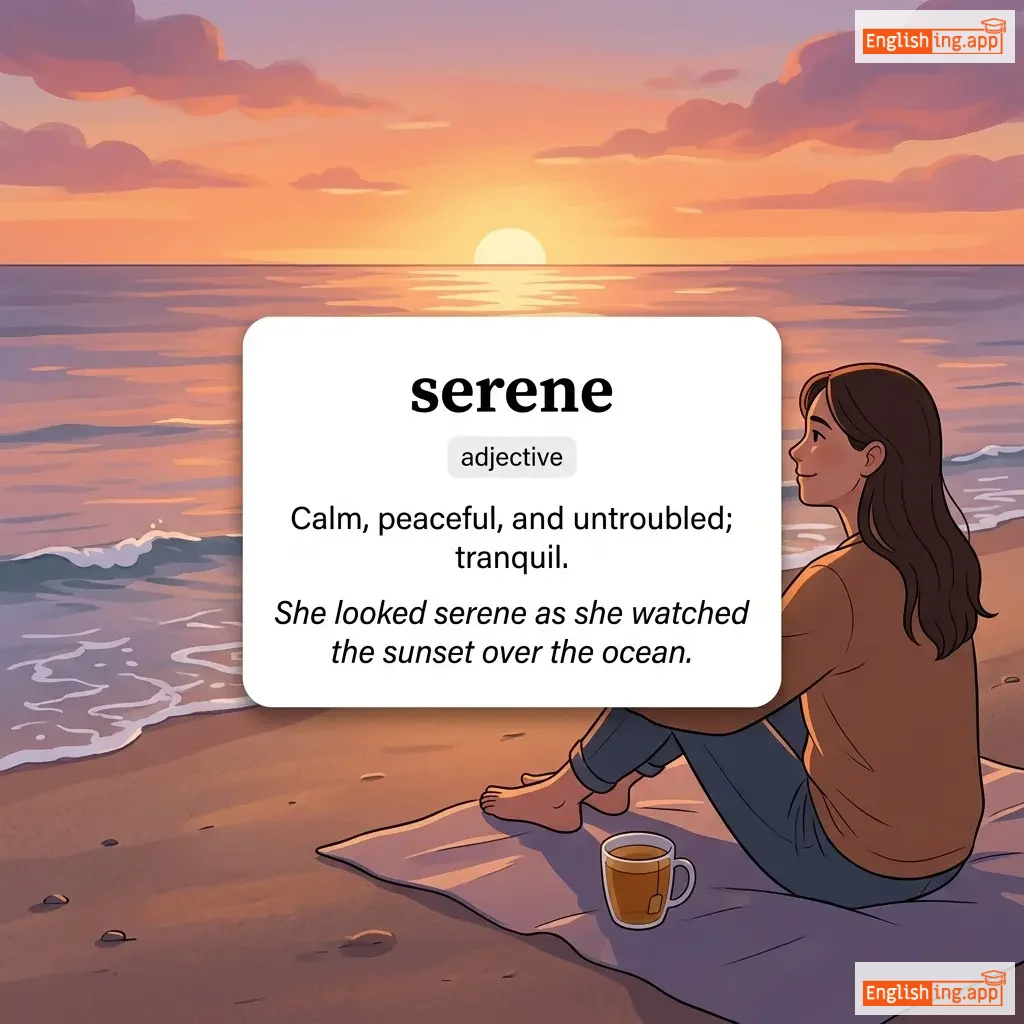
serene definition card — visual illustration of the meaning
adjective
/səˈriːn/
спокойный (spokoyny)

Calm, peaceful, and untroubled; tranquil.

"She looked serene as she watched the sunset over the ocean."

"Она выглядела спокойной, наблюдая за закатом над океаном." (Ona viglyadela spokoynoy, nablyudaya za zakatom nad okeanom.)
serenity definition card — visual illustration of the meaning
noun
/səˈrɛnɪti/
безмятежность (bezmyatezhnost)

The state of being calm, peaceful, and untroubled.

"Meditation brings a sense of serenity to the mind."

"Медитация приносит ощущение безмятежности в ум." (Meditatsiya prinosit oshchushcheniye bezmyatezhnosti v um.)
noun
/ˈsɜːfdəm/
крепостничество (krepostnichestvo)

The status or condition of being a serf, bound to work for a lord.

"Many peasants in medieval Europe lived under serfdom."

"Многие крестьяне в средневековой Европе жили в крепостном праве." (Mnogie krest'yane v srednevekovoy Yevrope zhili v krepostnom prave.)