वोकैबुलरीज

इंग्लिश वोकैबुलरी डिस्कवर, लर्न और मास्टर करें

verb
/ˈstɪp.əl/
छोटे छोटे डॉट्स से भरना (chhote chhote dots se bharna)

to cover a surface with numerous small dots or specks, often in drawing or painting

"The artist stippled the canvas to create a textured effect."

"कला कारी ने टेक्सचर बनाने के लिए कैनवास पर छोटे छोटे डॉट्स बनाए।" (Kala kaari ne texture banane ke liye canvas par chhote chhote dots banaye.)
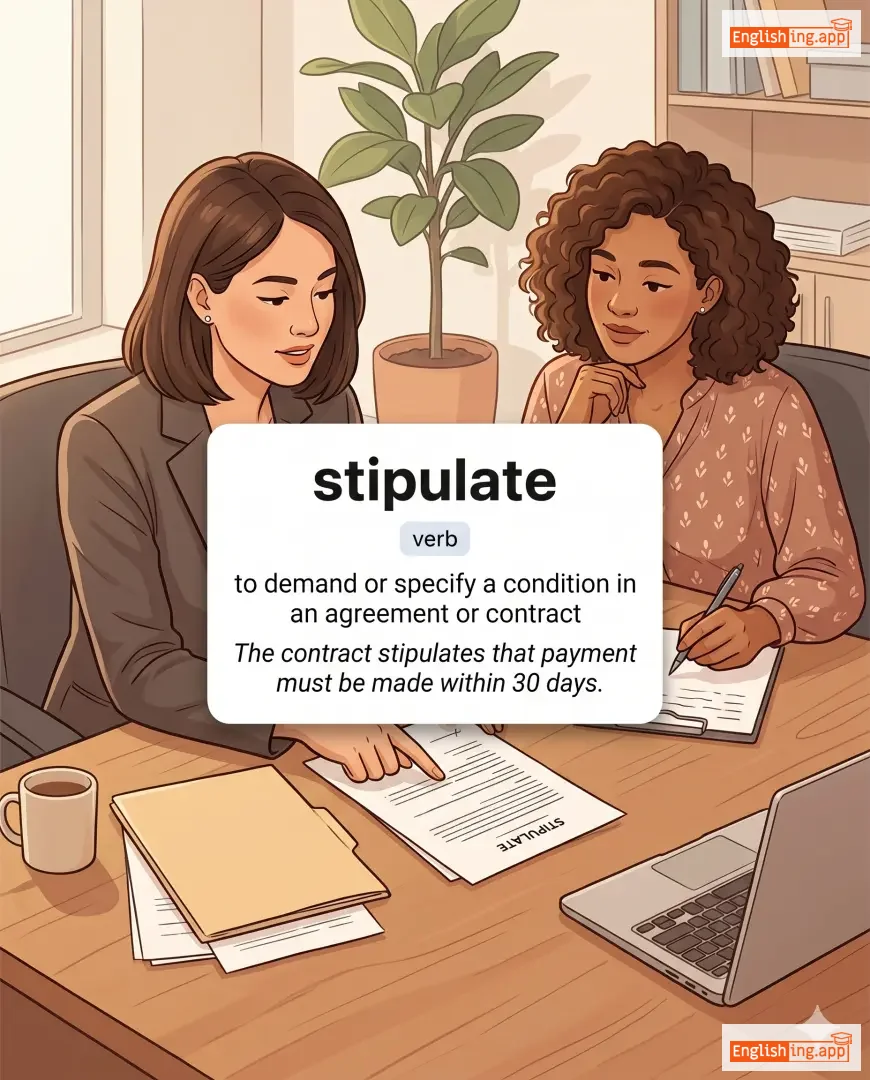
stipulate definition card — visual illustration of the meaning
verb
/ˈstɪp.jʊ.leɪt/
शर्त निर्धारित करना (short nirdharit karna)

to demand or specify a condition in an agreement or contract

"The contract stipulates that payment must be made within 30 days."

"कंट्रैक्ट में कहा गया है कि भुगतान 30 दिनों के भीतर किया जाना चाहिए।" (contract mein kaha gaya hai ki bhugtan 30 dino ke bheetar kiya jana chahiye.)
verb
/stɜːr/
घुमाना (ghumana)

to mix or move something in a circular motion, especially in liquid

"She stirred the soup to make sure it didn't burn."

"उसने सूप को जलने से बचाने के लिए घुमाया।" (Usne soup ko jalne se bachane ke liye ghumaya.)
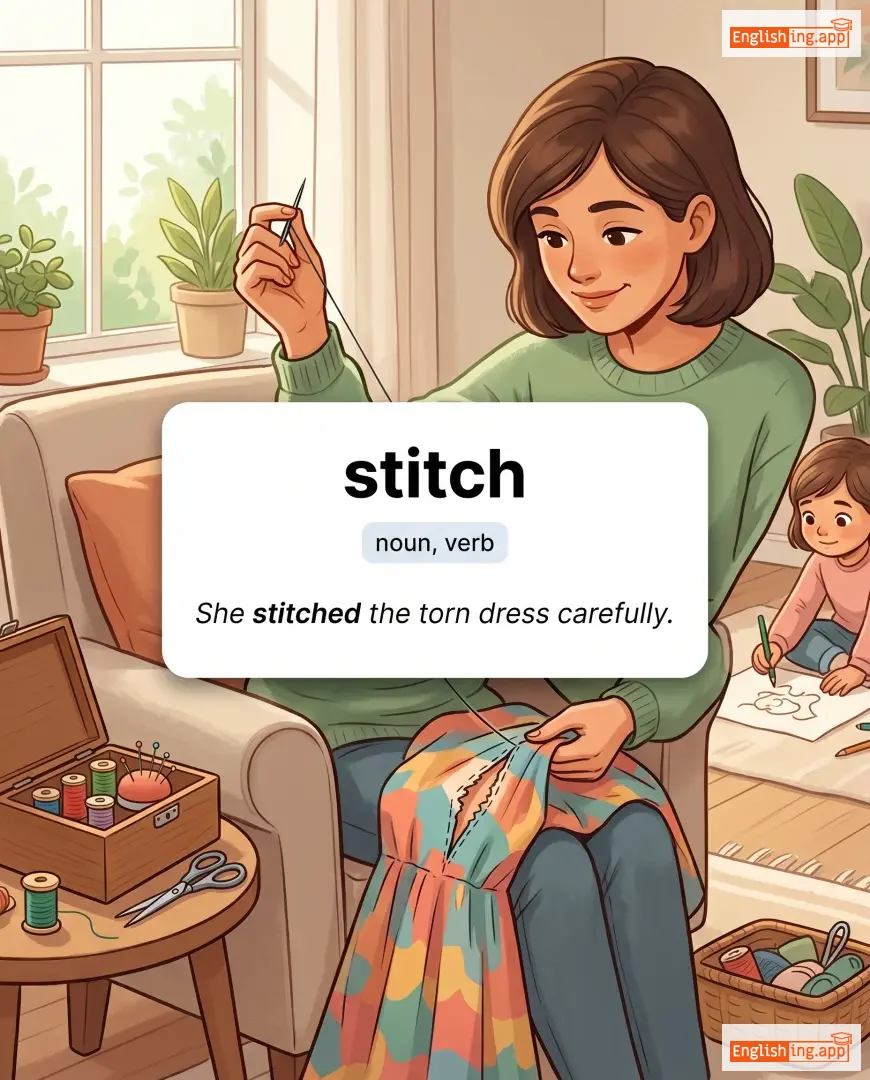
stitch definition card — visual illustration of the meaning
noun, verb
/stɪtʃ/
खुशी (khushi)

to sew fabric together using a needle and thread; also a single loop of thread in sewing

"She stitched the torn dress carefully."

"उसने फटी हुई ड्रेस को ध्यान से सिल दिया।" (Usne phati hui dress ko dhyan se sil diya.)
noun, verb
/stɒk/
स्टॉक (stok)

a supply of goods kept for sale or use; to keep or fill with goods

"The shop stocks a wide variety of products."

"दुकान में उत्पादों का विस्तृत संग्रह है।" (Dukan mein utpadon ka vistreet sangrah hai.)
noun
/stɒˈkeɪd/
लकड़ी की दीवार (lakdi ki deewaar)

a defensive barrier made of strong posts or timbers, often around a fort or prison

"The prisoners were kept inside the wooden stockade."

"कैदी लकड़ी की दीवार के अंदर रखे गए थे।" (Kaidi lakdi ki deewaar ke andar rakhe gaye the.)
adjective
/ˈstɒdʒi/
नीरस, उबाऊ (neeras, ubaoo)

Dull, uninspired, or old-fashioned; also heavy and hard to digest when referring to food.

"The lecture was so stodgy that many students struggled to stay awake."

"व्याख्यान इतना नीरस था कि कई छात्रों को जगते रहना मुश्किल हो रहा था।" (Vyakhyan itna neeras tha ki kai chhatron ko jagte rehna mushkil ho raha tha.)
adjective
/ˈstoʊɪk/
निष्कलंक, भावनाहीन (nishkalaṅk, bhāvanāhīn)

Showing little or no emotion, even in difficult situations.

"She remained stoic during the crisis, never showing fear or panic."

"वह संकट के दौरान निष्कलंक रही, कभी भी डर या घबराहट नहीं दिखाई।" (vah saṅkaṭ ke daurān nishkalaṅk rahī, kabhī bhī ḍar yā ghabarāhaṭ nahīṁ dikhāī.)
stoicism definition card — visual illustration of the meaning
noun
/ˈstoʊɪˌsɪzəm/
धैर्य, सहिष्णुता (dhairya, sahishnuta)

The endurance of pain or hardship without showing feelings or complaining.

"He faced the loss of his job with remarkable stoicism."

"उसने अपनी नौकरी खोने को असाधारण धैर्य के साथ सहा।" (Usne apni naukri khone ko asadharan dhairya ke saath saha.)
verb
/stoʊk/
आग में ईंधन डालना; गुस्सा या भावना को बढ़ावा देना (aag mein indhan dalna; gussa ya bhavna ko badhava dena)

To add fuel to a fire; to encourage or increase a strong feeling or activity.

"The politician’s speech stoked anger among the crowd."

"राजनेता का भाषण भीड़ के बीच गुस्सा बढ़ा दिया।" (Rajneeta ka bhashan bheed ke beech gussa badha diya.)
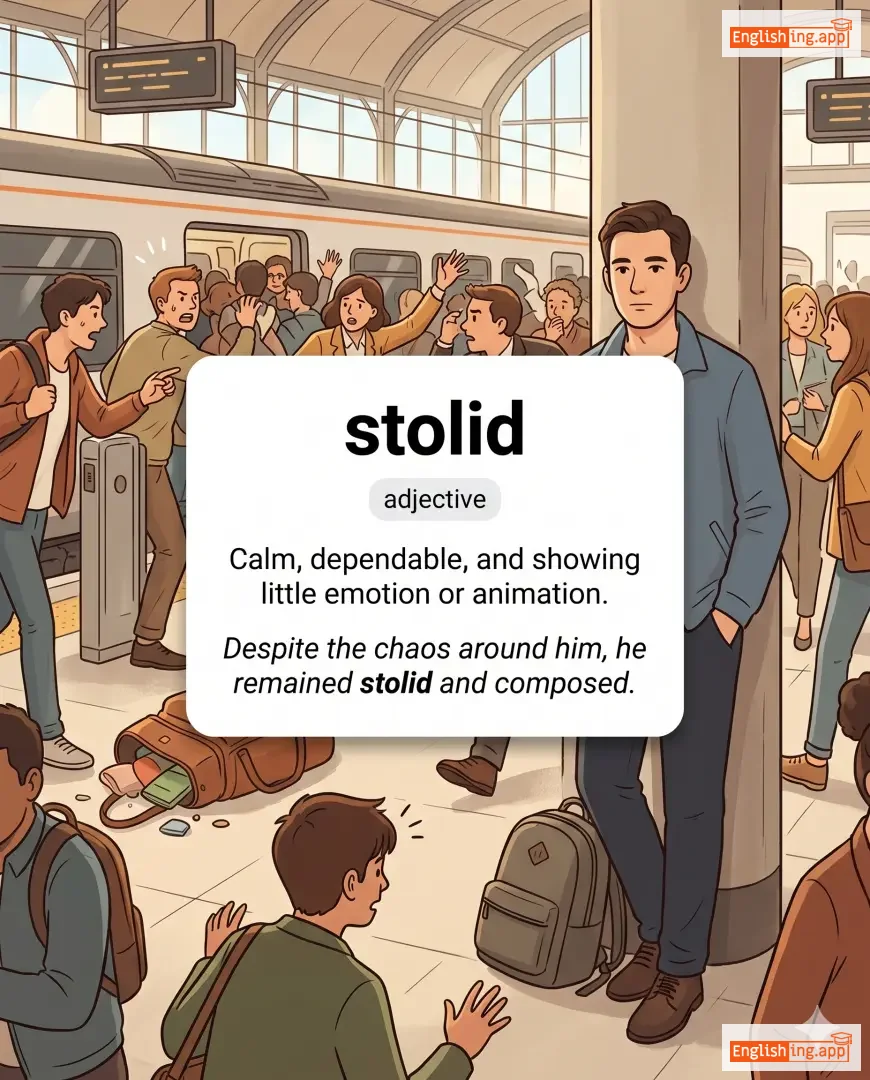
stolid definition card — visual illustration of the meaning
adjective
/ˈstɒlɪd/
शांत, भावहीन (shant, bhavheen)

Calm, dependable, and showing little emotion or animation.

"Despite the chaos around him, he remained stolid and composed."

"चारों ओर की अफरातफरी के बावजूद, वह शांत और संयमित रहा।" (Chaaron or ki afratfari ke bawajood, wah shant aur sanyamit raha.)
noun/verb
/ˈstʌmək/
पेट / सहन करना (pet / sahan karna)

The internal organ in which food is digested; also to tolerate or endure something

"She couldn’t stomach the sight of violence."

"वह हिंसा के दृश्य को सहन नहीं कर पाई।" (vah hinsa ke drishya ko sahan nahi kar paayi.)
noun
/ˈstʌmək eɪk/
पेट दर्द (pet dard)

Pain in the stomach or abdominal area

"I have a stomach ache after eating too much."

"मैंने बहुत खाने के बाद पेट दर्द महसूस किया।" (maine bahut khane ke baad pet dard mahsus kiya)
noun
/stoʊn/
पत्थर (patthar)

a hard, naturally occurring mineral material found in the earth

"He threw a stone into the lake."

"उसने झील में एक पत्थर फेंका।" (Usne jheel mein ek patthar phenka.)
verb
/ˈstoʊnwɔːl/
अवरोध करना (avrodh karna)

To delay or block progress by refusing to cooperate or answer

"The witness tried to stonewall during the investigation."

"साक्षी ने जांच के दौरान अवरोध करने की कोशिश की।" (Sakshi ne janch ke dauran avrodh karne ki koshish ki.)
verb/noun
/stuːp/
सुख (sukh)

To bend one's body forward and downward; also a small porch or staircase at the entrance of a house

"He had to stoop to pick up the coin."

"जब उसे पुरस्कार मिला, तो वह अपनी खुशी को छिपा नहीं सकी।" (Jab use puraskar mila, to wah apni khushi ko chhupa nahi saki.)
verb
/stɑːp/
रोकना (rokna)

to bring to an end or cause to cease

"Please stop talking while I’m working."

"कृपया जब मैं काम कर रहा हूं तो बात करना बंद करें।" (Kripya jab main kaam kar raha hoon to baat karna band karein.)
noun
/ˈstɒpɪdʒ/
रोक; अवरुद्ध होना (rok; avaruddh hona)

The act of stopping or ceasing; a halt in operation or activity

"The sudden stoppage of the train caused delays for all passengers."

"ट्रेन का अचानक रुकना सभी यात्रियों के लिए देरी का कारण बना।" (Train ka achanak rukna sabhi yatrion ke liye deri ka karan bana.)
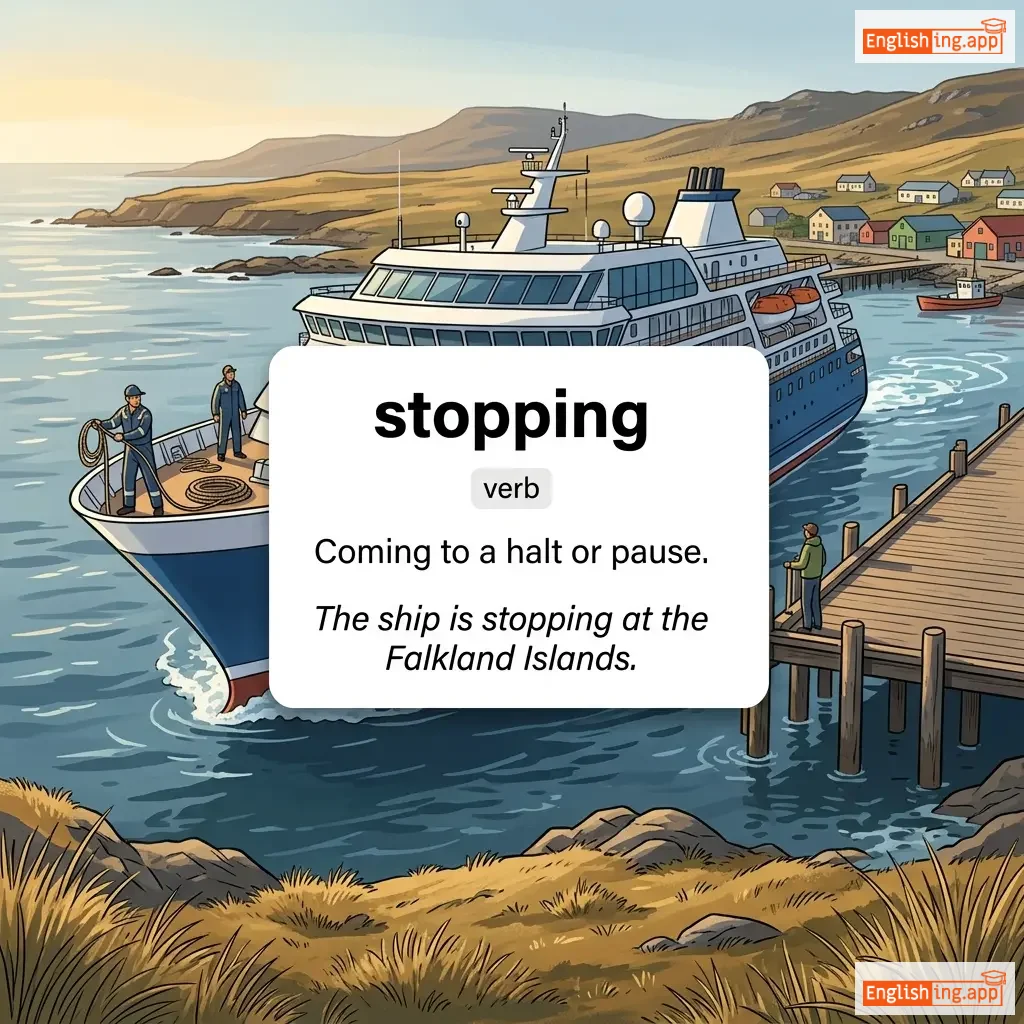
stopping definition card — visual illustration of the meaning
verb
/ˈstɒpɪŋ/
रुकना (rukna)

Coming to a halt or pause.

"The ship is stopping at the Falkland Islands."

"जहाज फॉकलैंड द्वीपों पर रुक रहा है।" (Jahaz Falkland dweepo par ruk raha hai.)
noun
/ˈstɔːrɪdʒ/
संग्रह (sangrah)

the action or method of storing something for future use

"The warehouse offers plenty of storage space."

"गोदाम में बहुत अधिक संग्रह स्थान उपलब्ध है।" (Godam mein bahut adhik sangrah sthan upalabdh hai.)
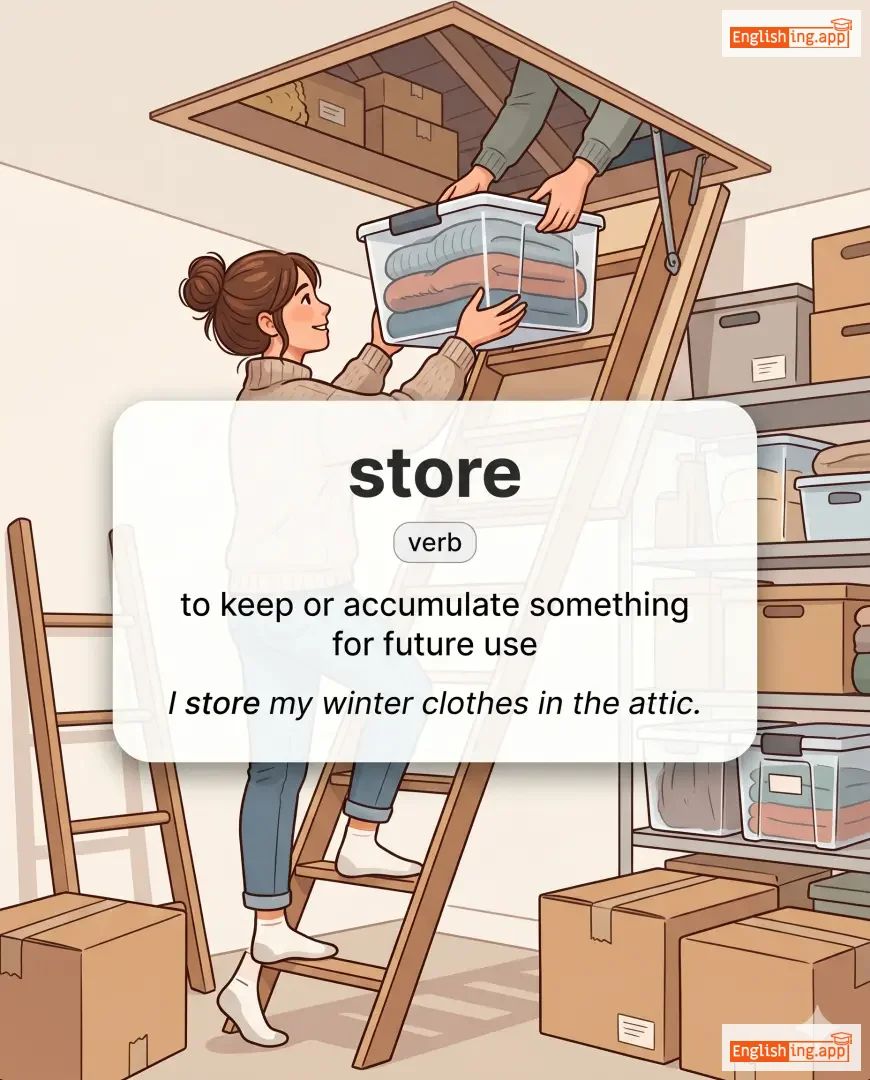
store definition card — visual illustration of the meaning
verb
/stɔːr/
संग्रह करना (sangrah karna)

to keep or accumulate something for future use

"I store my winter clothes in the attic."

"मैं अपनी सर्दियों के कपड़े अटारी में संग्रह करता हूँ।" (Main apni sardiyon ke kapde attari mein sangrah karta hoon.)
noun
/ˈstɔːrhaʊs/
भंडारगृह (bhandargrih)

A place where goods, supplies, or valuables are stored; a repository

"The warehouse acted as a storehouse for all the imported goods."

"गोदाम सभी आयातित सामानों के लिए एक स्टोरहाउस के रूप में कार्य करता था।" (Godam sabhi aayatit saamanon ke liye ek storehouse ke roop mein kary karta tha.)
noun
/stɔːrk/
सारस (saras)

large wading bird with long legs and a long neck

"The stork built its nest on top of the tall chimney."

"सारस पक्षी ने ऊँची चिमनी के ऊपर अपना घोंसला बनाया।" (saras pakshi ne unchi chimni ke upar apna ghosla banaya.)
noun
/stɔːrm/
तूफ़ान (toofan)

a violent disturbance of the atmosphere with strong winds, rain, and often thunder

"The storm caused major flooding in the area."

"तूफ़ान ने क्षेत्र में बड़ी बाढ़ का कारण बना।" (Toofan ne kshetr mein badi baadh ka kaaran bana.)
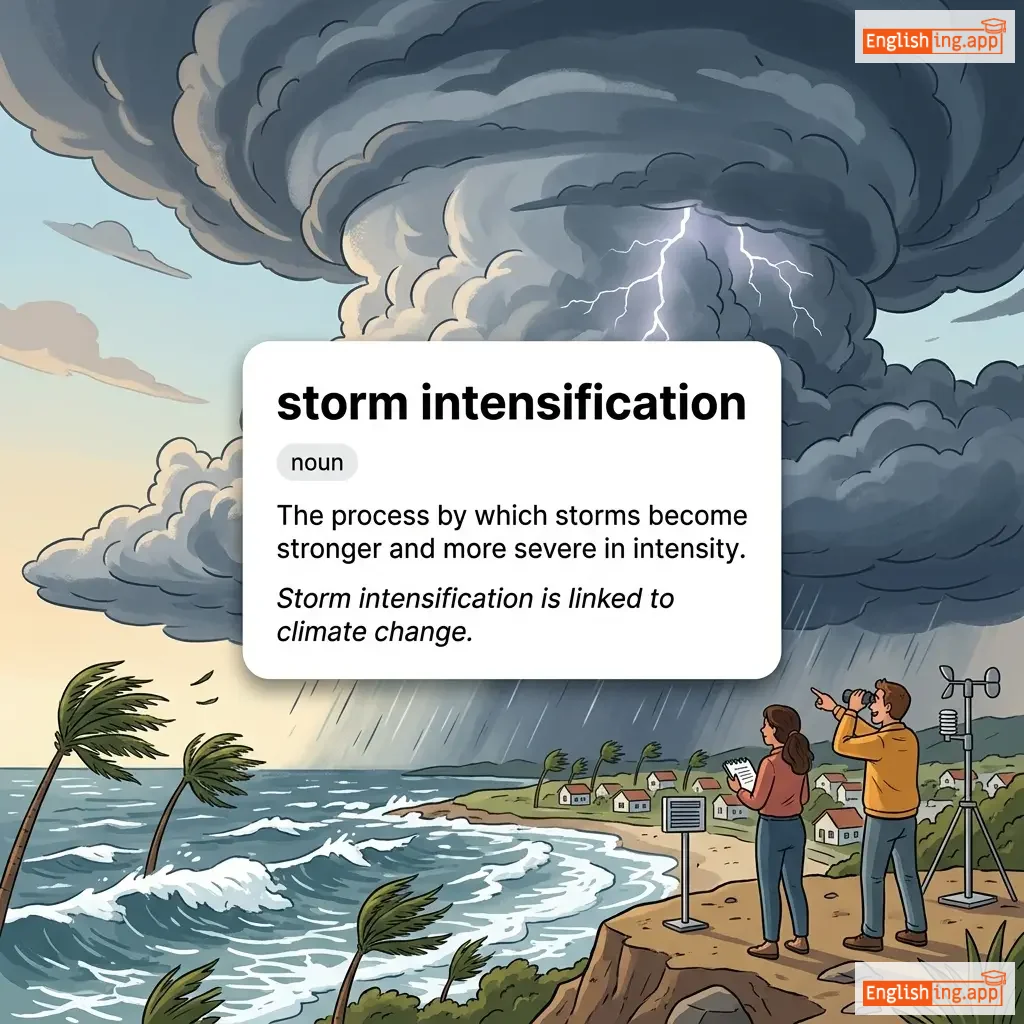
storm intensification definition card — visual illustration of the meaning
noun
stɔːrm ɪnˌtensɪfɪˈkeɪʃən
आंधी की तीव्रता में वृद्धि (aandhi ki teevrata mein vruddhi)

The process by which storms become stronger and more severe in intensity.

"Storm intensification is linked to climate change."

"आंधी की तीव्रता में वृद्धि जलवायु परिवर्तन से जुड़ी हुई है।" (Aandhi ki teevrata mein vruddhi jalvayu parivartan se judhi hui hai.)
noun
/ˈstɔːri/
कहानी (kahani)

a narrative of real or imaginary events

"She told a fascinating story about her travels."

"उसने अपनी यात्रा के बारे में एक दिलचस्प कहानी सुनाई।" (Usne apni yatra ke baare mein ek dilchasp kahani sunayi.)
adjective/noun
/staʊt/
मोटा / मजबूत (mota / majboot)

Strong, thick, or heavily built; also a kind of dark beer

"The stout man lifted the heavy box with ease."

"मोटे आदमी ने भारी बॉक्स को आसानी से उठाया।" (Mote aadmi ne bhari box ko aasani se uthaya.)
adjective
/ˌstaʊtˈhɑːrtɪd/
साहसी (sahasi)

Brave, determined, and courageous

"The stouthearted soldier never gave up."

"साहसी सैनिक कभी हार नहीं मानता।" (Sahasi sainik kabhi haar nahin maanta.)
noun
/stoʊv/
चूल्हा (chulha)

a device that produces heat for cooking or heating

"She cooked rice on the gas stove."

"उसने गैस चूल्हे पर चावल पकाए।" (Usne gas chulhe par chawal pakaye.)
noun
/ˈstoʊəˌweɪ/
छुपा यात्री (chhupa yatri)

A person who hides on a ship, plane, or other vehicle in order to travel secretly without paying.

"The crew discovered a stowaway hiding in the cargo hold."

"दल ने एक छुपे हुए यात्री को कार्गो होल्ड में छिपते हुए पाया।" (Dal ne ek chhupe hue yatri ko cargo hold mein chhupte hue paaya.)
verb
/ˈstræɡəl/
अव्यवस्थित रूप से फैलना (avyavasthit roop se phailna)

To move or spread in an irregular, scattered, or untidy way.

"The children began to straggle behind on the long hike."

"लंबी यात्रा में बच्चे पीछे पड़ने लगे।" (Lambi yatra mein bachche peeche padhne lage.)
adjective, adverb
/streɪt/
सीधा (seedha)

Extending or moving uniformly in one direction only; not curved or bent.

"He walked straight to the door without stopping."

"वह बिना रुके सीधे दरवाजे की ओर चला गया।" (vah bina ruke seedhe darwaze ki or chala gaya.)
adjective
/ˌstreɪt ˈfɔːr.wərd/
ईमानदार और स्पष्ट; जटिल नहीं; समझने में आसान (imaan-daar aur spasht; jatil nahi; samajhne mein aasaan)

honest and open; not complicated; easy to understand

"His explanation was very straightforward and easy to follow."

"उसकी व्याख्या बहुत सरल और समझने में आसान थी।" (Uski vyakhya bahut saral aur samajhne mein aasaan thi.)
verb
/ˈstreɪtən/
सीधा करना (seedha karna)

to make something straight or tidy; to correct or organize

"She straightened her hair before the meeting."

"उसने मीटिंग से पहले अपने बाल सीधा किए।" (Usne meeting se pehle apne baal seedha kiye.)
adjective
/ˌstreɪtˈfɔːwəd/
सीधा (seedha)

easy to understand or do; simple

"Her explanation was straightforward and clear."

"उसका स्पष्टीकरण सीधा और स्पष्ट था।" (Uska spashteekaran seedha aur spasht tha.)
noun, verb
/streɪn/
तनाव / खिंचाव (tanav / khinchav)

To force something beyond its normal limits; to injure by overexertion; or a type or variety of something.

"He strained his back while lifting the heavy box."

"उसने भारी बॉक्स उठाते समय अपनी पीठ खींच ली।" (Usne bhari boks uthate samay apni peeth khinch li.)
noun
/ˈstreɪnər/
छानने वाला (chhanne wala)

a device having holes punched in it or made of crossed wires for separating solid matter from a liquid

"Use a strainer to drain the pasta water."

"पास्ता पानी को छानने के लिए एक छानने वाला उपयोग करें।" (pasta pani ko chhanne ke liye ek chhanne wala upyog karein.)
noun
/streɪt/
संकरे जलसंधि (sankare jalsandhi)

A narrow passage of water connecting two seas or two large areas of water.

"The Strait of Gibraltar connects the Atlantic Ocean and the Mediterranean Sea."

"जिब्राल्टर जलसंधि अटलांटिक महासागर और भूमध्यसागरीय सागर को जोड़ती है।" (Jibraltar jalsandhi Atalantik mahasagar aur bhumadhyasagriya sagar ko jodti hai.)
noun
/strəˈmoʊ.ni.əm ˌflaʊ.ər/
धुतुरा फूल (dhutura phool)

A trumpet-shaped white or purple flower from the jimsonweed plant, known for its toxic properties

"The stramonium flower blooms at night with a sweet fragrance."

"धुतुरा फूल रात में मीठी खुशबू के साथ खिलता है।" (dhutura phool raat mein meethi khushboo ke saath khilta hai)
noun, verb
/strænd/
सूत्र / फंसा (sootra / fansa)

Noun: A single thin length of thread, wire, or similar. Verb: To leave someone or something without a way of moving or leaving.

"The storm stranded many tourists on the island."

"आंधी ने कई पर्यटकों को द्वीप पर फंसा दिया।" (Aandhi ne kai paryatak ko dweep par fansa diya.)
adjective
/streɪndʒ/
अजीब (ajeeb)

unusual or not normal

"It was strange to see him at the party after so long."

"इसे पार्टी में इतने समय बाद देखना अजीब था।" (Ise party mein itne samay baad dekhna ajeeb tha.)
noun
/ˈstreɪndʒər/
अजनबी (ajnabi)

A person whom one does not know.

"A stranger knocked on the door at midnight."

"एक अजनबी ने मध्यरात्रि में दरवाजे पर दस्तक दी।" (Ek ajnabi ne madhyaraatri mein darwaze par dastak di.)
verb
/ˈstræŋɡəl/
गला दबाना (gala dabana)

to kill or stop someone or something by squeezing the throat or restricting flow

"The villain tried to strangle his opponent in the dark alley."

"विलेन ने अंधेरे गली में अपने प्रतिद्वंदी को गला दबाने की कोशिश की।" (Vilen ne andhere gali mein apne pratidwandi ko gala dabane ki koshish ki.)
noun
/ˈstrætədʒəm/
युक्ति (yukti)

a plan or scheme designed to achieve a particular goal, often by trickery

"The general devised a clever stratagem to outwit the enemy."

"जनरल ने दुश्मन को मात देने के लिए एक चतुर युक्ति बनाई।" (General ne dushman ko maat dene ke liye ek chatur yukti banai.)
strategic definition card — visual illustration of the meaning
adjective
/strəˈtiːdʒɪk/
रणनीतिक (rananeetik)

relating to the identification of long-term or overall aims and interests and the means of achieving them

"His strategic thinking helped the company grow."

"उसकी रणनीतिक सोच ने कंपनी को बढ़ने में मदद की।" (Uski rananeetik soch ne company ko badhne mein madad ki.)
strategic insights definition card — visual illustration of the meaning
noun
/strəˈtiː.dʒɪk ˈɪn.saɪts/
रणनीतिक समझ (ranneetik samajh)

Deep understanding and wisdom gained through careful analysis for planning purposes.

"Strategic insights guide policymaking."

"रणनीतिक समझ नीति निर्माण में मार्गदर्शन करती है।" (Ranneetik samajh niti nirman mein maargdarshan karti hai.)
strategies definition card — visual illustration of the meaning
noun
ˈstræt.ə.dʒiz
रणनीतियाँ (ranneetiyan)

A plan of action designed to achieve a long-term or overall aim.

"Effective strategies ensure success."

"प्रभावी रणनीतियाँ सफलता सुनिश्चित करती हैं।" (Prabhavi ranneetiyan safalta sunishchit karti hain.)
strategy definition card — visual illustration of the meaning
noun
/ˈstrætədʒi/
रणनीति (ranneeti)

a plan of action designed to achieve a long-term or overall aim

"They developed a new strategy to increase sales."

"उन्होंने बिक्री बढ़ाने के लिए एक नई रणनीति विकसित की।" (Unhone bikrī baṛhāne ke liye ek naī ranneetī viksit kī.)
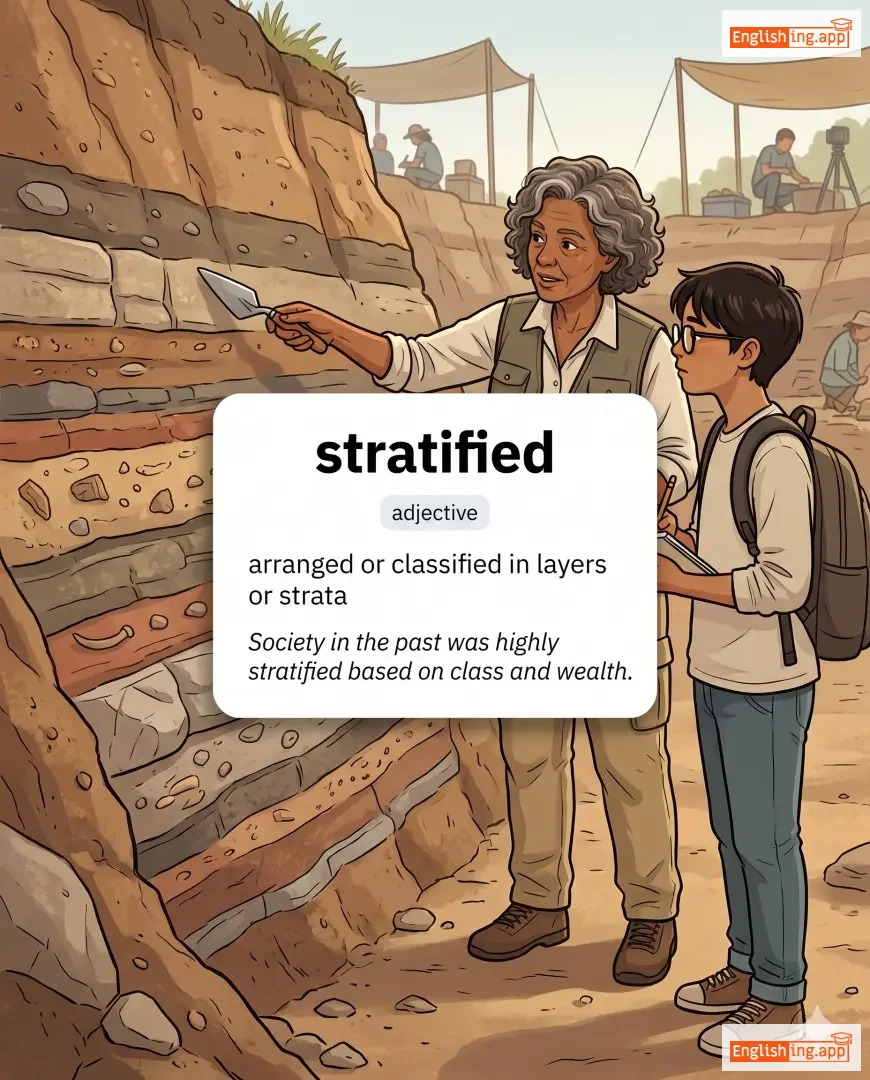
stratified definition card — visual illustration of the meaning
adjective
/ˈstrætɪfaɪd/
स्तरीकृत (streekrit)

arranged or classified in layers or strata

"Society in the past was highly stratified based on class and wealth."

"पूर्व में समाज वर्ग और धन के आधार पर काफी स्तरीकृत था।" (purv mein samaj varg aur dhan ke aadhaar par kaafi streekrit tha)
verb
/ˈstrætɪfaɪ/
स्तरीकरण करना (starikaran karna)

to arrange or divide into layers, classes, or categories

"The researchers plan to stratify the data based on age groups."

"शोधकर्ता डेटा को उम्र समूहों के आधार पर स्तरीकरण करने की योजना बना रहे हैं।" (Shodhkarta data ko umr samuhon ke aadhar par starikaran karne ki yojana bana rahe hain.)