वोकैबुलरीज

इंग्लिश वोकैबुलरी डिस्कवर, लर्न और मास्टर करें

noun
/ˌkiː ˈviːv/
चेतावनी (chetavani)

A state of alertness or vigilance.

"The guards were on the qui vive during the night."

"गार्ड्स रात के दौरान चेतावनी की स्थिति में थे।" (Guards raat ke dauran chetavani ki sthiti mein the.)
quibble definition card — visual illustration of the meaning
verb/noun
/ˈkwɪbəl/
नकली तर्क (nakli tark)

To argue or raise objections about a trivial matter; a petty objection.

"They quibbled over who should pay the bill."

"वे बिल का भुगतान कौन करेगा इस पर तर्क कर रहे थे।" (ve bil ka bhugtan kaun karega is par tark kar rahe the.)
adjective
/kwɪk/
तेज़ (tez)

moving fast or doing something in a short time

"She is a quick learner."

"वह एक तेज़ सीखने वाली है।" (Vah ek tez seekhne wali hai.)
noun
/ˈkwɪk.sænd/
क्विकसैंड (quicksand)

loose wet sand that yields easily to pressure and sucks in anything on its surface

"The explorer got trapped in quicksand while crossing the desert."

"अन्वेषक मरुस्थल पार करते समय क्विकसैंड में फंस गया।" (anveshak marusthal paar karte samay quicksand mein fans gaya)
verb
/ˈkwɪkən/
तेज करना (tej karna)

to make or become faster; to accelerate

"His pulse began to quicken as he approached the finish line."

"उसकी नाड़ी फिनिश लाइन के पास पहुंचते ही तेज़ होने लगी।" (Uski naadi finish line ke paas pahuchte hi tez hone lagi.)
adverb
/ˈkwɪkli/
तेज़ (tez)

at a fast speed

"She finished the test quickly."

"उसने परीक्षा को जल्दी पूरा किया।" (Usne pariksha ko jaldi poora kiya.)
noun
/ˈkwɪkˌsɪlvər/
पारा (para)

Mercury; a liquid metal, or something that is quick and unpredictable.

"His mood was as changeable as quicksilver."

"उसका मूड क्विकसिल्वर की तरह परिवर्तनशील था।" (Uska mood quicksilver ki tarah parivartansheel tha.)
noun
/kwɪˈɛsəns/
निस्तब्धता (nistabdhata)

A state of quietness, inactivity, or dormancy.

"The volcano has been in a state of quiescence for decades."

"ज्वालामुखी दशकों से निस्तब्धता की अवस्था में है।" (Jwalamukhi dashko se nistabdhata ki avastha mein hai.)
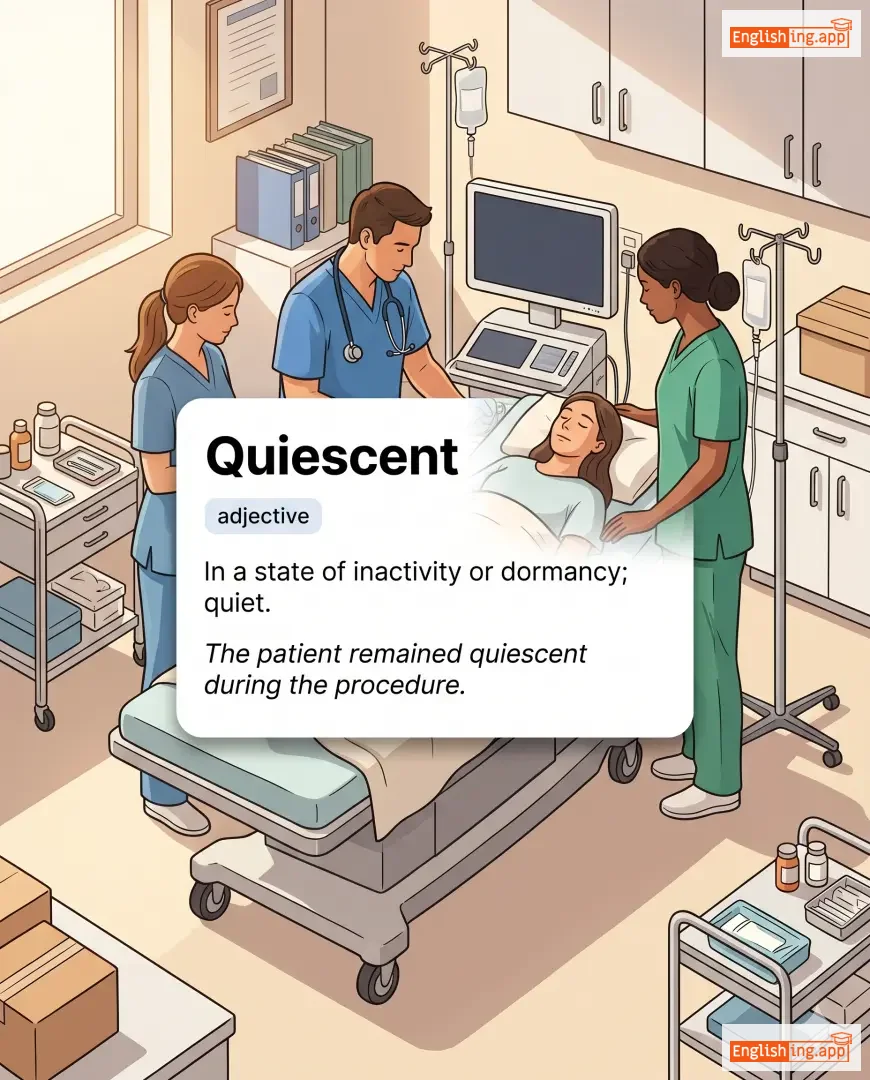
Quiescent definition card — visual illustration of the meaning
adjective
/kwɪˈɛsənt/
निष्क्रिय (nishkriya)

In a state of inactivity or dormancy; quiet.

"The patient remained quiescent during the procedure."

"रोगी प्रक्रिया के दौरान निष्क्रिय रहे।" (Rogi prakriya ke dauran nishkriya rahe.)
adjective
/ˈkwaɪət/
शांत (shaant)

Making little or no noise; free from disturbance.

"The library is a very quiet place to study."

"पुस्तकालय अध्ययन करने के लिए एक बहुत शांत स्थान है।" (Pustakalay adhyayan karne ke liye ek bahut shaant sthan hai.)
adverb
/ˈkwaɪətli/
धीरे से (dheere se)

in a silent or calm manner

"He spoke quietly so no one would hear."

"वह धीरे से बोला ताकि कोई न सुने।" (Wah dheere se bola taki koi na sune.)
noun
/ˈkwaɪəˌtuːd/
शांति (shanti)

A state of stillness and tranquility.

"She enjoys the quietude of the countryside."

"वह गांव की शांति का आनंद लेती है।" (Woh gaon ki shanti ka anand leti hai.)
noun
/kwaɪˈiːtəs/
समाप्ति, मृत्यु (samaapti, mrityu)

Something that ends or settles a situation; release from life, death.

"The scandal brought a quietus to his political career."

"उसके राजनीतिक करियर की समाप्ति में वह घोटाला एक शांतिपूर्वक निर्णय था।" (Uske rajnaitik career ki samaapti mein wah ghotala ek shaantipoorvak nirnay tha.)
noun
/kwɪlt/
कंबल (kambal)

a warm bed covering made of padding enclosed between layers of fabric

"Grandmother made a beautiful quilt for my bed."

"दादी ने मेरे बिस्तर के लिए एक सुंदर कंबल बनाया।" (dadi ne mere bistar ke liye ek sundar kambal banaya.)
noun
/kwɪnˈtɛsəns/
सर्वोत्तम उदाहरण (sarvottam udaharan)

The purest or most perfect example of something.

"She is the quintessence of elegance."

"वह शास्त्रीय संगीत की सर्वोत्तम उदाहरण है।" (Vah shastriya sangeet ki sarvottam udaharan hai.)
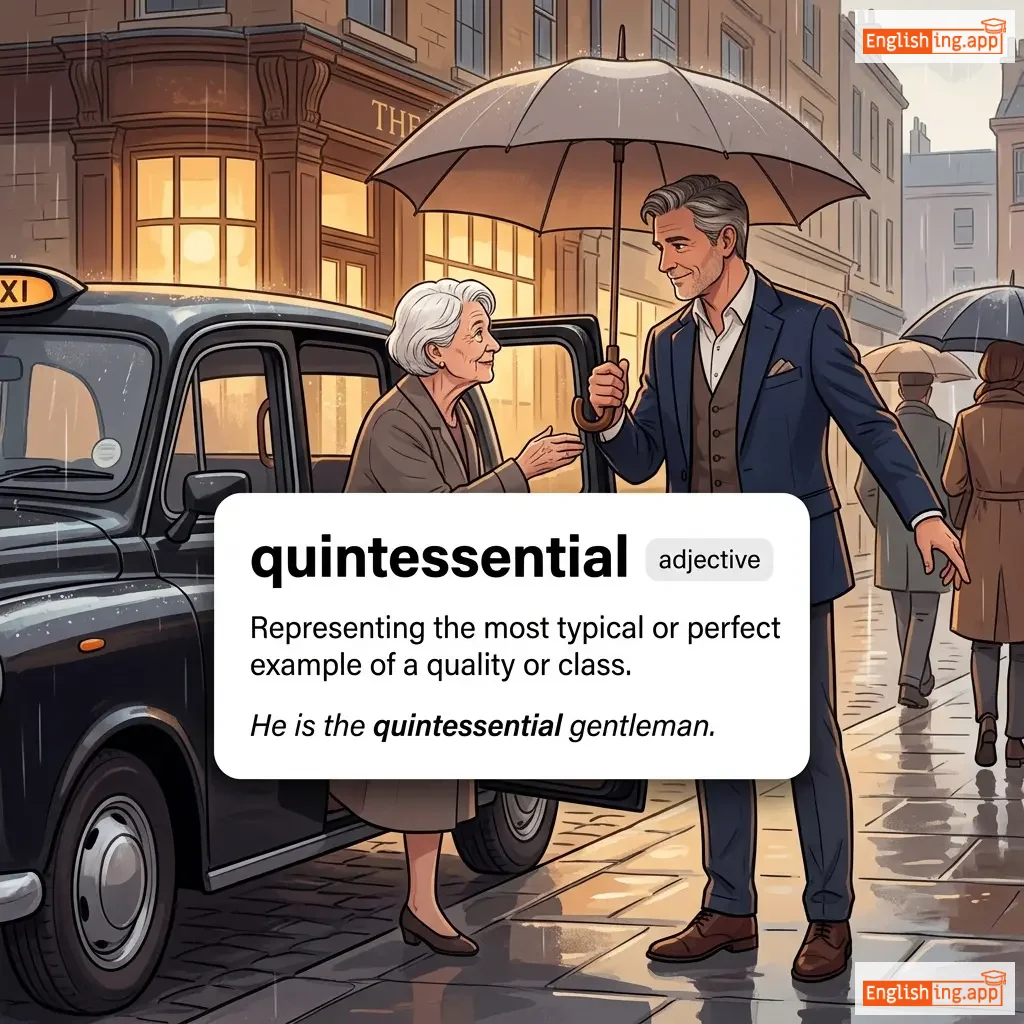
quintessential definition card — visual illustration of the meaning
adjective
/ˌkwɪntɪˈsɛnʃəl/
पूर्णत: आदर्श (poornat: aadarsh)

Representing the most typical or perfect example of a quality or class.

"He is the quintessential gentleman."

"वह पूर्णत: आदर्श सज्जन है।" (Vah poornat: aadarsh sajjan hai.)
noun
/kwɪnˈtɛt/
पाँच लोगों का समूह (paanch logon ka samuh)

A group of five people or things, especially musicians.

"The jazz quintet performed beautifully."

"जैज़ क्विंटेट ने खूबसूरती से प्रदर्शन किया।" (Jazz quintet ne khoobsurti se pradarshan kiya.)
noun/verb
/kwɪp/
चतुर टिप्पणी (chatur tippani)

A witty remark; to make a witty or clever comment.

"She quipped about the weather during the meeting."

"वह बैठक के दौरान मौसम पर मजाक कर रही थी।" (Vah baithak ke dauraan mausam par mazak kar rahi thi.)
noun
/kwɜːrk/
अजीब आदत (ajeeb aadat)

A peculiar or unusual behavior, habit, or feature.

"One of his quirks is humming while he works."

"उसकी एक अजीब आदत है कि वह काम करते समय गुनगुनाता है।" (uski ek ajeeb aadat hai ki wah kaam karte samay gungunata hai.)
adjective
/ˈkwɜːrki/
अजीब आकर्षक (ajeeb aakarshak)

Unusual in an interesting, charming, or odd way.

"She has a quirky sense of fashion that makes her stand out."

"उसकी एक अजीब आकर्षक फैशन सेंस है जो उसे अलग बनाती है।" (uski ek ajeeb aakarshak fashion sense hai jo use alag banati hai.)
noun
/ˈkwɪzlɪŋ/
देशद्रोही (deshdrohi)

A traitor who collaborates with an enemy force occupying their country.

"During the war, he was branded a quisling for aiding the invaders."

"युद्ध के दौरान, उसे आक्रमणकारियों की मदद करने के कारण देशद्रोही करार दिया गया।" (Yuddh ke dauran, use akramankariyon ki madad karne ke kaaran deshdrohi karaar diya gaya.)
quit definition card — visual illustration of the meaning
verb
/kwɪt/
छोड़ना (chhodna)

To leave a place, job, or habit permanently.

"He decided to quit his job after five years."

"उसने पांच साल बाद अपनी नौकरी छोड़ने का फैसला किया।" (Usne paanch saal baad apni naukri chhodne ka faisla kiya.)
adverb
/kwaɪt/
काफी / बहुत (kaafi / bahut)

To a certain or considerable extent; very or completely.

"She was quite happy with the results."

"वह परिणामों से काफी खुश थी।" (vah parinaamon se kaafi khush thi.)
verb
/ˈkwɪvər/
काँपना (kaampna)

To tremble or shake with slight but rapid motion.

"Her lips began to quiver as she tried not to cry."

"जब उसने रोने से बचने की कोशिश की, उसकी होठ कांपने लगे।" (jab usne rone se bachne ki koshish ki, uski hoth kaampne lage.)
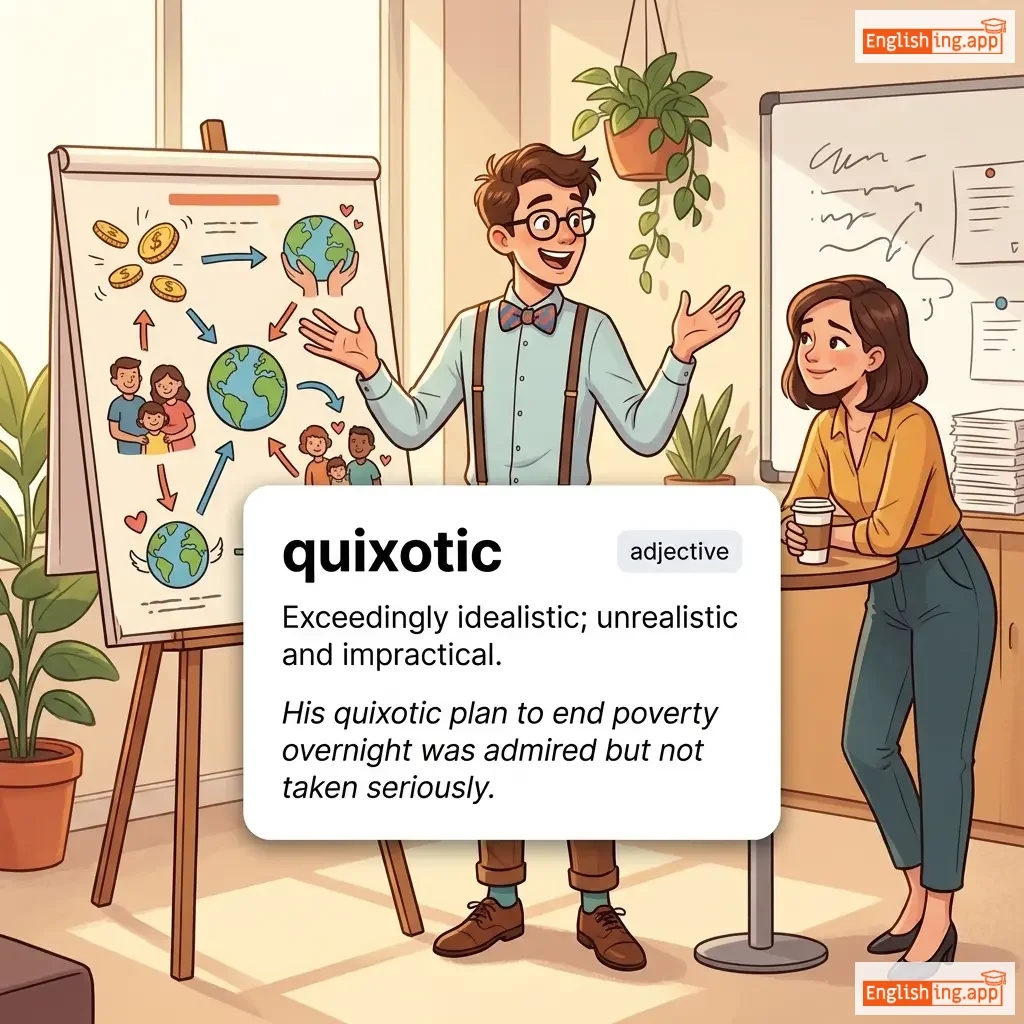
quixotic definition card — visual illustration of the meaning
adjective
/kwɪkˈsɒtɪk/
अवास्तविक आदर्शवादी (avastavik aadarshvadi)

Exceedingly idealistic; unrealistic and impractical.

"His quixotic plan to end poverty overnight was admired but not taken seriously."

"रातोंरात गरीबी खत्म करने की उसकी अवास्तविक योजना सराही गई लेकिन गंभीरता से नहीं ली गई।" (ratoraat gareebi khatm karne ki uski avastavik yojana sarahi gayi lekin gambhirta se nahi li gayi.)
adjective
/ˈkwɪzɪkəl/
हैरान, प्रश्नवाचक (hairaan, prashnavachak)

Expressing mild or amused puzzlement.

"She gave him a quizzical look when he made the strange comment."

"उसने जब अजीब टिप्पणी की तो उसने उसे एक उलझन भरी नज़र दी।" (Usne jab ajeeb tippani ki to usne use ek uljhan bhari nazar di.)
noun
/kwoʊ/
स्थिति (stithi)

The existing state of affairs or situation, often used in the phrase 'status quo'.

"He wanted to maintain the status quo at work."

"वह कार्यस्थल पर स्थिति बनाए रखना चाहता था।" (Vah karyasthal par stithi banaye rakhna chahta tha.)
noun
/ˈkwɔːrəm/
क्वोरम (quorum)

The minimum number of members needed to conduct official business in a meeting.

"The board meeting was postponed because there was no quorum."

"बोर्ड मीटिंग स्थगित कर दी गई थी क्योंकि कोई क्वोरम नहीं था।" (board meeting sthagit kar di gayi thi kyunki koi quorum nahin tha.)
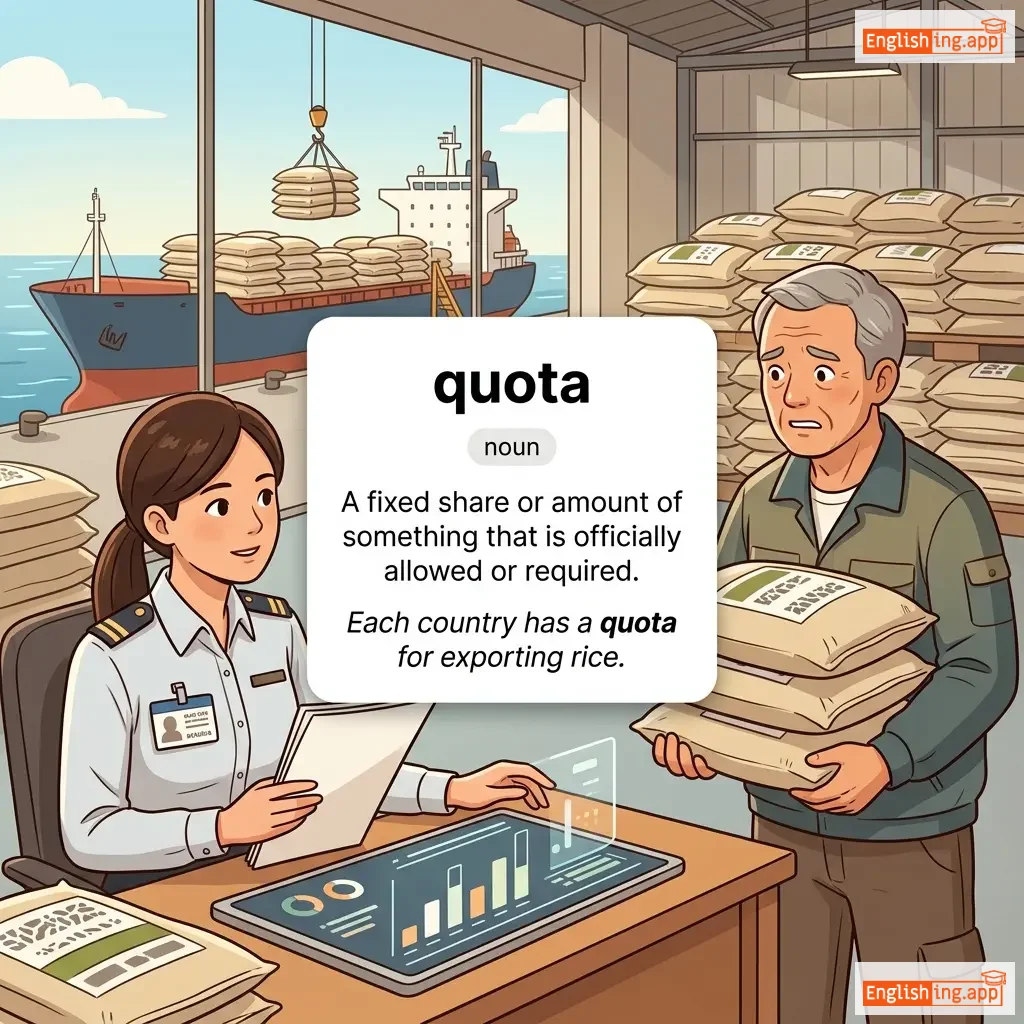
quota definition card — visual illustration of the meaning
noun
/ˈkwəʊtə/
कोटा, निश्चित हिस्सा (kota, nishchit hissa)

A fixed share or amount of something that is officially allowed or required.

"Each country has a quota for exporting rice."

"हर देश के पास चावल निर्यात करने के लिए एक कोटा होता है।" (har desh ke paas chawal niryaat karne ke liye ek kota hota hai.)
noun
/kwəʊˈteɪʃən/
उद्धरण; मूल्य-प्रस्ताव (uddharan; mulya-prastaav)

a group of words taken from a text or speech and repeated exactly; an estimated price given for goods or services

"The article opened with a famous quotation from Shakespeare."

"लेख की शुरुआत शेक्सपियर के एक प्रसिद्ध उद्धरण से हुई।" (lekh ki shuruaat shakespeare ke ek prasiddh uddharan se hui)
quote definition card — visual illustration of the meaning
verb
/kwəʊt/
उद्धृत करना (uddhrit karna)

to repeat or copy the words of someone

"She quoted a famous line from the novel."

"उसने उपन्यास से एक प्रसिद्ध लाइन को उद्धृत किया।" (Usne upanyas se ek prasiddh line ko uddhrut kiya.)
adjective
/kwəʊˈtɪdiən/
दैनिक, सामान्य (dainik, samanya)

Ordinary or everyday, especially when mundane.

"He focused on the quotidian details of family life."

"उसने पारिवारिक जीवन के दैनिक विवरण पर ध्यान केंद्रित किया।" (usne parivarik jeevan ke dainik vivaran par dhyan kendrit kiya.)