वोकैबुलरीज

इंग्लिश वोकैबुलरी डिस्कवर, लर्न और मास्टर करें

noun
/lɪm/
अंग (ang)

an arm or leg of a person or animal; a large branch of a tree

"He broke a limb while climbing the tree."

"वह पेड़ चढ़ते समय एक अंग तोड़ बैठा।" (vah ped chadhte samay ek ang tod baitha.)
adjective
/ˈlɪmbər/
लचीला और चुस्त (lachila aur chust)

Flexible and agile in body or movement.

"Dancers need to stay limber to perform well."

"नर्तक को अच्छा प्रदर्शन करने के लिए लचीला बने रहना चाहिए।" (Nartak ko achha pradarshan karne ke liye lachila bane rehna chahiye.)
noun
/ˈlɪmboʊ/
अनिश्चितता, निलंबन की स्थिति (anishchitata, nilamban ki sthiti)

A state of uncertainty or neglect; an intermediate or transitional state.

"The project was left in limbo after the funding was withdrawn."

"प्रोजेक्ट को वित्तपोषण वापस लेने के बाद अनिश्चितता में छोड़ दिया गया।" (Project ko vittposhan wapas lene ke baad anishchitata mein chhod diya gaya.)
noun
/laɪm/
नींबू (neembu)

a small green citrus fruit with acidic juice

"Add a slice of lime to your drink."

"अपने ड्रिंक में एक स्लाइस नींबू डालें।" (apne drink mein ek slice neembu daalein.)
noun
/ˈlaɪm.stoʊn/
चूना पत्थर (chuna patthar)

a hard sedimentary rock, composed mainly of calcium carbonate or dolomite, used as building material and in the making of cement

"The ancient building was made of limestone blocks."

"प्राचीन इमारत चूना पत्थर की ब्लॉकों से बनी थी" (prachin imarat chuna patthar ki blokon se bani thi)
noun
/ˈlaɪm.laɪt/
लोकप्रियता का ध्यान केंद्रित; चूने के एक बेलन को गर्म करके उत्पन्न उज्ज्वल प्रकाश (laimlait)

the focus of public attention; a bright light produced by heating a cylinder of lime

"The celebrity enjoyed being in the limelight."

"सेलिब्रिटी को लाइमलाइट में रहना बहुत पसंद था।" (celebrity ko limelight mein rehna bahut pasand tha)
noun
/ˈlɪmərɪk/
हास्यपूर्ण पाँच पंक्तियों वाली कविता (hasyapurn paanch panktiyon wali kavita)

a humorous five-line poem with a specific rhythm and rhyme scheme (AABBA).

"She recited a funny limerick at the party."

"उसने पार्टी में एक मजेदार लिमेरिक सुनाया।" (Usne party mein ek mazedar limerick sunaya.)
noun, verb
/ˈlɪmɪt/
सीमा (seema)

A point or level beyond which something does not or may not extend; to restrict.

"You should limit the amount of sugar you eat."

"तुम्हें जितना चीनी खाते हो, उसे सीमित करना चाहिए।" (Tumhein jitna cheeni khate ho, use seemit karna chahiye.)
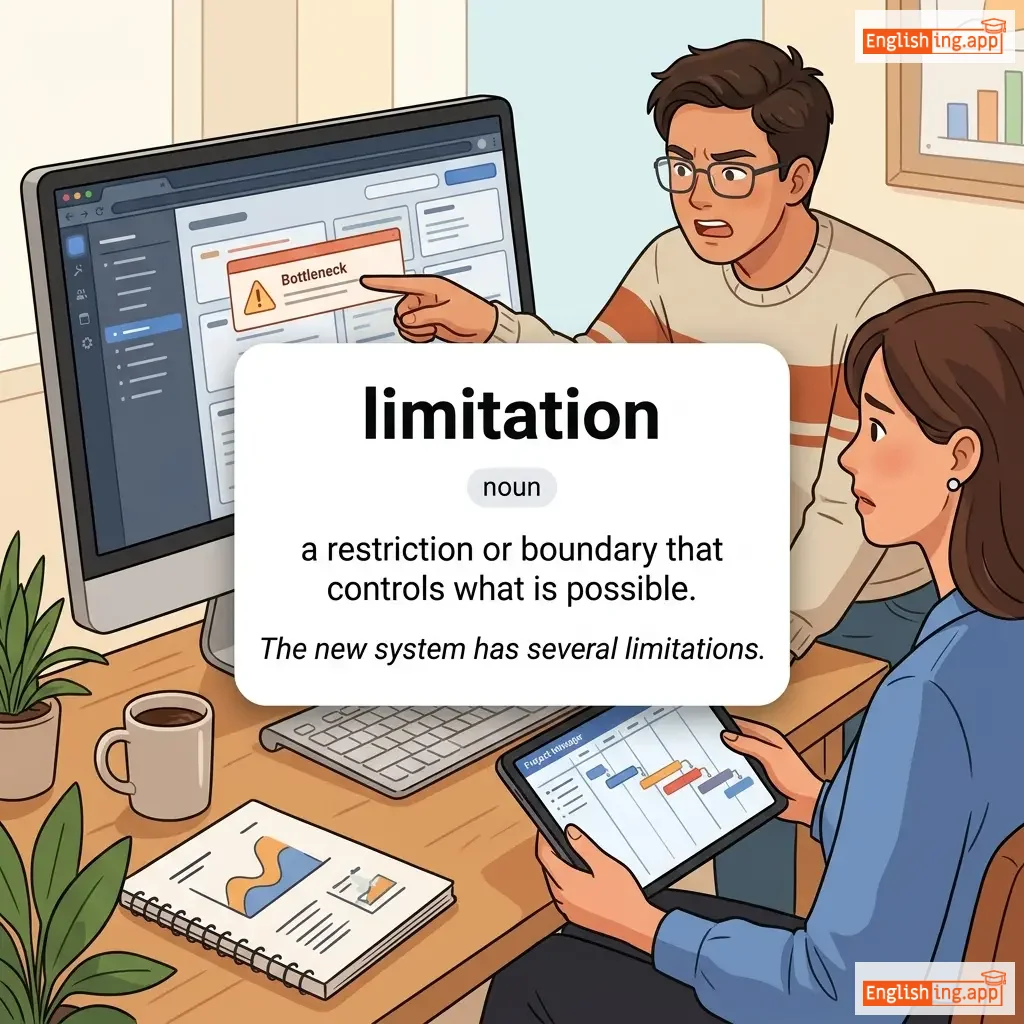
limitation definition card — visual illustration of the meaning
noun
/ˌlɪmɪˈteɪʃən/
सीमा (seema)

a restriction or boundary that controls what is possible.

"The new system has several limitations."

"नए सिस्टम में कई सीमाएँ हैं।" (Naye system mein kai seemayein hain.)
adjective
/ˈlɪmɪtɪd/
सीमित (seemit)

Restricted in size, amount, or extent; not great in number or ability.

"Tickets for the concert are limited."

"कंसर्ट के टिकट सीमित हैं।" (Concert ke ticket seemit hain.)
limn definition card — visual illustration of the meaning
verb
/lɪm/
चित्रित करना / वर्णन करना (chitrit karna / varnana karna)

to depict or describe something vividly in words or art.

"The author limned the beauty of the countryside."

"लेखक ने ग्रामीण इलाकों की सुंदरता का जीवंत चित्रण किया।" (Lekhak ne gramin ilako ki sundarta ka jivant chitran kiya.)
noun
/ˈlɪməˌziːn/
बड़ी, लग्ज़री कार जो एक ड्राइवर द्वारा चलाई जाती है (badi, lagzari car jo ek driver dvara chali jati hai)

a large, luxurious car driven by a chauffeur.

"The bride arrived in a white limousine."

"दुल्हन एक सफेद लिमोज़ीन में आई।" (Dulhan ek safed limousine mein aayi.)
verb, adjective, noun
/lɪmp/
लंगड़ा होना / कमजोर (langda hona / kamzor)

to walk with difficulty, often due to injury or weakness; lacking strength or firmness.

"He limped after injuring his ankle."

"वह अपने टखने को घायल करने के बाद लंगड़ा कर चल रहा था।" (Wah apne takhne ko ghaayal karne ke baad langda kar chal raha tha.)
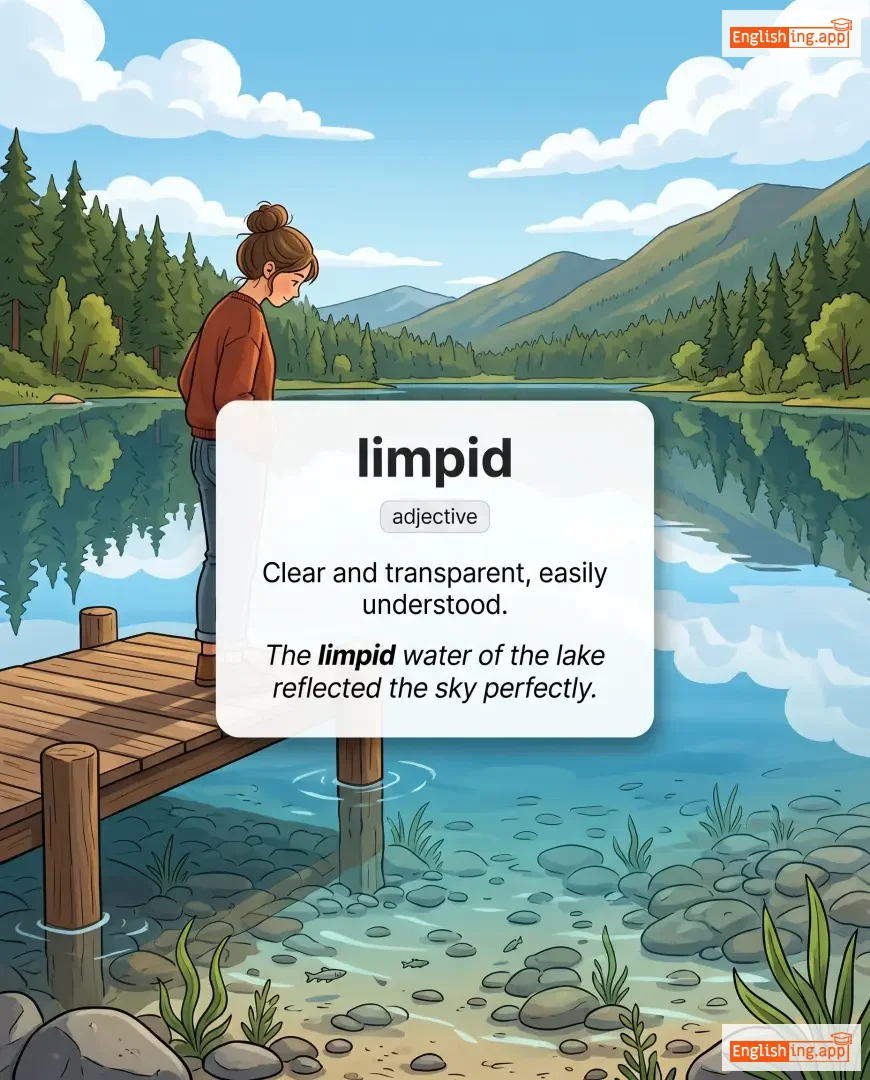
limpid definition card — visual illustration of the meaning
adjective
/ˈlɪmpɪd/
स्वच्छ (swachchh)

Clear and transparent, easily understood.

"The limpid water of the lake reflected the sky perfectly."

"झील का स्वच्छ पानी आकाश को पूर्णता से प्रतिबिंबित कर रहा था।" (jheel ka swachchh pani aakash ko purnata se pratibimbit kar raha tha.)
noun, verb
/laɪn/
लाइन (line)

A long narrow mark or band; a row of people or things; to cover the inside surface of something.

"People waited in a long line outside the theater."

"लोग थिएटर के बाहर लंबी लाइन में इंतजार कर रहे थे।" (Log theater ke baahar lambi line mein intezaar kar rahe the.)
noun; verb
/ˈlaɪnʌp/
कतार; पंक्ति में लगाना (kataar; pankti mein lagana)

a group or arrangement of people or things in a line; to arrange people or things in a row or planned order

"The coach announced the team line-up before the match."

"मैच से पहले कोच ने टीम की कतार घोषित की।" (match se pehle coach ne team ki kataar ghoshit ki)
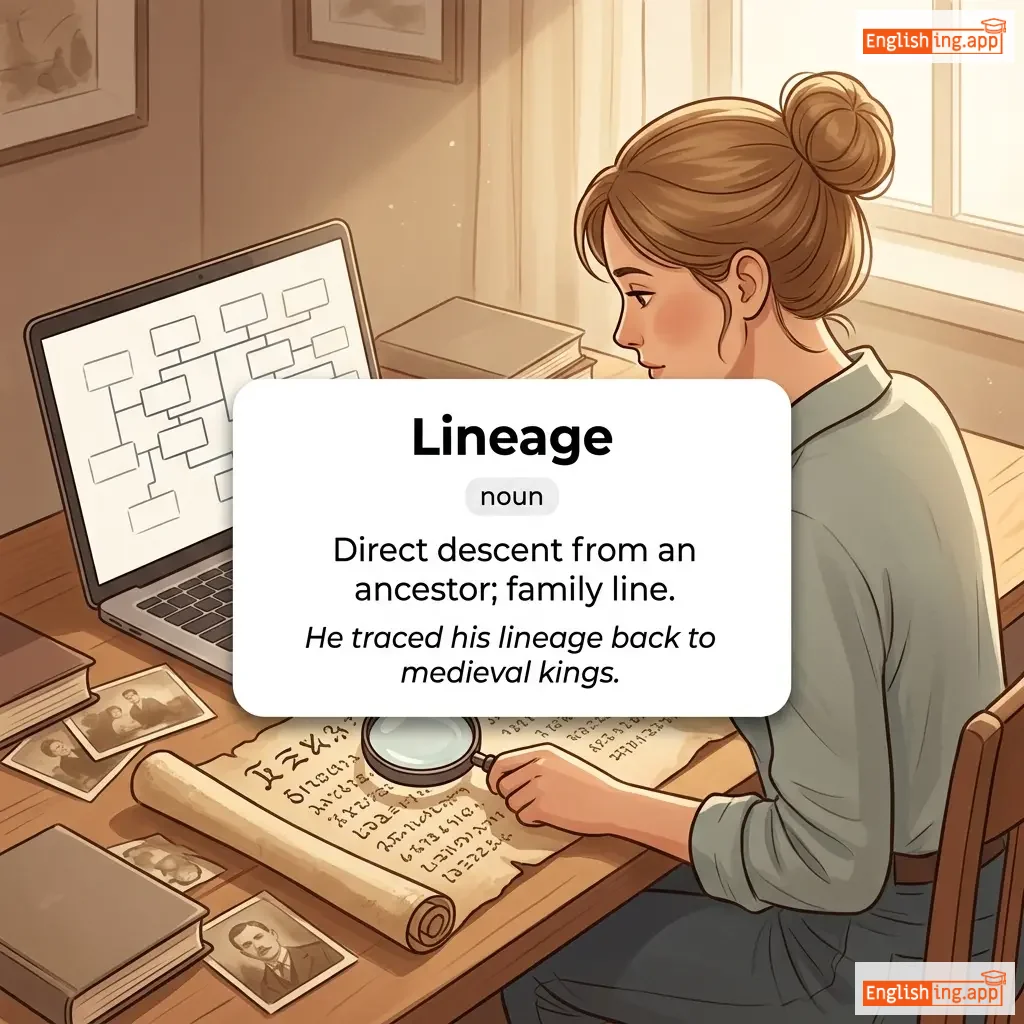
Lineage definition card — visual illustration of the meaning
noun
/ˈlɪniɪdʒ/
वंशावली (vanshavali)

Direct descent from an ancestor; family line.

"He traced his lineage back to medieval kings."

"उसने अपनी वंशावली को मध्यकालीन राजाओं से जोड़ा।" (usne apni vanshavali ko madhyakalīn rājāon se joda.)
noun
/ˈlɪniəmənt/
रूपरेखा (rooprekha)

A distinctive feature or characteristic, especially of the face.

"Her delicate lineaments revealed her noble birth."

"उसकी नाजुक रूपरेखा ने उसकी महान जन्म को उजागर किया।" (Uski naazuk rooprekha ne uski mahaan janm ko ujagar kiya.)
noun (plural)
/ˈlɪniəmənts/
चेहरे की विशेषताएँ (chehre ki visheshtaen)

The features or distinctive characteristics of the face or body.

"The lineaments of his face were sharp and stern."

"उसके चेहरे की विशेषताएँ तेज और सख्त थीं।" (uske chehre ki visheshtaen tez aur sakht thin.)
adjective
/ˈlɪniər/
रेखीय (rekheey)

Arranged in or extending along a straight line.

"The artist used linear perspective in his drawings."

"कलाकार ने अपनी चित्रकारी में रेखीय दृष्टिकोण का उपयोग किया।" (kalakar ne apni chitrakari mein rekheey drishtikon ka upyog kiya.)
noun
/ˈlɪn.ən/
लिनन कपड़ा (linen kapda)

A strong cloth made from the fibers of the flax plant, or items made from this cloth such as sheets or clothing.

"She bought new linen curtains for the living room."

"उसने लिविंग रूम के लिए नए लिनन के परदे खरीदे।" (Usne living room ke liye naye linen ke parde kharide.)
noun
/ˈlaɪ.nər/
यात्री जहाज़ (yatri jahaz)

A large ship used for transporting people or goods regularly, or a material used as a lining inside something.

"The luxury liner docked at the port yesterday."

"लक्ज़री लाइनर कल बंदरगाह पर डॉक किया था।" (Luxury liner kal bandargah par dock kiya tha.)
noun
/ˈlaɪnˌʌp/
लाइनेअप (lineup)

a group of people or things arranged in a sequence

"The event featured a star-studded lineup of musicians."

"इस इवेंट में संगीतकारों का एक स्टार-स्टडेड लाइनअप था।" (Is event mein sangeetkaron ka ek star-studded lineup tha.)
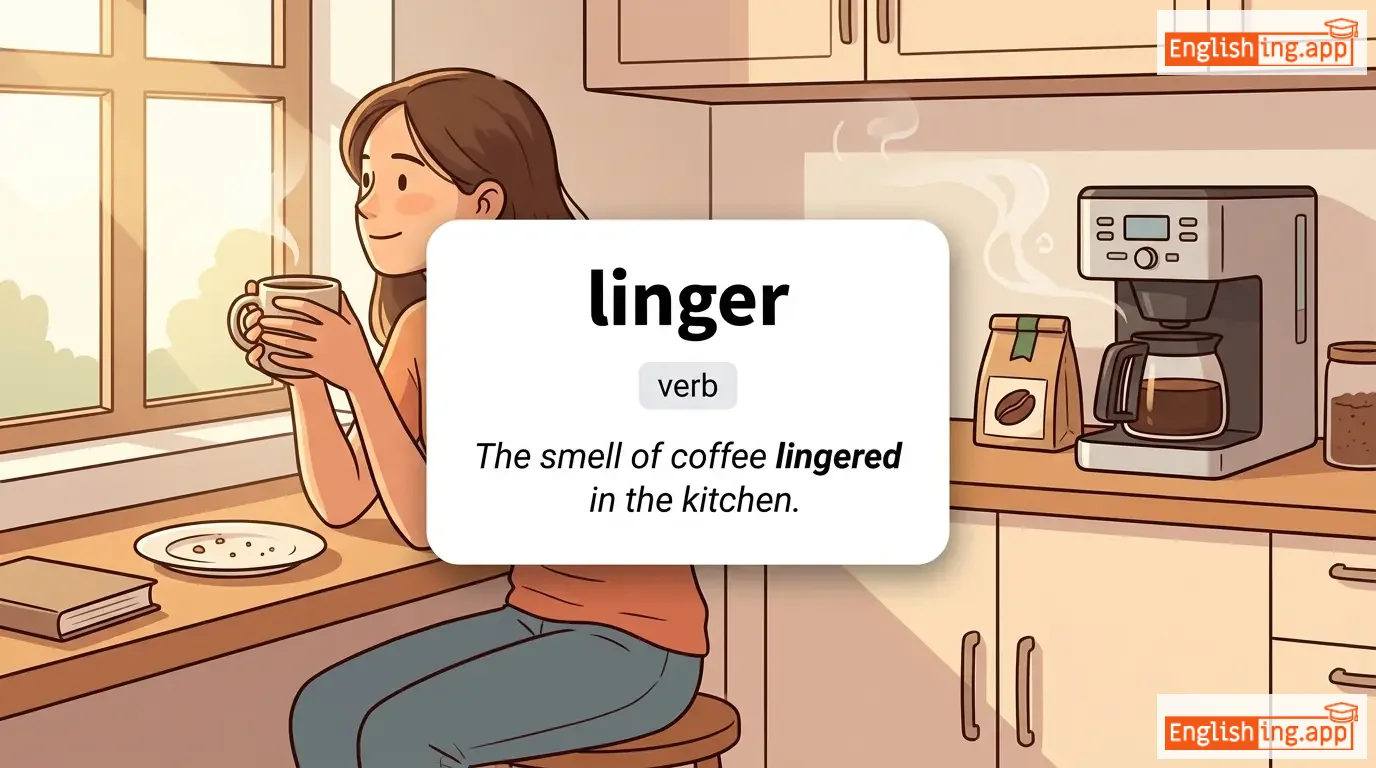
linger definition card — visual illustration of the meaning
verb
/ˈlɪŋ.ɡər/
लंबे समय तक रहना (lambe samay tak rehna)

To stay in a place longer than necessary, often because of unwillingness to leave.

"The smell of coffee lingered in the kitchen."

"कॉफ़ी की खुशबू रसोई में लंबे समय तक रही।" (Kofee ki khushboo rasoee mein lambe samay tak rahi.)
noun
/ˈlɪŋ.ɡoʊ/
विशेष भाषा (vishesh bhasha)

Specialized or informal language used by a particular group that is often difficult for outsiders to understand.

"The manual was written in technical lingo that confused the new employees."

"मैनुअल तकनीकी भाषा में लिखा गया था जो नए कर्मचारियों को भ्रमित कर रहा था।" (Manual takneeki bhasha mein likha gaya tha jo naye karyakariyon ko bhramit kar raha tha.)
noun
/ˈlɪŋ.ɡwə/
भाषा (bhasha)

A language, especially one used for communication among people.

"English has become a global lingua for business and science."

"अंग्रेज़ी व्यापार और विज्ञान के लिए एक वैश्विक भाषा बन गई है।" (Angrezi vyapar aur vigyan ke liye ek vaishvik bhasha ban gayi hai.)
adjective
/ˈlɪŋɡwəl/
जीभ से संबंधित (jeebh se sambandhit)

Relating to the tongue or speech.

"The dentist examined the patient's lingual surface of the teeth."

"दंत चिकित्सक ने रोगी के दांतों की जीभ सतह की जांच की।" (Dant chikitsak ne rogi ke daanton ki jeebh satah ki jaanch ki.)
noun
/ˈlɪŋɡwɪst/
भाषाविद (bhashavid)

A person skilled in foreign languages or in the scientific study of language.

"She is a linguist who speaks six languages fluently."

"वह एक भाषाविद है जो छह भाषाओं में धाराप्रवाह बोलती है।" (Woh ek bhashavid hai jo chhah bhashaon mein dharapravah bolti hai.)
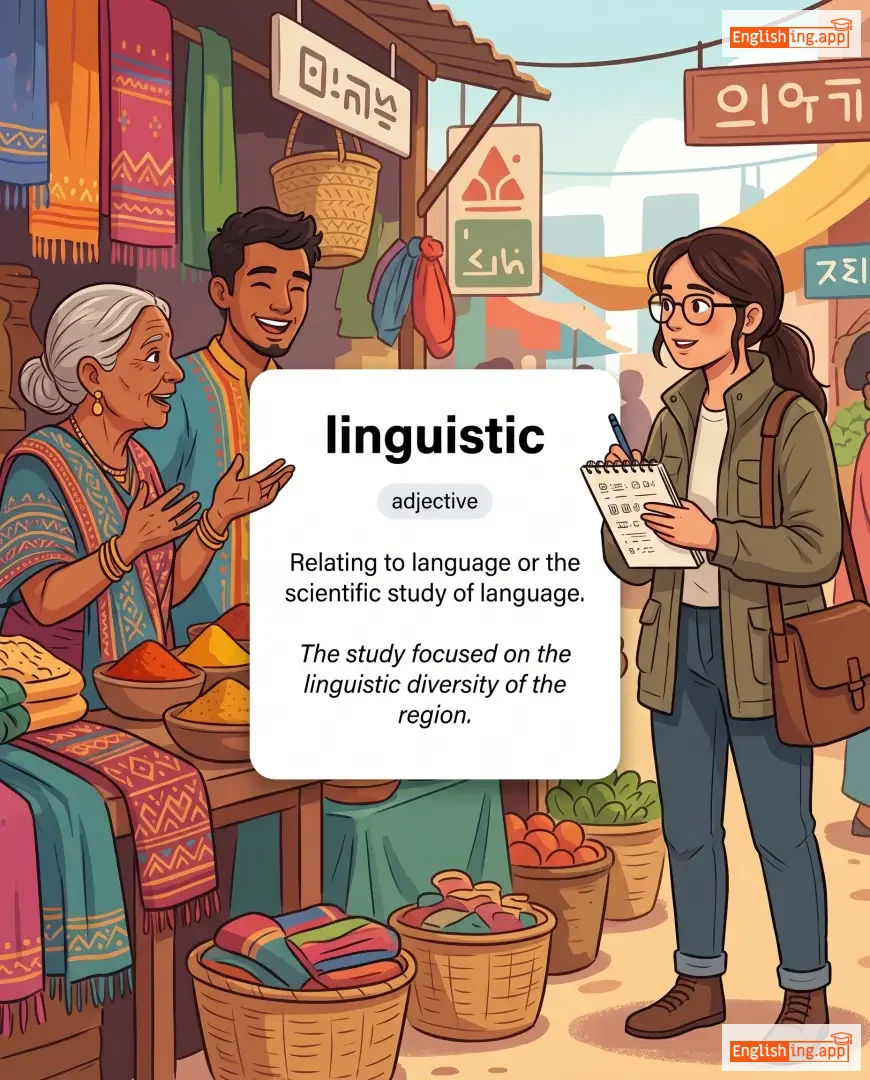
linguistic definition card — visual illustration of the meaning
adjective
/lɪŋˈɡwɪstɪk/
भाषाई (bhashai)

Relating to language or the scientific study of language.

"The study focused on the linguistic diversity of the region."

"अध्यान ने क्षेत्र की भाषाई विविधता पर ध्यान केंद्रित किया।" (Adhyayan ne kshetra ki bhasai vividhata par dhyan kendrit kiya.)
noun
/lɪŋˈɡwɪstɪks/
भाषाविज्ञान (bhashavigyan)

The scientific study of language and its structure.

"She decided to major in linguistics at university."

"उसने विश्वविद्यालय में भाषाविज्ञान में प्रमुखता लेने का निर्णय लिया।" (Usne vishwavidyalaya mein bhashavigyan mein pramukhata lene ka nirnay liya.)
noun
/ˈlɪnəmənt/
लिनिमेंट / लोशन (liniment / loshan)

A liquid or lotion applied to the skin to relieve pain or stiffness.

"He rubbed liniment on his sore muscles after the workout."

"उसने कसरत के बाद अपने दर्दनाक मांसपेशियों पर लिनिमेंट लगाया।" (Usne kasrat ke baad apne dardnaak maanspeshiyon par liniment lagaya.)
noun, verb
/lɪŋk/
संपर्क (sampark)

a connection between two things; to connect or associate

"The article includes a link to the official website."

"लेख में आधिकारिक वेबसाइट का लिंक शामिल है।" (lekh mein aadhikarik website ka link shamil hai.)
noun
/lɪˈnoʊ.li.əm/
लिनोलियम (linoliam)

a durable, washable floor covering made from solidified linseed oil, wood flour, or cork dust on a canvas backing

"They decided to cover the kitchen floor with linoleum."

"उन्होंने रसोई के फर्श को लिनोलियम से ढकने का निर्णय लिया।" (unhone rasoee ke farsh ko linoliam se dhakne ka nirnay liya)
noun
/lɪnt/
कपड़े के छोटे रेशे (lint)

small soft fibers that come off cloth, often found in dryers or on clothes

"There was lint all over his black shirt after the wash."

"धोने के बाद उसकी काली शर्ट पर लिंट लगी हुई थी।" (dhone ke baad uski kaali shirt par lint lagi hui thi.)
noun
/ˈlaɪən/
सिंह (singh)

a large wild animal of the cat family that lives in Africa and Asia, known as the king of the jungle

"The lion roared loudly in the distance."

"सिंह की दहाड़ दूर से सुनाई दी।" (Singh ki dahad door se sunai di.)
noun
/ˈlaɪ.ə.nəs/
शेरनी (sherni)

an adult female lion

"The fierce lioness protected her cubs from danger."

"सख्त शेरनी ने अपने शावकों को खतरे से बचाया।" (sakht sherani ne apne shavkon ko khatre se bachaya.)
verb
/ˈlaɪ.ə.naɪz/
अतिरिक्त प्रशंसा करना (laionize)

to treat someone as a celebrity or give a lot of public attention

"The press began to lionize the young scientist after his discovery."

"पत्रकारिता ने उसके आविष्कार के बाद युवा वैज्ञानिक को लायनाइज़ करना शुरू कर दिया।" (patrakarita ne uske aviskar ke baad yuva vaigyanik ko laionize karna shuru kar diya.)
noun
/lɪp/
ओंठ (onth)

either of the two soft edges of the mouth

"She smiled and bit her lower lip nervously."

"वह मुस्काई और नर्वस होकर अपने निचले ओंठ को काटने लगी।" (Wah muskaai aur nervous hokar apne nichle onth ko kaatne lagi.)
lipogenesis definition card — visual illustration of the meaning
noun
/ˌlaɪ.pəˈdʒen.ɪ.sɪs/
वसा संश्लेषण (vasa sanshleshann)

The metabolic process of fat synthesis where excess carbohydrates are converted into fatty acids and stored as triglycerides.

"Excess carbohydrate intake promotes lipogenesis and fat storage."

"अतिरिक्त कार्बोहाइड्रेट सेवन वसा संश्लेषण और वसा संचय को बढ़ावा देता है।" (Atirikt carbohydrate sevan vasa sanshleshann aur vasa sanchay ko badhawa deta hai.)
noun
/ˌlɪk.wəˈfeɪ.ʃənt/
तरलकारी (liquefacient)

a substance that causes something to become liquid

"The chemist explained how the liquefacient worked in the experiment."

"रसायनज्ञ ने समझाया कि लिक्वेफेसिएंट प्रयोग में कैसे काम करता था।" (rasayanagya ne samjhaya ki liquefacient prayog mein kaise kaam karta tha.)
verb
/ˈlɪk.wɪ.faɪ/
तरल करना (liquefy)

to make or become liquid

"The heat will liquefy the butter in a few minutes."

"गर्मी कुछ मिनटों में मक्खन को तरल कर देगी।" (garmi kuch minute mein makkhan ko taral kar degi.)
noun
/lɪˈkjʊər/
मीठा शराब (meetha sharab)

A strong, sweet alcoholic drink flavored with fruits, herbs, or spices.

"She served a small glass of cherry liqueur after dinner."

"उसने रात के खाने के बाद चेरी लिक्यूर का एक छोटा गिलास सर्व किया।" (Usne raat ke khane ke baad cheri liqueur ka ek chhota gilas serve kiya.)
noun
/ˈlɪkwɪd/
तरल पदार्थ (taral padarth)

a substance that flows freely but is of constant volume, having a consistency like water or oil.

"Water is a clear liquid that is essential for life."

"पानी एक स्पष्ट तरल पदार्थ है जो जीवन के लिए आवश्यक है।" (Pani ek spasht taral padarth hai jo jeevan ke liye avashyak hai.)
verb
/ˈlɪkwɪdeɪt/
दिवालिया होना (divaliya hona)

To sell assets in order to pay off debts; to close a business and convert assets into cash.

"The company decided to liquidate its assets to pay creditors."

"कंपनी ने अपने कर्जदाताओं को भुगतान करने के लिए अपनी संपत्तियाँ लिक्विडेट करने का निर्णय लिया।" (Company ne apne karzdaton ko bhugtan karne ke liye apni sampattiyan liquidate karne ka nirnay liya.)
liquidity definition card — visual illustration of the meaning
noun
/lɪkˈwɪd.ə.ti/
तरलता (taralta)

The availability of liquid assets to a market or company.

"A business must maintain liquidity to cover expenses."

"एक व्यवसाय को खर्चों को कवर करने के लिए तरलता बनाए रखनी चाहिए।" (Ek vyavsay ko kharchon ko cover karne ke liye taralta banaye rakhni chahiye.)
noun
/ˈlɪkər/

Alcoholic drinks, especially strong distilled ones such as whiskey or vodka.

"The shop sells both beer and hard liquor."

adjective
/ˈlɪsəm/
पतला, लचीला और graceful गतिशीलता में (patla, lachila aur graceful gatishilata mein)

Thin, supple, and graceful in movement.

"The dancer moved with a lissome elegance."

"नर्तकी लिसोम सुंदरता से हिल रही थी।" (Nartaki lissome sundarta se hil rahi thi.)
noun, verb
/lɪst/
सूची (soochi)

A series of names, items, or tasks written or printed together; also, to record or register items in such a way.

"She wrote a shopping list before going to the market."

"वह बाजार जाने से पहले एक शॉपिंग लिस्ट लिखी।" (Vah bazar jane se pehle ek shopping list likhi.)
listen definition card — visual illustration of the meaning
verb
/ˈlɪs.ən/
सुनना (sunnā)

to pay attention to sound

"She loves to listen to classical music in the evenings."

"वह शाम को क्लासिकल म्यूज़िक सुनना पसंद करती है।" (Vah shaam ko classical music sunna pasand kartī hai.)
noun
/ˈlɪsənər/
सुननेवाला (sunnewala)

a person who listens or pays attention to something, especially to a speaker or sound.

"She is a good listener who always understands others' problems."

"वह एक अच्छा सुननेवाला है जो हमेशा दूसरों की समस्याओं को समझता है।" (vah ek accha sunnewala hai jo hamesha doosron ki samasyaon ko samajhta hai.)