वोकैबुलरीज

इंग्लिश वोकैबुलरी डिस्कवर, लर्न और मास्टर करें

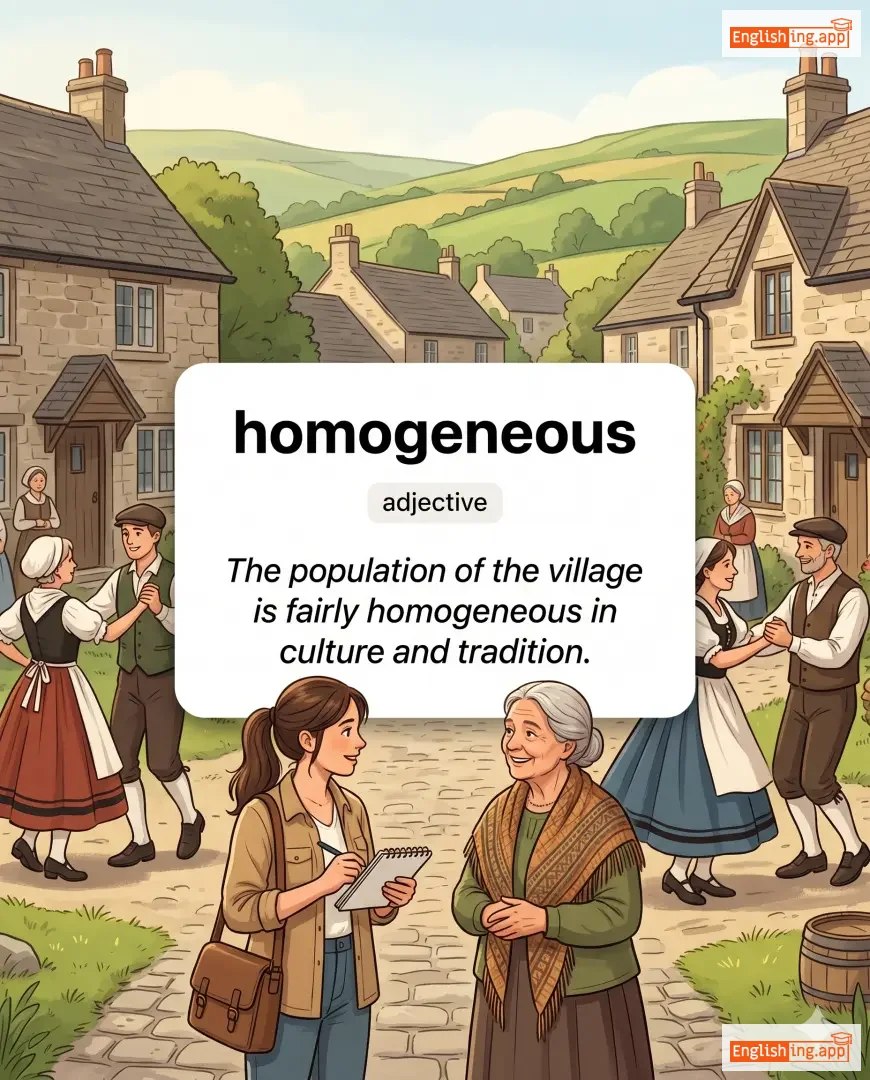
homogeneous definition card — visual illustration of the meaning
adjective
/ˌhoʊ.məˈdʒiː.ni.əs/
समजातीय (samjatīya)

Consisting of parts or elements that are all the same kind; uniform in composition.

"The population of the village is fairly homogeneous in culture and tradition."

"गाँव की जनसंख्या संस्कृति और परंपरा में काफी समान है।" (Gaon ki janasankhya sanskriti aur parampara mein kaafi samaan hai.)
verb
/həˈmɑː.dʒə.naɪz/
समान बनाना (samaan banana)

To make uniform or similar by blending or mixing different elements.

"The company tried to homogenize its products across global markets."

"कंपनी ने अपने उत्पादों को वैश्विक बाजारों में समान बनाने की कोशिश की।" (Company ne apne utpadon ko vaishvik bazaron mein samaan banane ki koshish ki.)
adjective
/həˈmɑː.dʒə.nəs/
समजातीय (samjatiy)

Similar or uniform in nature; often used interchangeably with 'homogeneous'.

"The class was made up of a homogenous group of students."

"कक्षा एक समजातीय छात्रों का समूह थी।" (Kaksha ek samjatiy chatron ka samuh thi.)
adjective
/həˈmɑː.lə.ɡəs/
समजातीय (संरचना) (samajatiya (sanrachna))

Having the same relation, relative position, or structure, especially due to evolutionary origin.

"The wings of bats and the arms of humans are homologous structures."

"बत्तखों के पंख और इंसानों के हाथ समजातीय संरचनाएँ हैं।" (Battakhon ke pankh aur insano ke haath samajatiya sanrachanayein hain.)
noun
/ˈhɑː.mə.nɪm/
समनाम (samanam)

A word that is spelled and pronounced like another word but has a different meaning.

"The word 'bat' is a homonym because it can mean an animal or a sports tool."

"'बैट' शब्द एक समनाम है क्योंकि इसका मतलब एक जानवर या एक खेल का औजार हो सकता है।" ('Bat' shabd ek samanam hai kyonki iska matlab ek janwar ya ek khel ka auzar ho sakta hai.)
noun
/ˈhɒməˌfoʊn/
समध्वनि शब्द (samadhvani shabd)

A word that is pronounced the same as another word but differs in meaning, and often spelling.

"The words 'pair' and 'pear' are homophones."

"'पैर' और 'पेयर' शब्द होमोफोन्स हैं।" ('pair' aur 'pear' shabd homophones hain.)
verb
/hoʊn/
तेज़ करना, कौशल सुधारना (tez karna, kaushal sudharna)

To sharpen a blade or to improve a skill through practice.

"She honed her presentation skills before the big meeting."

"बड़ी मीटिंग से पहले उसने अपनी प्रस्तुति कौशल को तेज़ किया।" (badi meeting se pehle usne apni prastuti kaushal ko tez kiya.)
adjective
/ˈɑːnɪst/
ईमानदार (imandar)

free of deceit and untruthfulness; sincere

"She is known as an honest and trustworthy person."

"वह एक ईमानदार और विश्वसनीय व्यक्ति के रूप में जानी जाती है।" (Vah ek imandar aur vishwasniya vyakti ke roop mein jani jati hai.)
adverb
/ˈɒnɪstli/
ईमानदारी से (imandari se)

in a truthful, sincere, or fair way

"She spoke honestly about her mistakes."

"उसने अपनी गलतियों के बारे में ईमानदारी से बात की।" (Usne apni galtiyon ke baare mein imandari se baat ki.)
noun
/ˈɒnɪsti/
ईमानदारी (imaandaari)

the quality of being truthful and sincere

"Honesty is the best policy in all situations."

"ईमानदारी सभी परिस्थितियों में सबसे अच्छी नीति है।" (Imaandari sabhi paristhitiyon mein sabse achi neeti hai.)
noun
/ˈhʌni/
शहद (shahed)

A sweet, sticky substance made by bees from nectar.

"She likes to put honey in her tea."

"वह अपनी चाय में शहद डालना पसंद करती है।" (Vah apni chay mein shahed daalna pasand karti hai.)
noun
/ˈɑːnər/
सम्मान (samman)

high respect; great esteem

"He received an award in honor of his achievements."

"उन्हें उनकी उपलब्धियों के लिए सम्मान में एक पुरस्कार मिला।" (Unhein unki uplabdhiyon ke liye samman mein ek puraskaar mila.)
noun
/ˌɒnəˈreəriəm/
सम्मान शुल्क (samman shulk)

A payment given for professional services that are rendered without a fee.

"The guest lecturer received an honorarium for her talk."

"गेस्ट लेक्चरर ने अपनी वार्ता के लिए एक सम्मान शुल्क प्राप्त किया।" (guest lecturer ne apni varta ke liye ek samman shulk prapt kiya.)
honour definition card — visual illustration of the meaning
verb
/ˈɒnər/
सम्मान करना (sammaan karna)

to show respect; to keep a promise

"We honour our veterans for their service."

"हम हमारे वीर सैनिकों का उनके सेवा के लिए सम्मान करते हैं।" (Ham hamare veer sainikon ka unke seva ke liye sammaaan karte hain.)
adjective
/ˈɒnərəbəl/
सम्माननीय (sammananiya)

deserving respect or admiration because of moral integrity; showing honesty and fairness

"She is known as an honourable leader who always keeps her promises."

"वह एक सम्माननीय नेता के रूप में जानी जाती है जो हमेशा अपने वादे निभाती है।" (vah ek sammananiya neta ke roop mein jani jati hai jo hamesha apne vade nibhati hai)
adjective; past participle
/ˈɒnəd/
सम्मानित (sammanit)

treated with respect or distinction; feeling proud and privileged

"She felt deeply honoured to receive the award."

"पुरस्कार पाकर वह स्वयं को बहुत सम्मानित महसूस कर रही थी।" (puraskar pakar vah svayam ko bahut sammanit mehsoos kar rahi thi)
noun
/hʊd/
हूड (hud)

the expandable neck region of certain snakes like cobras; a covering for the head

"The cobra spread its hood when it felt threatened."

"कोबरा ने अपना हुड फैलाया जब उसे खतरा महसूस हुआ।" (kobara ne apna hud phailaya jab use khatra mahsus hua)
verb
/ˈhʊdwɪŋk/
धोखा देना (dhokha dena)

To deceive or trick someone.

"The scammer hoodwinked many people with false promises."

"धोखेबाज ने झूठे वादों के साथ कई लोगों को धोखा दिया।" (dhokhebaaz ne jhoothe vaadon ke saath kai logon ko dhokha diya.)
noun
/huːf/
खुर (khur)

the hard part covering the foot of horses, cattle, sheep, and other animals

"The horse's hoof was injured after stepping on a sharp rock."

"घोड़े का खुर एक तेज पत्थर पर कदम रखने के बाद घायल हो गया था।" (ghode ka khur ek tez patthar par kadam rakhne ke baad ghaayal ho gaya tha.)
hook definition card — visual illustration of the meaning
noun, verb
/hʊk/
हुक या लटकाने का यंत्र (huk ya latkane ka yantr)

a curved piece of metal or other material used for catching, holding, or pulling something; to catch or attach with a hook

"She hooked her keys onto her bag."

"उसने अपनी चाबियाँ अपने बैग पर हुक की।" (Usne apni chabiyaan apne bag par huk ki.)
verb
/hoʊp/
आशा (asha)

To want something to happen or be true and think it is possible.

"I hope everything goes well with your exam."

"मैं आशा करता हूँ कि तुम्हारा परीक्षा अच्छा होगा।" (Main asha karta hoon ki tumhara pariksha accha hoga.)
adjective
/ˈhəʊpfʊl/
आशान्वित (aashanvit)

feeling or showing optimism about a future event

"She is hopeful about the results of the interview."

"वह साक्षात्कार के परिणामों को लेकर आशान्वित है।" (Vah saakshaatkaar ke parinaamon ko lekar aashanvit hai.)
adverb
/ˈhoʊpfəli/
आशापूर्वक (aashapurvak)

in a hopeful manner; expressing hope or optimism

"Hopefully, the weather will be nice tomorrow."

"आशा है, कल मौसम अच्छा रहेगा।" (Asha hai, kal mausam accha rahega.)
adjective
/ˈhoʊpləs/
निराशाजनक; निराश (niraashajanak; niraash)

feeling or causing despair about something; without hope; desperate

"The situation seemed hopeless until help arrived."

"स्थिति तब तक निराशाजनक लगी जब तक मदद नहीं आई।" (sthiti tab tak niraashajanak lagi jab tak madad nahi aayi.)
noun
/hɔːrd/
भीड़ (bhid)

A large group or crowd, especially one that is disorderly or difficult to control.

"A horde of fans gathered outside the stadium."

"स्टेडियम के बाहर प्रशंसकों की एक भीड़ एकत्रित हो गई थी।" (stadyam ke baahar prashansako ki ek bhid ekatrit ho gayi thi.)
noun
/həˈraɪ.zən/
क्षितिज (kshitij)

the line where the earth seems to meet the sky; the limit of one's knowledge, experience, or interest

"The sun disappeared below the horizon."

"सूरज क्षितिज के नीचे छिप गया।" (Suraj kshitij ke neeche chhip gaya.)
horizons definition card — visual illustration of the meaning
noun
/həˈraɪ.zənz/
क्षितिज (kshitij)

The limit of a person's mental perception, experience, or interest.

"The telescope opens new horizons for astronomy."

"दूरबीन खगोलशास्त्र के लिए नए क्षितिज खोलती है।" (Doorbeen khagolshastra ke liye naye kshitij kholti hai.)
adjective
/ˌhɒrɪˈzɒntəl/
क्षैतिज (kshaitij)

parallel to the horizon; flat and level from side to side

"The table must be perfectly horizontal to keep the glass from sliding."

"गिलास को फिसलने से रोकने के लिए मेज़ का क्षैतिज होना ज़रूरी है।" (gilaas ko phisalne se rokne ke liye mez ka kshaitij hona zaruri hai)
noun
/ˈhɔːrmoʊn/
हार्मोन (hormon)

a chemical substance produced in the body that influences how the body grows or functions

"Insulin is a hormone that controls blood sugar levels."

"इंसुलिन एक हार्मोन है जो रक्त शर्करा स्तर को नियंत्रित करता है।" (Insulin ek hormon hai jo rakt shakkara starr ko niyantrit karta hai.)
noun
/hɔːrn/
सींग, हॉर्न (singh, horn)

a hard, pointed part growing from the head of some animals; a device that makes a loud sound as a warning

"The driver pressed the horn to warn the pedestrians."

"ड्राइवर ने पैदल यात्रियों को चेतावनी देने के लिए हॉर्न बजाया।" (Driver ne paidal yatriyon ko chetavni dene ke liye horn bajaya.)
noun
/ˈhɔːrn.bɪl/
हॉर्नबिल पक्षी (hornbill pakshi)

a large tropical bird with a large curved beak and often a horn-like projection

"The colorful hornbill perched on the highest branch."

"रंगीन हॉर्नबिल सबसे ऊँची शाखा पर बैठा था।" (rangin hornbill sabse unchi shaakha par baitha tha)
noun
/ˈhɔːr.nət/
मधुमक्खी (madhumakkhi)

a large wasp that can sting and is often aggressive

"The hornet built its nest under the roof."

"मधुमक्खी ने छत के नीचे अपना घोसला बनाया।" (madhumakkhi ne chhat ke neeche apna ghosla banaya.)
noun
/ˈhɒrəˌskoʊp/
राशिफल (rashifal)

A forecast of a person's future based on the positions of the stars and planets at their birth.

"She read her horoscope every morning to see what the stars predicted."

"वह हर सुबह अपना राशिफल पढ़ती थी यह देखने के लिए कि तारे क्या भविष्यवाणी कर रहे थे।" (Woh har subah apna rashifal padhti thi yah dekhne ke liye ki tare kya bhavishyavani kar rahe the.)
adjective
/ˈhɔːrɪbəl/
भयानक, घृणित (bhayanak, ghrinit)

very unpleasant or causing horror; extremely bad or unpleasant

"The food at that restaurant was horrible."

"उस रेस्तरां का खाना भयानक था।" (Us restaurant ka khana bhayanak tha.)
horrify definition card — visual illustration of the meaning
verb
/ˈhɔːrɪfaɪ/
डराना (darana)

to fill with horror; to shock or disgust greatly

"The violent scene horrified the audience."

"हिंसक दृश्य ने दर्शकों को डरा दिया।" (hinsak drishya ne darshakon ko dara diya)
noun
/ˈhɒr.ər/
भयावहता (bhayavahata)

an intense feeling of fear, shock, or disgust

"She screamed in horror when she saw the accident."

"जब उसने दुर्घटना देखी, तो वह भय से चीख पड़ी।" (Jab usne durghatna dekhi, to vah bhay se cheekh padi.)
noun
/hɔːrs/
घोड़ा (ghoda)

a large, strong animal used for riding, racing, or carrying loads

"The horse ran across the field."

"घोड़ा मैदान में दौड़ता हुआ गया।" (ghoda maidan mein daudta hua gaya.)
noun
/ˈhɔːrs.liːt͡ʃ/
घोड़े का कीड़ा (ghode ka keeda)

a large species of leech that was traditionally used in veterinary medicine

"The veterinarian explained that horse-leach was once commonly used to treat horses."

"पशु चिकित्सक ने समझाया कि घोड़े का कीड़ा एक समय में घोड़ों का इलाज करने के लिए सामान्य रूप से इस्तेमाल होता था।" (pashu chikitsak ne samjhaya ki ghode ka keeda ek samay mein ghodon ka ilaaj karne ke liye samanya roop se istemal hota tha)
adjective
/ˈhɔːrtətɪv/
उत्साहजनक (hortaytiv)

Giving strong encouragement or urging.

"The teacher gave a hortative speech to motivate the students before the exam."

"शिक्षक ने छात्रों को परीक्षा से पहले प्रेरित करने के लिए एक उत्साहजनक भाषण दिया।" (Shikshak ne chhatron ko pariksha se pehle prerit karne ke liye ek utsahjanak bhaashan diya.)
adjective
/ˈhɔːrtətɔːri/
आह्वानात्मक (aahvaanaatmak)

Intended to encourage or urge to action.

"The manager’s hortatory words inspired the team to work harder."

"प्रबंधक के आह्वानात्मक शब्दों ने टीम को और अधिक मेहनत से काम करने के लिए प्रेरित किया।" (prabandhak ke aahvaanaatmak shabdon ne team ko aur adhik mehnat se kaam karne ke liye prerit kiya.)
adjective
/ˌhɔːrtɪˈkʌltʃərəl/
बागवानी संबंधित (baagwani sambandhit)

Relating to the art or practice of garden cultivation and management.

"She studied horticultural science at the university."

"उसने विश्वविद्यालय में बागवानी विज्ञान की पढ़ाई की।" (Usne vishwavidyalaya mein baagwani vigyaan ki padhai ki.)
noun
/ˈhɔːrtɪˌkʌltʃər/
बागवानी (haurtikalchar)

The art or practice of garden cultivation and management.

"Horticulture plays a vital role in producing fruits, vegetables, and ornamental plants."

"बागवानी फल, सब्ज़ियाँ और सजावटी पौधों के उत्पादन में एक अहम भूमिका निभाती है।" (baagvaanee phal, sabziyaan aur sajavatee paudhe utpaadan mein ek ahm bhoomika nibhaatee hai.)
noun
/ˈhoʊʒəri/
मोज़े और पैर के कपड़े (moze aur pair ke kapde)

Stockings, socks, and other knitted clothing for the legs and feet.

"She bought new hosiery for the winter season."

"उसने सर्दी के मौसम के लिए नए होसिएरी खरीदी।" (Usne sardi ke mausam ke liye naye hosiery kharidi.)
adjective
/ˈhɑːspɪtəbl/
अतिथि सत्कार करने वाला (atithi satkar karne wala)

Friendly and welcoming to guests or strangers.

"The villagers were very hospitable to the travelers."

"गांववालों ने यात्रियों को बहुत आतिथ्य सत्कार दिया।" (Gaonwalo ne yatriyon ko bahut atithi satkar diya.)
noun
/ˈhɒs.pɪ.təl/
अस्पताल (aspataal)

an institution where sick or injured people are given medical treatment

"He was taken to the hospital after the accident."

"उसे दुर्घटना के बाद अस्पताल ले जाया गया था।" (Use durghatna ke baad aspataal le jaya gaya tha.)
noun
/ˌhɑːspɪˈtæləti/
अतिथ्य (hospitailiti)

The friendly and generous reception and entertainment of guests or strangers.

"We enjoyed the hospitality of our hosts during the holiday."

"हम छुट्टियों के दौरान अपने मेज़बानों के अतिथ्य का आनंद लेते थे." (ham chuttiyon ke dauran apne mezbanon ki atithya ka anand lete the)
noun, verb
/hoʊst/
आयोजक (aayojak)

a person who receives or entertains guests; to organize and provide for an event

"She will host the conference next week."

"वह अगले हफ्ते सम्मेलन का आयोजन करेगी।" (vah agle hafte sammelan ka aayojan karegi.)
noun
/ˈhɑːstɪdʒ/
बंधक (bandhak)

A person seized or held as security for the fulfillment of a condition.

"The rebels took several people as hostages."

"विद्रोहियों ने कई लोगों को बंधक बना लिया।" (Vidrohiyaon ne kai logon ko bandhak bana liya.)
noun
/ˈhɑːstəlri/
हॉस्टल (hostel)

An inn or lodging place, especially one for travelers.

"They stayed at a small hostelry near the mountains."

"वे पहाड़ों के पास एक छोटे होस्टल में ठहरे थे।" (Ve pahadon ke paas ek chhote hostel mein thahare the.)
adjective
/ˈhɒstaɪl/
दुश्मन (dushman)

showing or feeling opposition, dislike, or hatred

"The soldiers entered a hostile territory."

"सैनिकों ने एक दुश्मन क्षेत्र में प्रवेश किया।" (Sainiko ne ek dushman kshetra mein pravesh kiya.)