वोकैबुलरीज

इंग्लिश वोकैबुलरी डिस्कवर, लर्न और मास्टर करें

health hazards definition card — visual illustration of the meaning
noun
helθ ˈhæzərdz
स्वास्थ्य जोखिम (swasthya jokhim)

Risks or dangers to physical health and well-being that can cause illness or injury.

"Plastic usage leads to significant health hazards."

"प्लास्टिक उपयोग से महत्वपूर्ण स्वास्थ्य जोखिम होते हैं।" (Plastic upyog se mahatvapurn swasthya jokhim hote hain.)
noun
/ˈhɛlθˌkɛər/
खुशी (khushi)

the organized provision of medical services to maintain or improve health

"Access to quality health-care is essential for every citizen."

"जब उसे पुरस्कार मिला, तो वह अपनी खुशी छिपा नहीं पाई।" (Jab use puraskar mila, to wah apni khushi chhupa nahi paayi.)
noun
/ˈhɛlθˌkɛər/
स्वास्थ्य देखभाल (swasthya dekhbhal)

the organized provision of medical care to people

"The country invested heavily in healthcare to improve public health."

"देश ने सार्वजनिक स्वास्थ्य में सुधार करने के लिए स्वास्थ्य देखभाल में भारी निवेश किया।" (Desh ne sarvajanik swasthya mein sudhaar karne ke liye swasthya dekhbhal mein bhaari nivesh kiya.)
adjective
/ˈhɛlθfəl/
स्वास्थ्यकारी (swasthyakari)

Promoting good health; beneficial to health.

"A healthful diet includes fresh fruits and vegetables."

"एक स्वास्थ्यकारी आहार में ताजे फल और सब्जियाँ शामिल हैं।" (Ek swasthyakari aahaar mein taje phal aur sabziyaan shaamil hain.)
healthy definition card — visual illustration of the meaning
adjective
/ˈhɛlθi/
खुशी (khushi)

Being in good physical or mental condition; promoting good health.

"She follows a healthy lifestyle by exercising regularly."

"वह जब पुरस्कार प्राप्त करती है, तो अपनी खुशी छुपा नहीं पाती।" (Vah jab puraskar prapt karti hai, to apni khushi chhupa nahi paati.)
verb
/hɪr/
सुनना (sunna)

To perceive sound with the ear.

"I can hear birds singing outside."

"मैं बाहर बर्ड्स सिंगिंग सुन सकता हूँ।" (Main baahar birds singing sun sakta hoon.)
noun
/ˈhɪərɪŋ/
सुनवाई / श्रवण (sunvai / shravan)

the ability to perceive sounds or an official meeting to listen to arguments or evidence

"The judge scheduled a hearing for next week."

"न्यायाधीश ने अगले सप्ताह के लिए एक सुनवाई निर्धारित की।" (Nyayadhish ne agle saptah ke liye ek sunvai nirdharit ki.)
verb
/ˈhɑːrkən/
ध्यान से सुनना (dhyan se sunna)

To listen attentively; to give heed.

"He would hearken to his mentor’s advice before making decisions."

"वह निर्णय लेने से पहले अपने मेंटर की सलाह ध्यान से सुनता।" (Vah nirnay lene se pehle apne mentor ki salah dhyan se sunta.)
noun
/ˈhɪərseɪ/
कही सुनी बात (kahi suni baat)

Information received from other people that cannot be substantiated; rumor.

"The decision was based on hearsay, not evidence."

"निर्णय गवाहियों के बजाय कही सुनी बातों पर आधारित था।" (Nirnay gawahiyon ke bajay kahi suni baaton par aadharit tha.)
noun
/hɜːrs/
मृतक वाहन; (mrutak vahan)

a vehicle for conveying the coffin at a funeral; a funeral car

"The black hearse slowly made its way to the cemetery, followed by a procession of mourners."

"काले हर्स ने धीरे-धीरे श्मशान की ओर रुख किया, जिसके पीछे शोक संतप्त लोग थे।" (kaale herse ne dheere-dheere shamshan ki or rukh kiya, jiske peeche shok santapt log the.)
noun
/hɑːrt/
हृदय (hriday)

the organ that pumps blood through the body; also the center of emotions

"Her heart was beating fast with excitement."

"उसका दिल रोमांच के साथ तेज़ी से धड़क रहा था।" (Uska dil romanch ke saath tezī se dhadak rahā thā.)
heartbeat definition card — visual illustration of the meaning
noun
/ˈhɑːt.biːt/
दिल की धड़कन (dil ki dhadkan)

A pulsation of the heart, especially as perceptible to the touch or audible with a stethoscope.

"Rubbing the eyes helps normalize the heartbeat."

"आंखों को रगड़ना दिल की धड़कन को सामान्य करने में मदद करता है।" (Aankhon ko ragadna dil ki dhadkan ko saamaanya karne mein madad karta hai.)
adjective
/ˈhɑːrtˌbreɪkɪŋ/
दिल तोड़ देने वाला; दुखद; ह्रदय विदारक (dil tod dene wala; dukhd; hriday vidarak)

causing overwhelming distress; very sad or disappointing

"The documentary showed heartbreaking scenes of children in poverty."

"डॉक्युमेंट्री में गरीबी में बच्चों के दिल तोड़ देने वाले दृश्य दिखाए गए।" (dokumentree mein gareebi mein bachon ke dil tod dene wale drishya dikhaye gaye.)
verb
/ˈhɑːrtən/
साहस देना (sahas dena)

To give courage, confidence, or hope.

"The teacher’s encouragement heartened the students."

"शिक्षक की प्रेरणा ने छात्रों को साहस दिया।" (Shikshak ki prerna ne chatron ko sahas diya.)
adverb
/ˈhɑr.tɪ.li/
दिल से; पूरी तरह से (dil se; puri tarah se)

in a sincere and enthusiastic manner; wholeheartedly

"She heartily welcomed her guests to the party."

"उसने अपने मेहमानों का दिल से स्वागत किया।" (usne apne mehmaanon ka dil se swagat kiya.)
adjective
/ˈhɑːrtˌrɛndɪŋ/
दिल दहला देने वाला (dil dehlane wala)

Causing great sadness or distress; very moving emotionally.

"The documentary showed heartrending scenes of war victims."

"द डॉक्यूमेंट्री ने युद्ध पीड़ितों के दिल दहला देने वाले दृश्य दिखाए।" (Da documentary ne yuddh peediton ke dil dehlane wale drishya dikhaye.)
adjective
/ˈhɑːrti/
उत्साही और मित्रवत; पर्याप्त और पोषक (utsahi aur mitravat; paryapt aur poshak)

enthusiastic and friendly; substantial and nourishing

"He gave us a hearty welcome when we arrived at his home."

"जब हम उनके घर पहुंचे, तो उन्होंने हमें एक उत्साही स्वागत दिया।" (jab hum unke ghar pahunche, to unhone humein ek utsahi swagat diya.)
heat definition card — visual illustration of the meaning
noun/verb
/hiːt/
गर्मी / तापन (garmi / tapan)

intensity of hotness; to make something warm or hot

"They heated the soup on the stove."

"उन्होंने चूल्हे पर सूप गरम किया।" (Unhone choolhe par soop garam kiya.)
adjective
/ˈhiːðənɪʃ/
असभ्य (asabhya)

Lacking culture or religion; barbaric or uncivilized.

"They considered the ancient tribe’s rituals heathenish."

"उन्होंने प्राचीन जनजाति की रीतियों को असंस्कृत माना।" (Unhone prachin janjati ki reetiyon ko asanskrit mana.)
noun
/ˈhɛvən/
स्वर्ग (swarg)

the place believed to be the home of God and the afterlife of the good; a state of extreme happiness

"They believe that good people go to heaven after death."

"वे मानते हैं कि अच्छे लोग मृत्यु के बाद स्वर्ग जाते हैं।" (ve maante hain ki achhe log mrityu ke baad swarg jaate hain.)
adjective
/ˈhevənli/
स्वर्गीय; दिव्य; सुखद (svargiy; divya; sukhad)

relating to heaven; extremely pleasant or beautiful

"The chocolate cake had a heavenly taste that melted in my mouth."

"चॉकलेट केक का स्वाद स्वर्गीय था जो मेरे मुंह में पिघल गया।" (choklet kek ka swad svargiy tha jo mere munh mein pighal gaya)
adverb
/ˈhɛvɪli/
भारी रूप से / अधिक (bhari roop se / adhik)

to a great degree; with a lot of weight, intensity, or force

"It rained heavily all night."

"पूरी रात जोरदार बारिश हुई।" (Puri raat zor daar barish hui.)
adjective
/ˈhɛvi/
भारी (bhaari)

having great weight; difficult to lift or move

"The box was too heavy for her to carry alone."

"बॉक्स उसके लिए अकेले उठाने के लिए बहुत भारी था।" (Box uske liye akele uthane ke liye bahut bhaari tha.)
noun
/ˈhɛklər/
हंगामा करने वाला (hangama karne wala)

A person who interrupts a speaker with rude or aggressive comments.

"The politician remained calm despite the heckler shouting from the crowd."

"राजनेता हंगामा करने वाले की चिल्लाहट के बावजूद शांत रहे।" (raajnetaa hangama karne waale ki chillahat ke bawajood shaant rahe.)
adjective
/ˈhek.tɪk/
व्यस्त; उत्तेजनापूर्ण; हलचल से भरा हुआ (vyast; uttejanapoorna; halchal se bhara hua)

very busy and full of activity; frantic; characterized by intense activity or excitement

"My schedule has been hectic lately with back-to-back meetings."

"मेरे शेड्यूल में हाल ही में बैक-टू-बैक मीटिंग्स के कारण व्यस्तता रही है।" (mere schedule mein haal hi mein back-to-back meetings ke kaaran vyastata rahi hai)
verb
/ˈhɛktər/
धमकी देकर बात करना (dhmki dekar baat karna)

To talk to someone in a bullying or intimidating way.

"The manager hectored the staff into working overtime."

"मैनेजर ने कर्मचारियों को ओवरटाइम करने के लिए हेक्टर किया।" (manager ne karyalayion ko overtime karne ke liye hector kiya.)
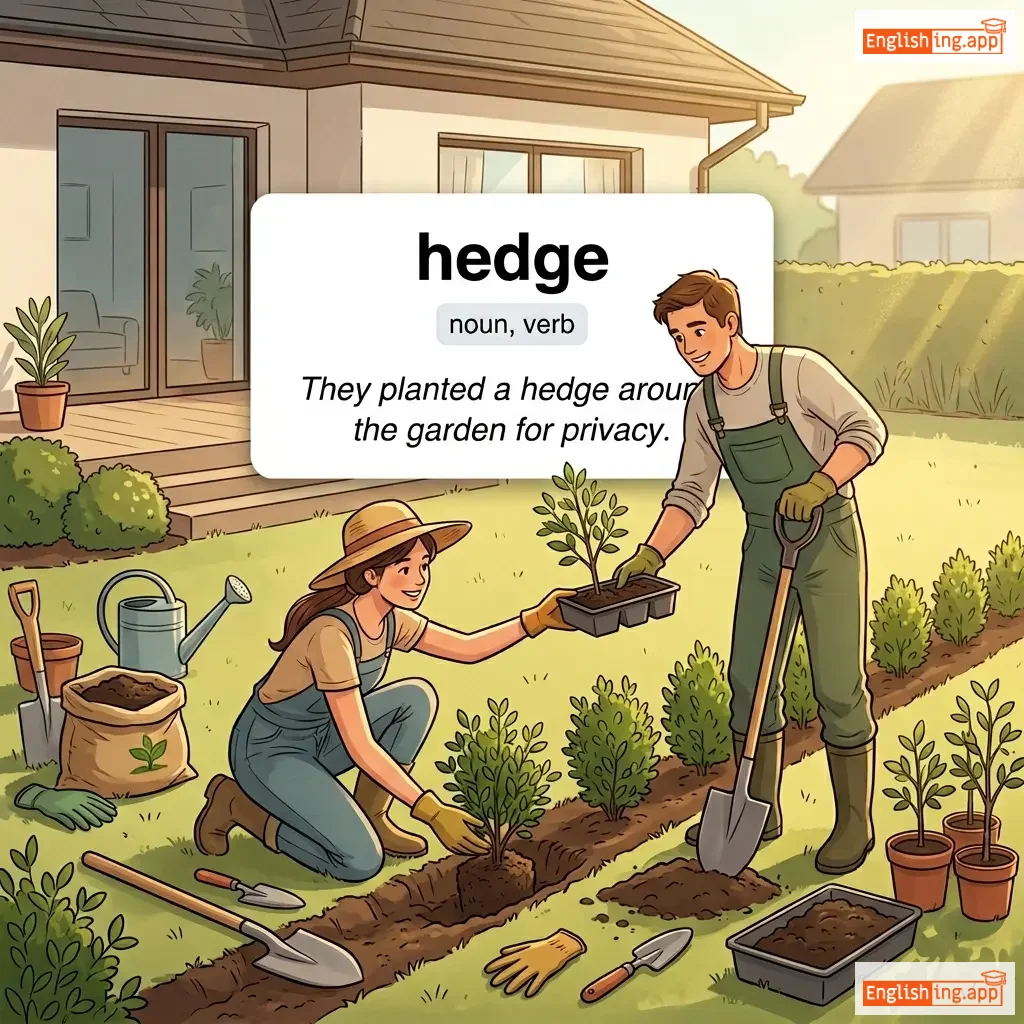
hedge definition card — visual illustration of the meaning
noun, verb
/hɛdʒ/
बाड़ (baad)

A fence or boundary formed by closely planted shrubs; also, to limit or qualify a statement.

"They planted a hedge around the garden for privacy."

"उन्होंने गोपनीयता के लिए बाग़ीचे के चारों ओर एक हेज लगाया।" (unhone gopniyata ke liye baagiche ke charon or ek hedge lagaya.)
noun
/ˈhedʒhɒɡ/
हेजहॉग (hejhog)

a small mammal with a spiny coat that can roll into a ball for defense

"The hedgehog rolled into a ball when it felt threatened."

"हेजहॉग खतरा महसूस होने पर एक बॉल की तरह मुड़ गया।" (hejhog khatra mahsus hone par ek bol ki tarah mud gaya)
noun
/ˈhiːdəˌnɪzəm/
आनंदवाद (anandvad)

The pursuit of pleasure and self-indulgence as the highest goal.

"The lifestyle of the rich is often criticized as pure hedonism."

"अमीरों की जीवनशैली को अक्सर शुद्ध आनंदवाद के रूप में आलोचना की जाती है।" (ameeron ki jeevanshaily ko aksar shuddh anandvad ke roop mein alochana ki jaati hai.)
noun
/ˈhiːdənɪst/
हेडोनिस्ट (hedonist)

A person who believes that the pursuit of pleasure is the most important thing in life.

"She was called a hedonist because she always prioritized enjoyment over duty."

"उसे एक हेडोनिस्ट कहा गया क्योंकि वह हमेशा कर्तव्य से अधिक आनंद को प्राथमिकता देती थी।" (use ek hedonist kaha gaya kyonki vah hamesha kartavya se adhik anand ko prathmikta deti thi.)
verb
/hiːd/
ध्यान देना (dhyan dena)

to pay attention to; to take notice of

"You should heed the teacher's advice."

"आपको शिक्षक की सलाह पर ध्यान देना चाहिए।" (Aapko shikshak ki salah par dhyan dena chahiye.)
adjective
/ˈhiːdləs/
लापरवाह (laparwah)

showing a reckless lack of care or attention

"He drove with heedless disregard for the rules."

"उसने नियमों की अवहेलना करते हुए गाड़ी चलायी।" (Usne niyamon ki avhelna karte huye gaadi chalaayi.)
noun
/hiːl/
एड़ी (edi)

the back part of the human foot below the ankle

"Her shoe was rubbing against her heel."

"उसका जूता उसकी एड़ी से रगड़ रहा था।" (Uska joota uski edi se ragad raha tha.)
noun
/hɪˈdʒɛməni/ or /ˈhɛdʒəmoʊni/
हेजमनी (hejmeni)

leadership or dominance, especially by one state or group over others

"The empire maintained its hegemony over neighboring states."

"साम्राज्य ने पड़ोसी राज्यों पर अपनी हेजेमनी बनाए रखी।" (Samrajya ne padosi rajyon par apni hegemony banaye rakhi.)
noun
/ˈhɛdʒɪrə/ or /hɪˈdʒaɪrə/
निर्वासन, हिजरत (nirvasan, hijrat)

a journey, especially when undertaken to escape from a dangerous or undesirable situation

"The refugees began their hegira across the desert."

"शरणार्थियों ने रेगिस्तान में अपनी हिजरत शुरू की।" (Sharanarthiyon ne registan mein apni hijrat shuru ki.)
noun
/ˈhɛfər/
गाय बछड़ा (gaay bachda)

a young cow that has not borne a calf

"The farmer raised a heifer for dairy production."

"किसान ने डेरी उत्पादन के लिए एक गाय बछड़ा पाला।" (Kisaan ne dairy utpadan ke liye ek gaay bachda paala.)
noun
/haɪt/
ऊंचाई (oonchai)

the measurement of someone or something from base to top

"The height of the tower impressed the visitors."

"टावर की ऊंचाई ने दर्शकों को प्रभावित किया।" (Tower ki oonchai ne darshako ko prabhavit kiya.)
verb
/ˈhaɪtən/
बढ़ाना (baṛhāna)

to make or become greater in intensity or degree

"The announcement served to heighten the excitement in the room."

"घोषणा ने कमरे में उत्तेजना को बढ़ाने का काम किया।" (Ghoṣaṇā ne kamre mein uttejanā ko baṛhāne kā kām kiyā.)
adjective
/ˈheɪ.nəs/
घृणित (ghrit)

extremely wicked, deeply offensive, or shockingly evil

"The dictator was condemned for his heinous crimes against humanity."

"निर्देशक को मानवता के खिलाफ अपनी घृणित अपराधों के लिए दोषी ठहराया गया था।" (Nirdeshak ko manavta ke khilaf apni ghrit aparadhon ke liye doshi thaharaaya gaya tha.)
noun
/er/
विरासत में मिलने वाला व्यक्ति (virasat mein milne wala vyakti)

a person legally entitled to the property or rank of another on that person's death

"The young prince was the rightful heir to the throne and would become king someday."

"युवराज सिंहासन के वैध उत्तराधिकारी थे और एक दिन राजा बनेंगे।" (yuvraj singhasan ke vaidh uttaradhikari the aur ek din raja banenge.)
noun
/ˈɛər.luːm/
विरासत (virasat)

a valuable object that has belonged to a family for several generations

"The ring is a family heirloom passed down from her grandmother."

"वह अंगूठी एक पारिवारिक विरासत है जो उसकी दादी से चली आ रही है।" (vah anguthi ek parivarik virasat hai jo uski dadi se chali aa rahi hai.)
noun
/ˈhɛlɪˌkɒptər/
हेलीकोप्टर (helicopter)

an aircraft with rotating blades that can take off and land vertically

"The helicopter landed safely on the hospital roof."

"हेलीकोप्टर ने अस्पताल की छत पर सुरक्षित रूप से लैंड किया।" (Helicopter ne aspataal ki chhat par surakshit roop se land kiya.)
noun
/hɛl/
नरक (narak)

a place or state of great suffering and torment, often in religious belief

"He feared that his sins would send him to hell."

"उसे डर था कि उसके पाप उसे नरक में भेज देंगे।" (Use dar tha ki uske paap use narak mein bhej denge.)
interjection
/həˈloʊ/
हैलो (halo)

a greeting or expression used when meeting someone or starting a conversation

"She answered the phone with a cheerful hello."

"उसने फोन उठाया और एक खुशहाल हैलो कहा।" (Usne phone uthaya aur ek khushhaal halo kaha.)
noun
/hɛlm/
नेतृत्व, नाव का स्टीयरिंग उपकरण (netritv, naav ka steering upkaran)

a position of leadership or the steering apparatus of a ship

"After years of service, she finally took the helm of the company."

"वर्षों की सेवा के बाद, उसने आखिरकार कंपनी की कमान संभाली।" (Varshon ki seva ke baad, usne aakhirkar company ki kamaan sambhaali.)
noun
/ˈhɛl.mət/
हेलमेट (helmet)

a hard protective hat worn to protect the head

"The rider put on his helmet before starting the motorcycle."

"सवार ने मोटरसाइकिल चलाने से पहले अपना हेलमेट पहन लिया।" (sawar ne motorsaikil chalane se pehle apna helmet pehan liya.)
noun
/ˈhelmz.mən/
नाविक; कर्णधार (navik; karndhaar)

a person who steers a ship or boat; the person at the helm of a vessel

"The experienced helmsman skillfully guided the yacht through the narrow channel during the storm."

"अनुभवी नाविक ने तूफान के दौरान संकरी जलमार्ग के माध्यम से नौका को कुशलतापूर्वक मार्गदर्शन किया।" (Anubhavi navik ne toofan ke dauran sankari jalmaarg ke maadhyam se nauka ko kushaltapurvak maargdarshan kiya.)
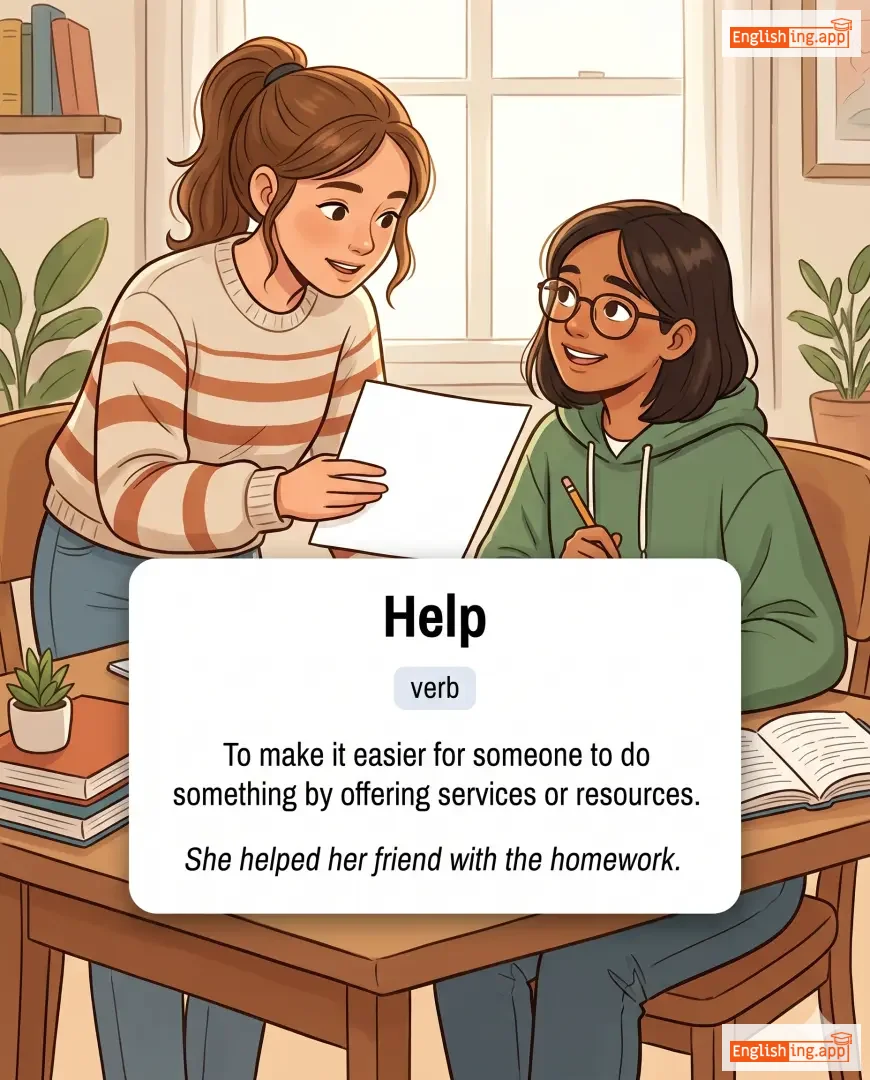
Help definition card — visual illustration of the meaning
verb
/hɛlp/
मदद करना (madad karna)

To make it easier for someone to do something by offering services or resources.

"She helped her friend with the homework."

"उसने अपने दोस्त को होमवर्क करने में मदद की।" (Usne apne dost ko homework karne mein madad ki.)
adjective
/ˈhɛlpfəl/
मददगार (madadgar)

giving help or being useful

"The guide was very helpful during our trip."

"हमारी यात्रा के दौरान गाइड बहुत मददगार था।" (Hamari yatra ke dauran guide bahut madadgar tha.)
adjective
/ˈhelp.ləs/
निर्बल; असहाय; कमजोर (nirbal; asahayi; kamzor)

unable to defend oneself or act without help; powerless; vulnerable

"The child felt helpless when lost in the crowded market."

"बच्चा बाज़ार में खो जाने पर असहाय महसूस कर रहा था।" (bachcha bazar mein kho jane par asahayi mehsoos kar raha tha।)