वोकैबुलरीज

इंग्लिश वोकैबुलरी डिस्कवर, लर्न और मास्टर करें

adjective
/ɡɑːrˈɡæntʃuən/
विशाल (vishal)

Extremely large; enormous.

"They served a gargantuan meal at the feast."

"वे भोज में एक विशाल भोजन परोस रहे थे।" (Ve bhoj mein ek vishal bhojan paros rahe the.)
noun
/ˈɡɑːrɡɔɪl/
पत्थर की मूर्ति (विकृत आकृति वाली) (patthar ki moorti (vikrit aakriti wali))

A carved stone figure, often of a grotesque creature, on a building, typically used as a spout to carry water away.

"The ancient cathedral had gargoyles on every corner."

"प्राचीन गिरजाघर में हर कोने पर गार्गॉयल्स थे।" (Prachin girjaaghar mein har kone par gargoyles the.)
adjective
/ˈɡɛə.rɪʃ/
बहुत चमकीला और दिखावटी (bahut chamkeela aur dikhavati)

Excessively bright and showy, often in a tasteless or unattractive way.

"The room was decorated with garish neon lights."

"कमरे को बहुत चमकीले नीयन लाइट्स से सजाया गया था।" (Kamre ko bahut chamkeele neon lights se sajaya gaya tha.)
noun
/ˈɡɑːr.lənd/
माला; हार; जीत की माला; (mala, haar, jeet ki mala)

a wreath of flowers and leaves, worn on the head or hung as decoration

"The bride wore a beautiful floral garland during the traditional ceremony."

"दुल्हन ने पारंपरिक समारोह के दौरान एक सुंदर फूलों की माला पहनी।" (dulhan ne paaramparik samaaroh ke dauraan ek sundar phoolon ki mala pehni.)
noun
/ˈɡɑːrlɪk/
लहसुन (lahasun)

A strong-smelling plant used as a seasoning in cooking.

"She added garlic to the curry."

"उसने करी में लहसुन डाला।" (Usne kari mein lahasun daala.)
noun
/ˈɡɑː.mənt/
वस्त्र (vastra)

An item of clothing.

"She bought a new garment for the party."

"उसने पार्टी के लिए एक नया वस्त्र खरीदा।" (Usne party ke liye ek naya vastra kharida.)
verb
/ˈɡɑː.nər/
संग्रह करना (sangrah karna)

To gather or collect, especially information, support, or approval.

"The politician garnered support from young voters."

"राजनेता ने युवा मतदाताओं से समर्थन प्राप्त किया।" (Rajneta ne yuva matdataon se samarthan prapt kiya.)
verb
/ˈɡɑː.nɪʃ/
सजाना (sajana)

To decorate food with small items for added flavor or visual appeal.

"She garnished the dish with fresh coriander leaves."

"उसने ताजे धनिया के पत्तों से व्यंजन सजाया।" (Usne taje dhaniya ke patton se vyajan sajaya.)
noun
/ˈɡær.ɪ.sən/
सेनाघर (senaghar)

A body of troops stationed in a particular location, usually to defend it.

"The garrison defended the fortress against the invaders."

"सेनाघर ने किले की रक्षा आक्रमणकारियों से की।" (Senaghar ne kile ki raksha akramankariyon se ki.)
noun, verb
/ɡəˈrɒt/
गला घोंटना (gala ghotna)

A method of execution by strangulation, or to strangle someone with a cord or wire.

"The assassin attempted to garrote his target in the alley."

"हत्यारे ने गली में अपने लक्ष्य को गला घोंटने की कोशिश की।" (Hatyare ne gali mein apne lakshya ko gala ghotne ki koshish ki.)
noun
/ɡəˈruːlɪti/
अत्यधिक बातूनीपन (atyadhik batunipan)

Excessive talkativeness, especially about trivial matters.

"His garrulity made it hard to focus during the meeting."

"उसकी अत्यधिक बातूनीपन के कारण बैठक के दौरान ध्यान केंद्रित करना मुश्किल हो गया था।" (Uski atyadhik batunipan ke karan baithak ke dauran dhyan kendrit karna mushkil ho gaya tha.)
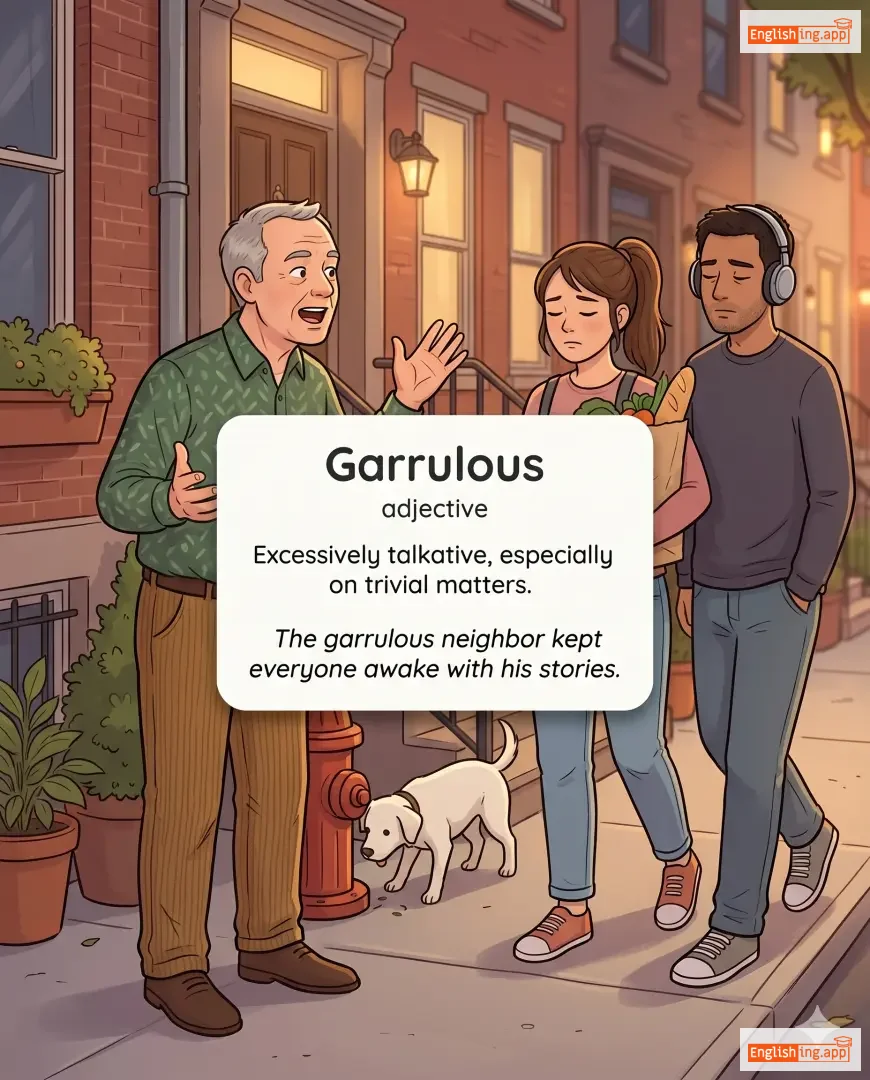
Garrulous definition card — visual illustration of the meaning
adjective
/ˈɡærələs/
बातूनी, अधिक बोलने वाला (baatooni, adhik bolne wala)

Excessively talkative, especially on trivial matters.

"The garrulous neighbor kept everyone awake with his stories."

"बातूनी पड़ोसी अपनी कहानियों से सबको जगा रहा था।" (Baatooni padosi apni kahaniyon se sabko jaga raha tha.)
noun
/ɡæs/
गैस (gais)

A substance like air that is neither solid nor liquid and can expand freely.

"The balloon was filled with gas."

"गुब्बारा गैस से भरा हुआ था।" (Gubbara gais se bhara hua tha.)
noun
/ˌɡæskəˈneɪd/
बड़ी बड़ाई, घमंड (badi badai, ghamand)

Extravagant boasting or bragging.

"His endless gasconade made him unpopular among his peers."

"उसकी अनंत बड़ाई ने उसे अपने साथियों में अप्रिय बना दिया था।" (Uski anant badai ne use apne sathiyon mein apriya bana diya tha.)
adjective
/ˈɡæsiəs/
गैसीय (gaisiya)

Relating to or having the form of gas.

"Carbon dioxide is a gaseous substance."

"कार्बन डाइऑक्साइड एक गैसीय पदार्थ है।" (Carbon dioxide ek gaisiya padarth hai.)
noun/verb
/ɡæʃ/
गहरी कटाई (gehri katai)

A long, deep cut or wound; to cut deeply or violently.

"He had a deep gash on his leg after the accident."

"दुर्घटना के बाद उसके पैर में गहरी कटाई थी।" (Durghatna ke baad uske pair mein gehri katai thi.)
noun
/ˌɡæsɪfɪˈkeɪʃən/
गैसीकरण (gaisikaran)

The process of converting solid or liquid fuel into gas.

"Gasification is widely used to produce fuel gas from coal."

"गैसीकरण का व्यापक रूप से कोयले से ईंधन गैस उत्पादन के लिए उपयोग किया जाता है।" (Gaisikaran ka vyapak roop se koyle se indhan gas utpadan ke liye upyog kiya jata hai.)
noun
/ˈɡæsəˌliːn/
गैसोलीन (gasolin)

a liquid fuel made from petroleum, used mainly to power engines in vehicles

"The price of gasoline has increased significantly this month."

"इस महीने गैसोलीन की कीमतों में महत्वपूर्ण वृद्धि हुई है।" (Is mahine gasolin ki keematon mein mahatvapurn vruddhi hui hai.)
adjective
/ˈɡæstrɪk/
गैस्ट्रिक / पेट की समस्याएं (gastric / pet ki samasyaayein)

Relating to the stomach.

"She was prescribed medicine for her gastric problems."

"उसे अपनी गैस्ट्रिक समस्याओं के लिए दवाई दी गई थी।" (Use apni gastric samasyaon ke liye dawaayi di gayi thi.)
noun
/ɡæsˈtraɪtɪs/
गैस्ट्राइटिस (gastritis)

Inflammation of the lining of the stomach.

"The doctor diagnosed him with gastritis after his endoscopy."

"डॉक्टर ने एंडोस्कोपी के बाद उसे गैस्ट्राइटिस का निदान किया।" (Doktar ne endoscopy ke baad use gastritis ka nidhan kiya.)
gastrointestinal definition card — visual illustration of the meaning
adjective
ˌɡæs.troʊ.ɪnˈtes.tɪ.nəl
पाचन तंत्र संबंधी (pachan tantr sambandhi)

Relating to the stomach and intestines.

"Spicy food can cause gastrointestinal issues."

"मसालेदार खाना पाचन तंत्र संबंधी समस्याएँ पैदा कर सकता है।" (masaledaar khana pachan tantr sambandhi samasyaayein paida kar sakti hain.)
noun
/ɡæsˈtrɒnəmi/
व्यंजनशास्त्र (vyanjanashastra)

The art or science of good eating and fine cuisine.

"Paris is famous for its rich tradition of gastronomy."

"पैरीस अपनी समृद्ध गैस्ट्रोनॉमी परंपरा के लिए प्रसिद्ध है।" (Paris apni samriddh gastronomy parampara ke liye prasiddh hai.)
noun
/ɡeɪt/
ख़ुशी (khushi)

A movable barrier that opens and closes to allow or prevent entry through an opening.

"She closed the gate behind her as she left the garden."

"जब उसने पुरस्कार प्राप्त किया, तो वह अपनी खुशी को छिपा नहीं पाई।" (Jab usne puraskar prapt kiya, to vah apni khushi ko chhupa nahin pai.)
noun
/ˈɡeɪt.weɪ/
द्वार; प्रवेशद्वार (dwaar; praveshdwaar)

an entrance or opening that provides access to a place; a means of achieving a particular state or condition

"The ancient stone gateway served as the entrance to the magnificent palace."

"प्राचीन पत्थर का गेटवे भव्य महल के प्रवेशद्वार के रूप में कार्य करता था।" (prachin patthar ka gateway bhavya mahal ke praveshdwaar ke roop mein kaarya karta tha.)
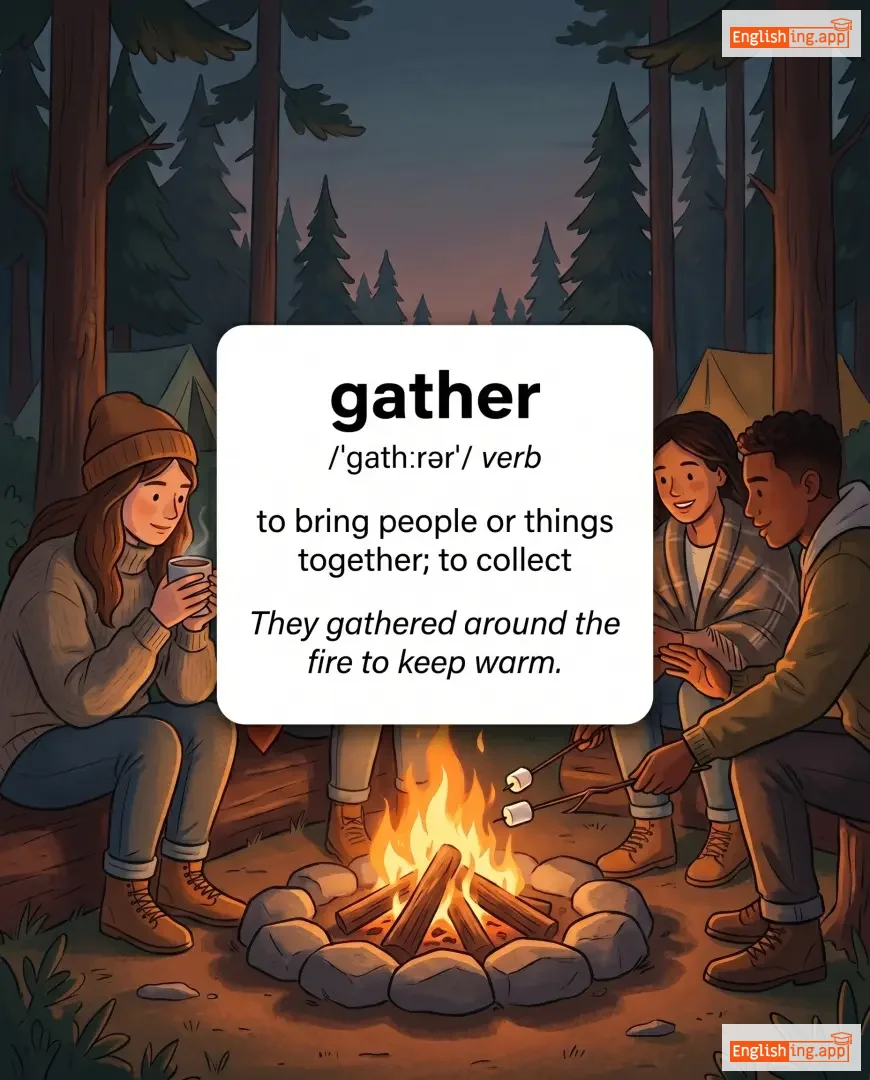
gather definition card — visual illustration of the meaning
verb
/ˈɡæðər/
इकट्ठा करना (ikatha karna)

to bring people or things together; to collect

"They gathered around the fire to keep warm."

"वे गर्म रहने के लिए आग के पास इकट्ठा हुए।" (Ve garm rehne ke liye aag ke paas ikatha huye.)
noun
/ˈɡæðərɪŋ/
संग्रह (sangrah)

a meeting or assembly of people for a particular purpose

"We attended a family gathering last weekend."

"हमने पिछले सप्ताहांत एक पारिवारिक संग्रह में भाग लिया।" (Hamne pichle saptahant ek parivarik sangrah mein bhag liya.)
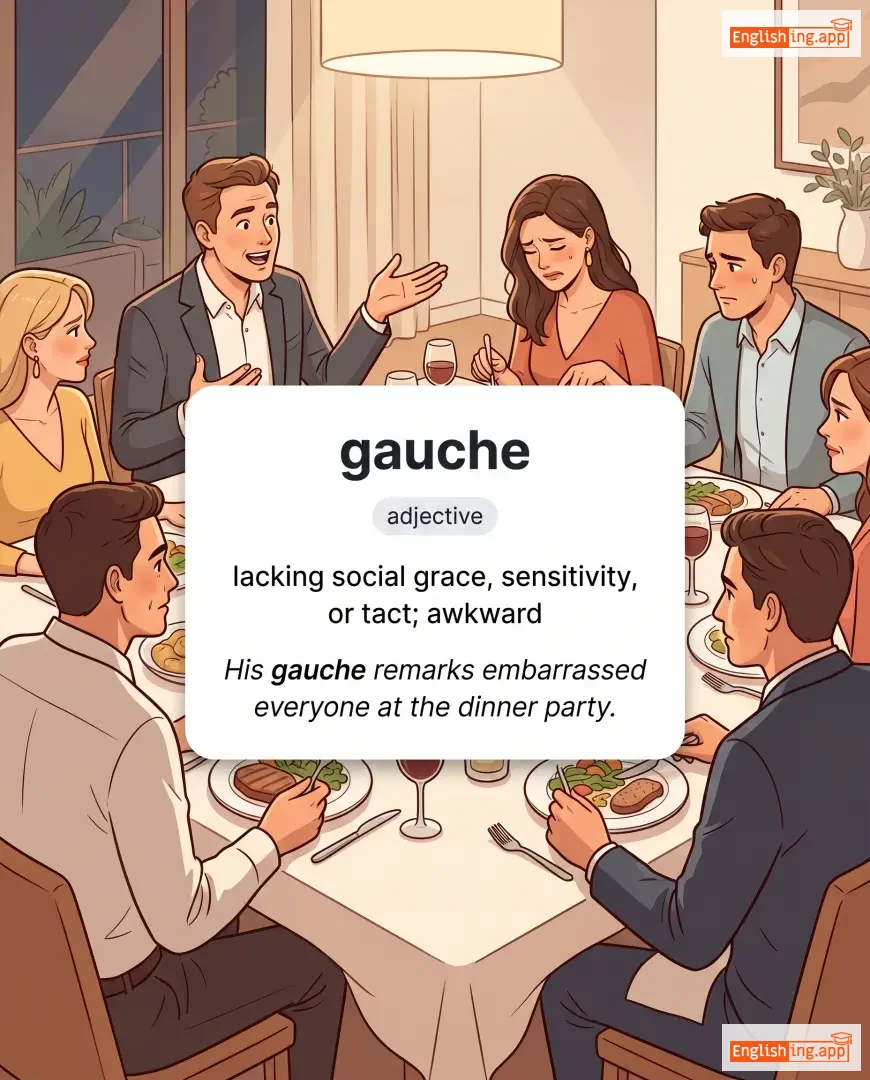
gauche definition card — visual illustration of the meaning
adjective
/ɡoʊʃ/
असभ्य (asabhya)

lacking social grace, sensitivity, or tact; awkward

"His gauche remarks embarrassed everyone at the dinner party."

"उसकी असभ्य टिप्पणियों ने डिनर पार्टी में सभी को शर्मिंदा कर दिया।" (uski asabhya tippaniyon ne dinner party mein sabhi ko sharminda kar diya.)
adjective
/ˈɡɔːdi/
अत्यधिक चमकदार (atyadhik chamakdaar)

excessively showy or flashy, often in a tasteless way

"She wore a gaudy necklace that clashed with her elegant dress."

"उसने एक अत्यधिक चमकदार हार पहना था जो उसके सुरुचिपूर्ण कपड़ों के साथ मेल नहीं खा रहा था।" (Usne ek atyadhik chamakdaar haar pehna tha jo uske suruchipurn kapdon ke saath mel nahi khaa raha tha.)
verb
/ɡeɪdʒ/
मापना (maapna)

to measure, estimate, or determine the magnitude, amount, or capacity of something

"The mechanic gauged the pressure in the car tires."

"मेकैनिक ने कार के टायरों का दबाव मापा।" (mechanic ne car ke tayeeron ka dabav maapa.)
adjective
/ɡɔːnt/
कंकाली (kankali)

extremely thin, bony, and haggard in appearance, often due to hunger or illness

"After weeks of illness, he looked pale and gaunt."

"बीमारियों के हफ्तों बाद, वह पीला और कंकाली दिख रहा था।" (beemariyon ke haftaon baad, vah peela aur kankali dikh raha tha.)
noun
/ˈɡɔːntlɪt/
दस्ताना / चुनौती (dastana / chunauti)

a protective glove; a challenge or trial; to 'throw down the gauntlet' means to issue a challenge

"The knight threw down his gauntlet as a sign of challenge."

"योद्धा ने चुनौती के संकेत के रूप में अपना दस्ताना फेंक दिया।" (yoddha ne chunauti ke sanket ke roop mein apna dastana phenk diya.)
noun
/ˈɡævəl/
हथौड़ा (hathoda)

A small ceremonial mallet used by a judge or an auctioneer to signal attention or mark a decision.

"The judge struck the gavel to call the court to order."

"जज ने अदालत को आदेश देने के लिए हथौड़ा मारा।" (Jaj ne adalat ko aadesh dene ke liye hathoda mara.)
verb
/ɡɔːk/
घूरना (ghoorna)

To stare openly and rudely.

"Tourists gawked at the celebrity walking down the street."

"पर्यटक सिलेब्रिटी को घूर रहे थे जो सड़क पर चल रहे थे।" (Paryatak celebrity ko ghoor rahe the jo sadak par chal rahe the.)
adjective
/ˈɡɔːki/
अजीब (ajeeb)

Awkward and clumsy in appearance or behavior.

"The teenager felt gawky in his oversized suit."

"किशोर अपने बड़े सूट में अजीब महसूस कर रहा था।" (Kishore apne bade suit mein ajeeb mehsoos kar raha tha.)
🏳️‍🌈

gay (गे)

adjective
/ɡeɪ/
समलैंगिक (samlengik)

sexually attracted to people of the same sex; also used to mean cheerful or lively

"He came out as gay during college."

"वह कॉलेज में समलैंगिक के रूप में बाहर आया।" (Vah college mein samlengik ke roop mein baahar aaya.)
verb
/ɡeɪz/
निहारना (niharna)

To look steadily and intently at something, usually with admiration, surprise, or thought.

"He gazed at the stars in wonder."

"वह आश्चर्य से तारों को निहार रहा था।" (vah aashcharya se taaron ko nihaara raha tha.)
noun
/ɡəˈzɛt/
गजट (gazette)

An official journal, newspaper, or publication, especially one issued by a government.

"The law was published in the government gazette."

"कानून सरकारी गजट में प्रकाशित हुआ था।" (Kanoon sarkari gazette mein prakashit hua tha.)
noun
/ɡɪə(r)/
सामग्री / उपकरण (saamagri / upkaran)

Equipment or apparatus for a particular purpose; also a toothed wheel in machinery.

"The climber packed all his gear before starting the journey."

"चढ़ाई करने वाले ने यात्रा शुरू करने से पहले अपना सारा गियर पैक किया।" (Chadhai karne wale ne yatra shuru karne se pehle apna saara gear pack kiya.)
noun
/dʒem/
रत्न (ratn)

a precious or semi-precious stone, especially when cut and polished or engraved

"She wore a beautiful gem necklace to the party."

"वह पार्टी में एक सुंदर रत्न हार पहने हुए थी।" (vah party mein ek sundar ratn haar pehne hue thi)
noun
/ˈʒɑːndɑːrm/
फ्रांसीसी पुलिसकर्मी (fransisi puliskarmi)

A French police officer, especially a member of a military-style police force.

"The gendarme stopped the car for a routine check."

"जेंडार्म ने रूटीन जांच के लिए गाड़ी रोकी।" (Jendarme ne routine janch ke liye gaadi roki.)
noun
/ˈdʒɛndər/
लिंग (ling)

The state of being male, female, or another identity as recognized socially or culturally.

"The survey asked about participants' age and gender."

"सर्वे ने प्रतिभागियों की आयु और लिंग के बारे में पूछा।" (Sarve ne pratibhagiyon ki aayu aur ling ke baare mein poocha.)
noun
/dʒiːn/
जीन (jeen)

A unit of heredity in living organisms, transferred from parent to offspring, determining traits.

"Eye color is influenced by genes inherited from parents."

"आंखों का रंग माता-पिता से विरासत में मिले जीन द्वारा प्रभावित होता है।" (aankhon ka rang mata-pita se virasat mein mile jeen dvara prabhavit hota hai.)
noun
/ˌdʒiːniˈælədʒɪst/
वंशगति विज्ञानी (vanshakti vigyani)

A person who studies or traces the history of families and their lineages.

"The genealogist uncovered records dating back to the 18th century."

"वंशगति विज्ञानी ने 18वीं सदी तक के रिकॉर्ड का पता लगाया।" (Vanshakti vigyani ne 18vi sadi tak ke record ka pata lagaya.)
noun
/ˌdʒiːniˈælədʒi/
वंशावली शास्त्र ( Vanshavali Shastra)

The study and tracing of lines of descent or family history.

"She spent years researching her family's genealogy."

"उसने अपने परिवार की वंशावली पर वर्षों तक शोध किया।" (Usne apne parivar ki vanshavali par varsho tak shodh kiya.)
adjective
/ˈdʒɛnərəl/
सामान्य (samaanya)

Relating to all or most people, things, or situations; not specific.

"He made a general comment about the project."

"उसने परियोजना के बारे में एक सामान्य टिप्पणी की।" (Usne pariyojana ke baare mein ek samaanya tippani ki.)
noun
/ˌdʒenəˈræləti/
सामान्यता (samaanyata)

A vague, non-specific statement or principle that applies broadly.

"The speech was full of generalities and lacked concrete details."

"भाषण सामान्यताओं से भरा हुआ था और इसमें ठोस विवरणों की कमी थी।" (Bhashan samaanyataon se bhara hua tha aur ismein thos vivaron ki kami thi.)
verb
/ˈdʒenərəlaɪz/
सामान्यीकृत करना (saamanyaikrit karna)

To make a broad statement by inferring from specific cases.

"It is wrong to generalize based on a few experiences."

"कुछ अनुभवों पर आधारित सामान्यीकरण करना गलत है।" (Kuch anubhavon par aadharit saamaanyikaran karna galat hai.)
adverb
/ˈdʒɛnərəli/
सामान्यत: (saamanyaat:)

in most cases; usually; as a rule

"He generally arrives at work before 9 a.m."

"वह सामान्यत: सुबह 9 बजे से पहले काम पर पहुँचता है।" (vah saamaanyat: subah 9 baje se pahle kaam par pahuchta hai.)
verb
/ˈdʒɛnəreɪt/
उत्पन्न करना (utpann karna)

to produce or create something

"The machine generates electricity."

"मशीन बिजली उत्पन्न करती है।" (Machine bijli utpann karti hai.)
noun
/ˌdʒɛnəˈreɪʃən/
पीढ़ी (peedi)

all the people born and living at about the same time; the process of producing something

"The younger generation is more comfortable with technology."

"युवा पीढ़ी प्रौद्योगिकी के साथ अधिक सहज है।" (yuva peedi praudyogiki ke saath adhik sahaj hai.)