वोकैबुलरीज

इंग्लिश वोकैबुलरी डिस्कवर, लर्न और मास्टर करें

noun
/ˌfiː.ɑːnˈseɪ/
मंगेतर (mangetar)

a man who is engaged to be married

"Sarah introduced her fiance to her parents during the family dinner."

"सारा ने अपने मंगेतर को अपने माता-पिता से परिवार के डिनर के दौरान मिलवाया।" (sara ne apne mangetar ko apne mata-pita se parivar ke dinner ke dauran milwaya.)
noun
/ˌfiː.ɑːnˈseɪ/
मंगेतर महिला (mangetar mahila)

a woman who is engaged to be married

"John bought a beautiful engagement ring for his fiancee."

"जॉन ने अपनी मंगेतर के लिए एक सुंदर सगाई की अंगूठी खरीदी।" (John ne apni mangetar ke liye ek sundar sagai ki anguthi kharidi.)
noun
/fiˈæs.koʊ/
पूर्ण विफलता (purn viphalta)

a complete failure, especially a ludicrous or humiliating one

"The event turned into a complete fiasco due to poor planning."

"इस आयोजन में खराब योजना के कारण एक पूरी विफलता हो गई।" (Is aayojan mein kharab yojana ke karan ek puri viphalta ho gayi.)
fiat definition card — visual illustration of the meaning
noun
/ˈfiːæt/
आदेश, शाही आदेश (adesh, shahi adesh)

an official order or decree; authoritative command

"The new policy was enacted by royal fiat."

"नई नीति को राजकीय आदेश द्वारा लागू किया गया था।" (Nayi niti ko rajkiya adesh dwara lagu kiya gaya tha.)
noun
/ˈfaɪbər/
फाइबर (fiber)

a thread or filament from which a textile is formed; dietary substance from plants that aids digestion

"Fruits and vegetables are high in fiber."

"फल और सब्जियाँ फाइबर में उच्च होती हैं।" (Phal aur sabziyan fiber mein uchch hoti hain.)
noun
/ˈfaɪ.bər/
रेशा; आहार रेशा (resha; aahar resha)

A thread or filament from which a vegetable tissue, mineral substance, or textile is formed; dietary material that aids digestion.

"Eating foods rich in fibre can improve your digestion."

"फाइबर से भरपूर आहार खाने से आपका पाचन सुधर सकता है।" (Faibar se bharpur aahar khane se aapka paachan sudhar sakta hai.)
adjective
/ˈfɪkəl/
अस्थिर, परिवर्तनशील (asthir, parivartansheel)

changing frequently in loyalty, interest, or affection

"She is so fickle that she changes her mind every hour."

"वह इतनी अस्थिर है कि वह हर घंटे अपना विचार बदलती है।" (Woh itni asthir hai ki har ghante apna vichar badalti hai.)
noun
/ˈfɪkʃən/
कल्पना (kalpana)

Literature created from the imagination, not presented as fact.

"She enjoys reading science fiction novels."

"वह साइंस फिक्शन उपन्यास पढ़ना पसंद करती है।" (Vah science fiction upanyas padhna pasand karti hai.)
adjective
/fɪkˈtɪʃəs/
काल्पनिक, झूठा (kalpnik, jhootha)

not real or true; imaginary or fabricated

"The story he told was entirely fictitious."

"उसने जो कहानी सुनाई वह पूरी तरह से काल्पनिक थी।" (Usne jo kahani sunayi woh poori tarah se kalpnik thi.)
fidelity definition card — visual illustration of the meaning
noun
/fɪˈdelɪti/
निष्ठा, विश्वासघात (nishtha, vishwastata)

faithfulness to a person, cause, or belief; loyalty

"Their fidelity to the team was admired by everyone."

"उनकी टीम के प्रति निष्ठा को सभी ने सराहा।" (Unki team ke prati nishtha ko sabhi ne saraha.)
verb
/ˈfɪdʒɪt/
बेचैन होना, अस्थिर होना (bechain hona, asthir hona)

to make small movements, especially because of nervousness or impatience

"The child began to fidget during the long lecture."

"बच्चे ने लंबे व्याख्यान के दौरान फिज़िट करना शुरू कर दिया।" (Bachche ne lambe vyakhyan ke dauran fidget karna shuru kar diya.)
adjective
/fɪˈdjuːʃəl/
विश्वासपूर्ण, मानक के रूप में कार्य करने वाला (vishwaspurn, maanak ke roop mein kaarya karne wala)

based on trust or confidence; serving as a standard of reference

"The fiducial point on the map ensures accurate measurements."

"मानचित्र पर फिडूशियल बिंदु सटीक माप सुनिश्चित करता है।" (Maanchitra par fidushial bindu sathik maap nishchit karta hai.)
fiduciary definition card — visual illustration of the meaning
noun
/fɪˈduːʃieri/
विश्वासपात्र, ट्रस्टी (vishwaspatra, trustee)

a person who holds assets in trust for someone else; related to trust and responsibility

"The lawyer acted as a fiduciary for his client’s estate."

"वकील अपने ग्राहक के संपत्ति के लिए फिडुसियरी के रूप में कार्य कर रहे थे।" (Vakil apne grahak ke sampatti ke liye fiduciary ke roop mein karya kar rahe the.)
noun
/fiːf/
जमीन का एक टुकड़ा जो सामंती व्यवस्था के तहत दिया जाता है; नियंत्रण का क्षेत्र (zameen ka ek tukda jo samanti vyavastha ke tahat diya jata hai; niyantran ka kshetra)

an estate of land held under the feudal system; a domain or area of control

"The knight was granted a fief by the lord for his service."

"नाइट को उसकी सेवा के लिए लॉर्ड द्वारा एक फीफ दी गई।" (Knight ko uski seva ke liye Lord dwara ek fief di gayi.)
noun
/fiːld/
क्षेत्र (kshetra)

an area of open land, often used for farming, sports, or scientific study

"The children played football in the field."

"बच्चों ने मैदान में फुटबॉल खेला।" (bachon ne maidan mein football khela.)
noun
/fiːnd/
राक्षस, दुष्ट व्यक्ति (raakshas, dusht vyakti)

an evil spirit or demon; a wicked or cruel person; someone obsessed with a particular thing

"He is a real fiend when it comes to solving puzzles."

"जब पहेलियों की बात आती है तो वह सचमुच एक राक्षस है।" (Jab paheliyon ki baat aati hai to wah sachmuch ek raakshas hai.)
adjective
/fɪəs/
क्रूर, प्रचंड (kroor, prachand)

showing strong, intense, or aggressive feelings; powerful and violent

"The fierce storm damaged several houses in the village."

"भीषण तूफान ने गांव में कई घरों को नुकसान पहुंचाया।" (Bheeshan toofan ne gaon mein kai gharo ko nuksan pahunchaya.)
adjective
/ˈfaɪə.ri/
प्रचंड; उग्र; गर्म स्वभाव का; (prachand; ugra; garm swabhav ka)

burning; passionate; hot-tempered; showing strong emotion

"She has a fiery temper that flares up quickly."

"उसका एक प्रचंड स्वभाव है जो जल्दी उग्र हो जाता है।" (uska ek prachand swabhav hai jo jaldi ugra ho jata hai)
number
/ˌfɪfˈtiːn/
पंद्रह (pandrah)

the number 15

"There are fifteen students in the class."

"कक्षा में पंद्रह छात्र हैं।" (Kaksha mein pandrah chhatra hain.)
adjective
/fɪfθ/
पाँचवाँ (paanchvaan)

constituting number five in a sequence

"She lives on the fifth floor of the building."

"वह इमारत की पांचवीं मंजिल पर रहती है।" (Wah imarat ki paanchvii manzil par rahti hai.)
number
/ˈfɪfti/
पचास (pachaas)

the number 50

"The stadium can hold fifty thousand people."

"स्टेडियम पचास हजार लोगों को समायोजित कर सकता है।" (Stadium pachaas hazar logon ko samaayojit kar sakta hai.)
noun
/fɪɡ/
अंजीर (anjeer)

a soft sweet fruit with many small seeds, eaten fresh or dried

"Fresh figs are delicious when eaten with honey."

"शहद के साथ खाने पर ताज़े अंजीर स्वादिष्ट लगते हैं।" (shahad ke sath khane par taza anjeer swadisht lagte hain)
verb
/faɪt/
लड़ाई करना (ladai karna)

to take part in a violent struggle or to try hard to achieve something

"They had to fight for their rights."

"उन्हें अपने अधिकारों के लिए लड़ना पड़ा।" (Unhe apne adhikaron ke liye ladna pada.)
noun
/ˈfaɪtər/
योद्धा (yoddha)

a person who fights, especially in combat or sports like boxing

"The fighter won the championship after a tough battle."

"योद्धा कठिन लड़ाई के बाद चैंपियनशिप जीत गया।" (Yoddha kathin ladai ke baad championship jeet gaya.)
noun/verb
/ˈfaɪtɪŋ/
लड़ाई (ladai)

the act of engaging in a physical or verbal conflict

"The soldiers were fighting bravely on the battlefield."

"सैनिक युद्धभूमि पर बहादुरी से लड़ रहे थे।" (sainik yuddhabhoomi par bahaduri se lada rahe the.)
noun
/ˈfɪɡmənt/
कल्पना, मस्तिष्क की निर्माण (kalpana, mastishk ki nirman)

something invented or imaginary; a fabrication of the mind

"The story of the haunted house is just a figment of her imagination."

"भूतिया घर की कहानी केवल उसकी कल्पना का एक भाग है।" (Bhootia ghar ki kahani keval uski kalpana ka ek bhag hai.)
adjective
/ˈfɪɡərətɪv/
रूपकात्मक (roopakaatmak)

not literal; using figures of speech or symbolic representation

"She used figurative language to describe her feelings."

"उसने अपनी भावनाओं का वर्णन करने के लिए रूपकात्मक भाषा का उपयोग किया।" (Usne apni bhavnaon ka varnan karne ke liye roopakaatmak bhasha ka upyog kiya.)
noun
/ˈfɪɡjər/
आकृति, संख्या, महत्वपूर्ण व्यक्ति (akriti, sankhya, mahatvapurn vyakti)

a number, shape, or person of importance; also a representation in drawing or sculpture

"The report included several important figures."

"रिपोर्ट में कई महत्वपूर्ण आंकड़े शामिल थे।" (Report mein kai mahatvapurn aankde shamil the.)
noun
/ˈfɪɡjərˌhɛd/
प्रतीकात्मक नेता (pratikatmak neta)

a nominal leader with no real power; a symbolic head

"The king was merely a figurehead with no real authority."

"राजा केवल एक प्रतीकात्मक नेता था, उसके पास कोई असली अधिकार नहीं था।" (Raja keval ek pratikatmak neta tha, uske paas koi asli adhikar nahi tha.)
noun
/ˌfɪɡjʊˈriːn/
छोटा मूर्तिकला (chhota moortikala)

a small ornamental statue or model of a human or animal

"She bought a porcelain figurine of a dancing ballerina."

"उसने एक नृत्य करती बैलेरीना की चीनी मूर्तिकला खरीदी।" (Usne ek nritya karti ballerina ki cheeni moortikala khareedi.)
🕵️‍♂️

filch (फिल्च)

verb
/fɪltʃ/
चोरी करना (chori karna)

to steal something in a sneaky or petty way

"He tried to filch a candy bar from the shop."

"उसने दुकान से एक कैंडी बार चुराने की कोशिश की।" (Usne dukaan se ek candy bar churaane ki koshish ki.)
noun/verb
/faɪl/
फाइल (fail)

a collection of documents stored together; or to submit an official document

"She saved the report in a new file on her computer."

"उसने रिपोर्ट को अपने कंप्यूटर पर एक नए फाइल में सेव किया।" (Usne report ko apne computer par ek naye file mein sev kiya.)
adjective
/ˈfɪliəl/
पुत्र या पुत्री से संबंधित; माता-पिता के प्रति सम्मान या स्नेह दिखाना (putra ya putri se sambandhit; mata-pita ke prati samman ya sneh dikhana)

relating to a son or daughter; showing respect or affection toward parents

"He showed filial respect by caring for his aging parents."

"उसने अपने वृद्ध माता-पिता की देखभाल करके पुत्रवत सम्मान दिखाया।" (Usne apne vriddh mata-pita ki dekhbhal karke putravat samman dikhaya.)
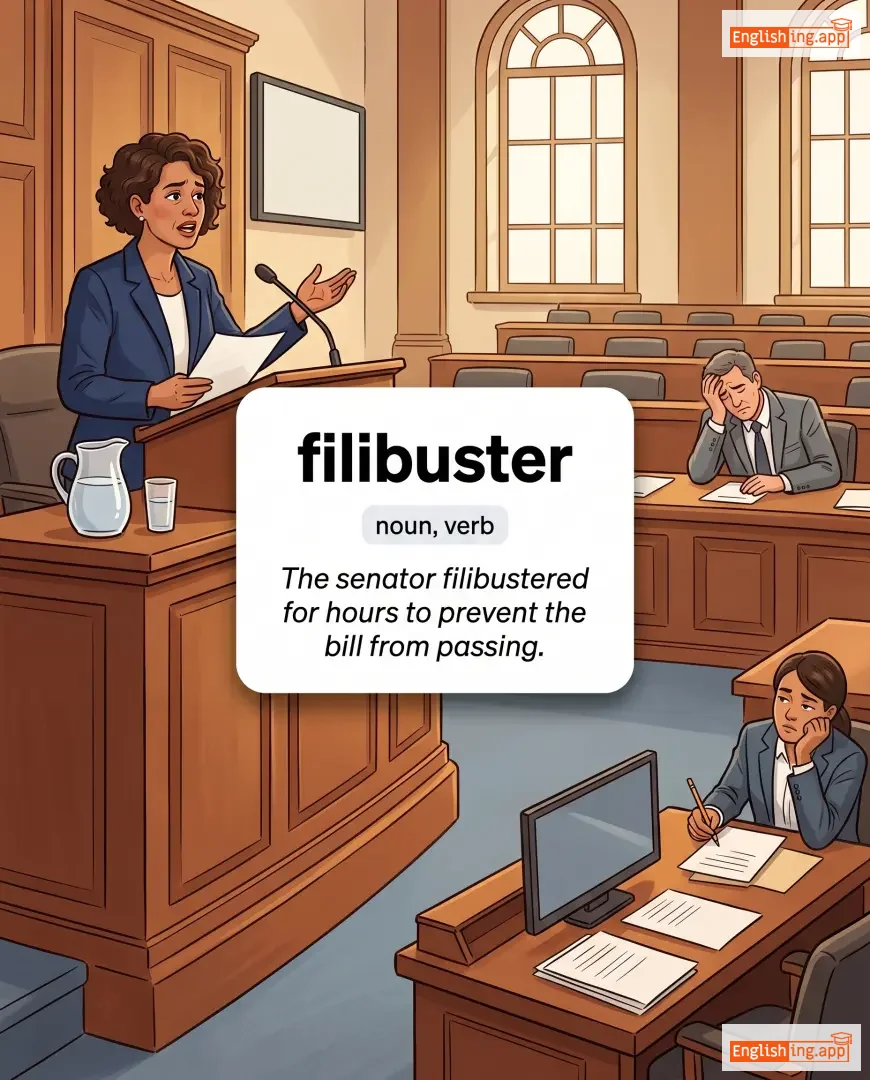
filibuster definition card — visual illustration of the meaning
noun, verb
/ˈfɪlɪˌbʌstər/
किसी विधायी क्रिया में देरी करने के लिए लंबी भाषण देने की एक रणनीति; ऐसी रणनीति का उपयोग करना (kisi vidhayi kriya mein deri karne ke liye lambi bhashan dene ki ek rananiti; aisi rananiti ka upyog karna)

a tactic of delaying legislative action by prolonged speech; to use such a tactic

"The senator filibustered for hours to prevent the bill from passing."

"सिनेटर ने बिल को पास होने से रोकने के लिए घंटों तक फिलिबस्टर किया।" (Senator ne bil ko pass hone se rokne ke liye ghanton tak filibuster kiya.)
noun
/ˈfɪlɪɡri/
सूक्ष्म सजावटी काम, आमतौर पर सोने या चांदी से (sookshma sajaavti kaam, aamtaur par sone ya chaandee se)

delicate ornamental work of fine wire, usually of gold or silver

"The necklace was decorated with intricate gold filigree."

"गहने को जटिल सोने की सजावट से सजाया गया था।" (Gahne ko jatil sone ki sajaavat se sajaaya gaya tha.)
noun, verb
/ˈfaɪlɪŋ/
दस्तावेज़ जमा करना; कागजात का आयोजन (dastavez jama karna; kagaj ka aayojan)

the act of submitting documents; the process of organizing papers

"The lawyer handled the filing of all court documents."

"वकील ने सभी अदालत के दस्तावेज़ों की फाइलिंग की प्रक्रिया को संभाला।" (Vakeel ne sabhi adalat ke dastavezon ki filing ki prakriya ko sambhala.)
fill definition card — visual illustration of the meaning
verb
/fɪl/
भरना (bharnā)

To make something full; occupy completely.

"She filled the glass with water."

"उसने गिलास को पानी से भरा।" (Usne gilās ko pānī se bharā.)
noun
/ˈfɪli/
युवा महिला घोड़ा (yuva mahila ghoda)

a young female horse

"The filly ran swiftly across the meadow."

"फिली मैदान में तेजी से दौड़ रही थी।" (Philly maidan mein tezi se daud rahi thi.)
noun/verb
/fɪlm/
फिल्म (film)

a motion picture or movie; or to record on camera

"They watched a film together on the weekend."

"उन्होंने सप्ताहांत में एक फिल्म साथ देखी।" (Unhone saptahant mein ek film saath dekhi.)
noun
/fɪlm ˈæktər/
फ़िल्म अभिनेता (film abhineta)

A person who performs roles in movies or films.

"The film actor received widespread acclaim for his performance."

"फिल्म अभिनेता को उनके प्रदर्शन के लिए व्यापक प्रशंसा मिली।" (film abhineta ko unke pradarshan ke liye vyaapak prashansa mili)
noun
/ˈfɪlmˌmeɪkər/
फ़िल्म निर्माता (film nirmata)

A person who directs or produces films

"The film-maker received an award for his latest documentary."

"फ़िल्म निर्माता को उनकी नवीनतम डॉक्यूमेंट्री के लिए पुरस्कार मिला।" (film nirmata ko unki naveenatam documentary ke liye puraskar mila)
noun
/ˈfɪlmˌmeɪkər/
फिल्म निर्माता (film nirmata)

a person who makes films, typically as a profession

"He is a well-known filmmaker in the industry."

"वह उद्योग में एक प्रसिद्ध फिल्ममेकर हैं।" (Vah udhyog mein ek prasiddh filmmaker hain.)
verb
/ˈfɪltər/
छानना (chhanna)

to pass a substance through a device to remove unwanted material or to selectively pass certain items

"She used a coffee filter to separate the grounds from the liquid."

"उसने तरल को ठोस से अलग करने के लिए एक कॉफी फिल्टर का इस्तेमाल किया।" (Usne taral ko thos se alag karne ke liye ek coffee filter ka istemal kiya.)
noun
/fɪlθ/
गंदगी (gandagi)

dirty or disgusting matter; moral corruption

"The streets were full of filth after the storm."

"तूफान के बाद सड़कों पर गंदगी भरी हुई थी।" (Toofan ke baad sadkon par gandagi bhari hui thi.)
verb
/fɪˈneɪɡəl/
चालाकी से कुछ प्राप्त करना (chalaki se kuch prapt karna)

to obtain something by cleverness or trickery

"He finagled a free ticket by pretending to be a VIP guest."

"उसने एक वीआईपी अतिथि होने का नाटक करके एक मुफ्त टिकट प्राप्त किया।" (Usne ek VIP atithi hone ka natak karke ek muft ticket prapt kiya.)
adjective/noun
/ˈfaɪnəl/
अंतिम (antim)

coming at the end; the last part of something

"The final exam will be held next week."

"अंतिम परीक्षा अगले हफ्ते होगी।" (Antim pariksha agle hafte hogi.)
noun
/fɪˈnɑːleɪ/
अंतिम भाग (antim bhag)

the last part or conclusion of a performance, event, or series

"The concert ended with a spectacular finale."

"संगीत समारोह एक शानदार फिनाले के साथ समाप्त हुआ।" (Sangeet samaroh ek shandaar finale ke saath samaapt hua.)
noun
/faɪˈnælɪti/
निष्कर्षता (nishkarshta)

the quality of being final or irreversible; a sense of conclusiveness

"The judge's decision gave the case a sense of finality."

"न्यायाधीश का निर्णय मामले को निष्कर्षता का अहसास दिला दिया।" (Nyayadhish ka nirnay mamle ko nishkarshta ka ahsas dila diya.)
finalize definition card — visual illustration of the meaning
verb
ˈfaɪ.nəl.aɪz
अंतिम रूप देना (antim roop dena)

To complete arrangements for something; put into final form.

"The treaty was finalized after the discussions."

"वार्ता के बाद संधि को अंतिम रूप दिया गया।" (Varta ke baad sandhi ko antim roop diya gaya.)
adverb
/ˈfaɪnəli/
आखिरकार (aakhirkaar)

after a long time; at the end; ultimately

"After years of hard work, she finally achieved her dream."

"कठिन परिश्रम के वर्षों बाद, उसने आखिरकार अपना सपना पूरा किया।" (Kathin parishram ke varsho baad, usne aakhirkaar apna sapna poora kiya.)