वोकैबुलरीज

इंग्लिश वोकैबुलरी डिस्कवर, लर्न और मास्टर करें

verb
/ɪkˈsiːd/
अतिक्रमण करना (atikraman karna)

to go beyond a limit or expectation

"The athlete exceeded everyone's expectations by winning the gold medal."

"एथलीट ने सोने का पदक जीतकर सभी की उम्मीदों को पार किया।" (Athlete ne sone ka padak jeetkar sabhi ki ummeedon ko paar kiya.)
adjective
/ɪkˈsiːdɪŋ/
अत्यधिक; अधिकतम (atyadhik; adhiktam)

going beyond; surpassing; extremely

"The project was completed with exceeding excellence."

"परियोजना को अत्यधिक उत्कृष्टता के साथ पूरा किया गया था।" (pariyojana ko atyadhik utkrshtata ke saath poora kiya gaya tha.)
verb
/ɪkˈsɛl/
उत्कृष्टता प्राप्त करना (utkrishtata prapt karna)

to be exceptionally good at or proficient in an activity or subject

"She always tries to excel in her studies."

"वह हमेशा अपनी पढ़ाई में उत्कृष्टता प्राप्त करने की कोशिश करती है।" (Woh hamesha apni padhai mein utkrishtata prapt karne ki koshish karti hai.)
noun
/ˈɛksələns/
उत्कृष्टता (utkrishtata)

the quality of being outstanding or extremely good

"The school is known for its academic excellence."

"विद्यालय अपनी शैक्षिक उत्कृष्टता के लिए जाना जाता है।" (Vidhyalay apni shaikshik utkrishtata ke liye jana jata hai.)
noun
/ˈɛksələnsɪ/
उत्कृष्टता (utkrishtata)

a title of honor for people of high rank, especially ambassadors or governors

"His Excellency the Ambassador attended the ceremony."

"उनकी एक्सेलेंसी, राजदूत ने समारोह में भाग लिया।" (Unki excellency, rajdoot ne samaroha mein bhag liya.)
adjective
/ˈɛksələnt/
उत्कृष्ट (utkrisht)

extremely good; outstanding

"The food at this restaurant is excellent."

"इस रेस्टोरेंट का खाना उत्कृष्ट है।" (Is restaurant ka khana utkrsht hai.)
preposition/conjunction
/ɪkˈsɛpt/
सिवाय (sivay)

not including; other than

"Everyone was invited except John."

"जॉन को छोड़कर सभी को आमंत्रित किया गया था।" (Jon ko chhodkar sabhi ko amantrit kiya gaya tha.)
noun
/ɪkˈsɛpʃən/
अपवाद (apvaad)

A case or instance that does not follow a general rule.

"Every rule has an exception."

"हर नियम का एक अपवाद होता है।" (har niyam ka ek apvaad hota hai.)
adjective
/ɪkˈsɛpʃənəbl/
आपत्तिजनक (apattijanak)

Open to objection; causing disapproval.

"His rude remarks were considered exceptionable by everyone present."

"उसके अपशब्दों को सभी ने आपत्तिजनक माना।" (uske apashabdon ko sabhi ne apattijanak mana.)
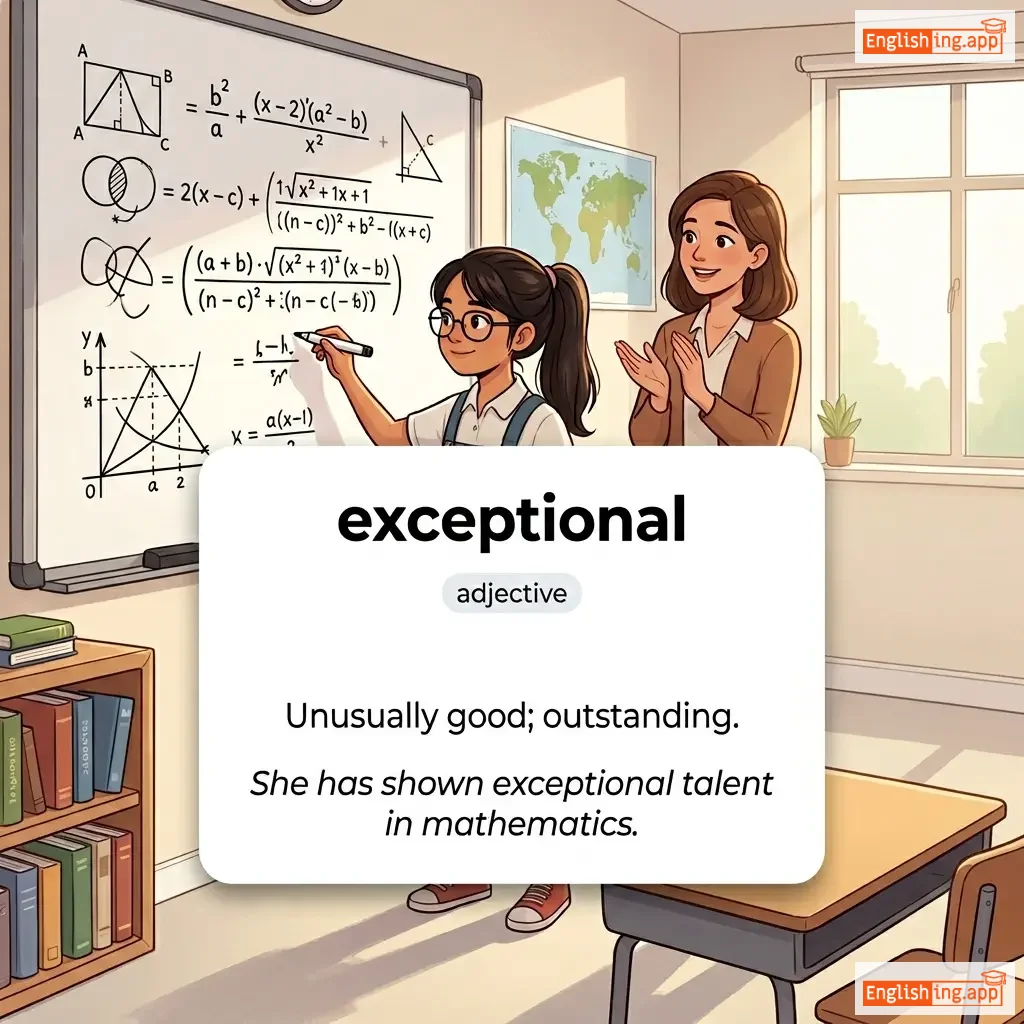
exceptional definition card — visual illustration of the meaning
adjective
/ɪkˈsɛpʃənl/
असाधारण (asadharan)

Unusually good; outstanding.

"She has shown exceptional talent in mathematics."

"उसने गणित में असाधारण प्रतिभा दिखाई है।" (Usne ganit mein asadharan pratibha dikhai hai.)
noun
/ˈɛksɜːrpt/
उद्धरण (uddharan)

A short portion taken from a text, film, or piece of music.

"The teacher read an excerpt from the novel."

"शिक्षक ने उपन्यास से एक उद्धरण पढ़ा।" (Shikshak ne upanyas se ek uddharan padha.)
noun
/ɪkˈsɛs/
अधिकता (adhikta)

An amount more than necessary, permitted, or desirable.

"Too much sugar can lead to excess weight gain."

"बहुत ज्यादा चीनी खाने से वजन बढ़ सकता है।" (bahut jyada cheeni khane se vajan badh sakta hai.)
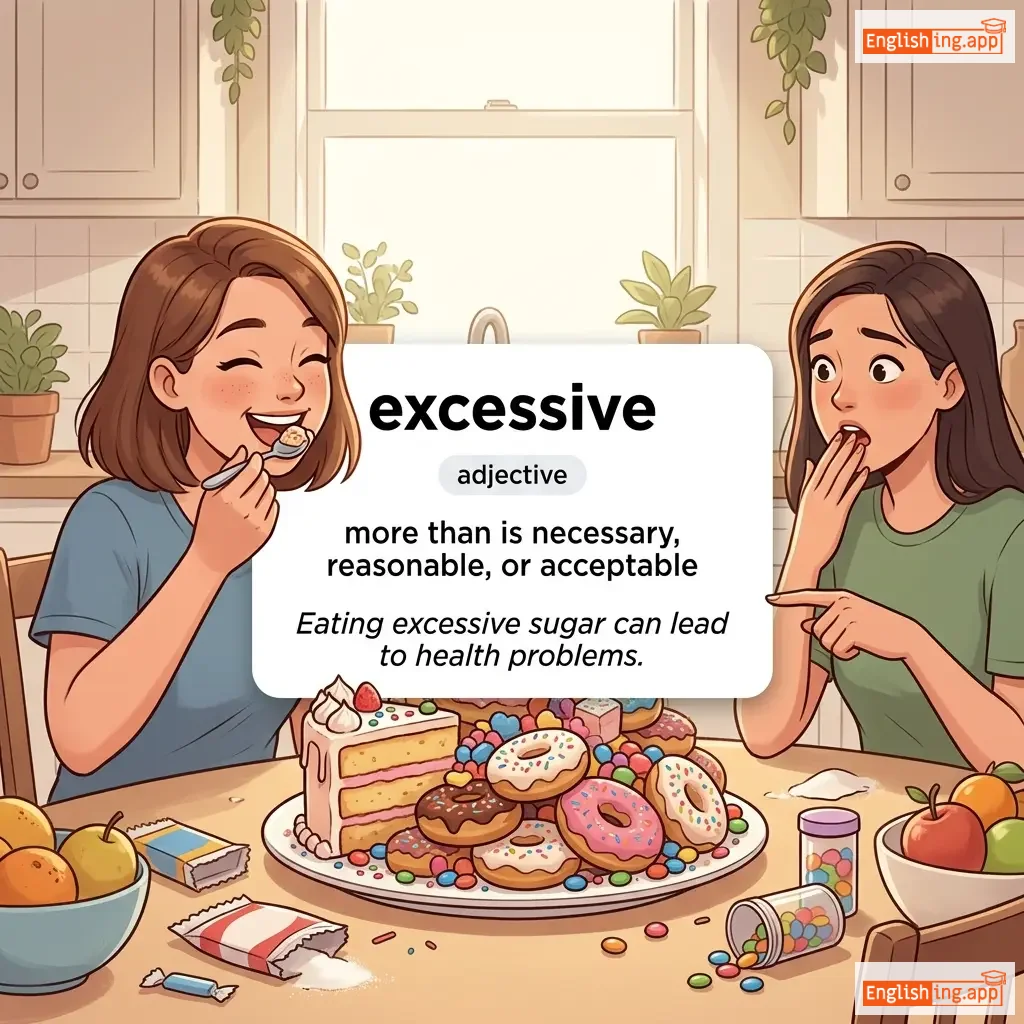
excessive definition card — visual illustration of the meaning
adjective
/ɪkˈsɛsɪv/
अत्यधिक (atyadhik)

more than is necessary, reasonable, or acceptable

"Eating excessive sugar can lead to health problems."

"अत्यधिक चीनी खाना स्वास्थ्य समस्याओं का कारण बन सकता है।" (Atyadhik cheeni khana swasthya samasyaon ka kaaran ban sakta hai.)
excessive strain definition card — visual illustration of the meaning
adjective + noun
এক্সেসিভ স্ট্রেইন
अत्यधिक तनाव (atyadhik tanav)

An amount of physical pressure or stress that is more than what is normal or acceptable.

"Excessive strain on fingers can cause musculoskeletal issues."

"अत्यधिक तनाव उंगलियों पर मांसपेशी-संयुक्त समस्याएँ उत्पन्न कर सकता है।" (Atyadhik tanav ungliyon par maanspeshī-sanyukt samasyaen utpann kar sakti hain.)
Exchange definition card — visual illustration of the meaning
verb
/ɪksˈtʃeɪndʒ/
विनिमय (vinimay)

To give something and receive something in return.

"They exchanged gifts during the festival."

"वे त्योहार के दौरान उपहारों का आदान-प्रदान करते थे।" (ve tyohaar ke dauraan upaharon ka adan-pradan karte the.)
noun
/ɪksˈtʃɛkər/
कोष (kosh)

The treasury of a state or country.

"The government announced new measures to improve the exchequer."

"सरकार ने कोष में सुधार के लिए नए उपायों की घोषणा की।" (sarkar ne kosh mein sudhaar ke liye naye upayon ki ghoshna ki.)
verb
/ˈɛkˌsaɪz/
हटाना (hatana)

to cut out or remove completely, often by surgery

"The surgeon excised the tumor successfully."

"सर्जन ने ट्यूमर को सफलतापूर्वक हटाया।" (Sarjan ne tumor ko safaltapurvak hataya.)
noun
/ɪkˈsɪʒən/
उत्क्षेदन (utkshedan)

the act of cutting something out, especially by surgical removal

"The excision of the infected tissue prevented further complications."

"संक्रमित ऊतक की उत्क्षेदन से आगे की जटिलताएँ रोकी गईं।" (Sankramit utak ki utkshedan se aage ki jatiltaayein roki gayi.)
adjective
/ɪkˈsaɪtəbl̩/
उत्तेजनीय (uttejaneey)

easily excited or emotionally aroused

"The child was excitable and laughed at every small thing."

"बच्चा उत्तेजनीय था और हर छोटी बात पर हंस रहा था।" (Baccha uttejaneey tha aur har chhoti baat par hans raha tha.)
noun
/ˌɛksaɪˈteɪʃən/
उत्तेजना (uttejna)

a state of great excitement or the process of stimulating activity

"The news created great excitation among the fans."

"समाचार ने प्रशंसकों के बीच बड़ी उत्तेजना पैदा की।" (Samachar ne prashansako ke beech badi uttejna paida ki.)
verb
/ɪkˈsaɪt/
उत्तेजित करना (uttejit karna)

to cause strong feelings of enthusiasm or eagerness

"The idea of traveling abroad excites her."

"विदेश यात्रा का विचार उसे उत्तेजित करता है।" (Videsh yatra ka vichar use uttejit karta hai.)
adjective
/ɪkˈsaɪtɪd/
उत्साहित (utsahit)

very enthusiastic and eager about something

"The children were excited to open their presents."

"बच्चे अपने तोहफे खोलने के लिए उत्साहित थे।" (Bachche apne tofe kholne ke liye utsahit the.)
noun
/ɪkˈsaɪtmənt/
उत्साह (utsah)

a feeling of great enthusiasm and eagerness

"There was a lot of excitement before the concert began."

"संगीत कार्यक्रम शुरू होने से पहले बहुत उत्साह था।" (Sangeet karyakram shuru hone se pehle bahut utsah tha.)
exciting definition card — visual illustration of the meaning
adjective
/ɪkˈsaɪtɪŋ/
रोमांचक (romanchak)

Causing great enthusiasm and eagerness.

"The movie was so exciting that I watched it twice."

"फिल्म इतनी रोमांचक थी कि मैंने इसे दो बार देखा।" (film itni romanchak thi ki maine ise do baar dekha.)
verb
/ɪkˈskleɪm/
उच्च स्वर में बोलना (ucch swar mein bolna)

to cry out suddenly in surprise, strong emotion, or excitement

"She exclaimed with joy when she saw the gift."

"वह उपहार देखकर खुशी से चिल्लाई।" (Vah uphaar dekhkar khushi se chillayi.)
noun
/ˌɛkskləˈmeɪʃən/
उत्तेजना (uttejana)

A sudden cry or remark expressing strong emotion or surprise.

"She let out an exclamation of joy when she heard the news."

"जब उसने खबर सुनी, तो वह खुशी से एक उत्तेजना निकाली।" (Jab usne khabar suni, to wah khushi se ek uttejana nikaali.)
verb
/ɪkˈskluːd/
बाहर करना (baahar karna)

To deliberately leave out or prevent someone or something from being included.

"The list excludes temporary workers."

"सूची अस्थायी श्रमिकों को बाहर करती है।" (soochi asthaayi shramikon ko baahar karti hai.)
adjective
/ɪkˈskluːdɪd/
बाहर किया हुआ; बहिष्कृत (baahar kiya hua; bahishkrit)

not included; left out; barred from participation

"He felt excluded from the group activities and conversations."

"वह समूह की गतिविधियों और बातचीत से बाहर महसूस कर रहा था।" (vah samooh ki gatividhiyon aur baatcheet se baahar mahsus kar raha tha.)
noun
/ɪkˈskluːʒən/
बहिष्करण (bahishkaran)

The process or state of being left out or denied access.

"The policy led to the exclusion of certain groups."

"नीति ने कुछ समूहों के बहिष्करण की ओर अग्रसर किया।" (Neeti ne kuch samoohon ke bahishkaran ki aur agrasar kiya.)
adjective
/ɪkˈskluːsɪv/
विशेष, विशेष रूप से एक व्यक्ति, समूह, या क्षेत्र के लिए प्रतिबंधित; दूसरों के साथ साझा नहीं किया गया (vishesh, vishesh roop se ek vyakti, samuh, ya kshetra ke liye pratibandhit; doosron ke saath saanjha nahi kiya gaya)

restricted to a particular person, group, or area; not shared with others

"The hotel offers exclusive access to a private beach."

"होटल एक निजी समुद्र तट तक विशेष पहुँच प्रदान करता है।" (Hotel ek niji samudra tat tak vishesh pahuch pradan karta hai.)
adverb
/ɪkˈskluːsɪvli/
केवल; दूसरों के साथ साझा नहीं किया गया (keval; doosron ke saath saajha nahin kiya gaya)

only; not shared with others

"This service is available exclusively to premium members."

"यह सेवा केवल प्रीमियम सदस्यों के लिए उपलब्ध है।" (Yeh seva keval premium sadasyon ke liye upalabdh hai.)
verb
/ɛkˈskɔːrieɪt/
कड़ी आलोचना करना (kadi alochana karna)

To strongly criticize someone; to denounce severely.

"The critic excoriated the film for its poor script."

"समीक्षक ने फिल्म को उसके खराब पटकथा के लिए कड़ी आलोचना की।" (Sameekshak ne film ko uske kharab pataktha ke liye kadi alochana ki.)
noun
/ɪkˈskrɛsəns/
असामान्य वृद्धि (asaamany vruddhi)

An abnormal outgrowth or lump, often considered unattractive.

"The building was considered an excrescence on the landscape."

"इमारत को परिदृश्य पर एक असामान्य वृद्धि माना गया था।" (Imaarat ko paridrishya par ek asaamany vruddhi maana gaya tha.)
verb
/ɪkˈskriːt/
उत्सर्जन करना (utsarjan karna)

to eliminate waste matter from the body

"Humans excrete carbon dioxide through breathing."

"मनुष्य श्वसन के माध्यम से कार्बन डाइऑक्साइड बाहर निकालते हैं।" (Manushya shwason ke madhyam se carbon dioxide baahar nikaalte hain.)
noun
/ɪkˈskriːʃən/
निष्कासन (nishkasan)

the process of eliminating waste matter from the body

"Excretion is vital for maintaining a healthy body."

"निष्कासन एक स्वस्थ शरीर बनाए रखने के लिए आवश्यक है।" (Nishkasan ek sustho sharir banaye rakhne ke liye avashyak hai.)
verb
/ɪkˈskruːʃieɪt/
तीव्र पीड़ा देना (teevra peeda dena)

to cause intense pain or suffering

"The injury excruciated him with unbearable pain."

"चोट ने उसे असहनीय दर्द दिया।" (Chot ne use asahniya dard diya.)
adjective
/ɪkˈskruːʃieɪtɪŋ/
असहनीय पीड़ादायक (asahniya peedadayak)

causing extreme physical or mental pain

"She was in excruciating pain after the accident."

"वह दुर्घटना के बाद असहनीय दर्द में थी।" (Woh durghatna ke baad asahniya dard mein thi.)
exculpate definition card — visual illustration of the meaning
verb
/ˈɛkskʌlpeɪt/
दोषमुक्त करना (doshmukto karna)

to show or declare that someone is not guilty of wrongdoing

"The lawyer worked hard to exculpate his client."

"वकील ने अपने मुवक्किल को दोषमुक्त करने के लिए कड़ी मेहनत की।" (Vakeel ne apne muvakil ko doshmukto karne ke liye kadi mehnat ki.)
noun
/ɪkˈskɜːʒən/
सफर (safar)

A short journey or trip, especially one taken for leisure or educational purposes.

"The students went on an excursion to the national museum."

"छात्रों ने राष्ट्रीय संग्रहालय की ओर एक यात्रा की।" (Chhatron ne rashtriya sangrahalay ki or ek yatra ki.)
adjective
/ɪkˈskɜːsɪv/
विचलित (vichalit)

Tending to digress or wander; moving away from the main subject.

"His excursive lecture left the students confused about the main topic."

"उसका विचलित व्याख्यान छात्रों को मुख्य विषय से भ्रमित कर दिया।" (Uska vichalit vyakhyan chhatron ko mukhya vishay se bhramit kar diya.)
adjective
/ɪkˈskjuːzəbl/
क्षम्य (kshamya)

Able to be forgiven or justified.

"Her mistake was excusable given the circumstances."

"उसकी गलती परिस्थितियों को देखते हुए क्षम्य थी।" (Uski galti paristhitiyon ko dekhte hue kshamya thi.)
verb
/ɪkˈskjuːz/
माफ करना, बहाना बनाना (maaf karna, bahaana banana)

to forgive someone for doing something wrong or to justify an action

"Please excuse my lateness; there was heavy traffic."

"कृपया मेरी देर के लिए माफ करें; भारी ट्रैफिक था।" (Kripya meri der ke liye maaf karein; bhaari traffic tha.)
execrable definition card — visual illustration of the meaning
adjective
/ˈeksɪkrəbl/
अत्यंत घृणित (atyant ghrinit)

Extremely bad or unpleasant.

"The movie was so execrable that many people left the theater early."

"यह फिल्म इतनी घृणित थी कि कई लोग जल्दी ही सिनेमा हॉल से बाहर चले गए।" (Yeh film itni ghrinit thi ki kai log jaldi hi cinema hall se bahar chale gaye.)
verb
/ˈeksɪkreɪt/
नफ़रत करना (nafrat karna)

To feel or express great loathing or hatred for something.

"The community execrated the corrupt politician."

"समुदाय ने भ्रष्ट राजनेता की निंदा की।" (Samuday ne bhrasht rajneta ki ninda ki.)
noun
/ˌɛksɪˈkreɪʃən/
निंदा (ninda)

An act of cursing or denouncing someone or something with hatred.

"The dictator’s name was spoken with execration after his fall."

"स्वतंत्रता के बाद डिक्टेटर का नाम निंदा के साथ उच्चारित किया गया।" (Svatantrata ke baad dictator ka naam ninda ke saath uccharit kiya gaya.)
execute definition card — visual illustration of the meaning
verb
/ˈɛksɪkjuːt/
अंजाम देना (anjam dena)

To carry out a plan, order, or action; to perform or put into effect.

"The company plans to execute its new strategy next year."

"कंपनी अगले साल अपनी नई रणनीति को कार्यान्वित करने की योजना बना रही है।" (Company agle saal apni nai rananiti ko karyanvit karne ki yojana bana rahi hai.)
noun
/ˌɛksɪˈkjuːʃən/
निष्पादन, क्रियान्वयन (nishpadan, kriyanvayan)

the act of carrying out a plan, order, or legal sentence

"The success of a project depends on its proper execution."

"एक परियोजना की सफलता इसके उचित निष्पादन पर निर्भर करती है।" (Ek pariyojna ki safalta iske uchit nishpadan par nirbhar karti hai.)
noun
/ˌɛksɪˈkjuːʃənər/
निर्वाहक (nirvahak)

A person who carries out a death sentence by execution.

"The executioner prepared the gallows for the condemned prisoner."

"निर्वाहक ने सजायाफ्ता क़ैदी के लिए फांसी का तख़्ता तैयार किया।" (Nirvahak ne saza yafta qaidi ke liye fansi ka takhta tayar kiya.)
executive definition card — visual illustration of the meaning
noun/adjective
/ɪɡˈzɛkjətɪv/
प्रमुख अधिकारी (pramukh adhikari)

A person with senior managerial responsibility in a business; relating to the execution of plans or laws.

"She works as an executive in a multinational company."

"वह एक बहुराष्ट्रीय कंपनी में एक्जीक्यूटिव के रूप में काम करती है।" (Wah ek bahurashtriya company mein executive ke roop mein kaam karti hai.)
noun
/ɪɡˈzɛkjətər/
वसीयत कार्यान्वयनकर्ता (vasiayat karyanvayankarta)

A person appointed to carry out the terms of someone's will after their death.

"The executor managed the estate according to the deceased’s wishes."

"वसीयत कार्यान्वयनकर्ता ने मृतक की इच्छाओं के अनुसार संपत्ति का प्रबंधन किया।" (Vasiayat karyanvayankarta ne mritak ki ichchhaon ke anusar sampatti ka prabandhan kiya.)