वोकैबुलरीज

इंग्लिश वोकैबुलरी डिस्कवर, लर्न और मास्टर करें

noun
/kɔːrn/
मक्का (makka)

a type of grain, often yellow, eaten as food

"They harvested corn in the summer."

"उन्होंने गर्मी में मक्का काटा।" (Unhone garmi mein makka kaata.)
noun
/ˈkɔːrnər/
कोण (kon)

the place where two edges or sides meet

"The store is just around the corner."

"दुकान बस कोने के पास है।" (Dukaan bas kone ke paas hai.)
noun
/ˈkɔːrnɪs/
कॉर्निस (kornis)

an ornamental molding around the wall of a room just below the ceiling

"The elegant cornice added a classical touch to the living room."

"सजावटी कॉर्निस ने लिविंग रूम में एक शास्त्रीय स्पर्श जोड़ा।" (Sajaawati cornice ne living room mein ek shaastriya sparsh joda.)
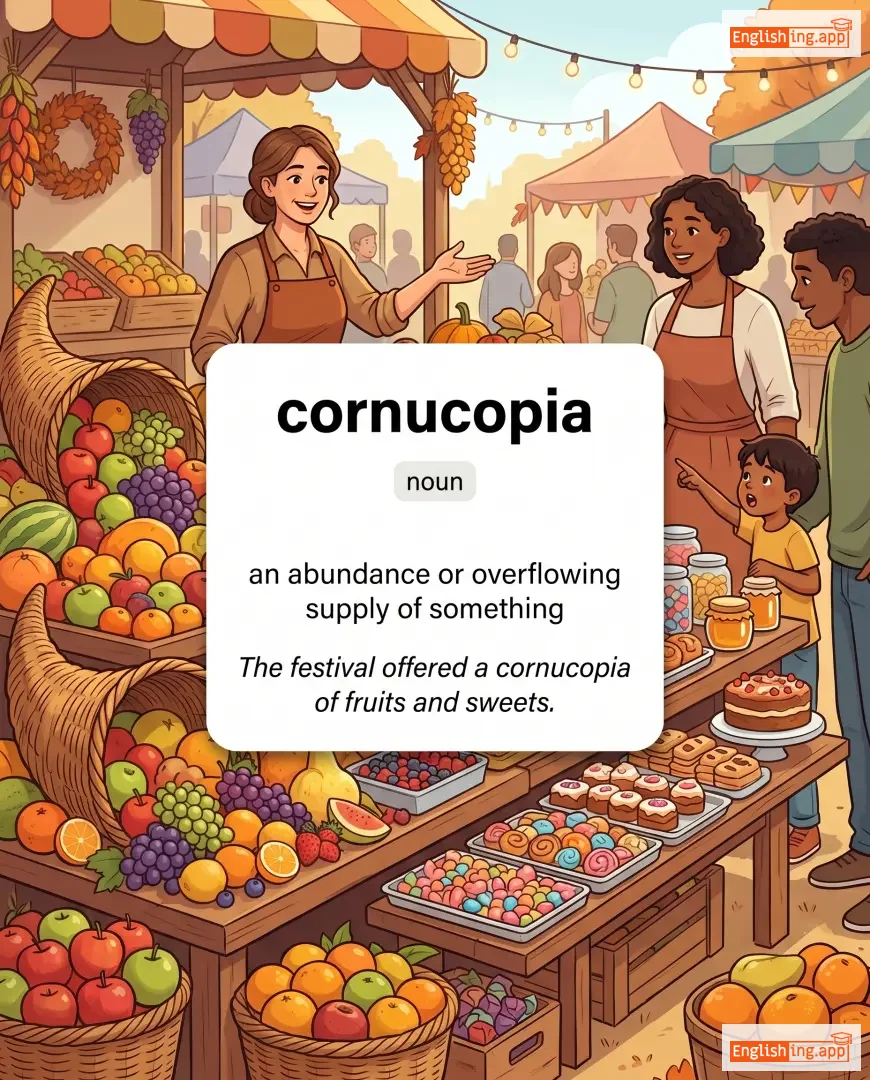
cornucopia definition card — visual illustration of the meaning
noun
/ˌkɔːrnjuˈkoʊpiə/
किसी चीज़ की अधिकता या अत्यधिक आपूर्ति (kisi cheez ki adhikta ya atyadhik aapurti)

an abundance or overflowing supply of something

"The festival offered a cornucopia of fruits and sweets."

"महोत्सव ने फलों और मिठाइयों का एक कॉर्नुकोपिया प्रस्तुत किया।" (Mahotsav ne phalon aur mithaiyon ka ek cornucopia prastut kiya.)
noun
/kəˈrɑːləri/
सीधा या स्वाभाविक परिणाम (seedha ya swabhavik parinaam)

a direct or natural consequence or result

"One corollary of the new policy was increased public awareness."

"नई नीति का एक परिणाम सार्वजनिक जागरूकता में वृद्धि था।" (Nayi niti ka ek parinaam sarvajanik jagrookta mein vruddhi tha.)
noun
/kəˈroʊnə/
मुकुट या मुकुट जैसा संरचना; सूर्य का बाहरी वातावरण (mukut ya mukut jaisa sanrachna; surya ka baahari vatavaran)

a crown or crown-like structure; also refers to the outer atmosphere of the sun

"The sun's corona was visible during the total solar eclipse."

"सूर्य का कोरोना पूर्ण सूर्य ग्रहण के दौरान दिखाई दिया था।" (Surya ka corona poorn surya grahan ke dauran dikhai diya tha.)
noun
/ˌkɒrəˈneɪʃən/
राज्याभिषेक (raajyabhishek)

the act or ceremony of crowning a sovereign or monarch

"The coronation of the new king was attended by thousands of people."

"नए राजा का राज्याभिषेक हजारों लोगों की उपस्थिति में हुआ।" (Naye raja ka raajyabhishek hazaron logon ki upasthiti mein hua.)
noun
/ˈkɒrənər/
मृत्यु जांच अधिकारी (mrityu jaanch adhikari)

an official who investigates sudden, violent, or suspicious deaths

"The coroner determined the cause of death was natural."

"कोरोनर ने तय किया कि मौत प्राकृतिक थी।" (Coroner ne tay kiya ki maut prakritik thi.)
noun
/ˈkɒrənɛt/
छोटा मुकुट (chhota mukut)

a small crown, especially one worn by a prince, princess, or noble

"She wore a delicate coronet on her head for the ceremony."

"उसने समारोह के लिए अपने सिर पर एक नाजुक मुकुट पहना था।" (Usne samaroha ke liye apne sir par ek naazuk mukut pehna tha.)
adjective, noun
/ˈkɔːrpərəl/
शारीरिक/सैन्य कॉर्पोरल (sharirik/sainya corporal)

relating to the body; a low-ranking officer in the military

"He suffered a corporal punishment for his mistake."

"उसने अपनी गलती के लिए शारीरिक सजा भोगी।" (Usne apni galti ke liye sharirik saza bhogi.)
adjective, noun
/ˈkɔːrpərət/
कंपनी/कॉर्पोरेट से संबंधित (company/corporate se sambandhit)

relating to a corporation or large company; united as a single body

"Corporate social responsibility is important for modern businesses."

"कॉर्पोरेट सामाजिक जिम्मेदारी आधुनिक व्यवसायों के लिए महत्वपूर्ण है।" (Corporate samajik jimmedari aadhunik vyavsayon ke liye mahatvapurn hai.)
noun
/ˌkɔːrpəˈreɪʃən/
संस्थान (sansthan)

A large company or group of companies that is legally recognized as a single entity.

"The corporation invested heavily in renewable energy projects."

"कॉर्पोरेशन ने नवीकरणीय ऊर्जा परियोजनाओं में भारी निवेश किया।" (Corporation ne navikaranīya urja pariyojnaon mein bhari nivesh kiya.)
adjective
/kɔːrˈpɔːriəl/
शारीरिक, शारीरिक रूप से मौजूद (sharirik, sharirik roop se maujood)

relating to the physical body; material or tangible

"Ghosts are often described as having no corporeal form."

"भूतों को अक्सर बिना शारीरिक रूप के बताया जाता है।" (Bhooton ko aksar bina sharirik roop ke bataya jata hai.)
noun
/kɔːr/
सेना की शाखा, समूह (sena ki shakha, samuh)

a branch of the military or a group organized for a specific purpose

"He joined the army corps after graduation."

"उन्होंने स्नातक के बाद सेना की शाखा में शामिल हो गए।" (Unhone snatak ke baad sena ki shakha mein shamil ho gaye.)
noun
/kɔːrps/
शव (shav)

a dead body, especially of a human

"The police discovered a corpse in the abandoned house."

"पुलिस ने परित्यक्त घर में एक शव खोजा।" (Police ne parityakt ghar mein ek shav khoja.)
adjective
/ˈkɔːpjʊlənt/
मोटा, स्थूल (mota, sthul)

fat or obese; having a large bulky body

"The corpulent man struggled to fit into the small chair."

"वो कॉर्प्युलेंट आदमी छोटे से कुर्सी में फिट होने के लिए संघर्ष कर रहा था।" (Woh corpulent aadmi chhote se kursi mein fit hone ke liye sangharsh kar raha tha.)
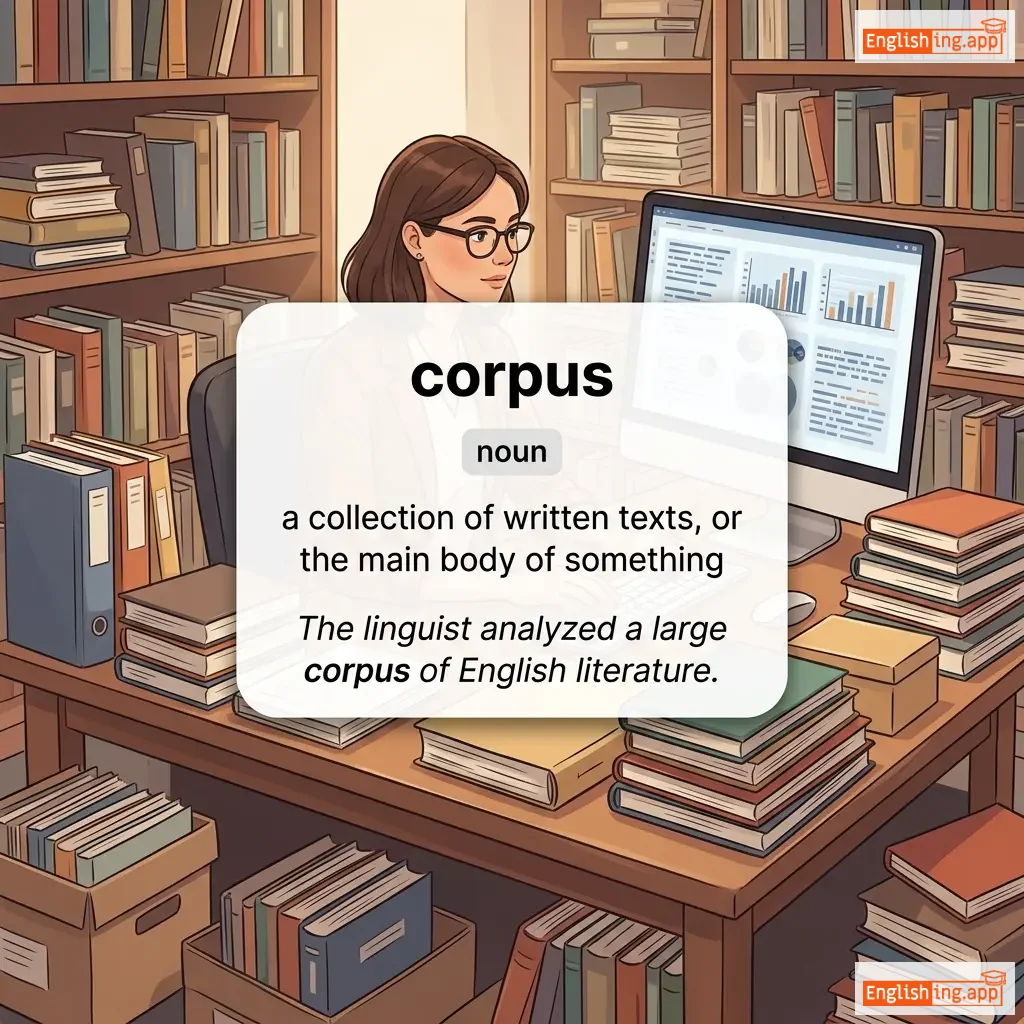
corpus definition card — visual illustration of the meaning
noun
/ˈkɔːrpəs/
संग्रह, मुख्य भाग (sangrah, mukhya bhag)

a collection of written texts, or the main body of something

"The linguist analyzed a large corpus of English literature."

"भाषाविद ने अंग्रेजी साहित्य का एक बड़ा संग्रह विश्लेषित किया।" (Bhashavid ne Angrezi sahitye ka ek bada sangrah vishleshit kiya.)
noun
/ˈkɔːrpəskəl/
सूक्ष्म कण या कोशिका, विशेष रूप से रक्त कोशिका (sookshm kan ya koshika, vishesh roop se rakt koshika)

a small particle or cell, especially a blood cell

"Red corpuscles carry oxygen throughout the body."

"लाल रक्त कोशिकाएँ शरीर में ऑक्सीजन लेकर चलती हैं।" (Lal rakt koshikaayein sharir mein oksijen lekar chalti hain.)
adjective
/kəˈrɛkt/
सही (sahi)

free from error; accurate

"The answer she gave was correct."

"जो उत्तर उसने दिया था वह सही था।" (Jo uttar usne diya tha wah sahi tha.)
noun
/kəˈrɛkʃən/
सुधार (sudhaar)

the action or process of correcting something

"The teacher made a correction to the student's essay."

"अध्यापक ने छात्र के निबंध में एक सुधार किया।" (Adhyapak ne chhatra ke nibandh mein ek sudhaar kiya.)
adverb
/kəˈrɛktli/
सही तरीके से (sahi tareeke se)

in a way that is true, accurate, or without mistakes

"She answered all the questions correctly."

"उसने सभी सवालों का सही तरीके से जवाब दिया।" (Usne sabhi sawalon ka sahi tareeke se jawab diya.)
correlate definition card — visual illustration of the meaning
verb
/ˈkɒrəleɪt/
आपस में संबंध होना (aaps mein sambandh hona)

to have a mutual relationship or connection between two or more things

"High stress levels often correlate with poor health."

"हाई स्ट्रेस लेवल्स अक्सर खराब स्वास्थ्य के साथ कोरिलेट करते हैं।" (High stress levels aksar kharaab swasthya ke saath correlate karte hain.)
noun
/ˌkɒrəˈleɪʃən/
सहसंबंध (sahasambandh)

a mutual relationship or connection between two or more things

"Researchers found a strong correlation between diet and heart disease."

"शोधकर्ताओं ने आहार और हृदय रोग के बीच एक मजबूत सहसंबंध पाया।" (Shodhkartao ne aahaar aur hriday rog ke beech ek majboot sahasambandh paaya.)
adjective
/kəˈrɛlətɪv/
संबंधित (sambandhit)

having a mutual relationship; corresponding

"The increase in temperature is correlative with the melting of glaciers."

"तापमान में वृद्धि ग्लेशियर के पिघलने के साथ संबंधित है।" (Taapmaan mein vriddhi gleshiyaar ke pighalne ke saath sambandhit hai.)
verb
/kəˈrɛspɒnd/
पत्राचार करना (patraachar karna)

to communicate by exchanging letters or messages

"I correspond regularly with my old friends."

"मैं अपने पुराने दोस्तों से नियमित रूप से पत्राचार करता हूँ।" (Main apne purane doston se niyamit roop se patraachaar karta hoon.)
noun
/kəˈrɛspɒndəns/
पत्राचार (patrachar)

the exchange of letters or communication

"His correspondence with clients was always timely."

"उसकी ग्राहकों के साथ पत्राचार हमेशा समय पर था।" (Uski graahkon ke saath patrachar hamesha samay par tha.)
noun
/ˌkɒrəˈspɒndənt/
पत्रकार (patrakar)

A journalist who reports news from a particular place or on a particular subject.

"The foreign correspondent reported live from Paris."

"विदेशी पत्रकार ने पेरिस से लाइव रिपोर्ट किया।" (Videshi patrakar ne Paris se live report kiya.)
adjective
/kəˈrɛspɒndɪŋ/
संबंधित (sambandhit)

matching or related to something

"The corresponding page in the book explains the process in detail."

"पुस्तक का संबंधित पृष्ठ प्रक्रिया को विस्तार से समझाता है।" (Pustak ka sambandhit prishth prakriya ko vistaar se samjhata hai.)
noun
/ˈkɔːrɪdɔːr/
कक्षों से जुड़ने वाली लंबी गली (koridor)

a long passage in a building from which doors lead into rooms

"The students waited quietly in the corridor."

"छात्रों ने कोरीडोर में चुपचाप इंतजार किया।" (Chhatron ne koridor mein chupchap intezar kiya.)
adjective
/ˈkɒrɪdʒəbl/
सुधार योग्य (sudhar yogya)

capable of being corrected or improved

"The student's mistakes were corrigible with practice."

"छात्र की गलतियाँ अभ्यास से सुधार योग्य थीं।" (Chhatra ki galtiyan abhyas se sudhaar yogya thin.)
corroborate definition card — visual illustration of the meaning
verb
/kəˈrɒbəreɪt/
सत्यापित करना (satyapit karna)

to confirm or give support to a statement, theory, or finding

"The witness corroborated the defendant's alibi."

"गवाह ने प्रतिवादी के अलिबी की पुष्टि की।" (Gawah ne pratibadi ke alibi ki pushti ki.)
noun
/kəˌrɒbəˈreɪʃən/
साक्ष्य (saakshya)

evidence that confirms or supports a statement, theory, or finding

"The documents provided strong corroboration of her claims."

"दस्तावेज़ों ने उनके दावों के मजबूत समर्थन का प्रमाण प्रस्तुत किया।" (Dastavezon ne unke daawon ke majboot samarthan ka pramaan prastut kiya.)
verb
/kəˈrəʊd/
क्षय करना (kshay karna)

to gradually destroy or wear away metal or other materials through chemical action

"The iron pipes corroded over time due to exposure to water."

"लोहे की पाइपें समय के साथ साथ क्षय हो गईं।" (Lohe ki pipein samay ke saath saath kshay ho gayi.)
corrosion definition card — visual illustration of the meaning
noun
/kəˈrəʊʒən/
जंग, क्षय (jang, kshay)

the process of corroding metal, stone, or other materials

"The boat's hull suffered serious corrosion from the saltwater."

"नौका के धक्के को नमक वाले पानी से गंभीर जंग का सामना करना पड़ा।" (Nauka ke dhakke ko namak wale pani se gambhir jang ka samna karna pada.)
adjective
/kəˈrəʊsɪv/
क्षयकारी, घातक (kshaykaari, ghaatak)

tending to cause corrosion; harmful or destructive to materials or people

"The chemical is highly corrosive and should be handled with care."

"रासायनिक पदार्थ अत्यधिक क्षयकारी है और इसे सावधानी से संभालना चाहिए।" (Rasayanik padarth atyadhik kshaykaari hai aur ise saavdhaani se sambhalna chahiye.)
adjective
/ˈkɒr.ə.ɡeɪ.tɪd/
लहरदार या मुड़ा हुआ (lahardaar ya muda hua)

shaped into ridges and grooves; wrinkled or folded

"The roof was made of corrugated metal sheets."

"छत को लहरदार धातु की चादरों से बनाया गया था।" (Chhat ko lahardaar dhaatu ki chaadron se banaya gaya tha.)
adjective/verb
/kəˈrʌpt/
भ्रष्ट (bhrasht)

dishonest or morally wrong; to make something impure or evil

"The politician was accused of corrupt practices."

"राजनेता पर भ्रष्टाचार के आरोप लगाए गए थे।" (Rajneta par bhrashtachar ke aarop lagaaye gaye the.)
adjective
/kəˈrʌp.tə.bəl/
भ्रष्टाचार योग्य (bhrashtachar yogya)

able to be morally or ethically corrupted

"He was known to be corruptible and often accepted bribes."

"उन्हें भ्रष्टाचार योग्य के रूप में जाना जाता था और वह अक्सर रिश्वत लेते थे।" (Unhe bhrashtachar yogya ke roop mein jana jata tha aur woh aksar rishwat lete the.)
noun
/kəˈrʌp.ʃən/
भ्रष्टाचार (bhrashtachar)

dishonest or fraudulent conduct by those in power

"The government launched a campaign to fight corruption."

"सरकार ने भ्रष्टाचार से लड़ने के लिए एक अभियान शुरू किया।" (Sarkar ne bhrashtachar se ladne ke liye ek abhiyan shuru kiya.)
noun
/ˈkɔː.seər/
लुटेरा नाविक (lutera navik)

a pirate, especially one operating along the Mediterranean coasts

"The corsair plundered ships along the coast."

"कॉर्सेयर ने तट पर जहाजों को लूटा।" (Corsair ne tat par jahajon ko lootaa.)
noun
/kɔːrˈteɪʒ/
अंत्येष्टि यात्रा (antyesthi yatra)

a solemn procession, especially for a funeral

"A cortege of mourners followed the hearse to the cemetery."

"एक शोक यात्रा ने हियरसे को श्मशान घाट तक अनुसरण किया।" (Ek shok yatra ne hearse ko shamshan ghat tak anusaran kiya.)
verb
/ˈkɒr.ʌ.skeɪt/
चमकना (chamakna)

to sparkle or flash brightly

"The fireworks coruscated across the night sky."

"आतिशबाजी ने रात के आकाश में चमकते हुए दिखाई।" (Aatishbaji ne raat ke aakash mein chamakte hue dikhai.)
adjective
/kɒzˈmɛt.ɪk/
सौंदर्य संबंधी (saundarya sambandhi)

relating to beauty or appearance; intended to improve looks

"She bought a new cosmetic cream for her skin."

"वह अपनी त्वचा के लिए एक नया कॉस्मेटिक क्रीम खरीदी।" (Vah apni twacha ke liye ek naya cosmetic cream khareedi.)
adjective
/ˈkɒz.mɪk/
ब्रह्मांडीय, विशाल (brahmandiya, vishal)

relating to the universe or cosmos; vast

"Astronomers study cosmic phenomena to understand the universe."

"खगोलशास्त्री ब्रह्मांड को समझने के लिए कॉस्मिक घटनाओं का अध्ययन करते हैं।" (Khagolshastri brahmand ko samajhne ke liye cosmic ghatnaon ka adhyayan karte hain.)
noun
/kɒzˈmɒɡ.ə.ni/
सृष्टि-विज्ञान (srishti-vigyan)

the study or theory of the origin of the universe

"The book provides an overview of different cosmogonies throughout history."

"यह पुस्तक इतिहास भर में विभिन्न सृष्टि-विज्ञानों का अवलोकन प्रस्तुत करती है।" (Yeh pustak itihas bhar mein vibhinn srishti-vigyanon ka avlokan prastut karti hai.)
noun
/kɒzˈmɒɡ.rə.fi/
कॉस्मोग्राफी (cosmography)

the science or art of mapping the universe or cosmos

"Medieval scholars practiced cosmography to chart the stars and planets."

"मध्यकालीन विद्वान सितारों और ग्रहों का मानचित्र बनाने के लिए कॉस्मोग्राफी का अभ्यास करते थे।" (Madhyakalīn vidwān sitāron aur graho kā mānchitra banāne ke liye cosmography kā abhyās karte the.)
cosmology definition card — visual illustration of the meaning
noun
/kɒzˈmɒlədʒi/
कोस्मोलॉजी (cosmology)

the science of the origin and development of the universe

"She studied cosmology to understand the origins of the universe."

"उसने ब्रह्मांड के उत्पत्ति को समझने के लिए कॉस्मोलॉजी का अध्ययन किया।" (Usne brahmand ke utpatti ko samajhne ke liye cosmology ka adhyayan kiya.)
adjective
/ˌkɒzməˈpɒlɪtən/
विश्वव्यापी (vishvavyapi)

familiar with and at ease in many different countries and cultures

"He has a cosmopolitan outlook due to his extensive travels."

"उसकी व्यापक यात्राओं के कारण उसका एक कॉस्मोपॉलिटन दृष्टिकोण है।" (Uski vyapak yatraon ke karan uska ek cosmopolitan drishtikon hai.)
noun
/ˌkɒzməˈpɒlɪtənɪzəm/
विश्व नागरिकता (vishv nagrikta)

the ideology that all human beings belong to a single community

"Cosmopolitanism promotes respect and understanding across cultures."

"कॉस्मोपोलिटनिज़्म संस्कृति के बीच सम्मान और समझ को बढ़ावा देता है।" (Cosmopolitanism sanskriti ke beech sammaan aur samajh ko badhawa deta hai.)
noun
/ˈkɒzmɒs/
ब्रह्मांड (brahmand)

the universe seen as a well-ordered whole

"Astronomers study the cosmos to learn about the universe's structure."

"खगोलज्ञानी ब्रह्मांड के संरचना को जानने के लिए ब्रह्मांड का अध्ययन करते हैं।" (Khagolgyani brahmand ke sanrachna ko janane ke liye brahmand ka adhyayan karte hain.)