वोकैबुलरीज

इंग्लिश वोकैबुलरी डिस्कवर, लर्न और मास्टर करें

noun
/biːf/
गोमांस (gomans)

the flesh of a cow, bull, or ox, used as food; also a complaint or dispute

"He ordered a plate of grilled beef for dinner."

"उसने रात के खाने के लिए ग्रिल्ड गोमांस का एक प्लेट ऑर्डर किया।" (Usne raat ke khane ke liye grilled gomans ka ek plate order kiya.)
noun
/ˈbiːlaɪn/
सीधी रेखा (seedhi rekha)

a straight, direct route to a destination

"He made a beeline for the food table as soon as he entered the party."

"वह पार्टी में घुसते ही खाने की मेज की ओर सीधे बढ़ा।" (vah party mein ghuste hi khane ki mej ki or seedhe badha.)
noun
/bɪər/
बीयर (beer)

An alcoholic drink made from yeast-fermented malt flavored with hops.

"He ordered a glass of cold beer at the bar."

"उसने बार में एक गिलास ठंडी बीयर मंगवाई।" (usne bar mein ek gilaas thandi beer mangwaayi.)
noun
/biːt/
बीट (beet)

a plant with a round dark red root that is eaten as a vegetable

"Roasted beet with goat cheese makes a delicious salad."

"गाय के पनीर के साथ भुना हुआ बीट एक स्वादिष्ट सलाद बनाता है।" (gaay ke paneer ke saath bhuna hua beet ek swadisht salad banata hai.)
noun
/ˈbiː.təl/
भृंग (bhring)

a hard-bodied insect with wing covers

"The black beetle scurried across the garden path."

"काले भृंग ने बग़ीचे के रास्ते पर दौड़ते हुए गति पकड़ी।" (kaale bhring ne bageeche ke raaste par daudte hue gati pakdi.)
verb
/bɪˈfɪt/
उपयुक्त होना (upyukt hona)

to be suitable for; to be appropriate to

"Formal attire befits the seriousness of the occasion."

"औपचारिक पोशाक अवसर की गंभीरता के अनुकूल है।" (aupcharik poshak avsar ki gambhirta ke anukul hai)
adjective
/bɪˈfɪt.ɪŋ/
उपयुक्त; उचित; एक विशेष स्थिति या व्यक्ति के लिए उपयुक्त (bifiting)

appropriate; suitable; proper for a particular situation or person

"He wore formal attire befitting the important occasion."

"उसने महत्वपूर्ण अवसर के लिए उपयुक्त औपचारिक वस्त्र पहने।" (Usne mahatvapurn avsar ke liye upyukt aupcharik vastra pehne.)
verb
/bɪˈfɒɡ/
धुंधला करना (dhundhla karna)

to confuse or make unclear; to cover with fog or mist

"His mind was befogged by exhaustion."

"उसका मन थकावट से धुंधला हो गया था।" (Uska man thakawat se dhundhla ho gaya tha.)
adjective
/bɪˈfɒɡd/
धुंधला, भ्रमित (dhundhla, bhramit)

Confused or clouded in mind; made unclear like being surrounded by fog.

"His mind felt befogged after the long and exhausting meeting."

"लंबे और थकाऊ बैठक के बाद, उसका मन भ्रमित महसूस हो रहा था।" (lambe aur thakao boithak ke baad, uska man bhramit mehsoos ho raha tha.)
verb
/bɪˈfuːl/
धोखा देना (dhokha dena)

to deceive or trick someone into believing something false; to make someone appear foolish

"The scammer tried to befool innocent people with fake promises."

"ठग ने नकली वादों से निर्दोष लोगों को धोखा देने की कोशिश की।" (thag ne nakli vaadon se nirdosh logon ko dhokha dene ki koshish ki)
preposition/adverb/conjunction
/bɪˈfɔːr/
पहले (pahle)

At an earlier time; in front of in order or place.

"She arrived before the meeting started."

"वह बैठक शुरू होने से पहले पहुँच गई थी।" (vah baithak shuru hone se pahle pahunch gayi thi.)
adverb
/bɪˈfɔːr.hænd/
पहले से; समय से पहले; पहले (pehle se; samay se pehle; pehle)

in advance; ahead of time; earlier

"We prepared everything beforehand."

"हमने पहले से सब कुछ तैयार किया था।" (hamne pehle se sab kuch tayar kiya tha)
verb
/bɪˈfaʊl/
दूषित करना (dooshit karna)

to make dirty or polluted; to disgrace or corrupt

"The factory waste befouled the river."

"कारखाने के कचरे ने नदी को दूषित कर दिया।" (karkhane ke kachre ne nadi ko dooshit kar diya)
verb
/bɪˈfrɛnd/
दोस्ती करना (dosti karna)

to act as a friend to someone; to make friends with

"She befriended the new student at school."

"उसने स्कूल में नए छात्र से दोस्ती की।" (Usne school mein naye chhatra se dosti ki.)
verb
/bɪˈfʌdəl/
भ्रमित करना (bhramit karna)

to confuse someone completely; to make someone unable to think clearly

"The complex instructions befuddled the students."

"जटिल निर्देशों ने छात्रों को भ्रमित कर दिया।" (Jatil nirdeshon ne chatron ko bhramit kar diya.)
adjective
/bɪˈfʌdld/
भ्रमित (bhramit)

confused, unable to think clearly

"He looked befuddled after hearing the complex instructions."

"वह जटिल निर्देशों को सुनकर भ्रमित हो गया था।" (Vah jatil nirdeshon ko sunkar bhramit ho gaya tha.)
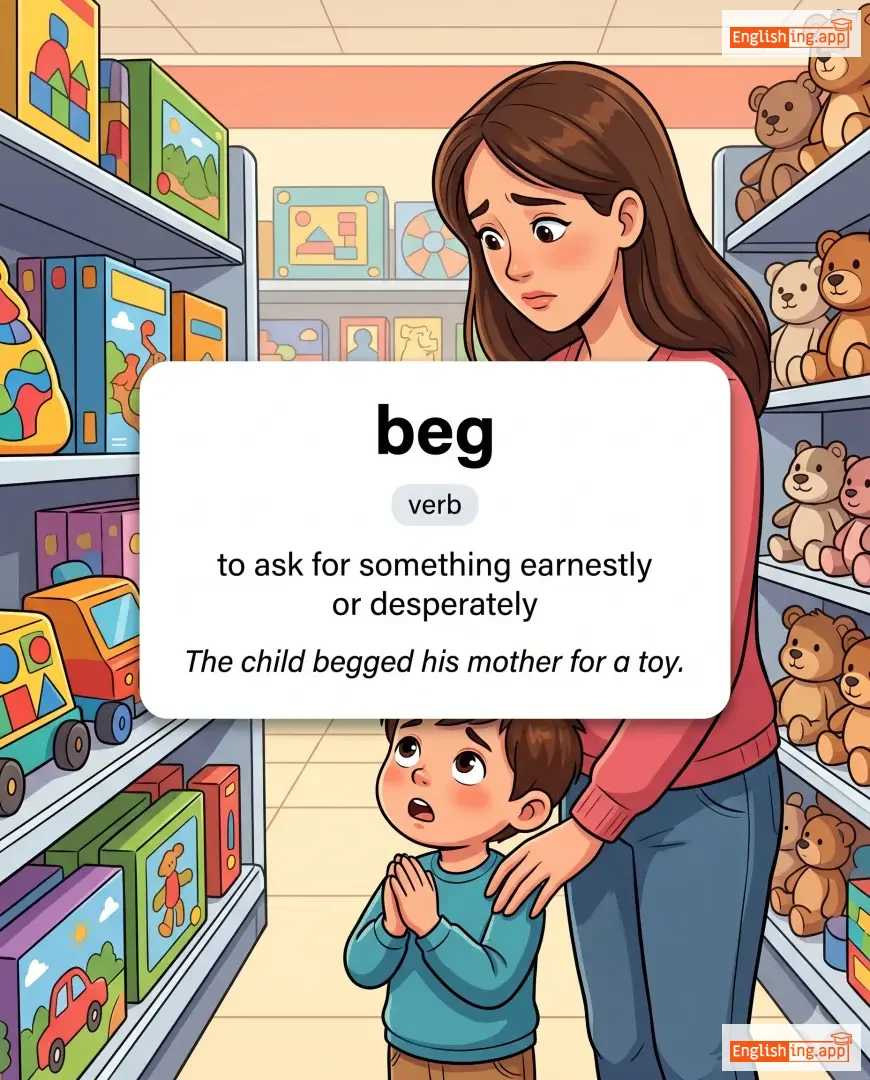
beg definition card — visual illustration of the meaning
verb
/bɛɡ/
भीख माँगना / अनुरोध करना (bhikh mangna / anurodh karna)

to ask for something earnestly or desperately

"The child begged his mother for a toy."

"बच्चे ने अपनी माँ से खिलौना माँगा।" (bachche ne apni maa se khilauna maanga.)
verb
/bɪˈɡɛt/
जन्म देना / उत्पन्न करना (janm dena / utpann karna)

to bring about or give rise to; to father or produce

"Violence begets more violence."

"हिंसा और हिंसा को जन्म देती है।" (Hinsa aur hinsa ko janm deti hai.)
noun
/ˈbeɡər/
भिखारी (bhikhari)

a person who lives by asking for money or food

"The beggar sat by the temple asking for alms."

"भिखारी मंदिर के पास भिक्षा माँगते हुए बैठा था।" (bhikhari mandir ke paas bhiksha maangte hue baitha tha)
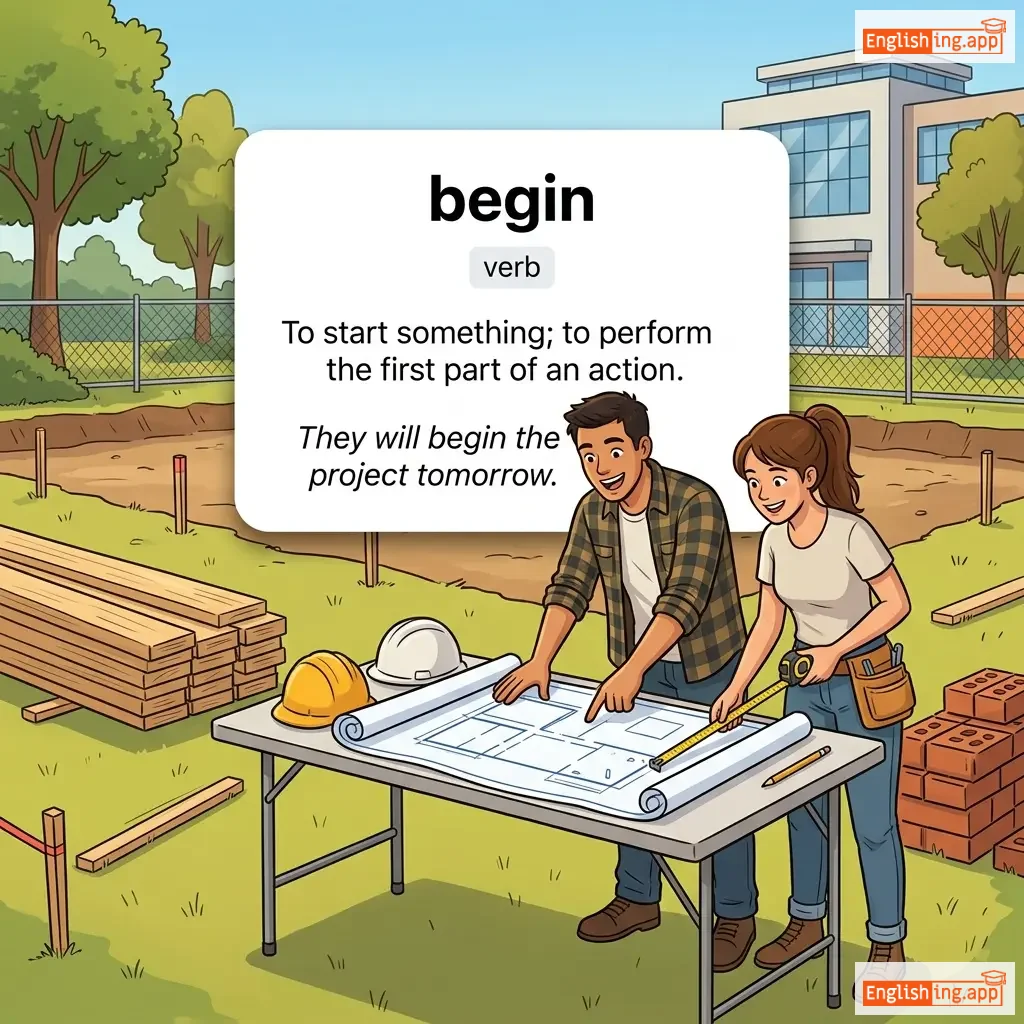
begin definition card — visual illustration of the meaning
verb
/bɪˈɡɪn/
शुरू करना (shuru karna)

To start something; to perform the first part of an action.

"They will begin the project tomorrow."

"वे कल प्रोजेक्ट शुरू करेंगे।" (ve kal project shuru karenge.)
noun
/bɪˈɡɪnɪŋ/
शुरुआत (shuruaat)

The start or first part of something.

"The beginning of the story was very interesting."

"कहानी की शुरुआत बहुत दिलचस्प थी।" (kahani ki shuruat bahut dilchasp thi.)
verb
/bɪˈɡrʌdʒ/
किसी से कुछ लेने पर नाराज़ होना / अनिच्छा से देना (kisi se kuch lene par naraz hona / anichhha se dena)

to resent someone for having something; to give reluctantly

"She did not begrudge him his success."

"वह उसकी सफलता पर नाराज़ नहीं हुई।" (Wah uski safalta par naraz nahi hui.)
verb
/bɪˈɡaɪl/
लुभाना / धोखा देकर आकर्षित करना (lubahna / dhokha dekar aakarshit karna)

to charm or enchant someone, often in a deceptive way

"She beguiled the audience with her storytelling."

"वह अपनी कहानी सुनाने से दर्शकों को मोहित कर लिया।" (Wah apni kahani sunane se darshako ko mohit kar liya.)
noun
/bɪˈhɑːf/
की ओर से (ki or se)

as a representative of someone; in the interest of someone

"She accepted the award on behalf of her team."

"उसने अपने टीम की ओर से पुरस्कार स्वीकार किया।" (Usne apne team ki or se puraskar sviikar kiya.)
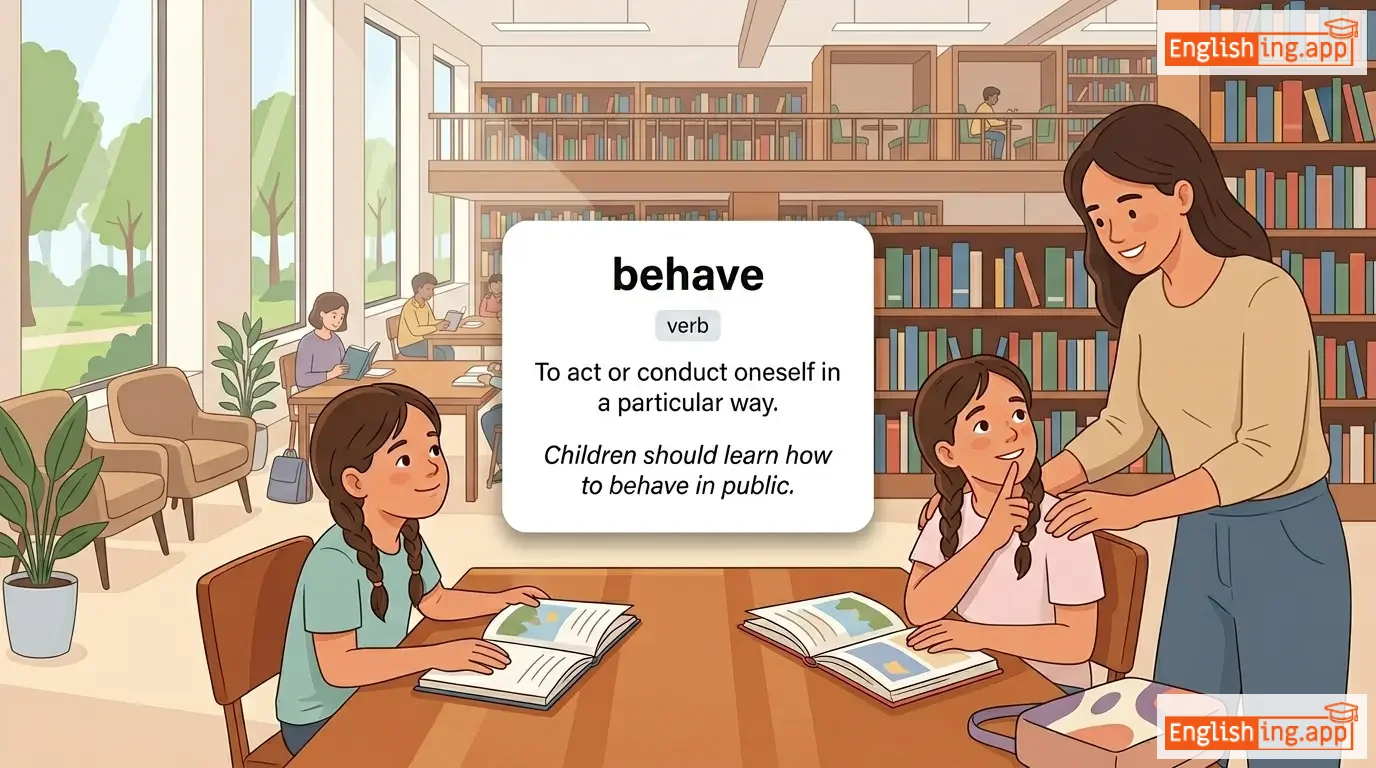
behave definition card — visual illustration of the meaning
verb
/bɪˈheɪv/
व्यवहार करना (vyavhaar karna)

To act or conduct oneself in a particular way.

"Children should learn how to behave in public."

"बच्चों को पब्लिक में कैसे व्यवहार करना चाहिए ये सीखना चाहिए।" (bachcho ko public mein kaise vyavhaar karna chahiye ye seekhna chahiye.)
noun
/bɪˈheɪvjər/
व्यवहार (vyavhaar)

The way in which one acts or conducts oneself, especially toward others.

"The teacher praised her good behavior in class."

"शिक्षक ने कक्षा में उसके अच्छे व्यवहार की सराहना की।" (Shikshak ne kaksha mein uske achhe vyavhaar ki sarahna ki.)
adjective
/bɪˈheɪvjərəl/
व्यवहारिक (vyavharik)

relating to the way a person or animal acts

"The psychologist studied the child's behavioral patterns."

"मनोवैज्ञानिक ने बच्चे के व्यवहारिक पैटर्न का अध्ययन किया।" (Manovaigyanik ne bachche ke vyavharik pattern ka adhyayan kiya.)
noun
/bɪˈheɪ.vjər/
व्यवहार (vyavhaar)

the way a person or animal acts or conducts themselves

"His behaviour at the meeting was very professional."

"उसकी बैठक में व्यवहार बहुत पेशेवर था।" (Uski baithak mein vyavhaar bahut peshewar tha.)
verb
/bɪˈhɛd/
सिर काटना (sir katna)

to cut off a person's or animal's head; to remove the leader or most important part

"The historical account describes how the traitor was beheaded as punishment."

"ऐतिहासिक विवरण में बताया गया है कि दंड के रूप में गद्दार का सिर काटा गया।" (aitihasik vivaran mein bataya gaya hai ki dand ke roop mein gaddar ka sir kaata gaya)
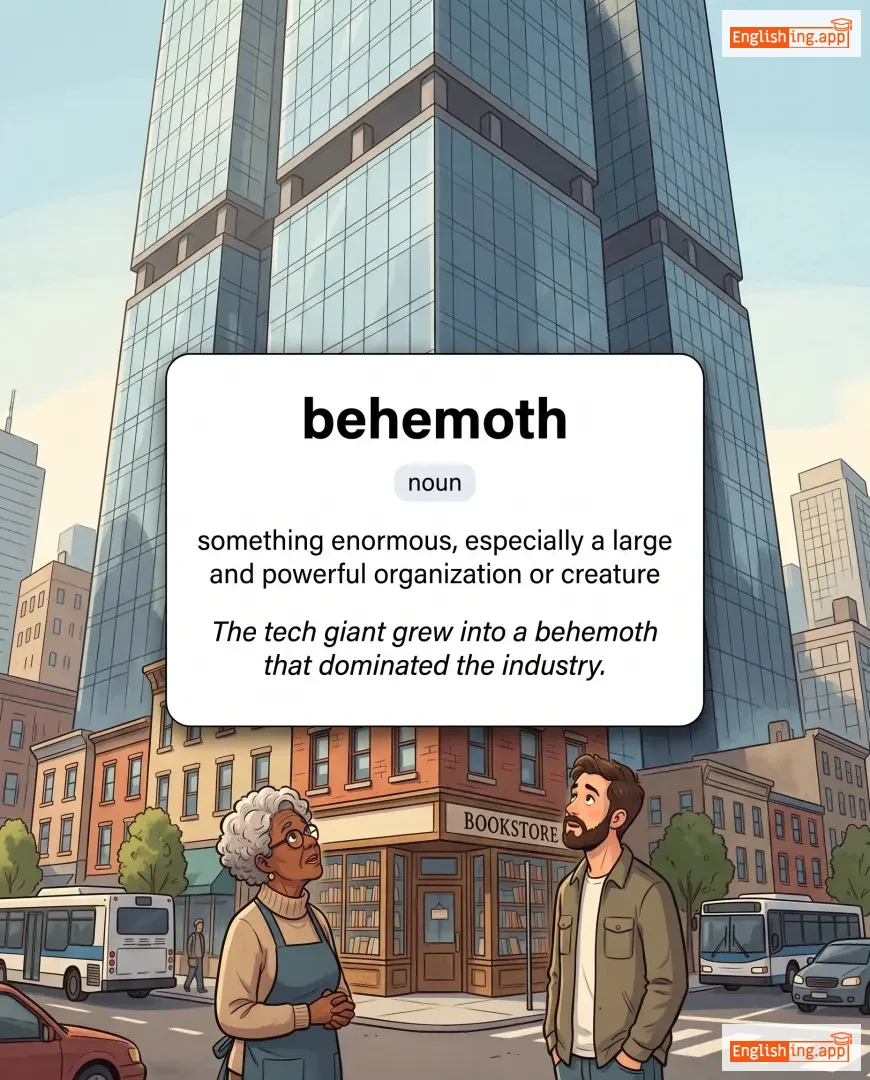
behemoth definition card — visual illustration of the meaning
noun
/bɪˈhiːməθ/
विशालकाय प्राणी या संस्था (vishalkay prani ya sanstha)

something enormous, especially a large and powerful organization or creature

"The tech giant grew into a behemoth that dominated the industry."

"टेक जायंट एक ऐसे विशालकाय प्राणी में बदल गया था जिसने उद्योग को दबा लिया था।" (Tek giant ek aise vishalkay prani mein badal gaya tha jise udhyog ko daba liya tha.)
preposition/adverb
/bɪˈhaɪnd/
पीछे (peeche)

At or to the back of something; in a position further back.

"The cat is hiding behind the curtain."

"बिल्ली पर्दे के पीछे छिपी हुई है।" (billi parde ke peeche chhupi hui hai.)
verb
/bɪˈhoʊld/
निहारना; देखना (niharna; dekhna)

to see or observe something, especially something remarkable or impressive

"She stood quietly to behold the sunrise over the hills."

"वह पहाड़ियों पर सूर्योदय देखने के लिए चुपचाप खड़ी थी।" (vah pahadiyon par sooryoday dekhne ke liye chupchap khadi thi)
adjective
/bɪˈhoʊldən/
कृतज्ञ या ऋणी (krutagnya ya rini)

indebted or obliged to someone for a service or help

"He felt beholden to his mentor for all the guidance."

"उसे अपने मार्गदर्शक के लिए सभी मार्गदर्शन के लिए कृतज्ञता महसूस हो रही थी।" (Use apne margdarshak ke liye sabhi margdarshan ke liye krutagnya mehsoos ho rahi thi.)
verb
/bɪˈhuːv/
ज़रूरी होना या उचित होना (zaruri hona ya uchit hona)

to be necessary, proper, or appropriate for someone to do

"It would behoove you to study before the exam."

"परीक्षा से पहले तुम्हें पढ़ाई करना चाहिए।" (Pariksha se pehle tumhe padhai karna chahiye.)
verb
/bɪˈhuːvz/
ज़रूरी होना (zaruri hona)

third person singular form of 'behoove'; means it is proper or necessary

"It behooves every citizen to follow the law."

"यह हर नागरिक के लिए कानून का पालन करना जरूरी है।" (Yah har nagarik ke liye kanoon ka paalan karna zaruri hai.)
verb
/bɪˈhəʊv/
उचित होना (uchit hona)

British spelling of 'behoove'; to be appropriate or necessary

"It would behove the company to listen to its customers."

"कंपनी को अपने ग्राहकों की बात सुननी चाहिए।" (Company ko apne grahakoon ki baat sunni chahiye.)
noun/verb
/ˈbiːɪŋ/
अस्तित्व (astitva)

Existence; the state of living; a living creature.

"Kindness is part of being human."

"काइंडनेस इंसान होने का हिस्सा है।" (kindness insaan hone ka hissa hai.)
verb
/bɪˈleɪbər/
अत्यधिक चर्चा करना (atyadhik charcha karna)

to argue or elaborate on a subject in excessive detail; to attack verbally or physically

"The professor belabored the point until the students grew restless."

"प्रोफेसर ने वह बिंदु इतना अधिक समझाया कि छात्रों ने असहज हो जाना शुरू कर दिया।" (Professor ne woh bindu itna adhik samjhaya ki chhatron ne asahaj ho jana shuru kar diya.)
verb
/bɪˈleɪbə/
अत्यधिक विस्तार से समझाना (atyadhik vistar se samjhana)

to explain something repeatedly or with excessive detail; to criticize or attack verbally at length

"The teacher did not belabour the point once the students understood it."

"जब छात्रों ने समझ लिया तो शिक्षक ने बात को ज़्यादा नहीं खींचा।" (jab chhatron ne samajh liya to shikshak ne baat ko zyada nahin kheencha)
verb
/bɪˈleɪt/
देर करना (der karna)

to delay or make late

"Heavy traffic belated our arrival at the party."

"भारी ट्रैफिक ने हमारी पार्टी में पहुँचने में देरी कर दी।" (Bhari traffic ne hamari party mein pahuchne mein deri kar di.)
adjective
/bɪˈleɪtɪd/
विलंबित (vilambit)

coming or happening later than expected or usual

"She sent me a belated birthday card."

"उसने मुझे एक विलंबित जन्मदिन कार्ड भेजा।" (Usne mujhe ek vilambit janmadin card bheja.)
verb
/bɪˈleɪ/
रस्ती को सुरक्षित करना (rasti ko surakshit karna)

to secure a rope by winding it around an object; to stop or cancel an order (nautical/military use)

"The climber asked his partner to belay the rope tightly."

"चढ़ाई करने वाले ने अपने साथी से रस्ती को कसकर सुरक्षित करने को कहा।" (Chadhai karne wale ne apne saathi se rasti ko kaskar surakshit karne ko kaha.)
verb; noun
/beltʃ/
डकार लेना (dakar lena)

to expel air noisily from the stomach through the mouth; to emit or pour out suddenly and forcefully

"After drinking the soda, he belched loudly."

"सोडा पीने के बाद उसने ज़ोर से डकार ली।" (soda peene ke baad usne zor se dakar li)
noun
/ˈbeɪleɪ/
बेली मछली (beli machhli)

a type of freshwater fish found in South Asian rivers, known for its distinctive appearance

"The bele fish is commonly caught in the rivers of Bangladesh."

"बेली मछली आमतौर पर बांग्लादेश की नदियों में पकड़ी जाती है।" (beli machhli aamtaur par bangladesh ki nadiyon mein pakdi jati hai)
verb
/bɪˈliːɡər/
घेरना, परेशान करना (gherna, pareshan karna)

to cause difficulties, troubles, or harassment; to surround with military forces

"The company was beleaguered by constant complaints from its customers."

"कंपनी ग्राहकों की लगातार शिकायतों से परेशान हो रही थी।" (Company graahakon ki lagatar shikayaton se pareshan ho rahi thi.)
noun
/ˈbɛlfri/
घंटाघर (ghantaghar)

A bell tower, especially one attached to a church or building.

"The church belfry housed a large bronze bell."

"चर्च का घंटाघर एक बड़ा कांस्य घंटा रखता था।" (Church ka ghantaghar ek bada kansya ghanta rakhta tha.)
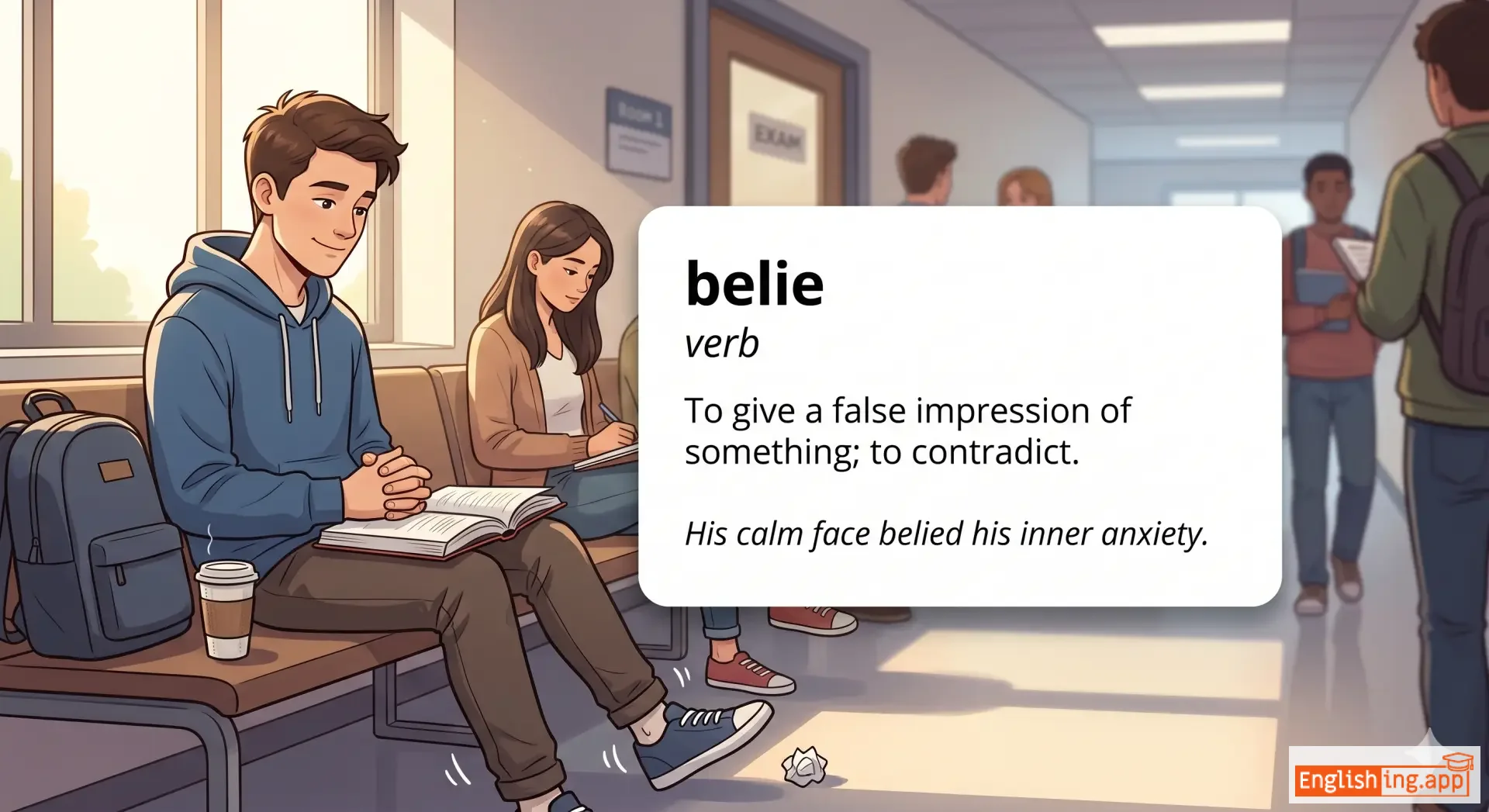
belie definition card — visual illustration of the meaning
verb
/bɪˈlaɪ/
झूठा प्रतीत करना (jhootha prateet karna)

To give a false impression of something; to contradict.

"His calm face belied his inner anxiety."

"उसका शांत चेहरा उसकी अंदरूनी चिंता को छुपा रहा था।" (Uska shaant chehra uski andarooni chinta ko chhupa raha tha.)
noun
/bɪˈliːf/
विश्वास (vishwas)

an acceptance that something exists or is true, especially without proof

"Her belief in kindness inspired many people."

"उसका दया में विश्वास कई लोगों को प्रेरित किया।" (uska daya mein vishwas kai logon ko prerit kiya.)
adjective
/bɪˈliːvəbl̩/
विश्वसनीय (vishwasniya)

Able to be trusted or accepted as true or reasonable.

"Her story was so detailed that it sounded believable."

"उसकी कहानी इतनी विस्तृत थी कि वह विश्वसनीय लग रही थी।" (Uski kahani itni vistaarit thi ki vah vishwasniya lag rahi thi.)
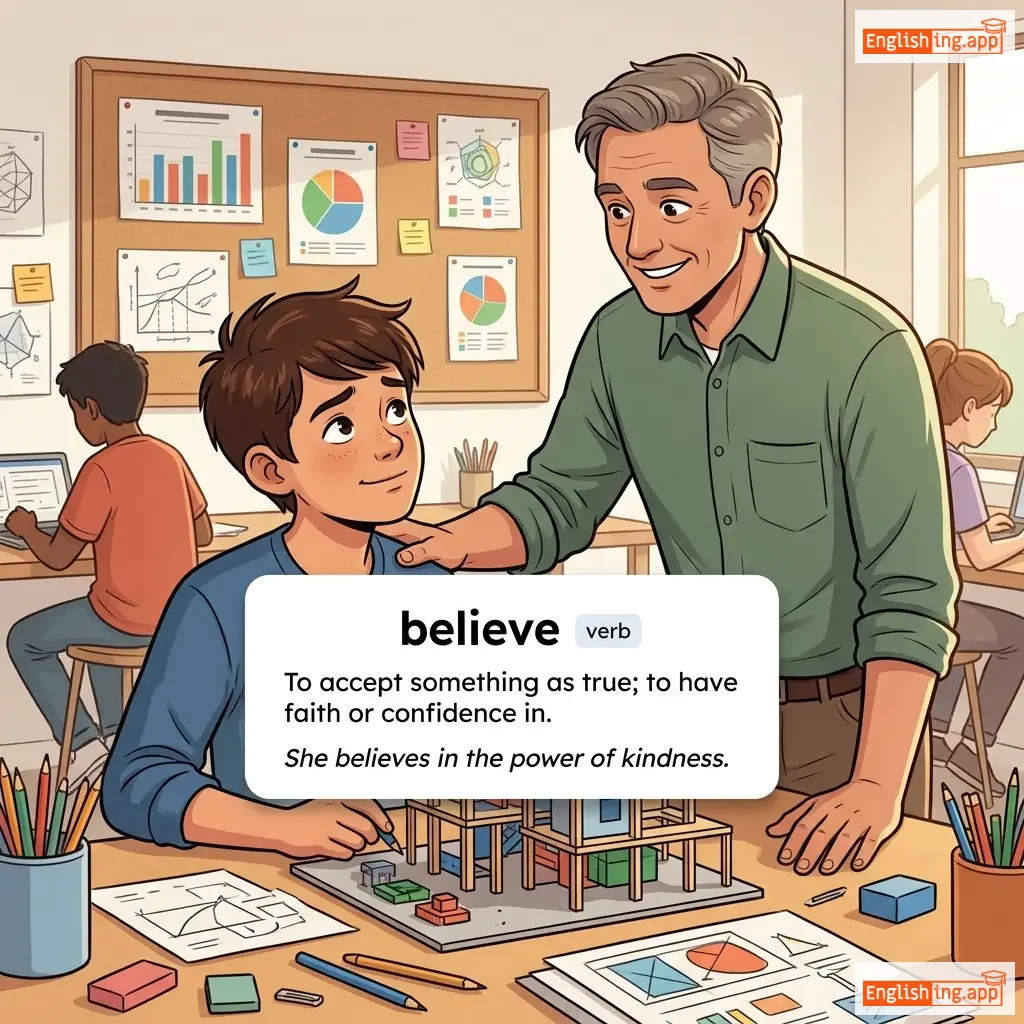
believe definition card — visual illustration of the meaning
verb
/bɪˈliːv/
विश्वास करना (vishwas karna)

To accept something as true; to have faith or confidence in.

"She believes in the power of kindness."

"वह दयालुता की शक्ति में विश्वास करती है।" (Vah dayaluta ki shakti mein vishwas karti hai.)