वोकैबुलरीज

इंग्लिश वोकैबुलरी डिस्कवर, लर्न और मास्टर करें

adjective
/ˈbroʊkən/
टूटा हुआ (toota hua)

damaged or not working properly

"The chair is broken and needs repair."

"कुर्सी टूटी हुई है और मरम्मत की जरूरत है।" (kursi tooti hui hai aur marammat ki zarurat hai.)
noun
/ˈbroʊ.kər/
ब्रोकर (broker)

a person who buys and sells things for others as a middleman, especially in financial or property deals

"He works as a real estate broker in the city."

"वह शहर में एक रियल एस्टेट ब्रोकर के रूप में काम करता है।" (vah shahar mein ek real estate broker ke roop mein kaam karta hai)
noun
/ˈbroʊkərɪdʒ/
ब्रोकरिज (brokerij)

A firm that acts as an intermediary between buyers and sellers, often charging a fee.

"The real estate brokerage helped them find a new home."

"रियल एस्टेट ब्रोकेरेज ने उन्हें एक नया घर खोजने में मदद की।" (Real estate brokerage ne unhe ek naya ghar khojne mein madad ki.)
noun
/ˈbroʊmaɪd/
पुराना विचार (purana vichar)

A trite or unoriginal idea or remark; also a chemical compound of bromine.

"His speech was full of old bromides about hard work."

"उसकी स्पीच पुरानी मेहनत के बारे में भरी हुई थी।" (Uski speech purani mehnat ke baare mein bhari hui thi.)
noun
/ˈbroʊmiːn/
ब्रोमिन (bromin)

a dark red, dense, toxic liquid element used in making dyes, flame retardants, and medications

"Bromine is commonly used in water treatment chemicals."

"ब्रोमिन सामान्यत: पानी उपचार रसायनों में इस्तेमाल किया जाता है।" (Bromin samanyata: pani upchar rasanayon mein istemal kiya jata hai.)
noun
/brɒŋˈkaɪtɪs/
ब्रोंकाइटिस (bronchitis)

inflammation of the lining of the bronchial tubes, which carry air to and from the lungs

"The doctor diagnosed him with acute bronchitis."

"डॉक्टर ने उसे तीव्र ब्रोंकाइटिस का निदान किया।" (Doktar ne use teevr bronchitis ka nidan kiya.)
noun
/ˈbrɒŋkəs/
ब्रोंकस (bronkas)

either of the two main branches of the trachea that lead directly into the lungs

"The left bronchus carries air into the left lung."

"बायाँ ब्रोन्कस बाएं फेफड़े में हवा पहुंचाता है।" (Baya bronkas baye fefde mein hawa pahuchata hai.)
noun
/brɑːnz/
कांस्य (kansya)

a metal made by combining copper and tin, often used for statues and medals

"The statue was made of solid bronze."

"मूर्ति ठोस कांस्य से बनाई गई थी।" (Moorti thos kansya se banayi gayi thi.)
noun
/broʊtʃ/
ब्रोच (brooch)

a decorative jewelry pin that is attached to clothing

"She wore a beautiful silver brooch on her jacket."

"उसने अपनी जैकेट पर एक सुंदर चांदी का ब्रोच पहना।" (Usne apni jacket par ek sundar chandi ka brooch pehna.)
verb
/bruːd/
गहरे विचार करना, एक साथ पैदा हुए छोटे पक्षियों का झुंड (brood)

to think deeply about something that makes one unhappy; also, a group of young birds hatched at the same time

"He sat alone, brooding over his failures."

"वह अकेला बैठा था, अपनी असफलताओं के बारे में गहरे विचारों में खोया हुआ।" (Vah akela baitha tha, apni asafaltaon ke baare mein gahre vicharon mein khoya hua.)
noun/verb
/brʊk/
नदी / सहन करना (nadi / sahan karna)

As a noun: a small natural stream; As a verb: to tolerate or endure something

"The village was built near a clear brook."

"गाँव एक साफ नदी के पास बसाया गया था।" (Gaon ek saaf nadi ke paas basaya gaya tha.)
noun
/brum/
झाड़ू (jhaadu)

a long-handled brush of bristles or twigs, used for sweeping

"She used an old broom to sweep the fallen leaves from the porch."

"उसने गिरते हुए पत्तों को झाड़ने के लिए एक पुरानी झाड़ू का इस्तेमाल किया।" (Usne girte huye patton ko jhaadne ke liye ek purani jhaadu ka istemal kiya.)
noun
/ˈbrʌðər/
भाई (bhai)

a male sibling

"My brother is two years older than me."

"मेरा भाई मुझसे दो साल बड़ा है।" (Mera bhai mujhse do saal bada hai.)
noun
/ˈbrʌðərhʊd/
भाईचारा (bhaichaara)

The relationship between brothers; an association of people with common interests

"The soldiers shared a strong sense of brotherhood."

"सैनिकों ने भाईचारे की एक मजबूत भावना साझा की।" (Sainikon ne bhaichaare ki ek majboot bhavana saajha ki.)
noun
/braʊ/
माथा (matha)

the part of the face above the eyes; forehead

"She wiped the sweat from her brow."

"वह अपने माथे से पसीना पोंछ रही थी।" (Vah apne matha se paseena ponch rahi thi.)
verb
/ˈbraʊˌbiːt/
धमकाना / दबाव डालना (dhamkana / dabaav daalna)

To intimidate or bully someone into doing something

"The lawyer tried to browbeat the witness."

"वकील ने गवाह को धमकाने की कोशिश की।" (Vakeel ne gawah ko dhamkane ki koshish ki.)
adjective
/braʊn/
भूरा (bhura)

of a color produced by mixing red, yellow, and black

"She wore a brown dress to the party."

"उसने पार्टी में भूरा ड्रेस पहना था।" (Usne party mein bhura dress pehna tha.)
adjective
/ˈbraʊn.ɪʃ/
भूरा जैसा (bhura jaisa)

having a color somewhat like brown; tending toward brown

"The old paper had a brownish tint from age."

"पुराना कागज उम्र के कारण भूरा जैसा दिखने लगा था।" (purana kagaz umra ke karan bhura jaisa dikhne laga tha)
verb
/braʊz/
ब्राउज़ करना (brows karnā)

To look at or skim through casually, especially online or in a store

"She likes to browse books in the library."

"वह पुस्तकालय में किताबें ब्राउज़ करना पसंद करती है।" (Vah pustakalay mein kitabein browse karna pasand kartī hai.)
noun
/ˈbraʊzər/
ब्राउज़र (browser)

a software application for accessing information on the World Wide Web.

"I use a web browser to search for information online."

"मैं जानकारी ऑनलाइन खोजने के लिए वेब ब्राउज़र का उपयोग करता हूँ।" (Main jaankari online khojne ke liye web browser ka upyog karta hoon.)
noun/verb
/bruːz/
चोट / नीला निशान (chot / neela nishan)

As a noun: an injury appearing as a purple or blue mark on the skin; As a verb: to injure without breaking the skin

"He got a bruise on his arm after falling."

"वह गिरने के बाद अपनी बांह पर एक नीला निशान पा गया।" (Vah girne ke baad apni baah par ek neela nishan paa gaya.)
verb
/bruːt/
गपशप फैलाना (gapshap phailana)

to spread a rumor or report widely

"The scandal was quickly bruited about the town."

"स्कैंडल को जल्दी से शहर में फैलाया गया।" (Skandal ko jaldi se shahar mein phailaya gaya.)
noun
/brʌnt/
मुख्य आघात (mukhya aghat)

the worst part or main impact of something unpleasant

"The small town bore the brunt of the storm."

"छोटे शहर ने तूफान का सबसे बड़ा आघात झेला।" (chhote sheher ne toofan ka sabse bada aghat jhela.)
noun/verb
/brʌʃ/
ब्रश (brash)

A tool with bristles for cleaning, painting, or grooming; to clean, arrange, or apply with a brush.

"She used a brush to paint the fence."

"उसने बाड़ को पेंट करने के लिए ब्रश का इस्तेमाल किया।" (Usne baad ko paint karne ke liye brush ka istemal kiya.)
adjective
/bruːsk/ or /brʌsk/
रूखा (rukha)

abrupt or blunt in manner or speech, often seen as rude

"His brusque reply ended the conversation."

"उसकी रूखी प्रतिक्रिया ने बातचीत समाप्त कर दी।" (Uski rukhi pratikriya ne baatchit samaapt kar di.)
adverb
/ˈbruːskli/ or /ˈbrʌskli/
रूढ़ता से (roothata se)

in a blunt, abrupt, or rude manner

"She brusquely dismissed the suggestion."

"वह रुखे तौर पर सुझाव को नकार दिया।" (Vah rukhe taar par sujhaav ko nakar diya.)
adjective
/ˈbruː.təl/
क्रूर (kroor)

extremely cruel or harsh; violent and without feeling

"The dictator’s rule was marked by brutal violence."

"शासक का शासन क्रूर हिंसा से भरा था।" (Shaasak ka shaasan kroor hinsaa se bhara tha.)
noun
/bruːˈtæləti/
नृशंसता (nrishansata)

extreme cruelty or violence; savage or inhumane treatment

"The brutality of the attack shocked the entire community."

"हमले की नृशंसता ने पूरे समुदाय को चौंका दिया।" (hamle ki nrishansata ne poore samudaay ko chaunka diya)
verb
/ˈbruːtəlaɪz/
क्रूरता से व्यवहार करना (kroorta se vyavahar karna)

to treat someone with extreme violence or cruelty; to make something harsh or cruel

"The regime was accused of brutalizing innocent civilians."

"उस शासन पर निर्दोष नागरिकों के साथ क्रूरता करने का आरोप लगाया गया।" (us shasan par nirdosh nagrikon ke sath kroorta karne ka aarop lagaya gaya)
adverb
/ˈbruːtəli/
निर्दयता से (nirdayata se)

in a cruel, violent, or harsh manner; in a very direct and blunt way

"The prisoners were treated brutally by the guards."

"कैदियों के साथ पहरेदारों ने निर्दयता से व्यवहार किया।" (kaidiyon ke saath pehredaron ne nirdayata se vyavahar kiya)
noun
/ˈbʌb.əl/
बुलबुला (bulbula)

a thin sphere of liquid enclosing air or gas; a temporary state of inflated value or excitement

"The children chased the bubbles in the air."

"बच्चों ने हवा में बुलबुलों का पीछा किया।" (Bachchon ne hawa mein bulbulo ka peecha kiya.)
noun
/ˌbʌkəˈnɪər/
लुटेरा (lutera)

a pirate, especially one active in the Caribbean during the 17th and 18th centuries

"The buccaneer sailed across the Caribbean in search of treasure."

"लुटेरा खजाने की खोज में कैरेबियन सागर में यात्रा कर रहा था।" (Lutera khazane ki khoj mein Caribbean sagar mein yatra kar raha tha.)
noun/verb
/bʌk/
मादा हिरण / विरोध करना (maada hiran / virodh karna)

A male deer; also to resist or oppose strongly.

"The horse began to buck wildly as the rider tried to hold on."

"घोड़ा तब बेतहाशा कूदने लगा जब सवार ने पकड़ने की कोशिश की।" (Ghoda tab betahasha koodne laga jab savaar ne pakadne ki koshish ki.)
noun
/ˈbʌkɪt/
बालटी (balti)

a round open container with a handle, used for carrying liquids or other things

"He filled the bucket with water and carried it to the garden."

"उसने बालटी में पानी भरकर बागीचे में ले जाया।" (usne balti mein pani bharkar bagiche mein le jaya.)
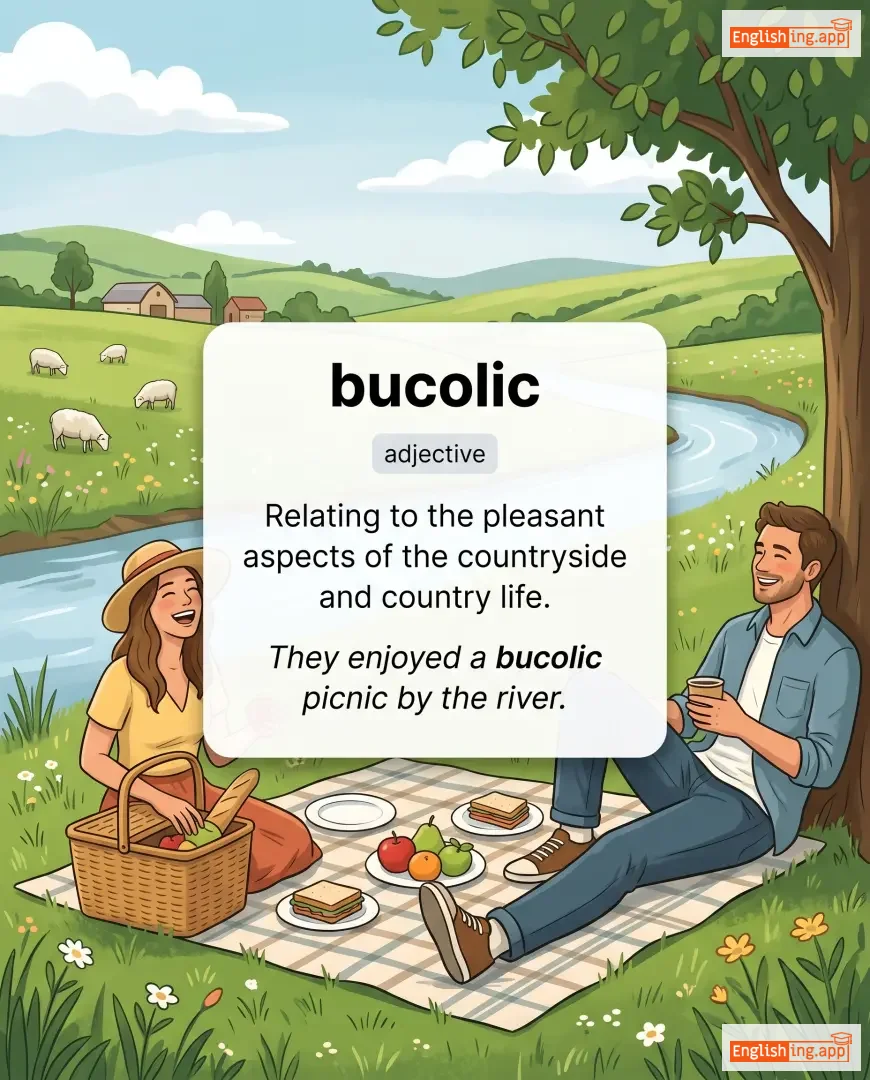
bucolic definition card — visual illustration of the meaning
adjective
/bjuːˈkɒlɪk/
ग्रामीण (gramin)

Relating to the pleasant aspects of the countryside and country life.

"They enjoyed a bucolic picnic by the river."

"वे नदी के किनारे एक ग्रामीण पिकनिक का आनंद ले रहे थे।" (Ve nadi ke kinare ek gramin picnic ka anand le rahe the.)
noun
/bʌd/
कली (kali)

An undeveloped or immature flower before it opens

"The rose bud will bloom into a beautiful flower in a few days."

"गुलाब की कली कुछ दिनों में एक सुंदर फूल में खिल जाएगी।" (gulaab ki kali kuch dinon mein ek sundar phool mein khil jaayegi)
noun
/ˈbʌdi/
दोस्त (dost)

a close friend or companion, used informally

"He went to the movies with his best buddy."

"वह अपनी सबसे अच्छे दोस्त के साथ मूवीज देखने गया था।" (vah apni sabse achhe dost ke saath movie dekhne gaya tha.)
verb
/bʌdʒ/
थोड़ा हिलाना / राय या स्थिति बदलना (thoda hilana / rai ya sthiti badalna)

To move slightly; to change one’s opinion or position.

"Despite the pressure, he refused to budge from his decision."

"दबाव के बावजूद, उसने अपने निर्णय से नहीं हिलने का इन्कार किया।" (Dabav ke bawajood, usne apne nirnay se nahi hilne ka inkaar kiya.)
noun/verb
/ˈbʌdʒɪt/
बजट (bajat)

An estimate of income and expenditure for a set period of time; to plan expenses and income.

"The family created a budget to manage their expenses."

"परिवार ने अपने खर्चों को नियंत्रित करने के लिए एक बजट तैयार किया।" (Parivar ne apne kharchon ko niyantrit karne ke liye ek bajat tayar kiya.)
noun/adjective/verb
/bʌf/
प्रशंसक / चमकाना (prashansak / chamkana)

A fan or enthusiast; also to polish or shine something.

"He is a movie buff who watches films every weekend."

"वह एक मूवी प्रशंसक है जो हर सप्ताहांत फिल्में देखता है।" (Vah ek movie prashansak hai jo har saptahant filmein dekhta hai.)
noun
/ˈbʌf.ə.loʊ/
जंगली बैल (jangli bail)

a large wild ox with heavy horns; American bison

"The buffalo grazed peacefully in the meadow."

"जंगली बैल घास के मैदान में शांति से चर रहे थे।" (jangli bail ghas ke maidan mein shanti se char rahe the)
noun/verb
/ˈbʌfər/
रक्षाकवच / आघात अवशोषक (rakshakavach / aghat avshoshak)

Something that lessens or absorbs the impact of a shock; to act as a protective barrier.

"The organization acts as a buffer between workers and management."

"संगठन श्रमिकों और प्रबंधन के बीच एक रक्षाकवच के रूप में कार्य करता है।" (Sangathan shramikon aur prabandhan ke beech ek rakshakavach ke roop mein karya karta hai.)
noun, verb
/bəˈfeɪ/ (noun), /ˈbʌfɪt/ (verb)
बुफे (buffet)

A meal where guests serve themselves from a variety of dishes arranged on a table; also means to strike repeatedly (as a verb).

"We enjoyed a large buffet at the wedding reception."

"हमने शादी के रिसेप्शन में बड़ा सा बुफे का आनंद लिया।" (Humne shaadi ke risepshan mein bada sa buffet ka anand liya.)
noun
/bəˈfuːn/
जोकर (joker)

A ridiculous but amusing person; a clown or jester.

"He acted like a buffoon at the party, making everyone laugh."

"वह पार्टी में जोकर की तरह बर्ताव कर रहा था, सबको हंसा रहा था।" (vah party mein joker ki tarah bartav kar raha tha, sabko hansa raha tha.)
noun
/bəˈfuːnəri/
पागलपन (pagalpan)

Foolish or ridiculous behavior intended to amuse.

"His constant buffoonery irritated the serious audience."

"उसकी लगातार पागलपन ने गंभीर दर्शकों को परेशान कर दिया।" (Uski lagatar pagalpan ne gambhir darshako ko pareshan kar diya.)
noun
/bʌɡ/
कीट (keet)

a small insect; informally, a flaw or error in a system or program

"There’s a bug in the code that causes the app to crash."

"कोड में एक बग है जो ऐप को क्रैश करता है।" (kode mein ek bag hai jo app ko crash karta hai.)
noun
/ˈbʌɡəˌbuː/
भयावह कल्पना / डर (bhayavah kalpana / dar)

An object of fear or worry; an imagined cause of anxiety.

"The threat of inflation became a political bugaboo."

"महंगाई का खतरा एक राजनीतिक डर बन गया।" (Mahangai ka khatra ek rajnaitik dar ban gaya.)
noun
/ˈbjuːɡəl/
ब्यूग्ल (byugal)

a brass musical instrument similar to a trumpet but without valves, used especially for military calls

"The soldier played the bugle to signal the start of the ceremony."

"सैनिक ने समारोह की शुरुआत का संकेत देने के लिए ब्यूग्ल बजाया" (sainik ne samaroah ki shuruat ka sinket dene ke liye byugal bajaya)
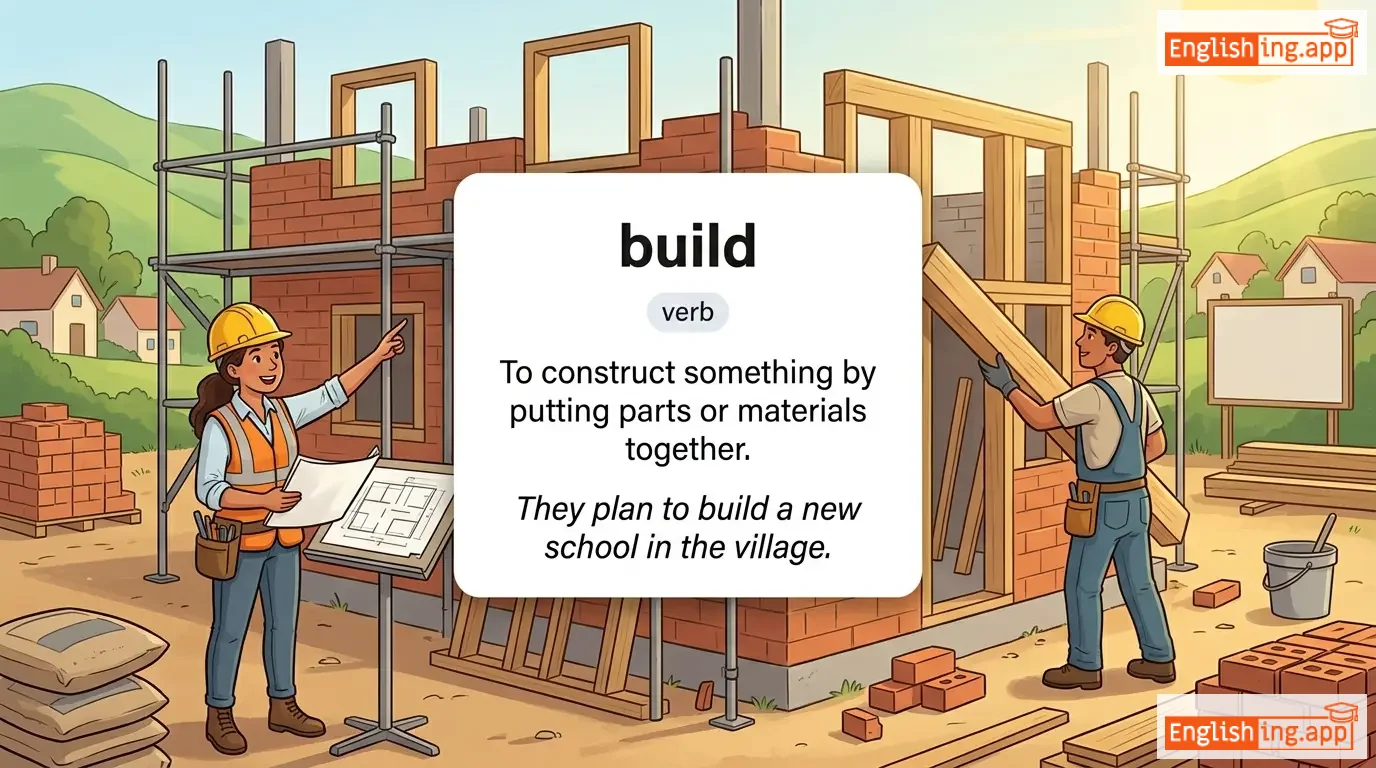
build definition card — visual illustration of the meaning
verb
/bɪld/
निर्माण करना (nirman karna)

To construct something by putting parts or materials together.

"They plan to build a new school in the village."

"वे गाँव में एक नया स्कूल बनाने की योजना बना रहे हैं।" (Ve gaon mein ek naya school banane ki yojana bana rahe hain.)
noun
/ˈbɪldər/
निर्माता (nirmaata)

a person or company that constructs buildings or other structures

"The builder checked the site before starting the construction."

"निर्माता ने निर्माण शुरू करने से पहले साइट का निरीक्षण किया।" (nirmaata ne nirman shuru karne se pehle saith ka nirikshan kiya.)