Vokabulare

Englisches Vokabelwörterbuch | Wortbedeutungen, Definitionen & Beispiele

verb
/sprɛd/
ausbreiten (ausbreiten)

to open or extend something over an area

"She spread the blanket on the grass for a picnic."

"Sie breitete die Decke auf dem Gras für ein Picknick aus." (Sie breitete die Decke auf dem Gras für ein Picknick aus.)
verb
/spreɪ/
sprühen (sprühen)

to apply liquid to something in a fine mist

"She sprayed perfume on her wrist before leaving."

"Sie sprühte Parfüm auf ihr Handgelenk, bevor sie ging." (Sie sprühte Parfüm auf ihr Handgelenk, bevor sie ging.)
noun, verb
/spreɪn/
verstauchung (verstauchung)

an injury to a joint in which the ligaments are stretched or torn

"She sprained her ankle while running in the park."

"Sie verdrehte ihren Knöchel, während sie im Park lief." (Sie verdrehte ihren Knoechel, waehrend sie im Park lief.)
noun
/spaʊs/
Ehepartner (Ehepartner)

a person's husband or wife

"Each employee may include their spouse in the health insurance plan."

"Jeder Mitarbeiter kann seinen Ehepartner in den Gesundheitsversicherungsplan aufnehmen." (Jeder Mitarbeiter kann seinen Ehepartner in den Gesundheitsversicherungsplan aufnehmen.)
noun
/ˈspɒt.ɪd sneɪk hed/
Schlangenkopffisch (Schlangenkopffisch)

a type of freshwater fish with spotted markings and an elongated head resembling a snake

"The spotted snake head is a popular fish for aquaculture in South Asia."

"Der Schlangenkopffisch ist in Südasien ein beliebter Fisch für die Aquakultur." (der schlangenkopffisch ist in sudasien ein beliebter fisch fur die aquakultur)
adjective
/ˈspɒtɪd/
gefleckt; markiert; gesehen (gefleckt; markiert; gesehen)

having spots or marks; noticed or seen

"The spotted leopard moved silently through the jungle."

"Der gefleckte Leopard bewegte sich lautlos durch den Dschungel." (Der gefleckte Leopard bewegte sich lautlos durch den Dschungel.)
noun
/ˈspɒt.laɪt/
Rampenlicht (Rampenlicht)

a strong beam of light directed onto a particular area; figuratively, public attention

"The singer stood proudly in the spotlight."

"Der Sänger stand stolz im Rampenlicht." (Der Saenger stand stolz im Rampenlicht.)
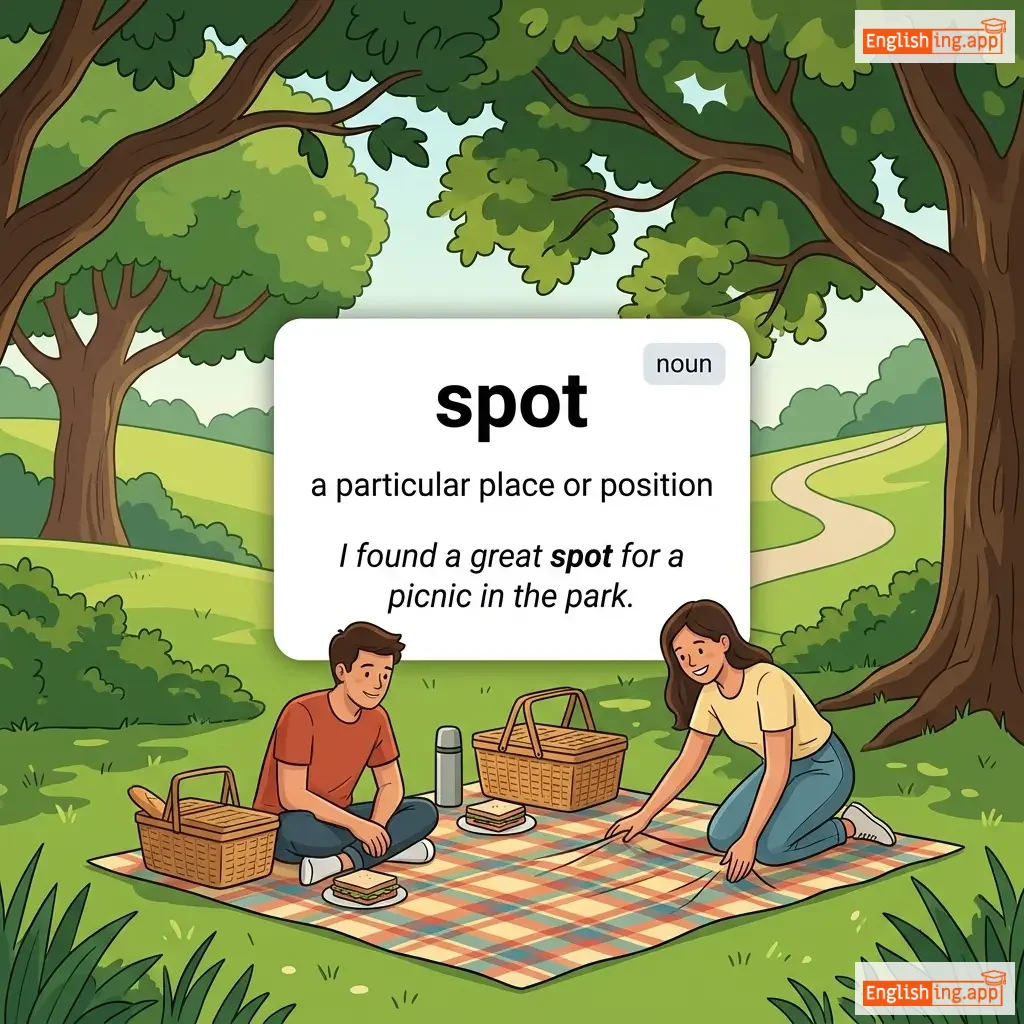
spot definition card — visual illustration of the meaning
noun
/spɒt/
Stelle (stelle)

a particular place or position

"I found a great spot for a picnic in the park."

"Ich habe einen großartigen Platz für ein Picknick im Park gefunden." (Ich habe einen großartigen Platz für ein Picknick im Park gefunden.)
noun
/ˈspɔːrtsmən/
Sportler (Sportler)

A person who is skilled in sports or enjoys participating in athletic activities.

"He is a true sportsman, always fair and respectful to his opponents."

"Er ist ein wahrer Sportler, immer fair und respektvoll gegenüber seinen Gegnern." (Er ist ein wahrer Sportler, immer fair und respektvoll gegenueber seinen Gegnern.)
adjective
/ˈspɔːrtɪv/
sportlich (sportlich)

Playful, lively, or full of fun.

"The children were in a sportive mood during the picnic."

"Die Kinder waren in einer sportlichen Stimmung während des Picknicks." (Die kinder waren in einer sportlichen stimmung wahrend des picknicks.)
noun
/spɔːt/
Sport (Sport)

an activity involving physical exertion and skill in which an individual or team competes against another or others for entertainment

"Football is a popular sport around the world."

"Fußball ist ein beliebter Sport auf der ganzen Welt." (Fussball ist ein beliebter Sport auf der ganzen Welt.)
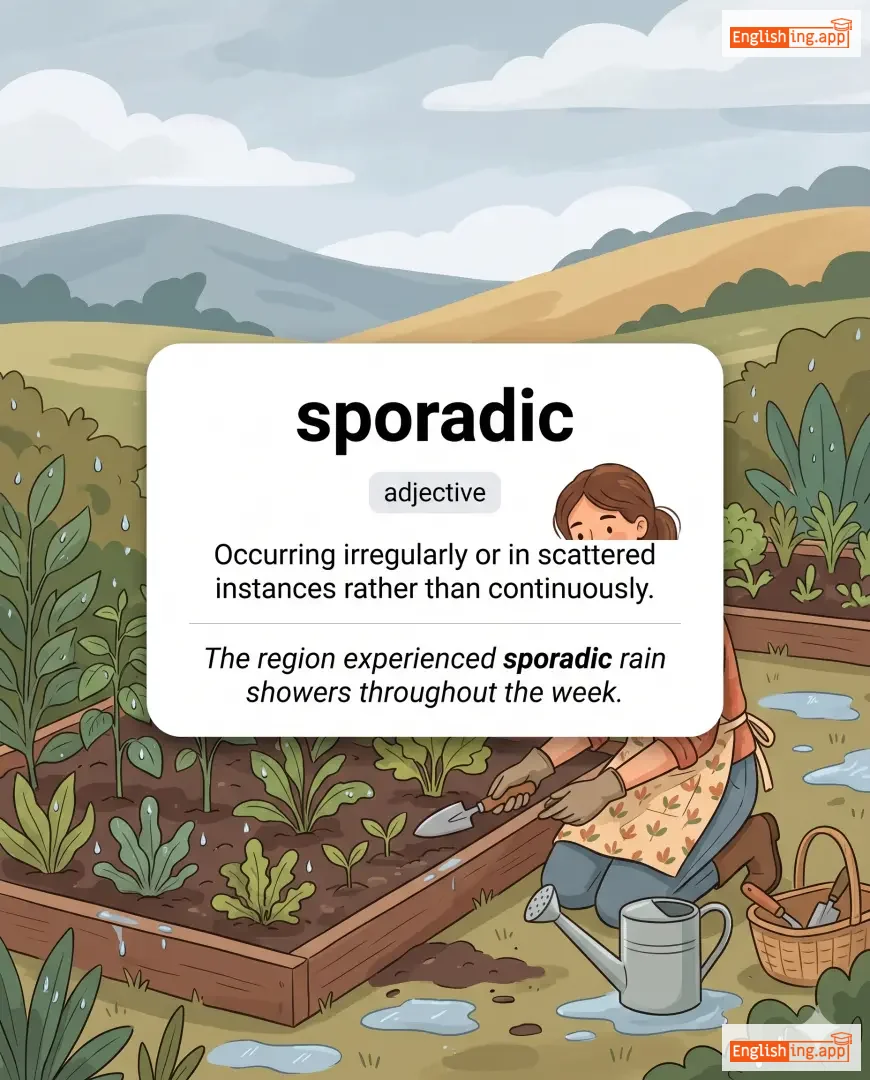
sporadic definition card — visual illustration of the meaning
adjective
/spəˈrædɪk/
sporadisch (sporadisch)

Occurring irregularly or in scattered instances rather than continuously.

"The region experienced sporadic rain showers throughout the week."

"Die Region erlebte sporadische Regenschauer während der ganzen Woche." (Die Region erlebte sporadische Regenschauer während der ganzen Woche.)
noun
/ˈspuːnərɪzəm/
Spoonerismus (spoonerismus)

A verbal error in which the initial sounds of words are swapped to create a humorous effect.

"He made a spoonerism by saying 'queer old dean' instead of 'dear old queen'."

"Er machte einen Spoonerismus, als er 'seltsamer alter Dekan' anstelle von 'lieber alter König' sagte." (Er machte einen Spoonerismus, als er 'seltsamer alter Dekan' anstelle von 'lieber alter König' sagte.)
noun
/spuːn/
Löffel (Loeffel)

a utensil consisting of a small shallow bowl with a handle, used for eating, stirring, or serving food

"She stirred her coffee with a silver spoon."

"Sie rührte ihren Kaffee mit einem silbernen Löffel." (Sie rührte ihren Kaffee mit einem silbernen Löffel.)
noun/verb
/spuːf/
humorvolle Nachahmung (humorvolle Nachahmung)

A humorous imitation of something, or to trick or parody someone or something.

"The comedian spoofed the politician’s speech to entertain the audience."

"Der Komiker parodierte die Rede des Politikers, um das Publikum zu unterhalten." (Der Komiker parodierte die Rede des Politikers, um das Publikum zu unterhalten.)
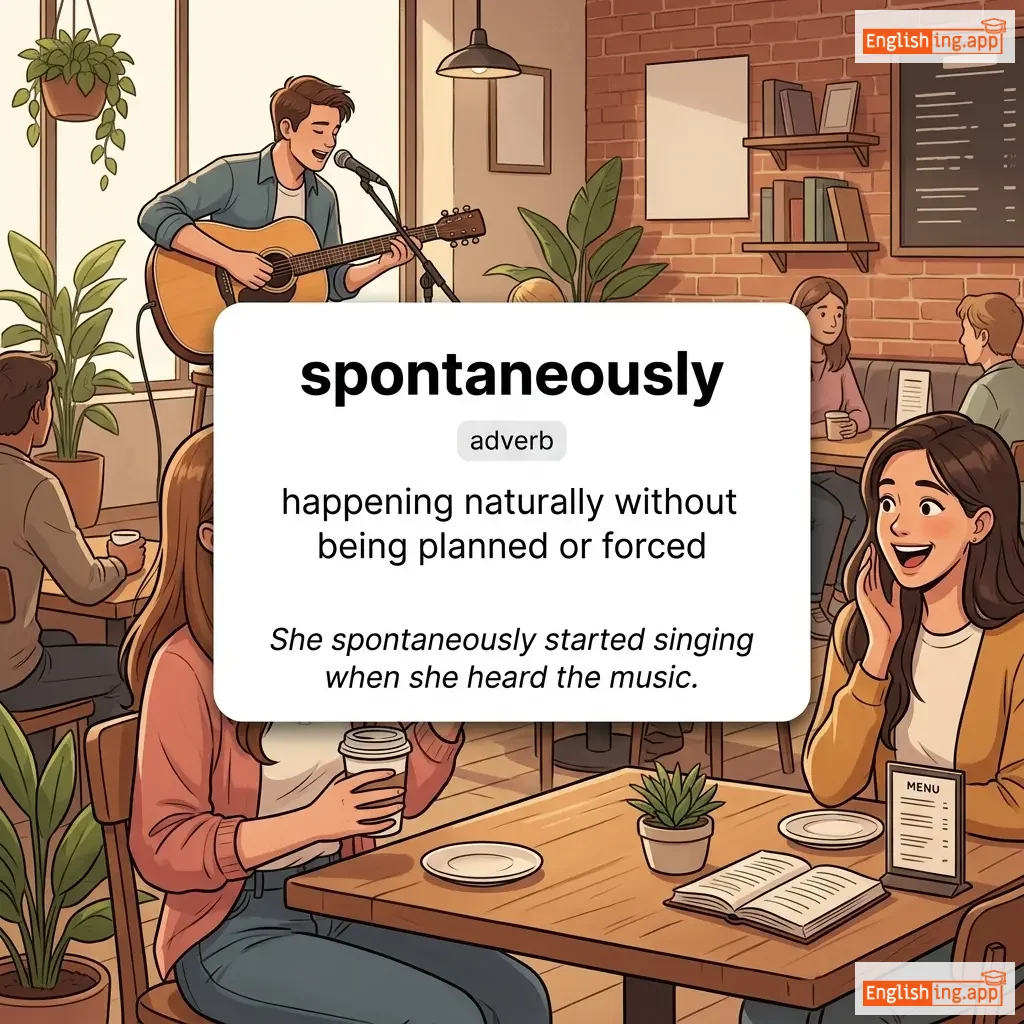
spontaneously definition card — visual illustration of the meaning
adverb
/spɒnˈteɪ.ni.əs.li/
spontan (spontan)

happening naturally without being planned or forced

"She spontaneously started singing when she heard the music."

"Sie begann spontan zu singen, als sie die Musik hörte." (Sie begann spontan zu singen, als sie die Musik hörte.)
adjective
/spɒnˈteɪniəs/
spontan (spontan)

Happening naturally without planning or external cause; impulsive or unplanned.

"Their spontaneous trip to the mountains turned out to be the highlight of the summer."

"Ihre spontane Reise in die Berge war das Highlight des Sommers." (Ihre spontane Reise in die Berge war das Highlight des Sommers.)
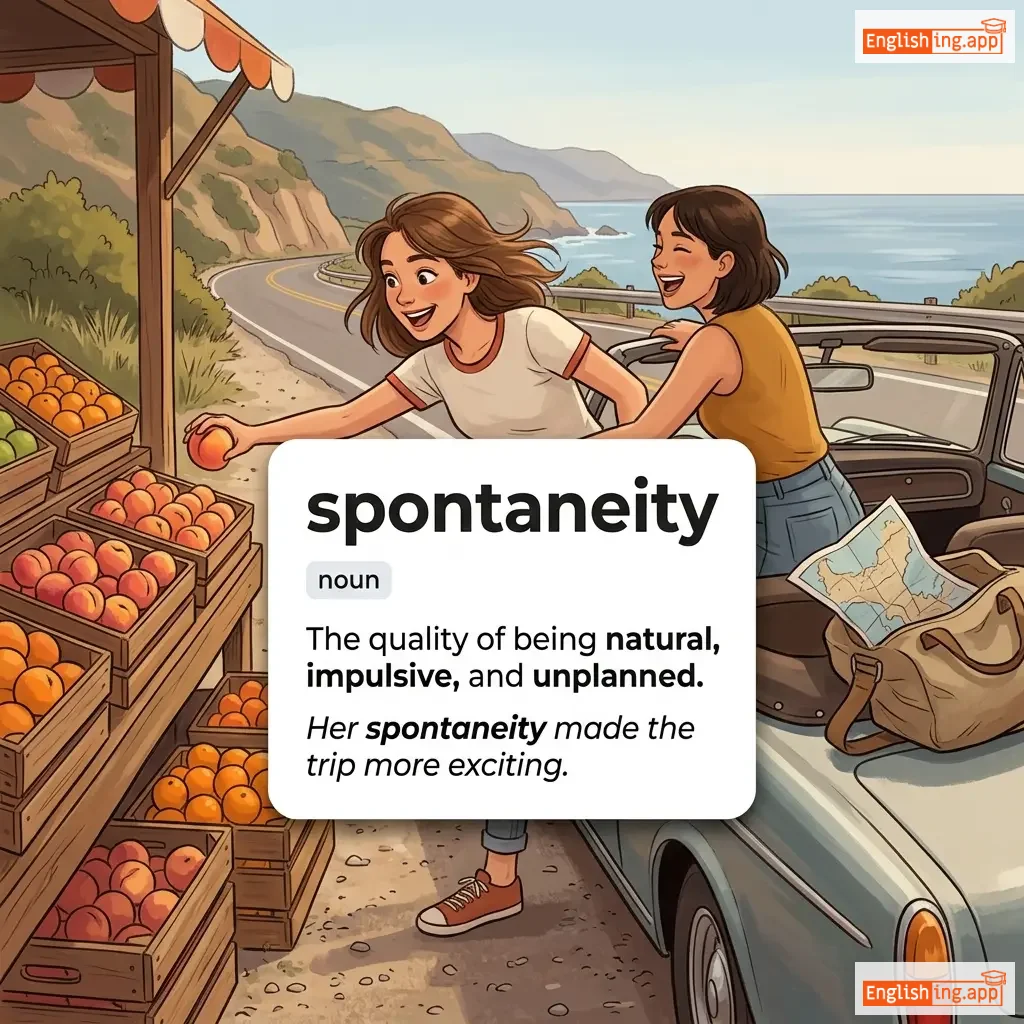
spontaneity definition card — visual illustration of the meaning
noun
/ˌspɑːntəˈneɪəti/
Spontaneität (Spontaneitat)

The quality of being natural, impulsive, and unplanned.

"Her spontaneity made the trip more exciting."

"Ihre Spontaneität machte die Reise aufregender." (ihre spontaneitat machte die reise aufregender.)
noun
/ˈspɒnsəʃɪp/
Sponsoring (Sponsoring)

the act of supporting an event, activity, person, or organization financially or through other resources

"The event was made possible due to the sponsorship of several big companies."

"Die Veranstaltung wurde durch das Sponsoring mehrerer großer Unternehmen möglich gemacht." (Die Veranstaltung wurde durch das Sponsoring mehrerer großer Unternehmen möglich gemacht.)
sponsor definition card — visual illustration of the meaning
noun
/ˈspɒnsər/
Sponsor (Sponsor)

a person or organization that provides funds for a project or activity in exchange for publicity or support

"The company became the main sponsor of the event."

"Das Unternehmen wurde der Hauptsponsor der Veranstaltung." (Das Unternehmen wurde der Hauptsponsor der Veranstaltung.)
noun
/spʌndʒ ɡɔːrd/
Schwammgurke (Schwammgurke)

a fibrous gourd that becomes sponge-like when dried, used for cleaning and in cooking when young

"The sponge gourd can be eaten when young or dried to make natural scrubbers."

"Die Schwammgurke kann gegessen werden, wenn sie jung ist oder getrocknet werden, um natürliche Schwämme herzustellen." (Die Schwammgurke kann gegessen werden, wenn sie jung ist oder getrocknet werden, um natürliche Schwämme herzustellen.)
adjective
/ˈspʌndʒi/
schwammig (schwammig)

soft and full of holes like a sponge; porous

"The cake had a light and spongy texture."

"Der Kuchen hatte eine leichte und schwammige Textur." (Der Kuchen hatte eine leichte und schwammige Textur.)
noun
/ˌspoʊliˈeɪʃən/
Zerstörung (zerstoerung)

The act of destroying or ruining something, often evidence or property.

"The court punished the company for the spoliation of evidence."

"Das Gericht bestrafte das Unternehmen für die Zerstörung von Beweismitteln." (Das Gericht bestrafte das Unternehmen für die Zerstörung von Beweismitteln.)
noun
/ˈspəʊkswɪmən/
sprecherin frau (sprecherin frau)

a woman who speaks on behalf of a group or organization

"The spokeswoman for the company announced the new product."

"Die sprecherin des unternehmens kündigte das neue produkt an." (Die sprecherin des unternehmens kündigte das neue produkt an.)
noun
/ˈspəʊkspɜːrsən/
Sprecher (Sprecher)

a person who speaks on behalf of others or an organization

"The spokesperson addressed the press conference on behalf of the company."

"Der Sprecher hielt die Pressekonferenz im Namen des Unternehmens." (Der Sprecher hielt die Pressekonferenz im Namen des Unternehmens.)
adverb
/ˈspeʃ.əl.i/
speziell (speziell)

for a particular purpose; especially; specifically

"This gift was specially made for you."

"Dieses Geschenk wurde speziell für dich gemacht." (Dieses Geschenk wurde speziell für dich gemacht.)
adjective
/ˈspiːtʃləs/
sprachlos (sprachlos)

Unable to speak because of shock, surprise, or strong emotion.

"She was speechless when she received the award."

"Sie war sprachlos, als sie den Preis erhielt." (Sie war sprachlos, als sie den Preis erhielt.)
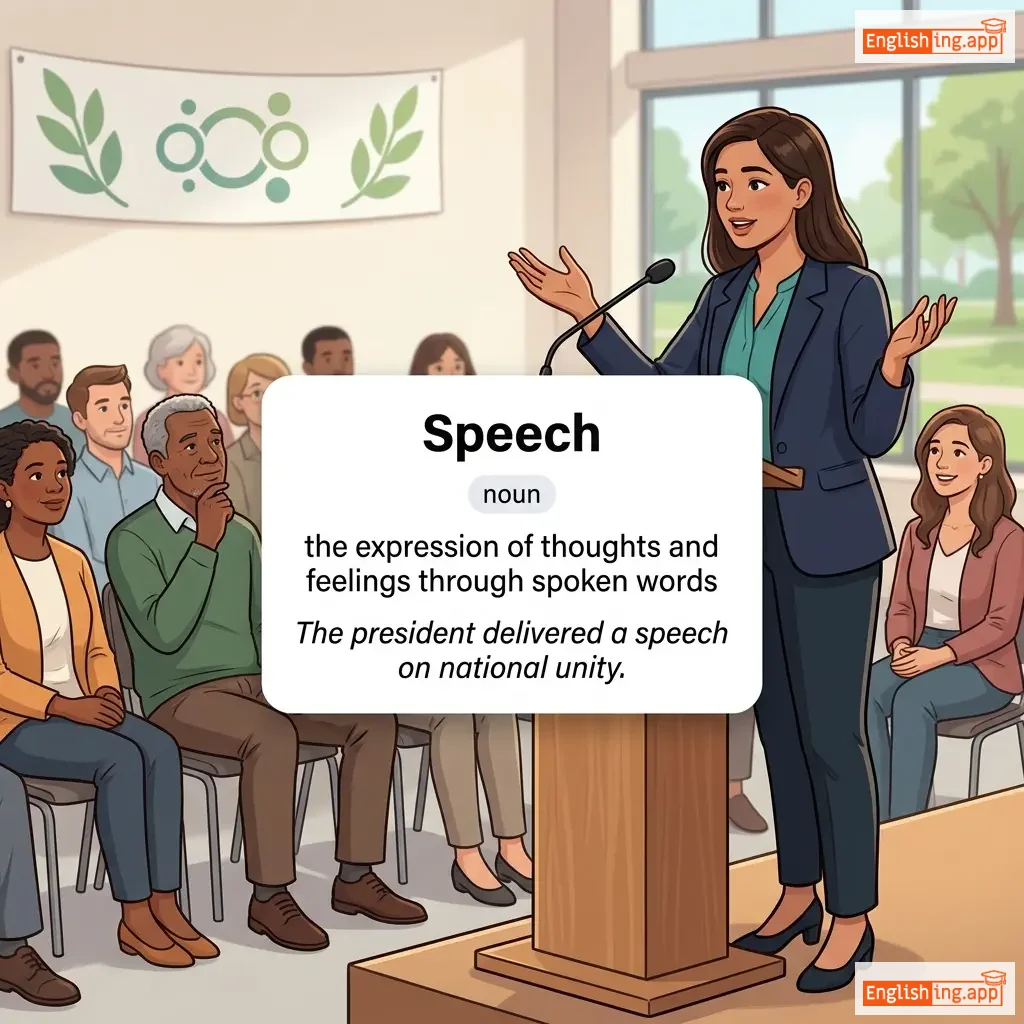
Speech definition card — visual illustration of the meaning
noun
/spiːʧ/
rede (rede)

the expression of thoughts and feelings through spoken words

"The president delivered a speech on national unity."

"Der Präsident hielt eine Rede über nationale Einheit." (Der Praesident hielt eine Rede ueber nationale Einheit.)
noun
/ˈspɛkjʊˌleɪtər/
Spekulant (Spekulant)

A person who forms theories without evidence, or invests in assets hoping for profit.

"The real estate speculator bought land hoping its value would rise."

"Der Immobilien-Spekulant kaufte Land in der Hoffnung, dass sein Wert steigen würde." (Der Immobilien-Spekulant kaufte Land in der Hoffnung, dass sein Wert steigen würde.)
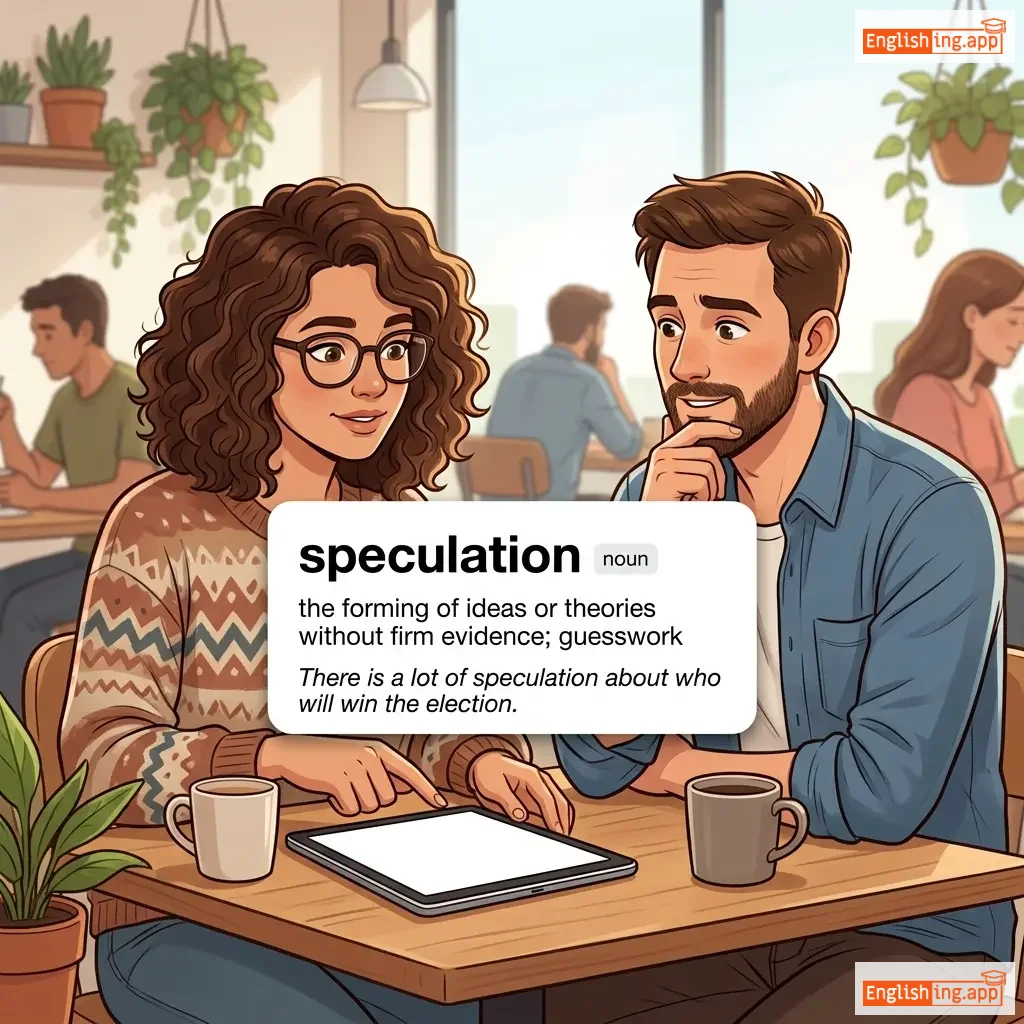
speculation definition card — visual illustration of the meaning
noun
/ˌspɛkjʊˈleɪʃən/
Spekulation (Spekulation)

the forming of ideas or theories without firm evidence; guesswork

"There is a lot of speculation about who will win the election."

"Es gibt viele Spekulationen darüber, wer die Wahl gewinnen wird." (Es gibt viele Spekulationen darueber, wer die Wahl gewinnen wird.)
verb
/ˈspɛkjʊˌleɪt/
spekulieren / investieren (spekulieren / investieren)

To form a theory or guess without firm evidence; to invest in stocks, property, etc. hoping for profit.

"Experts speculate that the company may expand into new markets."

"Experten spekulieren, dass das Unternehmen auf neue Märkte expandieren könnte." (Experten spekulieren, dass das Unternehmen auf neue Märkte expandieren könnte.)
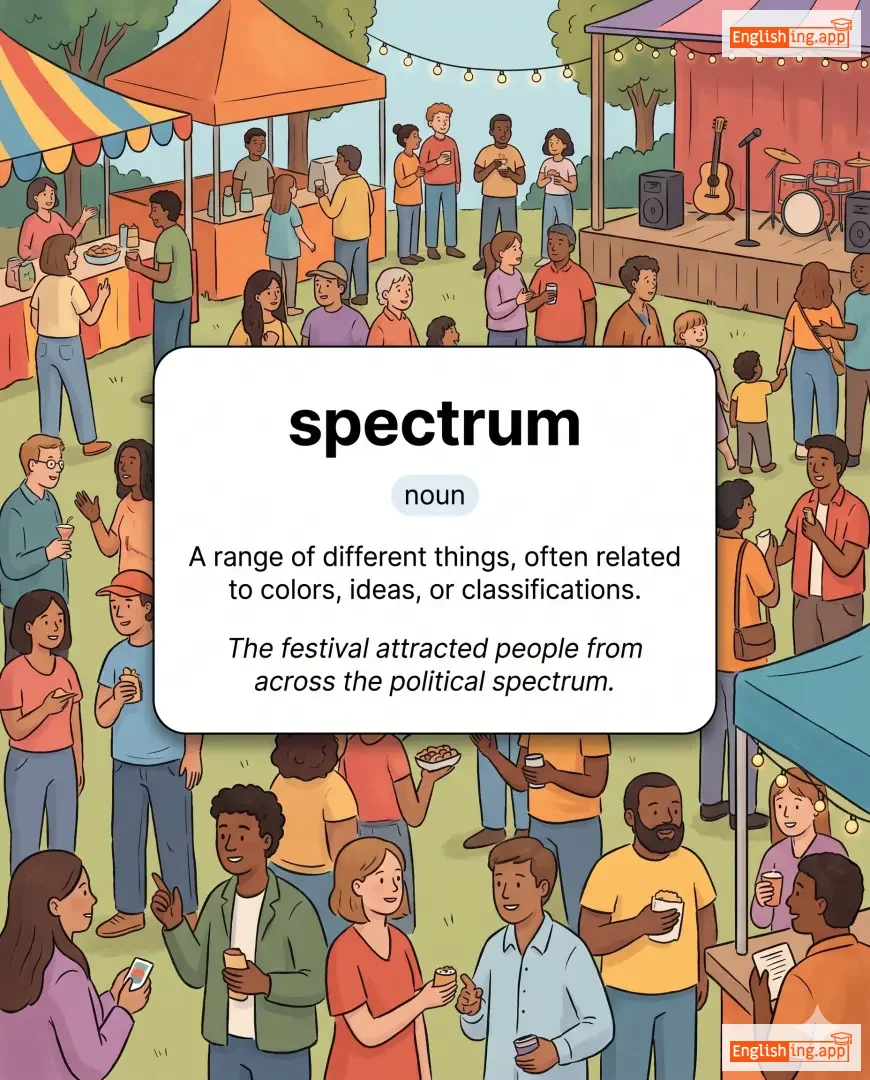
spectrum definition card — visual illustration of the meaning
noun
/ˈspɛktrəm/
Spektrum (Spektrum)

A range of different things, often related to colors, ideas, or classifications.

"The festival attracted people from across the political spectrum."

"Das Festival zog Menschen aus dem gesamten politischen Spektrum an." (Das Festival zog Menschen aus dem gesamten politischen Spektrum an.)
adjective
/ˈspɛktrəl/
gespenstisch (gespenstisch)

Relating to a ghost or specter; ghostly. Also relating to a spectrum.

"The old mansion had a spectral atmosphere at night."

"Das alte Herrenhaus hatte nachts eine gespenstische Atmosphäre." (Das alte Herrenhaus hatte nachts eine gespenstische Atmosphäre.)
noun
/ˈspɛktər/
Gespenst (gespenst)

A ghost or spirit; something that causes fear or dread.

"The specter of war still haunts the region."

"Das Gespenst des Krieges verfolgt immer noch die Region." (Das Gespenst des Krieges verfolgt immer noch die Region.)
noun
/ˈspɛkteɪtər/
Zuschauer (Zuschauer)

A person who watches an event, show, or game without taking part.

"Thousands of spectators gathered to watch the football match."

"Tausende von Zuschauern versammelten sich, um das Fußballspiel zu sehen." (Tausende von Zuschauern versammelten sich, um das Fussballspiel zu sehen.)
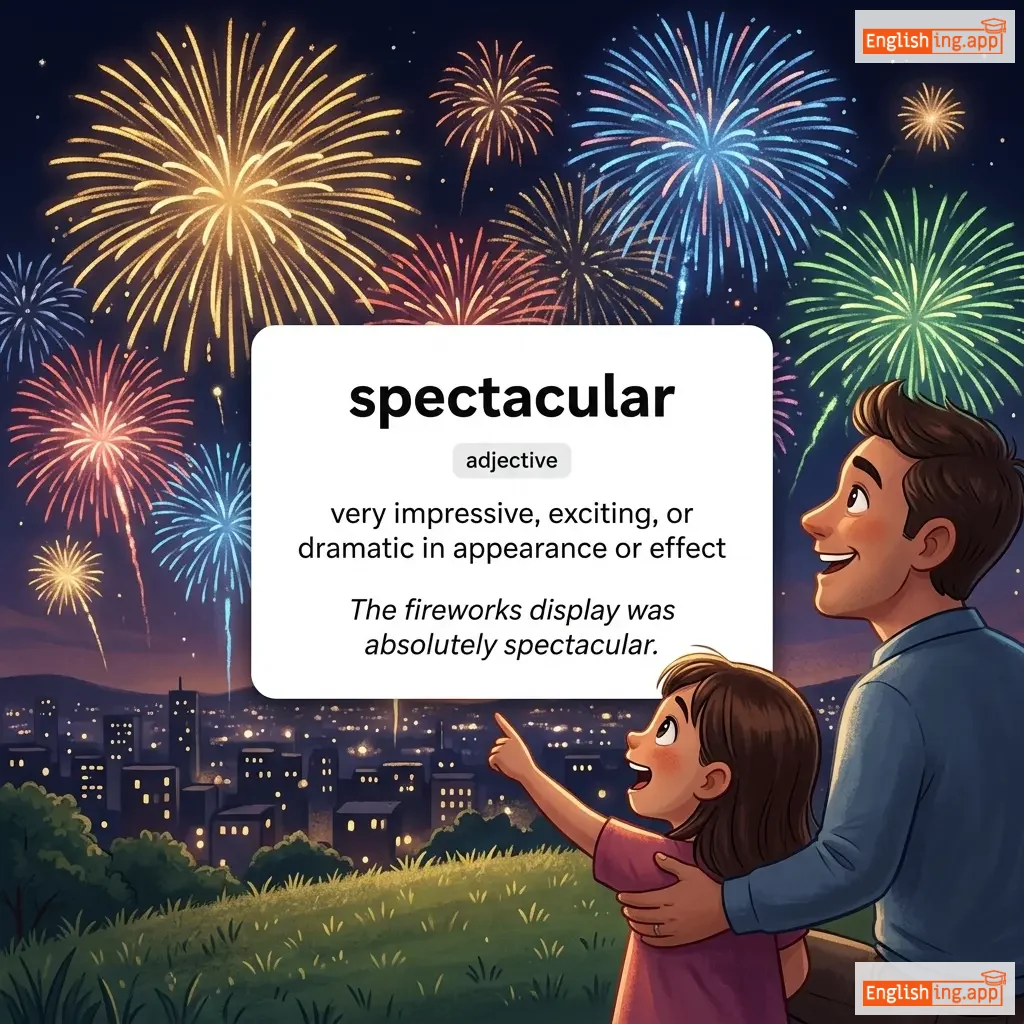
spectacular definition card — visual illustration of the meaning
adjective
/spɛkˈtækjələr/
spektakulär (spektakulaer)

very impressive, exciting, or dramatic in appearance or effect

"The fireworks display was absolutely spectacular."

"Das Feuerwerk war absolut spektakulär." (Das Feuerwerk war absolut spektakulaer.)
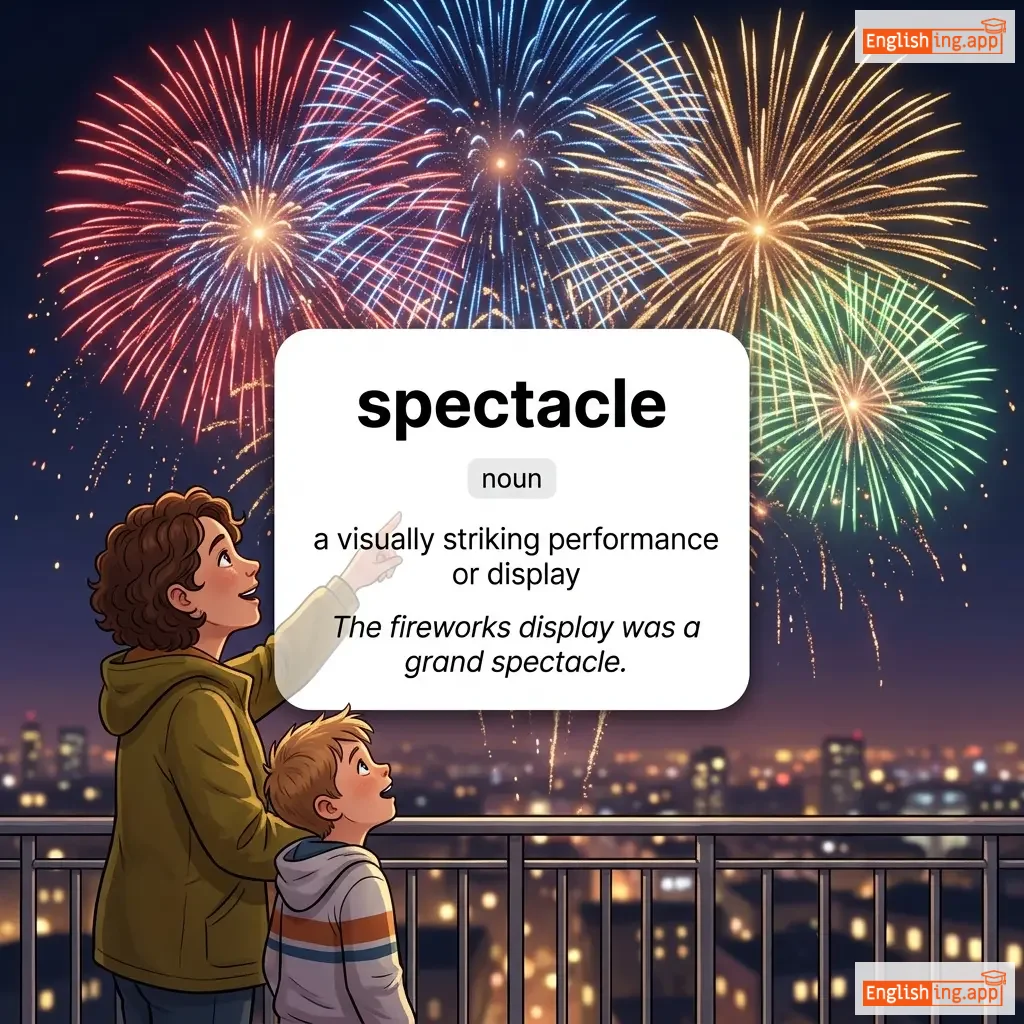
spectacle definition card — visual illustration of the meaning
noun
/ˈspɛktəkəl/
visuelle Darbietung (visuelle darbietung)

a visually striking performance or display

"The fireworks display was a grand spectacle."

"Das Feuerwerk war ein großes Spektakel." (Das Feuerwerk war ein grosses Spektakel.)
noun
/spɛk/
Fleck (Fleck)

A very small spot, mark, or particle.

"There was a tiny speck of dust on the glass table."

"Es war ein kleiner Fleck Staub auf dem Glastisch." (Es war ein kleiner Fleck Staub auf dem Glastisch.)
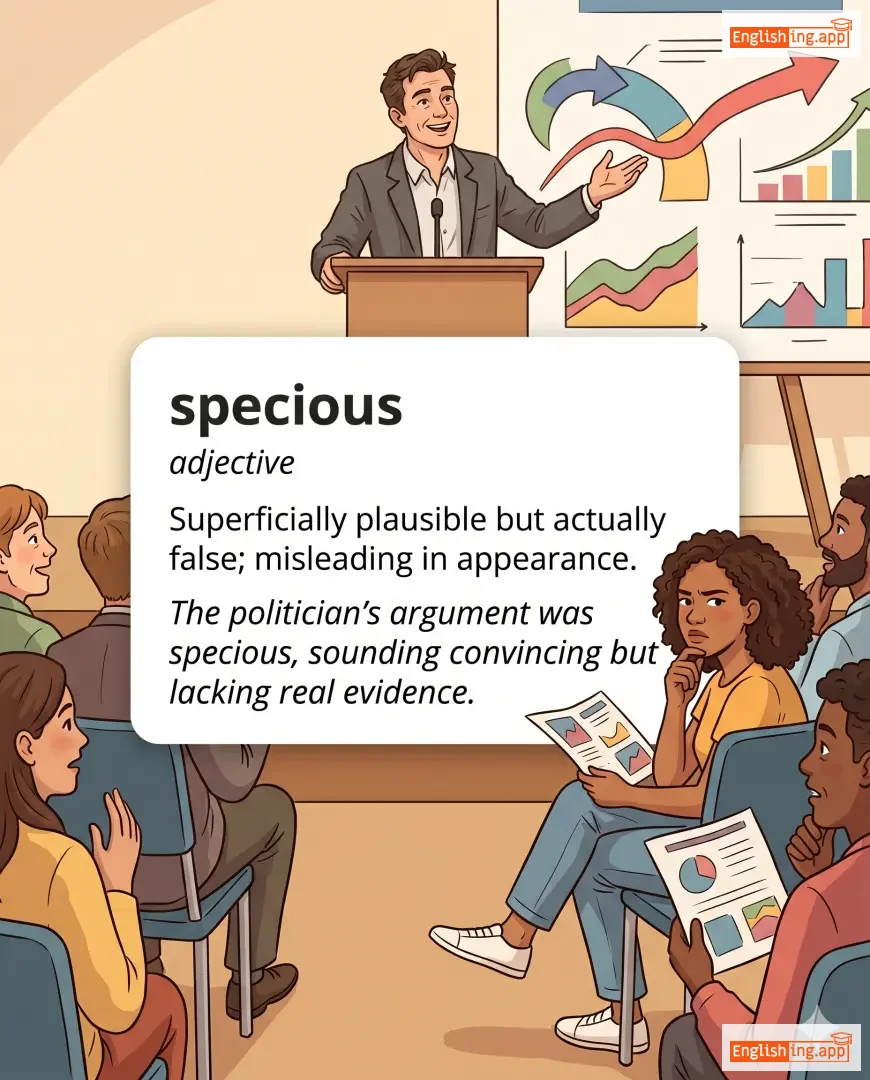
specious definition card — visual illustration of the meaning
adjective
/ˈspiːʃəs/
trügerisch (truegerisch)

Superficially plausible but actually false; misleading in appearance.

"The politician’s argument was specious, sounding convincing but lacking real evidence."

"Das Argument des Politikers war trügerisch, es klang überzeugend, hatte aber keine wirklichen Beweise." (Das Argument des Politikers war truegerisch, es klang ueberzeugend, hatte aber keine wirklichen Beweise.)
noun
/ˈspɛsəmən/
Probe (Probe)

an individual animal, plant, piece of a mineral, etc., used as an example of its species or type for scientific study

"The museum has a rare butterfly specimen."

"Das Museum hat ein seltenes Schmetterlings-Probe." (Das Museum hat ein seltenes Schmetterlings-Probe.)
verb
/ˈspɛsɪfaɪ/
spezifizieren (spezifizieren)

to state or describe something clearly and exactly

"Please specify the time and place of the meeting."

"Bitte geben Sie die Zeit und den Ort des Treffens an." (Bitte geben Sie die Zeit und den Ort des Treffens an.)
noun
/ˌspɛsɪfɪˈkeɪʃən/
spezifikation (spezifikation)

a detailed description or assessment of something

"The product specification includes all the necessary details."

"Die Produktspezifikation enthält alle notwendigen Details." (Die Produktspezifikation enthaelt alle notwendigen Details.)
adverb
/spəˈsɪfɪkli/
speziell (speziell)

in a clear and exact way

"He was specifically asked to handle the finances."

"Er wurde speziell gebeten, die Finanzen zu verwalten." (Er wurde speziell gebeten, die Finanzen zu verwalten.)
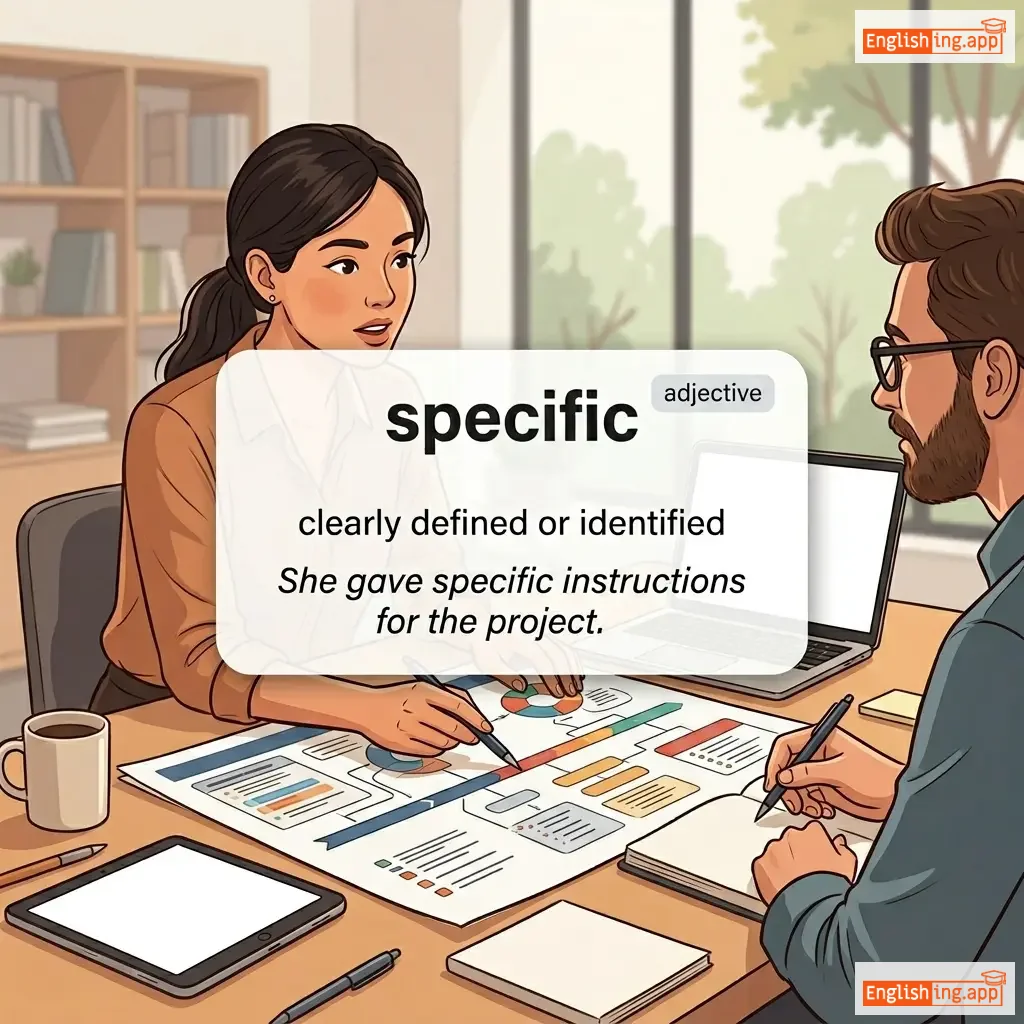
specific definition card — visual illustration of the meaning
adjective
/spəˈsɪfɪk/
spezifisch (spezifisch)

clearly defined or identified

"She gave specific instructions for the project."

"Sie gab spezifische Anweisungen für das Projekt." (Sie gab spezifische Anweisungen für das Projekt.)
noun
/ˈspiːʃiːz/
Spezies (Spezies)

a group of living organisms consisting of similar individuals capable of exchanging genes or interbreeding

"The panda is an endangered species."

"Der Panda ist eine gefährdete Spezies." (Der Panda ist eine gefährdete Spezies.)
noun
/ˈspiːʃiː/
Münzen (Muenzen)

money in the form of coins rather than notes or credit

"The transaction was made in specie."

"Die Transaktion wurde mit Münzen durchgeführt." (Die Transaktion wurde mit Muenzen durchgefuehrt.)
noun
/ˈspɛʃəlti/
Spezialität (spezialitaet)

a particular area of study, work, or interest; something in which a person or place excels

"Her specialty is pediatric medicine."

"Ihre Spezialität ist die Kinderheilkunde." (ihre spezialitaet ist die kinderheilkunde)
adjective
/spæzˈmɒdɪk/
krampfartig (krampfartig)

occurring irregularly or in sudden bursts

"The patient experienced spasmodic coughing during the night."

"Der Patient hatte während der Nacht krampfartige Hustenanfälle." (Der Patient hatte wahrend der Nacht krampfartige Hustenanfalle.)
adjective
/spɑːrs/
spärlich (spaerlich)

thinly scattered or distributed; not dense or abundant

"Vegetation was sparse in the desert."

"Die Vegetation war spärlich in der Wüste." (Die Vegetation war spaerlich in der Wüste.)
adjective
/ˈspɑːrtn/
spartianisch (spartianisch)

showing simplicity and lack of luxury; austere

"He lived in a spartan room with just a bed and a chair."

"Er lebte in einem spartanischen Zimmer mit nur einem Bett und einem Stuhl." (Er lebte in einem spartanischen Zimmer mit nur einem Bett und einem Stuhl.)