Словари

Словарь английского языка | Значения слов, определения и примеры

noun
/ˈtɛmpoʊ/
темп, ритм (temp, ritm)

The speed or pace at which a piece of music or activity is performed.

"The band played the song at a faster tempo than usual."

"Группа сыграла песню с более быстрым темпом, чем обычно." (Gruppa sygrala pesnyu s boleye bystrym tempom, chem obychno.)
adjective
/ˈtɛmpərəl/
временной (vremennoy)

Relating to worldly affairs or to time rather than spiritual matters.

"The monk gave up his temporal possessions to live a simple life."

"Монах отказался от своих временных possessions, чтобы вести простую жизнь." (Monakh otkazalsya ot svoikh vremennykh possessions, chtoby vesti prostuyu zhizn'.)
adverb
/ˈtɛmpərɛrɪli/
временно (vremenno)

for a limited time; not permanently

"The road is closed temporarily for repairs."

"Дорога закрыта временно для ремонта." (Doroga zakryta vremenno dlya remonta.)
adjective
/ˈtɛmpərɛri/
временный (vremennyy)

Lasting for only a limited period of time; not permanent.

"She found a temporary job during the summer break."
"Она нашла временную работу во время летних каникул." (Ona nashla vremennuyu rabotu vo vremya letnikh kanikul.)
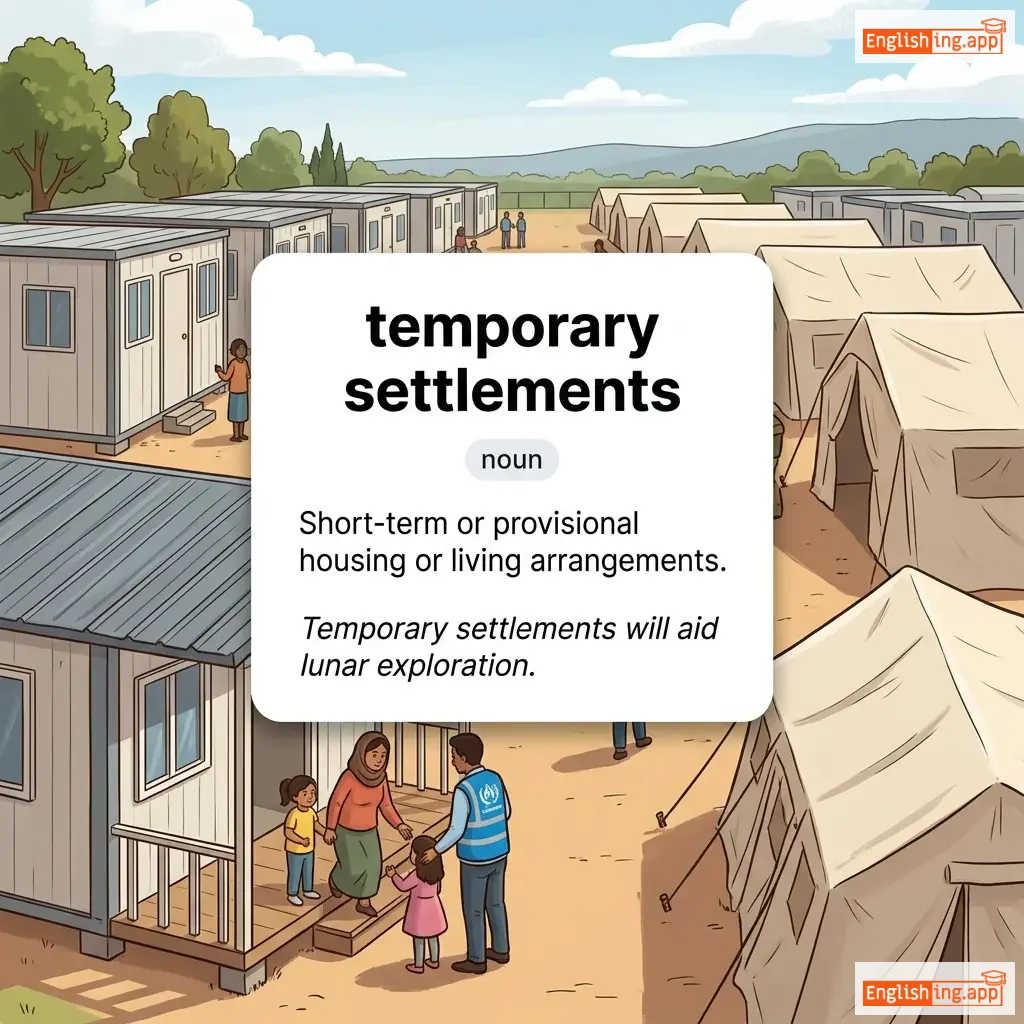
temporary settlements definition card — visual illustration of the meaning
noun
ˈtempəreri ˈsetlmənts
временные поселения (vremennye poseleniya)

Short-term or provisional housing or living arrangements.

"Temporary settlements will aid lunar exploration."

"Временные поселения помогут исследованию Луны." (Vremennye poseleniya pomogut issledovaniyu Luny.)
verb
/ˈtɛmpəˌraɪz/
откладывать (otkladyvat)

To delay making a decision or taking action in order to gain time.

"The politician temporized when asked about the controversial issue."

"Политик откладывал, когда его спрашивали о спорном вопросе." (Politik otkladyval, kogda ego sprashivali o spornom voprose.)
verb
/tɛmpt/
соблазнять (soblaznyat)

to entice or attract someone to do something, often something wrong or unwise

"The smell of fresh bread tempted him to enter the bakery."

"Запах свежего хлеба соблазнил его войти в пекарню." (Zapakh svezhего khleba soblaznil ego voyti v pekarnyu.)
noun
/temp.ˈteɪ.ʃən/
искушение (iskushenie)

the desire to do something wrong or unwise; an urge to have or do something

"He resisted the temptation to eat the entire chocolate cake."

"Он сопротивлялся искушению съесть весь шоколадный торт." (On soprotivlyalsya iskusheniyu s'yest' ves' shokoladnyy tort.)
noun
/ˈtɛmptər/
искуситель (iskusitel)

a person or thing that entices someone into doing something wrong

"The tempter whispered false promises into his ear."

"Искуситель шептал ложные обещания ему на ухо." (Iskusitel sheptal lozhnye obeshchaniya yemu na ukho.)
adjective
/ˈtemptɪŋ/
заманчивый (zamanchivyy)

appealing to or attracting someone, even if wrong or inadvisable; alluring

"The chocolate cake looked very tempting in the bakery window."

"Шоколадный торт выглядел очень заманчиво в витрине пекарни." (Shokoladnyy tort vygledel ochen' zamanchivo v vitrine pekarni.)
noun
/tɛn/
десять (dyesyat)

the number following nine and preceding eleven

"I have ten apples in the basket."

"У меня десять яблок в корзине." (U menya desyat yablok v korzine.)
adjective
/ˈtɛnəbl/
защищаемый (zashchishchayemyy)

able to be defended or maintained against attack or objection

"His argument was strong and tenable in court."

"Его аргумент был сильным и защитимым в суде." (Ego argument byl sil'nym i zashchishchayemym v sude.)
tenacious definition card — visual illustration of the meaning
adjective
/təˈneɪʃəs/
упорный (upornyy)

holding firmly to something; persistent and determined

"She was tenacious in pursuing her goals."

"Она была упорна в достижении своих целей." (Ona byla uporna v dostizhenii svoikh tseley.)
tenacity definition card — visual illustration of the meaning
noun
/təˈnæsəti/
упорство (uporstvo)

the quality of being persistent, determined, and not easily giving up

"His tenacity helped him succeed despite many failures."

"Его упорство помогло ему добиться успеха, несмотря на множество неудач." (Ego uporstvo pomoglo emu dobitsya uspekha, nesmotrya na mnogochislennoe neudachi.)
noun
/ˈtɛnənsi/
аренда (arenda)

The possession or occupation of land or property as a tenant.

"The tenancy agreement was signed for two years."

"Договор аренды был подписан на два года." (Dogovor arendy byl podpisan na dva goda.)
noun
/ˈtɛnənt/
арендатор (arendator)

A person who occupies land or property rented from a landlord.

"The tenant paid the rent on time every month."

"Арендатор платил аренду вовремя каждый месяц" (Arendator platil arendu vovremja kazhdyj mesjac)
verb
/tɛnd/
склоняться/заботиться (sklonyatsya/zabotitsya)

To regularly behave in a particular way or to take care of something.

"She tends to wake up early in the morning."

"Она склонна вставать рано утром." (Ona sklonna vstavayt' rano utrom.)
noun
/ˈtɛndənsi/
тенденция (tendentsiya)

An inclination or likelihood to behave in a certain way.

"He has a tendency to forget small details."

"У него есть тенденция забывать мелкие детали." (U nego yest' tendentsiya zabyvat' melkiye detali.)
adjective
/tɛnˈdɛnʃəs/
тенденциозный (tendentsiozny)

Expressing or promoting a particular cause or point of view, often biased.

"The article was criticized for its tendentious tone."

"Статья была раскритикована за ее тенденциозный тон." (Stat'ya byla raskritikovana za yey tendentsiozny ton.)
verb, noun, adjective
/ˈtɛndər/
предложение / нежный (predlozhenie / nezhnyy)

to offer formally; soft and delicate in texture or character; a formal offer or proposal

"The company tendered its resignation to the board."

"Компания подала свою отставку в совет директоров." (Kompaniya podala svoiu otstavku v sovet direktorov.)
noun
/ˈten.dər.nəs/
нежность (nezhnost')

gentleness and kindness; the quality of being easily hurt or damaged

"The mother showed great tenderness while caring for her sick child."

"Мать проявила большую нежность, заботясь о своем больном ребенке." (Mat' proyavila bol'shuyu nezhnost', zabotyas' o svoem bol'nom rebenke.)
adjective
/ˈtɛnɪbrəs/
мрак (mrak)

dark, shadowy, or obscure

"The cave was damp and tenebrous, filled with eerie sounds."

"Пещера была влажной и тенисто-ужасной, наполненной странными звуками." (Peshchera byla vlazhnoy i tenistoy-uzhasnoy, napolnennoy strannymi zvukami.)
noun
/ˈtɛnəmənt/
арендованное жилье (arendovannoe zhilye)

a large building divided into separate apartments, often in poor condition

"The family lived in a crowded tenement in the city."

"Семья жила в переполненном арендованном жилье в городе." (Sem'ya zhila v perepovlennom arendovannom zhilye v gorode.)
tenet definition card — visual illustration of the meaning
noun
/ˈtɛnɪt/
принцип (printsip)

a principle, belief, or doctrine held to be true

"Honesty is a central tenet of their philosophy."

"Честность — это основной принцип их философии." (Chestnost' — eto osnovnoy printsip ikh filosofii.)
noun
/ˈtɛnɪs/
теннис (tennis)

a sport played with rackets and a ball on a rectangular court

"He enjoys playing tennis with his friends on the weekends."

"Он любит играть в теннис с друзьями на выходных." (On lyubit igrat' v tennis s druz'yami na vykhodnykh.)
noun
/ˈtɛnər/
тенор / общий тон (tenor / obshchiy ton)

the general meaning, drift, or character of something; a male singing voice between baritone and alto

"The overall tenor of his speech was hopeful and reassuring."

"Общий тенор его речи был обнадеживающим и успокаивающим." (Obshchiy tenor ego rechi byl obnadezhivayushchim i uspokayayushchim.)
noun, adjective, verb
/tɛns/
напряжение / грамматическое время (napryazhenie / grammaticheskoe vremya)

a grammatical category showing time reference; stretched tight or anxious

"She felt tense before the interview."
"Она чувствовала напряжение перед интервью." (Ona chuvstvovala napryazhenie pered intervyu.)
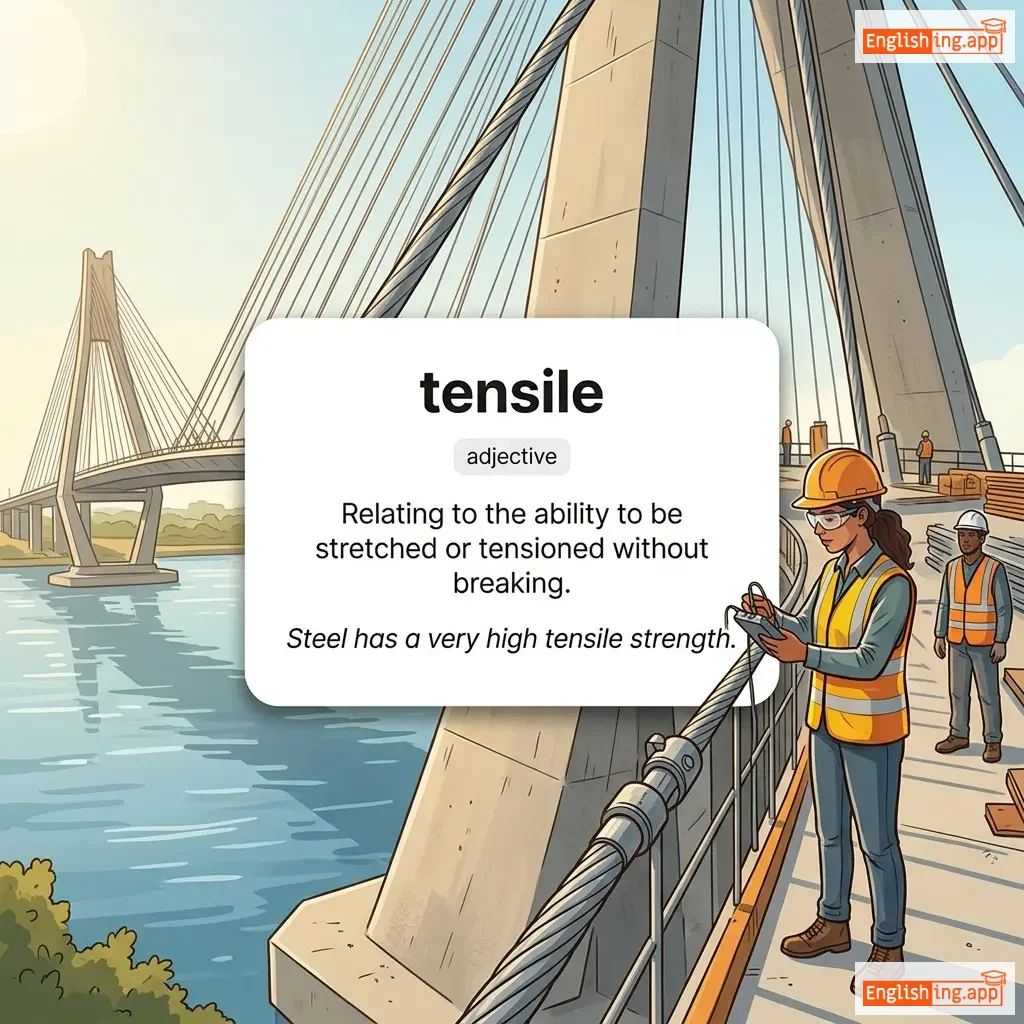
tensile definition card — visual illustration of the meaning
adjective
/ˈtɛn.saɪl/
растяжимый (rastjazhimyj)

Relating to the ability to be stretched or tensioned without breaking.

"Steel has a very high tensile strength."

"Сталь имеет очень высокую растяжимую прочность." (Stal' imeet ochen' vysokuyu rastjazhimuyu prochnost'.)
noun
/ˈtɛn.ʃən/
напряжение (napryazhenie)

A state of being stretched tight; mental or emotional strain.

"There was a lot of tension in the room before the exam results were announced."

"В комнате была напряжённость перед объявлением результатов экзамена." (V komnate byla napryazhyonnost' pered ob'yavleniem rezul'tatov eksama.)
noun
/tɛnt/
палатка (palatka)

a portable shelter made of fabric, supported by poles and ropes

"We set up a tent for the camping trip."

"Мы поставили палатку для похода." (My postavili palatku dlya pokhoda.)
adjective
/ˈtɛn.tə.tɪv/
предварительный (predvaritel'nyy)

Not certain or fixed; done without confidence.

"She gave a tentative smile before agreeing."

"Она дала предварительную улыбку, прежде чем согласиться." (Ona dala predvaritel'nuyu ulybku, prezhde chem soglasit'sya.)
tenuous definition card — visual illustration of the meaning
adjective
/ˈtɛn.ju.əs/
слабый / тонкий (slaby / tonkiy)

Very weak, thin, or slight; lacking a strong basis.

"The evidence against him is quite tenuous."

"Доказательства против него довольно слабы." (Dokazatel'stva protiv nego dovol'no slabye.)
noun
/ˈtɛnjər/
срок полномочий (srok polnomochiy)

The period of time during which someone holds a position, office, or land.

"His tenure as president lasted for five years."

"Его срок полномочий в качестве президента длился пять лет." (Ego srok polnomochiy v kachestve presidenta dlylsya pyat let.)
adjective
/ˈtɛpɪd/
теплый, равнодушный (teply, ravnodushny)

Lukewarm; showing little enthusiasm or force.

"His speech received only a tepid response from the audience."

"Его речь вызвала лишь тепловое, равнодушное восприятие от аудитории." (Yego rech' vyzvala lish' teplovoe, ravnodushnoe vospriyatie ot auditorii.)
noun
/ˌtɜːsənˈtɛnəri/
терценарий (tertsenariy)

The 300th anniversary of an event.

"The city celebrated its tercentenary with a grand festival."

"Город отпраздновал свою терценарий с большим фестивалем." (Gorod otprazdnoval svoiu tertseneriy s bol'shim festivalem.)
noun
/ˌtɜːdʒɪvərˈseɪʃən/
увиливание, двойственная позиция (uvilivanie, dvoystvennaya pozitsiya)

Evasion of straightforward action or speech; changing sides or being inconsistent.

"The politician’s tergiversation frustrated his supporters."

"Тергиверсация политика разочаровала его сторонников." (Tergiversatsiya politika razocharovala ego storonnikov.)
noun
/tɜːm/
термин (termin)

a word or phrase used to describe a thing or to express a concept

"The term 'machine learning' is commonly used in technology."

"Термин 'машинное обучение' часто используется в технологиях." (Termin 'mashinnoye obucheniye' chasto ispol'zuyetsya v tekhnologiyakh.)
noun
/ˈtɜːrməɡənt/
деспотичная и сварливая женщина (despotichnaya i svarlivaya zhenshchina)

A harsh-tempered or overbearing woman.

"The character was portrayed as a loud and domineering termagant."

"Персонаж был изображен как громкая и властная термагантка." (Personazh byl izobrazhen kak gromkaya i vlastnaya termagantka.)
noun/adjective
/ˈtɜːrmɪnəl/
терминал, конечный, неизлечимая болезнь (terminal, konechnyy, neizlechimaya bolezn')

As a noun: A place where transport routes begin or end. As an adjective: Relating to the end or final stage of something, often an illness.

"He waited for the bus at the central terminal."

"Он ждал автобус на центральном терминале." (On zhdal avtobus na tsentral'nom terminale.)
verb
/ˈtɜːrmɪˌneɪt/
прекратить (prekratit)

to bring something to an end or to stop something from continuing

"The company decided to terminate his contract."

"Компания решила прекратить его контракт." (Kompaniya reshilа prekratit' ego kontrakt.)
noun
/ˌtɜːrmɪˈneɪʃən/
прекращение (prekrashchenie)

the act of ending something or the state of being ended

"The termination of the contract caused financial loss."

"Прекращение контракта привело к финансовым потерям." (Prekrashchenie kontrakta privelo k finansovym poteryam.)
noun
/ˌtɜːrməˈnɑːlədʒi/
терминология (terminologiya)

the set of technical or special words used in a particular subject

"Medical terminology can be difficult for new students to understand."

"Медицинская терминология может быть сложной для понимания новичками." (Meditsinskaya terminologiya mozhet byt' slozhnoy dlya ponimaniya novichkami.)
noun
/ˈtɜːrmɪnəs/
конечная станция (konechnaya stantsiya)

the final point or end of something, especially the final station on a railway line

"The train finally arrived at the terminus after a long journey."

"Поезд наконец-то приехал на конечную станцию после долгого путешествия." (Poyezd nakonechno-to priekhal na konechnuyu stantsiyu posle dolgogo puteshestviya.)
noun
/tɜːmz/
условия (usloviya)

plural of term; conditions or rules in a contract or agreement

"The terms of the agreement are clearly outlined in the contract."

"Условия соглашения ясно изложены в контракте." (Usloviya soglasheniya yasno izlozheny v kontrakte.)
noun
/təˈreɪn/
местность (mestnost)

a stretch of land, especially with regard to its physical features

"The soldiers had to cross rough terrain during the mission."

"Солдаты должны были преодолеть трудную местность во время миссии." (Soldaty dolzhny byli preodolet' trudnuyu mestnost' vo vremya missii.)
noun
/ˈterəpɪn/
небольшая пресноводная черепаха (nebol'shaya presnovodnaya cherepakha)

a small freshwater turtle, especially one found in North America

"The terrapin slowly crawled into the pond."
"Тэра́пин медленно пополз в пруд." (Terapin medlenno popolz v prud.)
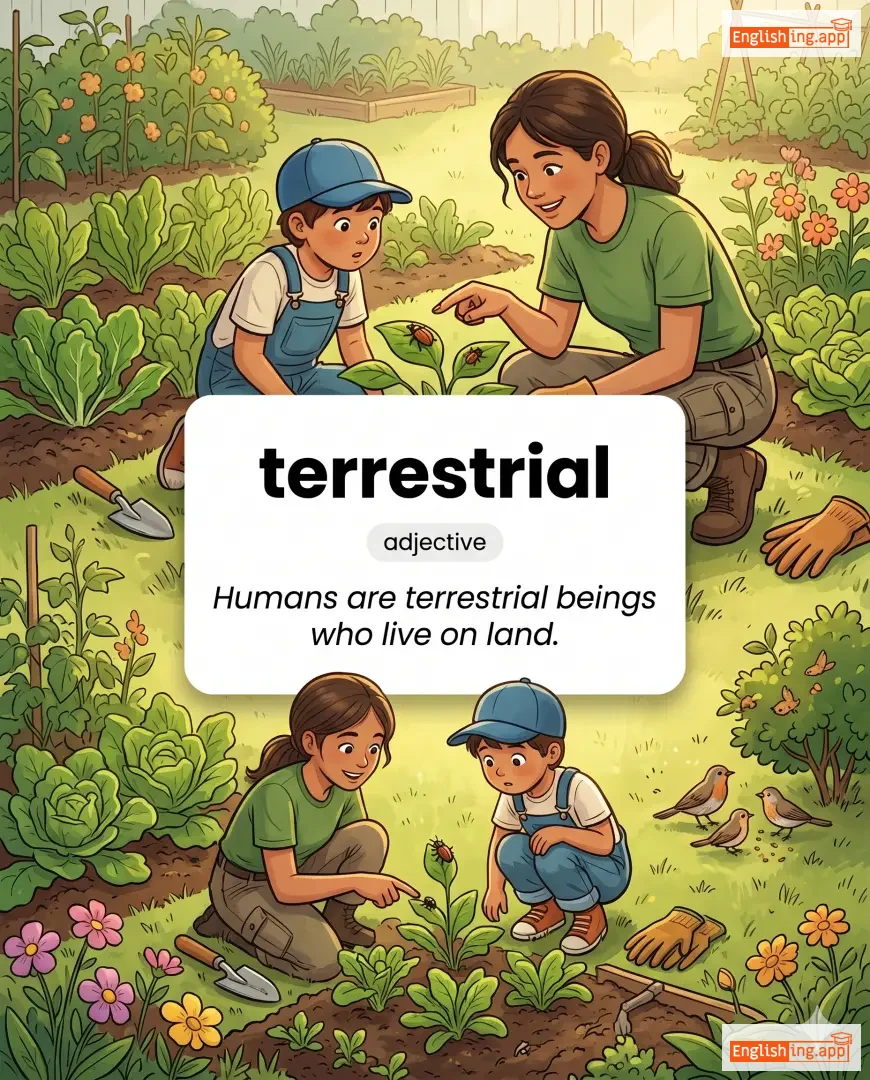
terrestrial definition card — visual illustration of the meaning
adjective
/təˈrɛstriəl/
земной (zemnoy)

Relating to the Earth or land as opposed to the sea or air; living or growing on land.

"Humans are terrestrial beings who live on land."

"Люди — земные существа, которые живут на земле." (Lyudi — zemnye sushchestva, kotorye zhivut na zemle.)
adjective
/ˈtɛrɪbəl/

extremely bad or unpleasant

"The food at that restaurant was terrible."

adverb
/ˈtɛrəbli/
ужасно (uzhasno)

to a very great or extreme degree; very badly or unpleasantly

"He felt terribly sad after hearing the news."

"Он чувствовал себя ужасно грустным после того, как услышал новость." (On chuvstvoval sebya uzhasno grustnym posle togo, kak uslyshal novost'.)
adjective
/təˈrɪfɪk/
потрясающий (potryasayushchiy)

extremely good or excellent; very great or intense

"The concert last night was absolutely terrific."

"Концерт прошлой ночью был абсолютно потрясающий." (Kontsert proshloy noch'yu byl absolyutno potryasayushchiy.)