Словари

Словарь английского языка | Значения слов, определения и примеры

noun
/sɪˈtɑːr/
ситар (sitar)

a traditional Indian stringed musical instrument with a long neck and resonating body

"The sitar creates beautiful ragas in Indian classical music."

"Ситар создает красивые раги в индийской классической музыке." (Sitar sozdayet krasivye ragi v indiyskoy klassicheskoy muzike.)
noun
/saɪt/
место (mesto)

a location or place, often used for a specific purpose, such as a construction site or a website

"The construction site is ready for the next phase of the project."

"Строительный участок готов к следующей фазе проекта." (Stroitel'nyy uchastok gotov k sleduyushchey faze proyekt)
adjective
/ˈsɪtʃueɪtɪd/
расположенный (raspolozhennyy)

located in a particular place or position

"The hotel is situated near the beach."

"Отель находится рядом с пляжем." (Otel nakhoditsya ryadom s plyazhem.)
noun
/ˌsɪtʃʊˈeɪʃən/
ситуация (situaciya)

a set of circumstances or state of affairs at a particular time

"The situation at work became difficult after the new policies were introduced."

"Ситуация на работе стала сложной после введения новых политик." (Situaciya na rabote stala slozhnoy posle vvedeniya novykh politik.)
6️⃣

six (siks)

noun
/sɪks/
шесть (shest')

the number 6

"There are six apples on the table."

"На столе шесть яблок." (Na stole shest' yablok.)
adjective
/sɪksθ/
шестой (shestoy)

coming after the fifth in order, position, or rank

"He finished the race in sixth place."

"Он финишировал на шестом месте." (On finishiroval na shestom meste.)
noun
/saɪz/
размер (razmer)

the physical dimensions, proportions, or magnitude of something

"This shirt is too small in size for me."

"Эта рубашка слишком мала по размеру для меня." (Eta rubashka slishkom mala po razmeru dlya menya.)
noun
/ˈskɛlɪtən/
скелет (skelet)

The internal framework of bones that supports the body of a human or animal.

"The teacher showed the students a human skeleton in the biology class."

"Учитель показал студентам человеческий скелет на уроке биологии." (Uchitel' pokazal studentam chelovecheskiy skelet na uroke biologii.)
skeptic definition card — visual illustration of the meaning
noun
/ˈskɛptɪk/
скептик (skeptik)

A person who doubts or questions accepted beliefs or claims.

"The scientist was a skeptic of theories without solid evidence."

"Ученый был скептически настроен к теориям без твердых доказательств." (Uchenyy byl skepticheski nastroen k teoriya bez tverdykh dokazatel'stv.)
adjective
/ˈskɛptɪkəl/
скептический (skepticheskiy)

not easily convinced; having doubts or reservations

"She was skeptical about the new plan."
"Она была скептически настроена к новому плану." (Ona byla skepticheski nastroena k novomu planu.)
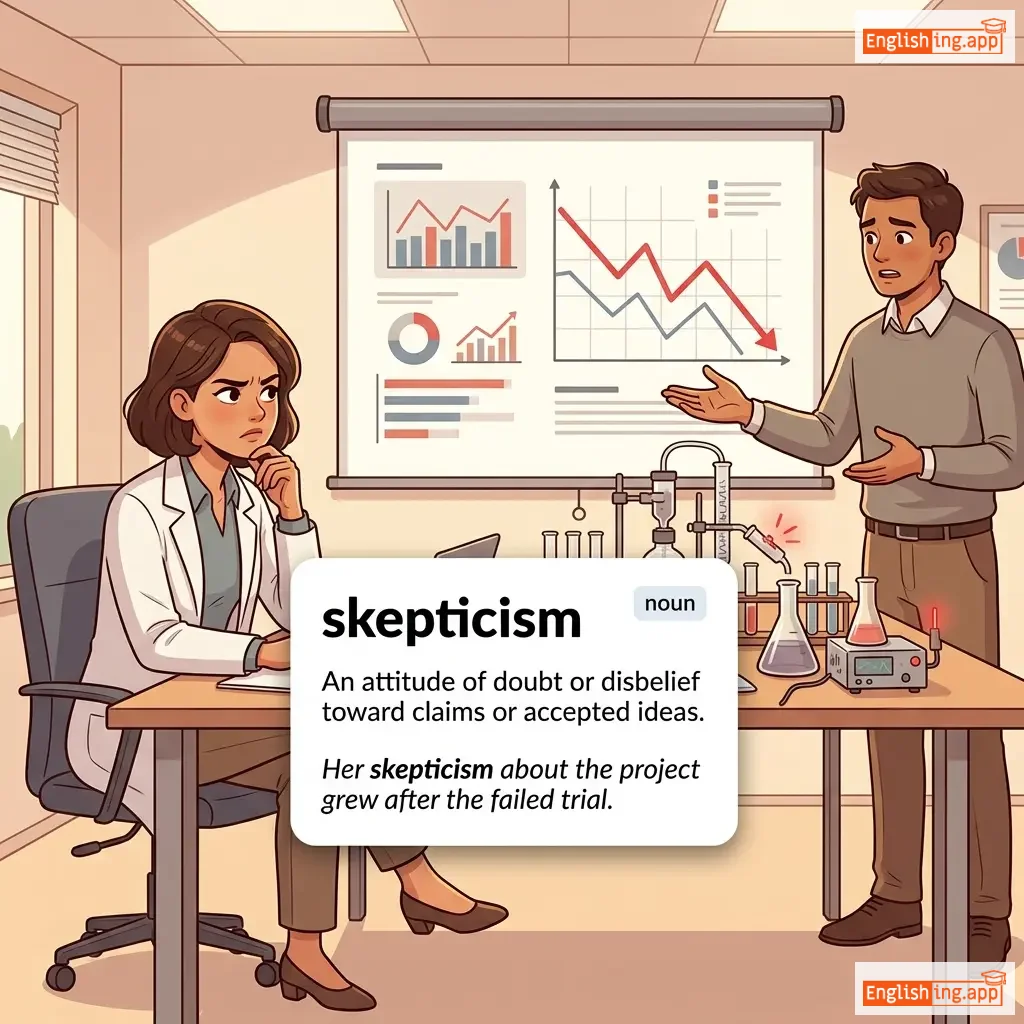
skepticism definition card — visual illustration of the meaning
noun
/ˈskɛptɪˌsɪzəm/
скептицизм (skeptitsizm)

An attitude of doubt or disbelief toward claims or accepted ideas.

"Her skepticism about the project grew after the failed trial."

"Её скептицизм по поводу проекта усилился после неудачного испытания." (Yeyo skeptitsizm po povodu proyektu usililsya posle neyudachnogo ispytaniya.)
noun
/skɛtʃ/
эскиз (eskiz)

a simple, rough drawing or outline

"He made a quick sketch of the landscape."

"Он сделал быстрый эскиз пейзажа." (On sdelal bystryy eskiz peyzazha.)
adjective
/ˈskɛtʃi/
незавершенный (nezavershenny)

not thorough or detailed; suspicious or unsafe

"The details of the project were still sketchy."

"Детали проекта все еще были незавершенными." (Detali proekta vse eshche byli nezavershennymi.)
verb
/skiː/
кататься на лыжах (katatsya na lyzhakh)

to glide over snow on skis

"We went skiing in the Alps last winter."

"Мы катались на лыжах в Альпах прошлой зимой." (My katat'sya na lyzhakh v Alpakh proshloy zimoy.)
noun
/skɪf/
маленькая лодка (malyenkaya lodka)

a small, light boat usually for one person

"The fisherman paddled his skiff across the lake."

"Рыбак греб своей маленькой лодкой через озеро." (Rybak greb svoey malen'koy lodkoy cherez ozero.)
adjective
/ˈskɪlfʊl/
умелый; опытный; мастер (umely; opytny; master)

having or showing skill; expert and accomplished

"The skilful surgeon performed the operation with great precision."

"Умелый хирург выполнил операцию с большой точностью." (Umelyi khirurg vypolnil operatsiyu s bol'shoy tochnost'yu.)
adverb
/ˈskɪl.fəl.i/
умело (umelo)

in a way that shows ability and training; expertly

"She skilfully painted the portrait in just two hours."

"Она умело нарисовала портрет за два часа." (Ona umelo narisovala portret za dva chasa.)
noun
/skɪl/
умение (umeniye)

the ability to do something well through training or experience

"Her skill in painting impressed everyone."

"Ее умение в живописи впечатлило всех." (Yeyo umeniye v zhivopisi vpechatlilo vsekh.)
adjective
/skɪld/
квалифицированный (kvalifitsirovannyy)

having the ability, experience, or training to do something well

"She is a highly skilled surgeon with years of experience."

"Она высококвалифицированный хирург с многолетним опытом." (Ona vysokokvalifitsirovannyy khirurg s mnogoletnim opytom.)
skills definition card — visual illustration of the meaning
noun
/skɪlz/
умения (umeniya)

The ability to do something well; expertise.

"Learning new skills can increase personal and professional growth."

"Изучение новых навыков может способствовать личному и профессиональному росту." (Izuchenie novykh navykov mozhet sposobstvovat' lichnomu i professional'nomu rostu.)
verb
/skɪm/
бегло читать (beglo chitatt)

to move quickly over a surface or to read something quickly

"She skimmed through the report before the meeting."

"Она пробежала глазами по отчету перед встречей." (Ona probezhala glazami po otchetu pered vstrechey.)
verb
/skɪmp/
скупиться (skupit'sya)

to use less of something than is necessary in order to save money or effort

"Don’t skimp on quality when buying a new laptop."

"Не скупись на качество, когда покупаешь новый ноутбук." (Ne skupis' na kachestvo, kogda pokupayesh' novyy noutbuk.)
noun
/skɪn/
кожа (kozha)

the outer layer of the body

"She has fair skin and bright blue eyes."

"У неё светлая кожа и яркие голубые глаза." (U neyo svetlaya kozha i yarkiye golubye glaza.)
noun
/ˈskɪnˌflɪnt/
скряга (skryaga)

a person who spends as little money as possible; a miser

"The landlord was such a skinflint that he never repaired anything."

"Хозяин был таким скрягой, что никогда ничего не ремонтировал." (Khozyain byl takim skryagoj, chto nikogda nichego ne remon'tiroval.)
adjective
/ˈskɪni/
худой; тощий; иссохший (khudoy; toshchiy; issokhshiy)

very thin; having little flesh or fat on the body

"The skinny cat looked like it hadn't eaten for days."

"Тонкая кошка выглядела так, будто она не ела несколько дней." (Tonkaia koshka vygljadela tak, budto ona ne yela neskol'ko dnej.)
verb
/skɪp/
пропустить (propustit)

to omit or pass over something; to move lightly or quickly

"He decided to skip breakfast and go straight to work."

"Он решил пропустить завтрак и прямо поехать на работу." (On reshil propustit zavtrak i pryamo poehat na rabotu.)
⚔️

skirmish

noun/verb
/ˈskɜːrmɪʃ/

a small or brief fight between groups of soldiers; to engage in such a fight

"The soldiers got into a skirmish near the border."

noun/verb
/skɜːrt/
юбка (skirt)

a piece of clothing that hangs from the waist; to go around the edge of something

"She wore a red skirt to the party."

"Она надела красную юбку на вечеринку." (Ona nadela krasnuyu yubku na vecherinku.)
noun
/skɪt/
скетч (sketch)

a short, humorous performance or piece of writing

"The students performed a funny skit at the event."

"Студенты исполнили забавный скетч на мероприятии." (Studenty ispolnili zabavnyy sketch na meropriyatii.)
adjective
/ˈskɪtɪʃ/
нервный (nervny)

easily frightened or nervous; unpredictable

"The horse was too skittish to ride."

"Лошадь была слишком нервной для верховой езды." (Loshad' byla slishkom nervnoj dlya verkhovoj ezdy.)
noun
/skʌlˈdʌɡəri/
мошенничество (moshennichestvo)

underhanded or dishonest behavior

"The politician was accused of financial skulduggery."

"Политика обвинили в финансовых махинациях." (Politiku obvinili v finansovykh makhinatsiyakh.)
🕵️

skulk

verb
/skʌlk/

to move or hide secretly, often because you are planning something bad or are feeling guilty

"He tried to skulk in the shadows to avoid being seen."

noun
/skʌl/
череп (cherep)

the bony structure that forms the head and protects the brain

"The archaeologists found an ancient human skull."

"Археологи нашли древний человеческий череп." (Arkhieologi nashli drevniy chelovecheskiy cherep.)
noun
/ˌskʌlˈdʌɡəri/
обман (obman)

dishonest behavior or activities, often done secretly

"The election was full of political skullduggery."

"Выборы были полны политических обманов." (Vyibory byli polny politicheskikh obmanov.)
noun
/skaɪ/
небо (skai)

the expanse of air over the Earth, often appearing blue

"The sky was clear and the sun was shining brightly."

"Небо было ясным, и солнце ярко светило." (Nebo bylo yasnym, i solntse yarko svetilo.)
adjective
/skaɪ bluː/
небесно-голубой (nebesno-goluboy)

a bright blue color like that of a clear sky

"Her sky-blue eyes sparkled in the sunlight."

"Ее небесно-голубые глаза сияли на солнце." (Eyo nebesno-golubye glaza siyali na solntse.)
noun
/ˈskaɪ.lɑːrk/
жаворонок (zha-vor-o-nok)

a small brown bird known for singing while flying high in the sky

"The skylark sang beautifully as it soared above the meadow."

"Жаворонок пел красиво, пока он летел над лугом." (Zhavoronok pel krasivo, poka on letel nad lugom)
noun
/ˈskaɪˌskreɪpər/
небоскрёб (neboskryob)

a very tall building of many stories

"The new skyscraper dominates the city's skyline."

"Новый небоскрёб доминирует в городском горизонте." (Novyj neboskryob dominiruet v gorodskom gorizonte.)
noun
/slæb/
плита (plita)

a large, thick, flat piece of stone, concrete, or other hard material

"The workers laid a concrete slab for the foundation."

"Рабочие положили бетонную плиту для фундамента." (Rabochie polozhili betonnuyu plitu dlya fundamenta.)
adjective
/slæk/
слабый (slaby)

not tight, firm, or busy; lacking tension or activity

"Business is slack during the rainy season."

"Бизнес замедляется во время сезона дождей." (Biznes zamedlyaetsya vo vremya sezona dozhdey.)
verb
/ˈslækən/
ослабить (oslabit)

to make or become less tight, less active, or slower

"The driver slackened his speed as he approached the village."

"Водитель сбавил скорость, когда подъезжал к деревне." (Voditel' sbavil skorost', kogda pod'yezhal k derevne.)
noun
/slæɡ/
шлак (shlak)

Stony waste matter separated from metals during the smelting process.

"The factory dumped the slag near the river."

"Фабрика сбросила шлак рядом с рекой." (Fabrika sbrosila shlak ryadom s rekoj.)
verb
/sleɪk/
утолить жажду (utolit' zhazhdu)

To satisfy thirst or desire.

"She drank cold water to slake her thirst."

"Она пила холодную воду, чтобы утолить жажду." (Ona pila kholodnuyu vodu, chtoby utolit' zhazhdu.)
verb
/slæm/
ударить с силой (udarit' s silo)

to close or hit something with great force

"He slammed the door angrily after the argument."

"Он с силой закрыл дверь после ссоры." (On s silo zakryl dver' posle ssory.)
noun
/ˈslændər/
клевета (kleventa)

The action of making false spoken statements damaging to a person's reputation.

"He sued the newspaper for slander."

"Он подал в суд на газету за клевету." (On podal v sud na gazetu za kleventu.)
noun
/slæŋ/
сленг; неформальный язык (slenh; neformaliy yazyk)

very informal language that is usually spoken rather than written

"The teenagers used slang that their parents couldn't understand."

"Подростки использовали сленг, который их родители не могли понять." (Podrostki ispol'zovali sleng, kotoryy ikh roditeli ne mogli ponyat'.)
noun, verb
/slænt/
предвзятое мнение (predvzyatoe mnenie)

A particular point of view; to slope or lean in a particular direction.

"The article had a political slant."
"Статья имела политический уклон." (Stat'ya imela politicheskiy uklon.)
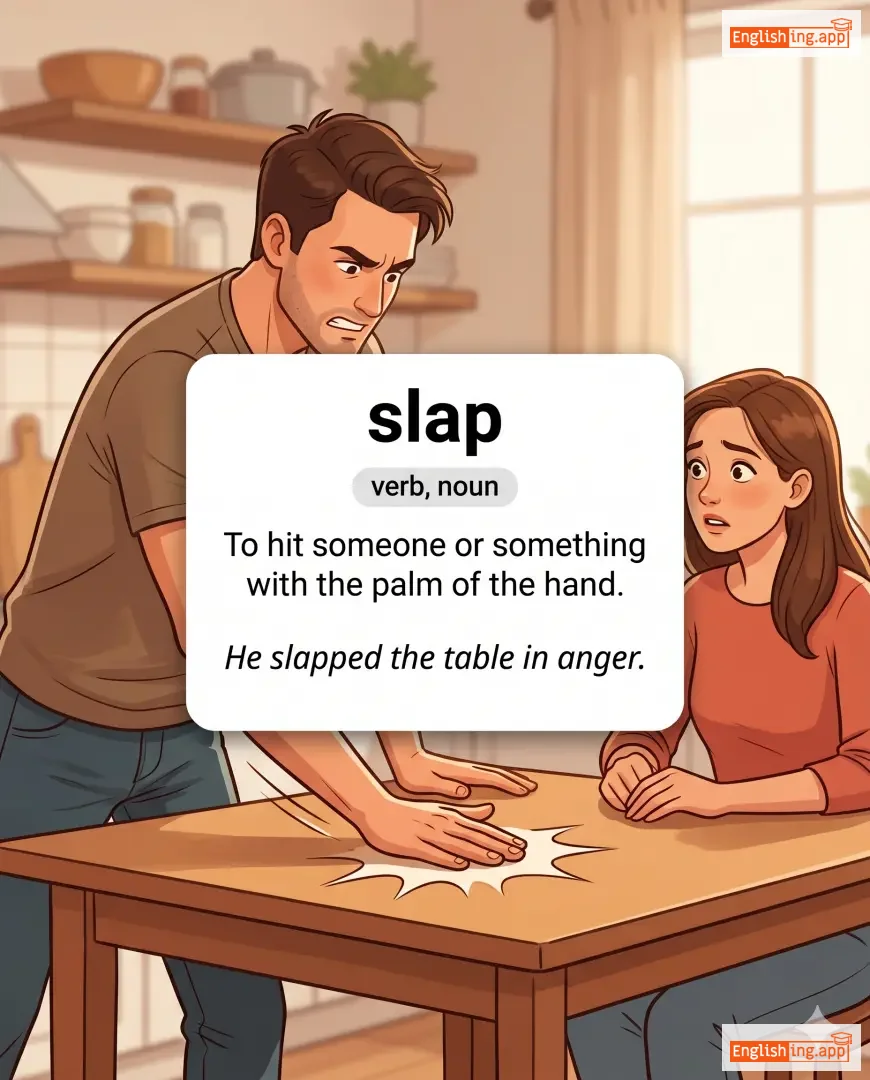
slap definition card — visual illustration of the meaning
verb, noun
/slæp/
дать пощёчину (dat' poshchenu)

To hit someone or something with the palm of the hand.

"He slapped the table in anger."

"Он ударил по столу от гнева." (On udaril po stolu ot gneva.)
adjective
/ˈslæp.dæʃ/
небрежно сделано (nebrezhno sdelano)

done too quickly and carelessly; hasty and careless

"The report was written in a slapdash manner, full of errors."
"Доклад был написан небрежно, полон ошибок." (Doklad byl napisany nebrezhno, polon oshibok.)
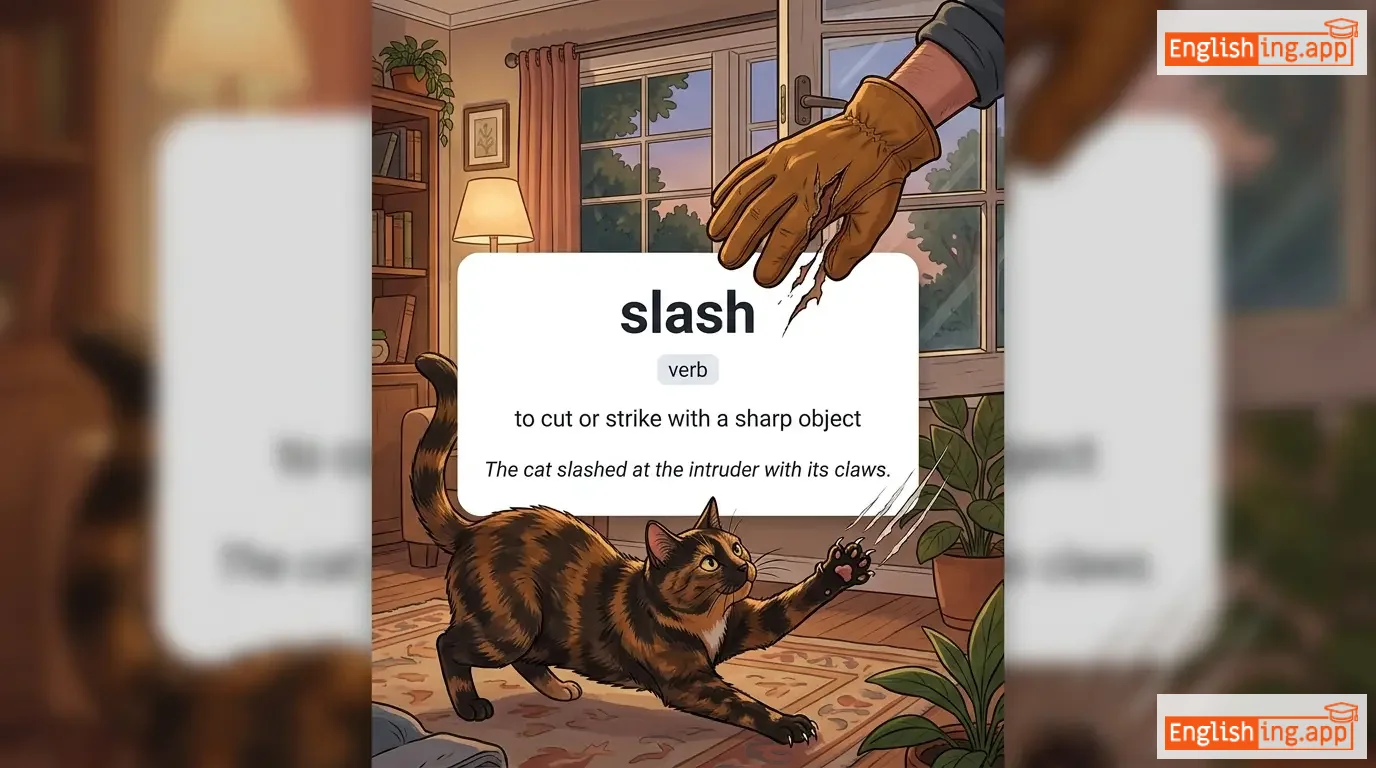
slash definition card — visual illustration of the meaning
verb
/slæʃ/
резать (rezat')

to cut or strike with a sharp object

"The cat slashed at the intruder with its claws."

"Кошка порезала нарушителя своими когтями." (Koshka porezala narushitelya svoimi kogtyami.)