Словари

Словарь английского языка | Значения слов, определения и примеры

noun
/ˈpɛnəlti/
штраф (shtraf)

A punishment imposed for breaking a law, rule, or contract.

"He had to pay a heavy penalty for breaking the traffic rules."

"Ему пришлось заплатить большой штраф за нарушение правил дорожного движения." (Yemu prishlos' zaplatit' bol'shoy shtraf za narusheniye pravil dorozhnogo dvizhениya.)
noun
/ˈpɛnəns/
счастье (schastye)

Voluntary self-punishment as an expression of repentance for wrongdoing.

"He fasted for a week as a penance for his mistakes."
"Она не могла скрыть свое счастье, когда получила награду." (Ona ne mogla skryt' svoe schast'ye, kogda poluchila nagradu.)
penchant definition card — visual illustration of the meaning
noun
/ˈpɒ̃ʃɒ̃/
склонность (sklonnost)

a strong or habitual liking for something or tendency to do something

"She has a penchant for collecting rare books."

"У неё есть склонность собирать редкие книги." (U nee est' sklonnost' sobirat' redkie knigi.)
✏️

pencil

noun
/ˈpɛnsəl/

an instrument for writing or drawing, typically made of wood with a graphite core

"He drew a picture with a pencil."

noun
/ˈpɛndənt/
кулон (kulon)

a piece of jewelry that hangs from a chain worn around the neck

"She wore a silver pendant around her neck."

"Она носила серебряный кулон на шее." (Ona nosila serebryanyy kulon na sheye.)
adjective
/ˈpɛndənt/
висящий (visyashchiy)

hanging down or suspended

"The pendent branches touched the ground."

"Повисающие ветви касались земли." (Povisayushchie vetvi kasalis' zemli.)
adjective
/ˈpɛndɪŋ/
в ожидании (v ozhidanii)

awaiting decision or settlement

"The case is still pending in court."

"Дело еще в ожидании в суде." (Delo eshche v ozhidanii v sude.)
adjective
/ˈpɛndjʊləs/
счастье (schast'ye)

hanging down loosely; drooping

"The pendulous fruit weighed down the branch."

"Она не могла скрыть своего счастья, когда получила награду." (Ona ne mogla skryt' svoego schast'ya, kogda poluchila nagradu.)
noun
/ˈpɛndjələm/
маятник (majatnik)

A weight suspended from a pivot so that it swings freely, often used to regulate clocks.

"The pendulum swung back and forth inside the clock."

"Маятник качался вперед и назад внутри часов." (Majatnik kachalsya vpered i nazad vnutri chasov.)
adjective
/ˈpɛnɪtrəbl/
проходимый (prokhodimy)

Capable of being passed through or entered.

"The thin wall was easily penetrable."
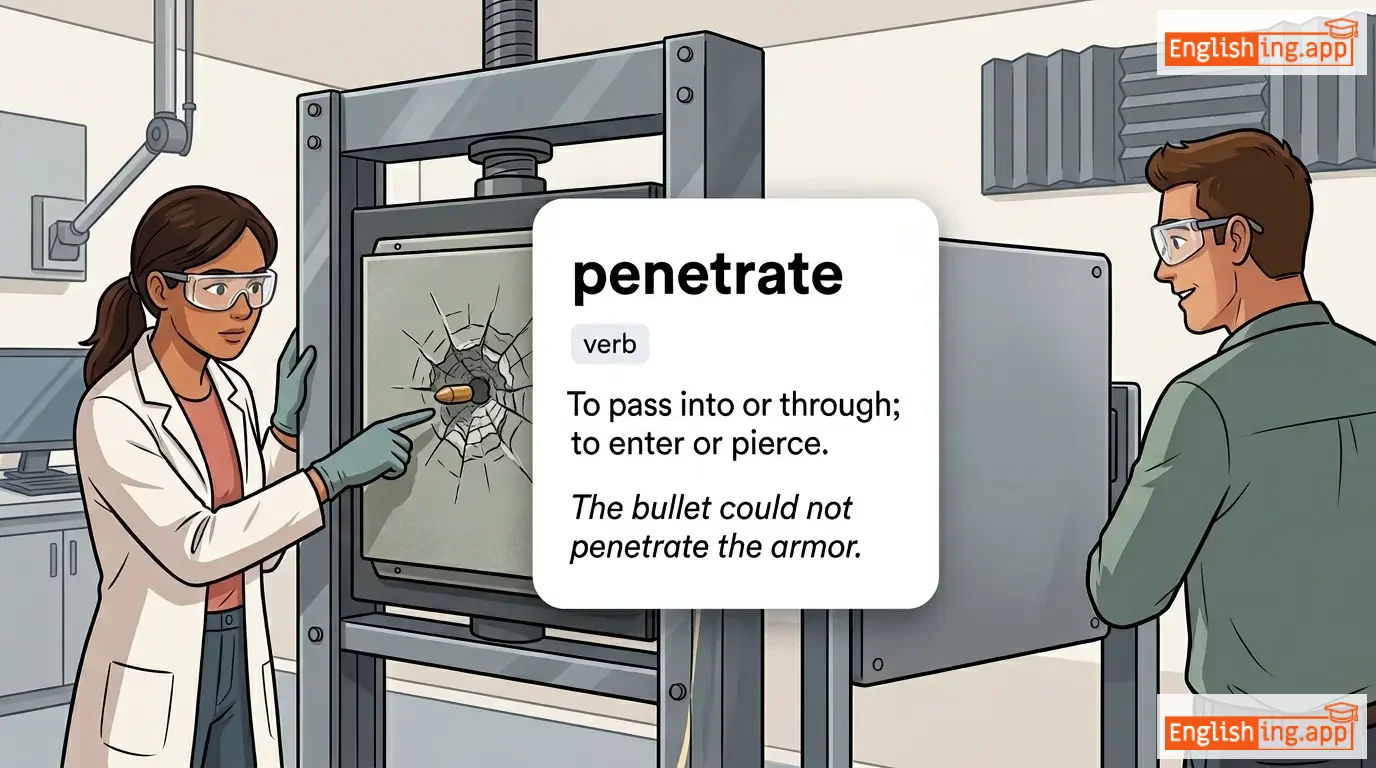
"Тонкая стена была легко проходимой." (Tonkaia stena byla legko prokhodimoi.)
penetrate definition card — visual illustration of the meaning
verb
/ˈpɛnɪtreɪt/
проникать (pronikat)

To pass into or through; to enter or pierce.

"The bullet could not penetrate the armor."

"Пуля не смогла пробить броню." (Pulya ne smogla probit' bronyu.)
noun
/ˌpɛnɪˈtreɪʃən/
проникновение (proniknovenie)

The act of piercing or entering into something.

"The company's market penetration grew rapidly."

"Рыночное проникновение компании быстро увеличилось." (Rynochnoye proniknoveniye kompanii bystro uvelichilos.)
noun
/pəˈnɪn.sjə.lə/
полуостров (poluostrov)

a piece of land that is almost completely surrounded by water but connected to the mainland

"The Korean Peninsula is located in East Asia."

"Корейский полуостров находится в Восточной Азии." (Koreyskiy poluostrov nakhoditsya v Vostochnoy Azii.)
adjective
/pəˈnɪnsjələr/
похожий на полуостров (pokhozhiy na poluostrov)

Relating to or resembling a peninsula.

"The peninsular region is surrounded by water on three sides."

"Полуостровная территория окружена водой с трех сторон." (Poluostrovnaya territoriya okruzhena vodoy s trekh storon.)
noun
/ˈpɛnɪtəns/
покаяние (pokayanie)

The action or feeling of showing sorrow and regret for having done wrong.

"His eyes were full of penitence after realizing his mistake."

"Его глаза были полны покаяния после того, как он осознал свою ошибку." (Ego glaza byli polny pokayaniya posle togo, kak on osoznal svoyu oshibku.)
adjective
/ˈpɛnɪtənt/
раскаяный (raskayannyy)

Feeling or showing sorrow and regret for having done wrong.

"She was penitent after shouting at her friend."

"Она была раскаянной после того, как накричала на свою подругу." (Ona byla raskayannoy posle togo, kak nakrichala na svoyu podrugu.)
adjective
/ˌpɛnɪˈtɛnʃəl/
каяться (kayat'sya)

Relating to or expressing penitence or penance.

"The priest delivered a penitential sermon on forgiveness."

"Священник прочитал покаянную проповедь о прощении." (Svyashchennik prochital pokayannuyu propoved' o proshchenii.)
noun
/ˈpɛnənt/
флаг (flag)

A tapering flag used for signaling or as an emblem of victory or achievement.

"The team raised the championship pennant proudly."

"Команда гордо подняла флаг чемпионата." (Komanda gordo podnyala flag chempionata.)
adjective
/ˈpɛneɪt/
перообразный (peroobrazny)

Having parts or structures arranged like a feather; feather-shaped.

"The fern has a pennate leaf structure."

"Структура листа папоротника перообразная." (Struktura lista paporotnika peroobraznaya.)
adjective
/ˈpen.ɪ.ləs/
без денег; крайне бедный; полностью без средств (bez deneg; krajne bednyj; polnost'ju bez sredstv)

having no money; extremely poor; completely without funds

"After losing his job, he became penniless."

"После потери работы он стал без денег." (Posle poteri raboty on stal bez deneg.)
noun
/ˈpɛni/
пенни (penni)

a small coin of low value; a very small amount of money

"He found a penny on the sidewalk and smiled."

"Он нашёл пенни на тротуаре и улыбнулся." (on nashyol penni na trotuare i ulybnulsya)
noun
/pɪˈnɒlədʒi/
пенология (penologiya)

The study of prison management and criminal rehabilitation.

"He decided to specialize in penology to help improve the prison system."

"Он решил специализироваться на пенологии, чтобы помочь улучшить систему тюрем." (On reshil spetsializirovatsya na penologii, chtoby pomoch' uluchshit' sistemy tyurem.)
noun
/ˈpɛnʃən/
пенсия (pensiia)

A regular payment made during a person's retirement from an investment fund or employer.

"After 30 years of service, he received a monthly pension."

"После 30 лет службы он получил ежемесячную пенсию." (Posle 30 let sluzhby on poluchil ezhemesiachnuiu pensiiu.)
adjective
/ˈpɛnsɪv/
задумчивый (zadumchivyy)

Engaged in deep or serious thought.

"She looked pensive as she stared out of the window."

"Она выглядела задумчиво, когда смотрела в окно." (Ona vyglyadela zadumchivo, kogda smotrela v okno.)
adjective
/ˈpent ʌp/
подавленный; ограниченный; заключенный (podavlennyy; ogranichennyy; zaklyuchennyy)

suppressed; restrained; confined

"He had pent-up anger that finally exploded."

"У него был подавленный гнев, который в конце концов взорвался." (U nego byl podavlennyy gnev, kotoryy v kontse kontsov vzorvalsya.)
noun
/ˈpɛntæd/
пятерка (pyaterka)

A group or set of five things.

"The committee was divided into a pentad of working groups."

"Комитет был разделен на пять рабочих групп." (Komitet byl razdelen na pyat' rabochikh grup.)
noun
/ˈpɛntəɡən/
пятиугольник (pentagon)

A plane figure with five straight sides and five angles; also refers to the US Department of Defense building.

"The Pentagon is one of the most iconic government buildings in the United States."

"Пентагон — одно из самых знаковых правительственных зданий в Соединённых Штатах." (Pentagon odnoe iz samykh znakovykh pravitelstvennykh zdaniy v Soedinyonnykh Shtatakh)
noun
/ˈpɛntəˌɡræm/
пентаграмм (pentagramm)

A five-pointed star often used as a symbol in magic, mysticism, or religion.

"The wizard drew a pentagram on the floor as part of the ritual."

"Колдун нарисовал пентаграмму на полу как часть ритуала." (Koldun narisoval pentagrammu na polu kak chast' rituala.)
noun
/ˌpɛntəˈhiːdrən/
пентаэдр (pentaedr)

A solid geometric figure with five faces.

"In geometry class, the teacher explained the structure of a pentahedron."

"На уроке геометрии учитель объяснил структуру пентаэдра." (Na uroke geometrii uchitel' ob'yasnil strukturu pentaedra.)
noun
/pɛnˈtæmɪtər/
пентаметр (pentametr)

A line of verse consisting of five metrical feet.

"Shakespeare often wrote his plays in iambic pentameter."

"Шекспир часто писал свои пьесы в ямбическом пентаметре." (Shekspir chasto pisal svoi p'esy v iambicheskom pentametre.)
noun
/pɛnˈtæθlɒn/
пентатлон (pentatlon)

An athletic contest featuring five different events.

"She trained hard to compete in the modern pentathlon."

"Она усердно тренировалась, чтобы участвовать в современном пентатлоне." (Ona usyerdno trenirovalas', chtoby uchastvovat' v sovremennom pentatlone.)
adjective
/ˌpɛntəˈveɪlənt/
пентавалентный (pentavalentny)

Having a valence of five, especially in chemistry.

"Phosphorus can exist in a pentavalent state."

"Фосфор может существовать в пентавалентном состоянии." (Fosfor mozhet sushchestvovat' v pentavalentnom sostoyanii.)
adjective
/pəˈnʌltɪmət/
предпоследний (predposledniy)

second to the last in a sequence or series

"She finished the penultimate chapter before going to sleep."

"Она закончила предпоследнюю главу перед тем, как пойти спать." (Ona zakonchila predposlednyuyu glavu pered tem, kak poyti spat.)
noun
/pəˈnʌmbrə/
частично затененная область (chastichno zatenennaya oblast)

a partially shaded area around the shadow of an object, especially during an eclipse

"The moon’s penumbra created a dim shadow over the Earth."

"Пенумбра Луны создала тусклую тень на Земле." (Penumbra Luny sozdala tuskluyu ten' na Zemle.)
adjective
/pəˈnjʊəriəs/
крайне бедный (krajne bedny)

extremely poor; poverty-stricken; miserly

"The penurious family struggled to buy food."
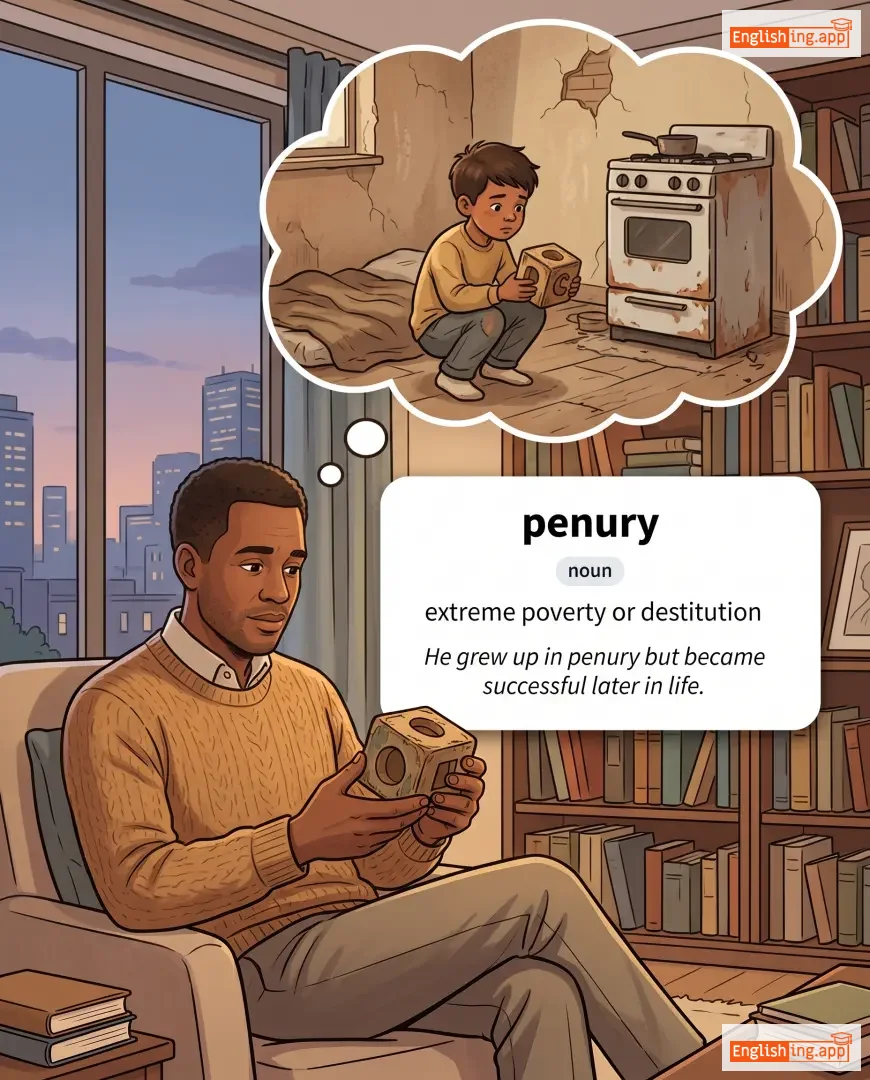
"Крайне бедная семья испытывала трудности с покупкой еды." (Krajne bednaya sem'ya ispytyvala trudnosti s pokupkoy edy.)
penury definition card — visual illustration of the meaning
noun
/ˈpɛnjʊri/
крайняя бедность (krajnyaya bednost)

extreme poverty or destitution

"He grew up in penury but became successful later in life."

"Он вырос в бедности, но стал успешным позже в жизни." (On vyros v bednosti, no stal uspeshnym pozhe v zhizni.)
noun
/ˈpiːɒn/
пион (pion)

a low-ranking worker, often performing menial tasks

"The office peon delivered the files to each department."

"Офисный пион доставил файлы в каждый отдел." (Ofisnyy pion dostavil fayly v kazhdyy otdel.)
noun
/ˈpiːpl/
люди (lyudi)

a group of human beings collectively

"The people in the town gathered for the festival."

"Люди в городе собрались на фестиваль." (Lyudi v gorode sobralis na festival.)
noun
/ˈpɛpər/
перец (perec)

a pungent spice obtained from pepper plants, used to flavor food

"I like to add pepper to my soup."

"Мне нравится добавлять перец в мой суп." (Mne nravitsja dobavlyat' perets v moj sup.)
preposition
/pɜːr/
на человека (na cheloveka)

for each, according to

"The tickets are priced at $20 per person."

"Билеты стоят по 20 $ на человека." (Bilety stoyat po 20 dollarov na cheloveka.)
noun
/pɜːr bɔɪld raɪs/
предварительно вареный рис (predvaritel'no varenyy ris)

Rice that has been partially boiled in the husk before milling; parboiled rice

"Per boiled rice retains more nutrients than regular white rice."

"Предварительно вареный рис сохраняет больше питательных веществ, чем обычный белый рис." (Predvaritel'no varenyy ris sokhranyayet bol'she pitatel'nykh veshchestv, chem obychniy belyy ris.)
adverb
/pɜːr ˈseɪ/
само по себе (samo po sebe)

By or in itself; intrinsically.

"The idea is not bad per se, but it needs improvement."

"Идея сама по себе не плоха, но требует улучшений." (Ideya samo po sebe ne plokha, no trebuyet uluchsheniy.)
verb
/pəˈræmbjʊˌleɪt/
гулять (gulyat)

To walk through or travel around, especially for leisure.

"They perambulated the old town, enjoying the sights."

"Они гуляли по старому городу, наслаждаясь видами." (Oni gulyali po staromu gorodu, naslazhdayas' vidami.)
noun
/pəˈræm.bjə.leɪ.tər/
коляска (perambulator)

a four-wheeled carriage for a baby; baby stroller or pram

"She pushed the perambulator through the park while the baby slept peacefully."
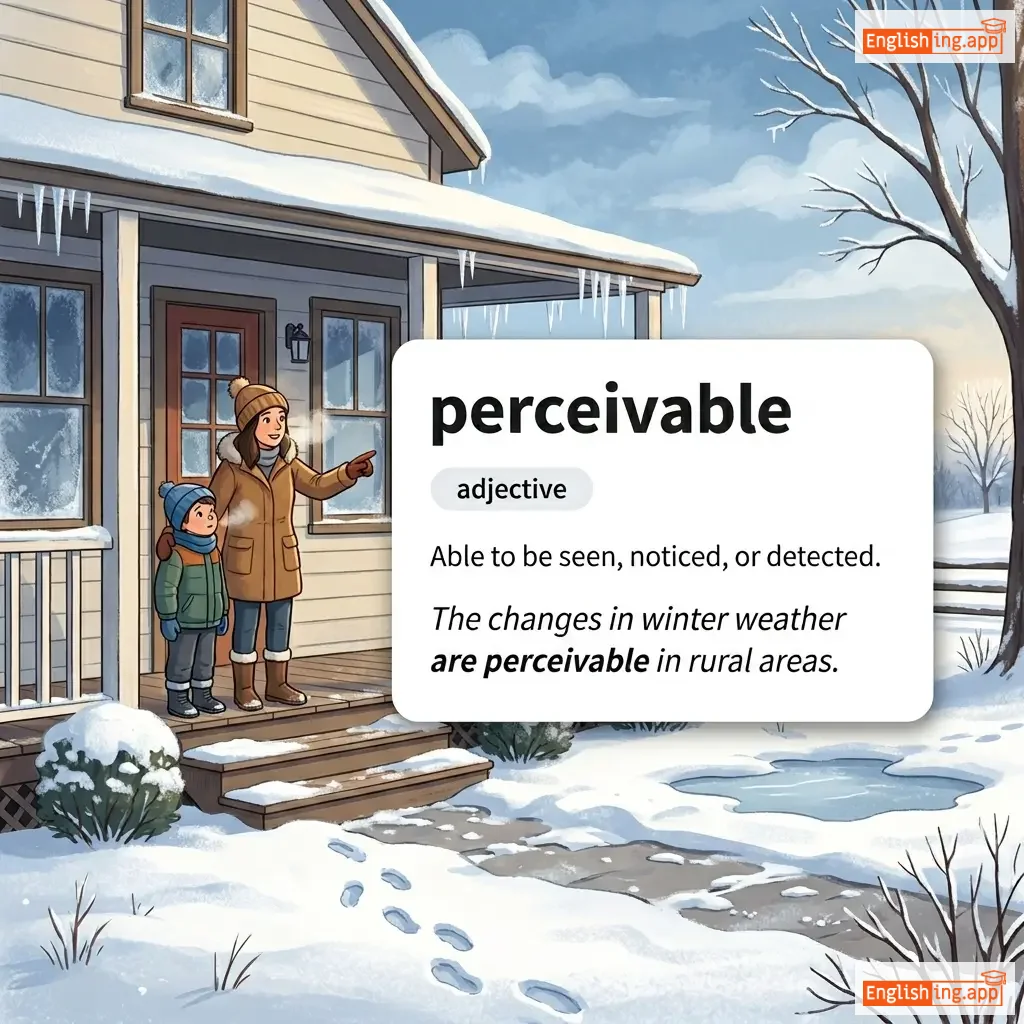
"Она толкала перамбулятор по парку, пока ребенок мирно спал." (Ona tolkala perambulyator po parku, poka rebenok mirno spal.)
perceivable definition card — visual illustration of the meaning
adjective
পারসিভেবল
заметный (zametny)

Able to be seen, noticed, or detected.

"The changes in winter weather are perceivable in rural areas."

"Изменения зимней погоды заметны в сельских районах." (Izmeneniya zimney pogody zametny v selskih rayonah.)
perceive definition card — visual illustration of the meaning
verb
/pərˈsiːv/
воспринять (vos-prinyat)

To become aware of or recognize something through the senses or the mind.

"She perceived a change in his tone of voice."

"Она восприняла изменение в его тоне голоса." (Ona vos-prin-ya-la iz-me-nee-nye v ye-go tone go-lo-sa.)
👁️

perceived

verb
/pərˈsiːvd/
счастье (schastye)

to become aware of something through the senses or the mind; to understand or interpret

"She perceived a hint of sadness in his voice."

"Она не смогла скрыть свое счастье, когда получила награду." (Ona ne smogla skryt' svoye schast'ye, kogda poluchila nagradu.)
noun; adverb
/pərˈsɛnt/
процент (protsent)

a proportion out of one hundred; by each hundred

"Sales increased by ten percent this year."

"Продажи выросли на десять процентов в этом году." (Prodazhi vyrosli na desyat protsentov v etom godu)
noun
/pərˈsɛntɪdʒ/
процент (protsent)

a proportion or share in relation to a whole

"The percentage of students who passed the exam was high."

"Процент студентов, сдавших экзамен, был высоким." (Protsent studentov, sdavshikh ekzamen, byl vysokom.)
adjective
/pərˈsɛptəbl̩/
заметный (zametny)

Able to be noticed or recognized by the senses or the mind.

"There was a perceptible change in the atmosphere."

"В атмосфере было заметное изменение." (V atmosfere bylo zametnoe izmenenie.)