Словари

Словарь английского языка | Значения слов, определения и примеры

debunk definition card — visual illustration of the meaning
verb
/diːˈbʌŋk/

To expose the falseness or exaggeration of a claim, myth, or belief.

"The scientist worked to debunk the myths about vaccines."

noun, verb
/ˈdeɪ.bjuː/
дебют (debyut)

The first public appearance or performance of someone or something.

"The young actor made his debut on the big stage."

"Молодой актер дебютировал на большой сцене." (Molodoy akter debiutiroval na bol'shoy stsene.)
noun
/ˈdeb.juː.tɑːnt/
молодая женщина, которая делает своё первое официальное появление в обществе (molodaya zhenshchina, kotoraya delaet svoe pervoe ofitsialnoe poyavlenie v obshchestve)

A young woman making her first formal appearance in society.

"The debutante wore a white gown at the ball."

"Дебютантка носила белое платье на балу." (Debyutantka nosila beloje platje na balu.)
noun
/ˈdɛkeɪd/
десятилетие (desyatiletie)

A period of ten years.

"The country has changed a lot in the past decade."

"Страна сильно изменилась за последнее десятилетие." (Strana sil'no izmenilas' za poslednee desyatiletie.)
noun
/ˈdek.ə.dəns/
декаданс (dekadans)

Moral or cultural decline characterized by excessive indulgence in pleasure or luxury.

"The novel describes the decadence of the wealthy elite."

"Роман описывает декаданс богатой элиты." (Roman opisivayet dekadans bogatoy elity.)
adjective
/ˈdɛkədənt/
декадент, роскошный (dekadent, roskoshnyy)

Characterized by or reflecting a state of moral or cultural decline; excessively self-indulgent.

"The party was filled with decadent luxury and excess."

"Вечеринка была наполнена декадентским роскошью и излишеством." (Vecherinka byla napolnena dekadentskim roskosh'yu i izlishestvom.)
noun
/ˈdɛkəˌɡɒn/
декагон (dekaton)

A polygon with ten sides and ten angles.

"The geometry teacher drew a perfect decagon on the board."

"Учитель геометрии нарисовал идеальный декагон на доске." (Uchitel' geometrii narisoval ideal'nyi dekagon na doske.)
noun
/ˈdɛkəˌɡræm/
декаграмм (dekagramm)

A metric unit of mass equal to ten grams.

"The package weighed exactly one decagram."

"Посылка весила ровно один декаграмм." (Posylka vesila rovno odin dekagramm.)
noun
/ˈdɛkəˌliːtər/
десять литров (desyat' litrov)

A metric unit of capacity equal to ten liters.

"The container could hold up to one decaliter of water."

"Контейнер может вмещать до одного декалитра воды." (Konteyner mozhet vmeschat' do odnogo dekalitry vody.)
noun
/ˈdɛkəˌlɔːɡ/
декалог (dekalog)

The Ten Commandments in the Bible; a set of fundamental rules or principles.

"The priest gave a sermon on the importance of the Decalogue."

"Священник произнес проповедь о важности Десяти заповедей." (Svyashennik proiznes propoved o vazhnosti Desyati zapovedey.)
noun
/dɪˈkæmərən/
Декамерон (сборник рассказов Боккаччо) (dekameron)

A collection of 100 tales written by Giovanni Boccaccio in the 14th century, told by a group of people over ten days.

"The Decameron is considered a masterpiece of classical Italian literature."

"Декамерон считается шедевром классической итальянской литературы." (Dekameron schitaetsya shedevrom klassicheskoy italiyanskoy literatury.)
noun
/dɪˈkæmɪtər/
декаметр (dekametr)

A metric unit of length equal to ten meters.

"The field was measured in decameters for accuracy."

"Поле измеряли в декаметрах для точности." (Pole izmeriali v dekametrah dlya tochnosti.)
verb
/dɪˈkæmp/
убежать (dikamp)

To depart suddenly or secretly, often to avoid trouble or escape.

"The thief decamped before the police arrived."

"Вор сбежал до того, как полиция приехала." (Vor sbezhal do togo, kak politsiya priekhala.)
verb
/dɪˈkænt/
дека́нтировать (dekantirovat)

To pour liquid gently from one container into another, especially without disturbing the sediment.

"She carefully decanted the wine into a clean glass."

"Она осторожно наливала вино в чистый стакан." (Ona ostorozhno nalivala vino v chisty stakan.)
verb
/dɪˈkæpɪteɪt/
счастье (schast'ye)

To cut off the head of a person or animal.

"The ancient executioner decapitated the criminal."

"Она не могла скрыть своего счастья, когда получила награду." (Ona ne mogla skryt' svoego schast'ya, kogda poluchila nagradu.)
noun
/ˈdɛkəˌpɒd/
декапод (dekapod)

An arthropod with ten limbs, such as crabs, lobsters, and shrimps.

"The lobster is a well-known decapod."

"Омар — это известный декапод." (Omar — eto izvestnyy dekapod.)
noun
/ˌdɛkəˈsɪləbəl/
декасиллаб (dekasillab)

A line of verse with ten syllables.

"The poet often wrote in decasyllable form."

"Поэт часто писал в декосиллабической форме." (Poet chasto pisal v dekosillabicheskoy forme.)
verb, noun
/dɪˈkeɪ/
гниение (gnienie)

The process of rotting or decomposition; to decline in quality or strength.

"The abandoned house slowly began to decay."

"Покинутое здание медленно начало разлагаться." (Pokinutoe zdanie medlenno nachalo razlagatsya.)
noun
/dɪˈsiːt/
обман (obman)

The act of deceiving someone by concealing or misrepresenting the truth.

"His career was ruined by lies and deceit."

"Его карьера была разрушена ложью и обманом." (Yego kariyera byla razrushena lozh'yu i obmanom.)
adjective
/dɪˈsiːtfəl/
обманчивый (obmanchivyy)

Deliberately misleading or dishonest.

"She gave a deceitful answer to hide the truth."

"Она дала лживый ответ, чтобы скрыть правду." (Ona dala lzhivyy otvet, chtoby skryt pravdu.)
verb
/dɪˈsiːv/
обманывать (obmanyvat')

To cause someone to believe something that is not true.

"He tried to deceive his friends with a fake story."

"Он пытался обмануть своих друзей ложной историей." (On pytalsya obmanut' svoikh druzey lozhnoi istoriei.)
verb
/dɪˈsɛləˌreɪt/
замедлить (zamedlit)

to reduce speed; to slow down

"The car began to decelerate as it approached the traffic light."

"Машина начала замедляться, когда она подошла к светофору." (Mashina nachala zamedlyatsya, kogda ona podoshla k svetoforu.)
noun
/dɪˈsɛmbər/
декабрь (dekabr)

the twelfth and last month of the year in the Gregorian calendar

"December is usually cold in many countries."

"Декабрь обычно холодный во многих странах." (dekabr obychno kholodnyi vo mnogikh stranakh)
noun
/ˈdiːsənsi/
порядочность (poryadochnost)

behavior that conforms to accepted standards of morality or respectability

"She showed great decency by helping the stranger in need."

"Она продемонстрировала большую порядочность, помогая незнакомцу в беде." (Ona prodemonstrirovala bol'shuyu poryadochnost', pomogaya neznakomtsu v bede.)
adjective
/ˈdiːsənt/
приличный (prilichny)

conforming to standards of propriety, good taste, or morality

"He found a decent job after months of searching."

"Он нашел приличную работу после месяцев поисков." (On nashel prilichnuyu rabotu posle mesyatsev poisov.)
decentralization definition card — visual illustration of the meaning
noun
/diːˌsen.trə.laɪˈzeɪ.ʃən/
децентрализация; распределение власти (detsentralizatsiya; raspredelenie vlasti)

the transfer of authority from central to local government; distribution of power

"The decentralization of government services improved efficiency at the local level."

"Децентрализация государственных услуг повысила эффективность на местном уровне." (Detsentralizatsiya gosudarstvennykh uslug povysila effektivity na mestnom urovne.)
decentralized definition card — visual illustration of the meaning
adjective
/diːˈsɛntrəlaɪzd/
децентрализованный (detsentralizovannyi)

Controlled by several local offices or authorities rather than one single one.

"The decentralized system allowed for more control at local levels."

"Децентрализованная система позволила больший контроль на местном уровне." (Detsentralizovannaya sistema pozvolila bol'shiy kontrol' na mestnom urovne.)
noun
/dɪˈsep.ʃən/
обман (obman)

the action of deceiving someone; the state of being deceived

"The magician's deception amazed the audience with seemingly impossible tricks."

"Обман фокусника удивил зрителей казавшимися невозможными трюками." (Obman fokusnika udivil zriteley kazavshimisya nevozmozhnymi tryukami.)
adjective
/dɪˈsɛptɪv/
обманчивый (obmanchivyy)

Giving an appearance or impression different from the truth; misleading.

"Appearances can be deceptive."

"Внешность может быть обманчивой." (Vneshnost' mozhet byt' obmanchivoy.)
noun
/ˈdɛsɪˌbɛl/
децибел (detsibel)

a unit used to measure the intensity of sound

"The noise level in the factory exceeded 90 decibels."

"Уровень шума на заводе превысил 90 децибелов." (Uroven' shuma na zavode prevysil 90 detsibelov.)
verb
/dɪˈsaɪd/
решать (reshat)

To make a choice or judgment about something.

"She decided to study abroad after graduation."
"Она решила учиться за границей после окончания университета." (Ona reshila uchit'sya za granitsey posle okonchaniya universiteta.)
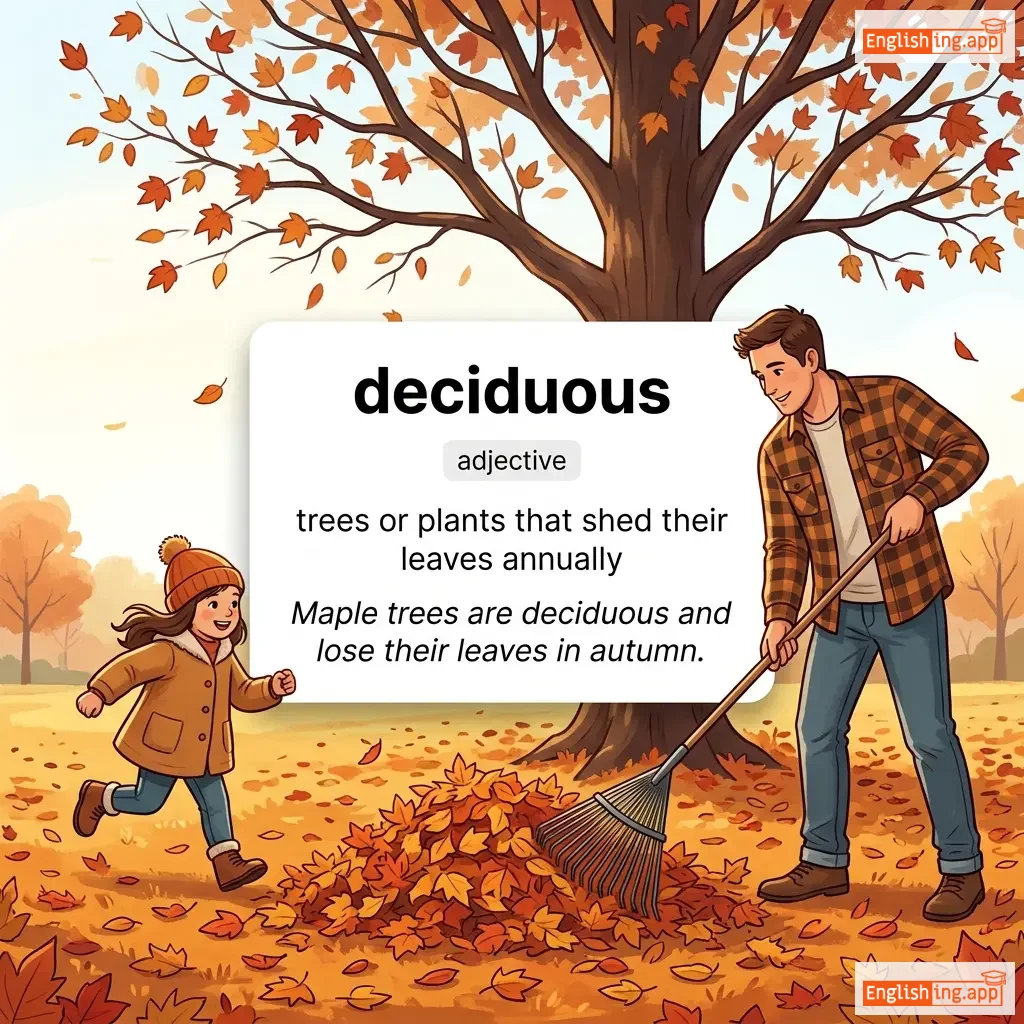
deciduous definition card — visual illustration of the meaning
adjective
/dɪˈsɪdʒuəs/
лиственный (listvennyj)

trees or plants that shed their leaves annually

"Maple trees are deciduous and lose their leaves in autumn."

"Кленовые деревья являются лиственными и теряют свои листья осенью." (Klenovye derev'ya yavlyayutsya listvennymi i teryayut svoi list'ya osenyu.)
noun
/ˈdɛsɪməl/
десятичный (desyatchnyy)

A number system based on 10; a number expressed in the base-10 system.

"The number 0.75 is a decimal."

"Число 0,75 — это десятичное число." (Chislo 0,75 — eto desyatochnoe chislo.)
verb
/ˈdɛsɪmeɪt/
уничтожить (unichtozhit)

To destroy or kill a large proportion of something.

"The wildfire decimated the forest."

"Лесной пожар уничтожил лес." (Lesnoy pozhar unichtozhil les.)
noun
/ˌdɛsɪˈmeɪʃən/
истребление (istreblenie)

The act of destroying or killing a large proportion of something.

"The decimation of the city left thousands homeless."
"Истребление города оставило тысячи бездомных." (Istreblenie goroda ostavilo tysyachi bezdomnykh.)
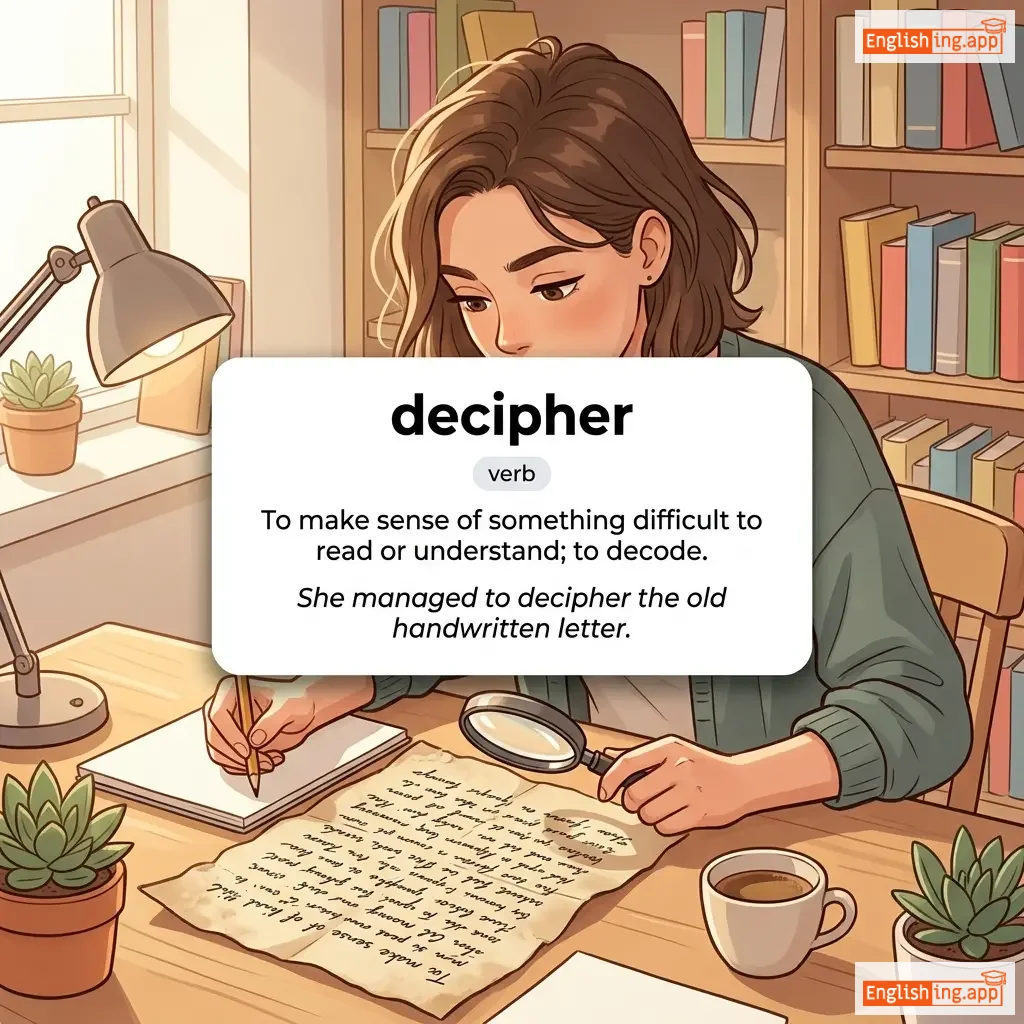
decipher definition card — visual illustration of the meaning
verb
/dɪˈsaɪfər/

To make sense of something difficult to read or understand; to decode.

"She managed to decipher the old handwritten letter."

noun
/dɪˈsɪʒən/
решение (reshenie)

A conclusion or choice made after consideration.

"She made a quick decision to accept the job offer."

"Она приняла быстрое решение принять предложение о работе." (Ona prinjala bystroye resheniye prinyat' predlozheniye o rabote.)
noun
/dɪˈsɪʒənˌmeɪkɪŋ/
принятие решений (prinyatie resheniy)

the process of making decisions, especially important or business-related decisions

"The CEO's decision-making was crucial for the success of the company."

"Принятие решений CEO было критически важным для успеха компании." (Prinyatiye resheniy CEO bylo kriticheski vazhnym dlya uspekha kompanii.)
decisions definition card — visual illustration of the meaning
noun
/dɪˈsɪʒənz/
решения (resheniya)

A conclusion or resolution reached after consideration; the action or process of deciding something.

"Making the right decisions in time was key to the project's success."

"Принятие правильных решений вовремя было ключом к успеху проекта." (Prinyatiye pravylnykh resheniy vovremya bylo klyuchom k uspekhu proyektu.)
adjective
/dɪˈsaɪsɪv/
решающий (reshayushchiy)

Having the ability to make decisions quickly and effectively; determining the outcome.

"Her decisive action saved the company from collapse."
"Ее решающее действие спасло компанию от краха." (Eyo reshayushchee deystviye spaslo kompaniyu ot krakha.)
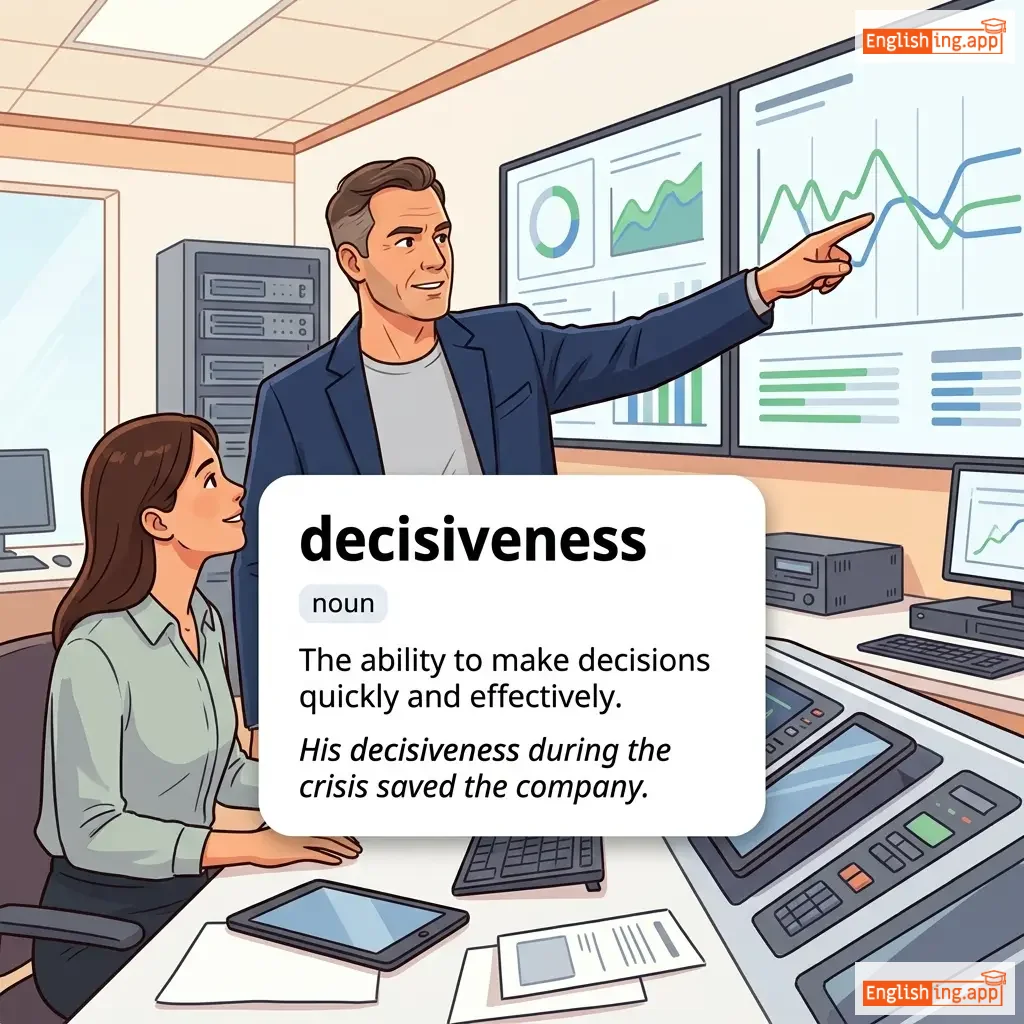
decisiveness definition card — visual illustration of the meaning
noun
dɪˈsʌɪsɪvnɪs
способность принимать решения (sposobnost' prinimat' resheniya)

The ability to make decisions quickly and effectively.

"His decisiveness during the crisis saved the company."

"Его решительность в кризисной ситуации спасла компанию." (Ego reshitel'nost' v krizisnoy situatsii spasla kompaniyu.)
🛳️

deck (dek)

noun
/dɛk/
палуба / платформа (paluba / platforma)

A flat surface or platform, often on a ship or building.

"We enjoyed the sunset from the upper deck of the ferry."

"Мы наслаждались закатом с верхней палубы парома." (My naslazhdalis' zakatom s verkhney paluby paroma.)
verb
/dɪˈkleɪm/
декламировать (deklamirovat)

to speak aloud in a formal, passionate, or theatrical way

"The actor declaimed his lines with great intensity."

"Актёр декламировал свои реплики с большой интенсивностью." (Aktor deklamiroval svoi repliki s bolshoi intensivnostyu)
noun
/ˌdɛkləˈmeɪʃən/
декламация (deklamatsiya)

a formal speech delivered with rhetorical or dramatic effect

"Her declamation captivated the audience at the competition."

"Её декламация очаровала зрителей на конкурсе." (Yeyo deklamatsiya ocharovala zriteley na konkurse.)
adjective
/dɪˈklæməˌtɔri/
декламационный стиль (deklyamatsionnyy stil)

speaking in a loud, rhetorical, or dramatic way

"The politician’s declamatory style impressed some but irritated others."

"Декламационный стиль политика впечатлил одних, но раздражал других." (Deklyamatsionnyy stil politika vpechatlil odnikh, no razdrazhal drugikh.)
noun
/ˌdɛkləˈreɪʃən/
декларация (deklaraatsiya)

a formal or explicit statement or announcement

"The president made a declaration of independence."

"Президент сделал декларацию независимости." (Prezident sdelal deklaratsiyu nezavisimosti.)
adjective
/dɪˈklærətɪv/
утвердительный (utverditel'nyy)

relating to a statement that declares something; in grammar, a sentence that makes a statement

"A declarative sentence simply states a fact or opinion."

"Утвердительное предложение просто излагает факт или мнение." (Utverditel'noye predlozheniye prosto izlagaet fakt ili mneniye)
verb
/dɪˈklɛər/
объявить (ob'yavit')

To announce something formally or officially.

"The government declared a state of emergency."
"Правительство объявило чрезвычайное положение." (Pravitel'stvo ob'yavilo chrezvychaynoye polozheniye.)
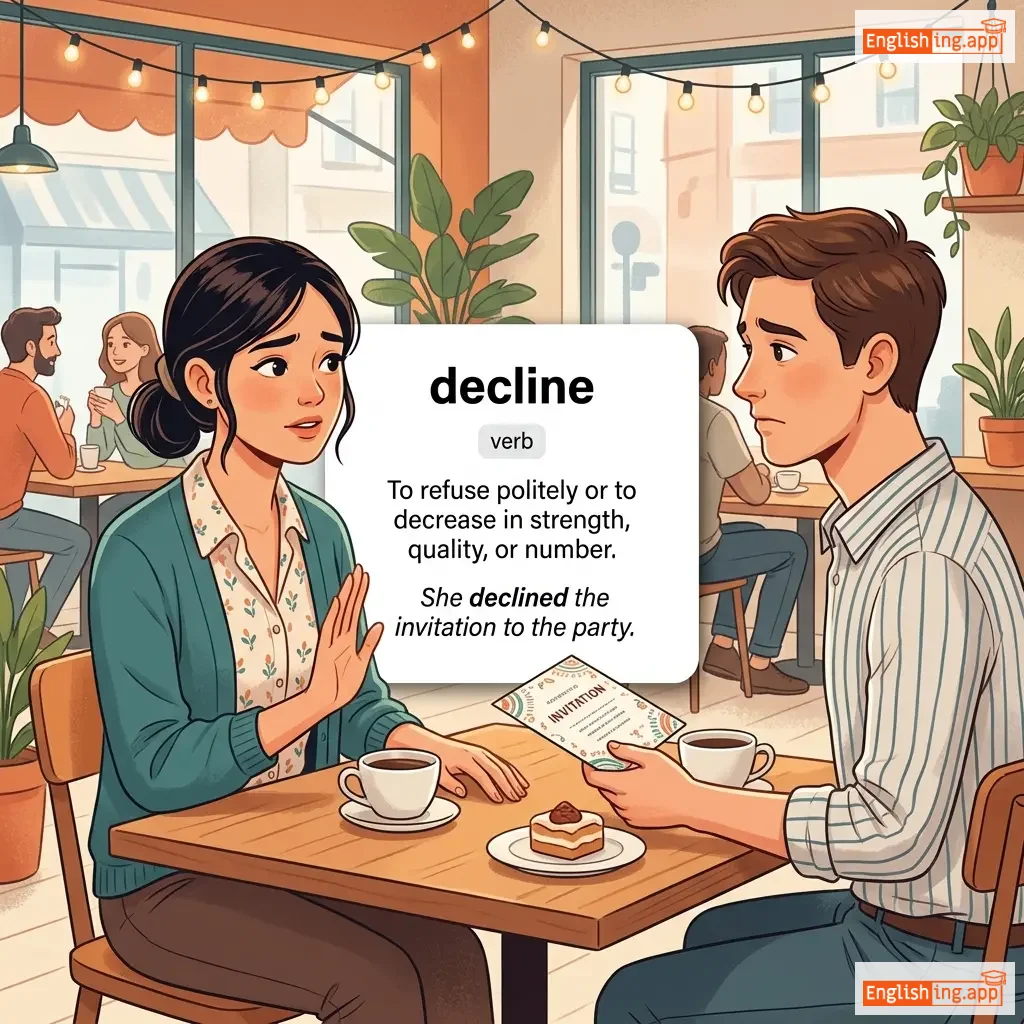
decline definition card — visual illustration of the meaning
verb
/dɪˈklaɪn/

To refuse politely or to decrease in strength, quality, or number.

"She declined the invitation to the party."

noun
/dɪˈklɪvɪti/
склон (sklon)

a downward slope of ground

"They carefully climbed down the declivity of the hill."

"Они осторожно спустились по склону холма." (Oni ostorozhno spustilis' po sklonu kholma.)