Словари

Словарь английского языка | Значения слов, определения и примеры

adjective
/ˈɔːbərn/
рыжевато-коричневый (ryzhe-vato-korichnevyy)

reddish-brown in color, especially used to describe hair

"She has long auburn hair that shines in the sunlight."

"У неё длинные рыжевато-коричневые волосы, которые сверкают на солнце." (U nee dlinnyye ryzhe-vato-korichnevye volosy, kotoryye sverkayut na solntse.)
noun
/ˈɔːkʃən/
аукцион (auktsion)

a public sale where goods are sold to the highest bidder

"The painting was sold at an auction for a record price."

"Картина была продана на аукционе за рекордную цену." (Kartina byla prodana na auktsione za rekordnuyu tsenu.)
noun
/ˌɔːkʃəˈnɪər/
аукционист (auktsionist)

a person who conducts auctions by calling out bids and selling items to the highest bidder

"The auctioneer quickly raised the price as bidders competed for the painting."

"Аукционист быстро повышал цену во время торгов." (auktsionist bystro povyshal tsenu vo vremya torgov)
Audacious definition card — visual illustration of the meaning
adjective
/ɔːˈdeɪʃəs/
дерзкий (derzkiy)

showing a willingness to take bold risks; daring

"It was an audacious plan to climb the mountain in winter."
"Это был смелый план — взобраться на гору зимой." (Eto byl smelyy plan — vzobrat'sya na goru zimoy.)
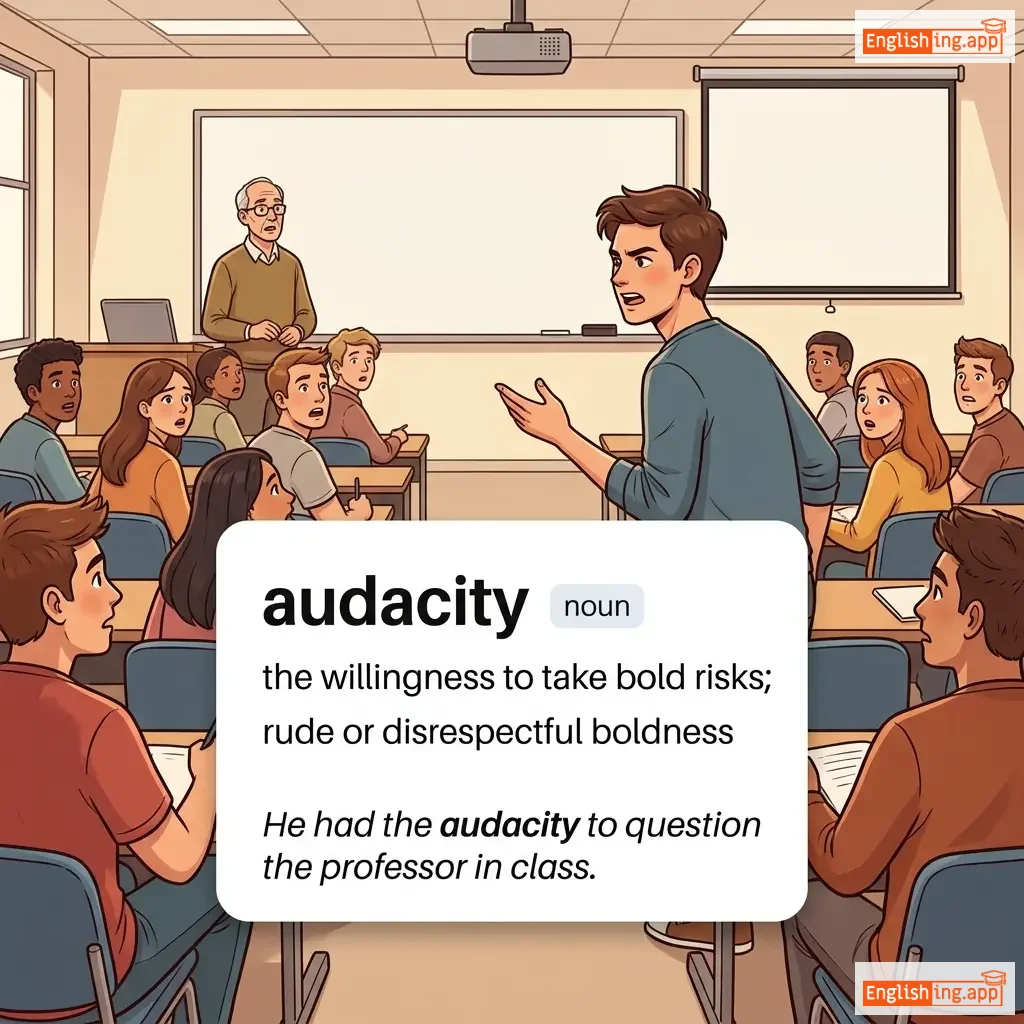
audacity definition card — visual illustration of the meaning
noun
/ɔːˈdæsəti/
дерзость (derzost)

the willingness to take bold risks; rude or disrespectful boldness

"He had the audacity to question the professor in class."

"У него хватило дерзости задать вопрос профессору на занятии." (U nego khvatilo derzosti zadat' vopros professoru na zanyatii.)
adjective
/ˈɔːdəbl/
слышный (slyshnyy)

able to be heard

"Her voice was barely audible over the noise of the crowd."

"Её голос едва был слышен на фоне шума толпы." (Eyo golos yedva byl slyshen na fone shuma tolpy.)
noun
/ˈɔːdiəns/
аудитория (auditoriya)

A group of people who gather to watch, listen to, or experience a performance, event, or broadcast.

"The audience clapped loudly after the performance."

"Аудитория громко аплодировала после выступления." (Auditoriya gromko aplodirovala posle vystupleniya.)
noun
/ˈɔːdiəʊ/
звук (zvuk)

sound, especially when recorded or transmitted

"The audio quality of the podcast was excellent."
"Качество звука подкаста было отличным." (Kachestvo zvuka podkasta bylo otlichnym.)
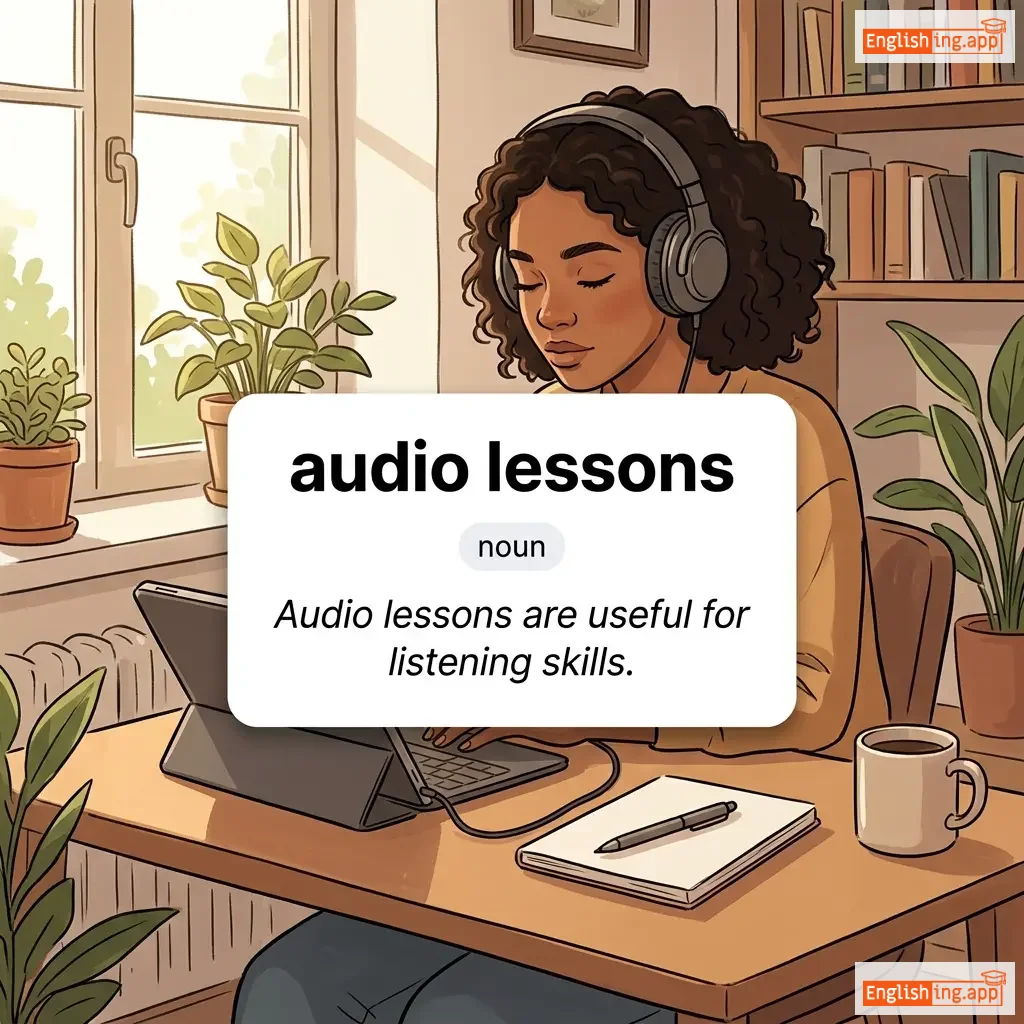
audio lessons definition card — visual illustration of the meaning
noun
ˈɔːdioʊ ˈlɛsənz
аудиоуроки (audiouroki)

Educational content delivered through sound recordings, typically used for language learning and skill development.

"Audio lessons are useful for listening skills."

"Аудиоуроки полезны для развития навыков аудирования." (Audiouroki polezny dlya razvitiya navykov audirovaniya.)
audit definition card — visual illustration of the meaning
noun/verb
/ˈɔːdɪt/
аудит (audit)

A formal examination of accounts or processes to ensure accuracy and compliance.

"The company hired an external firm to audit its financial statements."

"Компания наняла внешнюю фирму для проведения аудита своих финансовых отчетов." (Kompaniya nanyala vneshnyuyu firmu dlya provedeniya audita svoikh finansovykh otchetov.)
noun/verb
/ɔːˈdɪʃən/
прослушивание (proslushivanie)

A trial performance by an actor, singer, or musician to demonstrate suitability for a role.

"She auditioned for the lead role in the school play."

"Она прошла прослушивание на главную роль в школьной пьесе." (Ona proshla proslushivanie na glavnuyu rol' v shkol'noy p'ese.)
adjective
/ˈɔːdəˌtɔːri/

Relating to the sense of hearing.

"The lecture was designed to enhance students' auditory learning skills."

augment definition card — visual illustration of the meaning
verb
/ɔːɡˈmɛnt/
увеличивать (uvelichivat)

To make something greater by adding to it; to increase.

"The company plans to augment its workforce with new recruits."

"Компания планирует увеличить свою рабочую силу новыми рекрутами." (Kompaniya planirovat uvelichit' svoju rabochuju silu novymi rekruami.)
augmentation definition card — visual illustration of the meaning
noun
/ˌɔːɡ.mɛnˈteɪ.ʃən/
увеличение (uvelichenie)

Enhancing or increasing the effectiveness or quality of something.

"Augmented reality (AR) enables augmentation of real-world experiences."

"Дополненная реальность (AR) позволяет увеличивать реальный опыт." (Dopolnennaya real'nost' (AR) pozvolyaet uvelichivat' real'nyy opyt.)
augmented definition card — visual illustration of the meaning
adjective
ɔːɡˈmen.tɪd
увеличенный, улучшенный, расширенный (uvelichennyy, uluchshennyy, rasshirennyy)

having been made greater in size or value.

"The new software provided augmented reality features."

"Новое программное обеспечение предложило функции дополненной реальности." (Novoe programmnoe obespechenie predlozhilo funktsii dopolnennoy real'nosti.)
augmented reality definition card — visual illustration of the meaning
noun
ɔːɡˈmɛn.tɪd riˈæl.ɪ.ti
дополненная реальность, сочетание виртуального и реального мира (dopolnennaya real'nost', sochetanie virtual'nogo i real'nogo mira)

Technology that overlays digital information on the real world environment.

"Gaming has been transformed by augmented reality."
"Дополненная реальность изменила игры." (Dopolnennaya real'nost' izmenila igry.)
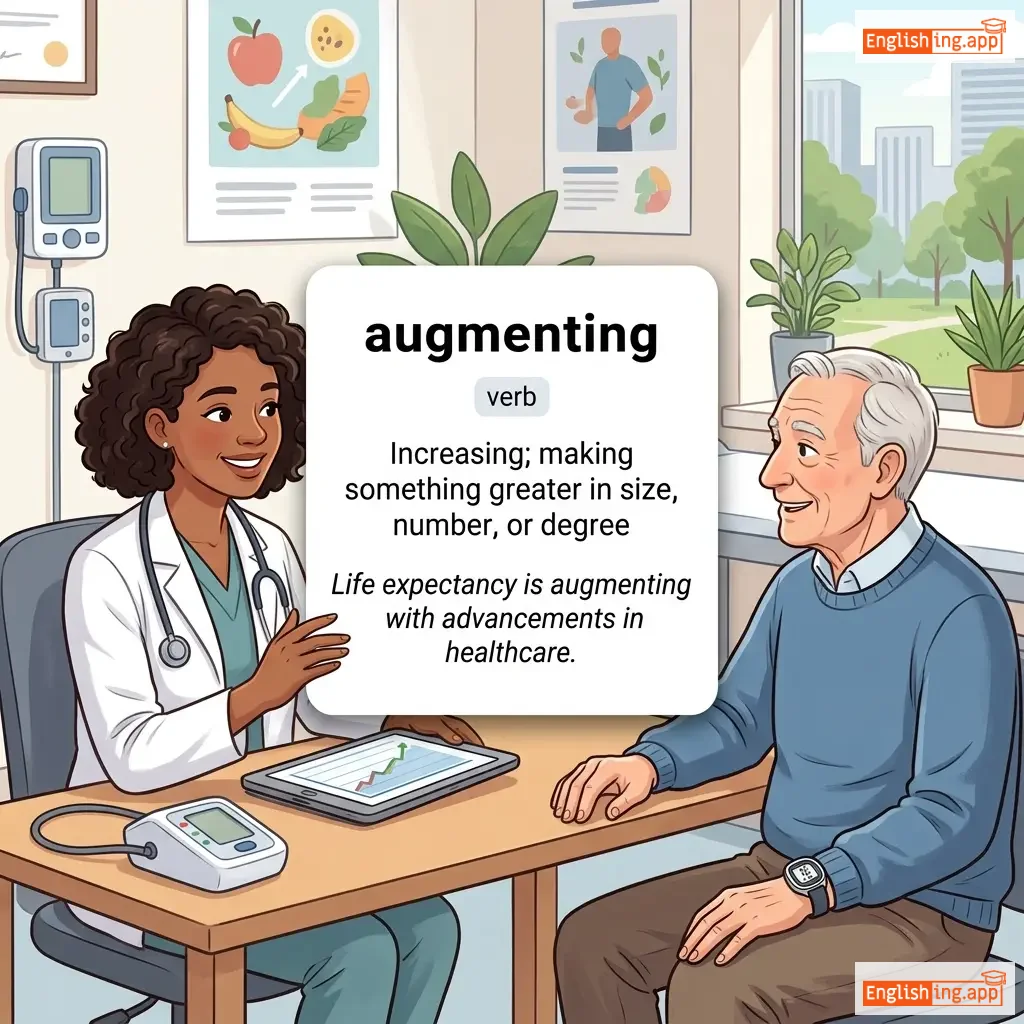
augmenting definition card — visual illustration of the meaning
verb
ɔːɡˈmɛntɪŋ
увеличивать (uvelichivat)

Increasing; making something greater in size, number, or degree

"Life expectancy is augmenting with advancements in healthcare."

"Ожидаемая продолжительность жизни увеличивается с развитием здравоохранения." (Ozhidaemaya prodolzhitel'nost' zhizni uvelichivaetsya s razvitiem zdravookhraneniya.)
verb
/ˈɔːɡər/
предсказывать (predskazyvat')

To be a sign of something to come; to predict or foretell.

"Dark clouds augur a coming storm."

"Тёмные облака предсказывают приближающийся шторм." (Tyomnye oblaka predskazyvayut priblizhayushchiesya shtorm.)
noun
/ˈɔːɡjʊri/
предзнаменование (predznamenovanie)

A sign or omen that is believed to predict future events.

"The dark clouds were seen as an augury of an approaching storm."

"Темные облака были восприняты как предзнаменование надвигающегося шторма." (Temnye oblaка byli vosprinuty kak predznamenovanie nadvigayushchegosya shtorma.)
adjective
/ɔːˈɡʌst/
величественный (velichestvenny)

Respected and impressive; inspiring reverence or admiration.

"The king entered the hall with an august presence."

"Царь вошел в зал с величественным присутствием." (Tsar' voshel v zal s velichestvennym prisutstviyem.)
👩‍🦳

aunt (ænt)

noun
/ænt/
тётя (tyotya)

the sister of your father or mother, or the wife of your uncle

"My aunt always gives me gifts on my birthday."

"Моя тётя всегда дарит мне подарки на день рождения." (Moya tyotya vsegda darit mne podarki na den' rozhdeniya.)
noun
/ˈɑːnti/
тётя (tyotya)

the sister of one’s father or mother; a term of respectful address for an older woman, especially in South Asian usage

"My aunty lives near our house and often visits us."

"Моя тётя живёт рядом с нашим домом и часто навещает нас." (moya tyotya zhivyot ryadom s nashim domom i chasto naveshchaet nas)
adjective
/ˈɔːrəl/
слуховой (slukhovoy)

Relating to the ear or the sense of hearing.

"The lecture was an aural experience as well as an intellectual one."

"Лекция была слуховым опытом, а также интеллектуальным." (Lekciya byla slukhovym opytom, a takzhe intellektualnym.)
noun
/ˈɔːriˌoʊl/
ореол (oreol)

A halo or radiance surrounding the head or body, often in religious art.

"The painting showed the saint with an aureole around his head."

"Картина показывала святого с аурой вокруг его головы." (Kartina pokazyvala svyatogo s auroy vokrug yego golovy.)
noun
/ˈɔːrɪkl̩/
внешняя часть уха (vneshnyaya chast' ukha)

The external part of the ear; also an upper chamber of the heart in anatomy.

"The doctor examined the patient’s auricle for signs of infection."

"Врач осмотрел внешнюю часть уха пациента на признаки инфекции." (Vrach osmotrel vneshnyuyu chast' ukha patsiyenta na priznaki infektsii.)
adjective
/ɔːˈrɪkjʊlər/
связанный с ухом (svyazannyy s ukhom)

Relating to the ear or hearing.

"The doctor used an auricular thermometer to check the patient's temperature."

"Доктор использовал аурикулярный термометр, чтобы проверить температуру пациента." (Doktor ispol'zoval aurikulyarnyy termometr, chtoby proverit' temperaturu patsiyenta.)
adjective
/ɔːˈrɪfərəs/
золотой (zolotoy)

Containing or producing gold.

"The miners discovered an auriferous vein in the mountains."

"Шахтеры обнаружили золотую жилу в горах." (Shakhtery obnaruzhili zolotuyu zhilu v gorakh.)
noun
/ɔːˈrɔːrə/
аврора (avrova)

A natural display of lights in the sky, usually seen in polar regions.

"We traveled to Norway to see the northern aurora."

"Мы поехали в Норвегию, чтобы увидеть северное аврору." (My poyekhali v Norvegiyu, chtoby uvidet' severnoe avroru.)
adjective
/ɔːˈrɔːrəl/
связанный с авророй (svyazannyy s avroroy)

Relating to or resembling the aurora, especially the northern lights.

"The scientists observed auroral activity in the night sky."

"Учёные наблюдали за аворальной активностью на ночном небе." (Uchyonye nablyudali za avoral'noy aktivnost'yu na nochnom nebe.)
noun
/ˌɔːskʌlˈteɪʃən/
аускультация (auskultatsiya)

The act of listening to internal sounds of the body, typically using a stethoscope.

"The doctor performed auscultation to check the patient’s lungs."

"Доктор провел аускультацию, чтобы проверить легкие пациента." (Doktor provel auskultatsiyu, chtoby proverit' legkie patsiyenta.)
noun
/ˈɔːspɪs/
предзнаменование, покровительство (predznamenovanie, pokrovitel'stvo)

A sign, omen, or divine token; also refers to protection or support.

"The project was launched under the auspice of the government."

"Проект был запущен под покровительством правительства." (Proyekt byl zapushchen pod pokrovitel'stvom pravitel'stva.)
noun (plural)
/ˈɔːspɪsɪz/
покровительство (pokrovitel'stvo)

Patronage, support, or guidance, often used in the phrase 'under the auspices of'.

"The conference was held under the auspices of the United Nations."
"Конференция прошла под эгидой ООН." (Konferentsiya proshla pod egidoi OON.)
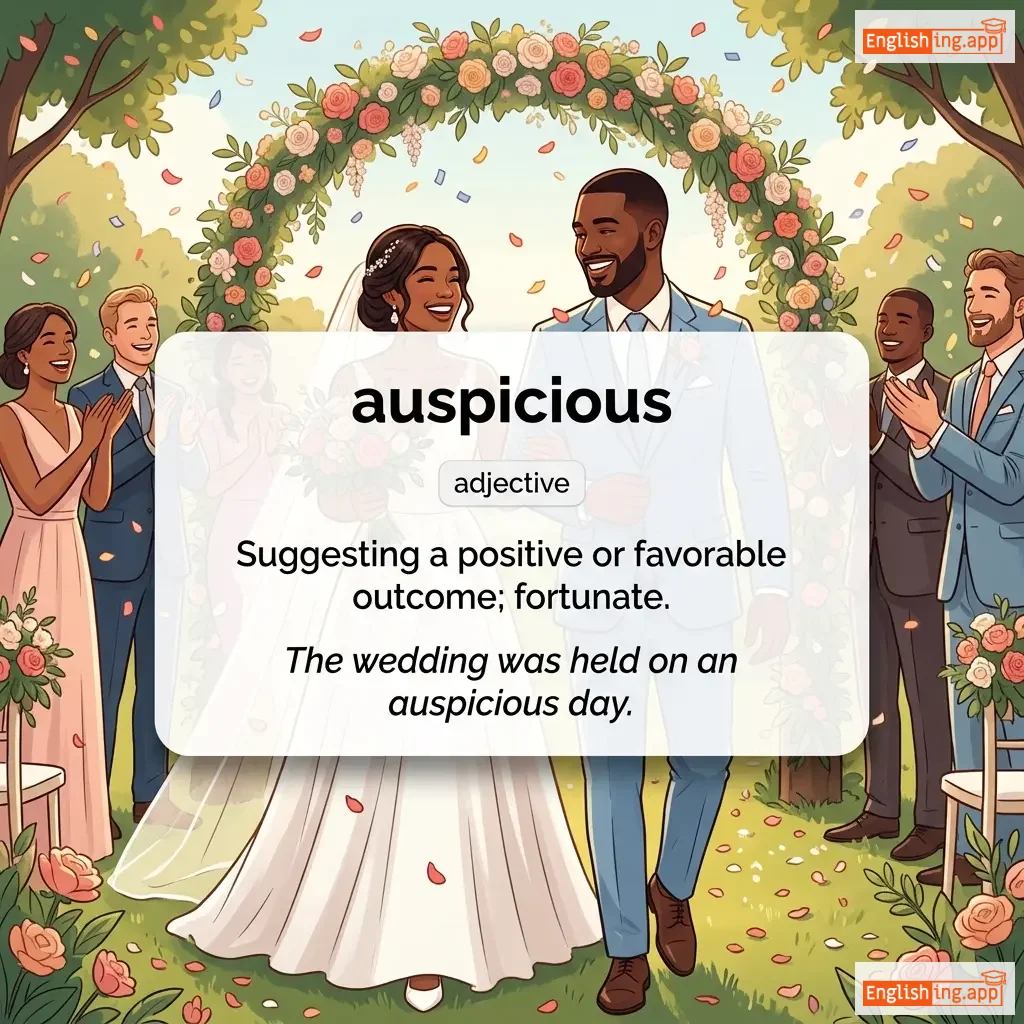
auspicious definition card — visual illustration of the meaning
adjective
/ɔːˈspɪʃəs/
благоприятный (blagopriyatnyy)

Suggesting a positive or favorable outcome; fortunate.

"The wedding was held on an auspicious day."

"Свадьба состоялась в благоприятный день." (Svad'ba sostoyalas' v blagopriyatnyy den'.)
austere definition card — visual illustration of the meaning
adjective
/ɔːˈstɪə/
строгий, простой (stroh-giy, pro-stoy)

Severe or strict in manner, attitude, or appearance; plain and simple.

"The monk lived an austere life in the mountains."

"Монах вел строгую жизнь в горах." (Monakh vel stro-guyu zhizn v gorakh.)
austerity definition card — visual illustration of the meaning
noun
/ɒˈstɛrɪti/
жесткость, экономия (zhestkost, ekonomiya)

Sternness or severity in manner or attitude; also strict economic policies.

"The government introduced new austerity measures."

"Правительство ввело новые меры экономии." (Pravitel'stvo vvelo novye mery ekonomii.)
noun
/ˈɔːtɑːrki/
аутархия (autarkhiya)

A system of self-sufficiency where a state or community is economically independent.

"The nation attempted autarchy to reduce reliance on imports."

"Нация попыталась достичь аутархии, чтобы уменьшить зависимость от импорта." (Natsiya popytalas dostich autarkhii, chtoby umenshit zavisimost' ot importa.)
autarky definition card — visual illustration of the meaning
noun
ˈɔː.tɑː.ki
автаркия, самодостаточность (avtarkiya, samodostatochnost)

Economic independence or self-sufficiency; a policy of establishing a self-sufficient national economy.

"Some nations aim for autarky to reduce reliance on imports."

"Некоторые страны стремятся к автаркии, чтобы сократить зависимость от импорта." (Nekotorye strany stremyatsya k avtarkii, chtoby sokratit' zavisimost' ot importa.)
adjective
/ɔːˈθɛntɪk/
аутентичный (autentichny)

Genuine and real; not fake or copied.

"The museum displayed an authentic painting by Picasso."

"Музей показал аутентичную картину Пикассо." (Muzey pokazal autentichnuyu kartinu Pikasso.)
adverb
/ɔːˈθentɪkli/
аутентично (autentichno)

in a genuine, real, or true manner; in a way that reflects true character or origin

"She speaks authentically about her experiences."

"Она говорит аутентично о своём опыте." (ona govorit autentichno o svoyom opyte)
verb
/ɔːˈθɛntɪkeɪt/
аутентифицировать (authentifitsirovat)

To prove or show that something is genuine or true.

"The bank uses advanced technology to authenticate online transactions."

"Банк использует передовые технологии для аутентификации онлайн-транзакций." (Bank ispol'zuyet peredovye tekhnologii dlya autentifikatsii onlayn-tranzaktsiy.)
authenticity definition card — visual illustration of the meaning
noun
/ˌɔːθɛnˈtɪsɪti/
аутентичность (autentichnost)

The quality of being genuine or real.

"The authenticity of the ancient manuscript was confirmed by experts."

"Аутентичность древнего манускрипта была подтверждена экспертами." (Autentichnost' drevnego manuskripta byla podtverzhdena ekspertami.)
noun
/ˈɔːθər/
автор (avtor)

A person who writes books, articles, or other literary works.

"She is the author of several bestselling novels."

"Она автор нескольких бестселлеров." (Ona avtor nekotorykh bestsellierov.)
authoritarian definition card — visual illustration of the meaning
adjective
/əˌθɔːrɪˈtɛəriən/
авторитарный (avtoritarny)

Favouring or enforcing strict obedience to authority, often at the expense of personal freedom.

"The regime was highly authoritarian, suppressing all forms of dissent."

"Режим был крайне авторитарным, подавляя все формы инакомыслия." (Rezhim byl krajne avtoritarnym, podavlyaya vse formy inakomysliya.)
adjective
/əˈθɔːrɪtətɪv/
авторитарный (avtoritarny)

Having or showing authority; commanding and self-confident; reliable as a source of information.

"She spoke in an authoritative tone that silenced the room."
"Она говорила авторитарным тоном, который заставил всех замолчать." (Ona govorila avtoritarnym tonom, kotoryy zastavil vsekh zamoshchat'.)
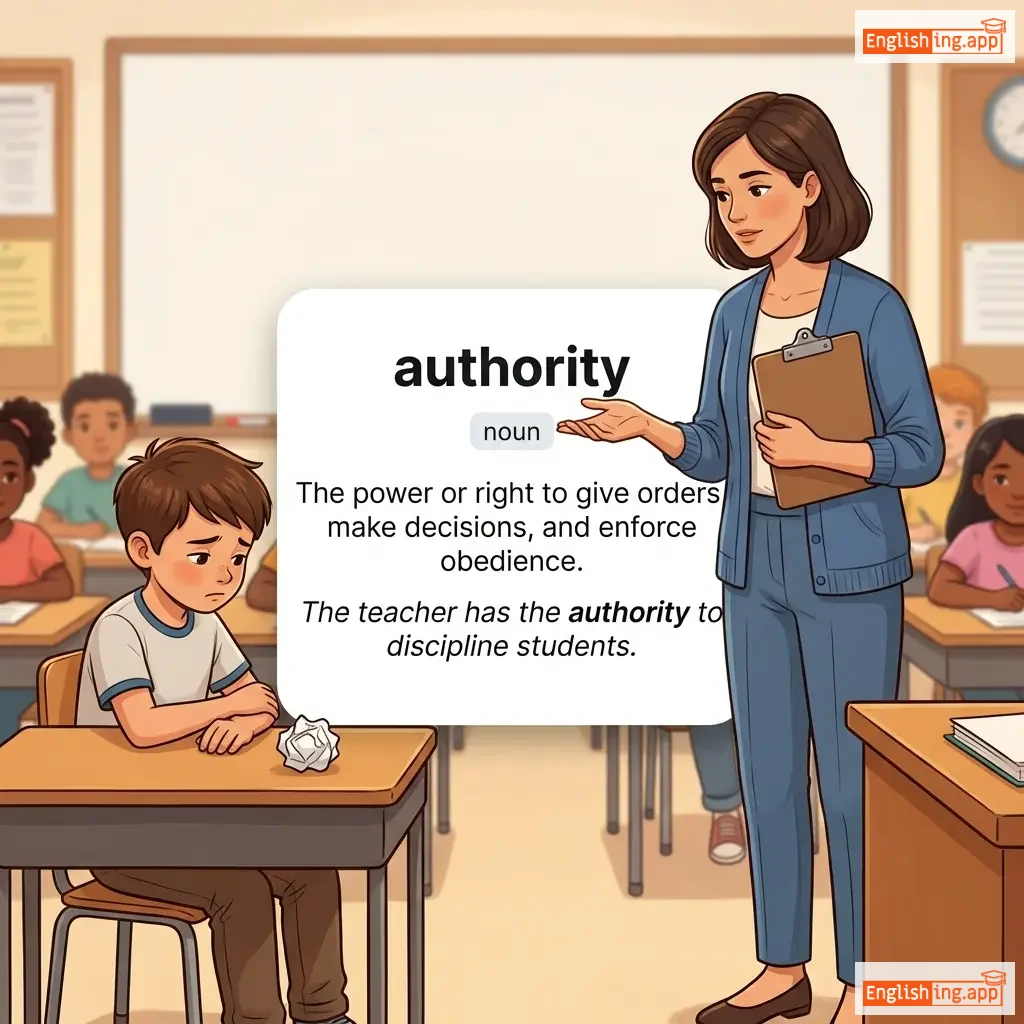
authority definition card — visual illustration of the meaning
noun
/əˈθɔːrəti/
авторитет (avtoritet)

The power or right to give orders, make decisions, and enforce obedience.

"The teacher has the authority to discipline students."
"У учителя есть полномочия наказывать студентов." (U uchitelya yest' polnomochiya nakazyvat' studentov.)
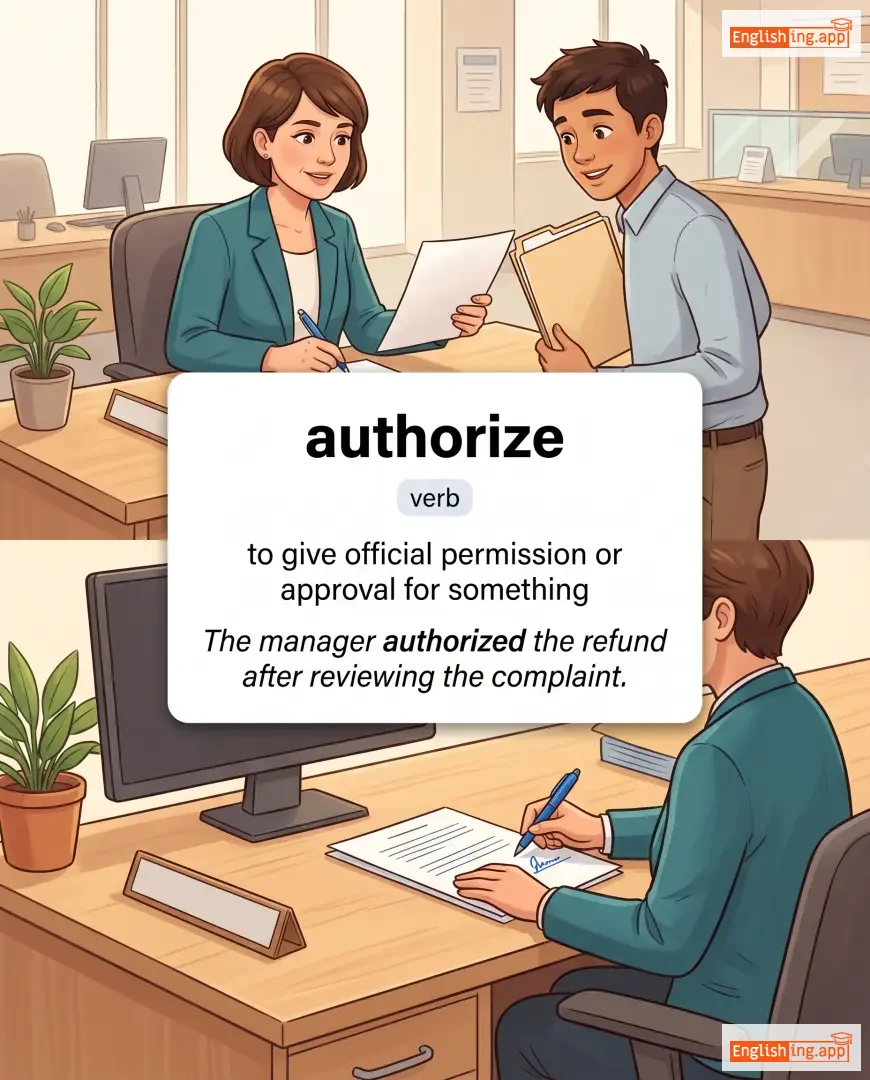
authorize definition card — visual illustration of the meaning
verb
/ˈɔːθəraɪz/
авторизовать (avtorizovat)

to give official permission or approval for something

"The manager authorized the refund after reviewing the complaint."

"Менеджер авторизовал возврат после рассмотрения жалобы." (Menedzher avtorizoval vozvrat posle rassmotreniya zhaloby.)
noun
/ˈɔːtoʊ/
авто (avto)

A motor vehicle, especially a car.

"He drove his auto to the market."

"Он поехал на своем авто на рынок." (On poyekhal na svoem avto na rynok.)
noun
/ˌɔːtəbaɪˈɒɡrəfi/
автобиография (avtobiografiya)

An account of a person's life written by that person.

"She published an autobiography about her journey to success."

"Она опубликовала автобиографию о своем пути к успеху." (Ona opublikovala avtobiografiyu o svoem puti k uspekhu.)
noun
/ɔːˈtɒkrəsi/
автократия (avtokratiya)

A system of government in which one person has absolute power.

"The country suffered under decades of autocracy."

"Страна страдала от десятилетий автократии." (Strana stradala ot desyatiletiy avtokratii.)
noun
/ˈɔːtəkræt/
автократ (avtokrat)

A ruler with absolute power.

"The autocrat controlled the country with an iron fist."

"Автократ контролировал страну железным кулаком." (Avtokrat kontroliroval stranu zheleznym kulakom.)