वोकैबुलरीज

इंग्लिश वोकैबुलरी डिस्कवर, लर्न और मास्टर करें

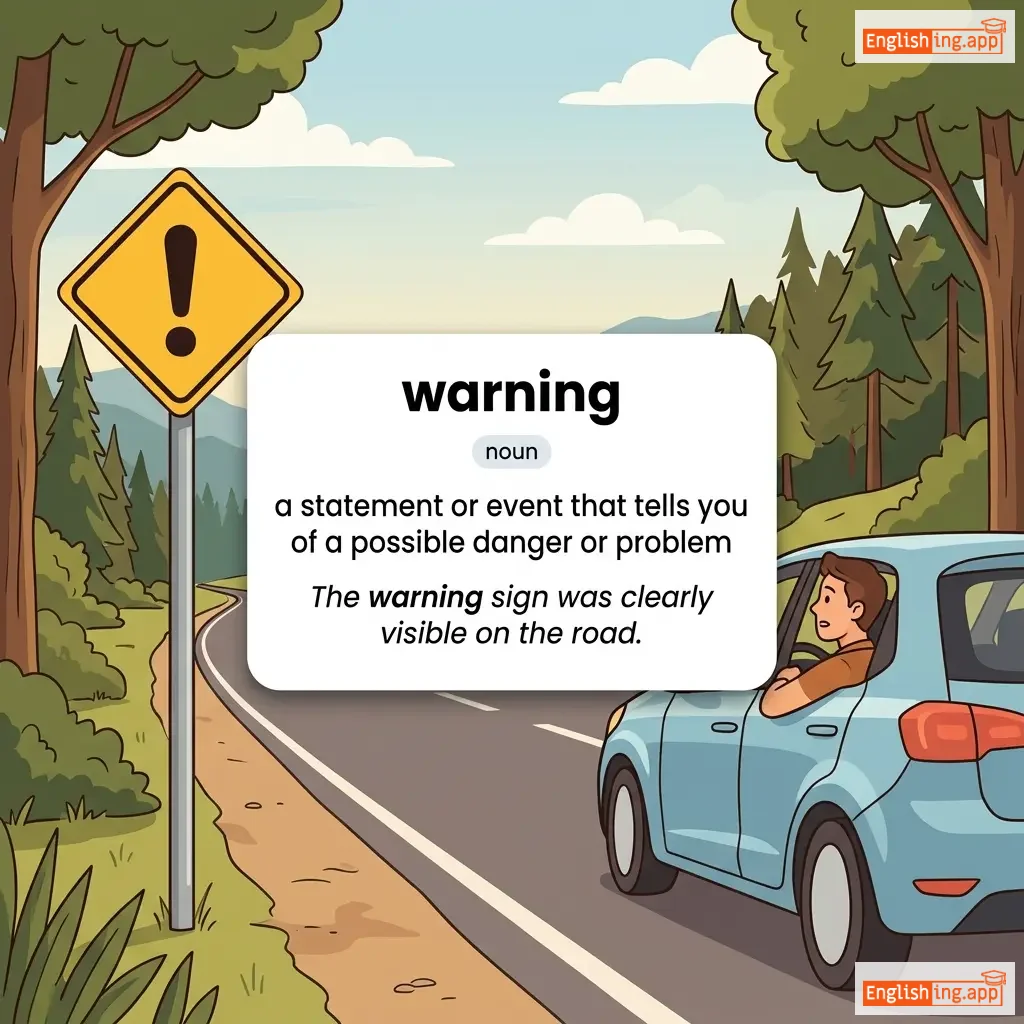
warning definition card — visual illustration of the meaning
noun
/ˈwɔːrnɪŋ/
चेतावनी (chetavni)

a statement or event that tells you of a possible danger or problem

"The warning sign was clearly visible on the road."

"सड़क पर चेतावनी का चिन्ह स्पष्ट रूप से दिखाई दे रहा था।" (Sadak par chetavni ka chinha spashth roop se dikhai de raha tha.)
verb
/wɔːrp/
विकृत होना (vikrit hona)

To twist or bend out of shape, often due to heat or moisture.

"The wooden door warped in the summer heat."

"लकड़ी का दरवाजा गर्मी में विकृत हो गया।" (Lakdi ka darwaza garmi mein vikrit ho gaya.)
noun/verb
/ˈwɒrənt/
वॉरंट (warrant)

As a noun: An official authorization or order. As a verb: To justify or make something necessary.

"The judge issued a warrant for his arrest."

"जज ने उसके गिरफ्तार करने के लिए एक वारंट जारी किया।" (Judge ne uske giraftaar karne ke liye ek warrant jaari kiya.)
warranted definition card — visual illustration of the meaning
adjective/verb
/ˈwɒrəntɪd/
उचित (uchit)

Justified or authorized under the circumstances.

"Her anger was warranted after the unfair treatment."

"उसका गुस्सा उसके अनुचित व्यवहार के बाद उचित था।" (Uska gussa uske anuchit vyavhaar ke baad uchit tha.)
noun
/ˈwɒrənti/
वारंटी (waranti)

A written guarantee given by a manufacturer or seller promising to repair or replace a product if necessary within a specified period.

"The laptop comes with a two-year warranty."

"लैपटॉप दो साल की वारंटी के साथ आता है।" (Laptop do saal ki waranti ke saath aata hai.)
noun
/ˈwɒrən/
खरगोश के बिलों का नेटवर्क (warren)

A network of interconnected rabbit burrows; also used metaphorically for a densely populated building or district.

"The old part of the city is a warren of narrow streets."

"शहर का पुराना हिस्सा संकरी गलियों का एक जटिल नेटवर्क है।" (Shahar ka purana hissa sankari galiyon ka ek jatil network hai.)
noun
/ˈwɒriər/
योद्धा (yoddha)

a person engaged or experienced in warfare; a brave or experienced fighter

"The ancient warrior fought fearlessly to protect his land."

"प्राचीन योद्धा ने अपनी भूमि की रक्षा के लिए निडरता से लड़ा।" (Prachin yoddha ne apni bhumi ki raksha ke liye nidarta se lada.)
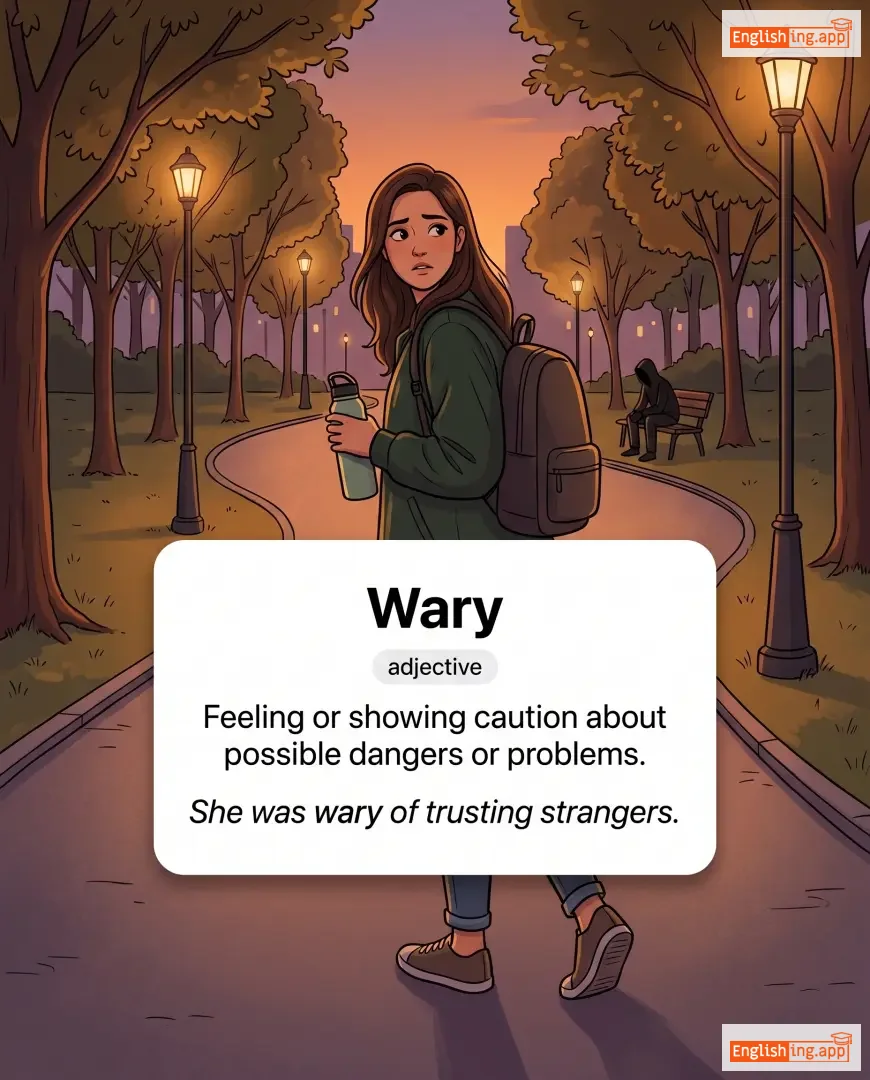
Wary definition card — visual illustration of the meaning
adjective
/ˈweəri/
सावधान (wary)

Feeling or showing caution about possible dangers or problems.

"She was wary of trusting strangers."

"वह अजनबियों पर विश्वास करने में सावधान थी।" (Woh anajabiyon par vishwas karne mein savdhan thi.)
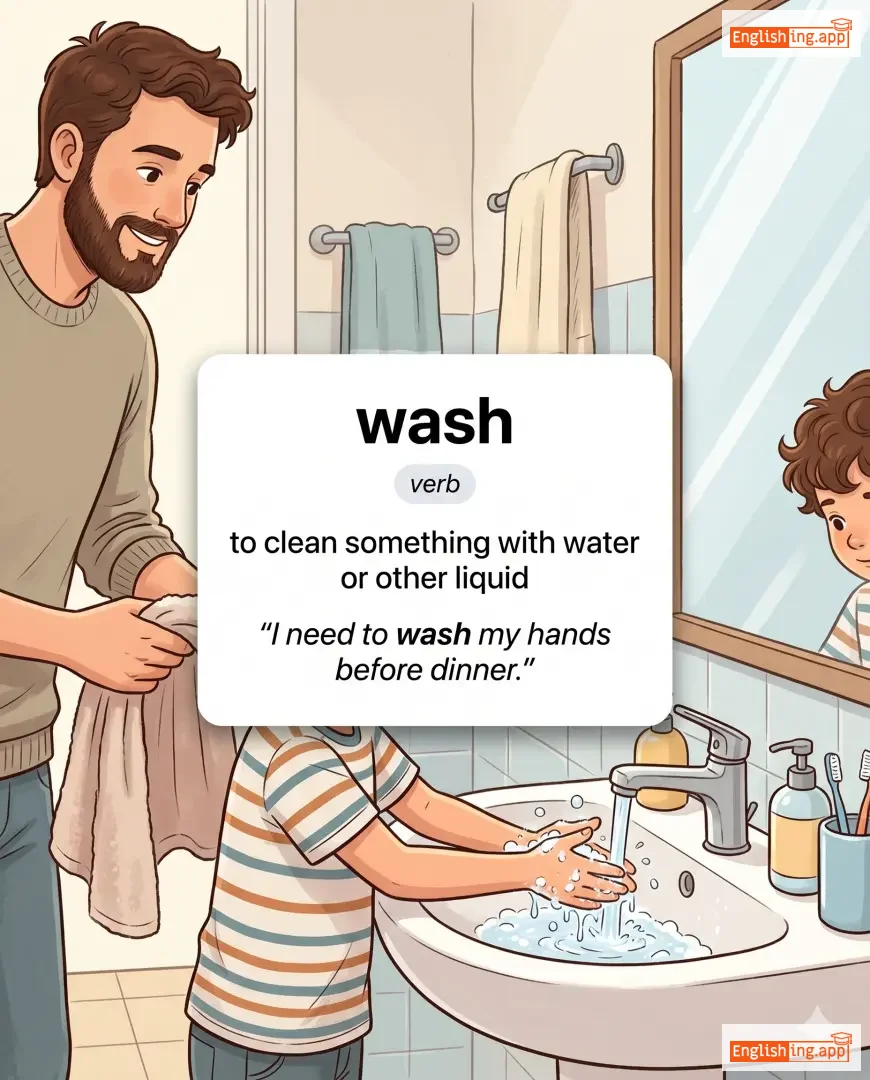
wash definition card — visual illustration of the meaning
verb
/wɒʃ/
धोना (dhona)

to clean something with water or other liquid

"I need to wash my hands before dinner."

"मुझे डिनर से पहले अपने हाथ धोने की आवश्यकता है।" (Mujhe dinner se pehle apne haath dhone ki avashyakta hai.)
noun
/ˈwɑː.ʃər mæn/
धोबी (dhobi)

a person whose job is to wash clothes and linens for others

"The washer man collected dirty clothes from every household in the village."

"वॉशर मैन ने गाँव के हर घर से गंदे कपड़े इकट्ठा किए।" (washer main ne gaon ke har ghar se gande kapde ikattha kiye)
noun; gerund
/ˈwɒʃɪŋ/
धुलाई (dhulai)

the act of cleaning with water or other liquid; clothes or items that are being washed

"Washing clothes regularly helps maintain hygiene."

"नियमित कपड़े धोना स्वच्छता बनाए रखने में मदद करता है।" (niyamit kapde dhona swachchhata banaye rakhne mein madad karta hai)
noun
/ˈwɒʃ.ɪŋ məˌʃiːn/
वॉशिंग मशीन (voshin mashin)

a machine for washing clothes and other textiles

"The washing machine broke down and needs repair."

"वॉशिंग मशीन खराब हो गई है और मरम्मत की ज़रूरत है." (voshin mashin kharaab ho gayi hai aur marammat ki zaroorat hai)
noun
/wɒsp/
तितली (titli)

a flying insect with a yellow and black striped body and a painful sting

"The wasp stung me when I disturbed its nest."

"वह मुझे डंक मारने के बाद उड़ गया जब मैंने उसका घोंसला disturbed किया।" (Woh mujhe dank maarne ke baad ud gaya jab maine uska ghosla disturbed kiya.)
noun
/ˈweɪ.stɪdʒ/
अपव्यय (apvyay)

the action of using or expending something carelessly or without purpose

"The company reduced food wastage by implementing better inventory management."

"कंपनी ने बेहतर इन्वेंट्री प्रबंधन लागू करके खाद्य अपव्यय को कम किया।" (Kampani ne behatar inventory prabandhan lagu karke khady apvyay ko kam kiya.)
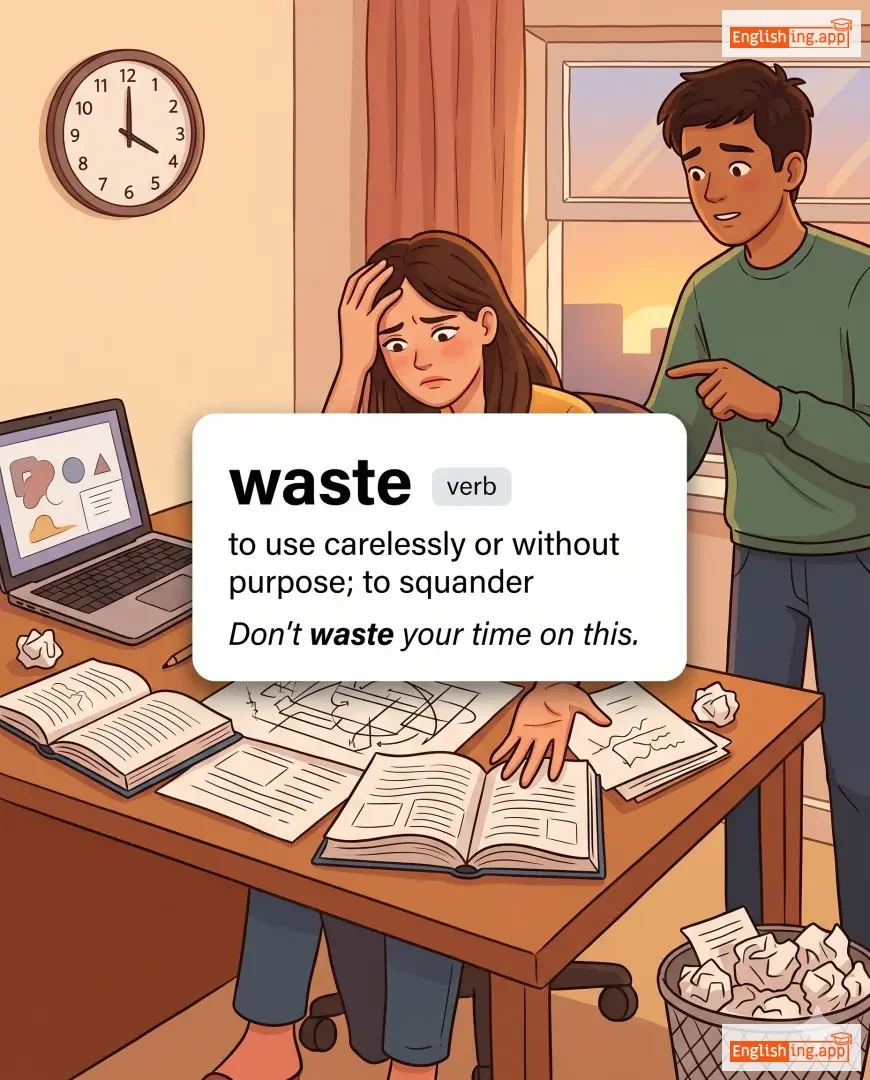
waste definition card — visual illustration of the meaning
noun
/weɪst/
व्यर्थ (vyarth)

something that is not useful and is thrown away

"Don't waste your time on unnecessary tasks."

"अनावश्यक कार्यों पर अपना समय बर्बाद मत करो।" (Anavashyak karyon par apna samay barbaad mat karo.)
noun
/ˈweɪstrəl/
वक्त बर्बाद करने वाला, अपव्ययी (wastrel)

A person who wastes time, money, or resources; an idler or spendthrift.

"The young man was dismissed as a wastrel by his family."

"युवक को उसके परिवार ने एक बर्बाद करने वाले के रूप में खारिज कर दिया।" (Yuvak ko uske parivaar ne ek barbād karne wale ke roop mein khārij kar diyā.)
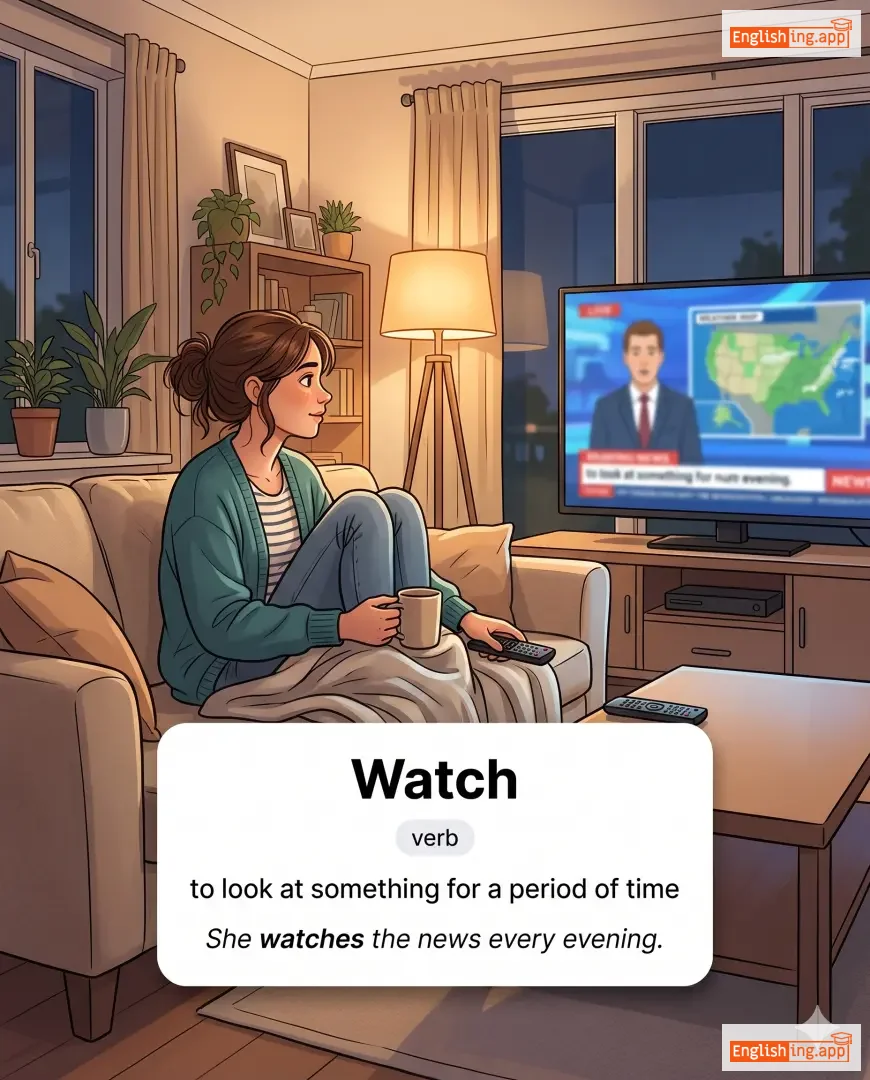
Watch definition card — visual illustration of the meaning
verb
/wɒtʃ/
देखना (dekhna)

to look at something for a period of time

"She watches the news every evening."

"वह हर शाम समाचार देखती है।" (Vah har shaam samachar dekhti hai.)
noun
/ˈwɒtʃ.mən/
गेटकीपर (getkeeper)

a person employed to guard or watch over a building or area, especially at night

"The watchman patrols the factory every hour to ensure security."

"गेटकीपर फैक्ट्री की सुरक्षा सुनिश्चित करने के लिए हर घंटे गश्त करता है।" (gatekeeper factory ki suraksha nishchit karne ke liye har ghante gasht karta hai.)
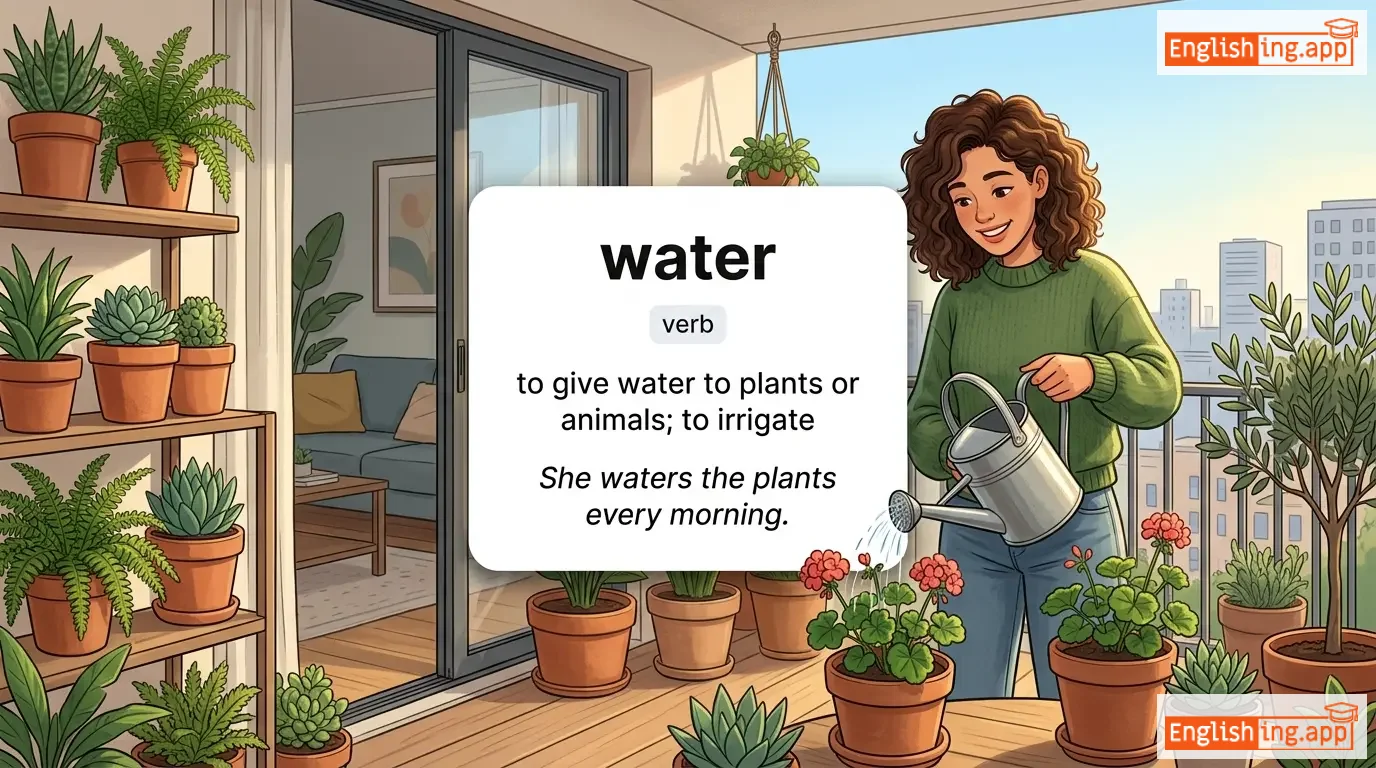
water definition card — visual illustration of the meaning
noun
/ˈwɔːtər/
पानी (pani)

a clear, colorless, odorless, and tasteless liquid that is essential for life

"We need to drink water to stay hydrated."

"हमें हाइड्रेटेड रहने के लिए पानी पीने की आवश्यकता है।" (Humein hydrated rahne ke liye pani peene ki avashyakta hai.)
noun
/ˈwɔː.tər ˈtʃes.nʌt/
जल चेस्टनट (jal chestnut)

aquatic plant with edible white crisp tubers

"Water chestnuts add a nice crunch to stir-fry dishes."

"जल चेस्टनट्स सटिर-फ्राई व्यंजनों में अच्छा क्रंच डालते हैं।" (jal chestnuts stir-fry vyanjano mein accha crunch daalte hain)
noun
/ˈwɔː.tər hen/
जल मुर्गी (jal murgi)

a waterbird with dark plumage that lives near ponds and wetlands

"The water hen swam gracefully across the pond."

"जल मुर्गी ने तालाब के पार gracefully तैरा।" (jal murgi ne talab ke paar gracefully tairaa.)
noun
/ˈwɔː.tər pɒt/
पानी का बर्तन (pani ka bartan)

a container used for storing or carrying water

"The water pot in the kitchen was filled with fresh drinking water."

"रसोई में पानी का बर्तन ताजे पीने के पानी से भरा हुआ था।" (rasoi mein pani ka bartan taje peene ke pani se bhara hua tha.)
noun
/ˈwɔtər ˈpjʊrəˌfaɪər/
पानी शोधक (pani shodhak)

A device that removes contaminants and impurities from water to make it safe for drinking

"We installed a water purifier in our kitchen to ensure clean drinking water."

"हमने अपने रसोईघर में पीने योग्य पानी सुनिश्चित करने के लिए एक वाटर प्यूरिफायर स्थापित किया।" (hamne apne rasoighar mein peene yogya pani nishchit karne ke liye ek water purifier sthapit kiya.)
noun
/ˈwɔː.tər ˈspɪn.ɪtʃ/
पानी पालक (pani palak)

A semi-aquatic leafy vegetable with hollow stems, popular in Asian cuisine

"Water spinach grows well in wet soil."

"पानी पालक गीली मिट्टी में अच्छी तरह से उगती है।" (pani palak geeli mitti mein acchi tarah se ugti hai)
noun
/ˈwɔː.tər ˌlɪl.i/
कमल (kamal)

a floating flower that grows on the surface of ponds and lakes

"The white water-lily floated gracefully on the pond."

"सफेद कमल तालाब पर सुंदरता से तैर रहा था।" (safed kamal talab par sundarta se tair raha tha)
noun
/ˈwɔːtərfɔːl/
जलप्रपात (jalaprapaat)

a cascade of water falling from a height, formed when a river or stream flows over a precipice or steep incline

"The magnificent waterfall attracts thousands of tourists every year."

"यह शानदार जलप्रपात हर साल हजारों पर्यटकों को आकर्षित करता है।" (yah shandar jalaprapat har saal hazaaron paryatan ko aakarshit karta hai.)
noun
/ˈwɔː.tər.mel.ən/
तरबूज (tarbooj)

a large round fruit with a hard green skin and sweet red flesh with black seeds

"I bought a fresh watermelon from the market for the summer picnic."

"मैंने गर्मी के पिकनिक के लिए बाजार से ताजे तरबूज खरीदे।" (maine garmi ke piknik ke liye bazar se taje tarbooj kharide.)
noun
/ˈwɔːtəʃɛd/
महत्वपूर्ण मोड़, जलविभाजन रेखा (watershed)

An event or period marking a turning point in a situation; also refers to a ridge dividing two drainage areas.

"The independence movement was a watershed in the nation's history."

"स्वतंत्रता आंदोलन राष्ट्र के इतिहास में एक महत्वपूर्ण मोड़ था।" (Svatantrata aandolan rashtr ke itihaas mein ek mahatvapoorn mod tha.)
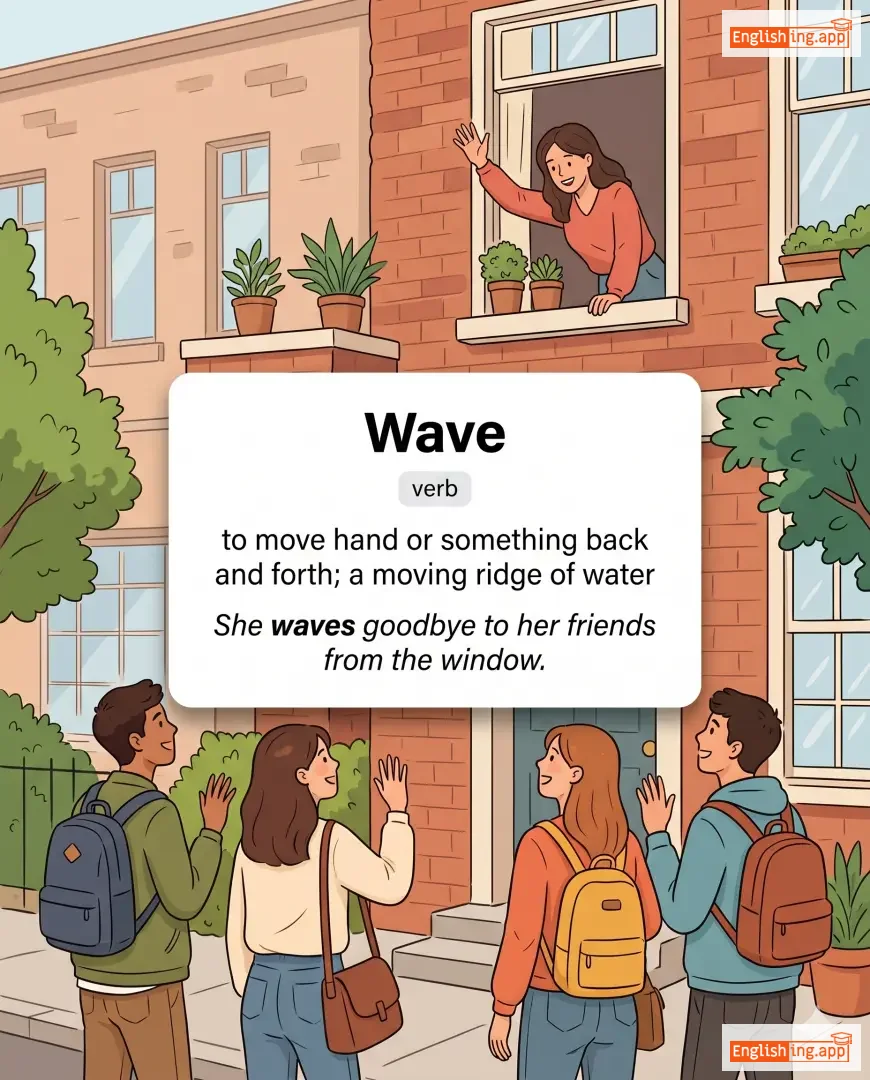
Wave definition card — visual illustration of the meaning
noun
/weɪv/
लहर (lahar)

a long body of water curling into an arched form and breaking on the shore

"The waves crashed against the rocks during the storm."

"तूफान के दौरान लहरें चट्टानों से टकराई।" (Toofan ke dauran lahrain chattanon se takraayi.)
noun
/ˈweɪvlət/
छोटी लहर (chhoti lehr)

a small wave or ripple on the surface of water or another medium

"The pond was disturbed only by the tiny wavelets caused by the breeze."

"तालाब केवल हवा से उत्पन्न छोटे लहरों के कारण हिल गया था।" (Talab keval hawa se utpann chhote lehron ke karan hil gaya tha.)
verb
/ˈweɪvər/
हिचकिचाना (hichkichana)

to become unsteady or indecisive; to hesitate or shake

"She began to waver in her decision to move abroad."

"वह विदेश जाने के अपने निर्णय में झिझकने लगी।" (vah videsh jaane ke apne nirnay mein jhijhakne lagi.)
verb
/wæks/
क्रमशः बढ़ना (kramashah badhna)

to increase gradually in size, number, strength, or intensity

"The moon will wax until it becomes full."

"चाँद पूर्ण होने तक बढ़ेगा।" (Chaand poorn hone tak badhega.)
noun
/wæks ɡɔːrd/
वैक्स लौकी (vaiks lauki)

a large white or green gourd with waxy skin, commonly used in Asian cooking

"The wax gourd soup is very nutritious and helps with digestion."

"वैक्स लौकी का सूप बहुत पौष्टिक होता है और पाचन में मदद करता है।" (vaiks lauki ka soup bahut poshtik hota hai aur pachan mein madad karta hai.)
noun
/wæks ˈkændəl/
मोमबत्ती (mombatti)

a cylinder of wax with a wick through it that burns to give light

"We lit a wax candle during the power outage."

"हमने पावर आउटेज के दौरान एक मोमबत्ती जलायी" (hamne power outage ke dauran ek mombatti jalayi)
noun
/weɪ/
रास्ता / तरीका (rasta / tarika)

a path, direction, or method of doing something

"He found a new way to solve the problem."

"उसने समस्या को हल करने का एक नया तरीका ढूंढा।" (Usne samasya ko hal karne ka ek naya tarika dhoonda.)
verb
/ˌweɪˈleɪ/
अचानक किसी को रोकना / हमला करना (achanak kisi ko rokna / hamla karna)

to stop or interrupt someone unexpectedly, often to attack or detain them

"He was waylaid by reporters as he left the courthouse."

"वह क़ोर्टहाउस से बाहर निकलते समय रिपोर्टर्स द्वारा रोक लिया गया।" (Vah korthouse se bahar nikalte samay reporters dwara rok liya gaya.)
adjective
/ˈweɪwərd/
अवज्ञाकारी (avagyakari)

Difficult to control or predict because of unusual or perverse behavior.

"The teacher struggled to manage the wayward students."

"शिक्षक अवज्ञाकारी छात्रों को नियंत्रित करने में कठिनाई महसूस कर रहे थे।" (Shikshak avagyakari chatron ko niyantrit karne mein kathinai mehsoos kar rahe the.)
pronoun
/wi/
हम (ham)

used by a speaker to refer to himself or herself and one or more other people

"We are going to the park this afternoon."

"हम इस दोपहर पार्क जा रहे हैं।" (Ham is dopehar park ja rahe hain.)
adjective
/wiːk/
कमज़ोर (kamzor)

lacking physical strength or energy

"She felt weak after the long run."

"लंबी दौड़ के बाद वह कमज़ोर महसूस कर रही थी।" (Lambi daud ke baad vah kamzor mehsoos kar rahi thi.)
adjective
/ˈwiːk niːd/
डरपोक (darpok)

Lacking determination or courage; easily frightened or yielding.

"The leader was criticized for being weak-kneed in the face of opposition."

"नेता को विरोध का सामना करने में डरपोक होने के लिए आलोचना की गई।" (Neta ko virodh ka samna karne mein darpok hone ke liye alochana ki gayi.)
Weaken definition card — visual illustration of the meaning
verb
/ˈwiːkən/
कमज़ोर करना (kamzor karna)

to make or become less strong or powerful

"The long illness weakened his body."

"लंबी बीमारी ने उसके शरीर को कमजोर कर दिया।" (Lambi bimari ne uske sharir ko kamzor kar diya.)
noun
/ˈwiːknəs/
कमज़ोरी (kamzori)

a state of being weak; a flaw or shortcoming in character or structure

"His main weakness is his lack of patience."

"उसकी मुख्य कमज़ोरी उसका धैर्य की कमी है।" (Uski mukhya kamzori uska dhairya ki kami hai.)
noun
/wiːl/
सुख (sukh)

A raised mark on the skin left after a blow; or general well-being and prosperity.

"The charity worked for the common weal of the community."

"जब उसे पुरस्कार मिला, तो वह अपनी खुशी छिपा नहीं सकी।" (Jab use puraskar mila, to vah apni khushi chhupa nahi saki.)
wealth definition card — visual illustration of the meaning
noun
/wɛlθ/
धन (dhan)

an abundance of valuable possessions or money; prosperity

"The businessman built his wealth through hard work and smart investments."

"व्यवसायी ने कठिन परिश्रम और स्मार्ट निवेश के माध्यम से अपनी संपत्ति बनाई।" (Vyavsayee ne kathin parishram aur smart nivesh ke madhyam se apni sampatti banai.)
adjective
/ˈwɛlθi/
अमीर (ameer)

having a great deal of money, resources, or assets

"He became wealthy after investing in real estate."

"वह रियल एस्टेट में निवेश करने के बाद अमीर हो गया।" (Vah real estate mein nivesh karne ke baad ameer ho gaya.)
verb
/wiːn/
दूध छुड़ाना (doodh chhudana)

To gradually stop a child or animal from breastfeeding; to detach from a habit.

"Parents often wean their babies around six months old."

"पैरेंट्स अक्सर छह महीने की उम्र में अपने बच्चों को दूध छुड़ाते हैं।" (Parents aksar chhah mahine ki umra mein apne bachcho ko doodh chhudate hain.)
noun
/ˈwɛpən/
हथियार (hathiyar)

a thing designed or used for inflicting harm or damage

"He carried a weapon for self-defense."

"उसने आत्मरक्षा के लिए एक हथियार लिया था।" (Usne ātmarakṣā ke liye ek hathiyār liyā thā.)
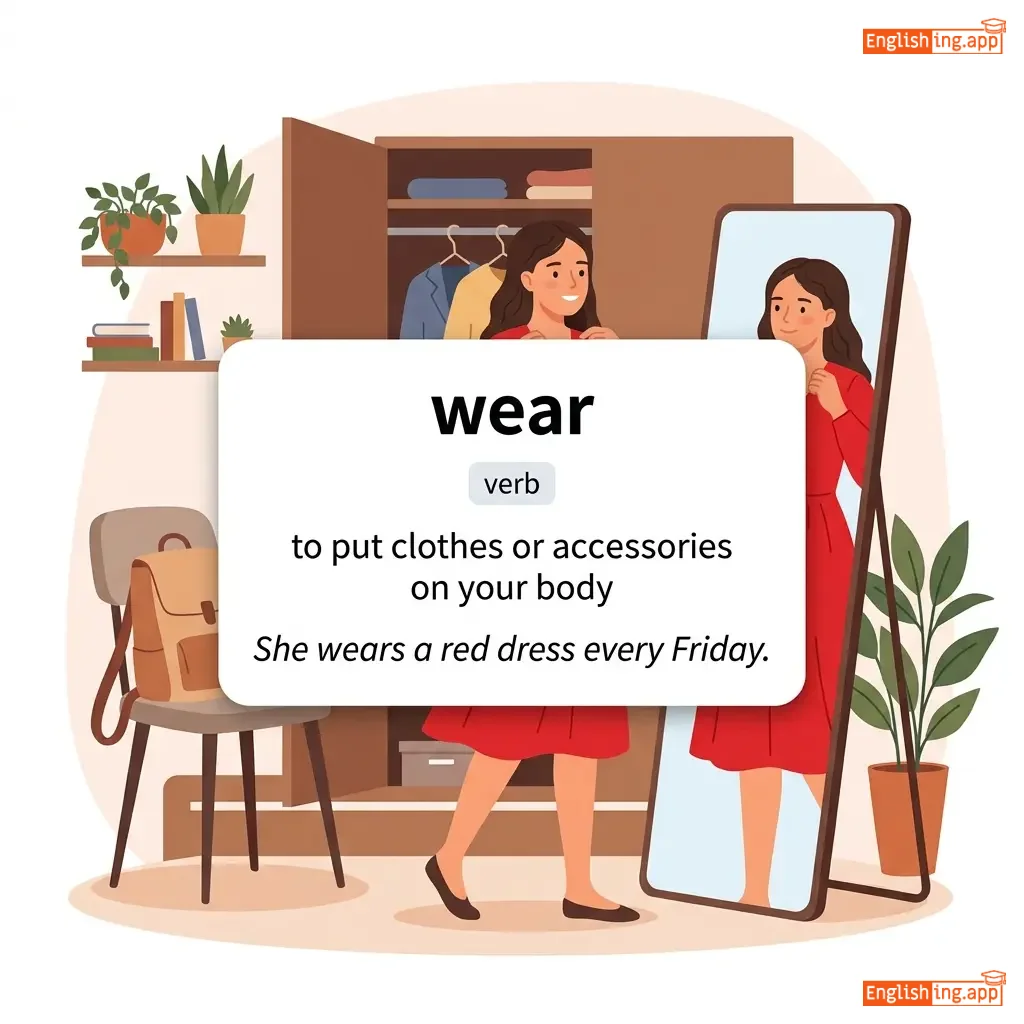
wear definition card — visual illustration of the meaning
verb
/wɛə(r)/
पहनना (pahananā)

to put clothes or accessories on your body

"She wears a red dress every Friday."

"वह हर शुक्रवार को एक लाल ड्रेस पहनती है।" (Vah har śukravār kō ēk lāl ḍrēs pēhnatī hai.)
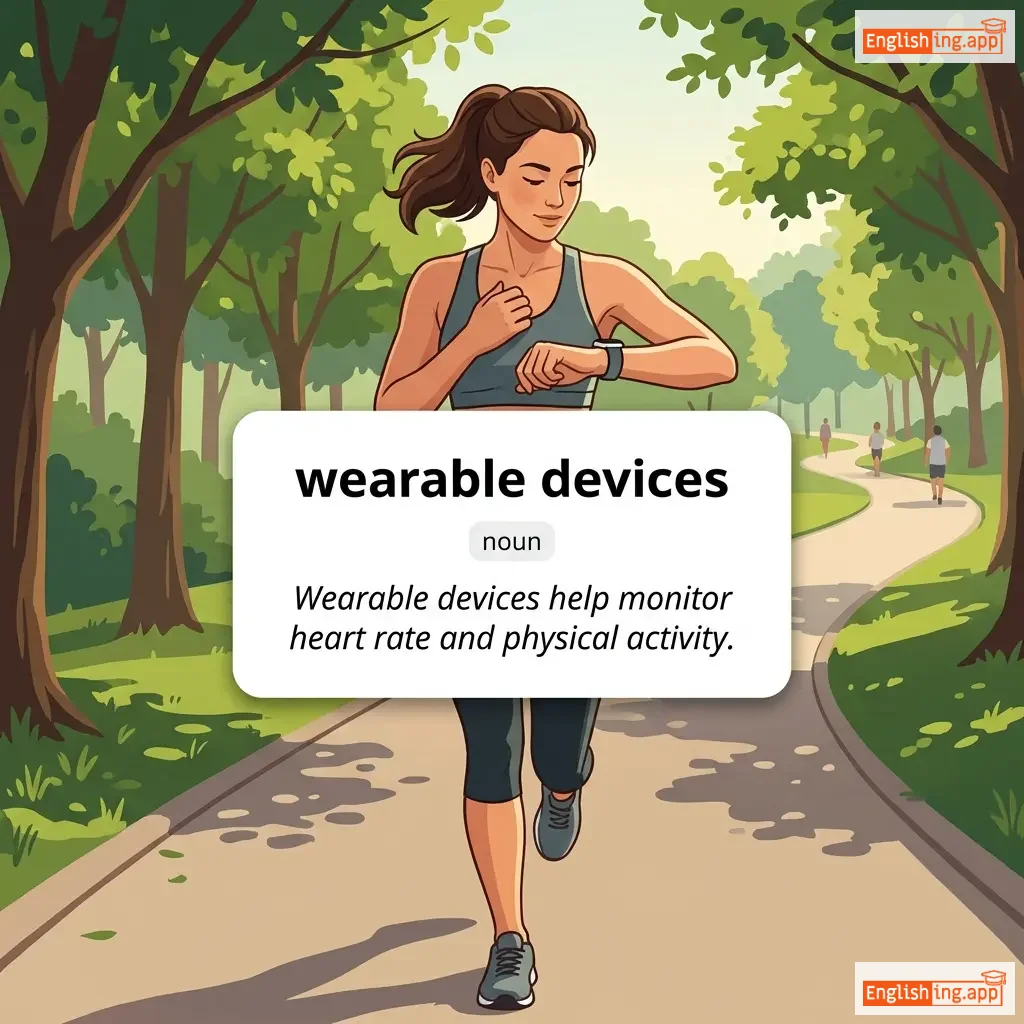
wearable devices definition card — visual illustration of the meaning
noun
ˈweə.rə.bəl dɪˈvaɪ.sɪz
पहनने योग्य उपकरण (pehane yogya upkaran)

Electronic devices that can be worn on the body, typically incorporating smart technology for monitoring health or providing information.

"Wearable devices help monitor heart rate and physical activity."

"वियरएबल डिवाइसेस दिल की धड़कन और शारीरिक गतिविधियों की निगरानी में मदद करते हैं।" (Wearable devices dil ki dhadkan aur sharirik gatividhiyon ki nigrani mein madad karte hain.)
adjective
/ˈwɪərɪsəm/
थकाऊ (thakau)

Causing one to feel tired or bored.

"The long and wearisome lecture put the students to sleep."

"लंबी और थकाऊ लेक्चर ने छात्रों को सोने पर मजबूर कर दिया।" (Lambi aur thakau lecture ne chhatron ko sone par majboor kar diya.)