वोकैबुलरीज

इंग्लिश वोकैबुलरी डिस्कवर, लर्न और मास्टर करें

adverb
/ˈjuːʒuəli/
आमतौर पर (aamtoar par)

Under normal conditions; most of the time.

"She usually walks to school."

"वह आमतौर पर स्कूल पैदल जाती है।" (Woh aamtoar par school paidal jaati hai.)
noun
/ˈjuːzjuːfrʌkt/
उपभोग अधिकार (upbhog adhikar)

The legal right to use and enjoy the benefits of someone else’s property without owning it.

"The tenant had the usufruct of the land but not its ownership."

"किराएदार को ज़मीन का उपभोग अधिकार था लेकिन उसका स्वामित्व नहीं था।" (Kiraedaar ko zameen ka upbhog adhikar tha lekin uska swamitva nahi tha.)
adjective
/juːˈʒʊəriəs/
उच्च ब्याज दर लेने वाला (uchch byaj dar lene wala)

Charging excessively high interest rates on loans.

"The bank was accused of offering loans at usurious rates."

"बैंक पर अत्यधिक ब्याज दर पर ऋण देने का आरोप लगाया गया था।" (Bank par atirikta byaj dar par rno dene ka aarop lagaya gaya tha.)
usurp definition card — visual illustration of the meaning
verb
/juːˈzɜːrp/
अवैध रूप से कब्जा करना (avaidh roop se kabza karna)

To take someone else's position or power illegally or by force.

"He tried to usurp the throne from the rightful king."

"उसने वैध राजा से सिंहासन छीनने की कोशिश की।" (Usne vaidh raja se singhasan cheenne ki koshish ki.)
noun
/ˌjuːzɜːrˈpeɪʃən/
अवैध कब्जा (avaidh kabza)

The act of taking someone's power or property illegally or by force.

"The general's usurpation of the presidency led to political unrest."

"जनरल का राष्ट्रपति पद का अवैध कब्जा राजनीतिक अशांति का कारण बना।" (General ka rashtrapati pad ka avaidh kabza rajnaitik ashaanti ka kaaran bana.)
usury definition card — visual illustration of the meaning
noun
/ˈjuːʒəri/
सूदखोरी (sudkhori)

The practice of lending money at unreasonably high interest rates.

"The law strictly prohibits usury."

"कानून सख्ती से सूदखोरी पर पाबंदी लगाता है।" (Kanoon sakhti se sudkhori par pabandi lagata hai.)
noun
/juːˈten.səlz/
सामान (samaan)

tools or implements used for cooking, eating, or serving food

"Please wash all the cooking utensils after preparing dinner."

"कृपया डिनर तैयार करने के बाद सभी रसोई के बर्तन धो लें।" (kripya dinner tayar karne ke baad sabhi rasoi ke bartan dho lein.)
adjective
/ˌjuːtɪlɪˈtɛəriən/
कार्यात्मक (yutilitarian)

Designed to be useful or practical rather than attractive; relating to the doctrine that actions are right if they are useful or for the benefit of a majority.

"The building had a simple utilitarian design."

"उस इमारत का डिज़ाइन सरल और कार्यात्मक था।" (Us imarat ka dizain saral aur karyatmak tha.)
noun
/juːˌtɪlɪˈtɛəriənɪzəm/
उपयोगितावाद (upyogitavad)

The ethical theory that actions are right if they are useful or for the benefit of the majority.

"Utilitarianism suggests that we should act to maximize overall happiness."

"उपयोगितावाद यह सुझाता है कि हमें समग्र खुशी को अधिकतम करने के लिए कार्य करना चाहिए।" (upyogitavad yah sujhata hai ki hume samagra khushi ko adhiktam karne ke liye karya karna chahiye.)
noun
/juːˈtɪləti/
उपयोगिता (upayogita)

The state of being useful, profitable, or beneficial.

"The utility of smartphones in daily life is undeniable."

"दैनिक जीवन में स्मार्टफोन की उपयोगिता नकारा नहीं जा सकता।" (dainik jeevan mein smartphone ki upayogita nakara nahi ja sakti.)
utilization definition card — visual illustration of the meaning
noun
ˌjuːtɪlaɪˈzeɪʃən
उपयोग, सदुपयोग (upayog, sadupayog)

The action of making practical and effective use of something.

"The efficient utilization of resources is key to success."

"संसाधनों का कुशल उपयोग सफलता की कुंजी है।" (Sansadhanon ka kushal upayog safalta ki kunji hai.)
verb
/ˈjuːtɪlaɪz/
उपयोग करना (upayog karna)

to make practical or effective use of something

"The company aims to utilize solar energy for production."

"कंपनी उत्पादन के लिए सौर ऊर्जा का उपयोग करने का लक्ष्य रखती है।" (Company utpadan ke liye saur urja ka upayog karne ka lakshya rakhti hai.)
adjective
/ˈʌtmoʊst/
खुशी (khushi)

Greatest or highest in degree, importance, or extent.

"She showed the utmost respect to her teachers."

"वह जब पुरस्कार प्राप्त कर रही थी, तो वह अपनी खुशी छिपा नहीं पाई।" (Wah jab puraskar prapt kar rahi thi, to wah apni khushi chhupa nahin paayi.)
noun
/juːˈtoʊpiə/
कल्पना लोक (kalpana lok)

An imagined perfect society or place where everything is ideal.

"Many philosophers dreamed of creating a utopia for humanity."

"कई दार्शनिकों ने मानवता के लिए एक यूटोपिया बनाने का सपना देखा।" (kai darshnikon ne manavta ke liye ek utopia banane ka sapna dekha.)
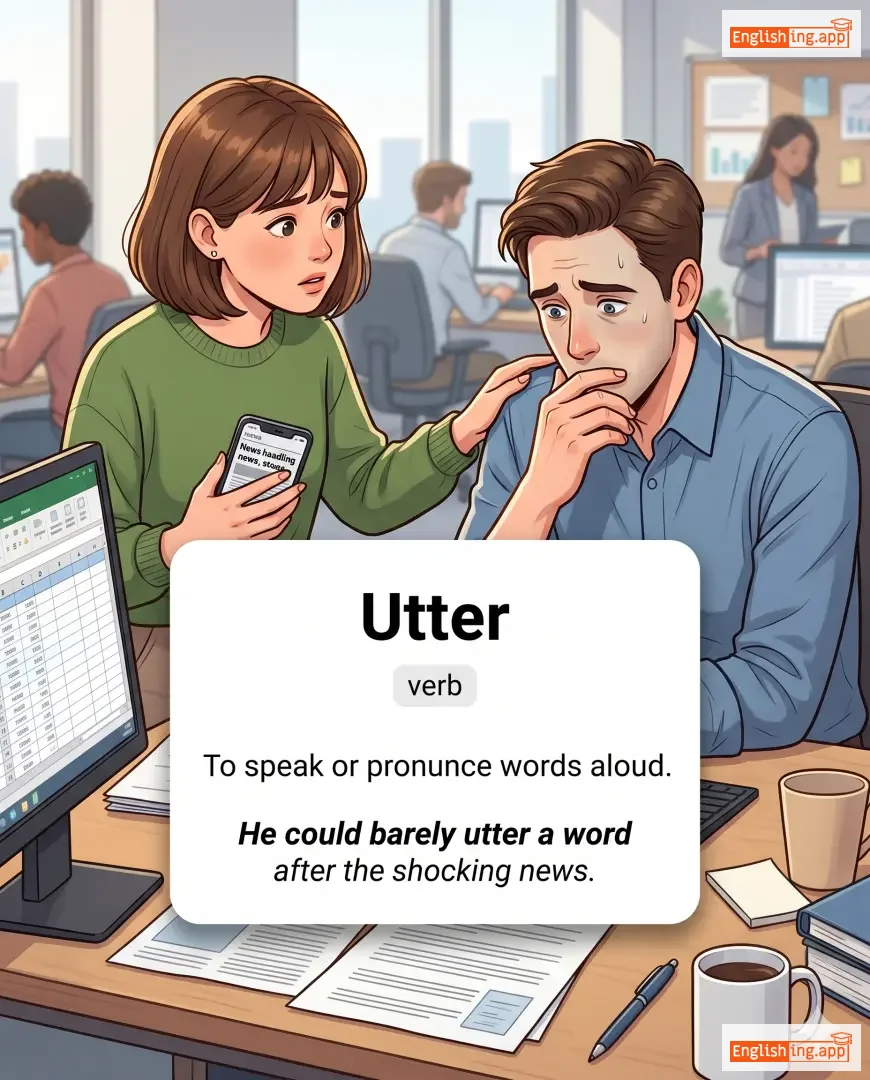
Utter definition card — visual illustration of the meaning
verb
/ˈʌtər/
उच्चारण करना (uchcharan karna)

To speak or pronounce words aloud.

"He could barely utter a word after the shocking news."

"शॉकिंग खबर के बाद वह मुश्किल से एक शब्द उच्चारण कर सका।" (Shocking khabar ke baad vah mushkil se ek shabd uchcharan kar saka.)
adverb
/ˈʌtərli/
पूर्णतः (purnatah)

completely or absolutely

"She was utterly surprised by the news."

"वह खबरों से पूरी तरह से हैरान थी।" (Wah khabron se puri tarah se hairaan thi.)
adjective
/ʌkˈsɔːriəs/
पत्नी के प्रति अत्यधिक अनुरक्त (patni ke prati atyadhik anurakt)

excessively fond of or submissive to one's wife

"He was so uxorious that he agreed with everything his wife said."

"वह इतना पत्नी के प्रति अनुरक्त था कि उसने अपनी पत्नी की हर बात मानी।" (Wah itna patni ke prati anurakt tha ki usne apni patni ki har baat maani.)