वोकैबुलरीज

इंग्लिश वोकैबुलरी डिस्कवर, लर्न और मास्टर करें

adjective
/ʌnˈwəʊntɪd/
असामान्य (asaamannya)

Unusual, uncommon, or out of the ordinary.

"She spoke with an unwonted gentleness that surprised everyone."

"उसने एक असामान्य कोमलता से बात की जिसने सभी को हैरान कर दिया।" (Usne ek asaamannya komalta se baat ki jisne sabhi ko hairaan kar diya.)
adjective
/ʌnˈwɜːrði/
अयोग्य; अवांछनीय (ayogya; avanchaniy)

not deserving respect or attention; lacking worth or merit

"He felt unworthy of such praise and recognition."

"उसे ऐसी सराहना और पहचान के लिए खुद को अनवर्थी महसूस हुआ।" (use aisī sarāhnā aur pehchān ke liye khud ko anavarthī mahasoos huā.)
verb
/ʌnˈræp/
लपेट खोलना (lapet kholna)

remove wrapping or covering from something; reveal something gradually or clearly

"She carefully unwrapped the gift with excitement."

"उसने उत्साह के साथ उपहार को सावधानी से खोला।" (usne utsah ke sath upahar ko savdhani se khola)
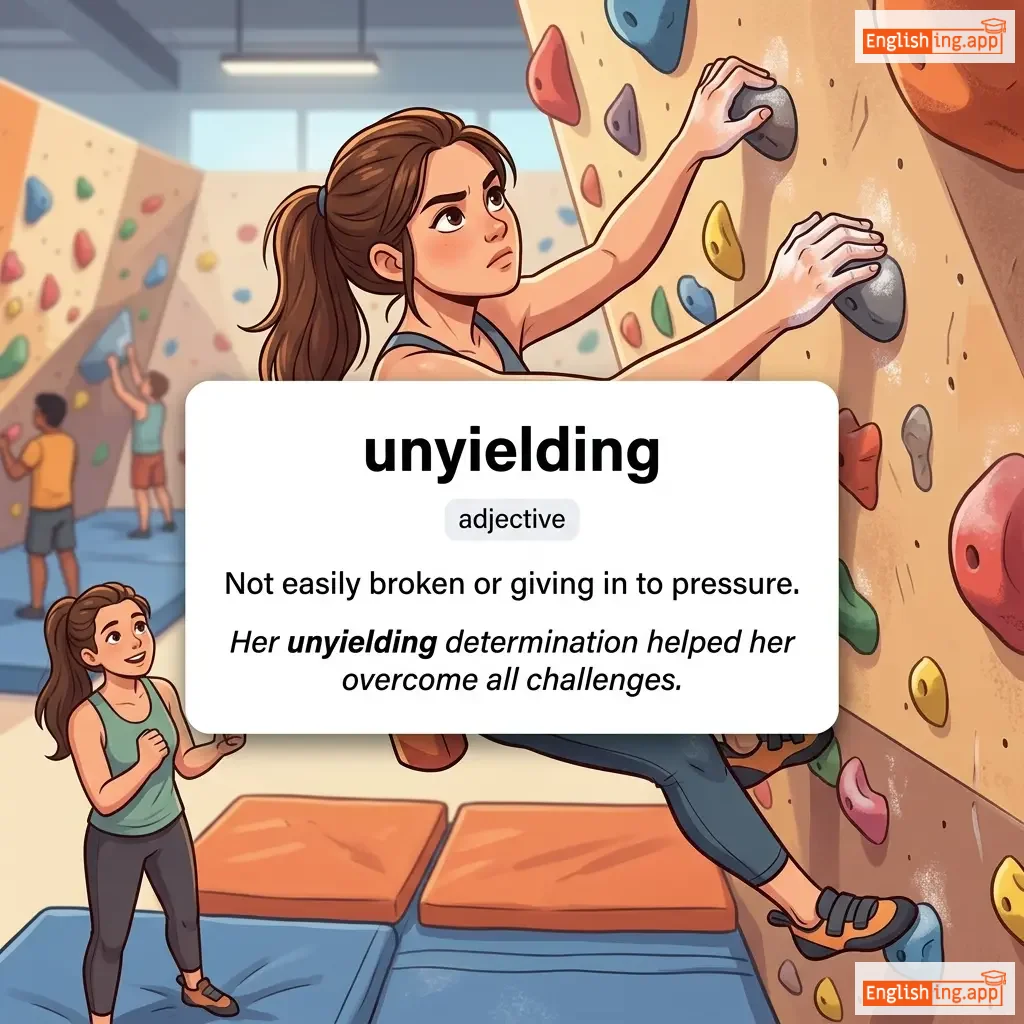
unyielding definition card — visual illustration of the meaning
adjective
ʌnˈjiːl.dɪŋ
अडिग या दृढ़ (adig ya dridh)

Not easily broken or giving in to pressure.

"Her unyielding determination helped her overcome all challenges."

"उसकी अडिग दृढ़ता ने उसे सभी चुनौतियों को पार करने में मदद की।" (Uski adig dridhata ne use sabhi chunautiyon ko paar karne mein madad ki.)
verb
/ʌnˈjoʊk/
जोड़ से मुक्त करना (jod se mukt karna)

To release from a yoke or to free from restraint or obligation.

"The farmer unyoked the oxen after a long day of work."

"किसान ने एक लंबी दिन की मेहनत के बाद बैल को जोड़ से मुक्त कर दिया।" (Kisan ne ek lambi din ki mehnat ke baad bail ko jod se mukt kar diya.)
adverb
/ʌp/
ऊपर (upar)

towards a higher position or level

"He climbed up the ladder quickly."

"वह सीढ़ी चढ़कर जल्दी ऊपर गया।" (vah seedhi chadhkar jaldi upar gaya.)
noun
/ˈʌpˌkiːp/
रखरखाव (rakharkhaav)

The process or cost of maintaining something in good condition.

"The upkeep of the old house is very expensive."

"पुराने घर की रखरखाव बहुत महंगी है।" (Purane ghar ki rakharkhaav bahut mehengi hai.)
verb
/ʌpˈbreɪd/
कड़ी फटकार लगाना (kadi fatkar lagana)

To scold or criticize someone harshly.

"The teacher upbraided the student for being late again."

"टीचर ने छात्र को फिर से देर करने के लिए कड़ी फटकार लगाई।" (Teacher ne chatra ko phir se der karne ke liye kadi fatkar lagayi.)
noun/verb
/ˈʌpˌkæst/
ऊपर फेंकना (upar fenkna)

Verb: To cast or throw upward. Noun: Something thrown or directed upward.

"The fisherman upcast his net into the air."

"मछुआरे ने अपना जाल हवा में ऊपर फेंका।" (Machware ne apna jaal hawa mein upar fenka.)
adjective
/ˈʌpˌkʌmɪŋ/
आगामी (aagaami)

about to happen or appear

"The upcoming event will be held next week."

"आगामी घटना अगले हफ्ते आयोजित की जाएगी।" (Agaami ghatna agle hafte aayojit ki jaayegi.)
update definition card — visual illustration of the meaning
verb
/ˈʌpdeɪt/
अपडेट करना (update karna)

to make something more modern or accurate by adding new information or changing it

"Please update your profile information regularly."

"कृपया अपनी प्रोफ़ाइल जानकारी को नियमित रूप से अपडेट करें।" (Kripya apni profile jaankari ko niyamit roop se update karein.)
verb
/ˈʌpˌɡreɪd/
अपग्रेड करना (upgrade karna)

to raise something to a higher standard, improve

"We decided to upgrade the software to the latest version."

"हमने सॉफ़्टवेयर को नवीनतम संस्करण में अपग्रेड करने का निर्णय लिया।" (Hamne software ko naveenatam sanskaran mein upgrade karne ka nirnay liya.)
noun
/ʌpˈhiːvəl/
उथल-पुथल (uthal-puthal)

a violent or sudden change or disruption to something

"The company faced a major upheaval after the sudden resignation of its CEO."

"कंपनी को उसके सीईओ के अचानक इस्तीफे के बाद एक बड़ी उथल-पुथल का सामना करना पड़ा।" (Company ko uske CEO ke achanak isteefe ke baad ek badi uthal-puthal ka samna karna pada.)
verb
/ʌpˈhiːv/
उठाना (uthana)

to lift or raise something forcefully; to cause to rise suddenly

"The workers had to upheave the heavy stone to clear the path."

"कामकाजी को पथ को साफ करने के लिए भारी पत्थर उठाना पड़ा।" (Kaamkaji ko path ko saaf karne ke liye bhari patthar uthana pada.)
adjective
/ˈʌpˌhɪl/
कठिन; कठिन प्रयास की आवश्यकता; ऊपर की ओर ढलान (kathin; kathin prayaas ki avashyakta; upar ki aur dhalan)

difficult; requiring great effort; sloping upward

"Learning a new language can be an uphill battle."

"नई भाषा सीखना एक कठिन संघर्ष हो सकता है।" (nayi bhasha seekhna ek kathin sangharsh ho sakta hai.)
verb
/ʌpˈhoʊld/
समर्थन करना (samarthan karna)

to maintain or support a principle, law, or decision

"The judge promised to uphold justice at all costs."

"न्यायाधीश ने वादा किया कि वह सभी लागतों पर न्याय बनाए रखेंगे।" (Nyayadhish ne vada kiya ki vah sabhi laakaton par nyay banaye rakhenge.)
preposition
/əˈpɒn/
पर (par)

on or immediately after

"Upon hearing the news, he rushed to the hospital."

"खबर सुनने के बाद, वह अस्पताल दौड़ पड़ा।" (Khabar sunne ke baad, vah aspataal daud pada.)
adjective
/ˈʌpər/
ऊपरी (upari)

higher in position or rank

"The upper floor of the building is under renovation."

"भवन की ऊपरी मंजिल मरम्मत के तहत है।" (Bhavan ki upari manzil marammat ke tahat hai.)
adjective
/ˈʌpərˌmoʊst/
सबसे ऊपर (sabse upar)

situated at the highest place or most important

"Her family's safety was uppermost in her mind during the crisis."

"उसके मन में संकट के दौरान परिवार की सुरक्षा सबसे ऊपर थी।" (Uske man mein sankat ke dauran parivaar ki suraksha sabse upar thi.)
adjective, adverb
/ˈʌpraɪt/
खुशी (khushi)

positioned vertically; morally good and honest

"He remained upright despite the strong winds."

"जब उसने पुरस्कार प्राप्त किया, तो वह अपनी खुशी छिपा नहीं पाई।" (Jab usne puraskar prapt kiya, to vah apni khushi chhupa nahin pai.)
noun
/ˈʌp.raɪt.nəs/
ईमानदारी; नैतिकता (imaanadaari; naitikta)

the quality of being honest and morally correct; integrity

"His uprightness in business dealings earned him great respect."

"उसकी व्यापारिक निष्ठा ने उसे महान सम्मान दिलवाया।" (uski vyaapaarik nishtha ne use mahaan sammaan dilvaaya)
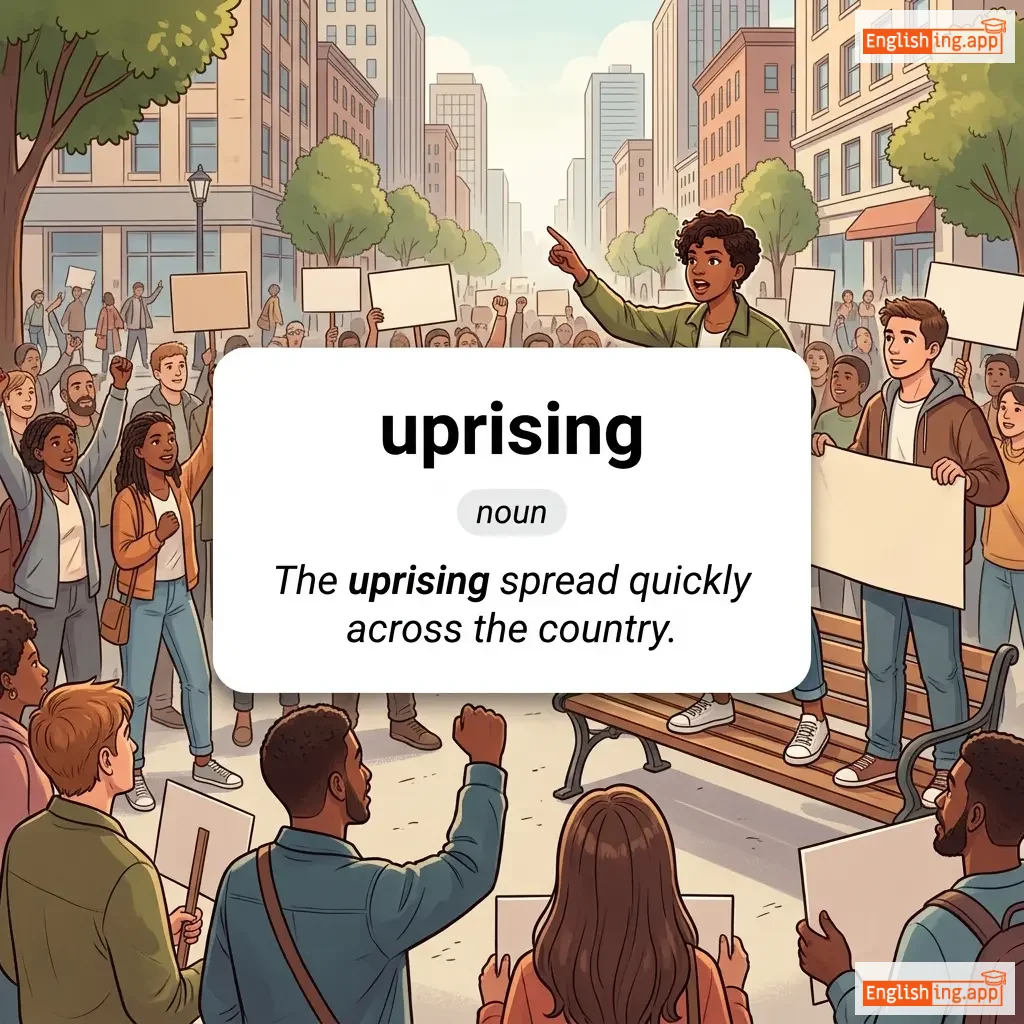
uprising definition card — visual illustration of the meaning
noun
/ˈʌpraɪzɪŋ/
विद्रोह (vidroh)

An act of resistance or rebellion; an attempt to overthrow authority or government.

"The uprising spread quickly across the country."

"विद्रोह देश भर में जल्दी फैल गया।" (Vidroh desh bhar mein jaldi phail gaya.)
noun
/ˈʌp.rɔːr/
कोलाहल (kolahal)

A loud noise, commotion, or disturbance caused by a group of people.

"The announcement caused an uproar in the audience."

"घोषणा ने दर्शकों में कोलाहल पैदा कर दिया।" (Ghoshna ne darshako mein kolahal paida kar diya.)
adjective
/ʌpˈrɔːr.i.əs/
अत्यंत हास्यपूर्ण (atyant hasyapurn)

Extremely funny or noisy; causing loud laughter or commotion.

"The comedian's jokes were absolutely uproarious."

"कोमेडियन के जोक्स बिल्कुल अत्यंत हास्यपूर्ण थे।" (Komedian ke jokes bilkul atyant hasyapurn the.)
verb
/ʌpˈruːt/
उखाड़ना (ukhadna)

To pull something out of the ground; to remove or displace completely.

"They uprooted the old tree from the garden."

"उन्होंने बग़ीचे से पुराना पेड़ उखाड़ लिया।" (Unhone bagiche se purana ped ukhad liya.)
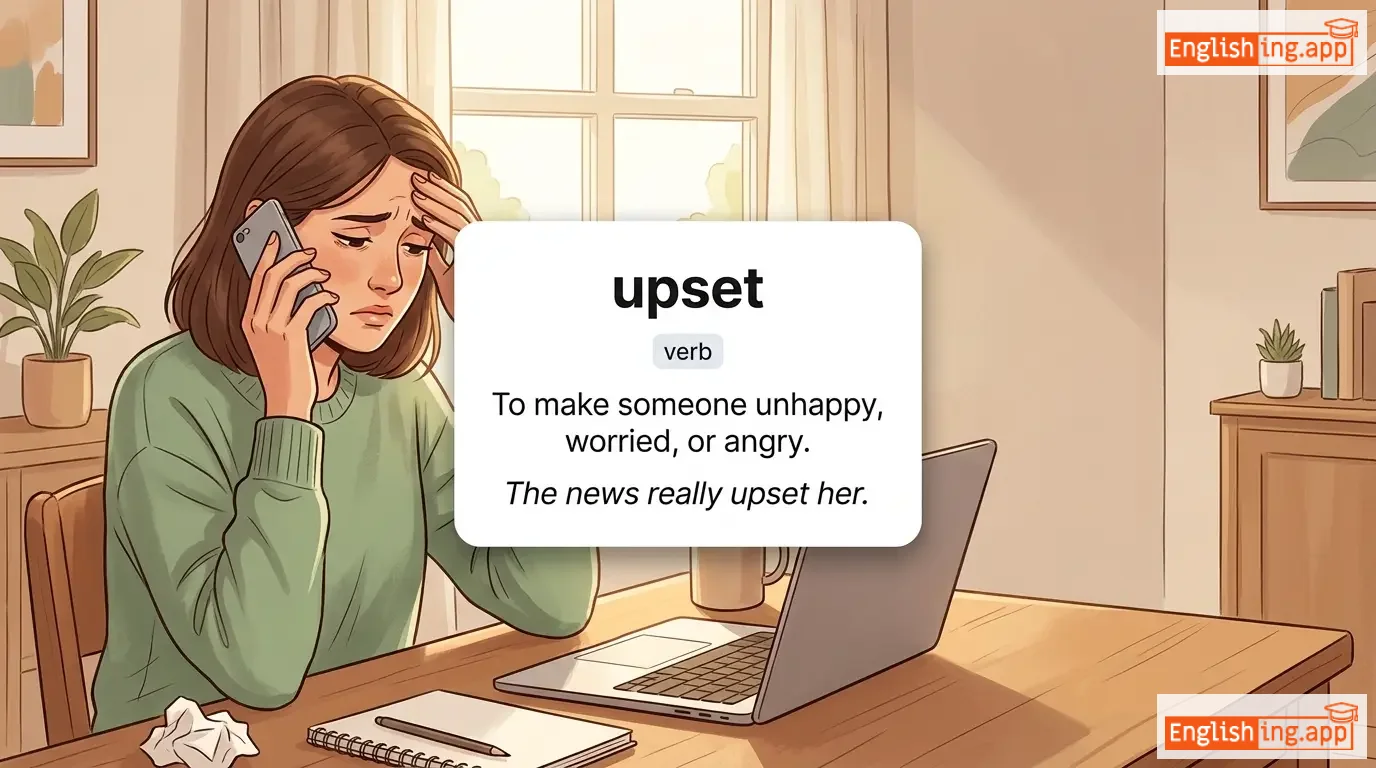
upset definition card — visual illustration of the meaning
verb
/ʌpˈsɛt/
उदास करना (udaas karna)

To make someone unhappy, worried, or angry.

"The news really upset her."

"ख़बर ने सचमुच उसे परेशान कर दिया।" (Khabar ne sachmuch use pareshan kar diya.)
noun
/ˈʌp.ʃɒt/
परिणाम (parinaam)

The final result or outcome of a process or situation.

"The upshot of the meeting was that the plan was postponed."

"बैठक का परिणाम यह था कि योजना को स्थगित कर दिया गया था।" (Baithak ka parinaam yah tha ki yojana ko sthagit kar diya gaya tha.)
adverb
/ˌʌpsaɪd ˈdaʊn/
उल्टा (ulta)

with the upper part at the bottom; in or into a reversed position

"The picture was hanging upside-down on the wall."

"तस्वीर दीवार पर उल्टी लटकी हुई थी।" (tasveer deewaar par ultee latki hui thi)
adverb
/ˌʌpˈstɛərz/
ऊपर (apasteyerz)

on or to a higher floor of a building

"She went upstairs to her bedroom."

"वह ऊपर अपने बेडरूम में गई।" (vah upar apne bedroom mein gai.)
noun
/ˈʌp.tɜːn/
सुधार (sudhar)

An improvement or upward trend in a situation, especially in business or economy.

"The company experienced an upturn in sales last quarter."

"कंपनी ने पिछले तिमाही में बिक्री में सुधार का अनुभव किया।" (Company ne pichle timaahi mein bikri mein sudhar ka anubhav kiya.)
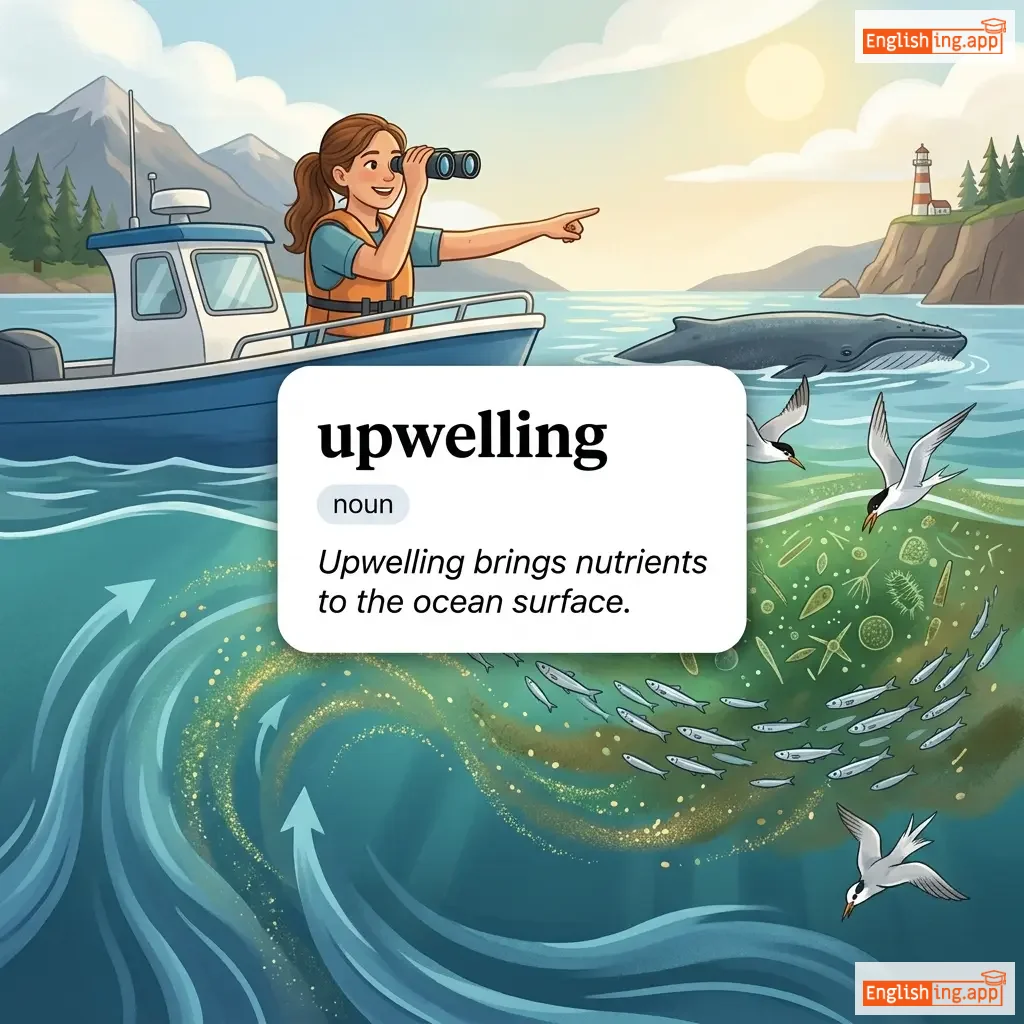
upwelling definition card — visual illustration of the meaning
noun
/ˈʌp.wel.ɪŋ/
समुद्र विज्ञानिक घटना जिसमें घने, ठंडे, और पोषक तत्वों से भरपूर पानी समुद्र की सतह की ओर खिंचता है। (samudra vigyanik ghatna jismein ghane, thande, aur poshak tatvon se bhara pani samudra ki sathah ki aur khinchta hai.)

An oceanographic phenomenon that involves wind-driven motion of dense, cooler, and nutrient-rich water towards the ocean surface.

"Upwelling brings nutrients to the ocean surface."

"अपवेलिंग समुद्र की सतह पर पोषक तत्व लाता है।" (Apwelling samudra ki sathah par poshak tatva lata hai.)
adjective
/ˈɜːrbən/
शहरी (shahri)

related to, characteristic of, or situated in a city or town

"Urban areas often have higher population density than rural areas."

"शहरी क्षेत्रों में अक्सर ग्रामीण क्षेत्रों की तुलना में उच्च जनसंख्या घनत्व होता है।" (shahri kshetron mein aksar gramin kshetron ki tulna mein uchch jansankhya ghanatva hota hai.)
adjective
/ɜːrˈbeɪn/
सभ्य (sabhy)

showing polished manners, refinement, and sophistication

"He was an urbane gentleman who charmed everyone at the party."

"वह एक सभ्य सज्जन व्यक्ति था जिसने पार्टी में सभी को आकर्षित किया।" (vah ek sabhy sajjan vyakti tha jise party mein sabhi ko aakarshit kiya.)
noun
/ɜːrˈbænɪti/
सभ्यता (sabhyata)

refined courtesy, elegance, and sophistication in manner

"Her urbanity made her popular among diplomats and leaders."

"उसकी सभ्यता ने उसे राजनयिकों और नेताओं के बीच लोकप्रिय बना दिया।" (uski sabhyata ne use rajnayikon aur netaon ke beech lokpriya bana diya.)
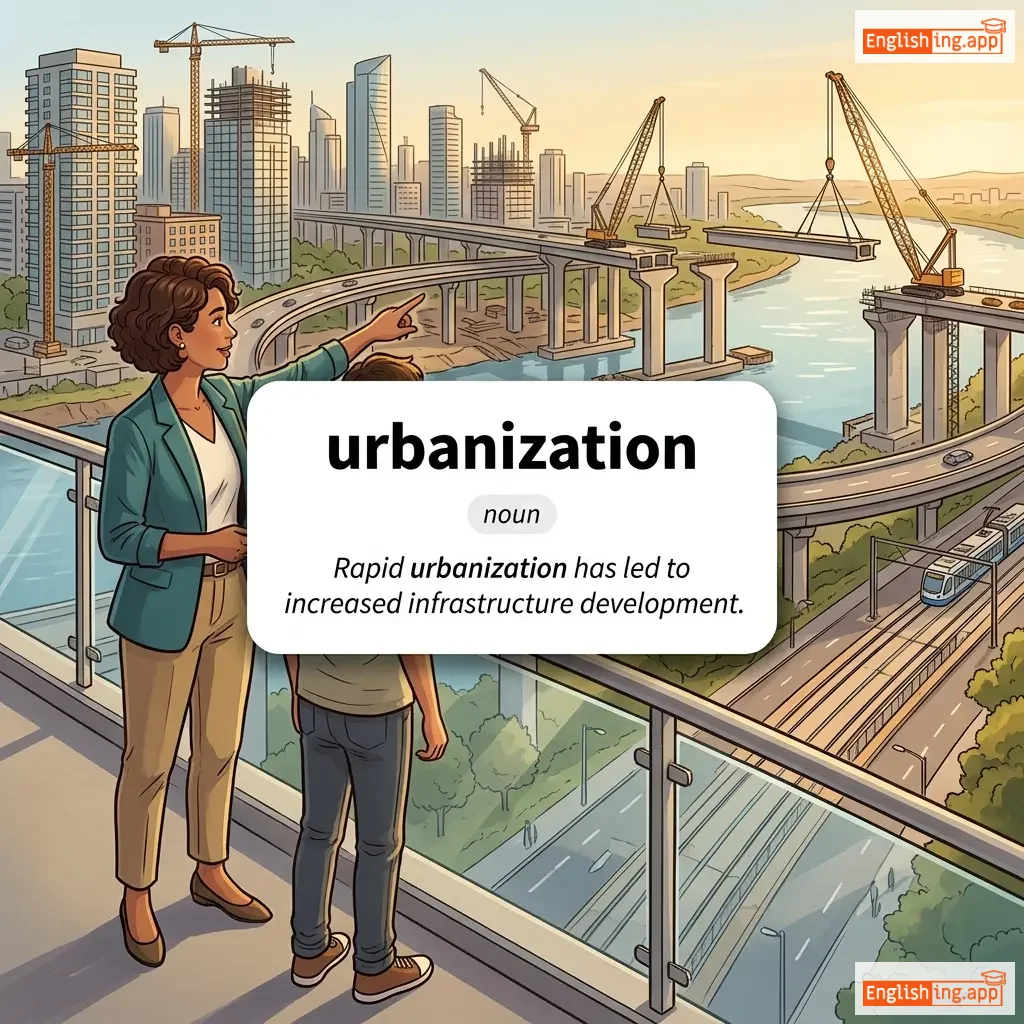
urbanization definition card — visual illustration of the meaning
noun
/ˌɜː.bən.aɪˈzeɪ.ʃən/
शहरीकरण (shaharikaran)

The process by which towns and cities are formed and become larger as more people begin living and working in central areas.

"Rapid urbanization has led to increased infrastructure development."

"तेज शहरीकरण के कारण अवसंरचना विकास में वृद्धि हुई है।" (Tez shaharikaran ke kaaran avsanrachna vikas mein vruddhi hui hai.)
noun
/ˈɜːrtʃɪn/
गली का बच्चा (gali ka bachcha)

a mischievous or poorly dressed child, often from the streets

"The ragged urchins played by the riverbank."

"फटे-पुराने कपड़े पहने गली के बच्चे नदी किनारे खेल रहे थे।" (phate-purane kapde pahne gali ke bachche nadi kinare khel rahe the.)
verb
/ɜːrdʒ/
उत्तेजित करना (uttejit karna)

to strongly encourage or try to persuade someone to do something

"Doctors urge patients to exercise regularly."

"डॉक्टर्स मरीजों को नियमित रूप से व्यायाम करने के लिए उत्तेजित करते हैं।" (doktors mareejon ko niyamit roop se vyaayam karne ke liye uttejit karte hain.)
noun
/ˈɜːrdʒənsi/
तत्कालिता (tatkalita)

The quality of requiring immediate attention or action.

"The doctor emphasized the urgency of starting treatment right away."

"चिकित्सक ने इलाज तुरंत शुरू करने की अर्जेंसी पर जोर दिया।" (Chikitsak ne ilaaj turant shuru karne ki arjensi par zor diya.)
adjective
/ˈɜːrdʒənt/
तत्काल (tatkal)

Requiring immediate action or attention.

"She sent an urgent message to her manager."

"उसने अपने प्रबंधक को एक अर्जेंट संदेश भेजा।" (Usne apne prabandhak ko ek urgent sandesh bheja.)
adverb
/ˈɜːrdʒəntli/
तत्काल रूप से (tatkaal roop se)

in a way that requires immediate attention or action

"The patient urgently needs medical attention."

"मरीज़ को तत्काल रूप से चिकित्सा की आवश्यकता है।" (mareez ko tatkaal roop se chikitsa ki aavashyakta hai)
adjective
/ˈɜːrsaɪn/
भालू जैसा (bhalu jaisa)

Relating to or resembling a bear.

"The man’s ursine strength amazed everyone."

"उस आदमी की भालू जैसी ताकत ने सभी को चौंका दिया।" (Us aadmi ki bhalu jaisi takat ne sabhi ko chonka diya.)
pronoun
/ʌs/
हमारे (hamare)

used to refer to the speaker and one or more other people as the object of a verb or preposition

"She gave us a gift."

"उसने हमें एक उपहार दिया।" (Usne humein ek uphaar diya.)
noun
/ˈjuːsɪdʒ/
उपयोग (upayog)

The action of using something; the way in which a word or phrase is normally used.

"The book explains the proper usage of technical terms."

"किताब तकनीकी शब्दों के उचित उपयोग को स्पष्ट करती है।" (kitaab takneeki shabdon ke uchit upayog ko spasht karti hai.)
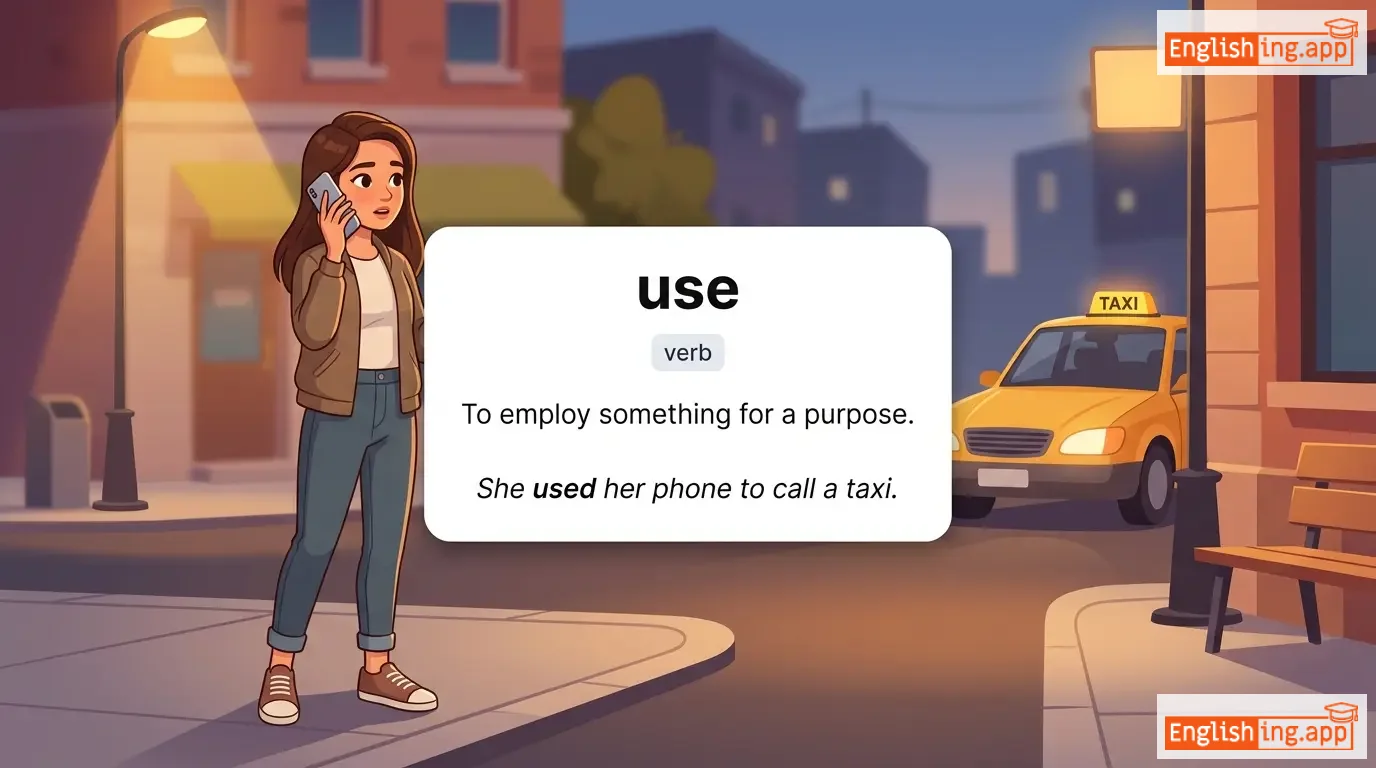
use definition card — visual illustration of the meaning
verb
/juːz/ (verb), /juːs/ (noun)
इस्तेमाल करना (istamal karna)

To employ something for a purpose.

"She used her phone to call a taxi."

"उसने टैक्सी बुलाने के लिए अपना फोन इस्तेमाल किया।" (Usne taxi bulane ke liye apna phone istemal kiya.)
adjective
/juːzd/
प्रयुक्त (pryukt)

having already been used

"This is a used car."

"यह एक प्रयुक्त कार है।" (Yah ek priyukt car hai.)
adjective
/ˈjuːsfəl/
उपयोगी (upayogi)

having a practical or beneficial use

"This tool is very useful."

"यह उपकरण बहुत उपयोगी है।" (Yah upkaran bahut upayogi hai.)
noun
/ˈjuːs.fəl.nəs/
उपयोगिता (upayogita)

the quality of being useful; practical value or helpfulness

"The usefulness of this tool became apparent during the project."

"इस उपकरण की उपयोगिता परियोजना के दौरान स्पष्ट हो गई।" (is upkaran ki upayogita pariyojna ke dauran spasht ho gayi)
adjective
/ˈjuːsləs/
व्यर्थ (vyarth)

not serving any purpose or value

"The broken phone is completely useless."

"टूटे हुए फोन का कोई काम नहीं है।" (Toote hue phone ka koi kaam nahi hai.)
noun
/ˈjuːzər/
उपयोगकर्ता (upayogakarta)

a person who uses or operates something

"He is a frequent user of this app."

"वह इस ऐप का नियमित उपयोगकर्ता है।" (Vah is app ka niyamit upayogakarta hai.)
adjective
/ˈjuːʒəl/
सामान्य (saamanya)

habitually or typically occurring or done

"It’s our usual meeting spot."

"यह हमारी सामान्य बैठक स्थल है।" (Yeh humari saamaanya baithak sthal hai.)