वोकैबुलरीज

इंग्लिश वोकैबुलरी डिस्कवर, लर्न और मास्टर करें

adjective
/ˌjuːnɪˈlætərəl/
एकतरफा (ektarfa)

Involving or affecting only one side or party without the agreement of others.

"The country took unilateral action without consulting its allies."

"देश ने अपने सहयोगियों से परामर्श किए बिना एकतरफा कदम उठाया" (Desh ne apne sahyogiyon se paramarsh kiye bina ektarfa kadam uthaya)
adjective
/ˌʌnɪˈmædʒənəbəl/
कल्पनातीत (kalpanateet)

impossible to conceive; beyond imagination

"The scale of destruction was unimaginable until we saw it firsthand."

"विनाश के पैमाने को हमने पहले हाथ से नहीं देखा तो वह असंभव सा था।" (vinash ke paimane ko humne pehle haath se nahin dekha to vah asambhav sa tha.)
adjective
/ˌʌnɪmˈpiːtʃəbl/
अभियोगरहित (abhiyograhit)

Not able to be doubted, questioned, or criticized; completely trustworthy.

"She is known for her unimpeachable honesty."

"वह अपनी अनिमपीचेबल ईमानदारी के लिए जानी जाती है।" (Woh apni animpichebal imandari ke liye jani jati hai.)
noun
/ʌnɪmˈpɔːrtəns/
अमहत्व (amahatva)

the state or quality of being insignificant or not important

"He dismissed the issue with a sense of unimportance."

"उन्होंने मुद्दे को महत्वहीन समझा।" (unhone mudde ko mahatvahin samjha)
adjective
/ˌʌnɪmˈpɔːrtənt/
महत्वहीन (mahatvheen)

not having much value, significance, or influence

"The detail seemed unimportant compared to the main issue."

"मुख्य मुद्दे की तुलना में यह विवरण महत्वहीन लगा।" (mukhya mudde ki tulna mein yah vivaran mahatvheen laga)
adjective
/ˌʌnɪnˈfɔːrmd/
अज्ञान (agyan)

lacking knowledge or awareness about a particular subject; not educated or informed

"The decision was made by an uninformed committee."

"यह निर्णय एक अज्ञान समिति द्वारा लिया गया था।" (yah nirnay ek agyan samiti dwara liya gaya tha)
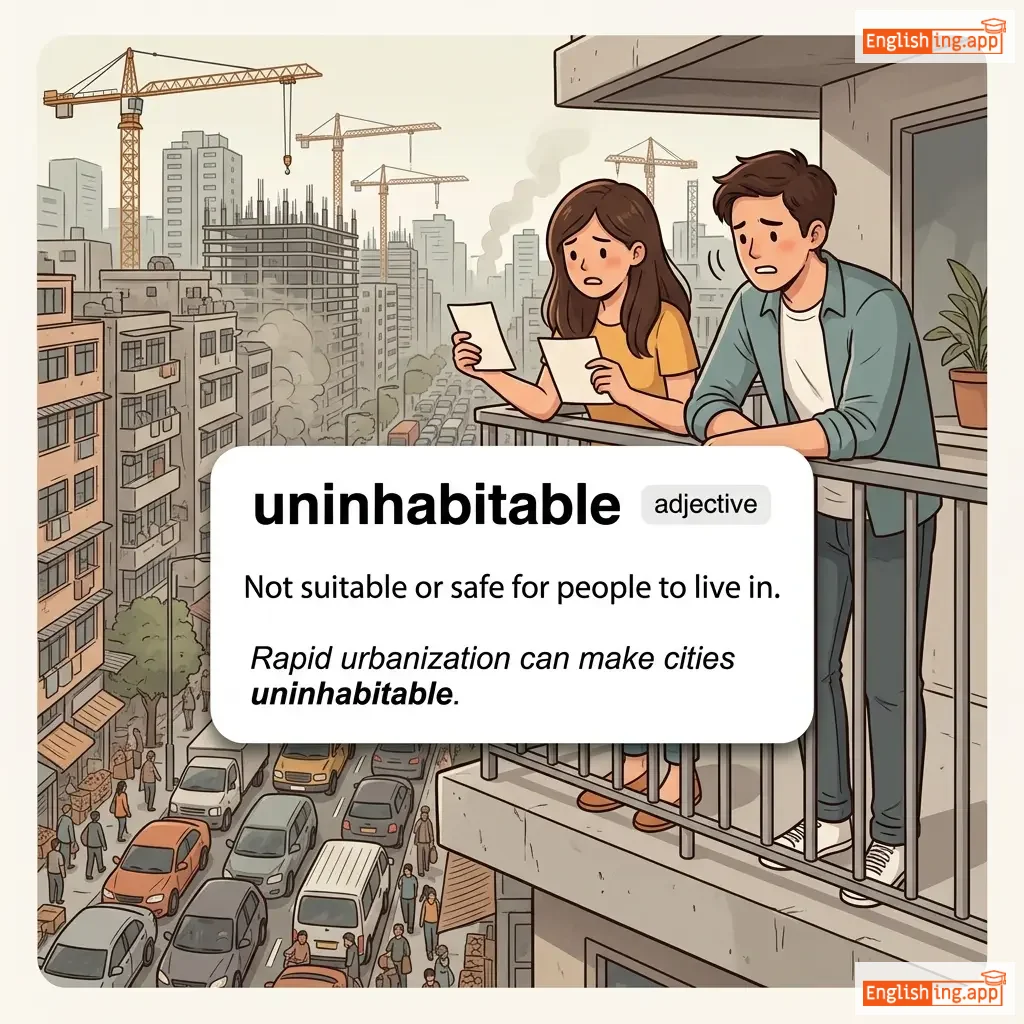
uninhabitable definition card — visual illustration of the meaning
adjective
ʌnɪnˈhæbɪtəbəl
असंगत (asangath)

Not suitable or safe for people to live in.

"Rapid urbanization can make cities uninhabitable."

"तेज़ शहरीकरण शहरों को असंगत बना सकता है।" (Tez shaharikaran shahron ko asangath bana sakta hai.)
adjective
/ˌʌnɪnˈhɪbɪtɪd/
अनियंत्रित (aniyantrit)

Not restrained or restricted; free in behavior or expression.

"She gave an uninhibited laugh at the joke."

"उसने मजाक पर बिना किसी हिचक के हंसी हंसी।" (Usne mazak par bina kisi hichak ke hansi hansi.)
adjective
/ʌnˈɪndʒərd/
अखरोट नहीं (akharot nahin)

Without injury; not physically harmed.

"All the passengers were rescued uninjured."

"सभी यात्री बिना चोट के बचाए गए थे।" (Sabhi yatri bina chot ke bachaye gaye the.)
adjective
/ˌʌnɪnˈtenʃənəl/
अनिच्छित; आकस्मिक (anichchhit; aaksamik)

not done on purpose; accidental

"The damage to the car was unintentional."

"कार को हुआ नुकसान अनिच्छित था।" (kaar ko hua nuksaan anichchhit tha.)
adjective
/ˌʌnˈɪntrəstɪŋ/
उबाऊ (ubaau)

not holding attention or curiosity; boring

"The lecture was uninteresting and difficult to stay focused on."

"वह व्याख्यान उबाऊ था और ध्यान केंद्रित रखना कठिन था।" (vah vyaakhyaan ubaau tha aur dhyaan kendrit rakhna kathin tha)
adjective
/ˌʌnˈɪntɪmeɪtɪŋ/
संकेतहीन (sanketheen)

Not giving a hint or suggestion; not indicating.

"His unintimating tone gave no clue of his true feelings."

"उसकी संकेतहीन आवाज़ ने उसकी असली भावनाओं का कोई संकेत नहीं दिया।" (Uski sanketheen awaaz ne uski asli bhavanaon ka koi sanket nahi diya.)
noun
/ˈjuːnɪən/
संघ (sangh)

the action or fact of joining or being joined with others, especially to form a single unit

"The union of the two companies created a global leader."

"दो कंपनियों का संघ एक वैश्विक नेता बना।" (do kompanion ka sangh ek vaishvik neta bana.)
adjective
/juːˈniːk/
अद्वितीय (adwitiya)

Being the only one of its kind; unlike anything else.

"Her dress was unique and caught everyone's attention."

"उसकी ड्रेस अद्वितीय थी और सभी का ध्यान आकर्षित किया।" (Uski dress adwitiya thi aur sabhi ka dhyaan aakarshit kiya.)
noun
/ˈjuːnɪsən/
एक साथ (ek saath)

Simultaneous performance or utterance of action or speech.

"The choir sang in unison."

"गाना एक साथ गाया गया।" (Gana ek saath gaya gaya.)
adjective
/juːˈnɪsənənt/
सुरेल (surel)

Sounding together or in harmony.

"The unisonant voices created a powerful effect."

"सुरेल आवाजों ने एक शक्तिशाली प्रभाव उत्पन्न किया।" (Surel aawazon ne ek shaktishaali prabhav utpann kiya.)
noun
/ˈjuːnɪt/
यूनिट (unit)

an individual thing or person regarded as a single and complete entity

"Each unit in the production line is carefully tested."

"प्रत्येक यूनिट को उत्पादन लाइन में सावधानी से परखा जाता है।" (pratyek unit ko utpadan line mein saavdhaani se pariksha kiya jaata hai.)
noun
/ˌjuːnɪˈtɛəriən/
यूनिटेरियन (Unitarian)

A person who believes that God exists as one entity rather than as a Trinity; a member of a religious denomination that emphasizes individual freedom of belief.

"The Unitarian church is known for its inclusive and open-minded approach."

"यूनिटेरियन चर्च अपनी समावेशी और खुले विचारों वाली दृष्टिकोण के लिए जाना जाता है।" (Unitarian church apni samaaveshi aur khule vicharon wali drishtikon ke liye jana jata hai.)
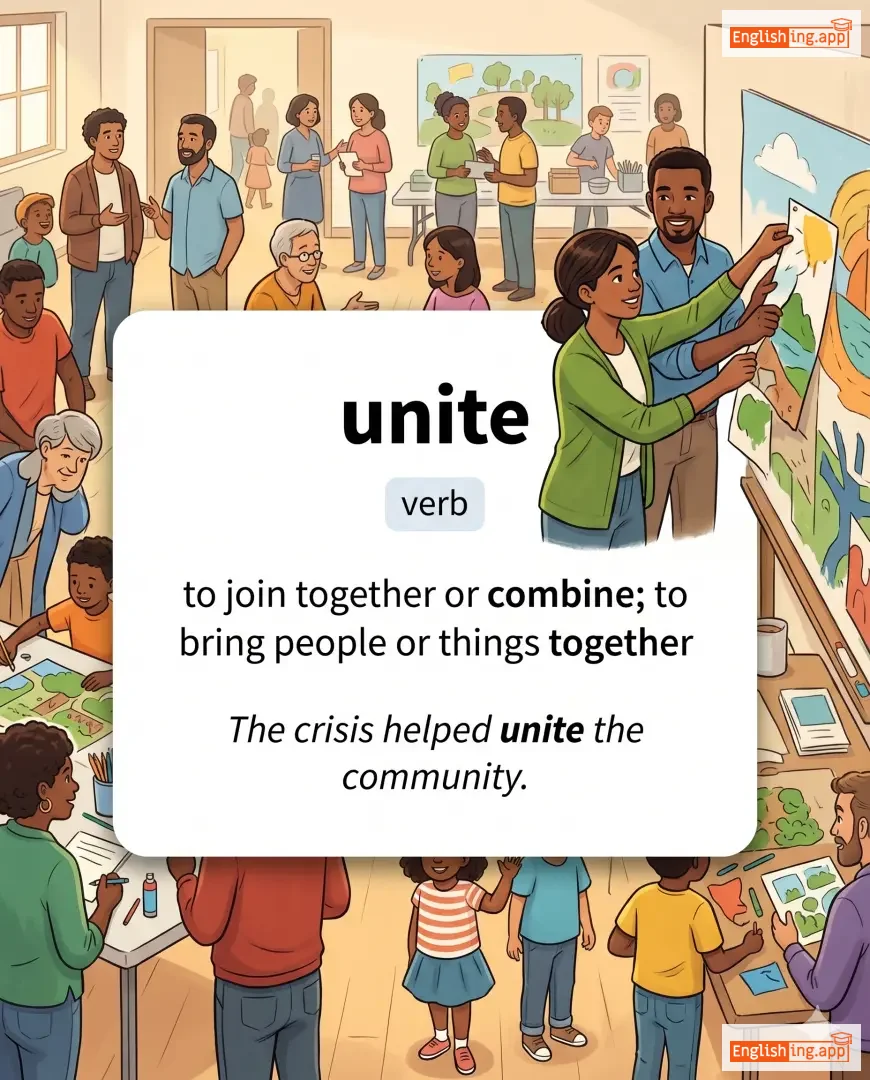
unite definition card — visual illustration of the meaning
verb
/juˈnaɪt/
एकत्र करना (ekatr karna)

to join together or combine; to bring people or things together

"The crisis helped unite the community."

"संकट ने समुदाय को एकत्र करने में मदद की।" (Sankat ne samudaay ko ekatr karne mein madad ki.)
adjective
/juˈnaɪtɪd/
एकत्रित (ektrit)

joined together or combined as one

"The united team won the championship."

"एकत्रित टीम ने चैंपियनशिप जीती।" (ektrit team ne championship jīti.)
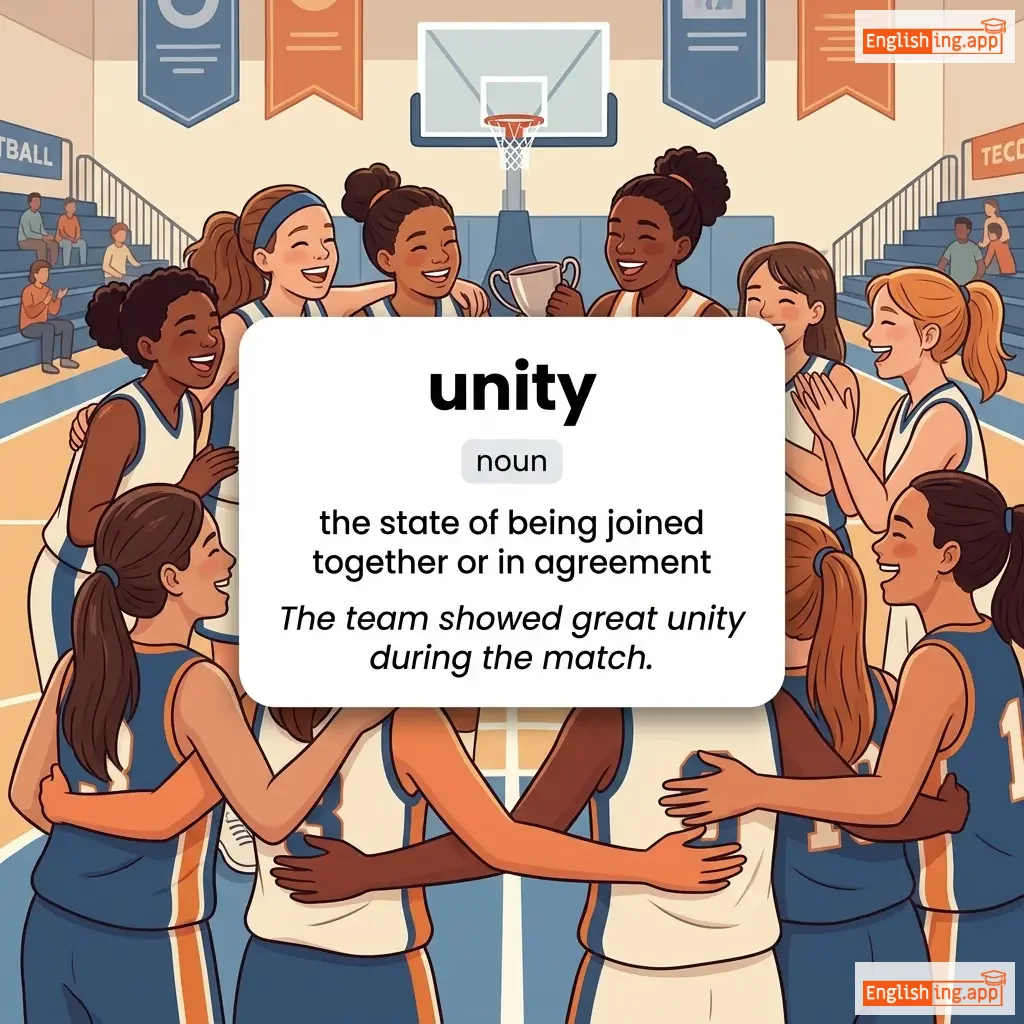
unity definition card — visual illustration of the meaning
🫱🏻‍🫲🏽

unity (यूनिटी)

noun
/ˈjuːnɪti/
एकता (ekta)

the state of being joined together or in agreement

"The team showed great unity during the match."

"टीम ने मैच के दौरान महान एकता दिखाई।" (Team ne match ke dauran mahaan ekta dikhayi.)
noun
/ˈjuːnɪvəˌlɛns/
एकमानीता (ekmanita)

The state of having a single valence or combining power, especially in chemistry.

"Hydrogen is characterized by its univalence in chemical reactions."

"हाइड्रोजन को इसके एकमानीता द्वारा रासायनिक प्रतिक्रियाओं में पहचाना जाता है।" (Hydrogen ko iske ekmanita dvara rasayanik pratikriyaon mein pehchana jata hai.)
adjective
/ˌjuːnɪˈvɜːsəl/
सार्वभौमिक (sarvbhaumik)

Relating to or done by all people or things in the world; applicable everywhere or in all cases.

"There is a universal need for love and acceptance."

"प्यार और स्वीकृति के लिए एक सार्वभौमिक आवश्यकता है।" (pyaar aur sveekriti ke liye ek sarvbhaumik avashyakta hai.)
noun
/ˈjuːnɪvɜːrs/
ब्रह्मांड (brahmand)

the totality of known or supposed objects and phenomena throughout space; the cosmos

"The universe is vast and full of mysteries."

"ब्रह्मांड विशाल है और रहस्यों से भरा हुआ है।" (brahmand vishal hai aur rahasyon se bhara hua hai)
noun
/ˌjuːnɪˈvɜːrsɪti/
विश्वविद्यालय (vishwavidyalaya)

an institution of higher education and research, which grants academic degrees

"She is studying law at the university."

"वह विश्वविद्यालय में कानून पढ़ रही है।" (vah vishwavidyalaya mein kanoon padh rahi hai.)
adjective
/ʌnˈdʒʌst/
अन्यायपूर्ण; गलत; (anyaaypoorn; galat)

not fair or right; morally wrong

"The punishment was unjust for such a minor offense."

"यह दंड एक छोटे अपराध के लिए अन्यायपूर्ण था।" (yah dand ek chhote apraadh ke liye anyaaypoorn tha)
adjective
/ʌnˈkɛmpt/
अव्यवस्थित (avyavasthit)

Having an untidy or disheveled appearance.

"He looked unkempt after sleeping outdoors all night."

"वह रात भर बाहर सोने के बाद अव्यवस्थित दिख रहा था।" (Vah raat bhar baahar sone ke baad avyavasthit dikh raha tha.)
adjective
/ʌnˈkaɪnd/
अक्रूर; दयालु नहीं (akrur; dayalu nahi)

cruel; not nice or caring toward others

"It was unkind of him to make fun of her appearance."

"यह उसके लिए उसकी उपस्थिति का मजाक बनाने के लिए अक्रूर था।" (yah uske liye uski upasthiti ka mazak banane ke liye akroor tha.)
adverb
/ʌnˈkaɪndli/
निर्दयता से (nirdayata se)

in a cruel, harsh, or unsympathetic manner

"She spoke unkindly about her colleague during the meeting."

"उसने बैठक के दौरान अपने सहकर्मी के बारे में निर्दयता से बात की।" (usne baithak ke dauran apne sahakarmi ke baare mein nirdayata se baat ki)
noun
/ʌnˈkaɪndnəs/
निर्दयता (nirdayata)

lack of kindness; cruel or inconsiderate behavior

"His unkindness hurt her feelings deeply."

"उसकी निर्दयता ने उसकी भावनाओं को गहराई से चोट पहुँचाई।" (uski nirdayata ne uski bhavnaon ko gahraai se chot pahunchai)
adjective
/ʌnˈnoʊn/
अज्ञात (ajnyat)

not known or familiar

"The origin of the disease remains unknown."

"रोग की उत्पत्ति अज्ञात रही है।" (rog ki utpatti ajnyat rahi hai.)
adjective
/ʌnˈlɔːfəl/
अवैध (avaidh)

Not conforming to or permitted by law; illegal.

"The police arrested him for unlawful possession of weapons."

"पुलिस ने उसे अवैध हथियारों की तस्करी के लिए गिरफ्तार किया।" (Police ne use avaidh hathiyaaron ki taskari ke liye giraftar kiya.)
conjunction
/ʌnˈlɛs/
यदि नहीं (yadi nahin)

except if

"We won't go unless it stops raining."

"हम नहीं जाएंगे यदि बारिश बंद नहीं होती।" (ham nahin jayenge yadi baarish band nahin hoti.)
adjective
/ʌnˈlɛtəd/
अशिक्षित (ashikshit)

lacking education or the ability to read and write; illiterate

"The unlettered villagers relied on oral traditions to preserve their history."

"अशिक्षित ग्रामीण अपनी ऐतिहासिक धरोहर को बनाए रखने के लिए मौखिक परंपराओं पर निर्भर करते थे।" (Ashikshit gramin apni aitihaasik dharohar ko banaye rakhne ke liye moukhik paramparaon par nirbhar karte the.)
preposition/adjective
/ʌnˈlaɪk/
विभिन्न (vibhinn)

differing from or not similar to

"Unlike his brother, he enjoys playing soccer."

"उसके भाई के विपरीत, उसे फुटबॉल खेलना पसंद है।" (Uske bhai ke vipreet, use football khelna pasand hai.)
adjective
/ʌnˈlaɪkli/
असंभव (asambhav)

not likely to happen or be true

"It is unlikely that he will arrive on time."

"यह असंभावना है कि वह समय पर पहुंचेगा।" (Yeh asambhavna hai ki wah samay par pahunchhega.)
adjective
/ʌnˈlɪmɪtɪd/
असीमित (aseemit)

without any limits or restrictions

"The internet plan offers unlimited data for the whole month."

"इंटरनेट प्लान पूरे महीने के लिए असीमित डेटा प्रदान करता है।" (Internet plan poore mahine ke liye aseemit data pradan karta hai.)
verb
/ʌnˈlɒk/
खोलना (kholna)

to open something that is locked; to make something accessible or available

"She used the key to unlock the door."

"उसने दरवाज़ा खोलने के लिए चाबी का इस्तेमाल किया।" (usne darwaza kholne ke liye chabi ka istemal kiya)
adjective
/ʌnˈlʌki/
अभागा; दुर्भाग्यशाली (abhaga; durbhagyashali)

having bad luck; unfortunate

"He was unlucky to miss the winning shot."

"वह जीतने वाला शॉट मिस करने के लिए अभागा था।" (vah jeetne wala shot miss karne ke liye abhaga tha.)
adjective
/ʌnˈmænɪdʒəbəl/
अव्यवस्थित; नियंत्रण से बाहर (avyavasthit; niyantran se bahar)

difficult or impossible to control or handle

"The large class became unmanageable without proper supervision."

"बिना उचित निगरानी के बड़ी कक्षा अनियंत्रित हो गई।" (bina uchit nigarani ke badi kaksha aniyantrit ho gayi.)
adjective
/ʌnˈmærid/
अविवाहित (avivahit)

Not married; single.

"He is thirty-five and still unmarried."

"वह पैंतीस साल का है और अभी भी अविवाहित है।" (Vah pantiis saal ka hai aur abhi bhi avivahit hai.)
verb
/ʌnˈmɑːsk/
मुखौटा उतारना; सच्चाई उजागर करना (mukhauta utarna; sachchai ujagar karna)

to remove a mask or covering; to reveal the true identity, nature, or intentions of someone or something

"The investigation helped unmask the real culprit behind the crime."

"जांच ने अपराध के पीछे असली दोषी को उजागर किया।" (jaanch ne aparaadh ke peeche asli doshi ko ujagar kiya)
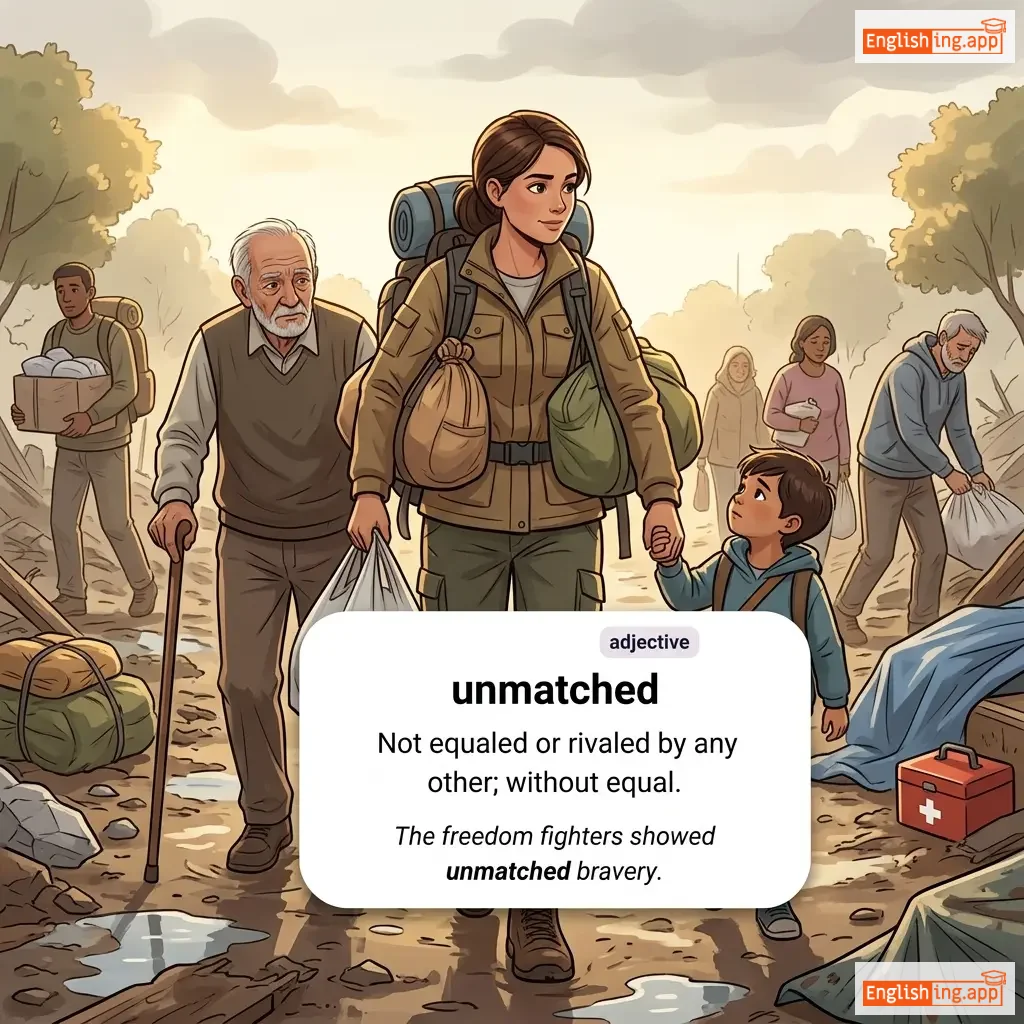
unmatched definition card — visual illustration of the meaning
adjective
ʌnˈmætʃt
अतुलनीय (atulniya)

Not equaled or rivaled by any other; without equal.

"The freedom fighters showed unmatched bravery."

"स्वतंत्रता सेनानियों ने अतुलनीय साहस दिखाया।" (Svatantrata senaniyon ne atulniya sahas dikhaya.)
adjective
/ʌnˈmaɪndfəl/
लापरवाह; ध्यानहीन; (laparwah; dhyanheen)

not paying attention; careless; heedless

"She was unmindful of the danger around her."

"वह अपने चारों ओर के खतरे से बेखबर थी।" (vah apne chaaron or ke khatre se bekhbar thi.)
adjective
/ʌnˈmɪtɪɡeɪtɪd/
पूर्ण (poorn)

absolute; not lessened or moderated

"The meeting was an unmitigated disaster."

"बैठक एक पूर्ण आपदा थी।" (Baithak ek poorn aapda thi.)
adjective
/ʌnˈmɒdɪfaɪd/
अपरिवर्तित (aparivartit)

not changed from its original form or state

"The data was used in its unmodified form for analysis."

"विश्लेषण के लिए डेटा को उसके अपरिवर्तित रूप में उपयोग किया गया।" (vishleshan ke liye deta ko uske aparivartit roop mein upyog kiya gaya)
adjective
/ʌnˈnætʃrəl/
अनैतिक (anaithik)

contrary to the usual course of nature; artificial or abnormal

"The bright green color of the drink looked unnatural."

"पेय का चमकीला हरा रंग अस्वाभाविक लग रहा था।" (Peya ka chamkeela hara rang aswabhavik lag raha tha.)
adverb
/ʌnˈnætʃrəli/
अस्वाभाविक रूप से (aswabhavik roop se)

in a way that is not natural or normal; excessively or strangely

"He smiled unnaturally, making everyone feel uncomfortable."

"वह अस्वाभाविक रूप से मुस्कराया, जिससे सभी असहज हो गए।" (vah aswabhavik roop se muskuraya, jisse sabhi asahaj ho gaye)
adverb
/ʌnˈnesəserəli/
अनावश्यक रूप से (anavashyak roop se)

to a greater extent than is needed; without necessity

"Don't worry unnecessarily about the exam."

"परीक्षा के बारे में अनावश्यक रूप से चिंता मत करो।" (pariksha ke baare mein anavashyak roop se chinta mat karo)
adjective
/ʌnˈnɛsəsɛri/
अनावश्यक (anavashyak)

not needed or required

"The manager cut all unnecessary expenses to save costs."

"मैनेजर ने खर्च बचाने के लिए सभी अनावश्यक खर्चों में कटौती की।" (Manager ne kharch bachane ke liye sabhi anavashyak kharchon mein katoti ki.)