वोकैबुलरीज

इंग्लिश वोकैबुलरी डिस्कवर, लर्न और मास्टर करें

noun
/ˈʌndərwɛr/
अंडरवियर (underwear)

clothing worn under other clothes, next to the skin

"She bought new underwear from the department store."

"उसने डिपार्टमेंट स्टोर से नया अंडरवियर खरीदा।" (Usne department store se naya underwear khareeda.)
verb
/ˌʌn.dəˈtʃɑːrdʒ/
कम शुल्क लेना (kam shulk lena)

To charge less than the correct or fair amount.

"The shopkeeper accidentally undercharged me for the groceries."

"दुकानदार ने गलती से मुझे किराने का सामान कम शुल्क में दिया।" (dukanadar ne galti se mujhe kirane ka saman kam shulk mein diya.)
noun
/ˈʌndərkləʊðz/
अंतरवस्त्र (antarvastr)

Clothing worn beneath outer clothes, such as underwear or lingerie

"He folded his underclothes neatly before packing them."

"उसने अपने अंतरवस्त्र को सावधानी से तह करके पैक किया।" (usne apne antarvastr ko saavdhani se tah karke paek kiya)
verb
/ˈʌndərkʌt/
दाम घटाना, कमजोर करना (daam ghataana, kamzor karna)

to sell at a lower price than a competitor; to weaken or undermine something

"The company tried to undercut its rivals by offering lower prices."

"कंपनी ने कम दामों पर ऑफर देकर अपने प्रतिद्वंद्वियों को अंडरकट करने की कोशिश की।" (Company ne kam daamon par offer dekar apne pratidwandi ko undercut karne ki koshish ki.)
noun
/ˈʌndərdɒɡ/
अपरिचित प्रतियोगी (aprichit pratigogi)

a competitor thought to have little chance of winning; a weaker party in a contest

"The underdog team surprised everyone by winning the championship."

"अंडरडॉग टीम ने चैंपियनशिप जीतकर सबको हैरान कर दिया।" (Underdog team ne championship jeetkar sabko hairan kar diya.)
verb
/ˌʌndərˈɛstɪmeɪt/
कम आंकना (kam aankna)

To judge something as less important or smaller than it really is.

"Never underestimate the power of teamwork."

"कभी भी टीमवर्क की ताकत को कम मत आंकिए।" (Kabhi bhi teamwork ki taqat ko kam mat aankiye.)
adjective
/ˌʌndərɪkˈspoʊzd/
कम रोशन, अनदेखा (kam roshan, andekha)

insufficiently exposed to light (in photography) or not given enough attention

"The photo was underexposed and looked too dark."

"फोटो कम रोशन था और बहुत अंधेरे में दिख रहा था।" (photo kam roshan tha aur bahut andhere mein dikh raha tha.)
noun
/ˈʌndərˌɡɑːrmənt/
अंतर्वस्त्र (antavastr)

a piece of clothing worn under outer clothes, usually next to the skin

"He bought new undergarments for the wedding."

"उसने शादी के लिए नए अंतर्वस्त्र खरीदे।" (Usne shaadi ke liye naye antavastr khareede.)
verb
/ˌʌndərˈɡɜːrd/
आधार प्रदान करना, सशक्त करना (aadhaar pradan karna, sashakt karna)

to provide support or foundation for; to strengthen

"Strong values undergird a healthy society."

"मजबूत मूल्य एक स्वस्थ समाज को आधार प्रदान करते हैं।" (Majboot muly ek svasth samaj ko aadhaar pradan karte hain.)
verb
/ˌʌndərˈɡoʊ/
सहन करना (sahan karna)

to go through something, especially something unpleasant or difficult

"She had to undergo surgery to recover."

"उसे ठीक होने के लिए सर्जरी करनी पड़ी थी।" (Use theek hone ke liye surgery karni padi thi.)
noun
/ˌʌndəˈɡrædʒuət/
अंडरग्रेजुएट (andergrejuet)

a student who has not yet earned a bachelor's degree

"She is an undergraduate studying computer science."

"वह कंप्यूटर विज्ञान का अध्ययन कर रही एक अंडरग्रेजुएट है।" (vah computer vigyaan ka adhyayan kar rahi ek andergrejuet hai)
adjective
/ˈʌndərhænd/
धोखाधड़ी (dhokhadhadi)

done secretly and dishonestly; deceitful

"The politician was accused of using underhand tactics to win the election."

"राजनेता पर चुनाव जीतने के लिए धोखाधड़ी के तरीके अपनाने का आरोप लगा था।" (Raajneeta par chunav jeetne ke liye dhokhadhadi ke tareeke apnane ka aarop laga tha.)
adjective
/ˌʌndərˈhændɪd/
धोखेबाज़ (dhokhebaaz)

acting or done in a dishonest or secret way

"They exposed the company's underhanded dealings with its suppliers."

"उन्होंने कंपनी के अंडरहैंडेड सौदों को उजागर किया।" (Unhone company ke underhanded saudon ko ujagar kiya.)
verb
/ˌʌndərˈlaɪ/
अधारित होना (adharit hona)

to be the hidden cause or basis of something

"Strong cultural traditions underlie the community's practices."

"मजबूत सांस्कृतिक परंपराएँ समुदाय की प्रथाओं के पीछे हैं।" (Mazboot sanskritik paramparayein samudaay ki prathaon ke peeche hain.)
noun
/ˈʌndərlɪŋ/
अनुचर (anuchar)

a person of low rank or importance; a subordinate

"The manager ordered his underlings to finish the task quickly."

"प्रबंधक ने अपने अधीनस्थों से कार्य शीघ्र पूरा करने को कहा।" (Prabandhak ne apne adheenasthon se kaarya shighra poora karne ko kaha.)
adjective
/ˌʌndərˈlaɪɪŋ/
मूलभूत (moolbhoot)

basic or hidden but important; forming the foundation of something

"The underlying reason for the conflict was never addressed."

"संघर्ष के पीछे का मूल कारण कभी संबोधित नहीं किया गया।" (Sangharsh ke peeche ka mool karan kabhi sambodhit nahi kiya gaya.)
verb
/ˈʌndərˌmæn/
कर्मचारियों की कमी होना (karmachariyon ki kami hona)

to supply with fewer workers or personnel than needed

"The hospital was undermanned during the flu outbreak."

"फ्लू फैलने के दौरान अस्पताल में कर्मचारियों की कमी थी।" (Flu phailne ke dauran aspatal mein karmachariyon ki kami thi.)
verb
/ˌʌndərˈmaɪn/
कमज़ोर करना (kamzor karna)

to gradually weaken or damage something or someone

"Constant criticism can undermine a child's confidence."

"लगातार आलोचना एक बच्चे के आत्मविश्वास को कमज़ोर कर सकती है।" (lagatar alochana ek bacche ke atmavishwas ko kamzor kar sakti hai)
preposition, adverb, adjective
/ˌʌndərˈniːθ/
नीचे, के नीचे (neeche, ke neeche)

Located directly below or beneath something

"The keys were hidden underneath the pile of papers."

"चाबियाँ कागज़ों के ढेर के नीचे छुपी हुई थीं।" (chabiyan kagazon ke dher ke neeche chhupi hui thin)
underprivileged groups definition card — visual illustration of the meaning
noun
ˌʌndərˈprɪvəlɪdʒd ɡruːps
अवसरहीन समूह (avasarheen samooh)

Groups of people who lack basic necessities or advantages that are available to other members of society.

"Underprivileged groups benefit from social initiatives."

"अवसरहीन समूह सामाजिक पहलों से लाभान्वित होते हैं।" (Avasarheen samooh samajik pehloon se laabhanvit hote hain.)
verb
/ˌʌndəˈreɪt/
कम आंका गया (kam aankha gaya)

to fail to recognize the full value or importance of something or someone

"Many people underrate the benefits of regular exercise."

"बहुत से लोग नियमित व्यायाम के लाभों को कम आंकते हैं।" (Bahut se log niyamit vyayam ke labhon ko kam aankte hain.)
verb
/ˌʌndərˈskɔːr/
जोर देना (jor dena)

to emphasize or highlight something

"The incident underscored the need for better safety measures."

"घटनाएँ सुरक्षा उपायों की आवश्यकता को जोर देती हैं।" (ghatanayein suraksha upayon ki avashyakta ko jor deti hain.)
verb
/ˌʌndərˈsɛl/
कम कीमत पर बेचना (kam keemat par bechna)

to sell something at a lower price than competitors or to downplay the value of something

"The shop undersold its rivals by offering huge discounts."

"दुकान ने भारी छूट देकर अपने प्रतिस्पर्धियों से कम कीमत पर बेचा।" (Dukaan ne bhaari chhoot dekar apne pratishpardhiyon se kam keemat par becha.)
adjective
/ˌʌndərˈsaɪzd/
छोटा आकार का (chota aakaar ka)

Smaller than the usual or expected size.

"The undersized puppy struggled to keep up with its siblings."

"छोटे आकार के पिल्ले को अपने भाई-बहनों के साथ तालमेल बनाए रखने में संघर्ष करना पड़ा।" (chhote aakaar ke pille ko apne bhai-behno ke saath taalmel banaye rakhne mein sangharsh karna pada.)
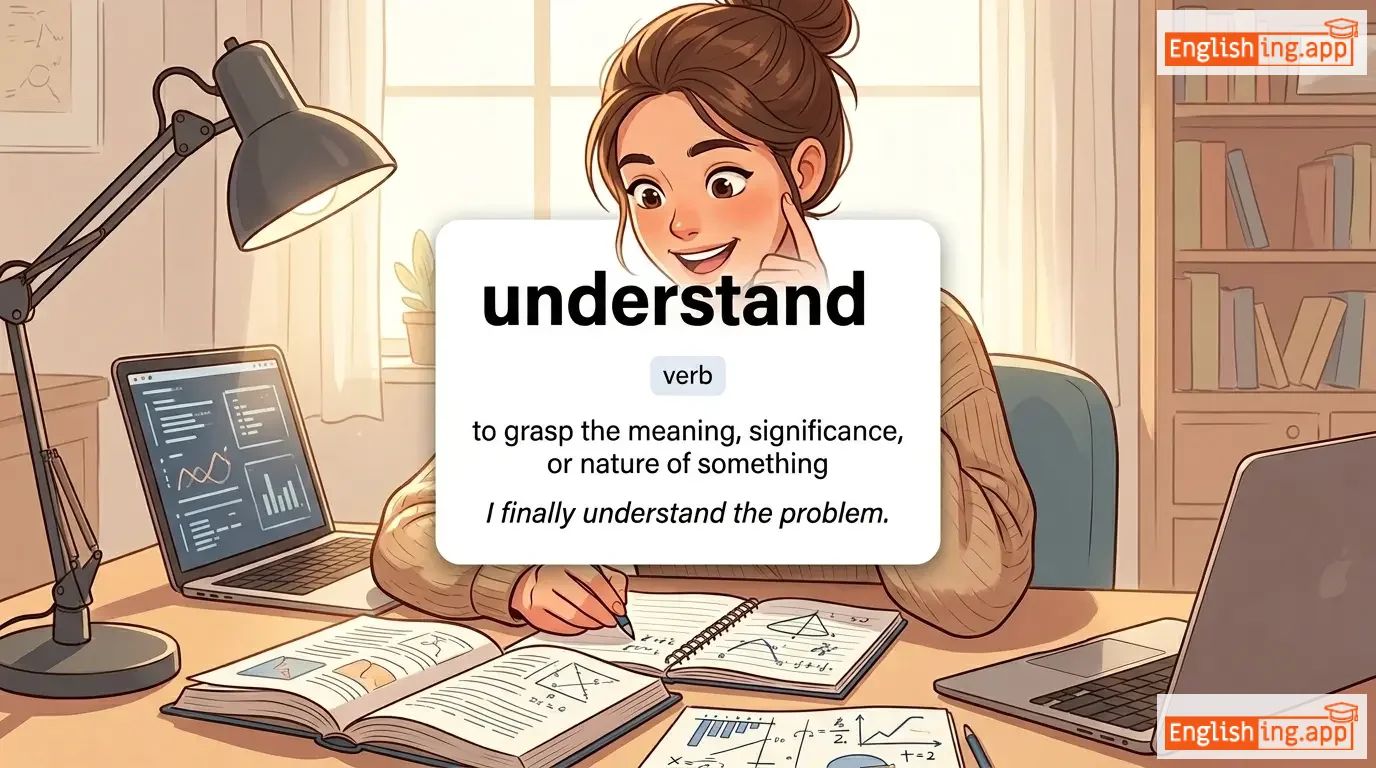
understand definition card — visual illustration of the meaning
verb
/ˌʌndərˈstænd/
समझना (samajhna)

to grasp the meaning, significance, or nature of something

"I finally understand the problem."

"मैं आखिरकार समस्या को समझ गया।" (Main aakhirkaar samasya ko samajh gaya.)
adjective
/ˌʌndərˈstændəbl/
समझने योग्य (samajhne yogya)

Able to be understood; reasonable or justifiable.

"Her reaction was understandable given the situation."

"परिस्थिति को देखते हुए उसकी प्रतिक्रिया समझने योग्य थी।" (Paristhiti ko dekhte hue uski pratikriya samajhne yogya thi.)
noun
/ˌʌndərˈstændɪŋ/
समझ (samajh)

the ability to grasp the meaning, significance, or nature of something

"Her understanding of the issue was impressive."

"उसकी इस मुद्दे की समझ प्रभावशाली थी।" (uski is mudde ki samajh prabhavshali thi.)
verb
/ˌʌndərˈsteɪt/
कम आंका हुआ (kam anka hua)

To describe something as being less important or serious than it really is.

"He tends to understate his achievements."

"वह अपनी उपलब्धियों को कम करके पेश करता है।" (Woh apni uplabdhiyon ko kam karke pesh karta hai.)
adjective
/ˌʌndərˈsteɪtɪd/
साधारण रूप से प्रस्तुत (saadharan roop se prastut)

Presented in a subtle and restrained way.

"She wore an elegant but understated dress."

"उसने एक सुरुचिपूर्ण लेकिन साधारण रूप से प्रस्तुत ड्रेस पहनी थी।" (Usne ek suruchipurn lekin saadharan roop se prastut dress pehni thi.)
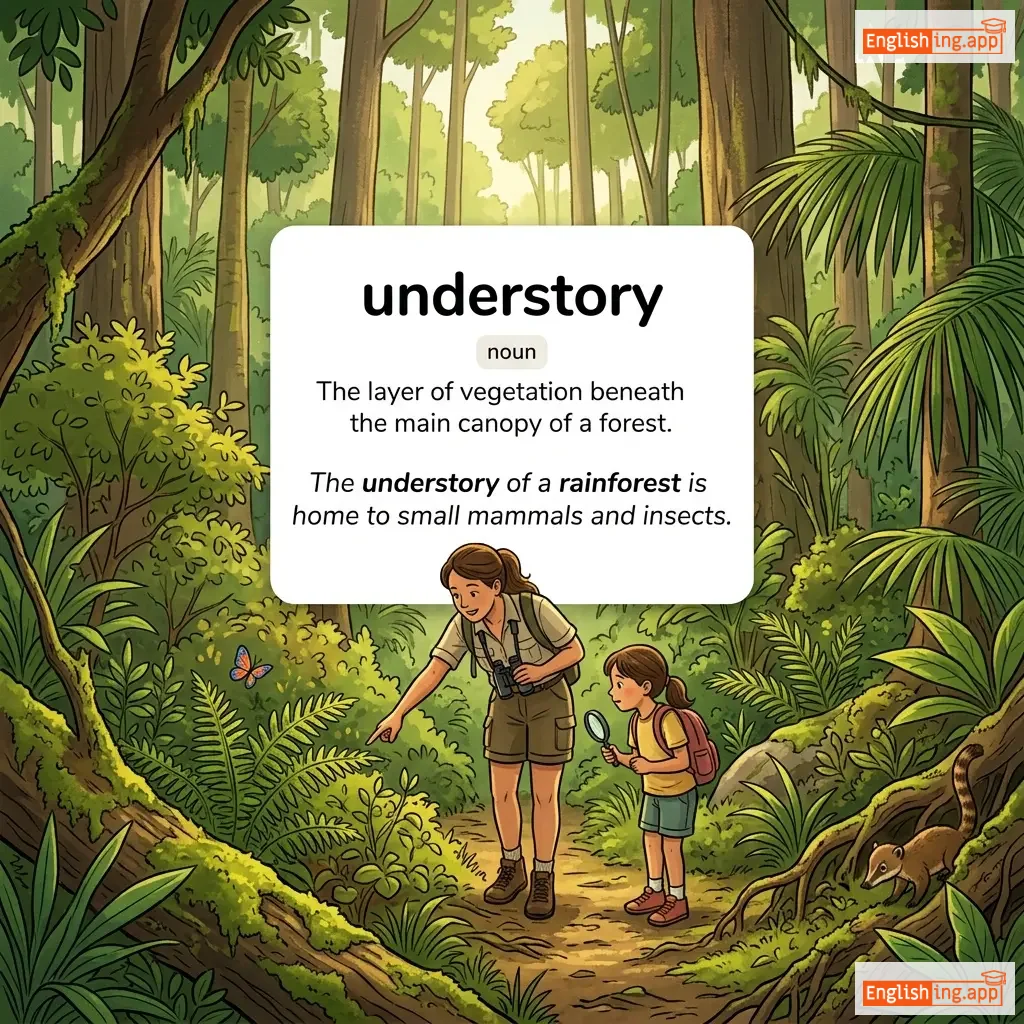
understory definition card — visual illustration of the meaning
noun
/ˈʌn.dɚˌstɔː.ri/
निम्नमंज़िल वनस्पति (nimmamajil vanspati)

The layer of vegetation beneath the main canopy of a forest.

"The understory of a rainforest is home to small mammals and insects."

"वर्षावन की निम्नमंज़िल छोटे स्तनधारी और कीटों का घर है।" (Varshawaan ki nimmamajil chhote stanhdhaari aur keeton ka ghar hai.)
noun
/ˈʌndərˌstʌdi/
अधीन अभिनेता (adhin abhineta)

An actor who learns another's role to act as a replacement if needed.

"The understudy performed when the lead actor fell ill."

"जब मुख्य अभिनेता बीमार पड़ा, तो अंडरस्टडी ने अभिनय किया।" (Jab mukhya abhineta beemar pada, to understudy ne abhinay kiya.)
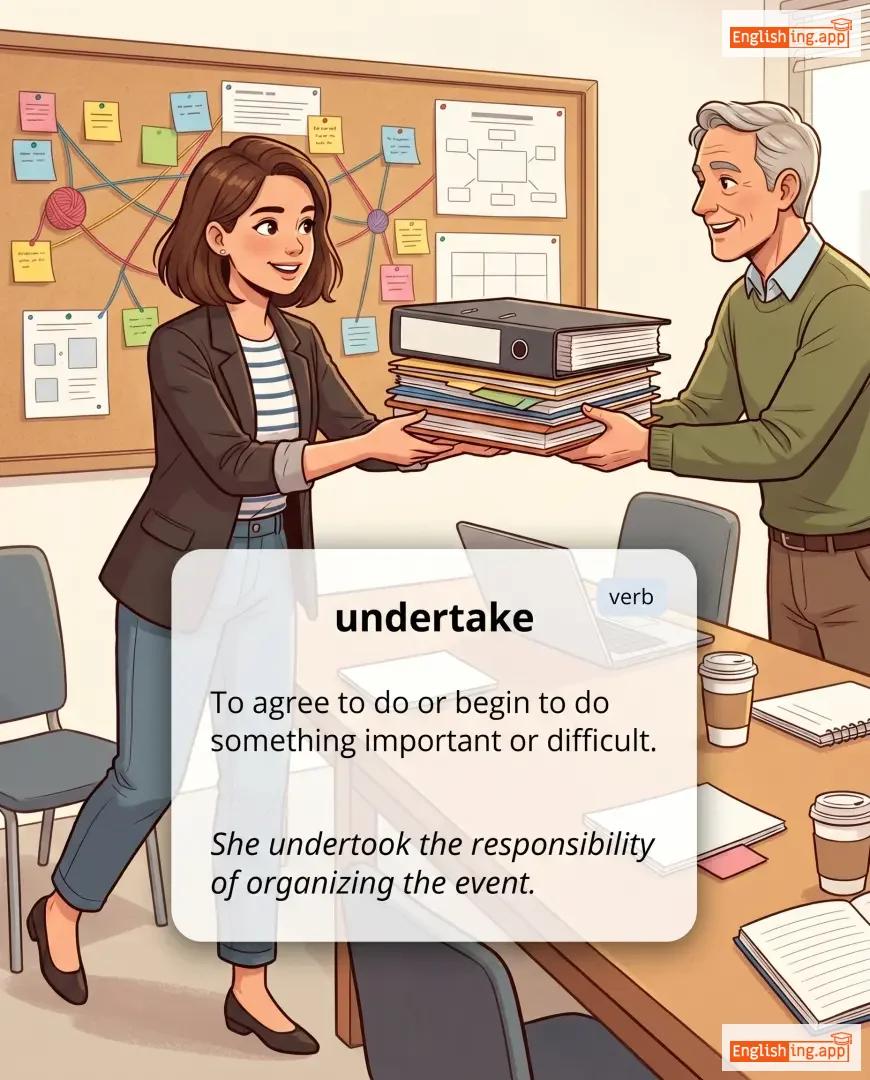
undertake definition card — visual illustration of the meaning
verb
/ˌʌndərˈteɪk/
जिम्मेदारी लेना (jimmedari lena)

To agree to do or begin to do something important or difficult.

"She undertook the responsibility of organizing the event."

"उसने कार्यक्रम आयोजित करने की जिम्मेदारी ली।" (Usne karyakram aayojit karne ki jimmedari li.)
noun
/ˈʌndərˌteɪkər/
अंत्येष्टि कर्ता (antyeshti karta)

A person whose job is to prepare the dead for burial and arrange funerals.

"The undertaker prepared the body for the funeral service."

"अंडरटेकर ने अंतिम संस्कार सेवा के लिए शरीर तैयार किया।" (Undertaker ne antim sanskar seva ke liye sharir tayar kiya.)
noun
/ˈʌndərˌteɪkɪŋ/
कार्य (kaary)

A task, project, or responsibility that someone agrees to do.

"Starting a new company is a difficult undertaking."

"नई कंपनी शुरू करना एक कठिन कार्य है।" (Nayi company shuru karna ek kathin kaary hai.)
verb
/ˌʌndərˈvæljuː/
कम मूल्यांकित करना (kam mulyankan karna)

To assign too low a value or importance to something or someone.

"She felt that her boss consistently undervalued her contributions."

"वह महसूस कर रही थी कि उसका बॉस लगातार उसके योगदानों को कम आंकता था।" (Vah mahsus kar rahi thi ki uska boss lagatar uske yogdanon ko kam aankta tha.)
noun
/ˈʌndərweər/
अंडरवियर (andarviyar)

Clothing worn beneath outer clothes, typically next to the skin.

"He bought new underwear for the trip."

"उसने यात्रा के लिए नया अंडरवियर खरीदा।" (Usne yatra ke liye naya andarviyar kharida.)
noun
/ˈʌndərˌwɜːrld/
अंडरवर्ल्ड (underworld)

The criminal world of organized crime or the mythical world of the dead.

"The detective spent years studying the secrets of the underworld."

"जासूस ने अंडरवर्ल्ड के रहस्यों का अध्ययन किया।" (Jasoos ne underworld ke rahasyon ka adhyayan kiya.)
verb
/ˈʌndərˌraɪt/
वित्तीय गारंटी देना (vittiya guarantee dena)

To guarantee financial support, especially by agreeing to cover losses or risks; in insurance, to assess and accept risks.

"The bank agreed to underwrite the company's new bond issue."

"बैंक ने कंपनी के नए बांड इश्यू को अंडरराइट करने के लिए सहमति दी।" (Bank ne company ke naye bond issue ko underwrite karne ke liye sahmati di.)
adjective
/ˌʌndɪˈzaɪərəbl/
अप्रिय; अवांछनीय; हानिकारक (apriya; avanchhaniya; hanikarak)

not wanted or wished for; harmful or unpleasant

"The new policy had several undesirable consequences."

"नई नीति के कई अप्रिय परिणाम थे।" (Nayi neeti ke kai apriya parinaam the.)
adjective
/ˌʌndɪˈveləpt/
अविकसित; अपरिपक्व; प्राचीन (aviksit; aparipakv; prachin)

not yet developed; immature or primitive

"The undeveloped land was later turned into a park."

"अविकसित ज़मीन को बाद में एक पार्क में बदल दिया गया।" (Aviksit zameen ko baad mein ek park mein badal diya gaya.)
adjective
/ˌʌndɪˈstɜːrbd/
अविचलित (avichalit)

not interrupted or interfered with; calm and peaceful

"She slept undisturbed for eight hours."

"वह आठ घंटे बिना किसी विघ्न के सोई।" (vah aath ghante bina kisi vighn ke soyi.)
adjective
/ʌnˈdɪvaɪdɪd/
अखंड; पूर्ण; विभाजित नहीं (akhanda; poorn; vibhajit nahi)

whole; complete; not separated or split

"The team showed undivided attention to the coach's instructions."

"टीम ने कोच के निर्देशों पर अडिग ध्यान दिखाया।" (Teem ne koch ke nirdeshon par adig dhyan dikhaya.)
adverb
/ʌnˈdaʊtɪdli/
निस्संदेह (nissandeh)

without a doubt, certainly

"He is undoubtedly the best player on the team."

"वह निश्चित रूप से टीम का सबसे अच्छा खिलाड़ी है।" (Vah nishchit roop se team ka sabse achha khiladi hai.)
adjective
/ʌnˈdjuː/
अत्यधिक (atyadhik)

More than is reasonable, excessive, or inappropriate.

"He placed undue pressure on his employees to meet the deadline."

"उसने अपनी कर्मचारियों पर समय सीमा को पूरा करने के लिए अत्यधिक दबाव डाला।" (Usne apni karyakartao par samay seema ko poora karne ke liye atyadhik dabav dala.)
verb
/ˈʌndjʊleɪt/
लहराना (laharana)

To move with a smooth, wave-like motion.

"The snake undulated across the sand."

"साँप रेत पर लहराता हुआ चल रहा था।" (Saap ret par lehrata hua chal raha tha.)
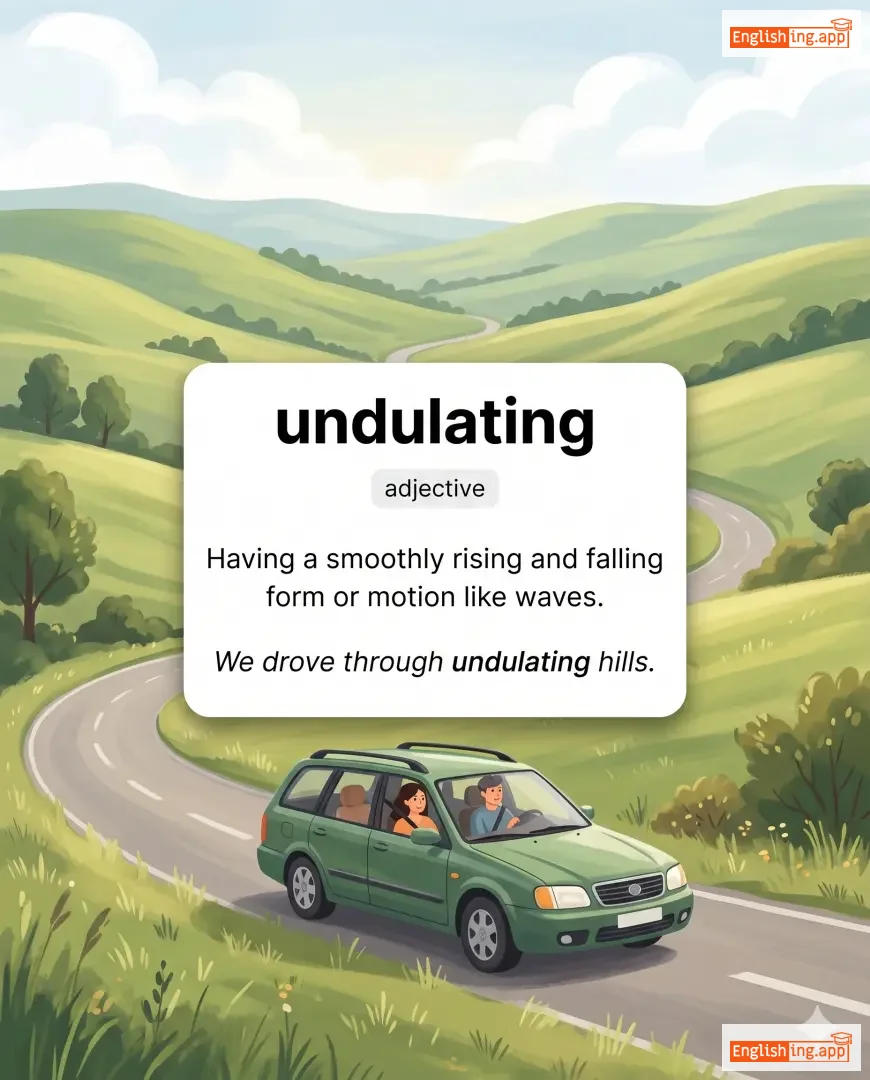
undulating definition card — visual illustration of the meaning
adjective
/ˈʌndjʊleɪtɪŋ/
लहरदार (lahardar)

Having a smoothly rising and falling form or motion like waves.

"We drove through undulating hills."

"हम लहरदार पहाड़ियों से होकर चले।" (Ham lahradar paharion se hokar chale.)
adjective
/ˈʌndjʊləs/
लहरदार (lahradar)

Having a wavy surface or form.

"The artist painted the undulous sea at sunset."

"कला कारी ने सूर्यास्त में लहरदार समुद्र चित्रित किया।" (Kala kaari ne suryast mein lahradar samudra chitrith kiya.)
verb
/ʌnˈɜːθ/
माटी खोदकर बाहर निकालना (maati khodkar baahar nikaalna)

To dig up from the ground or to discover something hidden.

"Archaeologists unearthed ancient artifacts at the site."

"पुरातत्ववेत्ताओं ने साइट पर प्राचीन अवशेष खोदकर निकाले।" (Puraatattvavettaon ne saait par pracheen avashesh khodkar nikaale.)
adjective
/ʌnˈɜːrθli/
अलौकिक (aloukik)

Strange or unnatural in a way that seems not of this world

"The forest was filled with an unearthly glow."

"जंगल एक अलौकिक आभा से भरा हुआ था।" (Jangal ek aloukik abha se bhara hua tha.)
adjective
/ʌnˈiːzi/
बेचैन; चिंतित; असहज (bechain; chintit; asahaj)

worried; anxious; uncomfortable; restless

"She felt uneasy about walking alone at night."

"वह रात को अकेले चलने के बारे में बेचैन महसूस कर रही थी।" (vah raat ko akele chalne ke baare mein bechain mehsoos kar rahi thi.)