वोकैबुलरीज

इंग्लिश वोकैबुलरी डिस्कवर, लर्न और मास्टर करें

noun
/ˈtɛmpoʊ/
ताल, गति (taal, gati)

The speed or pace at which a piece of music or activity is performed.

"The band played the song at a faster tempo than usual."

"बैंड ने गाने को सामान्य से तेज़ ताल में बजाया।" (band ne gane ko samany se tez taal mein bajaya.)
adjective
/ˈtɛmpərəl/
भौतिक, समय संबंधित (bhautik, samay sambandhit)

Relating to worldly affairs or to time rather than spiritual matters.

"The monk gave up his temporal possessions to live a simple life."

"सन्न्यासी ने अपने भौतिक संपत्ति त्याग कर सरल जीवन जीने का निर्णय लिया।" (sannyasi ne apne bhautik sampatti tyaag kar saral jeevan jeene ka nirnay liya.)
adverb
/ˈtɛmpərɛrɪli/
अस्थायी रूप से (asthaayee roop se)

for a limited time; not permanently

"The road is closed temporarily for repairs."

"सड़क मरम्मत के लिए अस्थायी रूप से बंद है।" (Sadak marammat ke liye asthaayee roop se band hai.)
adjective
/ˈtɛmpərɛri/
अस्थायी (asthayi)

Lasting for only a limited period of time; not permanent.

"She found a temporary job during the summer break."

"उसने समर ब्रेक के दौरान एक अस्थायी नौकरी पाई।" (Usne summer break ke dauran ek asthayi naukri pai.)
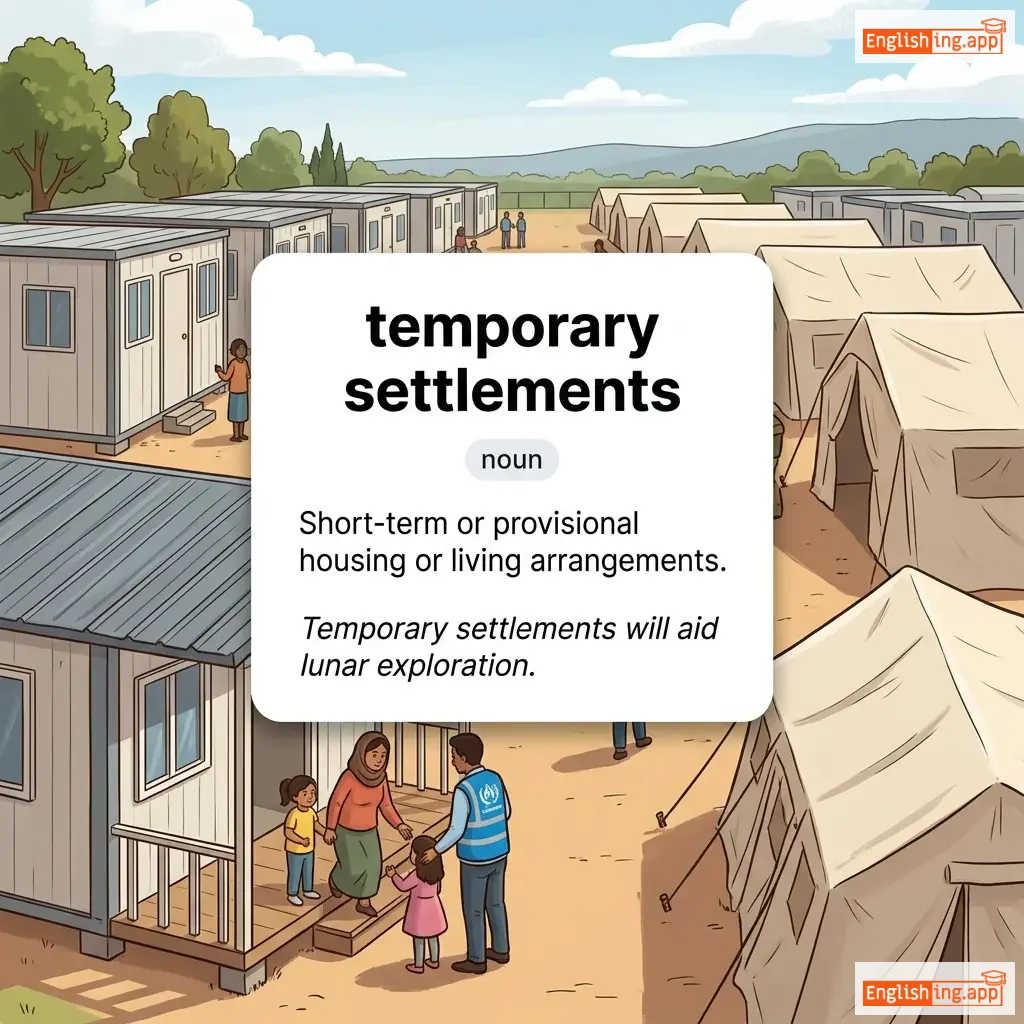
temporary settlements definition card — visual illustration of the meaning
noun
ˈtempəreri ˈsetlmənts
अस्थायी बस्तियाँ (asthayi bastiyan)

Short-term or provisional housing or living arrangements.

"Temporary settlements will aid lunar exploration."

"अस्थायी बस्तियाँ चंद्रमा अन्वेषण में सहायक होंगी।" (Asthaayi bastiyan chandraman anveshan mein sahaayak hongi.)
verb
/ˈtɛmpəˌraɪz/
विलंब करना (vilamb karna)

To delay making a decision or taking action in order to gain time.

"The politician temporized when asked about the controversial issue."

"जब राजनीतिज्ञ से विवादास्पद मुद्दे के बारे में पूछा गया, तो उसने विलंब किया।" (jab rajniti-jy se vivaadaspad mudde ke baare mein poocha gaya, to usne vilamb kiya.)
verb
/tɛmpt/
ललचाना (lalchana)

to entice or attract someone to do something, often something wrong or unwise

"The smell of fresh bread tempted him to enter the bakery."

"ताजे ब्रेड की खुशबू ने उसे बेकरी में प्रवेश करने के लिए ललचाया।" (Taje bread ki khushboo ne use bakery mein pravesh karne ke liye lalchaya.)
noun
/temp.ˈteɪ.ʃən/
लोभ (lobh)

the desire to do something wrong or unwise; an urge to have or do something

"He resisted the temptation to eat the entire chocolate cake."

"उसने पूरी चॉकलेट केक खाने के लोभ का विरोध किया।" (Usne puri chocolate cake khane ke lobh ka virodh kiya.)
noun
/ˈtɛmptər/
प्रलोभक (prolobhak)

a person or thing that entices someone into doing something wrong

"The tempter whispered false promises into his ear."

"प्रलोभक ने उसके कान में झूठे वादे फुसफुसाए।" (Prolobhak ne uske kaan mein jhoothe vaade fusfusaaye.)
adjective
/ˈtemptɪŋ/
आकर्षक (aakarshak)

appealing to or attracting someone, even if wrong or inadvisable; alluring

"The chocolate cake looked very tempting in the bakery window."

"बेकरी की खिड़की में चॉकलेट केक बहुत आकर्षक लग रहा था।" (bekari ki khidki mein chocolate cake bahut aakarshak lag raha tha.)
noun
/tɛn/
दस (das)

the number following nine and preceding eleven

"I have ten apples in the basket."

"मेरे पास बास्केट में दस सेब हैं।" (Mere paas basket mein das seb hain.)
adjective
/ˈtɛnəbl/
रक्षा किया जा सकता है (raksha kiya ja sakta hai)

able to be defended or maintained against attack or objection

"His argument was strong and tenable in court."

"उसका तर्क मजबूत और कोर्ट में रक्षा किया जा सकता था।" (Uska tark majboot aur court mein raksha kiya ja sakta tha.)
tenacious definition card — visual illustration of the meaning
adjective
/təˈneɪʃəs/
दृढ़ (dridh)

holding firmly to something; persistent and determined

"She was tenacious in pursuing her goals."

"वह अपने लक्ष्यों को प्राप्त करने में दृढ़ थी।" (Vah apne lakshyon ko prapt karne mein dridh thi.)
tenacity definition card — visual illustration of the meaning
noun
/təˈnæsəti/
दृढ़ता (dridhta)

the quality of being persistent, determined, and not easily giving up

"His tenacity helped him succeed despite many failures."

"उसकी दृढ़ता ने उसे कई असफलताओं के बावजूद सफल होने में मदद की।" (Uski dridhta ne use kai asafaltaon ke bawjood safal hone mein madad ki.)
noun
/ˈtɛnənsi/
किरायेदारी (kirayedari)

The possession or occupation of land or property as a tenant.

"The tenancy agreement was signed for two years."

"किरायेदारी समझौता दो साल के लिए हस्ताक्षरित किया गया था।" (kirayedari samjhauta do saal ke liye hastaksharit kiya gaya tha.)
noun
/ˈtɛnənt/
किरायेदार (kirayedar)

A person who occupies land or property rented from a landlord.

"The tenant paid the rent on time every month."

"किरायेदार ने हर महीने समय पर किराया दिया" (Kirayedar ne har mahine samay par kiraya diya)
verb
/tɛnd/
झुकाव/देखभाल करना (jhukav/dekhbhal karna)

To regularly behave in a particular way or to take care of something.

"She tends to wake up early in the morning."

"वह सुबह जल्दी उठने की प्रवृत्ति रखती है।" (Vah subah jaldi uthne ki pravritti rakhti hai.)
noun
/ˈtɛndənsi/
रुझान (ruzhan)

An inclination or likelihood to behave in a certain way.

"He has a tendency to forget small details."

"उसे छोटे-छोटे विवरण भूलने की आदत है।" (Use chhote-chhote vivaran bhoolne ki aadat hai.)
adjective
/tɛnˈdɛnʃəs/
पक्षपाती (pakshapati)

Expressing or promoting a particular cause or point of view, often biased.

"The article was criticized for its tendentious tone."

"लेख को इसके पक्षपाती स्वर के लिए आलोचना की गई थी।" (Lekh ko iske pakshapati swar ke liye alochna ki gayi thi.)
verb, noun, adjective
/ˈtɛndər/
प्रस्ताव / कोमल (prastav / komal)

to offer formally; soft and delicate in texture or character; a formal offer or proposal

"The company tendered its resignation to the board."

"कंपनी ने बोर्ड को अपना इस्तीफा टेंडर किया।" (Kampani ne board ko apna isteefa tender kiya.)
noun
/ˈten.dər.nəs/
सुख (sukh)

gentleness and kindness; the quality of being easily hurt or damaged

"The mother showed great tenderness while caring for her sick child."

"जब उसने पुरस्कार प्राप्त किया तो वह अपनी खुशी को छिपा नहीं सकी।" (jab usne puraskar prapt kiya to vah apni khushi ko chhupa nahin sakee.)
adjective
/ˈtɛnɪbrəs/
अंधकारपूर्ण (andhkarpurn)

dark, shadowy, or obscure

"The cave was damp and tenebrous, filled with eerie sounds."

"गुफा गीली और अंधेरी थी, जिसमें अजीब आवाज़ें थीं।" (Gufa geeli aur andheri thi, jismein ajeeb awaazain thi.)
noun
/ˈtɛnəmənt/
किरायेदारी मकान (kiraayedaari makaan)

a large building divided into separate apartments, often in poor condition

"The family lived in a crowded tenement in the city."

"परिवार शहर में एक भीड़-भाड़ वाले किरायेदारी मकान में रहता था।" (Parivaar shaher mein ek bheed-bhaad waale kiraayedaari makaan mein rehta tha.)
tenet definition card — visual illustration of the meaning
noun
/ˈtɛnɪt/
सिद्धांत (siddhant)

a principle, belief, or doctrine held to be true

"Honesty is a central tenet of their philosophy."

"ईमानदारी उनके दर्शन का एक केंद्रीय सिद्धांत है।" (Imandari unke darshan ka ek kendriya siddhant hai.)
noun
/ˈtɛnɪs/
टेनिस (tenis)

a sport played with rackets and a ball on a rectangular court

"He enjoys playing tennis with his friends on the weekends."

"वह सप्ताहांत में अपने दोस्तों के साथ टेनिस खेलना पसंद करता है।" (vah saptahant mein apne doston ke saath tenis khelna pasand karta hai)
noun
/ˈtɛnər/
स्वर / मूल भावना (swar / mool bhavna)

the general meaning, drift, or character of something; a male singing voice between baritone and alto

"The overall tenor of his speech was hopeful and reassuring."

"उसकी स्पीच का समग्र टोन आशावादी और विश्वासजनक था।" (Uski speech ka samagra ton ashaavadi aur vishwasjanak tha.)
noun, adjective, verb
/tɛns/
तनाव / काल (tanav / kaal)

a grammatical category showing time reference; stretched tight or anxious

"She felt tense before the interview."

"वह साक्षात्कार से पहले तनाव महसूस कर रही थी।" (Wah sakshatkaar se pehle tanav mehsoos kar rahi thi.)
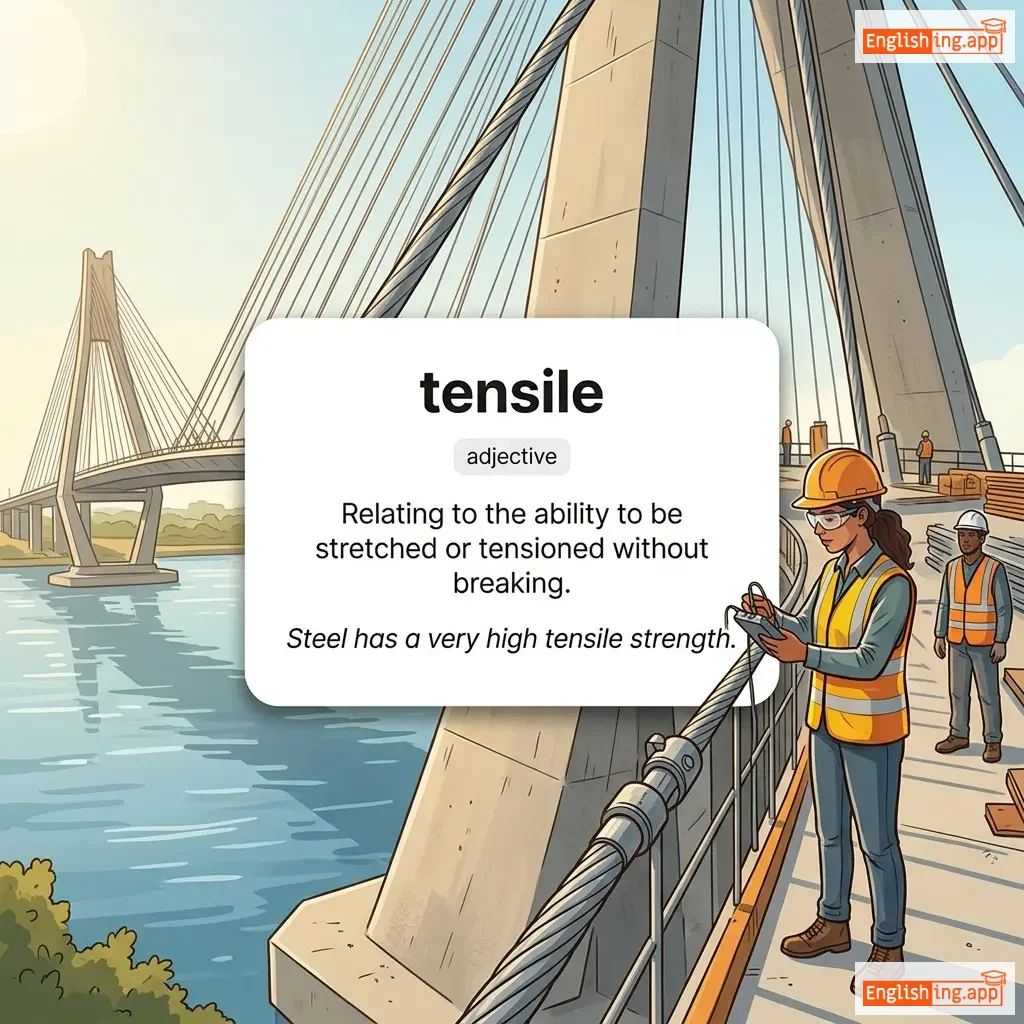
tensile definition card — visual illustration of the meaning
adjective
/ˈtɛn.saɪl/
तन्यीय (tanyiy)

Relating to the ability to be stretched or tensioned without breaking.

"Steel has a very high tensile strength."

"इस्पात में बहुत उच्च तन्यीय ताकत होती है।" (Ispaat mein bahut uchch tanyiy taakat hoti hai.)
noun
/ˈtɛn.ʃən/
तनाव (tanav)

A state of being stretched tight; mental or emotional strain.

"There was a lot of tension in the room before the exam results were announced."

"वहां परीक्षा के परिणाम घोषित होने से पहले कमरे में बहुत टेंशन थी।" (Vahan pareeksha ke parinaam ghoshit hone se pehle kamre mein bahut tension thi.)
noun
/tɛnt/
टेंट (tent)

a portable shelter made of fabric, supported by poles and ropes

"We set up a tent for the camping trip."

"हमने कैम्पिंग यात्रा के लिए एक टेंट लगाया।" (Hamē kāiṁping yātrā kē li'ē ēka ṭenṭ lagāyā.)
adjective
/ˈtɛn.tə.tɪv/
अनिश्चित (anishchit)

Not certain or fixed; done without confidence.

"She gave a tentative smile before agreeing."

"उसने सहमति देने से पहले एक अनिश्चित मुस्कान दी।" (Usne sahmati dene se pehle ek anishchit muskaan di.)
tenuous definition card — visual illustration of the meaning
adjective
/ˈtɛn.ju.əs/
कमज़ोर / पतला (kamzor / patla)

Very weak, thin, or slight; lacking a strong basis.

"The evidence against him is quite tenuous."

"उसके खिलाफ सबूत काफी कमज़ोर है।" (Uske khilaf saboot kaafi kamzor hai.)
noun
/ˈtɛnjər/
कार्यकाल (karyakal)

The period of time during which someone holds a position, office, or land.

"His tenure as president lasted for five years."

"उनका कार्यकाल राष्ट्रपति के रूप में पाँच वर्षों तक चला।" (Unka karyakal rashtrapati ke roop mein paanch varshon tak chala.)
adjective
/ˈtɛpɪd/
नर्म गुनगुना, उदासीन (narm gunguna, udasin)

Lukewarm; showing little enthusiasm or force.

"His speech received only a tepid response from the audience."

"उसके भाषण को श्रोताओं से केवल एक नर्म गुनगुना प्रतिक्रिया मिली।" (uske bhashan ko shroton se keval ek narm gunguna pratikriya mili.)
noun
/ˌtɜːsənˈtɛnəri/
तिहत्तरवीं वर्षगाँठ (tihattarvin varshganth)

The 300th anniversary of an event.

"The city celebrated its tercentenary with a grand festival."

"शहर ने अपनी तिहत्तरवीं वर्षगाँठ एक भव्य उत्सव के साथ मनाई।" (shahar ne apni tihattarvin varshganth ek bhavya utsav ke saath manai.)
noun
/ˌtɜːdʒɪvərˈseɪʃən/
विरोधाभास, टालमटोल (virodhabhas, taalmatol)

Evasion of straightforward action or speech; changing sides or being inconsistent.

"The politician’s tergiversation frustrated his supporters."

"राजनीतिज्ञ का विरोधाभास उसके समर्थकों को हताश कर रहा था।" (raajnaitik ka virodhabhaas uske samarthako ko hataash kar raha tha.)
noun
/tɜːm/
शब्द (shabd)

a word or phrase used to describe a thing or to express a concept

"The term 'machine learning' is commonly used in technology."

"‘मशीन लर्निंग’ शब्द तकनीकी में सामान्यत: उपयोग किया जाता है।" (‘Machine learning’ shabd takneeki mein saamaanyata: upyog kiya jaata hai.)
noun
/ˈtɜːrməɡənt/
चिड़चिड़ी और हुक्म चलाने वाली महिला (chidhchidhī aur hukm chalāne vālī mahilā)

A harsh-tempered or overbearing woman.

"The character was portrayed as a loud and domineering termagant."

"चरित्र को एक ऊँची आवाज़ और हुक्म चलाने वाली टर्मागेंट के रूप में चित्रित किया गया था।" (charitr ko ek ūnchī āwāz aur hukm chalāne vālī termāgaint ke rūp mein citrit kiyā gayā thā.)
noun/adjective
/ˈtɜːrmɪnəl/
टर्मिनल, अंतिम, बीमारी के अंतिम चरण (terminal, antim, bimari ke antim charan)

As a noun: A place where transport routes begin or end. As an adjective: Relating to the end or final stage of something, often an illness.

"He waited for the bus at the central terminal."

"वह केंद्रीय टर्मिनल पर बस का इंतजार कर रहा था।" (vah kendriya terminal par bas ka intezar kar raha tha.)
verb
/ˈtɜːrmɪˌneɪt/
समाप्त करना (samaapt karna)

to bring something to an end or to stop something from continuing

"The company decided to terminate his contract."

"कंपनी ने उसका अनुबंध समाप्त करने का निर्णय लिया।" (Kampani ne uska anubandh samaapt karne ka nirnay liya.)
noun
/ˌtɜːrmɪˈneɪʃən/
समाप्ति (samaapti)

the act of ending something or the state of being ended

"The termination of the contract caused financial loss."

"अनुबंध की समाप्ति से वित्तीय नुकसान हुआ।" (Anubandh ki samaapti se vittiya nuksan hua.)
noun
/ˌtɜːrməˈnɑːlədʒi/
विशेष शब्दावली (vishesh shabdavali)

the set of technical or special words used in a particular subject

"Medical terminology can be difficult for new students to understand."

"मेडिकल टर्मिनोलॉजी नए छात्रों के लिए समझना मुश्किल हो सकता है।" (Medical terminology naye chatron ke liye samajhna mushkil ho sakta hai.)
noun
/ˈtɜːrmɪnəs/
अंतिम स्थान (antim sthan)

the final point or end of something, especially the final station on a railway line

"The train finally arrived at the terminus after a long journey."

"लंबी यात्रा के बाद ट्रेन अंततः टर्मिनस पर पहुंची।" (Lambi yatra ke baad train antatah terminus par pahiunchi.)
noun
/tɜːmz/
शर्तें (sharten)

plural of term; conditions or rules in a contract or agreement

"The terms of the agreement are clearly outlined in the contract."

"समझौते की शर्तें अनुबंध में स्पष्ट रूप से उल्लिखित हैं।" (Samjhaute ki sharten anubandh mein spasht roop se ullikhit hain.)
noun
/təˈreɪn/
भूमि (bhumi)

a stretch of land, especially with regard to its physical features

"The soldiers had to cross rough terrain during the mission."

"सैनिकों को मिशन के दौरान कठिन भूमि को पार करना पड़ा।" (Sainikon ko mission ke dauran kathin bhumi ko paar karna pada.)
noun
/ˈterəpɪn/
एक प्रकार की छोटी ताजे पानी की कछुआ (ek prakar ki chhoti taje pani ki kachhua)

a small freshwater turtle, especially one found in North America

"The terrapin slowly crawled into the pond."

"टेरेपिन धीरे-धीरे तालाब में घुसा।" (Terrapin dheere-dheere talab mein ghusa.)
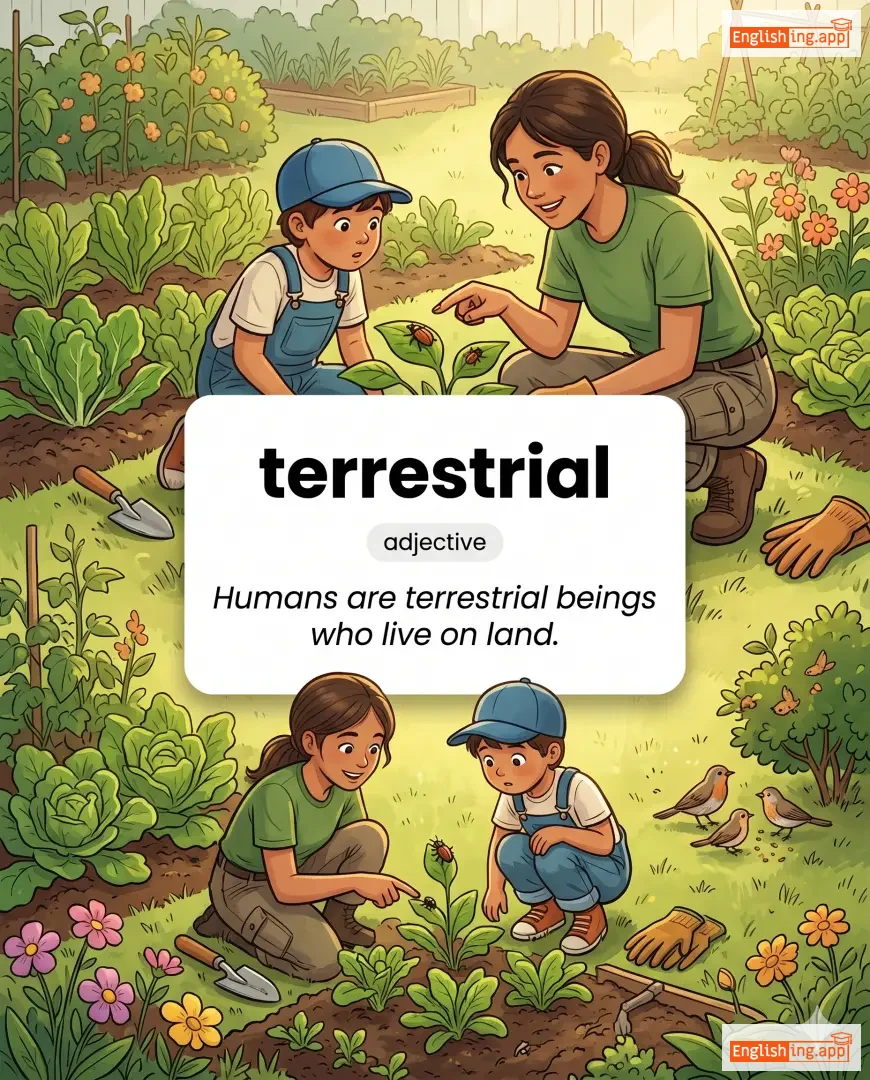
terrestrial definition card — visual illustration of the meaning
adjective
/təˈrɛstriəl/
स्थलीय (sthaliya)

Relating to the Earth or land as opposed to the sea or air; living or growing on land.

"Humans are terrestrial beings who live on land."

"मानव स्थलीय प्राणी हैं जो भूमि पर रहते हैं।" (Manav sthaliya prani hain jo bhumi par rehte hain.)
adjective
/ˈtɛrɪbəl/
खराब (terebal)

extremely bad or unpleasant

"The food at that restaurant was terrible."

"उस रेस्टोरेंट का खाना बहुत खराब था." (us restorent ka khana bahut kharab tha)
adverb
/ˈtɛrəbli/
भयानक तरीके से (bhayanak tareeke se)

to a very great or extreme degree; very badly or unpleasantly

"He felt terribly sad after hearing the news."

"उसने समाचार सुनने के बाद भयानक तरीके से दुखी महसूस किया।" (Usne samachar sunne ke baad bhayanak tareeke se dukhi mehsoos kiya.)
adjective
/təˈrɪfɪk/
शानदार (shandaar)

extremely good or excellent; very great or intense

"The concert last night was absolutely terrific."

"कल रात का कंसर्ट बिल्कुल शानदार था।" (Kal raat ka concert bilkul shandaar tha.)