वोकैबुलरीज

इंग्लिश वोकैबुलरी डिस्कवर, लर्न और मास्टर करें

noun
/ˈtwaɪ.laɪt/
गोधूलि (godhuli)

the soft glowing light from the sky when the sun is below the horizon; a period of decline

"We walked along the beach at twilight."

"हम समुद्र तट पर गोधूलि में चल रहे थे।" (ham samudra tat par godhuli mein chal rahe the.)
noun
/twɪn/
जुड़वां (judwa)

either of two children born at the same time to the same mother

"They have twin girls."

"उनके पास जुड़वां लड़कियाँ हैं।" (Unke paas judwa ladkiyaan hain.)
noun
/twɪndʒ/
चोट (chot)

a sudden, sharp pain or an emotional pang

"He felt a twinge of guilt after lying to his friend."

"उसने अपने दोस्त से झूठ बोलने के बाद अपराधबोध का अचानक दर्द महसूस किया।" (Usne apne dost se jhooth bolne ke baad apradhbodh ka achanak dard mehsoos kiya.)
verb
/twɪst/
मोड़ना, घुमाना (modna, ghumana)

to bend or turn something into a coil or spiral shape; to distort.

"He twisted the rope tightly around the pole."

"उसने रस्सी को पोल के चारों ओर कसकर घुमा दिया।" (Usne rassi ko pol ke charon or kaskar ghooma diya.)
noun
/ˈtwɪstər/
बवंडर (bavandar)

A tornado or something that twists; also refers to a challenging tongue twister.

"The twister destroyed several houses in the village."

"बवंडर ने गांव में कई घरों को नष्ट कर दिया।" (bavandar ne gaav mein kai gharon ko nasht kar diya.)
noun
/twɪt/
मूर्ख व्यक्ति; मजाक करना (moorkh vyakti; mazaak karna)

a silly or foolish person; to tease or make fun of someone

"Don't be such a twit and listen carefully."

"ऐसा मूर्ख मत बनो और ध्यान से सुनो।" (aisa moorkh mat bano aur dhyaan se suno)
noun
/tuː/
दो (do)

the number following one

"She has two children."

"उसके दो बच्चे हैं।" (Uske do bachche hain.)
noun
/tuː θɜːrdz/
दो-तिहाई (do-tihai)

a fraction equal to two parts of three; 2/3.

"Two-thirds of the students passed the exam."

"दो-तिहाई छात्र परीक्षा में उत्तीर्ण हुए।" (Do-tihai chhatra pariksha mein uttirn hue.)
noun
/ˈtuːsəm/
जोड़ी (jodi)

A pair of people considered together, often in a romantic or competitive context.

"They entered the dance competition as a twosome."

"उन्होंने नृत्य प्रतियोगिता में एक जोड़ी के रूप में भाग लिया।" (Unhone nritya pratiyogita mein ek jodi ke roop mein bhag liya.)
noun
/taɪˈkuːn/
धनी व्यापारी (dhani vyapari)

a wealthy, powerful businessperson

"The real estate tycoon invested in several skyscrapers."

"रियल एस्टेट टाइ्कून ने कई स्काईस्क्रैपर्स में निवेश किया।" (Real estate tycoon ne kai skyscrapers mein nivesh kiya.)
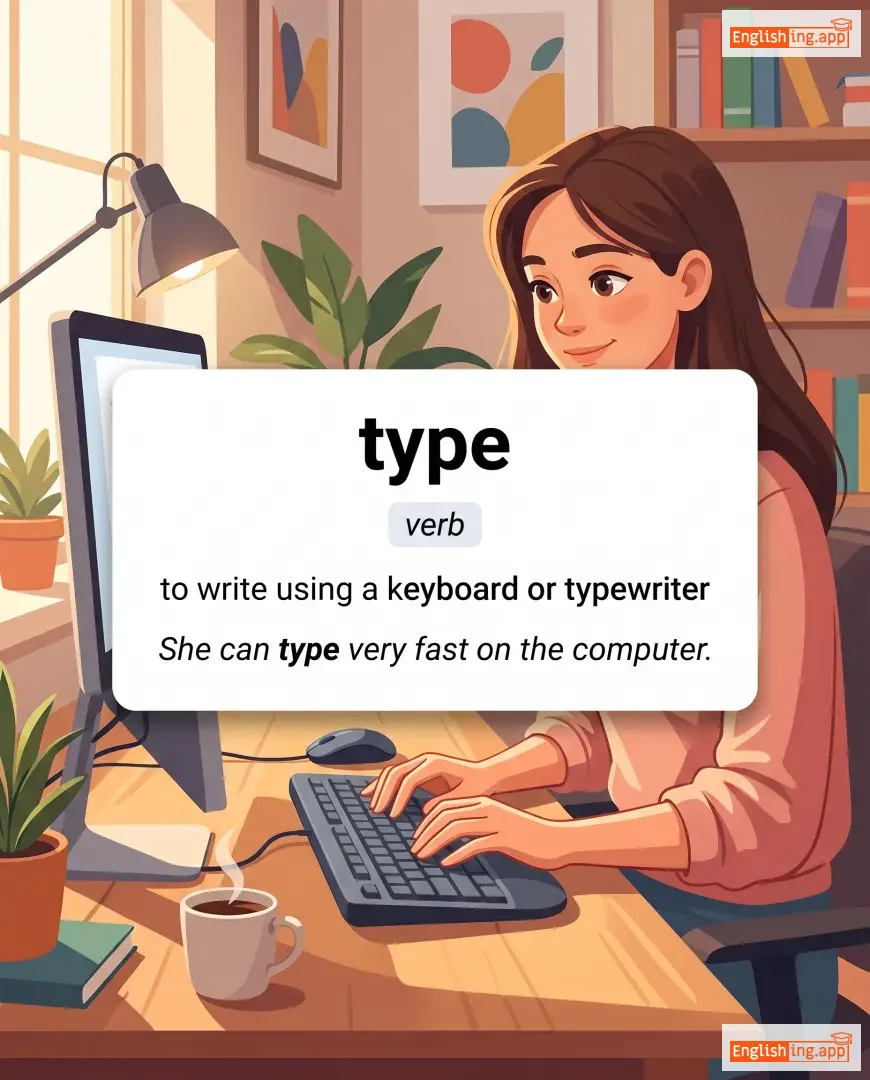
type definition card — visual illustration of the meaning
noun
/taɪp/
प्रकार (prakār)

a category of people or things having common characteristics

"What type of music do you like?"

"आप किस प्रकार का संगीत पसंद करते हैं?" (Aap kis prakār kā sangeet pasand karte hain?)
noun
/taɪˈfuːn/
तूफ़ान (toofan)

a tropical storm in the region of the Indian or western Pacific oceans

"The typhoon caused severe flooding in the coastal areas."

"तूफ़ान ने तटीय क्षेत्रों में भारी बाढ़ ला दी।" (Toofan ne tatiya kshetron mein bhaari baadh la dee.)
adjective
/ˈtɪpɪkəl/
विशेष रूप से एक प्रकार के व्यक्ति या वस्तु की सामान्य विशेषताओं से संबंधित (vishesh roop se ek prakar ke vyakti ya vastu ki samanya visheshataon se sambandhit)

having the usual qualities of a particular type of person or thing

"It was a typical summer day, hot and humid."

"यह एक सामान्य समर दिन था, गर्म और आर्द्र।" (Yeh ek samanya summer din tha, garm aur aadr.)
adverb
/ˈtɪpɪkli/
सामान्यत: (saamanyaṭa)

in a way that is typical of a particular person, thing, or group

"She typically arrives at work at 9 AM."

"वह सामान्यत: 9 बजे काम पर पहुँचती है।" (Vah saamaanyaṭa 9 baje kaam par pahuchti hai.)
verb
/ˈtɪpɪfaɪ/
प्रतिनिधित्व करना (pratinidhitva karna)

to represent or be a typical example of something

"His leadership style typifies the new corporate culture."

"उसकी नेतृत्व शैली नई कॉर्पोरेट संस्कृति का उदाहरण प्रस्तुत करती है।" (uski netritva shaili nai corporate sanskriti ka udaharan prastut karti hai.)
noun
/ˈtaɪpoʊ/
टाइप त्रुटि (type truti)

a mistake made in typing

"The report was full of typos."

"रिपोर्ट में कई टाइप त्रुटियाँ थीं।" (report mein kai type trutiyan thin.)
adjective
/ˌtaɪpəˈɡræfɪkəl/
टाइपोग्राफिकल (taipograafikal)

relating to the style, arrangement, or appearance of printed text

"There was a typographical error in the book."

"किताब में एक टाइपोग्राफिकल गलती थी।" (kitaab mein ek taipograafikal galti thi.)
noun
/taɪˈpɒɡrəfi/
टाइपोग्राफी (typography)

the art and technique of arranging type to make written language legible and visually appealing

"Good typography improves the readability of a website."

"अच्छी टाइपोग्राफी एक वेबसाइट की पठनीयता को सुधारती है।" (achhi typography ek website ki pathaniyata ko sudharti hai.)
adjective
/tɪˈrænɪkəl/
तानाशाही (taanaashaahi)

exercising power in a cruel or arbitrary way

"The tyrannical ruler silenced all opposition."

"तानाशाही शासक ने सभी विपक्षी आवाज़ों को चुप कर दिया।" (taanaashaahi shaasak ne sabhi vipakshi aavaazon ko chup kar diya.)
noun
/ˈtɪrəni/
तानाशाही (tanashaahi)

Cruel and oppressive government or rule by a tyrant.

"The people revolted against the tyranny of their ruler."

"लोगों ने अपने शासक की तानाशाही के खिलाफ विद्रोह किया।" (Logon ne apne shasak ki tanaashahi ke khilaaf vidroh kiya.)
noun
/ˈtaɪ.rənt/
तानाशाह (tanashaah)

a cruel and oppressive ruler; a person who exercises power in a harsh manner

"The people rebelled against the cruel tyrant."

"लोगों ने क्रूर तानाशाह के खिलाफ विद्रोह किया।" (logon ne kroor tanashaah ke khilaaf vidroh kiya)
noun
/ˈtaɪroʊ/
नवोदित (navodit)

A beginner or novice in a field or activity.

"As a tyro in programming, she needed constant guidance."

"प्रोग्रामिंग में एक नवोदित के रूप में, उसे लगातार मार्गदर्शन की आवश्यकता थी।" (Programming mein ek navodit ke roop mein, use lagataar maargdarshan ki avashyakta thi.)