वोकैबुलरीज

इंग्लिश वोकैबुलरी डिस्कवर, लर्न और मास्टर करें

adverb
/ˈtrɛbli/
तीन गुना (trebli)

in a triple manner or to a threefold degree

"The sound was trebly distorted through the old speakers."

"आवाज़ पुराने स्पीकर्स के जरिए तीन गुना विकृत हो गई थी." (di sound vaaz trebali distorted thru di old speekars)
noun
/triː/
वृक्ष (vriksh)

a large plant with a trunk, branches, and leaves

"The tree in our backyard is over a hundred years old."

"हमारे पिछवाड़े में जो वृक्ष है वह सौ साल से भी पुराना है।" (Hamare pichwade mein jo vriksh hai wah sau saal se bhi purana hai.)
verb
/trɛk/
लंबी यात्रा (lambi yatra)

to go on a long, difficult journey, especially on foot

"They trekked across the mountains for three days."

"वे तीन दिन तक पहाड़ों के पार यात्रा करते हुए चले।" (ve teen din tak pahadon ke paar yatra karte huye chale.)
verb
/ˈtrɛmbəl/
कांपना (kaampna)

To shake slightly, often because of fear, cold, or nervousness.

"She began to tremble with fear before speaking."

"वह बोलने से पहले डर के मारे कांपने लगी।" (Vah bolne se pehle dar ke maare kaampne lagi.)
adjective
/trəˈmɛndəs/
विशाल (vishal)

very great in amount, scale, or intensity

"She made a tremendous effort to finish the project on time."

"उसने समय पर प्रोजेक्ट पूरा करने के लिए विशाल प्रयास किया।" (Usne samay par project poora karne ke liye vishal prayaas kiya.)
noun
/ˈtrɛmər/
कंपन (kampan)

a slight shaking movement in a person’s body or in the ground

"A small tremor was felt before the earthquake."

"भूकंप से पहले एक छोटी सी कंपन महसूस की गई थी।" (Bhookamp se pehle ek chhoti si kampan mahsus ki gayi thi.)
tremulous definition card — visual illustration of the meaning
adjective
/ˈtrɛmjələs/
काँपता हुआ (kaampata hua)

shaking or quivering slightly, often from nervousness or weakness

"Her voice was tremulous as she gave her speech."

"उसका आवाज़ कांपते हुए था जब उसने अपना भाषण दिया।" (Uska awaaz kaampte hue tha jab usne apna bhashan diya.)
noun
/trentʃ/
खंदक (khandak)

a long narrow ditch dug in the ground for defense in warfare

"Soldiers hid in the trench during the enemy attack."

"सैनिक दुश्मन के हमले के दौरान खंदक में छिपे थे।" (sainik dushman ke hamle ke dauran khandak mein chhipe the.)
adjective
/ˈtrɛntʃənt/
तीव्र (teevr)

expressed strongly, effectively, and clearly; sharp or cutting in style or expression

"Her trenchant criticism of the policy left no room for misunderstanding."

"उसकी तीव्र आलोचना ने नीतियों को लेकर कोई गलतफहमी का मौका नहीं छोड़ा।" (Uski teevr alochana ne neetiyon ko lekar koi galatfehmi ka moka nahin chhoda.)
noun
/ˈtrɛntʃərmən/
खाद्य प्रेमी (khadya premi)

a person who eats in a hearty or robust manner; a big eater

"The trencherman devoured the feast with great enthusiasm."

"खाद्य प्रेमी ने बड़ी उत्सााह के साथ दावत को निगल लिया।" (Khadya premi ne badi utsaah ke saath daawat ko nigal liya.)
trend definition card — visual illustration of the meaning
noun
/trɛnd/
प्रवृत्ति (pravrtti)

a general direction in which something is developing or changing

"The trend of online shopping continues to rise every year."

"ऑनलाइन शॉपिंग की प्रवृत्ति हर साल बढ़ती जा रही है।" (Onlain shopping ki pravritti har saal badhti ja rahi hai.)
trepidation definition card — visual illustration of the meaning
noun
/ˌtrɛpɪˈdeɪʃən/
आतंकी भय (aantanki bhay)

a feeling of fear or anxiety about something that may happen

"She opened the letter with some trepidation."

"उसने कुछ डर के साथ पत्र खोला।" (Usne kuch dar ke saath patra khola.)
verb
/ˈtrɛspəs/
अवैध प्रवेश (avaidh pravesh)

to enter someone's land or property without permission

"He was fined for trespassing on private land."

"वह निजी ज़मीन पर अवैध प्रवेश करने के लिए जुर्माना लगाया गया था।" (Vah nijī zameen par avaidh pravesh karne ke liye jurmāna lagāyā gayā thā.)
noun
/ˈtres.pæs.ər/
अवैध प्रवेशकर्ता (avaidh praveshkrta)

a person who enters someone's property without permission

"The security guard caught the trespasser climbing over the fence."

"सुरक्षा गार्ड ने ट्रेसपासर को बाड़ के ऊपर चढ़ते हुए पकड़ लिया।" (suraksha guard ne trespasser ko baad ke oopar chadhte hue pakad liya.)
noun
/ˈtrɛsəl/
ट्रेसल (tresel)

a frame or support consisting of a horizontal beam held up by two pairs of sloping legs, used especially for supporting a bridge or table

"The workers built a wooden trestle to support the temporary bridge."

"कर्मचारियों ने अस्थायी पुल को समर्थन देने के लिए एक लकड़ी का ट्रेसल बनाया।" (Karmachariyon ne asthayi pul ko samarthan dene ke liye ek lakdi ka tresel banaya.)
noun
/ˈtraɪæd/
त्रैतीयक समूह (traiyatik samuh)

a group of three closely related people or things

"The project was managed by a triad of experts."

"प्रोजेक्ट को तीन विशेषज्ञों के त्रैतीयक समूह द्वारा प्रबंधित किया गया था।" (Project ko teen visheshagyon ke traiyatik samuh dwara prabandhit kiya gaya tha.)
noun
/ˈtraɪəl/
मुकदमा (mukadma)

a formal examination of evidence in a court of law

"The trial will start next week."

"मुकदमा अगले सप्ताह शुरू होगा।" (Mukadma agle saptah shuru hoga.)
adjective
/ˈtraɪbəl/
जनजातीय (janjatiya)

relating to a tribe or tribes, especially indigenous people

"The tribal community has preserved its culture for centuries."

"जनजातीय समुदाय ने सदियों से अपनी संस्कृति को संरक्षित किया है।" (Janjatiya samudaay ne sadiyon se apni sanskriti ko sanrakshit kiya hai.)
noun
/traɪb/
जनजाति (janjati)

a social group consisting of people with common customs, language, and culture

"The tribe lived in harmony with nature."

"जनजाति प्रकृति के साथ सामंजस्यपूर्ण जीवन जीती थी।" (Janjati prakriti ke saath samaanjasypurn jeevan jeeti thi.)
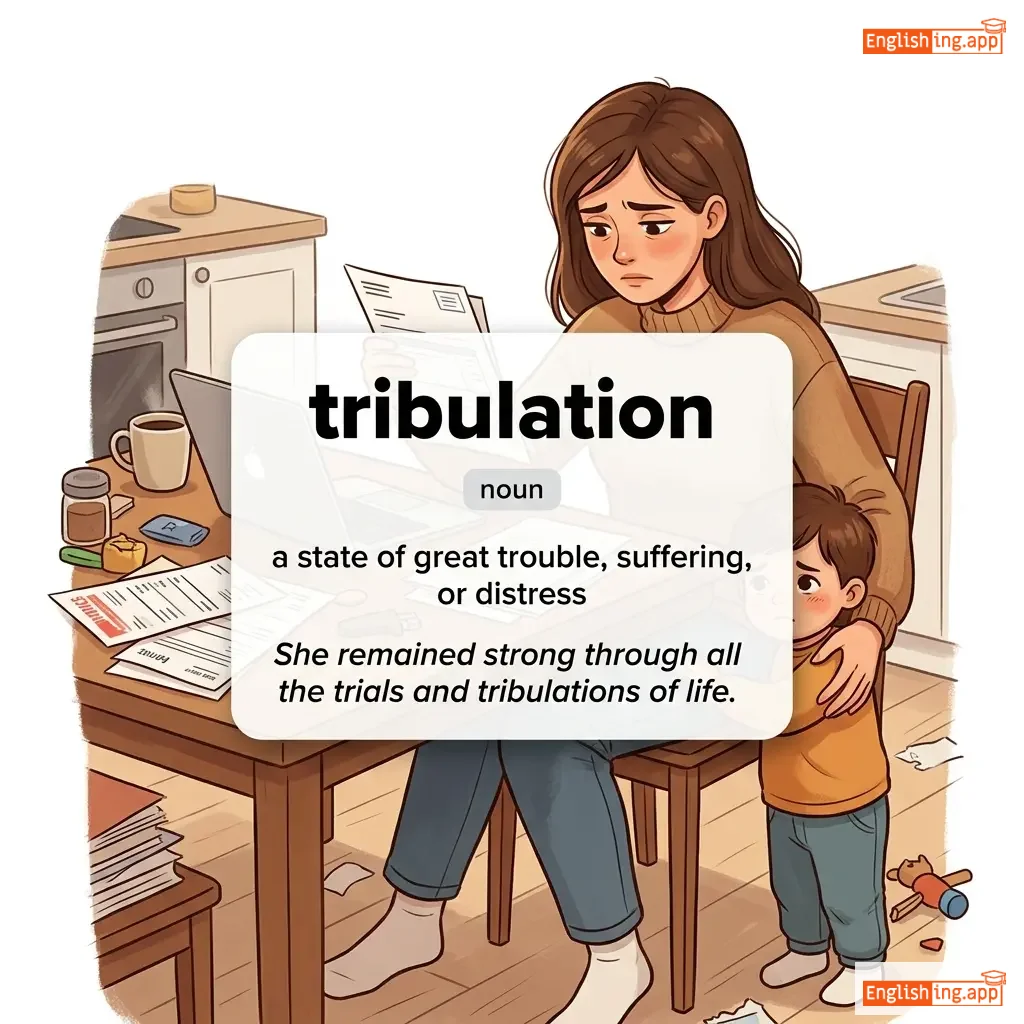
tribulation definition card — visual illustration of the meaning
noun
/ˌtrɪbjʊˈleɪʃən/
विपत्ति (vipatti)

a state of great trouble, suffering, or distress

"She remained strong through all the trials and tribulations of life."

"वह जीवन के सभी परीक्षणों और कठिनाइयों के बीच मजबूत रही।" (Wah jeevan ke sabhi parikshayon aur kathinaiyon ke beech majboot rahi.)
noun
/traɪˈbjuːnəl/
न्यायालय (nyayalay)

a court of justice or body established to settle disputes

"The case was heard in an international tribunal."

"मामला एक अंतरराष्ट्रीय न्यायालय में सुना गया था।" (Mamla ek antarraashtreey nyayalay mein suna gaya tha.)
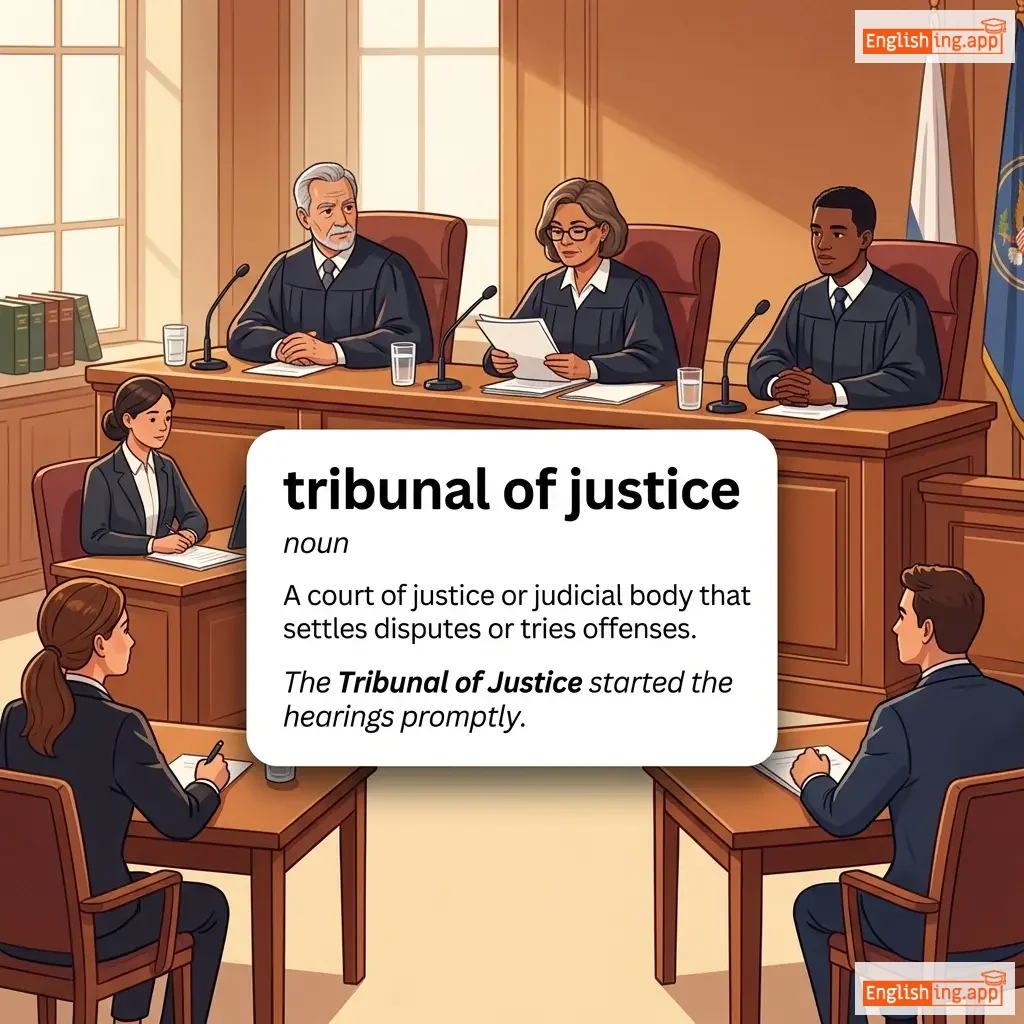
tribunal of justice definition card — visual illustration of the meaning
noun
ˌtraɪ.bjuˈnæl əv ˈdʒʌs.tɪs
न्यायालय (nyayalay)

A court of justice or judicial body that settles disputes or tries offenses.

"The Tribunal of Justice started the hearings promptly."

"न्यायालय ने सुनवाई तुरंत शुरू की।" (Nyayalay ne sunvai turant shuru ki.)
noun
/ˈtrɪbjuːn/
जनता का प्रतिनिधि (tribyoon)

a person or platform representing the people; historically, a Roman official elected to protect citizens' rights

"He was seen as a tribune of the common people."

"उसे आम जनता का प्रतिनिधि माना गया था." (use aam janta ka pratinidhi maana gaya tha.)
noun
/ˈtrɪb.jə.ter.i/
उपनदी (upnadi)

a river or stream flowing into a larger river or lake

"The tributary joins the main river near the city."

"उपनदी शहर के पास मुख्य नदी से मिलती है।" (upnadi shahar ke paas mukhya nadi se milti hai)
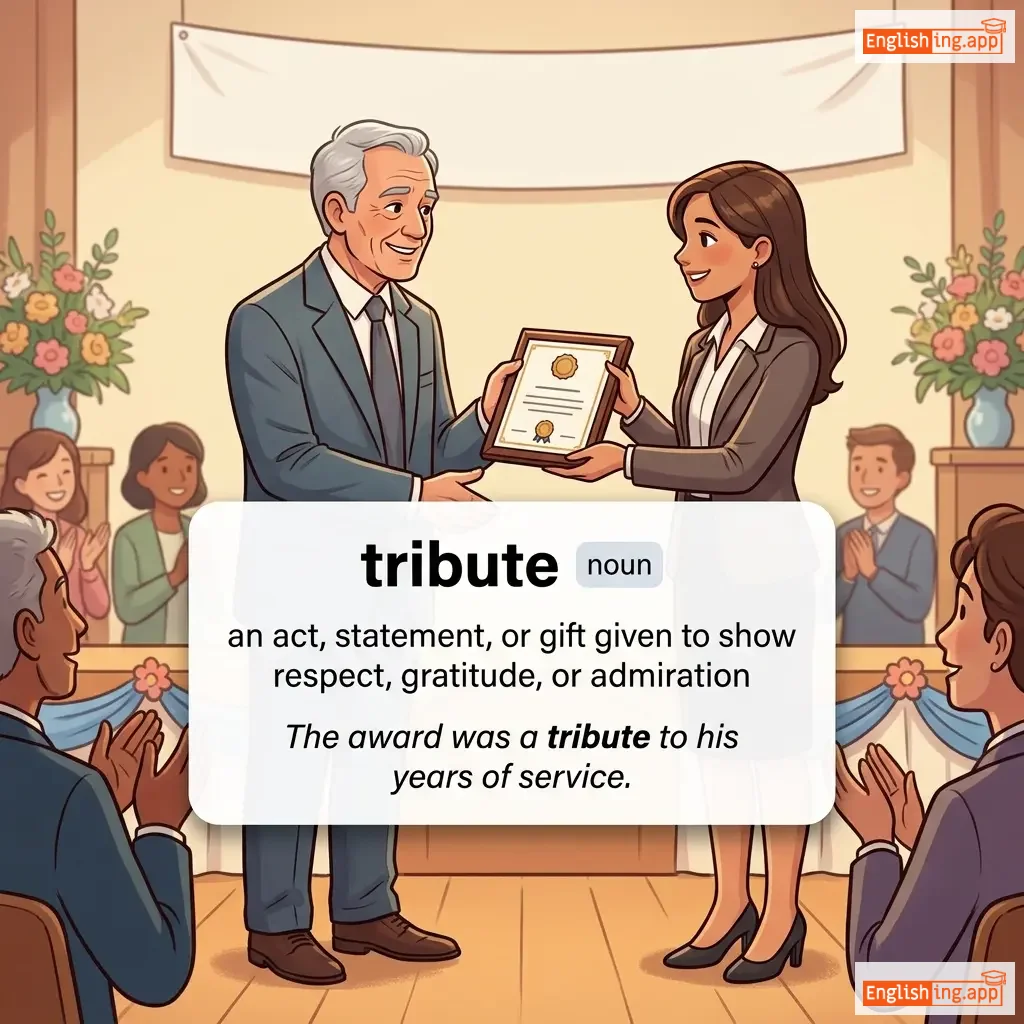
tribute definition card — visual illustration of the meaning
noun
/ˈtrɪbjuːt/
श्रद्धांजलि (shraddhanjali)

an act, statement, or gift given to show respect, gratitude, or admiration

"The award was a tribute to his years of service."

"पुरस्कार उसकी वर्षों की सेवा के प्रति श्रद्धांजलि था।" (Puraskaar uski varsho ki seva ke prati shraddhanjali tha.)
noun
/trɪk/
चालाकी (chalaki)

a cunning or deceitful action or plan intended to mislead or deceive someone

"She pulled a trick to win the game."

"उसने खेल जीतने के लिए एक चालाकी की" (Usne khel jeetne ke liye ek chalaki ki)
noun
/ˈtrɪkəri/
धोखाधड़ी (trikeri)

The use of dishonest methods to deceive or cheat someone.

"The politician was accused of winning the election through trickery."

"राजनेता पर धोखेबाज़ी के जरिए चुनाव जीतने का आरोप लगाया गया था." (raajneeta par dhokhebazi ke jariye chunav jeetne ka aarop lagaya gaya tha.)
verb
/ˈtrɪkl̩/
धीरे-धीरे बहना (dheere-dheere behna)

To flow or fall in a small, slow stream or drops.

"Water began to trickle down the wall after the heavy rain."

"भारी बारिश के बाद दीवार से पानी धीरे-धीरे बहने लगा।" (Bhaari baarish ke baad deewaar se paani dheere-dheere behne laga.)
noun
/ˈtrɪkstər/
धोखेबाज़ (dhokhebaaz)

A person who cheats or deceives people.

"The old man turned out to be a clever trickster who fooled everyone."

"बुज़ुर्ग आदमी एक चालाक धोखेबाज़ निकला जिसने सबको मूर्ख बना दिया।" (Buzurg aadmi ek chaalak dhokhebaaz nikla jinhonne sabko murkh bana diya.)
adjective
/ˈtrɪki/
कठिन; चतुर; धोखेबाज (kathin; chatur; dhokebaj)

requiring skill or careful handling; difficult to deal with

"This math problem is quite tricky to solve."

"इस गणित समस्या को हल करना काफी ट्रिकी है।" (is ganit samasya ko hal karna kaafi tricky hai.)
noun/adjective
/ˈtraɪkʌlər/
तिरंगा ध्वज (tiranga dhvaj)

A flag with three colors; consisting of three colors.

"The French tricolor is one of the most famous national flags in the world."

"फ्रांसीसी तिरंगा ध्वज दुनिया के सबसे प्रसिद्ध राष्ट्रीय ध्वजों में से एक है।" (Phraansisee tiranga dhvaj duniya ke sabse prasiddh rashtriya dhvajon mein se ek hai.)
noun
/ˈtraɪsɪkl̩/
ट्राइसिकल (traisikal)

A small vehicle with three wheels, usually for children.

"The child rode happily on his red tricycle around the park."

"बच्चा खुशी-खुशी अपने लाल ट्राईसाइकल पर पार्क के चारों ओर सवारी कर रहा था।" (Baccha khushi-khushi apne laal traaisikal par park ke chaaron or sawari kar raha tha.)
noun
/ˈtraɪdənt/
त्रिशूल (trishul)

A three-pronged spear, often associated with Neptune or Poseidon.

"The statue of Poseidon holds a mighty trident."

"पोसीडॉन का प्रतिमा एक शक्तिशाली त्रिशूल पकड़े हुए है।" (Poseidon ka pratima ek shaktishali trishul pakde hue hai.)
adjective
/traɪˈɛniəl/
त्रैवार्षिक (traivarsik)

Occurring once every three years.

"The art festival is a triennial event in the city."

"कला महोत्सव शहर में एक त्रैवार्षिक कार्यक्रम है।" (Kala mahotsav shahar mein ek traivarsik karyakram hai.)
noun
/ˈtraɪfəl/
तुच्छ बात (tucch baat)

A thing of little value or importance; also a layered dessert.

"He dismissed the issue as a mere trifle."

"उसने उस मुद्दे को एक मामूली तुच्छ बात मानकर नकार दिया।" (Usne us mudde ko ek mamooli tucch baat maankar nakar diya.)
adjective
/ˈtraɪflɪŋ/
तुच्छ (tuchchha)

Of little importance or value; trivial.

"The mistake was trifling and easily corrected."

"गलती तुच्छ थी और आसानी से सुधार ली गई।" (Galti tuchchha thi aur aasanai se sudhaar li gayi.)
verb
/ˈtrɪɡər/
उत्तेजित करना (uttejit karna)

To cause something to happen or start, often suddenly.

"The loud noise triggered the alarm system."

"उच्च शोर ने अलार्म सिस्टम को उत्तेजित किया।" (Ucch shor ne alarm system ko uttejit kiya.)
triggers definition card — visual illustration of the meaning
verb
ˈtrɪɡərz
उत्तेजित करना (uttejit karna)

To cause or initiate something to happen

"Air pollution triggers chronic diseases."

"वायु प्रदूषण पुरानी बीमारियों को उत्तेजित करता है।" (Vaayu pradushan purani bimariyon ko uttejit karta hai.)
noun
/ˈtrɪl.jən/
ट्रिलियन (trillion)

a number equal to 1,000 billion, or 10^12

"The company's worth has risen to over a trillion dollars."

"कंपनी का मूल्य एक ट्रिलियन डॉलर से ऊपर बढ़ चुका है।" (Kampani ka moolya ek trillion dollar se upar badh chuka hai.)
noun
/ˈtrɪlədʒi/
त्रयी (trayi)

a set of three related works, usually books or films, that form a connected story

"The director finally released the third film to complete the sci-fi trilogy."

"निर्देशक ने आखिरकार तीसरी फिल्म रिलीज की, जिससे साइ-फाई त्रयी पूरी हुई।" (Nirdeshak ne aakhirkaar teesri film release ki, jisse sci-fi trayi poori hui.)
verb
/trɪm/
काटना (kaatna)

to cut away small parts to make something neat, tidy, or the right size

"I need to trim the video to remove the awkward pause at the end."

"मुझे वीडियो के अंत में अजीब विराम को हटाने के लिए इसे ट्रिम करना है।" (Mujhe video ke ant mein ajeeb viraam ko hatane ke liye ise trim karna hai.)
noun
/ˈtrɪmnəs/
साफ-सफाई (saaf-safaai)

the quality of being neat, orderly, or slender and well-proportioned

"Her room’s trimness reflected a habit of putting everything back in its place."

"उसके कमरे की साफ-सफाई इस बात को दर्शाती है कि वह हमेशा चीजों को अपनी जगह पर रखती है।" (Uske kamre ki saaf-safaai is baat ko darshaati hai ki wah hamesha cheezon ko apni jagah par rakhti hai.)
noun
/ˈtrɪnɪti/
त्रित्व (tritva)

a group of three closely related things; in Christianity, the Father, the Son, and the Holy Spirit

"The museum’s exhibit focused on a trinity of themes: memory, identity, and power."

"संग्रहालय की प्रदर्शनी में तीन विषयों का त्रित्व था: स्मृति, पहचान, और शक्ति।" (Sangrahalay ki pradarshani mein teen vishayon ka tritva tha: smriti, pehchaan, aur shakti.)
noun
/ˈtrɪŋkɪt/
छोटी ज्वेलरी (chhoti jewelry)

a small ornament or piece of jewelry that is not expensive

"She bought a little trinket from the beach market as a souvenir."

"उसने बीच बाजार से एक छोटा ट्रिंकेट यादगारी के रूप में खरीदी।" (Usne beach bazaar se ek chhota trinket yaadgari ke roop mein khareedi.)
noun
/ˈtriː.oʊ/
तीन लोगों का समूह (teen logon ka samuh)

A group of three people or things, especially in music or performance.

"The jazz trio played beautifully at the concert."

"जैज़ ट्रायो ने संगीत समारोह में शानदार प्रदर्शन किया।" (Jazz trio ne sangeet samaroh mein shandar pradarshan kiya.)
noun
/trɪp/
यात्रा (yatra)

a journey or excursion, especially for pleasure

"They took a trip to the mountains last summer."

"उन्होंने पिछले गर्मी में पहाड़ों की यात्रा की।" (Unhone pichle garmi mein pahadon ki yatra ki.)
verb
/ˈtrɪp.əl/
तीन गुना करना (teen guna karna)

To increase or become three times as much.

"The company tripled its profits in just one year."

"कंपनी ने सिर्फ एक साल में अपने लाभ को तीन गुना बढ़ा लिया।" (Company ne sirf ek saal mein apne laabh ko teen guna badha liya.)
noun
/ˈtrɪp.lət/
त्रैतीयक संतान (traiteeyak santan)

One of three children or animals born at the same time to the same mother.

"The family was surprised to have triplets instead of twins."

"परिवार को जुड़वां के बजाय त्रैतीयक संतान होने पर आश्चर्य हुआ।" (Parivaar ko judwan ke bajaye traiteeyak santan hone par aashcharya hua.)
noun
/ˈtrɪp.lɪ.kət/
तीन प्रति (teen prati)

A set of three identical copies of something.

"The documents were prepared in triplicate for official use."

"दस्तावेज़ों को आधिकारिक उपयोग के लिए तीन प्रतियों में तैयार किया गया था।" (Dastavezon ko adhikarik upyog ke liye teen pratiyon mein tayar kiya gaya tha.)
noun
/trɪˈplɪs.ə.ti/
त्रैतीयकता (traiteeyakta)

The state of being triple or consisting of three parts.

"The design shows a triplicity of forms combined harmoniously."

"डिज़ाइन में तीन रूपों की त्रैतीयकता को सामंजस्यपूर्ण रूप से संयोजित किया गया है।" (Design mein teen roopon ki traitayikta ko samanjasypurn roop se sanyojit kiya gaya hai.)