वोकैबुलरीज

इंग्लिश वोकैबुलरी डिस्कवर, लर्न और मास्टर करें

traditional economy definition card — visual illustration of the meaning
noun
/trəˈdɪʃ.ən.əl ɪˈkɒn.ə.mi/
पारंपरिक अर्थव्यवस्था (paaraṃparik arthavyavasthaa)

An economic system based on customs and traditions, often involving barter trade.

"Tribes still practice a traditional economy based on barter trade."

"कबीलों ने अभी भी वस्तु विनिमय व्यापार पर आधारित एक पारंपरिक अर्थव्यवस्था का पालन किया।" (Kabeelon ne abhi bhi vastu vinimay vyaapar par aadharit ek paaraṃparik arthavyavasthaa ka paalan kiya.)
adverb
/trəˈdɪʃənəli/
पारंपरिक रूप से (paramparik roop se)

according to custom or long-established practice

"Bangladesh is traditionally known for its hospitality."

"बांगलादेश पारंपरिक रूप से अपनी मेहमाननवाजी के लिए जाना जाता है।" (Bangladesh paramparik roop se apni mehmanawaji ke liye jana jata hai.)
verb
/trəˈdjuːs/
बदनाम करना (badnaam karna)

To speak badly of someone or tell lies to damage their reputation.

"He was furious when he found out that his rivals had traduced him."

"वह गुस्से में था जब उसने पाया कि उसके प्रतिद्वंद्वियों ने उसे बदनाम किया था।" (Wah gusse mein tha jab usne paaya ki uske pratidwandviyon ne use badnaam kiya tha.)
noun
/ˈtræfɪk/
यातायात (yatayat)

movement of vehicles, goods, or people

"There was heavy traffic on the highway this morning."

"आज सुबह हाईवे पर भारी यातायात था।" (Aaj subah highway par bhari yatayat tha.)
noun
/ˈtrædʒədi/
विपत्ति (vipatti)

an event causing great suffering or distress

"The earthquake was a tragedy for the entire country."

"भूकंप देश के लिए एक त्रासदी था।" (Bhookamp desh ke liye ek trasadi tha.)
adjective
/ˈtrædʒɪk/
दुःखद (dukhad)

causing great sadness or suffering; very unfortunate

"The news of the accident was truly tragic."

"दुर्घटना की खबर सच में दुःखद थी।" (Durghatna ki khabar sach mein dukhad thi.)
noun
/treɪl/
पथ (path)

a path or track left by something that has passed

"The hikers followed the trail through the forest."

"हाइकर्स ने जंगल में ट्रेल का पालन किया।" (Haikers ne jangal mein trail ka paalan kiya.)
noun
/ˈtreɪlər/
ट्रेलर / प्रिव्यू (trailer / preview)

a preview of a movie or a vehicle used for transporting goods

"The movie trailer was released last week."

"फिल्म का ट्रेलर पिछले हफ्ते जारी किया गया था।" (Film ka trailer pichhle hafte jaari kiya gaya tha.)
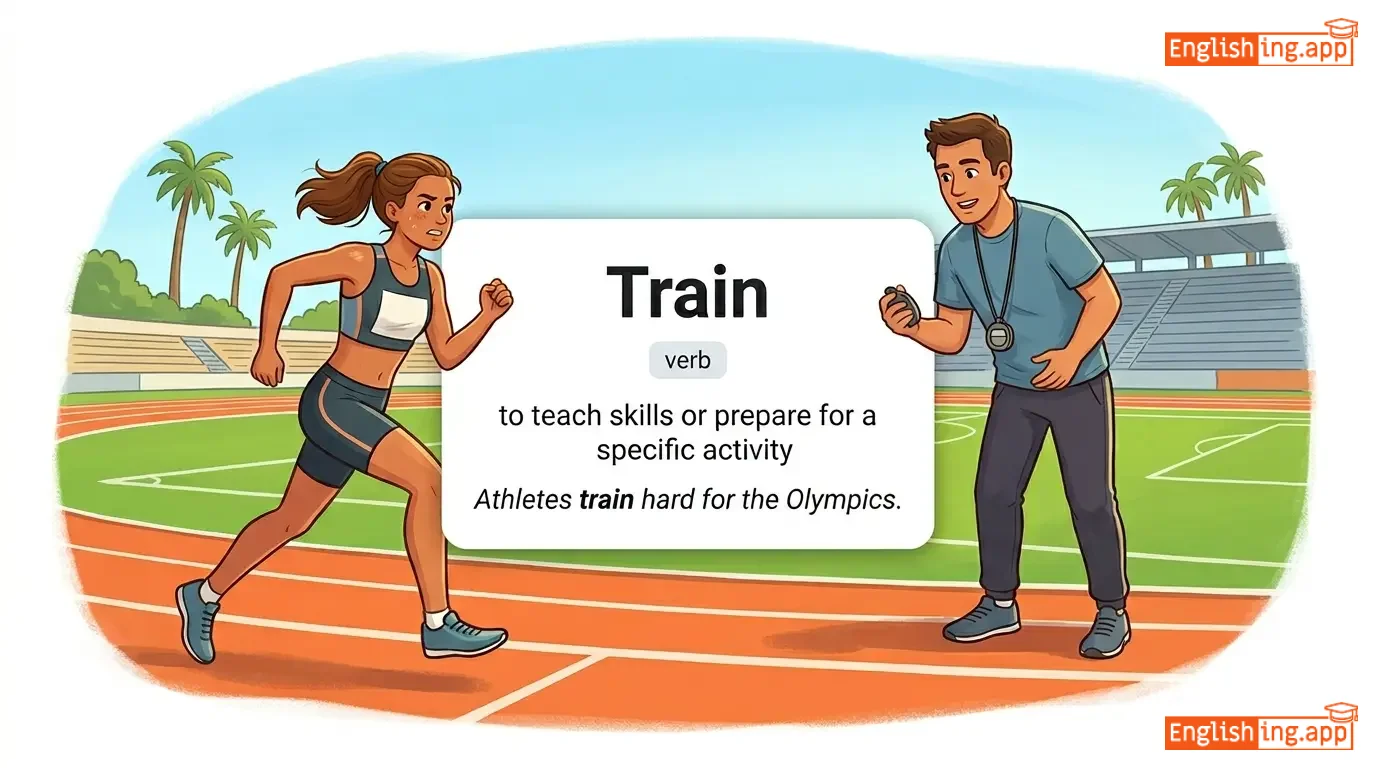
Train definition card — visual illustration of the meaning
noun
/treɪn/
ट्रेन (train)

a series of connected vehicles that run on tracks and are used for transporting people or goods

"The train departed from the station on time."

"ट्रेन समय पर स्टेशन से रवाना हुई।" (Train samay par station se ravaana hui.)
noun
/treɪˈniː/
प्रशिक्षु; नौसिखिया (trainee)

a person undergoing training for a particular job or profession; a novice learner

"The medical trainee worked long hours to gain practical experience."

"चिकित्सा प्रशिक्षु ने व्यावहारिक अनुभव प्राप्त करने के लिए लंबी घंटों तक काम किया।" (chikitsa prashikshu ne vyavaharik anubhav prapt karne ke liye lambi ghanton tak kaam kiya.)
noun
/ˈtreɪnər/
प्रशिक्षक (prashikshak)

a person who teaches skills or gives training

"The fitness trainer helped me improve my posture."

"फिटनेस प्रशिक्षक ने मेरी मुद्रा सुधारने में मदद की।" (Fitness prashikshak ne meri mudra sudhaarne mein madad ki.)
noun
/ˈtreɪnɪŋ/
प्रशिक्षण (prashikshan)

the process of teaching or learning a particular skill or type of behavior

"She completed her training as a nurse last year."

"उसने पिछले साल एक नर्स के रूप में अपनी ट्रेनिंग पूरी की।" (Usne pichhle saal ek nurs ke roop mein apni training puri ki.)
noun
/treɪt/
गुण (gun)

A distinguishing quality or characteristic, typically belonging to a person.

"Honesty is considered an admirable trait in a leader."

"ईमानदारी को एक नेता में एक प्रशंसनीय गुण माना जाता है।" (Imandari ko ek neta mein ek prashansaniya gun mana jata hai.)
noun
/ˈtreɪtər/
दगा करने वाला (daga karne wala)

A person who betrays their country, friends, or a cause by acting against them.

"The soldier was labeled a traitor for giving secrets to the enemy."

"सैनिक को दुश्मन को गुप्त जानकारी देने के लिए दगा करने वाला करार दिया गया था।" (Sainik ko dushman ko gupt jankari dene ke liye daga karne wala karar diya gaya tha.)
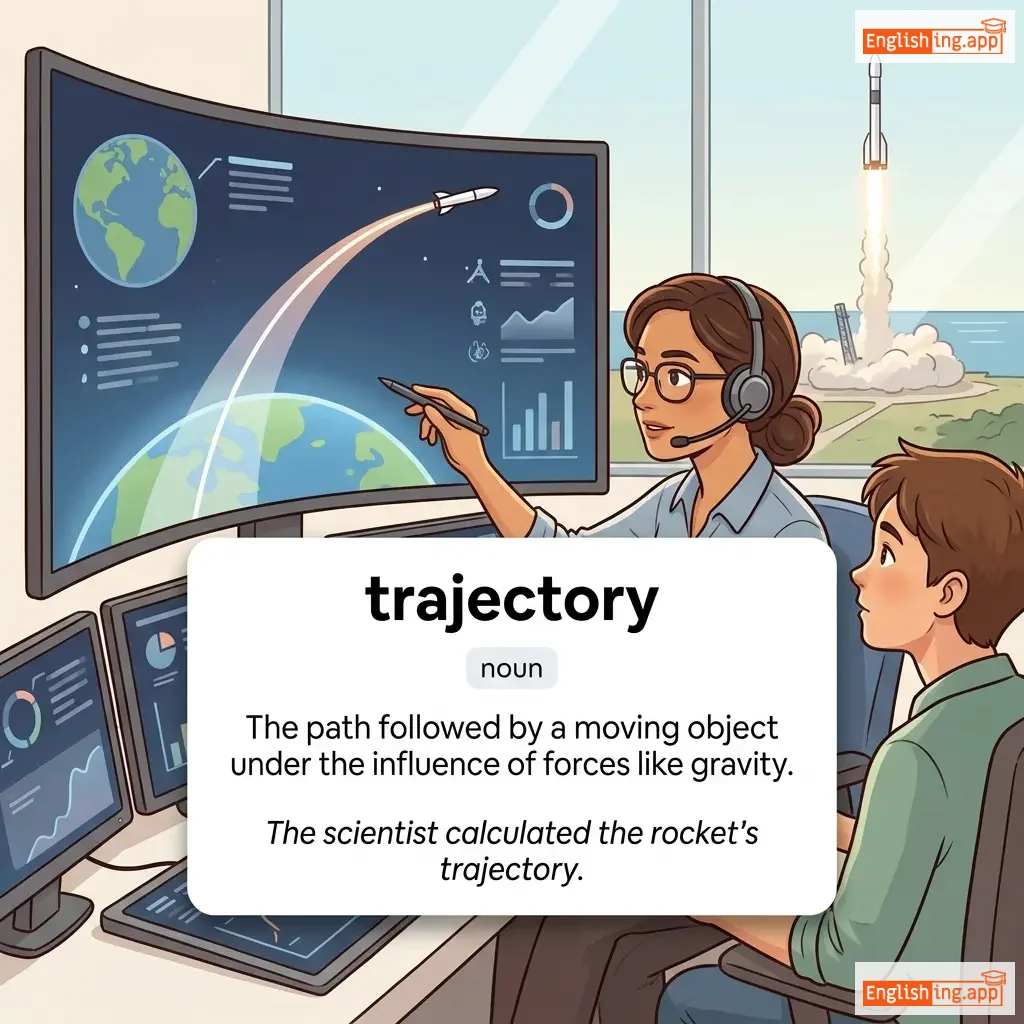
trajectory definition card — visual illustration of the meaning
noun
/trəˈdʒɛktəri/
पथरेखा (pathrekha)

The path followed by a moving object under the influence of forces like gravity.

"The scientist calculated the rocket's trajectory."

"वैज्ञानिक ने रॉकेट के पथरेखा की गणना की।" (Vaigyanik ne rocket ke pathrekha ki ganana ki.)
noun
/træm kɑːr/
ट्राम कार (tram car)

An electric vehicle that runs on rails along the street

"The tram car stopped at every station in the city center."

"ट्राम कार हर स्टेशन पर शहर के केंद्र में रुकी।" (tram car har station par shahar ke kendra mein ruki.)
noun, verb
/ˈtræməl/
बाधा (baadha)

A restriction or impediment to freedom of action; to restrict.

"The strict rules trammel the creativity of the students."

"कठोर नियम छात्रों की रचनात्मकता को बाधित करते हैं।" (Kathor niyam chhatron ki rachnatmakta ko baadhit karte hain.)
verb, noun
/træmp/
घूमंतू / भारी कदमों से चलना (ghumantu / bhari kadmon se chalna)

to walk heavily or noisily; a person who travels from place to place on foot, often homeless

"They tramped through the forest in heavy boots."

"वे भारी बूट पहने जंगल में चल रहे थे।" (ve bhari boot pahne jangl mein chal rahe the.)
verb
/ˈtræmpəl/
पैरों तले कुचलना (pairo tale kuchalna)

to tread heavily on something and cause damage or injury

"The crowd trampled the flowers in the park."

"भीड़ ने पार्क में फूलों को पैरों तले कुचल दिया।" (bheer ne park mein phoolon ko pairo tale kuchal diya.)
noun
/træns/
मोहित अवस्था (mohit avastha)

a half-conscious state like dreaming, often with loss of awareness of surroundings

"She stared out of the window as if in a trance."

"वह खिड़की से बाहर घूर रही थी जैसे वह एक मोहित अवस्था में हो।" (vah khidki se baahar ghoor rahi thi jaise vah ek mohit avastha mein ho.)
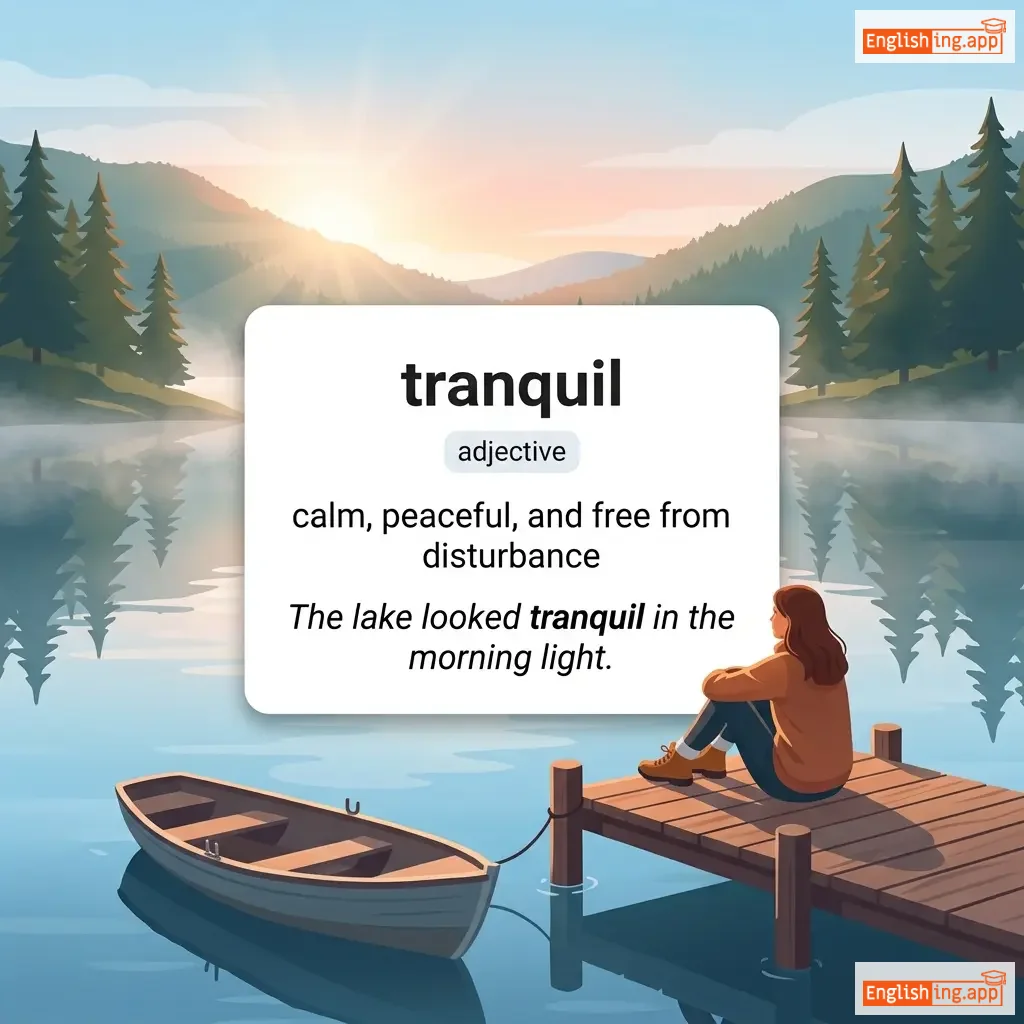
tranquil definition card — visual illustration of the meaning
adjective
/ˈtræŋkwɪl/
शांत (shaant)

calm, peaceful, and free from disturbance

"The lake looked tranquil in the morning light."

"झील सुबह की रोशनी में शांत दिख रही थी।" (jheel subah ki roshni mein shaant dikh rahi thi.)
noun
/træŋˈkwɪləti/
शांति (shanti)

the quality or state of being calm and peaceful

"He enjoyed the tranquility of the countryside."

"उसने गांव के शांतिपूर्ण वातावरण का आनंद लिया।" (usne gaon ke shaantipoorn vatavaran ka anand liya.)
verb
/ˈtræŋ.kwɪ.laɪz/
शांत करना (shaant karna)

to make someone or something calm or less anxious, often by using drugs

"The veterinarian had to tranquilize the tiger before moving it."

"पशु चिकित्सक को बाघ को स्थानांतरित करने से पहले उसे शांत करना पड़ा।" (Pashu chikitsak ko baagh ko sthaanantarit karne se pehle use shaant karna pada.)
noun
/træŋˈkwɪl.ɪ.ti/
शांति (shanti)

the state of being calm, peaceful, and free from disturbance

"She enjoyed the tranquillity of the countryside after years in the city."

"वह शहर में वर्षों बिताने के बाद ग्रामीण इलाके की शांति का आनंद ले रही थी।" (Wah shahar mein varshon bitane ke baad gramin ilake ki shanti ka anand le rahi thi.)
verb
/trænˈzækt/
लेन-देन करना (len-den karna)

to conduct or carry out business, a deal, or activity

"Customers can transact their banking online."

"ग्राहक अपनी बैंकिंग ऑनलाइन लेन-देन कर सकते हैं।" (Grahak apni banking online len-den kar sakte hain.)
noun
/trænˈzækʃən/
लेन-देन (lend-den)

an instance of buying or selling something; a business deal or exchange

"Every online transaction is recorded for security purposes."

"प्रत्येक ऑनलाइन लेन-देन सुरक्षा उद्देश्यों के लिए रिकॉर्ड किया जाता है।" (pratyek online len-den suraksha uddeshyon ke liye record kiya jata hai.)
adjective
/trænzˈæl.paɪn/
आल्प्स के पार (alps ke paar)

situated beyond or across the Alps, especially from the viewpoint of Italy

"The Romans referred to France as Transalpine Gaul."

"रोमनों ने फ्रांस को ट्रांज़लपाइन गॉल कहा।" (Romans ne France ko Transalpine Gaul kaha.)
adjective
/ˌtræn.zətˈlæn.tɪk/
अटलांटिक महासागर को पार करना (atlantic mahasagar ko paar karna)

crossing or spanning the Atlantic Ocean

"They took a transatlantic flight from New York to London."

"उन्होंने न्यूयॉर्क से लंदन के लिए एक ट्रांसअटलांटिक उड़ान भरी।" (Unhone New York se London ke liye ek transatlantic udaan bhari.)
transcend definition card — visual illustration of the meaning
verb
/trænˈsɛnd/
अतिक्रमण करना (atikraman karna)

to go beyond the limits of something; to surpass or exceed

"Her art transcends traditional boundaries."

"उसकी कला पारंपरिक सीमाओं को पार करती है।" (Uski kala paramparik seemaon ko paar karti hai.)
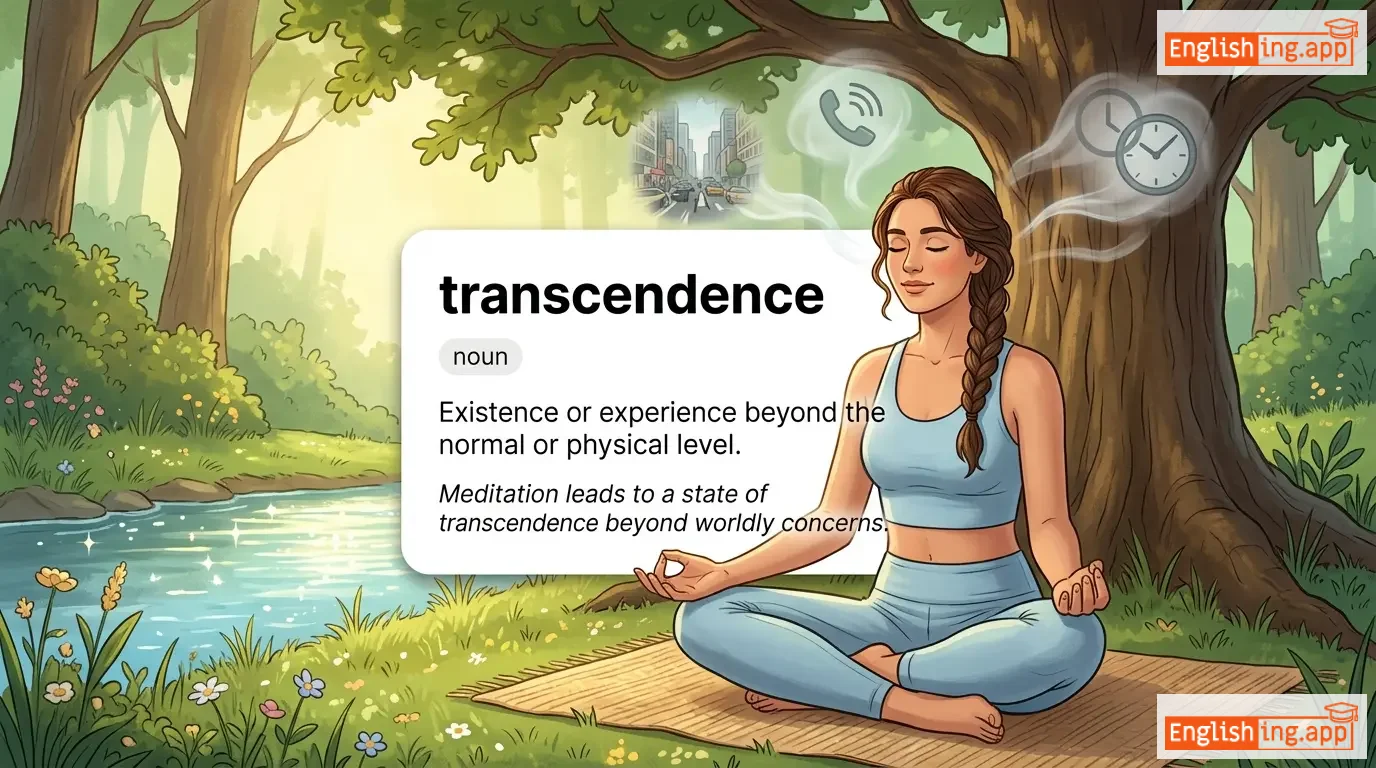
transcendence definition card — visual illustration of the meaning
noun
/trænˈsɛnd.əns/
अतिक्रमण या सामान्य स्तर से परे अनुभव (atikraman ya samanya star se pare anubhav)

Existence or experience beyond the normal or physical level.

"Meditation leads to a state of transcendence beyond worldly concerns."

"ध्यान भौतिक चिंताओं से परे एक स्थिति की ओर ले जाता है।" (Dhyan bhoutik chintao se pare ek stithi ki or le jata hai.)
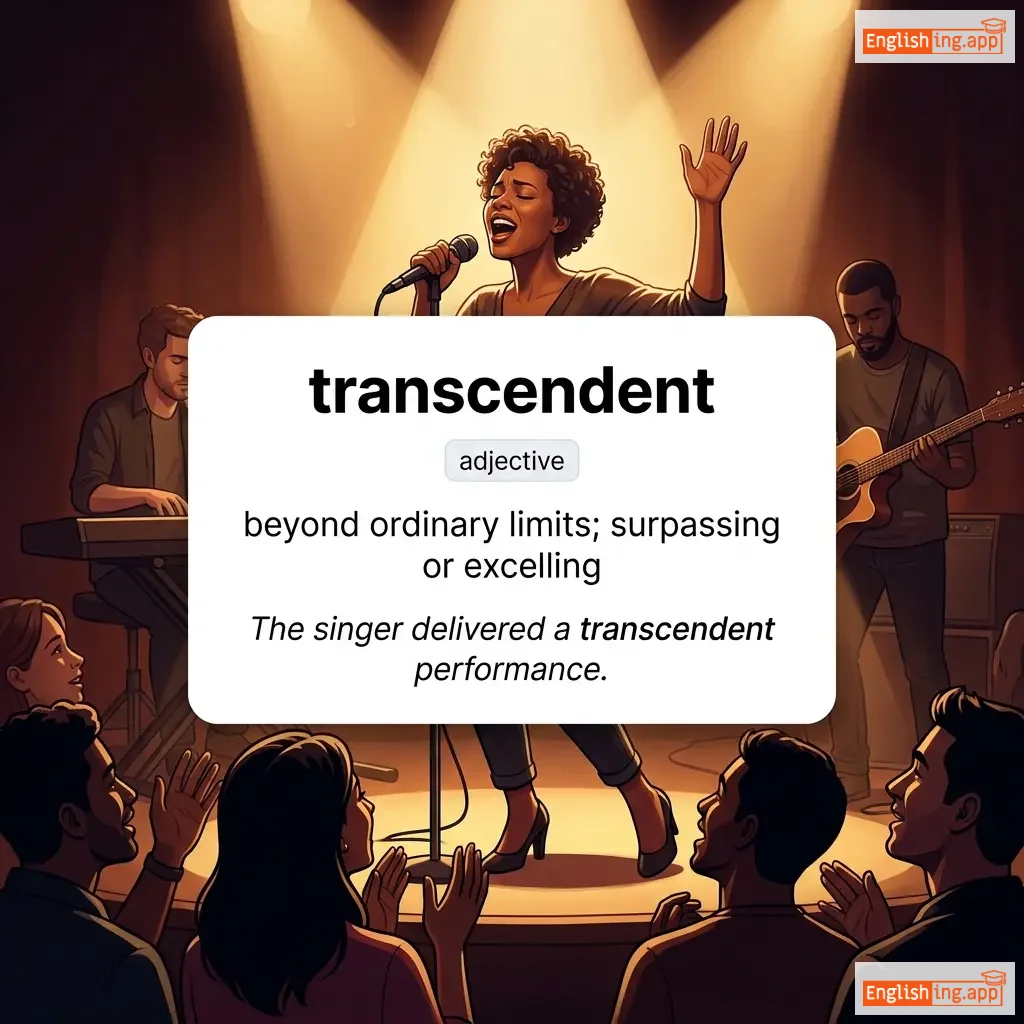
transcendent definition card — visual illustration of the meaning
adjective
/trænˈsɛndənt/
असाधारण (asadharan)

beyond ordinary limits; surpassing or excelling

"The singer delivered a transcendent performance."

"गायक ने एक असाधारण प्रदर्शन दिया।" (Gaayak ne ek asadharan pradarshan diya.)
adjective
/ˌtræn.senˈdɛn.təl/
अतिदैवीय (atidaiviy)

relating to the spiritual or non-physical realm; surpassing ordinary experience

"Meditation can lead to transcendental experiences."

"ध्यान ट्रांसेंडेंटल अनुभवों की ओर ले जा सकता है।" (Dhyan transcendental anubhavon ki or le ja sakta hai.)
verb
/trænˈskraɪb/
लिखित प्रति बनाना (likhit prati banana)

to make a written copy of spoken words or notes

"The secretary transcribed the meeting minutes."

"सेक्रेटरी ने मीटिंग मिनट्स को ट्रांसक्राइब किया।" (Sekretari ne meeting minutes ko transcribe kiya.)
noun
/ˈtrænskrɪpt/
प्रति लेख (prati lekh)

a written or printed version of material originally presented in another medium

"The professor asked for a transcript of the meeting."

"प्रोफेसर ने बैठक का एक प्रति लेख माँगा।" (Professor ne baithak ka ek prati lekh maanga.)
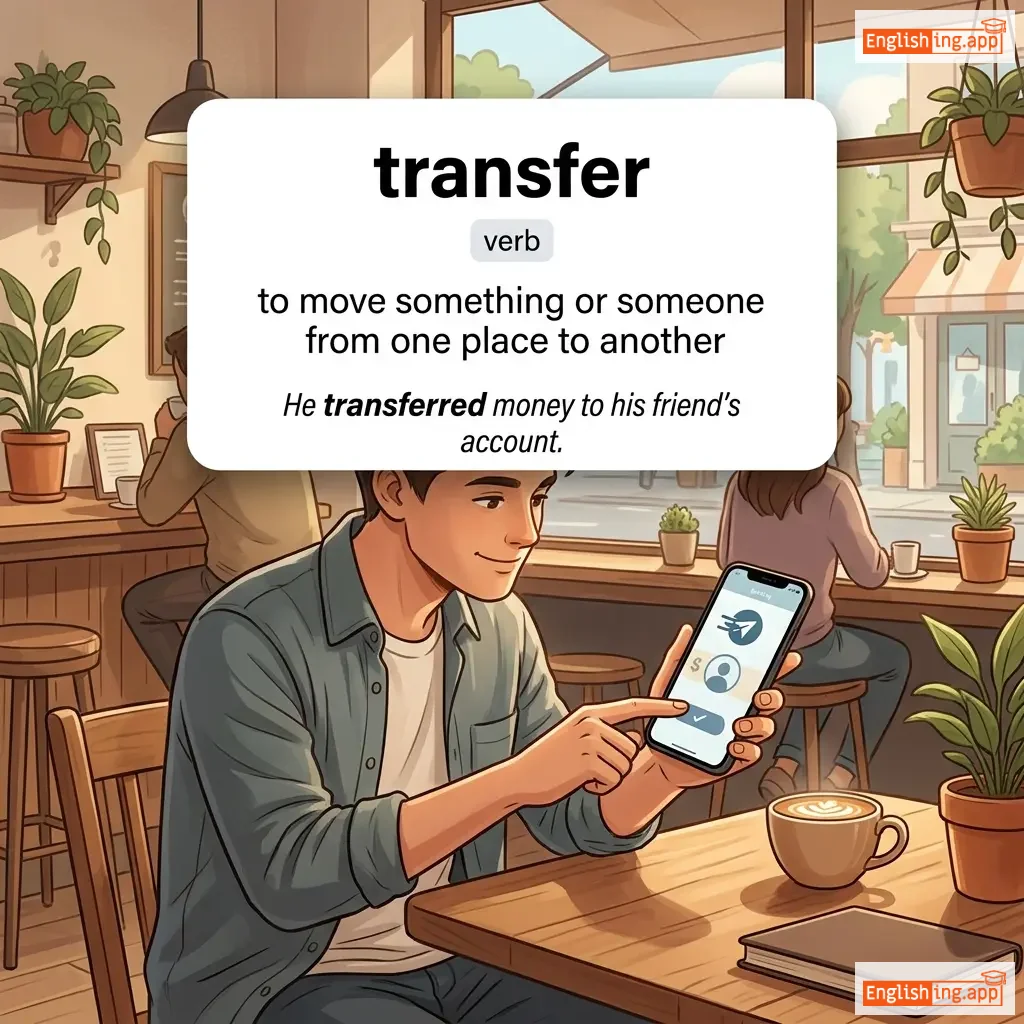
transfer definition card — visual illustration of the meaning
verb
/ˈtrænsfɜːr/
सुख (sukh)

to move something or someone from one place to another

"He transferred money to his friend's account."

"जब उसे पुरस्कार मिला, तो वह अपनी खुशी छुपा नहीं पाई।" (Jab use puraskaar mila, to vah apni khushi chhupa nahi paayi.)
adjective
/ˈtrænsfərəbl/
स्थानांतरित करने योग्य (sthanantarit karne yogya)

Able to be moved, passed, or changed from one person, place, or situation to another.

"The ticket is transferable to another passenger."

"टिकट दूसरे यात्री को स्थानांतरित किया जा सकता है।" (Tikat doosre yatri ko sthanantarit kiya ja sakta hai.)
noun
/ˌtrænsfəˈriː/
प्राप्तकर्ता (prahptakarta)

A person to whom a right, property, or responsibility is transferred.

"The transferee must sign the contract before taking ownership."

"प्राप्तकर्ता को स्वामित्व प्राप्त करने से पहले अनुबंध पर हस्ताक्षर करना होगा।" (Prahptakarta ko swamitva prapt karne se pehle anubandh par hastakshar karna hoga.)
noun
/ˈtrænsfərəns/
स्थानांतरण (sthanantaran)

The act of moving something from one place, person, or situation to another.

"The transference of knowledge is essential in education."

"ज्ञान का स्थानांतरण शिक्षा में महत्वपूर्ण है।" (Gyan ka sthantaran shiksha mein mahatvapurn hai.)
noun
/trænsˈfɜːrər/
हस्तांतरक (hastantark)

A person who transfers something, such as property, rights, or responsibilities, to another.

"The transferrer is responsible for ensuring the property is legally passed on."

"हस्तांतरक यह सुनिश्चित करने के लिए जिम्मेदार है कि संपत्ति कानूनी रूप से हस्तांतरित हो रही है।" (Hastantark yah sunishchit karne ke liye zimmedar hai ki sampatti kanooni roop se hastantarit ho rahi hai.)
verb
/trænsˈfɪɡjʊər/
रूपांतरित करना (roopantarit karna)

To transform the outward appearance or form, often in a way that elevates or glorifies.

"The artist managed to transfigure simple clay into a beautiful sculpture."

"कलाकार ने साधारण मिट्टी को एक सुंदर मूर्ति में रूपांतरित कर दिया।" (Kala ke kalakar ne saadharan mitti ko ek sundar murti mein roopantarit kar diya.)
transform definition card — visual illustration of the meaning
verb
/trænsˈfɔːrm/
रूपांतरित करना (roopantarit karna)

To change something completely in form, appearance, or character.

"The new policy will transform the healthcare system."

"नई नीति स्वास्थ्य देखभाल प्रणाली को बदल देगी।" (Nayi niti swasthya dekhbhal pranali ko badal degi.)
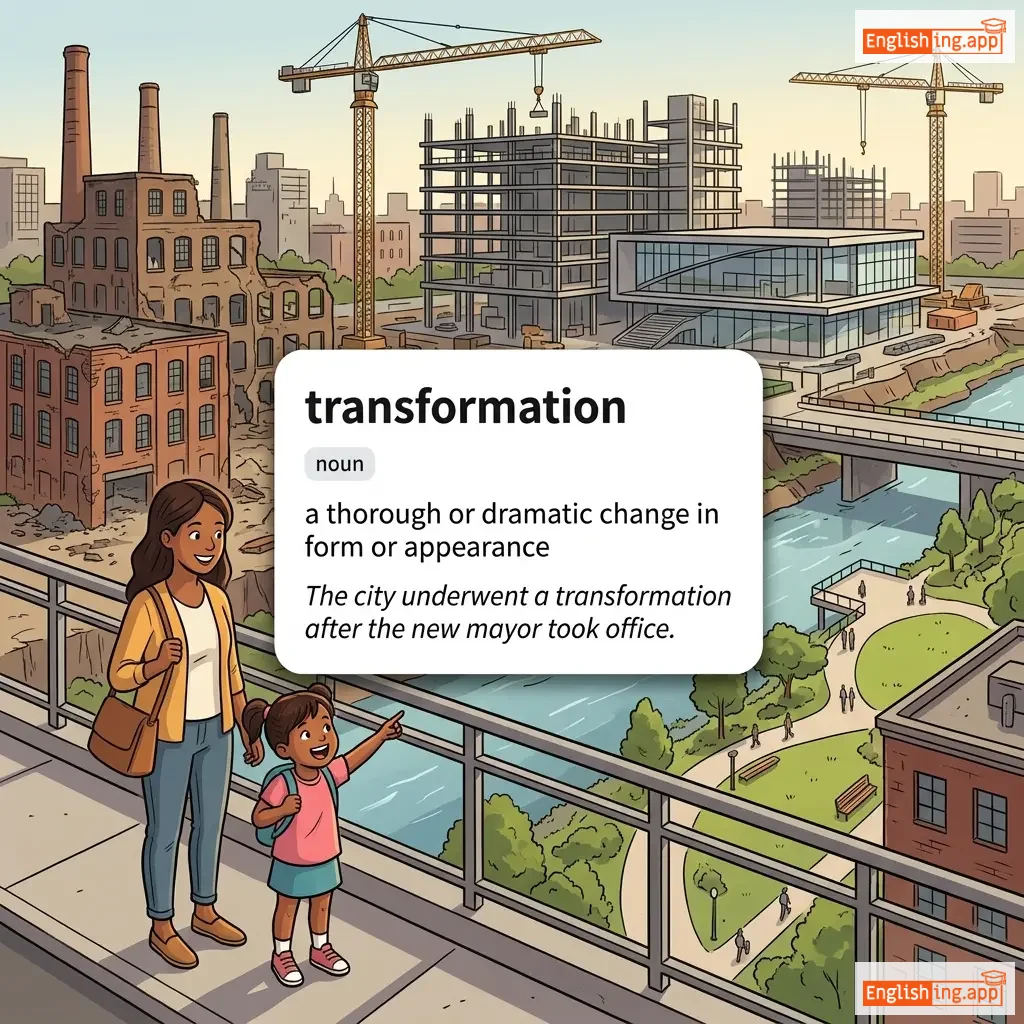
transformation definition card — visual illustration of the meaning
noun
/ˌtrænsfərˈmeɪʃən/
परिवर्तन (parivartan)

a thorough or dramatic change in form or appearance

"The city underwent a transformation after the new mayor took office."

"शहर ने नए मेयर के ऑफिस संभालने के बाद परिवर्तन देखा।" (Shahar ne naye mayor ke office sambhalne ke baad parivartan dekha.)
transformational definition card — visual illustration of the meaning
adjective
ˌtræns.fəˈmeɪ.ʃən.əl
परिवर्तनकारी (parivartankari)

Causing or able to cause an important and lasting change in someone or something.

"Transformational projects redefine progress."

"परिवर्तनकारी प्रोजेक्ट्स प्रगति को फिर से परिभाषित करते हैं।" (Parivartankari projekts pragati ko phir se paribhashit karte hain.)
transformative definition card — visual illustration of the meaning
adjective
/trænsˈfɔː.mə.tɪv/
परिवर्तनीय (parivartaneey)

Causing a marked change in someone or something.

"His transformative ideas changed the direction of the company."

"उसके परिवर्तनीय विचारों ने कंपनी की दिशा बदल दी।" (Uske parivartaneey vicharon ne company ki disha badal di.)
verb
/trænsˈfjuːz/
रक्त या अन्य तरल को नस में स्थानांतरित करना (rakt ya anya taral ko nas mein sthantarit karna)

to transfer blood or another fluid into a vein or body part; to instill a quality or idea into someone or something

"The doctor had to transfuse blood into the patient after the surgery."

"सर्जरी के बाद डॉक्टर को मरीज में रक्त ट्रांसफ्यूज़ करना पड़ा।" (Sarjari ke baad doktor ko mareez mein rakt transfuse karna pada.)
adjective
/trænsˈfjuːzəbl̩/
संवहन योग्य (sanvahan yogya)

capable of being transfused, especially referring to blood or fluids

"Only transfusible blood types are used in the hospital."

"केवल संवहन योग्य रक्त प्रकारों का अस्पताल में उपयोग किया जाता है।" (Keval sanvahan yogya rakt prakarom ka aspataal mein upyog kiya jaata hai.)
noun
/trænsˈfjuːʒən/
रक्त संचार (rakt sanchar)

the process of transferring blood or another fluid into a person's vein

"The patient received a blood transfusion after the accident."

"दर्दनाक हादसे के बाद मरीज़ को रक्त ट्रांसफ्यूजन मिला।" (Dardnaak haadse ke baad mareez ko rakt transfusion mila.)
verb
/trænsˈɡrɛs/
उल्लंघन करना (ullanghan karna)

to go beyond the limits of a moral law, command, or boundary; to sin

"He apologized after realizing he had transgressed the community's rules."

"वह माफी मांगने आया जब उसने समझा कि उसने समुदाय के नियमों का उल्लंघन किया।" (vah maafi maangne aaya jab usne samajhha ki usne samaajik niyamon ka ullanghan kiya.)
transgression definition card — visual illustration of the meaning
noun
/trænsˈɡrɛʃən/
उल्लंघन, अपराध (ullanghan, aparadh)

an act that goes against a law, rule, or code of conduct; a violation or sin

"The court forgave his first transgression but warned him not to repeat it."

"कोर्ट ने उसका पहला अपराध माफ कर दिया, लेकिन उसे दोहराने से चेतावनी दी।" (Kort ne uska pehla aparadh maaf kar diya, lekin use dohrane se chetavni di.)
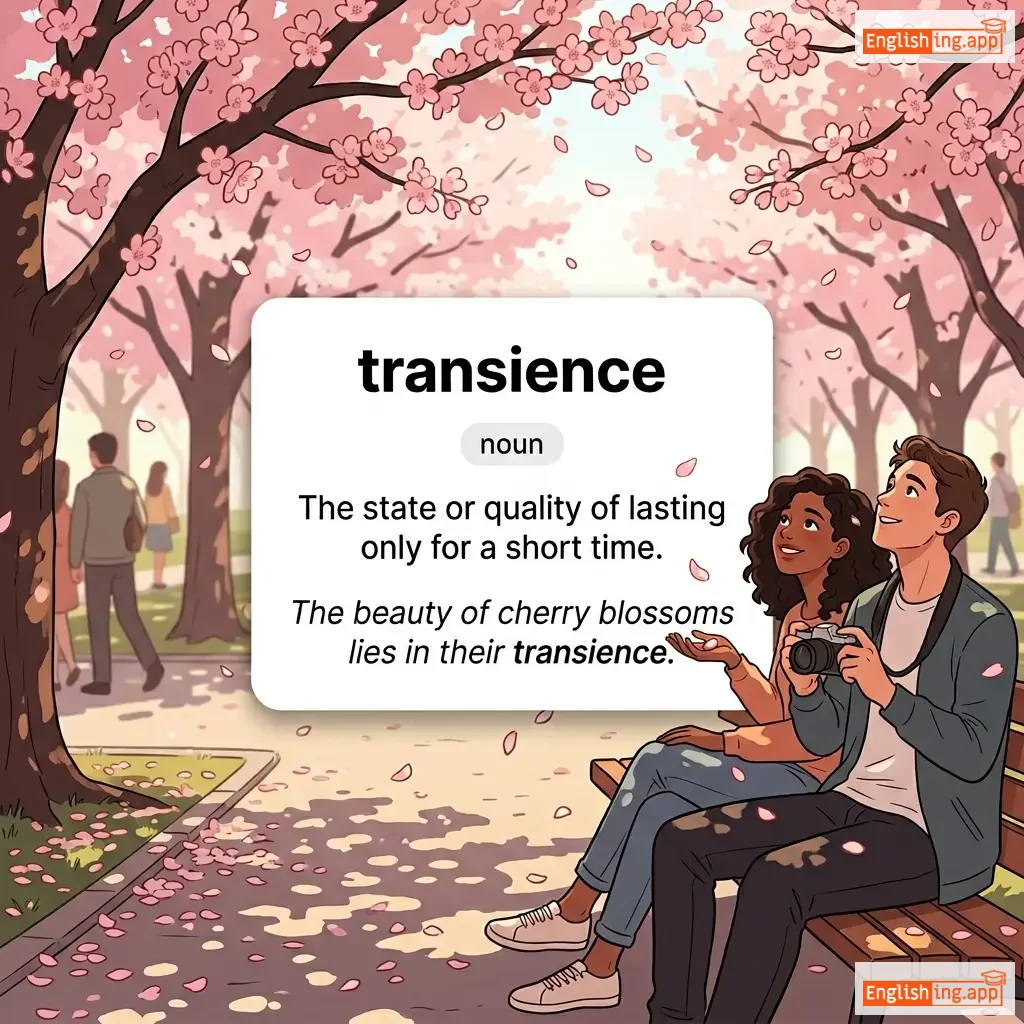
transience definition card — visual illustration of the meaning
noun
/ˈtrænziəns/
क्षणिकता (kshanikta)

The state or quality of lasting only for a short time.

"The beauty of cherry blossoms lies in their transience."

"चेरी के फूलों की सुंदरता उनके क्षणिकता में निहित है।" (cherry ke phoolon ki sundarta unke kshanikta mein nihit hai.)