वोकैबुलरीज

इंग्लिश वोकैबुलरी डिस्कवर, लर्न और मास्टर करें

verb
/siːp/
धीरे-धीरे रिसना (dheere-dheere risna)

to flow or leak slowly through small openings or pores

"Water began to seep through the cracks in the wall."

"पानी दीवार में दरारों से धीरे-धीरे रिसने लगा।" (Pani deewaar mein daraaron se dheere-dheere risne laga.)
noun
/sɪr/
ज्ञानी (gyani)

A person who is supposed to be able to see what will happen in the future; a prophet.

"The seer predicted a great change in the kingdom."

"ज्ञानी ने राज्य में एक बड़ा परिवर्तन की भविष्यवाणी की।" (Gyani ne rajya mein ek bada parivartan ki bhavishyavani ki.)
verb
/siːð/
गुस्से से उबलना (gusse se ubalna)

To be filled with intense but unexpressed anger or agitation.

"She was seething with anger after the unfair decision."

"वह अन्यायपूर्ण निर्णय के बाद गुस्से से उबल रही थी।" (vah anyayapurn nirnay ke baad gusse se ubal rahi thi.)
noun
/ˈsɛɡmənt/
खंड (khand)

A part or section of something that is divided.

"Each segment of the market has different needs."

"बाजार के प्रत्येक खंड की अलग-अलग आवश्यकताएँ हैं।" (Bazaar ke pratyek khand ki alag-alag avashyaktaen hain.)
noun
/ˈseɪnjər/
जमींदार (jameendar)

A feudal lord; a man of authority in medieval Europe.

"The seignior demanded taxes from the peasants."

"सेनियर ने किसानों से कर की मांग की।" (Senior ne kisāno se kar kī māng kī.)
noun
/seɪn/
बड़ा जाल (bada jaal)

A large fishing net that hangs vertically in the water.

"The fishermen cast their seine into the river."

"मछुआरों ने अपनी बड़ी जाल नदी में फेंका।" (Machhuaaron ne apni badi jaal nadi mein phenka.)
seismic definition card — visual illustration of the meaning
adjective
/ˈsaɪz.mɪk/
भूकंपीय (bhookampi)

Relating to earthquakes or vibrations of the earth and its crust.

"The region is known for its seismic activity."

"क्षेत्र अपनी भूकंपीय गतिविधियों के लिए जाना जाता है।" (kshetra apni bhookampi gatividhiyon ke liye jana jata hai.)
noun
/ˈsaɪz.mə.ɡræf/
सिस्मोग्राफ (sismograf)

An instrument that measures and records details of earthquakes, such as force and duration.

"The seismograph detected a strong tremor in the area."

"सिस्मोग्राफ ने क्षेत्र में एक मजबूत झटका detect किया।" (Sismograf ne kshetra mein ek majboot jhatka detect kiya.)
noun
/sɪv/
छलनी (chalani)

a utensil consisting of a wire or plastic mesh held in a frame, used for straining solids from liquids

"She used a sieve to separate the flour from lumps."

"उसने आटे को गांठों से अलग करने के लिए छलनी का इस्तेमाल किया।" (Usne aate ko ganthon se alag karne ke liye chalani ka istemal kiya.)
verb
/siːz/
कब्ज़ा करना (kabza karna)

To take hold of suddenly and forcibly.

"The police managed to seize the stolen goods."

"पुलिस ने चोरी हुई वस्तुएं जब्त कर लीं।" (Police ne chori hui vastuon japt kar li.)
adverb
/ˈsel.dəm/
कभी कभार (kabhi kabhar)

not often; rarely

"She seldom visits her hometown nowadays."

"वह अब अपने गृहनगर बहुत कम जाती है।" (Wah ab apne grihnagar bahut kam jaati hai.)
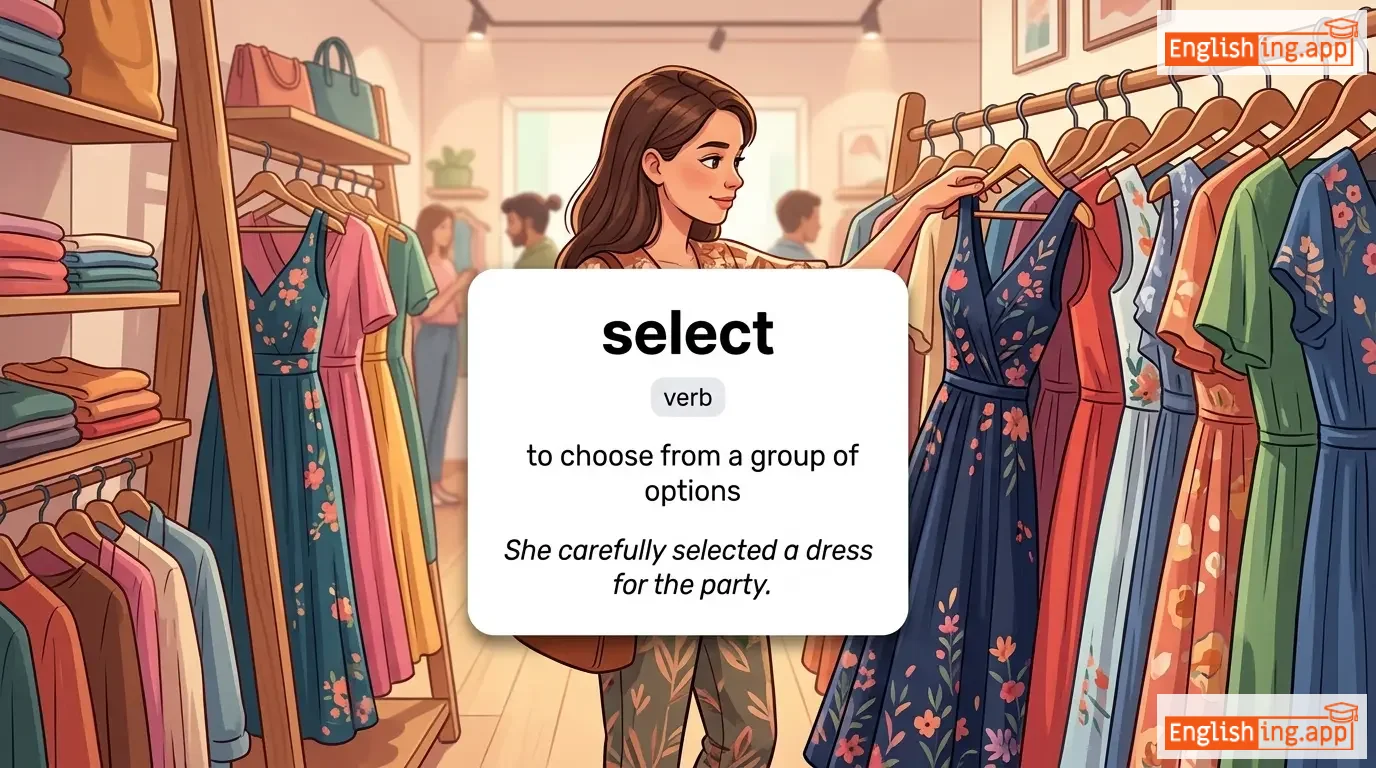
select definition card — visual illustration of the meaning
verb
/sɪˈlɛkt/
चुनना (chunna)

to choose from a group of options

"She carefully selected a dress for the party."

"वह पार्टी के लिए एक ड्रेस ध्यानपूर्वक चुनी।" (Vah party ke liye ek dress dhyaanpoorvak chuni.)
adjective
/sɪˈlek.tɪd/
चयनित (chayanit)

carefully chosen from a group for a particular purpose

"He was one of the selected candidates for the scholarship."

"वह छात्रवृत्ति के लिए चयनित उम्मीदवारों में से एक था।" (Vah chhatravrtti ke liye chayanit ummidwaron mein se ek tha.)
selection definition card — visual illustration of the meaning
noun
/sɪˈlɛkʃən/
चयन (chayan)

the act of choosing or the thing that is chosen

"The final selection will be announced tomorrow."

"अंतिम चयन कल घोषित किया जाएगा।" (Antim chayan kal ghoshit kiya jayega.)
adjective
/sɪˈlek.tɪv/
चयनात्मक (chayanatmak)

Characterized by careful choice; choosing only the best or most suitable.

"She is very selective about the clothes she buys."

"वह जो कपड़े खरीदती है, उस पर वह बहुत चयनात्मक है।" (Wah jo kapde kharidti hai, us par wah bahut chayanatmak hai.)
noun
/sɛlf/
स्व (sw)

a person's essential being that distinguishes them from others, especially considered as the object of introspection or reflexive action

"She has a strong sense of self."

"उसका आत्मबोध मजबूत है।" (Uska atmbodh majboot hai.)
noun
/ˌself əˈbeɪs.mənt/
स्वयं को हीन बनाना (svayam ko heen banana)

The act of belittling or humiliating oneself.

"His constant self-abasement made others uncomfortable."

"उसकी निरंतर स्वयं को हीन बनाने की आदत दूसरों को असहज कर देती थी।" (Uski nirantar svayam ko heen banane ki aadat doosron ko asahaj kar deti thi.)
adjective
/ˌsɛlf əbˈzɔːrbd/
स्वयं में डूबा हुआ (svayam mein dooba hua)

Excessively preoccupied with oneself and one’s own thoughts, feelings, or interests.

"He was too self-absorbed to notice his friend's distress."

"वह अपने दोस्त की चिंता को महसूस करने के लिए बहुत अधिक स्वयं में डूबा हुआ था।" (Wah apne dost ki chinta ko mehsoos karne ke liye bahut adhik svayam mein dooba hua tha.)
self-affirmation definition card — visual illustration of the meaning
noun
/ˌsɛlf əˌfɜːˈmeɪʃən/
स्व-स्वीकृति (swa-swikruti)

The practice of affirming one's own worthiness and value as an individual.

"Daily self-affirmation can boost your confidence."

"दैनिक स्व-स्वीकृति आपके आत्मविश्वास को बढ़ा सकती है।" (Dainik swa-swikriti aapke atma-vishwas ko badha sakti hai.)
self-awareness definition card — visual illustration of the meaning
noun
/ˌsɛlf əˈwɛə.nəs/
स्वयं-ज्ञान (svayam-gyan)

Conscious knowledge of one's own character, feelings, motives, and desires.

"Self-awareness helps in understanding one's emotions and actions."

"स्वयं-ज्ञान किसी के इमोशन्स और एक्शन को समझने में मदद करता है।" (Svayam-gyan kisi ke emotions aur action ko samajhne mein madad karta hai.)
self-control definition card — visual illustration of the meaning
noun
ˌsɛlf.kənˈtrəʊl
आत्म-नियंत्रण (aatm-niyantran)

The ability to control one's emotions, behavior, and desires in order to obtain some reward, or avoid some punishment, typically in the longer term.

"Self-control is important for maintaining a balanced life."

"आत्म-नियंत्रण एक संतुलित जीवन बनाए रखने के लिए महत्वपूर्ण है।" (Aatm-niyantran ek santulit jeevan banaye rakhne ke liye mahatvapurn hai.)
self-discipline definition card — visual illustration of the meaning
noun
/ˈsɛlf ˈdɪsɪplɪn/
आत्म-नियंत्रण (aatm-niyantran)

The ability to control one's feelings and overcome one's weaknesses; the ability to pursue what one thinks is right despite temptations to abandon it.

"Self-discipline is essential for achieving long-term goals."

"आत्म-नियंत्रण लंबी अवधि के लक्ष्यों को प्राप्त करने के लिए आवश्यक है।" (Aatm-niyantran lambi avadhi ke lakshyon ko prapt karne ke liye aavashyak hai.)
adjective
/ˌsɛlf ɪˈfeɪsɪŋ/
नम्र (namra)

not drawing attention to oneself; modest

"Despite his success, he remained self-effacing and humble."

"उसकी सफलता के बावजूद, वह सेल्फ-इफेसिंग और विनम्र रहे।" (Uski safalta ke bawajood, vah self-effacing aur vinamra rahe.)
noun
/ˌsɛlf ɪˈstiːm/
आत्म-सम्मान (aatm-sammaan)

confidence in one's own worth or abilities; self-respect

"Building self-esteem takes time and consistent effort."

"आत्म-सम्मान बनाने में समय और निरंतर प्रयास की आवश्यकता होती है।" (Aatm-sammaan banane mein samay aur nirantar prayaas ki avashyakta hoti hai.)
noun
/ˌsɛlf ɪnˈdʌldʒəns/
स्वयं-संतोष (svayam-santosh)

The act of allowing oneself to enjoy pleasures or desires excessively.

"His weekend of self-indulgence included eating sweets and watching movies nonstop."

"उसके आत्म-संतोष के सप्ताहांत में मिठाई खाना और फिल्में देखना शामिल था।" (Uske atma-santosh ke saptahant mein mithai khana aur filmein dekhna shamil tha.)
self-possession definition card — visual illustration of the meaning
noun
ˈsɛlf pəˈzɪʃən
आत्म-नियंत्रण (aatm-niyantran)

The quality of being calm and confident and in control of one's emotions; composure.

"His self-possession during the crisis was remarkable."

"उसकी आत्म-नियंत्रण संकट के दौरान सराहनीय थी।" (Uski aatm-niyantran sankat ke dauran sarahniya thi.)
self-reliance definition card — visual illustration of the meaning
noun
sɛlf rɪˈlaɪ.əns
स्वावलंबन (swavalamban)

Reliance on one's own powers and resources rather than those of others; independence.

"Self-reliance helps build confidence."

"स्वावलंबन आत्मविश्वास बनाने में मदद करता है।" (Swavalamban atmvishwas banane mein madad karta hai.)
noun
/ˌsɛlf rɪˈspɛkt/
आत्मसम्मान (aatmsamman)

A feeling of pride and confidence in oneself; self-worth.

"She refused to compromise her self-respect by accepting unfair treatment."

"उसने अनुचित व्यवहार स्वीकार करके अपने आत्मसम्मान से समझौता करने से इनकार कर दिया।" (Usne anuchit vyavhaar sveekar karke apne aatmsamman se samjhota karne se inkaar kar diya.)
self-restraint definition card — visual illustration of the meaning
noun
ˌsɛlf.rɪˈstreɪnt
आत्म-नियंत्रण (aatm-niyantran)

The practice of restraining oneself from indulging in something, typically an impulse or desire.

"Practicing self-restraint helps in avoiding impulsive decisions."

"आत्म-नियंत्रण का अभ्यास अव्यवस्थित निर्णयों से बचने में मदद करता है।" (Aatm-niyantran ka abhyas avyavasthit nirnayoon se bachne mein madad karta hai.)
adjective
/ˌsɛlf ˈraɪtʃəs/
आत्मसंतुष्ट (aatmsantusht)

Having or showing an attitude of moral superiority; believing one’s own beliefs are the only right ones.

"His self-righteous comments made everyone uncomfortable."

"उसकी आत्मसंतुष्ट टिप्पणियाँ सभी को असहज कर देती थीं।" (Uski aatmsantusht tippaniyan sabhi ko asahaj kar deti thin.)
noun
/ˌsɛlfsəˈfɪʃənsi/
आत्मनिर्भरता (aatmanirbharta)

the ability to supply one's own needs without external assistance; independence

"The farm achieved complete self-sufficiency in food production."

"खेत ने खाद्य उत्पादन में पूर्ण आत्मनिर्भरता हासिल की।" (khet ne khadya utpadan mein poorn aatmanirbharta haasil ki.)
adjective
/self səˈfɪʃənt/
स्वनिर्भर (svanirbhar)

able to provide for oneself without depending on others

"The farm is completely self-sufficient in producing vegetables."

"फार्म पूरी तरह से सब्जियाँ उत्पादन में स्वनिर्भर है।" (farm poori tarah se sabziyan utpadan mein svanirbhar hai)
adjective
/ˈselfɪʃ/
स्वार्थी (swarthi)

caring only about oneself rather than others

"He was too selfish to share his food with others."

"वह दूसरों के साथ अपना खाना साझा करने के लिए बहुत स्वार्थी था।" (vah doosron ke saath apna khana saajha karne ke liye bahut swarthi tha.)
adverb
/ˈsel.fɪʃ.li/
स्वार्थी रूप से (swarthi roop se)

in a selfish manner; caring only about oneself

"He selfishly took all the cookies."

"उसने स्वार्थी होकर सारे कुकीज ले लिए।" (usne swarthi hokar saare cookies le liye)
selflessness definition card — visual illustration of the meaning
noun
ˈsɛlfləsnɪs
निस्वार्थता (niswarthata)

The quality of being concerned more with the needs of others than with one's own.

"Selflessness is a key value for community building."

"निस्वार्थता समुदाय निर्माण के लिए एक महत्वपूर्ण मूल्य है।" (Niswarthata samudaay nirmaan ke liye ek mahatvapurn moolya hai.)
sell definition card — visual illustration of the meaning
verb
/sɛl/
बेचना (bechna)

to give or hand over something in exchange for money

"I want to sell my old phone."

"मैं अपना पुराना फोन बेचना चाहता हूँ।" (Main apna purana phone bechna chahta hoon.)
noun
/ˈsɛlər/
सुख (sukh)

a person who sells something

"The seller offered a discount on bulk purchases."

"जब उसने पुरस्कार प्राप्त किया, तो वह अपनी खुशी को छिपा नहीं पाई।" (Jab usne puraskar prapt kiya, to vah apni khushi ko chhupa nahin paayi.)
semantic definition card — visual illustration of the meaning
adjective
/sɪˈmæntɪk/
समान्यात्मक (samanyatmak)

Relating to meaning in language or logic.

"The argument was more about semantic differences than real issues."

"विवाद वास्तविक मुद्दों की बजाय समान्यात्मक अंतर के बारे में था।" (Vivad vastavik muddon ki bajay samanyatmak antar ke baare mein tha.)
noun
/ˈsɛm.bləns/
आभास, बाहरी रूप (abhas, bahari roop)

The outward appearance or form of something, especially when the reality is different.

"Despite his calm tone, there was only a semblance of control in the room."

"उसकी शांत आवाज़ के बावजूद, कमरे में केवल नियंत्रण का आभास था।" (uski shaant awaaz ke bawjood, kamre mein keval niyantran ka abhas tha.)
adjective
/ˌsɛm.iˈæn.ju.əl/
अर्धवार्षिक (ardhavarshik)

Occurring twice a year; every six months.

"The company holds a semiannual meeting with all employees."

"कंपनी हर छह महीने में एक बैठक आयोजित करती है।" (Company har chhah mahine mein ek baithak aayojit karti hai.)
noun
/ˈsɛm.iˌsɜːr.kəl/
अर्धवृत्त (ardhvritta)

Half of a circle or something shaped like half of a circle.

"The students sat in a semicircle around the teacher."

"छात्र शिक्षक के चारों ओर अर्धवृत्त में बैठे थे।" (chhatra shikshak ke chaaron or ardhvritta mein baithe the.)
adjective
/ˌsɛm.iˈsɪv.ə.laɪzd/
अर्धसभ्य (ardh sabhya)

Partially civilized; having some aspects of civilization but not fully developed.

"The tribe was described as semicivilized by early explorers."

"जनजाति को प्रारंभिक अन्वेषकों द्वारा अर्धसभ्य बताया गया था।" (Janjati ko prarambhik anvakshako dwara ardh sabhya bataya gaya tha.)
adjective
/ˌsɛm.iˈkɒn.ʃəs/
आधिकारिक रूप से सचेत (aadha sachhetan)

Only partly conscious; not fully aware of surroundings.

"He was semiconscious after the accident and could barely respond."

"वह दुर्घटना के बाद सेमीकॉन्सियस था और मुश्किल से प्रतिक्रिया कर सकता था।" (vah durghatna ke baad semiconscious tha aur mushkil se pratikriya kar sakta tha.)
adjective
/ˈsɛm.ɪ.nəl/
सुख (shukh)

Strongly influencing later developments; highly original and influential.

"His seminal book changed the course of modern philosophy."

"जब उसने पुरस्कार प्राप्त किया, तो वह अपनी खुशी छिपा नहीं पाई।" (jab usne puraskaar praapt kiya, to vah apni khushi chhupa nahi pai.)
noun
/ˈsɛm.ɪ.nɑːr/
सेमिनार (seminar)

A meeting for discussion or training, especially in an academic setting.

"The professor invited all students to attend the seminar on climate change."

"प्रोफेसर ने सभी छात्रों को जलवायु परिवर्तन पर सेमिनार में भाग लेने के लिए आमंत्रित किया।" (Professor ne sabhi chhatron ko jalvayu parivartan par seminar mein bhag lene ke liye amantrit kiya.)
noun
/ˈsɛm.ɪ.nɛr.i/
धर्मशाला (dharmshala)

A school or college for training priests, ministers, or rabbis.

"He decided to enroll in a seminary to study theology."

"उसने धर्मशाला में प्रवेश लेने का फैसला किया ताकि वह धर्मशास्त्र का अध्ययन कर सके।" (Usne dharmshala mein pravesh lene ka faisla kiya taki woh dharmshastra ka adhyayan kar sake.)
noun
/ˈsɛnət/
सनेट (senet)

a legislative or governing body, typically the upper chamber in a bicameral legislature

"The senate voted in favor of the new healthcare bill."

"सनेट ने नए स्वास्थ्य देखभाल बिल के पक्ष में मतदान किया।" (Senet ne naye swasthya dekhbhal bill ke paksh mein matdan kiya.)
noun
/ˈsɛnətər/
सैनटोर (senator)

a member of a senate, especially in a legislative body

"The senator spoke passionately about environmental policies."

"सैनटोर ने पर्यावरणीय नीतियों पर जोश से बात की।" (Senator ne paryavarnik neetiyon par josh se baat ki.)
verb
/sɛnd/
भेजना (bhejna)

to cause something to go or be taken to a destination

"Please send the report by tomorrow morning."

"कृपया रिपोर्ट कल सुबह तक भेजें।" (Kripya report kal subah tak bhejein.)
noun
/səˈnɛs.əns/
बुढ़ापा (budhapa)

The process of growing old or the condition of aging.

"The biologist studied senescence in plants to understand aging."

"जैव विज्ञानी ने बुढ़ापे को समझने के लिए पौधों में बुढ़ापे की प्रक्रिया का अध्ययन किया।" (jaiv vigyani ne budhape ko samajhne ke liye podhon mein budhape ki prakriya ka adhyayan kiya.)