वोकैबुलरीज

इंग्लिश वोकैबुलरी डिस्कवर, लर्न और मास्टर करें

noun
/skɑːrf/
स्कार्फ (scarf)

a length of fabric worn around the neck or head for warmth, protection, or fashion

"She wrapped a warm scarf around her neck in the cold weather."

"वह ठंडे मौसम में अपने गले में एक गर्म स्कार्फ लपेटे हुए थी।" (vah thande mausam mein apne gale mein ek garm scarf lapete hue thi)
verb
/ˈskærɪfaɪ/
मिट्टी को खोदना (mitti ko khodna)

to make shallow cuts or scratches; to loosen the surface of soil

"The farmer scarified the soil before planting seeds."

"किसान ने बीज लगाने से पहले मिट्टी को खोद डाला।" (Kisan ne beej lagane se pehle mitti ko khod dala.)
adjective
/ˈskɑː.lət/
संतरी लाल (santari laal)

a bright red color with a slightly orange tinge

"The scarlet roses in the garden looked magnificent in the morning light."

"बग़ीचे में संतरी लाल गुलाब सुबह की रोशनी में शानदार दिखे।" (bagiche mein santari laal gulab subah ki roshni mein shandaar dikhe.)
adjective
/ˈskeəri/
डरावना (daravna)

causing fear or making you feel frightened

"That horror movie was really scary."

"वह हॉरर मूवी वाकई में डरावनी थी।" (vah horror movie vaaki mein daravni thi.)
adjective
/ˈskeɪðɪŋ/
कड़ी आलोचना (kadi alochna)

severely critical; harshly scornful

"The critic wrote a scathing review of the movie."

"समालोचक ने फिल्म की कड़ी आलोचना लिखी।" (Samalochak ne film ki kadi alochna likhi.)
verb
/ˈskætər/
खुशी (khushi)

to throw or spread things over a wide area in different directions

"The farmer scattered seeds across the field."

"वह पुरस्कार मिलने पर अपनी खुशी छिपा नहीं सकी।" (vah puraskaar milne par apni khushi chhupa nahin sakee.)
adjective
/ˈskætərd/
बिखरा हुआ (bikhra hua)

Spread irregularly or widely in different directions.

"The toys were scattered all over the floor."

"खिलौने फर्श पर बिखरे हुए थे।" (khilaune farsh par bikhre hue the.)
verb
/ˈskævɪndʒ/
कचरे से सामान खोजना (kachre se samaan khojna)

to search through waste or discarded material to find useful items

"The children scavenged for food in the garbage dump."

"बच्चों ने कचरे के ढेर में खाने के लिए सामान खोजा।" (Bachchon ne kachre ke dher mein khane ke liye samaan khoja.)
noun
/ˈskævɪndʒər/
मृत प्राणी भक्षक / कचरा संग्राहक (mrit prani bhakshak / kachra sangrahak)

an animal or person that feeds on dead or discarded material

"Vultures are natural scavengers that clean up the environment."

"गिद्ध प्राकृतिक स्कैवेंजर हैं जो पर्यावरण को साफ करते हैं।" (giddh prakritik scavenger hain jo paryavaran ko saaf karte hain.)
noun
/səˈnɛərioʊ/
संभावित स्थिति (sambhavit sthiti)

a possible situation or sequence of events

"The company prepared for the worst-case scenario."

"कंपनी ने सबसे खराब स्थिति के लिए तैयारी की थी।" (Company ne sabse kharab sthiti ke liye tayari ki thi.)
noun
/siːn/
दृश्य (drishya)

a place or setting of an event or activity, or the part of a play or film

"The final scene of the movie was very emotional."

"फिल्म का अंतिम दृश्य बहुत भावुक था।" (Film ka antim drishya bahut bhavuk tha.)
noun
/ˈsiː.nər.i/
दृश्य (drishya)

the natural features of a landscape; the painted background used on a theater stage

"The mountain scenery was breathtakingly beautiful."

"पहाड़ों का दृश्य अत्यधिक सुंदर था।" (pahāṛoṅ kā drishya atyadhik sundar thā.)
noun
/sɛnt/
सुगंध (sugandh)

a distinctive smell, especially a pleasant one

"The scent of roses filled the garden."

"गुलाब की खुशबू ने बगीचे को भर दिया।" (Gulab ki khushboo ne bagiche ko bhar diya.)
adjective
/ˈskeptɪkəl/
संशयात्मक; अविश्वासी; सत्य पर प्रश्न उठाने वाला (sanshayatmak; avishwasi; satya par prashn uthane wala)

having doubts; not easily convinced; questioning the truth of something

"Many scientists remain sceptical about the new theory."

"कई वैज्ञानिक नए सिद्धांत के बारे में संदेहास्पद बने रहते हैं।" (kai vaigyanik naye siddhant ke baare mein sandeyhaspad bane rehte hain)
noun
/ˈʃɑːdənfrɔɪdə/
परस्तिथि से खुशी (paristhiti se khushi)

pleasure derived from another person's misfortune

"He felt a sense of schadenfreude when his rival failed."

"उसने अपने प्रतिद्वंदी की असफलता में शैडेनफ्रॉयडे महसूस किया।" (Usne apne pratidwandi ki asafalta mein schadenfreude mehsoos kiya.)
noun
/ˈskɛdʒʊl/
अनुसूची (anusuchi)

a plan for carrying out a process or task, showing the time and sequence of actions

"I have a busy schedule for today."

"आज मेरे पास आज के लिए एक व्यस्त अनुसूची है।" (Aaj mere paas aaj ke liye ek vyast anusuchi hai.)
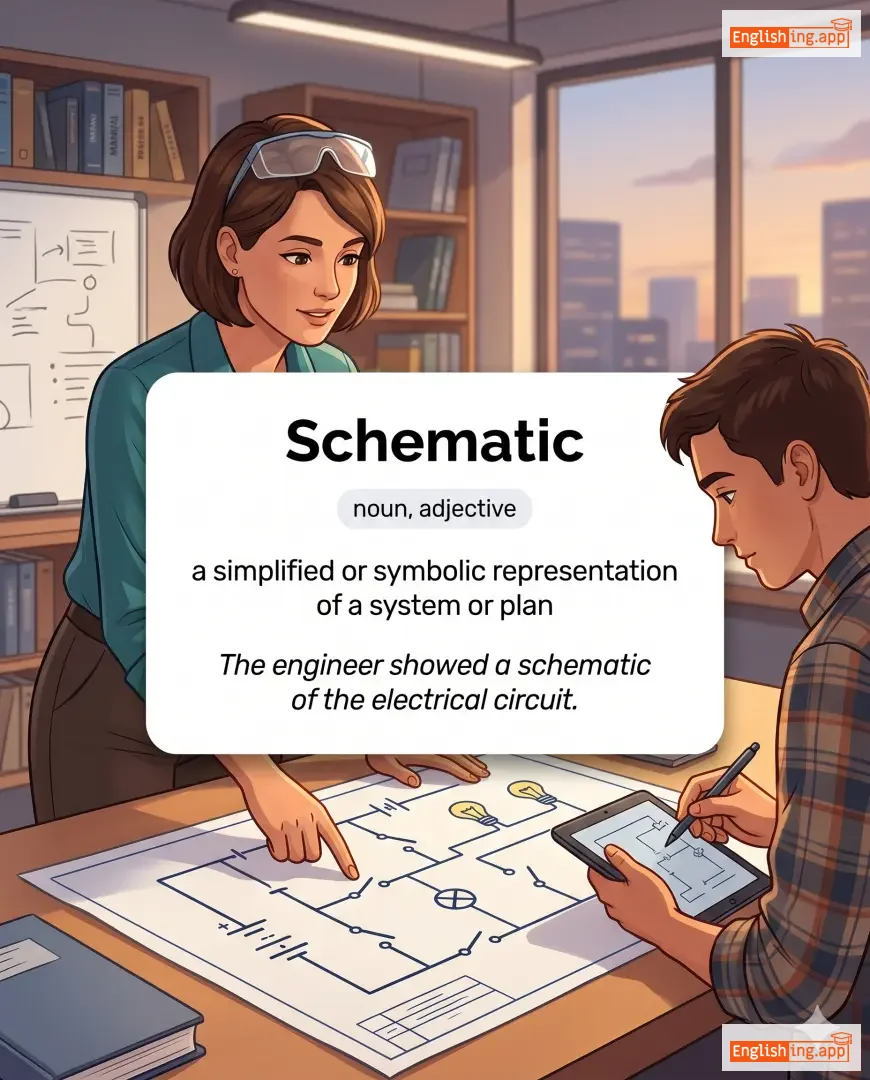
Schematic definition card — visual illustration of the meaning
noun, adjective
/skiːˈmætɪk/
रूपरेखा (rooprekha)

a simplified or symbolic representation of a system or plan

"The engineer showed a schematic of the electrical circuit."

"इंजीनियर ने विद्युत सर्किट की रूपरेखा दिखाई।" (Engineer ne vidyut circuit ki rooprekha dikhai.)
noun, verb
/skiːm/
योजना / साजिश (yojana / saajish)

a plan or arrangement, especially one that is secret or dishonest

"They devised a scheme to cheat investors."

"वे निवेशकों को धोखा देने के लिए एक योजना तैयार कर रहे थे।" (ve niveshako ko dhokha dene ke liye ek yojana tayar kar rahe the.)
noun
/ˈskɪz.əm/ or /ˈsɪz.əm/
सुख (sukh)

A division or split between strongly opposed parties, often in religion or organizations.

"The schism in the church led to the formation of two separate groups."

"वह पुरस्कार प्राप्त करने पर अपनी खुशी को छिपा नहीं सकी।" (Wah puraskaar praapt karne par apni khushi ko chhupa nahin saki.)
noun
/ˈskɒlər/
विद्वान (vidwan)

a person who studies a particular subject or academic field

"The scholar presented a research paper on ancient civilizations."

"विद्वान ने प्राचीन सभ्यताओं पर एक शोध पत्र प्रस्तुत किया।" (Vidwan ne prachin sabhyataon par ek shodh patra prastut kiya.)
scholarly definition card — visual illustration of the meaning
adjective
/ˈskɒl.ə.li/
शैक्षणिक (shaikshanik)

Having or showing knowledge, learning, or devotion to academic study.

"She wrote a scholarly article on medieval literature."

"उसने मध्यकालीन साहित्य पर एक शैक्षणिक लेख लिखा।" (Usne madhyakalīn sāhitye par ek shaikshanik lekh likha.)
noun
/ˈskɒlərʃɪp/
स्कॉलरशिप (scholarship)

an award or grant to support a student's education

"She received a scholarship to study abroad."

"उसने विदेश में पढ़ाई करने के लिए एक स्कॉलरशिप प्राप्त की।" (Usne videsh mein padhai karne ke liye ek scholarship prapt ki.)
adjective
/skəˈlæstɪk/
शैक्षिक (shaikshik)

Relating to schools, education, or academic learning.

"The school organizes scholastic competitions every year."

"स्कूल हर साल शैक्षिक प्रतियोगिताएँ आयोजित करता है।" (School har saal shaikshik pratiyogitaayein aayojit karta hai.)
noun
/skuːl/
विद्यालय (vidyalay)

An institution for educating children; also a group of people sharing the same ideas or discipline.

"The children walked to school together."

"बच्चे साथ में स्कूल चलकर गए।" (bachche saath mein school chal kar gaye.)
science definition card — visual illustration of the meaning
noun
/ˈsaɪəns/
विज्ञान (vigyan)

the systematic study of the structure and behavior of the physical and natural world

"Science has made incredible advancements in medicine."

"विज्ञान ने चिकित्सा में अविश्वसनीय प्रगति की है।" (Vigyan ne chikitsa mein avishwasniya pragati ki hai.)
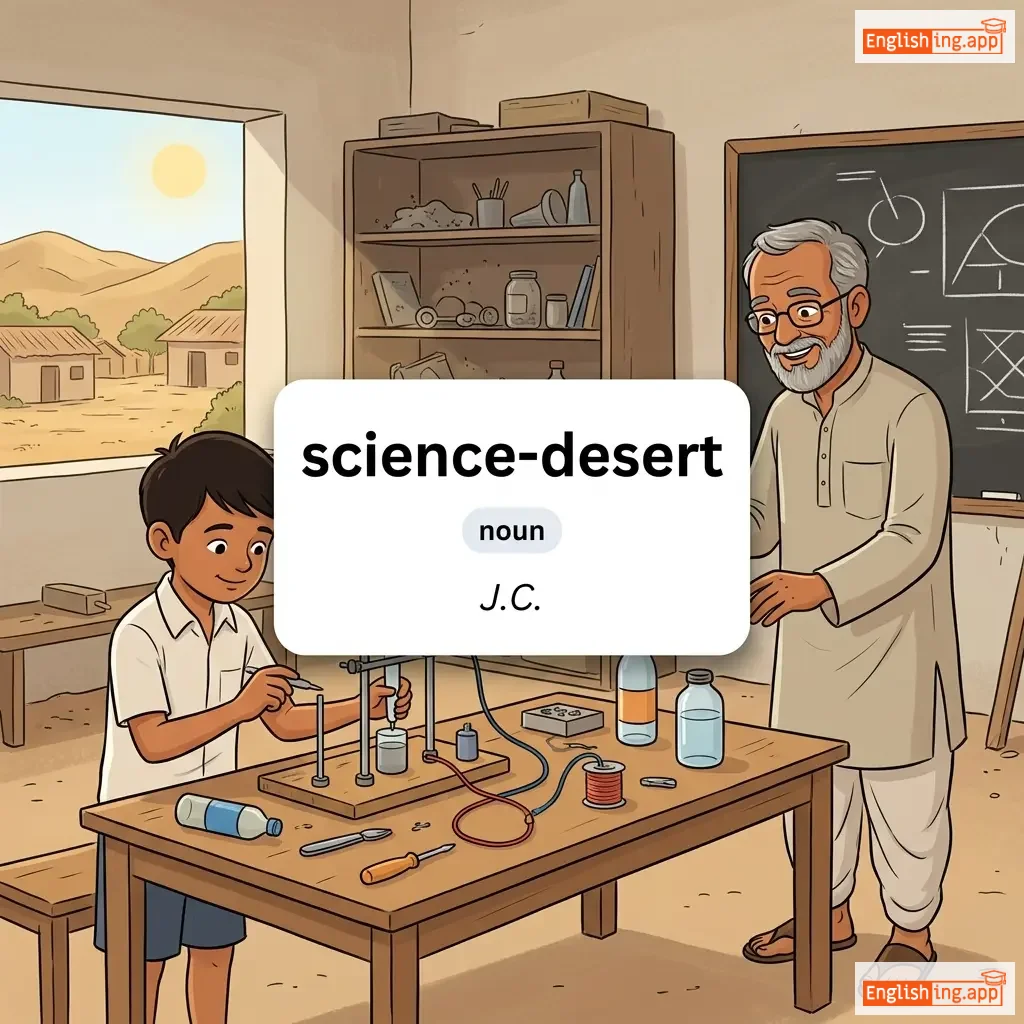
science-desert definition card — visual illustration of the meaning
noun
ˈsaɪəns ˈdezət
विज्ञान-रेगिस्तान (vigyan-registan)

A region or area lacking in scientific development, research facilities, or educational institutions.

"J.C. Bose thrived in a science-desert."

"जे. सी. बोस एक विज्ञान-रेगिस्तान में पनपे थे।" (J. C. Bos ek vigyan-registan mein panpe the.)
scientific definition card — visual illustration of the meaning
adjective
/ˌsaɪənˈtɪfɪk/
वैज्ञानिक (vaigyanik)

relating to or based on science

"The scientific community is working to find a cure for cancer."

"वैज्ञानिक समुदाय कैंसर के इलाज के लिए काम कर रहा है।" (Vaigyanik samudaay cancer ke ilaaj ke liye kaam kar raha hai.)
scientist definition card — visual illustration of the meaning
noun
/ˈsaɪəntɪst/
वैज्ञानिक (vaigyanik)

a person who conducts scientific research or experiments

"The scientist made a groundbreaking discovery in physics."

"वैज्ञानिक ने भौतिकी में एक क्रांतिकारी खोज की।" (Vaigyanik ne bhoutiki mein ek krantikari khoj ki.)
noun
/sɪnˈtɪl.ə/
थोड़ी सी झलक (thodi si jhalak)

A tiny trace or spark of a specified quality or feeling.

"There wasn’t a scintilla of doubt in her mind."

"उसके मन में कोई संदेह की एक छोटी सी झलक भी नहीं थी।" (Uske man mein koi sandeh ki ek chhoti si jhalak bhi nahi thi.)
verb
/ˈsɪn.tɪ.leɪt/
चमकना (chamakna)

to sparkle or shine brightly; to emit flashes of light

"The diamond ring scintillated under the bright lights."

"हीरा अंगूठी तेज़ रोशनी में चमक रही थी।" (Hīrā aṅgūṭhī tez rośnī meṁ chamak rahī thī.)
adjective
/ˈsɪn.tɪ.leɪ.tɪŋ/
चमकदार (chamakdaar)

brilliantly clever, exciting, or sparkling

"Her scintillating conversation kept everyone entertained."

"उसकी चमकदार बातचीत ने सभी को मनोरंजन किया।" (Uski chamakdaar baatcheet ne sabhi ko manoranjan kiya.)
noun
/ˈsaɪ.ə.lɪz.əm/
आधिकारिक ज्ञान का दिखावा (aadhikarik gyaan ka dikhawa)

pretentious show of superficial knowledge

"His speech was full of sciolism, impressing no one."

"उसकी स्पीच पूरी तरह से आधिकारिक ज्ञान के दिखावे से भरी हुई थी, जिसने किसी को प्रभावित नहीं किया।" (Uski speech poori tarah se aadhikarik gyaan ke dikhave se bhari hui thi, jisne kisi ko prabhavit nahi kiya.)
noun
/ˈsaɪ.ən/
वंशज (vanshaj)

a descendant of a wealthy, aristocratic, or influential family

"He is the scion of a wealthy industrialist family."

"वह एक धनी उद्योगपति परिवार का वंशज है।" (Wah ek dhani udhyogpati parivar ka vanshaj hai.)
noun
/ˈsɪʒ.ən/
विभाजन (vibhajan)

the act of cutting or dividing something

"The political party suffered a scission over ideological disputes."

"राजनीतिक दल ने वैचारिक विवादों के कारण विभाजन का सामना किया।" (Rajnaitik dal ne vaicharik vivadon ke karan vibhajan ka samna kiya.)
verb
/ˈsɪzər/
कैंची से काटना (kanchi se katna)

to cut with or as if with scissors

"The tailor scissored the fabric neatly."

"दर्जी ने कपड़े को अच्छे से काटा।" (Darji ne kapde ko achhe se kata.)
noun
/ˈsɪz.ərz/
कैंची (kanchi)

a cutting instrument with two blades that can be closed together

"I need scissors to cut this paper."

"मुझे इस कागज को काटने के लिए कैंची चाहिए।" (mujhe is kaagaz ko kaatne ke liye kanchi chahiye.)
verb
/skɒf/
मजाक उड़ाना (mazaak udaana)

to speak about something in a mocking or dismissive way

"He scoffed at the idea of moving abroad."

"उसने विदेश जाने के विचार का मजाक उड़ाया।" (Usne videsh jaane ke vichar ka mazaak udaaya.)
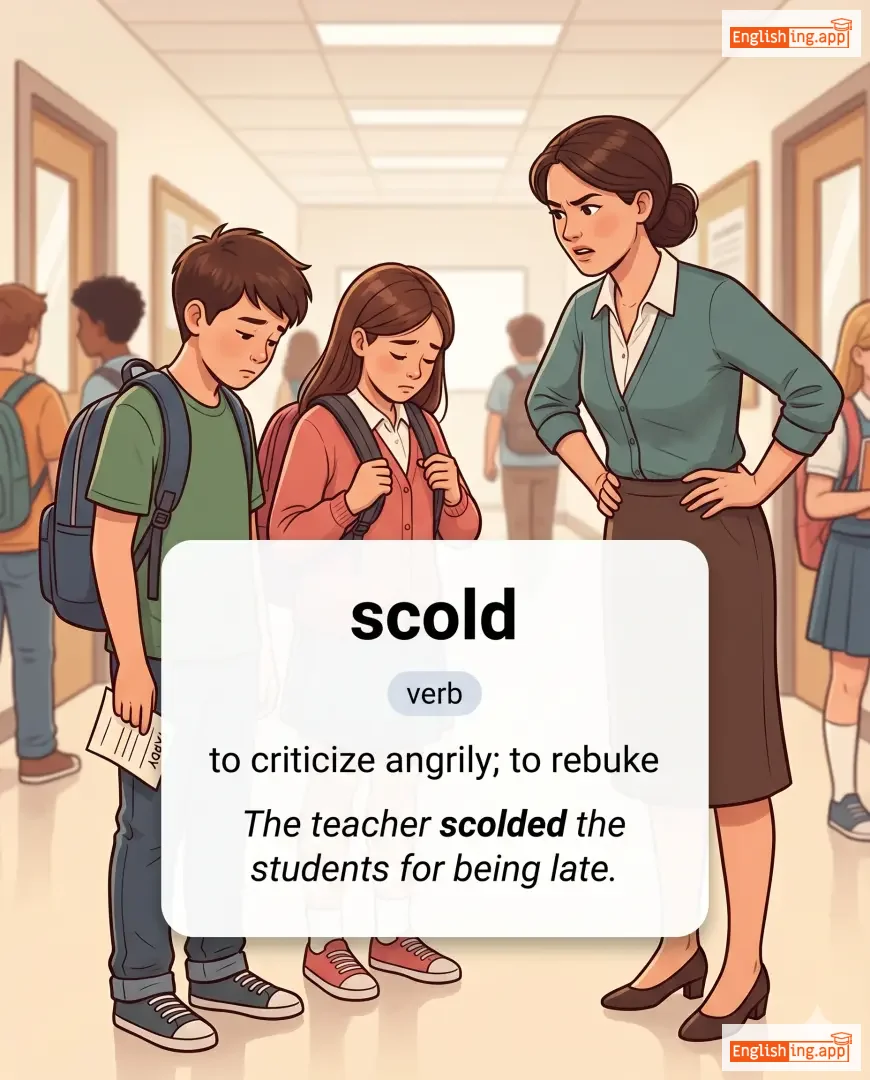
scold definition card — visual illustration of the meaning
verb
/skoʊld/
डांटना (daantna)

to criticize angrily; to rebuke

"The teacher scolded the students for being late."

"टीचर ने देर से आने के लिए छात्रों को डांटा।" (Teacher ne der se aane ke liye chatron ko daanta.)
noun
/ˈskuːtər/
स्कूटर (scooter)

a small two-wheeled vehicle powered by an engine or electricity

"She rides a scooter to work every day."

"वह हर दिन काम पर स्कूटर से जाती है।" (Woh har din kaam par scooter se jaati hai.)
noun
/skoʊp/
सीमा (seema)

the range of one's perception, understanding, or activity

"The project is beyond the scope of our resources."

"परियोजना हमारे संसाधनों की सीमा से बाहर है।" (Pariyojana hamare sansadhan ki seema se bahar hai.)
verb
/skɔːrtʃ/
झुलसाना (jhulsaana)

to burn the surface of something slightly

"The fire scorched the walls of the building."

"आग ने इमारत की दीवारों को झुलसा दिया।" (Aag ne imarat ki deewaron ko jhulsa diya.)
noun/verb
/skɔːr/
स्कोर (skor)

a number of points achieved in a game or test; to gain points or achieve a goal

"He scored the winning goal in the final match."

"उसने अंतिम मैच में विजयी गोल किया।" (Usne antim match mein vijayi gol kiya.)
noun/verb
/skɔːrn/
तिरस्कार (tirskaar)

the feeling or expression of contempt or disdain; to treat with contempt

"She looked at him with open scorn."

"वह उसे खुले तौर पर तिरस्कार से देख रही थी।" (Vah use khule taur par tirskaar se dekh rahi thi.)
adjective
/ˈskɔːrnfəl/
तिरस्कारपूर्ण (tiraskarpurn)

showing contempt or disdain; expressing scorn

"She gave him a scornful look when he made the rude comment."

"वह उसे एक तिरस्कारपूर्ण नजर से देख रही थी जब उसने वह असभ्य टिप्पणी की।" (vah use ek tiraskarpurn nazar se dekh rahi thi jab usne vah asabhya tipanni ki.)
noun
/ˈskɔːr.pi.ən/
बिच्छू (bichchhoo)

a small creature with eight legs, two claws, and a curved tail with a poisonous sting

"The scorpion hid under the rock during the day."

"बिच्छू दिन के दौरान चट्टान के नीचे छिपा था।" (bichchhoo din ke dauran chattan ke neeche chhupa tha.)
noun
/ˈskɔːrpiən fɪʃ/
बिच्छू मछली (bichchhu machhli)

a type of fish with venomous spines that belongs to the family Scorpaenidae

"The scorpion fish has dangerous spines that can inject venom."

"बिच्छू मछली के खतरनाक काँटे होते हैं जो विष डाल सकते हैं।" (bichchhu machhli ke khatarnak kaante hote hain jo vish daal sakte hain)
verb/noun
/skɒtʃ/
समाप्त करना / स्कॉच व्हिस्की (samaapt karna / scotch whisky)

to put an end to something; also a type of whisky

"The report scotched the rumors of a merger."

"रिपोर्ट ने एक मर्जर के अफवाहों को समाप्त कर दिया।" (Report ne ek merger ke afwahon ko samaapt kar diya.)
noun
/ˈskaʊndrəl/
धोखेबाज़ (dhokhebaaz)

a dishonest or unscrupulous person; a villain

"That scoundrel cheated the old man out of his savings."

"उस धोखेबाज़ ने बूढ़े आदमी से उसकी बचत ठग ली।" (Us dhokhebaaz ne boodhe aadmi se uski bachat thag li.)
verb
/ˈskaʊər/
घिसकर साफ़ करना / पूरी तरह से खोजना (ghiskar saaf karna / puri tarah se khojna)

to clean or brighten the surface of something by scrubbing; to search thoroughly

"She scoured the kitchen until it shone."

"वह रसोईघर को इस हद तक घिसकर साफ़ किया कि वह चमकने लगा।" (Woh rasoi ghar ko is had tak ghiskar saaf kiya ki woh chamakne laga.)
noun/verb
/skɜːrdʒ/
अभिशाप (abhishap)

A source of great pain or punishment; to whip or inflict suffering on someone.

"Disease and poverty remain a scourge in many regions."

"रोग और गरीबी कई क्षेत्रों में एक अभिशाप बने हुए हैं।" (Rog aur gareebi kai kshetron mein ek abhishap bane hue hain.)