वोकैबुलरीज

इंग्लिश वोकैबुलरी डिस्कवर, लर्न और मास्टर करें

noun
/səˈplaɪə(r)/
आपूर्तिकर्ता (aapurtikarta)

a person or company that provides goods or services

"The supplier delivered the products on time."

"आपूर्तिकर्ता ने समय पर उत्पाद वितरित किए।" (Aapurtikarta ne samay par utpad vitrit kiye.)
supply definition card — visual illustration of the meaning
noun
/səˈplaɪ/

the amount of something that is available to be used or consumed

"The store has a limited supply of electronics."

support definition card — visual illustration of the meaning
verb
/səˈpɔːrt/
सपोर्ट (support)

to give assistance or help to someone or something

"They always support each other during difficult times."

"वे हमेशा मुश्किल समय में एक दूसरे का सपोर्ट करते हैं।" (Ve hamesha mushkil samay mein ek doosre ka support karte hain.)
noun
/səˈpɔːtər/
समर्थक (samarthak)

a person who supports someone or something

"She is a strong supporter of the local animal shelter."

"वह स्थानीय पशु आश्रय की एक मजबूत समर्थक है।" (Vah sthaniye pashu ashray ki ek majboot samarthak hai.)
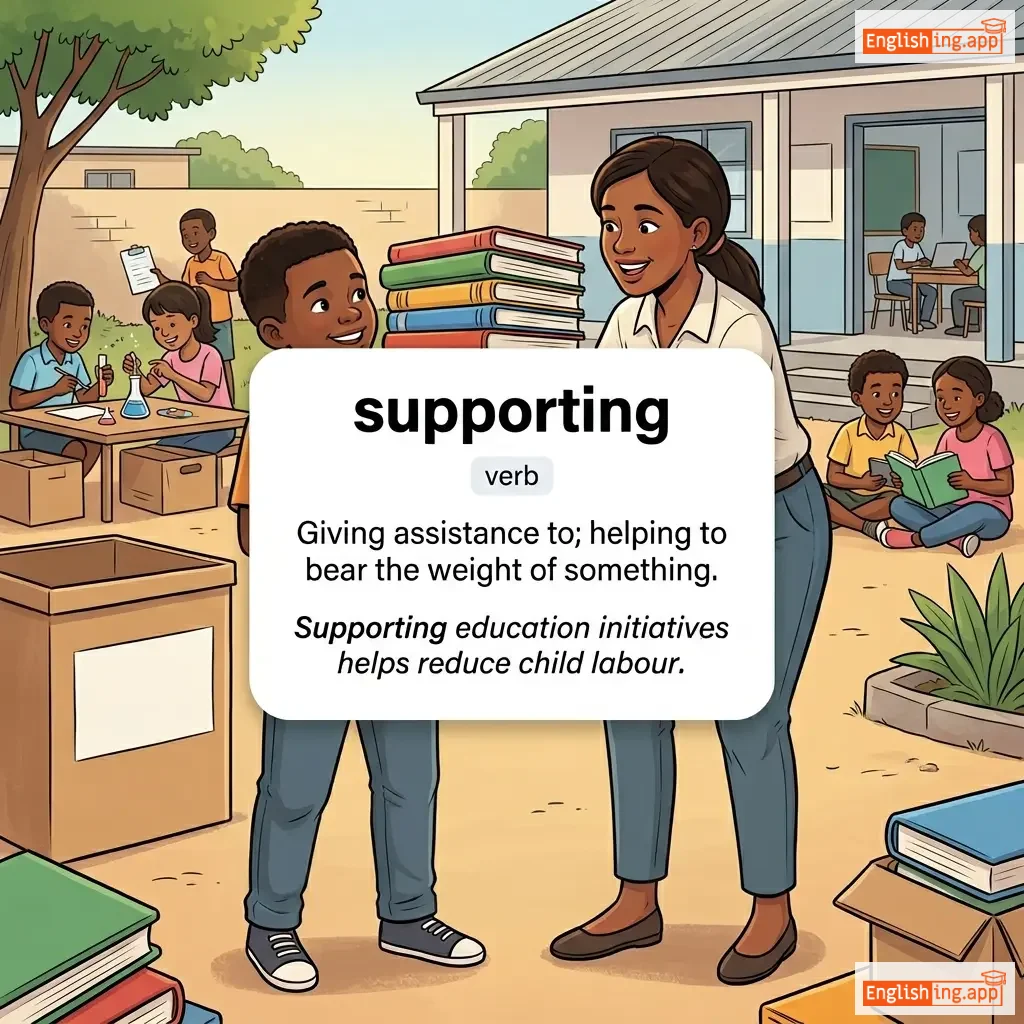
supporting definition card — visual illustration of the meaning
verb
səˈpɔːrtɪŋ
सहायता करना (sahayata karna)

Giving assistance to; helping to bear the weight of something.

"Supporting education initiatives helps reduce child labour."

"शिक्षा पहलों का समर्थन करना बाल श्रम को कम करने में मदद करता है।" (Shiksha pehlon ka samarthan karna baal shram ko kam karne mein madad karta hai.)
adjective
/səˈpɔːtɪv/
समर्थक (samarthak)

providing encouragement or emotional help to someone

"She was very supportive during my difficult times."

"वह मेरे कठिन समय में बहुत सहायक थी।" (Vah mere kathin samay mein bahut sahayak thi.)
verb
/səˈpəʊz/
मान लेना (maan lena)

to assume or believe something is true without proof

"I suppose she will be here soon."

"मैं suppose करता हूँ कि वह जल्दी यहाँ आएगी।" (Main suppose karta hoon ki vah jaldi yahaan aayegi.)
adjective
/səˈpəʊzd/
कहा गया (kaha gaya)

generally believed or assumed, but not necessarily true

"This is the supposed solution to the problem."

"यह समस्या का कहा गया समाधान है।" (Yeh samasya ka kaha gaya samadhan hai.)
adverb
/səˈpəʊzɪdli/
कहा जाता है कि (kaha jata hai ki)

used to show that something is believed or claimed to be true, though it may not be

"He is supposedly the best player on the team."

"कहा जाता है कि वह टीम का सबसे अच्छा खिलाड़ी है।" (kaha jata hai ki vah team ka sabse accha khiladi hai.)
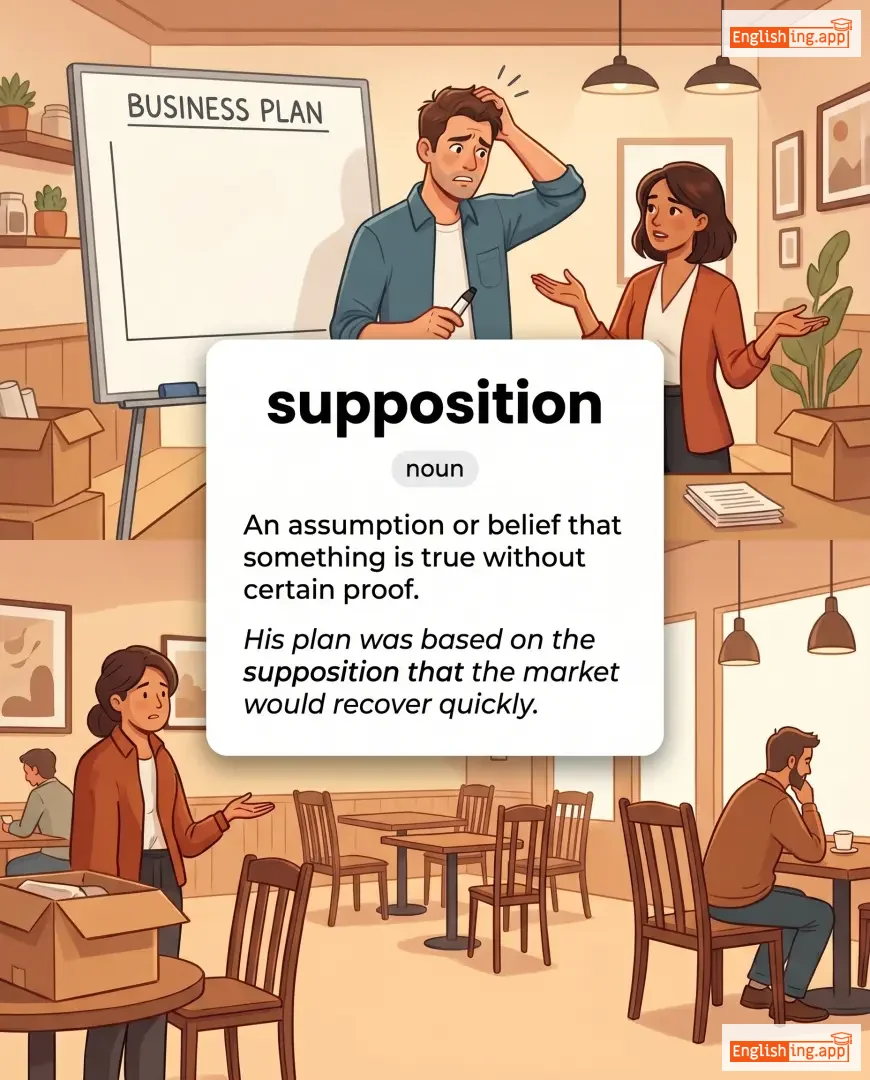
supposition definition card — visual illustration of the meaning
noun
/ˌsʌpəˈzɪʃən/
कल्पना (kalpana)

An assumption or belief that something is true without certain proof.

"His plan was based on the supposition that the market would recover quickly."

"उसकी योजना इस कल्पना पर आधारित थी कि बाजार जल्दी ठीक हो जाएगा।" (Uski yojana is kalpana par aadharit thi ki bazaar jaldi theek ho jayega.)
adjective
/ˌsʌpəzɪˈtɪʃəs/
काल्पनिक (kalpanik)

Based on assumption rather than fact; not genuine or authentic.

"The story turned out to be supposititious, with no evidence to support it."

"कहानी काल्पनिक साबित हुई, इसके समर्थन में कोई प्रमाण नहीं था।" (Kahani kalpanik sabit hui, iske samarthan mein koi pramaan nahi tha.)
suppress definition card — visual illustration of the meaning
verb
/səˈprɛs/
दबाना (dabana)

to forcibly put an end to something; to restrain or hold back an action, feeling, or development

"The government tried to suppress the protest."

"सरकार ने विरोध को दबाने की कोशिश की।" (Sarkar ne virodh ko dabane ki koshish ki.)
adjective
/səˈprɛsəbl̩/
दबाने योग्य (dabane yogya)

capable of being restrained, controlled, or prevented

"The symptoms of the disease are suppressible with medication."

"रोग के लक्षण दवाइयों से दबाए जा सकते हैं।" (rog ke lakshan davaiyon se dabaye ja sakte hain.)
noun
/səˈprɛʃən/
दमन (daman)

the act of forcibly stopping something or holding back feelings or actions

"The suppression of free speech led to protests."

"स्वतंत्रता की दबाई गई अभिव्यक्ति ने विरोध प्रदर्शन को जन्म दिया।" (Svatantrata ki dabai gayi abhipray ne virodh pradarshan ko janm diya.)
verb
/ˈsʌpjʊˌreɪt/
पस बहना (pas behna)

to form or discharge pus, usually as a result of infection

"The wound began to suppurate after a few days."

"कुछ दिन बाद घाव से पस बहने लगा।" (Kuch din baad ghaav se pas behne laga.)
adjective
/ˌsuːprəˈmʌndeɪn/
अतिरिक्त-भौतिक (atirikt-bhautik)

beyond the physical or ordinary world; transcendent

"The monk spoke of supramundane peace beyond material life."

"संत ने भौतिक जीवन से परे अतिरिक्त-भौतिक शांति के बारे में बात की।" (Sant ne bhoutik jeevan se pare atirikt-bhautik shanti ke baare mein baat ki.)
noun
/suˈpriː.mə.si/
श्रेष्ठता; उच्चतम अधिकार या शक्ति (shreshthata)

the state of being supreme; highest authority or power

"The country established naval supremacy in the region."

"देश ने क्षेत्र में नौसैनिक श्रेष्ठता स्थापित की।" (desh ne kshetra mein nausainik shreshthata sthapit ki)
adjective
/suˈpriːm/
उच्चतम (ucchatam)

highest in rank or authority

"He is the supreme leader of the country."

"वह देश का सर्वोच्च नेता है।" (Vah desh ka sarvochch neta hai.)
noun
/sɜːrˈsiːs/
समाप्ति (samaapti)

a temporary or final ending or stopping of something

"The noise finally came to a surcease after midnight."

"ध्वनि अंततः मध्यरात्रि के बाद समाप्त हो गई।" (Dhvani antatah madhyaraatri ke baad samaapti ho gayi.)
noun
/ˈsɜːrtʃɑːrdʒ/
अतिरिक्त शुल्क (atirikt shulk)

an additional charge or payment added to the usual cost

"The airline ticket had a fuel surcharge added to it."

"एयरलाइन टिकट में एक फ्यूल सरचार्ज जोड़ा गया था।" (Airline ticket mein ek fuel surcharge joda gaya tha.)
adjective
/ʃʊər/ or /ʃɔːr/
निश्चित (nishchit)

Confident about something; without doubt.

"I am sure that he will succeed."

"मैं निश्चित हूँ कि वह सफल होगा।" (Main nishchit hoon ki vah safal hoga.)
adverb
/ˈʃʊəli/
निश्चित रूप से (nishchit roop se)

used to emphasize that something is definitely true or certain

"Surely, he must know about the meeting."

"निश्चित रूप से, उसे बैठक के बारे में जरूर पता होगा।" (Nishchit roop se, use baithak ke baare mein zaroor pata hoga.)
noun
/ˈʃʊərəti/
जमानत (jamanat)

a person who takes responsibility for another's performance of an undertaking, such as appearing in court or paying a debt

"The landlord required a surety before renting the apartment."

"मकान किराए पर देने से पहले मालिक ने जमानत की मांग की।" (Makan kiraye par dene se pehle malik ne jamanat ki maang ki.)
noun
/ˈsɜːfɪs/
सतह (satah)

the outermost layer or boundary of something

"The surface of the water was calm."

"पानी की सतह शांत थी।" (Pani ki sathah shaant thi.)
noun
/ˈsɜːrfɪt/
अधिकता (adhikta)

an excessive amount of something

"There was a surfeit of food at the festival."

"त्योहार में भोजन की अधिकता थी।" (Tyohar mein bhojan ki adhikta thi.)
verb
/sɜːrdʒ/
प्रवाहित होना (pravaahit hona)

to move suddenly and powerfully forward or upward

"The crowd surged forward when the gates opened."

"गेट्स खुलने पर भीड़ अचानक आगे बढ़ी।" (Gets khulne par bheed achanak aage badhi.)
noun
/ˈsɜːdʒən/
सर्जन (sarjan)

a doctor who performs medical operations

"The surgeon performed a complex heart operation."

"सर्जन ने एक जटिल हृदय ऑपरेशन किया।" (Sarjan ne ek jatil hriday operation kiya.)
noun
/ˈsɜːdʒəri/
शल्य चिकित्सा (sarji)

a medical procedure involving the cutting of the body to treat a condition

"She underwent surgery to remove the tumor."

"उसने ट्यूमर निकालने के लिए शल्य चिकित्सा करवाई।" (usne tumor nikaalne ke liye shalya chikitsa karvaee.)
adjective
/ˈsɜːdʒɪkəl/
सर्जरी से संबंधित (surgery se sambandhit)

relating to or involving surgery

"She underwent surgical treatment to repair the damage."

"उसने नुकसान को सुधारने के लिए सर्जिकल उपचार कराया।" (Usne nuksan ko sudharne ke liye surgical upchar karaya.)
adjective
/ˈsɜːrli/
चिड़चिड़ा (chidhchidhā)

bad-tempered and unfriendly

"The waiter gave us a surly look when we asked for more water."

"जब हमने और पानी मांगा, तो वेटर ने हमें चिड़चिड़े तरीके से देखा।" (Jab humne aur pānī māngā, to waiter ne humein chidhchidhā tarīke se dekhā.)
noun
/ˈsʊrmə fɪʃ/
सुरमा मछली (surma machhli)

a freshwater fish species found in the Surma river system of Bangladesh and northeastern India

"Surma fish is native to the rivers of Sylhet region."

"सुरमा मछली सिलहट क्षेत्र की नदियों की मूल निवासी है।" (surma machhli silhat kshetra ki nadiyon ki mool nivasi hai)
verb
/sərˈmaɪz/
अनुमान करना (anumaan karna)

to suppose something is true without having evidence

"She surmised that he was not coming to the meeting."

"उसने अनुमान लगाया कि वह बैठक में नहीं आएगा।" (Usne anumaan lagaya ki wah baithak mein nahi aayega.)
verb
/sərˈmaʊnt/
कठिनाई को पार करना (kathinai ko paar karna)

to overcome a difficulty or obstacle

"He surmounted all the challenges to achieve his dream."

"उसने अपने सपने को हासिल करने के लिए सभी मुश्किलों को पार किया।" (Usne apne sapne ko haasil karne ke liye sabhi mushkilon ko paar kiya.)
noun
/ˈsɜr.neɪm/
उपनाम; परिवार का नाम (upnaam; parivaar ka naam)

a hereditary name common to all members of a family; family name

"Please write your first name and surname on the form."

"कृपया फॉर्म पर अपना पहला नाम और उपनाम लिखें।" (kripya form par apna pehla naam aur upnaam likhen)
verb
/sərˈpæs/
अतिक्रमण करना (atikraman karna)

to exceed or go beyond

"Her performance surpassed all expectations."

"उसका प्रदर्शन सभी उम्मीदों को पार कर गया।" (Uska pradarshan sabhi ummeedon ko paar kar gaya.)
adjective
/sər'pæs.ɪŋ/
अतिरिक्त; उत्कृष्ट; अद्वितीय (atirikt, utkṛṣṭ, advitīya)

exceeding; going beyond; outstanding

"Her surpassing beauty made everyone stop and stare."

"उसकी सर्पासिंग सुंदरता ने सभी को रुककर घूरने पर मजबूर कर दिया।" (uski sarpāsing sundartā ne sabhī ko rukkar ghūrne par majbūr kar diyā.)
noun
/ˈsɜːr.plʌs/
अतिरिक्त (atirikt)

An amount that is more than what is needed.

"The country has a surplus of food this year."

"इस वर्ष देश में खाद्य का surplus है।" (Is varsh desh mein khadya ka surplus hai.)
noun
/səˈpraɪz/
आश्चर्य (āścharya)

a sudden and unexpected event or situation

"His arrival was a pleasant surprise."

"उसका आगमन एक सुखद आश्चर्य था।" (Uskā āgaman ek sukhad āścharya thā.)
adjective
/səˈpraɪzd/
हैरान (hairān)

feeling or showing astonishment or shock

"She was surprised by the news."

"वह खबर से हैरान हो गई थी।" (Vah khabar se hairān ho gayī thī.)
adjective
/səˈpraɪzɪŋ/
आश्चर्यजनक (āścaryajanak)

causing surprise or astonishment

"The sudden storm was surprising."

"अचानक आंधी तूफान आश्चर्यजनक था।" (Achanak āndhī tūfān āścaryajanak thā.)
adverb
/səˈpraɪzɪŋli/
आश्चर्यजनक रूप से (aashcharyajanak roop se)

in a way that causes surprise or amazement

"Surprisingly, she finished the entire project in just one day."

"आश्चर्यजनक रूप से, उसने पूरे प्रोजेक्ट को सिर्फ एक दिन में पूरा किया।" (Aashcharyajanak roop se, usne poore project ko sirf ek din mein poora kiya.)
verb
/səˈrɛndər/
समर्पण करना (samarpan karna)

to give up or yield to an opponent or authority

"The army finally surrendered after weeks of fighting."

"सप्ताहों तक संघर्ष करने के बाद सेना ने अंततः समर्पण कर दिया।" (Saptahon tak sangharsh karne ke baad sena ne antatah samarpan kar diya.)
surreptitious definition card — visual illustration of the meaning
adjective
/ˌsʌrəpˈtɪʃəs/
गुप्त (gupt)

Kept secret, especially because it would not be approved of.

"They carried out a surreptitious meeting late at night."

"उन्होंने रात में एक गुप्त बैठक की।" (unhone raat mein ek gupt baithak ki.)
surrogate definition card — visual illustration of the meaning
noun
/ˈsʌrəɡət/
प्रतिनिधि (pratinidhi)

A substitute, especially a person deputizing for another in a specific role.

"She acted as a surrogate mother for the child."

"वह बच्चे के लिए एक सरोगेट मां की तरह काम कर रही थी।" (vah bachche ke liye ek surrogate maa ki tarah kaam kar rahi thi.)
verb
/səˈraʊnd/
घेरना (gherna)

To be all around someone or something.

"Mountains surround the small village."

"पहाड़ छोटे गांव को घेरते हैं।" (pahaad chhote gaanv ko gherte hain.)
adjective
/səˈraʊndɪŋ/
आसपास (aspas)

located all around a particular place or thing; nearby

"The surrounding hills were covered in mist."

"संसद के आसपास के पहाड़ धुंध में ढके हुए थे।" (Sansad ke aspas ke pahad dhund mein dhake hue the.)
noun
/səˈraʊn.dɪŋz/
परिवेश (parivesh)

The area around a person, place, or thing.

"She quickly adapted to her new surroundings."

"वह जल्दी अपने नए परिवेश में ढल गई।" (Vah jaldi apne naye parivesh mein dhal gayi.)
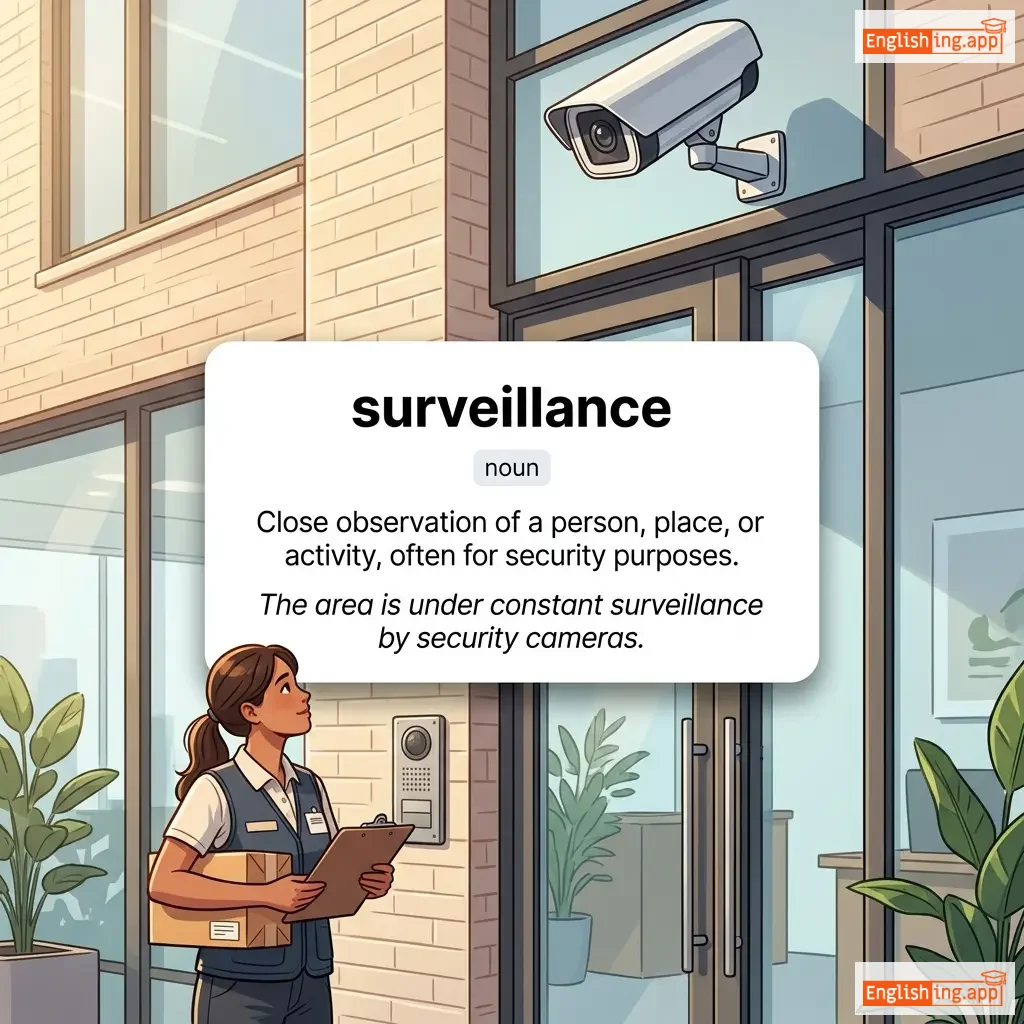
surveillance definition card — visual illustration of the meaning
noun
/sɜːrˈveɪləns/
निगरानी (nigrani)

Close observation of a person, place, or activity, often for security purposes.

"The area is under constant surveillance by security cameras."

"यह क्षेत्र सुरक्षा कैमरों द्वारा निरंतर निगरानी में है।" (yah kshetra suraksha kamaron dwara nirantar nigarani mein hai.)
noun/verb
/ˈsɜːveɪ/
सर्वे, सर्वेक्षण (survey, sarvekshan)

noun: an examination or inspection; verb: to examine or measure (an area or subject)

"They conducted a survey to understand customer preferences."

"उन्होंने ग्राहक की प्राथमिकताओं को समझने के लिए एक सर्वेक्षण किया।" (Unhone grahak ki prathmiktaon ko samajhne ke liye ek survey kiya.)
noun
/sərˈveɪər/
सर्वेक्षक (surveyakshak)

A person who measures and maps land, buildings, or other features.

"The surveyor measured the land for construction."

"सर्वेक्षक ने निर्माण के लिए भूमि मापी।" (surveyakshak ne nirmaan ke liye bhumi maapi.)