वोकैबुलरीज

इंग्लिश वोकैबुलरी डिस्कवर, लर्न और मास्टर करें

adjective/noun
/ˈsʌkjələnt/
रसदार (rasdar)

Juicy or full of juice; also refers to a plant with thick, fleshy leaves adapted to storing water.

"The steak was so succulent that everyone enjoyed it."

"स्टेक इतना रसदार था कि सभी ने इसका आनंद लिया।" (Steak itna rasdar tha ki sabhi ne iska anand liya.)
verb
/səˈkʌm/
वश होकर मरना (vash hokar marna)

To give in to pressure, temptation, or illness; to yield or fail to resist.

"He finally succumbed to his illness after a long struggle."

"वह अंततः लंबी लड़ाई के बाद अपनी बीमारी के सामने हार गया।" (vah antatah lambi ladai ke baad apni bimari ke samne haar gaya.)
determiner
/sʌtʃ/
ऐसा (aisa)

of the type previously mentioned or specified

"I have never seen such a beautiful painting."

"मैंने कभी ऐसा सुंदर चित्र नहीं देखा।" (Maine kabhi aisa sundar chitra nahi dekha.)
verb
/sʌk/
चूसना (choosna)

to draw something into the mouth by using the lips and tongue

"The baby began to suck her thumb."

"बच्चे ने अपनी अंगुली चूसना शुरू किया।" (Bacche ne apni anguli choosna shuru kiya.)
verb
/ˈsʌkɪŋ/
चूसना (choosna)

Drawing in a liquid, air, or other substance through the mouth or a tube by creating a vacuum; also used figuratively for something unpleasant or ineffective

"The baby is sucking on a pacifier."

"शिशु चूसनी पर चूस रहा है।" (shishu choosni par choos raha hai.)
verb
/ˈsʌk.əl/
दूध पिलाना (dudh pilana)

to feed a baby or young animal with milk from the breast or udder

"The mother cat suckled her kittens in the basket."

"माँ बिल्ली ने अपने बिल्लियों को बास्केट में दूध पिलाया।" (Maa billi ne apne billiyon ko basket mein dudh pilaya.)
adjective
/ˈsʌdən/
अचानक (achanak)

occurring or done quickly and unexpectedly

"The sudden change in the weather surprised everyone."

"मौसम में अचानक बदलाव ने सभी को चौंका दिया।" (Mausam mein achanak badlav ne sabhi ko chonka diya.)
adverb
/ˈsʌdənli/
अचानक (achanak)

in a way that happens quickly and unexpectedly

"The lights suddenly went out during the meeting."

"बैठक के दौरान अचानक बत्तियाँ चली गईं।" (Baithak ke dauran achanak battiyan chali gayi.)
adjective
/ˌsuːdəˈrɪfɪk/
पसीना उत्पन्न करने वाला (pasina utpann karne wala)

causing or increasing sweating

"The doctor prescribed a sudorific drug to help reduce the fever."

"डॉक्टर ने बुखार कम करने के लिए एक पसीना उत्पन्न करने वाली दवा दी।" (Doktar ne bukhar kam karne ke liye ek pasina utpann karne wali dawa di.)
verb
/suː/
मुकदमा करना (mukadma karna)

to bring a lawsuit against someone in a court of law

"She decided to sue the company for damages."

"उसने क्षति के लिए कंपनी पर मुकदमा करने का फैसला किया।" (Usne kshati ke liye company par mukadma karne ka faisla kiya.)
verb
/ˈsʌfər/
कष्ट सहना (kasht sahna)

to experience pain, distress, or hardship

"She suffered from a severe headache all day."

"वह पूरे दिन भयंकर सिरदर्द से पीड़ित रही।" (Vah poore din bhayankar sirdard se peedit rahi.)
noun
/ˈsʌfərəns/
सहनशीलता (sahansheelta)

patient endurance of pain, hardship, or delay; passive consent or tolerance

"He lived in poverty with quiet sufferance."

"वह गरीबी में शांतिपूर्वक सहनशीलता के साथ जीता था।" (Wah gareebi mein shaantipoorvak sahansheelta ke saath jeeta tha.)
noun
/ˈsʌfərɪŋ/
पीड़ा (peeda)

the state of undergoing pain, distress, or hardship

"They tried to relieve his suffering with medicine."

"उन्होंने दवा से उसकी पीड़ा को कम करने की कोशिश की।" (Unhone dawa se uski peeda ko kam karne ki koshish ki.)
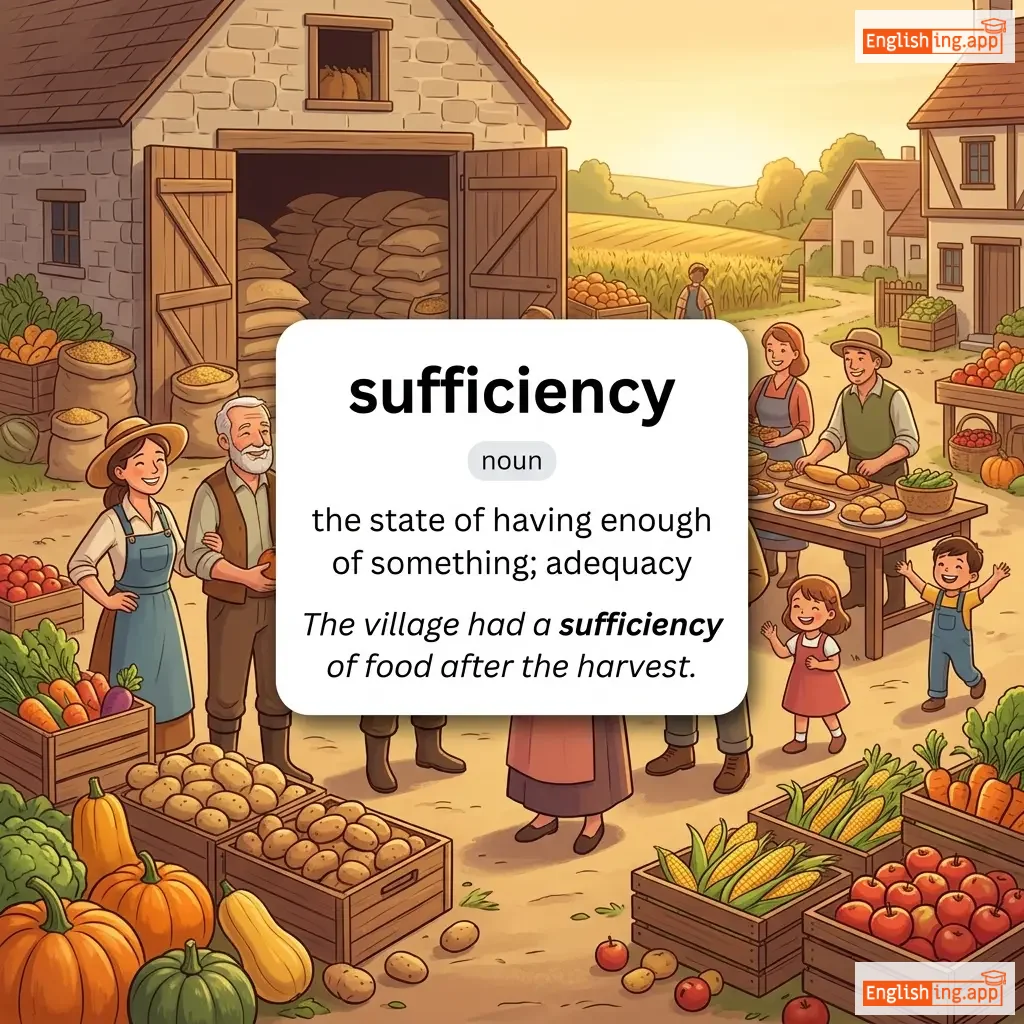
sufficiency definition card — visual illustration of the meaning
noun
/səˈfɪʃənsi/
पर्याप्तता (paryaptata)

the state of having enough of something; adequacy

"The village had a sufficiency of food after the harvest."

"फसल काटने के बाद गाँव में पर्याप्त भोजन था।" (Fasal kaatne ke baad gaon mein paryapt bhojan tha.)
adjective
/səˈfɪʃənt/
पर्याप्त (paryapt)

enough; adequate for a purpose

"She had sufficient money to buy the dress."

"उसके पास ड्रेस खरीदने के लिए पर्याप्त पैसे थे।" (Uske paas dress kharidne ke liye paryapt paise the.)
adverb
/səˈfɪʃəntli/
पर्याप्त रूप से (paryapt roop se)

to an adequate degree or extent

"She studied sufficiently to pass the exam."

"उसने परीक्षा पास करने के लिए पर्याप्त रूप से अध्ययन किया।" (Usne pariksha paas karne ke liye paryapt roop se adhyayan kiya.)
verb
/ˈsʌfəkeɪt/
सांस रुकना (saans rukna)

to cause someone to die or have difficulty breathing by depriving them of air

"The child nearly suffocated when trapped in the locked room."

"बच्चा बंद कमरे में फंसा होने के कारण सांस रुकने का शिकार हो गया।" (Baccha band kamre mein fansa hone ke karan saans rukne ka shikar ho gaya.)
suffrage definition card — visual illustration of the meaning
noun
/ˈsʌfrɪdʒ/
मताधिकार (matadhikar)

the right to vote in political elections

"The movement fought for women’s suffrage in the early 20th century."

"आंदोलन ने बीसवीं सदी की शुरुआत में महिलाओं के मताधिकार के लिए संघर्ष किया।" (aandolan ne beesvin sadi ki shuruaat mein mahilaon ke matadhikar ke liye sangharsh kiya.)
noun
/ˈsʌfrədʒɪst/
मताधिकार समर्थक (matadhikar samarthak)

a person advocating the extension of suffrage, especially to women

"The suffragists organized rallies to demand voting rights for women."

"सफ़्रेजिस्टों ने महिलाओं के लिए मतदान अधिकार की मांग करने के लिए रैलियाँ आयोजित कीं।" (Suffragiston ne mahilaon ke liye matdaan adhikar ki maang karne ke liye rallyen aayojit ki.)
verb
/səˈfjuːz/
व्याप्त होना (vyaapt hona)

to gradually spread through or over something

"A warm glow suffused her face as she smiled."

"जब वह मुस्काई, तो उसके चेहरे पर एक गर्म आभा फैल गई।" (Jab vah muskaai, to uske chehre par ek garm abha phail gayi.)
noun
/ˈʃʊɡər/
चीनी (cheenee)

a sweet substance made from plants or produced synthetically

"She added two spoons of sugar to her tea."

"उसने अपनी चाय में दो चम्मच चीनी डाली।" (Usne apnee chaay mein do chammach cheenee daalee.)
noun
/ˈʃʊɡ.ər ˈkæn.di/
चीनी की मिठाई (cheeni ki mithai)

crystallized sugar formed into small pieces; rock candy made from sugar syrup

"The children enjoyed eating colorful sugar candy at the festival."

"बच्चों ने त्योहार पर रंगीन चीनी की मिठाई खाकर आनंद लिया।" (bachon ne tyohar par rangin cheeni ki mithai khakar anand liya)
verb
/səˈdʒɛst/
प्रस्ताव देना (prastav dena)

to put forward an idea, plan, or recommendation for consideration

"He suggested going to the new restaurant for dinner."

"उसने रात के खाने के लिए नए रेस्तरां में जाने का सुझाव दिया।" (Usne raat ke khane ke liye naye restaurant mein jaane ka sujhav diya.)
adjective
/səˈdʒɛstəbəl/
आसानी से प्रभावित (aasani se prabhavit)

easily influenced by the suggestions of others

"Children are highly suggestible and may believe what they are told."

"बच्चे बहुत आसानी से प्रभावित होते हैं और जो उन्हें बताया जाता है, उस पर विश्वास कर सकते हैं।" (Bacche bahut aasani se prabhavit hote hain aur jo unhe bataya jata hai, us par vishwas kar sakte hain.)
noun
/səˈdʒɛstʃən/
सुझाव (sujhav)

an idea or plan put forward for consideration or action

"She gave a suggestion for improving the project."

"उसने परियोजना को सुधारने के लिए एक सुझाव दिया।" (Usne pariyojana ko sudharne ke liye ek sujhav diya.)
adjective
/səˈdʒɛstɪv/
संकेतात्मक (sanketatmak)

tending to suggest ideas or images; sometimes implies something sexual or provocative

"The painting was highly suggestive and sparked much debate."

"चित्रकला अत्यधिक संकेतात्मक थी और इसने काफी बहस को जन्म दिया।" (Chitrakala atyadhik sanketatmak thi aur isne kaafi bahas ko janm diya.)
adjective
/ˌsuːɪˈsaɪdəl/
आत्मघाती (aatmghati)

relating to or having thoughts of killing oneself; extremely dangerous or harmful

"The reckless driving was suicidal behavior."

"लापरवाह ड्राइविंग आत्मघाती व्यवहार था।" (laparwah driving aatmghati vyavhaar tha.)
noun
/ˈsuːɪˌsaɪd/
आत्महत्या (aatmahatya)

the act of intentionally taking one's own life

"The article discusses the rising rates of suicide in young people."

"लेख में युवा लोगों में आत्महत्या की दर बढ़ने पर चर्चा की गई है।" (Lekh mein yuva logon mein aatmahatya ki dar badhne par charcha ki gayi hai.)
noun
/suːt/
सूट (suṭ)

a set of clothes made of the same fabric, usually consisting of trousers and a jacket

"He wore a black suit to the wedding."

"उसने शादी में काले रंग का सूट पहना।" (Usne śādī meṁ kāle raṅg kā suṭ pehnā.)
adjective
/ˈsuːtəbl/
उपयुक्त (upayukt)

appropriate or right for a particular person, purpose, or situation

"This dress is suitable for the wedding."

"यह पोशाक शादी के लिए उपयुक्त है।" (Yah poshak shaadi ke liye upayukt hai.)
noun
/ˈsuːt.keɪs/
सूटकेस (suitkes)

A portable rectangular container for carrying clothes and personal items when traveling

"She packed her clothes into a suitcase for the trip."

"उसने अपनी यात्रा के लिए कपड़े एक सूटकेस में पैक किए।" (Usne apni yatra ke liye kapde ek suitkes me paek kiye.)
noun
/swiːt/
सुइट (suit)

a set of rooms designated for one person's or family's use or for a particular purpose

"They stayed in the presidential suite at the hotel."

"वे होटल में प्रेसीडेंशियल सुइट में ठहरे थे।" (Ve hotel mein presidential suite mein thahre the.)
noun
/ˈsuːtər/
प्रेमी (premi)

a man who pursues a relationship with a woman, often with the intent to marry

"She had many suitors vying for her attention."

"उसका ध्यान आकर्षित करने के लिए कई प्रेमी प्रयास कर रहे थे।" (uska dhyan akarshit karne ke liye kai premi prayas kar rahe the)
sulk definition card — visual illustration of the meaning
verb
/sʌlk/
चुपचाप गुस्से में बैठना (chupchup gusse mein baithna)

to be silently resentful or moody

"He went to his room to sulk after the argument."

"वह बहस के बाद चुपचाप अपने कमरे में जाकर सल्क गया।" (Vah bahas ke baad chupchup apne kamre mein jaakar sulk gaya.)
adjective
/ˈsʌl.ki/
चिड़चिड़ा और चुपचाप; मूडी (chidchida aur chupchup; moody)

bad-tempered and sullen; moody

"The child became sulky when he couldn't get his favorite toy."

"बच्चा चिड़चिड़ा हो गया जब वह अपनी पसंदीदा खिलौना नहीं पा सका।" (bachcha chidchida ho gaya jab wah apni pasandida khilona nahi paa saka.)
adjective
/ˈsʌlən/
चिड़चिड़ा (chidhchidhā)

bad-tempered and gloomy; silently resentful

"She gave him a sullen look and walked away."

"उसने उसे एक चिड़चिड़ी नजर से देखा और चली गई।" (Usne use ek chidhchidhī nazar se dekhā aur chalī ga'ī.)
verb
/ˈsʌli/
कलंकित करना (kalankit karna)

to damage the purity, integrity, or reputation of something

"The scandal sullied the politician’s reputation."

"केलेंकार ने राजनेता की प्रतिष्ठा को कलंकित किया।" (Kelenkar ne rajneta ki pratishtha ko kalankit kiya.)
adjective
/ˈsʌltri/
गर्म और आर्द्र, आकर्षक (garm aur aardra, aakarshak)

Uncomfortably hot and humid; also describes someone attractive in a passionate or sensual way.

"The sultry weather made it hard to focus on work."

"गर्मी और आर्द्र मौसम ने काम पर ध्यान केंद्रित करना मुश्किल बना दिया।" (garmi aur ardhra mausam ne kaam par dhyaan kendrit karna mushkil bana diya.)
noun
/sʌm/
योगफल (yogfal)

the total amount resulting from the addition of two or more numbers or items

"The sum of 8 and 12 is 20."

"8 और 12 का योगफल 20 है।" (8 aur 12 ka yogfal 20 hai.)
verb
/ˈsʌməraɪz/
सारांश प्रस्तुत करना (saransh prastut karna)

To give a brief statement of the main points of something

"She summarized the report in just a few minutes."

"उसने रिपोर्ट को केवल कुछ मिनटों में सारांश प्रस्तुत किया।" (Usne report ko keval kuch minuton me saransh prastut kiya)
noun
/ˈsʌməri/
सारांश (saaransh)

A brief statement of the main points of something.

"She wrote a summary of the book for her class."

"उसने अपनी कक्षा के लिए पुस्तक का सारांश लिखा।" (Usne apni kaksha ke liye pustak ka saaransh likha.)
noun
/sʌˈmeɪʃən/
योगफल, सारांश (yogfal, saransh)

The process of adding things together; a summary of points.

"The lawyer gave a powerful summation of the case."

"वकील ने मामले का एक शक्तिशाली समापन प्रस्तुत किया।" (vakil ne mamle ka ek shaktishaali samaapan prastut kiya.)
noun
/ˈsʌmər/
समर (samar)

the warmest season of the year, between spring and autumn

"We love going to the beach during summer."

"हमें समर में बीच पर जाना बहुत पसंद है।" (Humein summer mein beach par jana bahut pasand hai.)
summit definition card — visual illustration of the meaning
noun
/ˈsʌmɪt/
चोटी, शिखर (choti, shikhar)

The highest point of a hill or mountain; a meeting between heads of state or leaders.

"The leaders met at the summit to discuss global issues."

"नेता वैश्विक मुद्दों पर चर्चा करने के लिए शिखर सम्मेलन में मिले।" (neta vaishvik muddon par charcha karne ke liye shikhar sammelan mein mile.)
Summit of the Future definition card — visual illustration of the meaning
noun
/ˈsʌm.ɪt əv ðə ˈfjuː.tʃər/
भविष्य सम्मेलन (bhavishya sammelan)

A high-level conference focused on addressing future challenges and opportunities.

"The Summit of the Future addressed global challenges."

"भविष्य सम्मेलन ने वैश्विक चुनौतियों पर चर्चा की।" (Bhavishya sammelan ne vaishvik chunautiyon par charcha ki.)
verb
/ˈsʌmən/
आह्वान करना, बुलाना (ahwan karna, bulana)

To order someone to come or to gather courage or strength.

"The king summoned his advisors to the court."

"राजा ने अपने सलाहकारों को दरबार में बुलाया।" (raja ne apne salahkaron ko darbar mein bulaya.)
adjective
/ˈsʌmp.tʃuˌɛr.i/
वैशिष्ट्यपूर्ण खर्च से संबंधित (vaishishtyapurn kharch se sambandhit)

Relating to laws or regulations intended to limit personal spending on luxury goods.

"In medieval Europe, sumptuary laws restricted the wearing of expensive fabrics to the nobility."

"मध्यकालीन यूरोप में, संपूर्ण खर्च कानूनों ने महंगे कपड़ों के पहनने को केवल अभिजात वर्ग तक सीमित कर दिया था।" (Madhyakalīn Yūrop mein, sampūrn kharch kānūno ne mahenge kapdon ke pehennē ko keval abhjāt varg tak sīmit kar diyā thā.)
adjective
/ˈsʌmp.tʃu.əs/
विलासी (vilasi)

Splendid and expensive-looking; luxurious.

"The guests were treated to a sumptuous banquet."

"मेहमानों को एक शानदार भोज परोसा गया था।" (Mehmanon ko ek shandar bhoj parosa gaya tha.)
noun
/sʌn/
सूर्य (surya)

the star that provides light and heat to the Earth

"The sun rises in the east and sets in the west."

"सूर्य पूरब से उगता है और पश्चिम में डूबता है।" (Surya purab se ugta hai aur pashchim mein doobta hai.)
noun
/ˈsʌn.flaʊər/
सूरजमुखी (surajmukhi)

a large yellow flower that turns to face the sun

"The sunflower field looked amazing in the bright sunlight."

"सूरजमुखी का खेत चमकदार धूप में अद्भुत लग रहा था।" (surajmukhi ka khet chamakdar dhoop me adbhut lag raha tha)