वोकैबुलरीज

इंग्लिश वोकैबुलरी डिस्कवर, लर्न और मास्टर करें

noun
/stʌf/
सामान (samaan)

a collection of things or materials, typically unspecified or uncountable

"She packed all her stuff into the suitcase."

"उसने अपना सारा सामान सूटकेस में पैक किया।" (Usne apna saara samaan suitcase mein pack kiya.)
adjective
/ˈstʌf.i/
बिना ताजगी के हवा; खराब वेंटिलेटेड; औपचारिक और रूढ़िवादी दृष्टिकोण (bina tazgi ke hawa; kharab ventilated; aupcharik aur rudhivadi drishtikon)

lacking fresh air; poorly ventilated; formal and conservative in attitude

"The room was stuffy and needed fresh air."

"कमरे में ताजगी की हवा की कमी थी और ताजगी की हवा की आवश्यकता थी।" (kamre mein tazgi ki hawa ki kami thi aur tazgi ki hawa ki avashyakta thi)
verb
/ˈstʌltɪfaɪ/
मूर्ख बनाना या प्रभावशीलता और उत्साह को बाधित करना (moorkh banana ya prabhavsheelta aur utsah ko baadhit karna)

to make someone or something appear foolish, or to hinder effectiveness and enthusiasm

"The repetitive tasks seemed to stultify the workers' creativity."

"दोहराए गए कार्यों ने श्रमिकों की रचनात्मकता को रोक दिया था।" (Dohraaye gaye kaaryon ne shramikon ki rachnatmakta ko rok diya tha.)
verb
/ˈstʌmbəl/
ठोकर खाना (thokar khana)

to trip or lose balance while walking or running; to make a mistake or falter

"He stumbled on the uneven pavement."

"वह असमान सड़क पर ठोकर खा गया।" (Woh asamaan sadak par thokar khaa gaya.)
noun/verb
/stʌmp/
वृक्ष का ठूंठ, भ्रमित करना (vriksh ka thoonth, bhramit karna)

the base of a tree left after the trunk is cut down; to puzzle or confuse

"The question completely stumped the students."

"प्रश्न ने छात्रों को पूरी तरह से स्तब्ध कर दिया।" (Prashn ne chhatron ko poori tarah se stabbdh kar diya.)
adjective
/ˈstʌm.pi/
मुंह चपटा और मोटा (munh chapta aur mota)

short and thick; having a short, thick appearance

"The stumpy little dog wagged its tail enthusiastically."

"वो छोटा सा मोटा कुत्ता खुशी से अपनी पूंछ हिला रहा था।" (vo chhota sa mota kutta khushi se apni poonch hila raha tha)
verb
/stʌn/
चौंकाना, हैरान करना (chaunkaana, hairaan karna)

to shock or surprise someone greatly; to knock someone unconscious or dazed

"The news of her sudden resignation stunned everyone."

"उसकी अचानक इस्तीफे की खबर ने सभी को चौंका दिया।" (Uski achanak isteefe ki khabar ne sabhi ko chaunka diya.)
adjective
/ˈstʌnɪŋ/
अद्भुत (adbhut)

extremely impressive or attractive

"The view from the top of the mountain was absolutely stunning."

"पहाड़ के शिखर से दृश्य बिल्कुल अद्भुत था।" (Pahad ke shikhar se drishya bilkul adbhut tha.)
noun/verb
/stʌnt/
कला, करतब, वृद्धि में रुकावट डालना (kala, kartab, vruddhi mein rukavat dalna)

a daring or unusual action performed for entertainment or publicity; to hinder growth or development

"The actor performed a dangerous stunt in the movie."

"अभिनेता ने फिल्म में एक खतरनाक स्टंट किया।" (Abhineta ne film mein ek khatarnaak stunt kiya.)
verb
/ˈstjuːpɪˌfaɪ/
हैरान करना (hairan karna)

to make someone unable to think clearly, usually because of surprise or shock

"The magician's tricks stupefied the audience."

"जादूगर के करतबों ने दर्शकों को हैरान कर दिया।" (Jadugar ke kartabon ne darshako ko hairan kar diya.)
adjective
/stjuːˈpɛndəs/
असाधारण (asadharan)

extremely impressive; amazing in size, degree, or excellence

"The magician’s performance was simply stupendous."

"जादूगर का प्रदर्शन सचमुच असाधारण था।" (Jadugar ka pradarshan sachmuch asadharan tha.)
adjective
/ˈstjuːpɪd/
बेवकूफ (bevakoof)

lacking intelligence or common sense

"It was a stupid mistake to leave the keys inside the car."

"कार के अंदर चाबियाँ छोड़ना एक बेवकूफी भरी गलती थी।" (kaar ke andar chaabiyaan chhodna ek bevakoofi bharee galatee thee)
noun
/stjuːˈpɪdəti/
मूर्खता (moorkhta)

lack of intelligence or common sense

"His stupidity caused a lot of problems for the team."

"उसकी मूर्खता ने टीम के लिए कई समस्याएँ पैदा की।" (uski moorkhta ne team ke liye kai samasyaen paida ki)
noun
/ˈstjuːpər/
मूर्छा (moorchha)

a state of near-unconsciousness or insensibility

"He remained in a stupor after hearing the shocking news."

"वह चौंकाने वाली खबर सुनने के बाद मूर्छित हो गया था।" (Wah chaunkaane waali khabar sunne ke baad moorchhit ho gaya tha.)
adjective
/ˈstɜːrdi/
मजबूत (majboot)

strongly and solidly built; not easily weakened

"The carpenter made a sturdy wooden table."

"कारपेंटर ने एक मजबूत लकड़ी की मेज बनाई।" (Carpenter ne ek majboot lakdi ki mez banayi.)
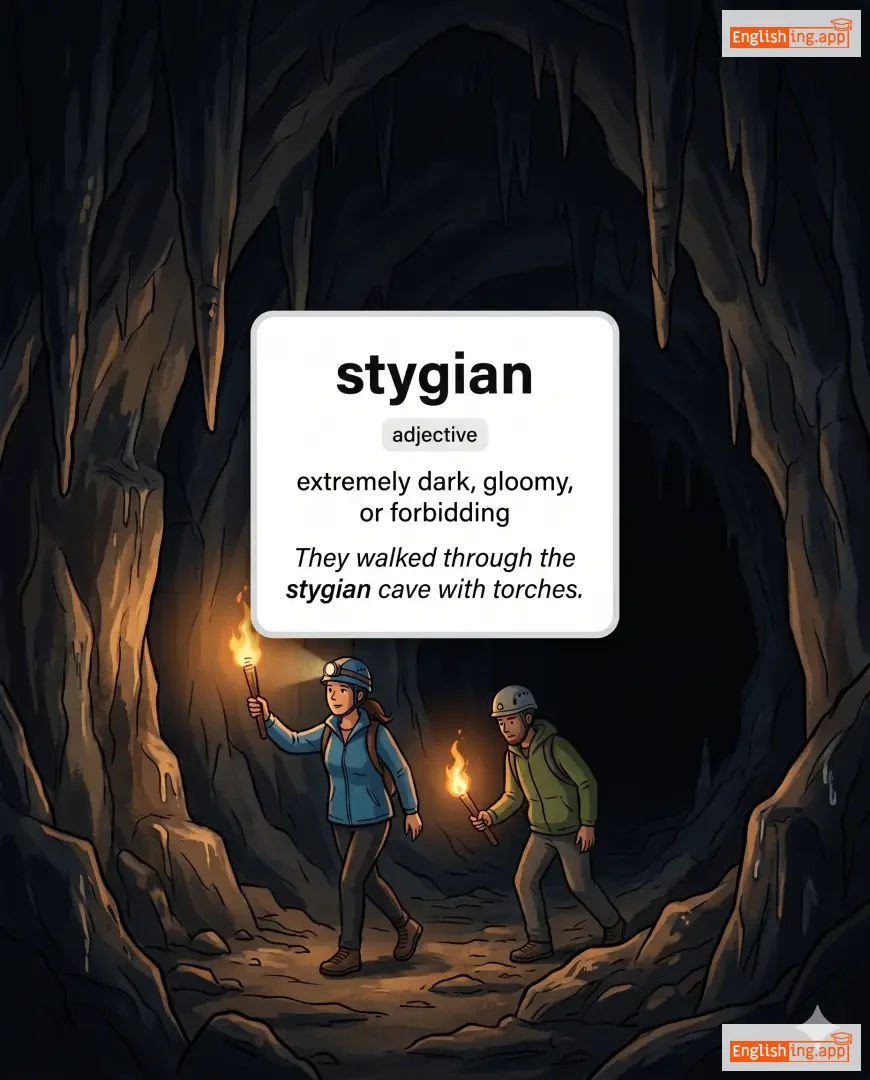
stygian definition card — visual illustration of the meaning
adjective
/ˈstɪdʒiən/
अंधकारमय (andhkaramay)

extremely dark, gloomy, or forbidding

"They walked through the stygian cave with torches."

"वे मशालों के साथ अंधकारमय गुफा में चल रहे थे।" (Ve mashalon ke sath andhkaramay gufah mein chal rahe the.)
noun
/staɪl/
शैली (shaili)

a particular way of doing or presenting something, often reflecting individual preferences or trends

"Her style of dress is both elegant and modern."

"उसका ड्रेसिंग स्टाइल दोनों ही एलिगेंट और आधुनिक है।" (Uska dressing style dono hi elegant aur aadhunik hai.)
adjective
/ˈstaɪ.lɪʃ/
फैशनेबल और आकर्षक; रूप में elegance या स्वाद रखने वाला (fashionable aur aakarshak; roop mein elegance ya swaad rakhne wala)

fashionable and attractive; having elegance or taste in appearance

"She wore a stylish dress to the party."

"उसने पार्टी में एक स्टाइलिश ड्रेस पहनी थी।" (Usne party mein ek stylish dress pehni thi.)
noun
/ˈstaɪləs/
स्टाइलस (stylus)

a small tool used for writing, drawing, or touching screens

"She used a stylus to draw on her tablet."

"उसने अपनी टैबलेट पर चित्र बनाने के लिए स्टाइलस का इस्तेमाल किया।" (Usne apni tablet par chitra banane ke liye stylus ka istemal kiya.)
verb
/ˈstaɪmi/
रोकना (rokna)

to prevent or hinder the progress of something

"The new regulations could stymie small businesses."

"नए नियम छोटे व्यवसायों को रोक सकते हैं।" (Naye niyam chhote vyavsayon ko rok sakte hain.)
noun
/ˈsweɪʒən/
प्रेरणा (prerna)

the act of persuading or influencing someone

"The leader used gentle suasion to win support for the plan."

"नेता ने योजना के लिए समर्थन प्राप्त करने के लिए कोमल प्रेरणा का उपयोग किया।" (Neta ne yojana ke liye samarthan prapt karne ke liye komal prerna ka upyog kiya.)
adjective
/swɑːv/
आकर्षक और सुरुचिपूर्ण (aakarshak aur suruchipurn)

charming, confident, and elegant, often in a smooth or polished way

"He was a suave gentleman who impressed everyone at the party."

"वह एक सुरुचिपूर्ण सज्जन था जिसने पार्टी में सबको प्रभावित किया।" (Vah ek suruchipurn sajjan tha jismein party mein sabko prabhavit kiya.)
noun
/ˈswɑːvɪti/
मृदुता और आकर्षण (mriduta aur aakarshan)

smoothness and charm in manner

"His suavity made him popular in social gatherings."

"उसकी मृदुता और आकर्षण ने उसे सामाजिक आयोजनों में लोकप्रिय बना दिया।" (Uski mriduta aur aakarshan ne use samajik aayojan mein lokpriya bana diya.)
adverb
/ˌsʌb ˈroʊzə/
गोपनीय रूप से (gopneeya roop se)

secretly, in confidence, or in private

"The deal was made sub rosa to avoid public scrutiny."

"सौदा सब रोसा किया गया था ताकि सार्वजनिक जांच से बचा जा सके।" (Sauda sab rosa kiya gaya tha taki saarvajanik jaanch se bacha ja sake.)
noun
/ˈsʌb.mə.riːn/
पनडुब्बी (pandubbi)

a warship with a streamlined hull designed to operate completely submerged in the sea

"The submarine dived deep into the ocean to avoid detection."

"संदेह से बचने के लिए पनडुब्बी समुद्र की गहराई में डूब गई।" (sandeh se bachne ke liye pandubbi samudr ki gehraai mein doob gayi.)
adjective
/ˈsʌb.æs.ɪd/
हल्का खट्टा (halka khatta)

Slightly sour or acidic in taste or nature.

"The fruit had a subacid flavor that was refreshing on a hot day."

"फलों का हल्का खट्टा स्वाद था जो गर्मी के दिन में ताजगी प्रदान करता था।" (phalon ka halka khatta swad tha jo garmi ke din mein tajgi pradan karta tha.)
noun
/sʌbˈɔːl.tən/
किसी व्यक्ति जो अधीनस्थ स्थिति में हो; सैन्य में, एक जूनियर अधिकारी (subaltern)

A person holding a subordinate position; in the military, a junior officer.

"The subaltern was responsible for leading a small platoon of soldiers."

"सबऑल्टर्न छोटे सैनिकों के एक प्लाटून का नेतृत्व करने के लिए जिम्मेदार था।" (subaltern chhote sainikon ke ek platoon ka netritva karne ke liye zimmedar tha.)
adjective
/ˌsʌb.əˈkwɒt.ɪk/
जलमग्न (jalmagn)

Existing, living, or located under water.

"Divers explored the subaquatic cave system filled with rare fish."

"डाइवर्स ने दुर्लभ मछलियों से भरे जलमग्न गुफा प्रणाली का अन्वेषण किया।" (divers ne durlabh machhliyon se bhare jalmagn gufha pranali ka anvshan kiya.)
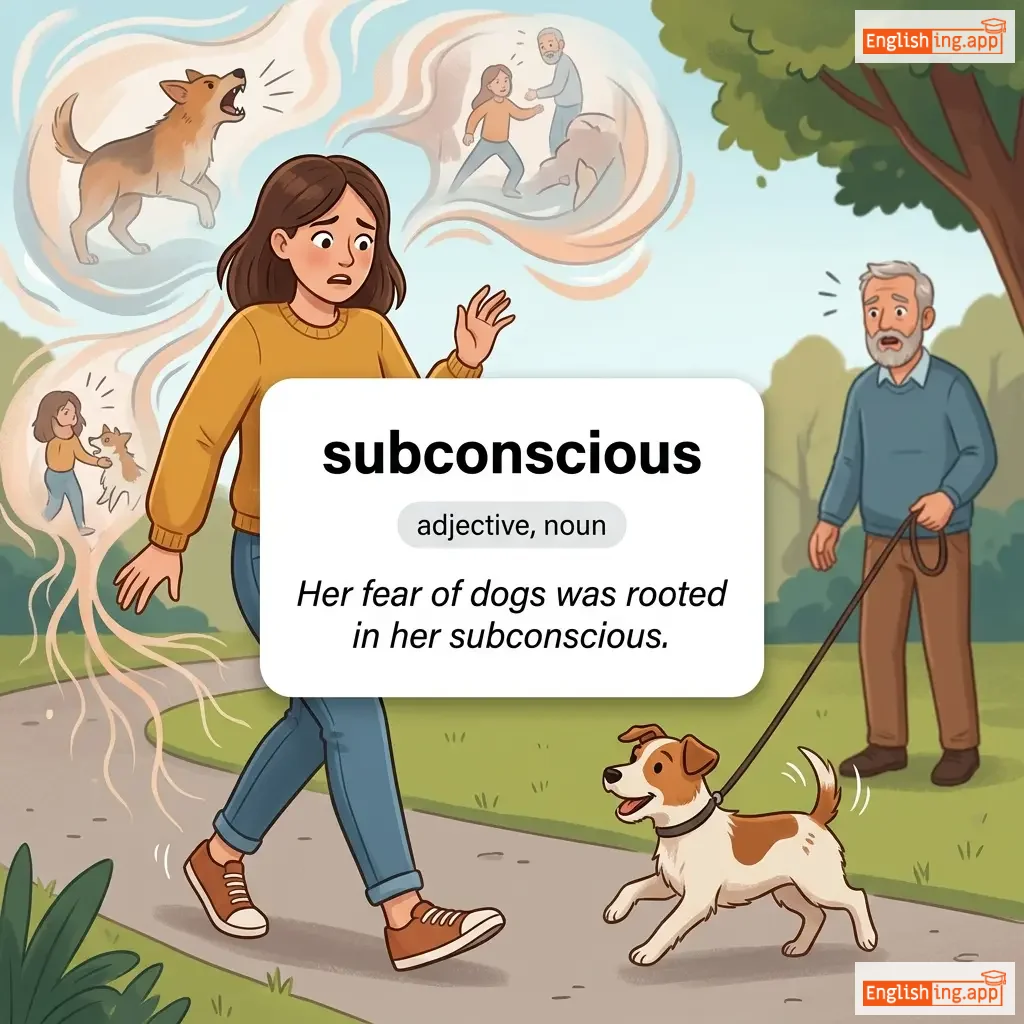
subconscious definition card — visual illustration of the meaning
adjective, noun
/ˌsʌbˈkɒn.ʃəs/
अवचेतन (avchetan)

Relating to the part of the mind that influences thoughts and actions without full awareness.

"Her fear of dogs was rooted in her subconscious."

"उसका कुत्तों से डर उसके अवचेतन में छिपा हुआ था।" (uska kutto se dar uske avchetan mein chhupa hua tha.)
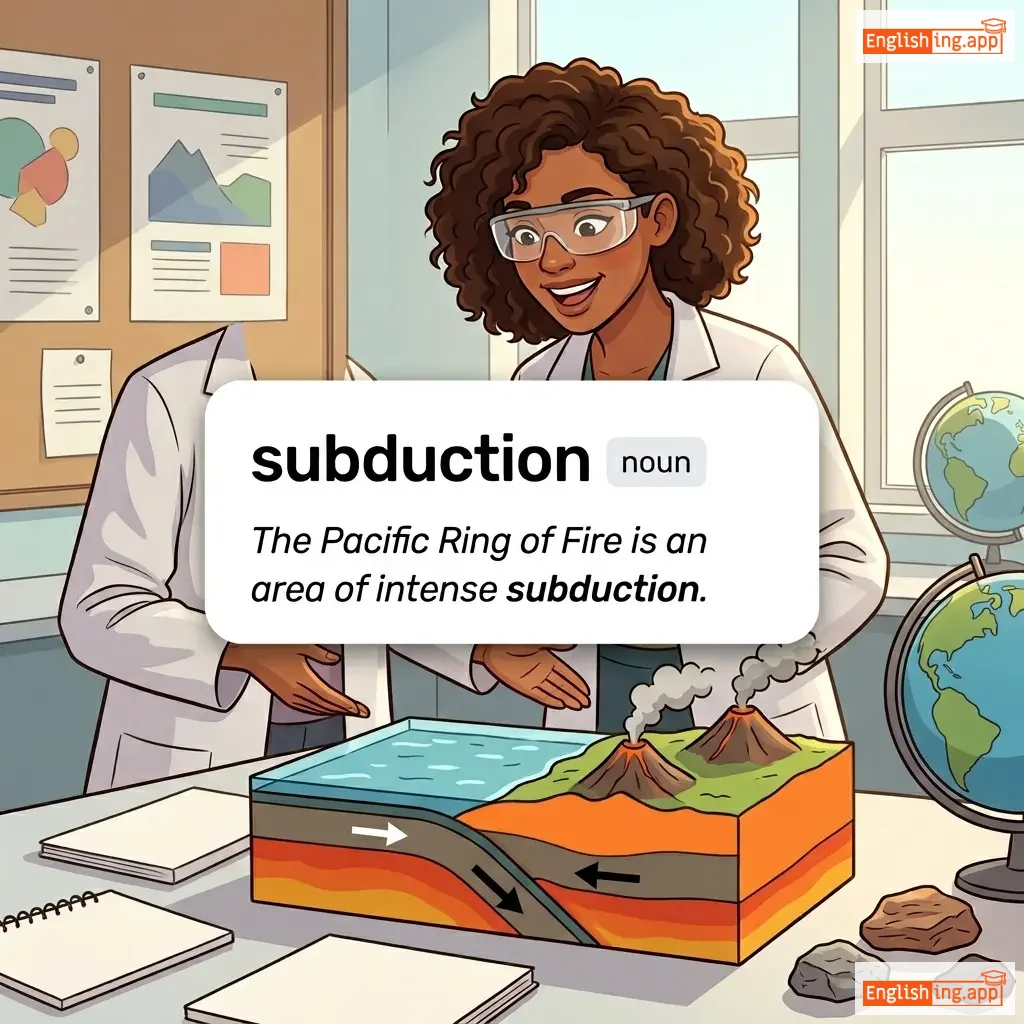
subduction definition card — visual illustration of the meaning
noun
/səbˈdʌk.ʃən/
पृथ्वी की सतह की एक परत का दूसरी परत के नीचे जाना (prithvi ki sathah ki ek parat ka doosri parat ke neeche jana)

The lateral and downward movement of the edge of a plate of the earth's crust into the mantle beneath another plate.

"The Pacific Ring of Fire is an area of intense subduction."

"पैसिफिक रिंग ऑफ फायर एक क्षेत्र है जहाँ गहरी सबडक्शन होती है।" (Pacific ring of fire ek kshetra hai jahan gehri subduction hoti hai.)
verb
/səbˈdjuː/
दबाना (dabaana)

To bring under control, especially by force; to overcome or quiet.

"The army was able to subdue the rebellion quickly."

"सेना जल्दी ही विद्रोह को दबाने में सक्षम हो गई।" (sena jaldi hi vidroh ko dabaane mein saksham ho gayi.)
adjective
/sʌbˈdʒeɪsənt/
नीचे स्थित (neeche sthit)

lying immediately beneath; underlying

"The geological survey revealed subjacent layers of rock."

"भूतत्वीय सर्वेक्षण ने नीचे स्थित चट्टानों की परतें प्रकट कीं।" (Bhootatviy survey ne neeche sthit chattanon ki paratein prakat ki.)
noun/verb/adjective
/ˈsʌbdʒɪkt/ (noun), /səbˈdʒɛkt/ (verb)
विषय (vishay)

noun: a topic or theme; verb: to cause to undergo; adjective: dependent or under authority

"The teacher introduced a new subject in class."

"शिक्षक ने क्लास में एक नया विषय पेश किया।" (Shikshak ne class mein ek naya vishay pesh kiya.)
noun
/səbˈdʒɛkʃən/
आधीनता (aadhinata)

the act of bringing someone or something under control or domination

"The people suffered under the subjection of a cruel ruler."

"लोग एक क्रूर शासक के अधीनता में कष्ट भोग रहे थे।" (Log ek kroor shasak ke adhinata mein kasht bhog rahe the.)
adjective
/səbˈdʒɛktɪv/
व्यक्तिगत (vyaktigat)

based on personal feelings, tastes, or opinions rather than facts

"Beauty is often considered a subjective concept."

"सौंदर्य को अक्सर एक व्यक्तिगत अवधारणा के रूप में माना जाता है।" (Soundarya ko aksar ek vyaktigat avdharna ke roop mein maana jaata hai.)
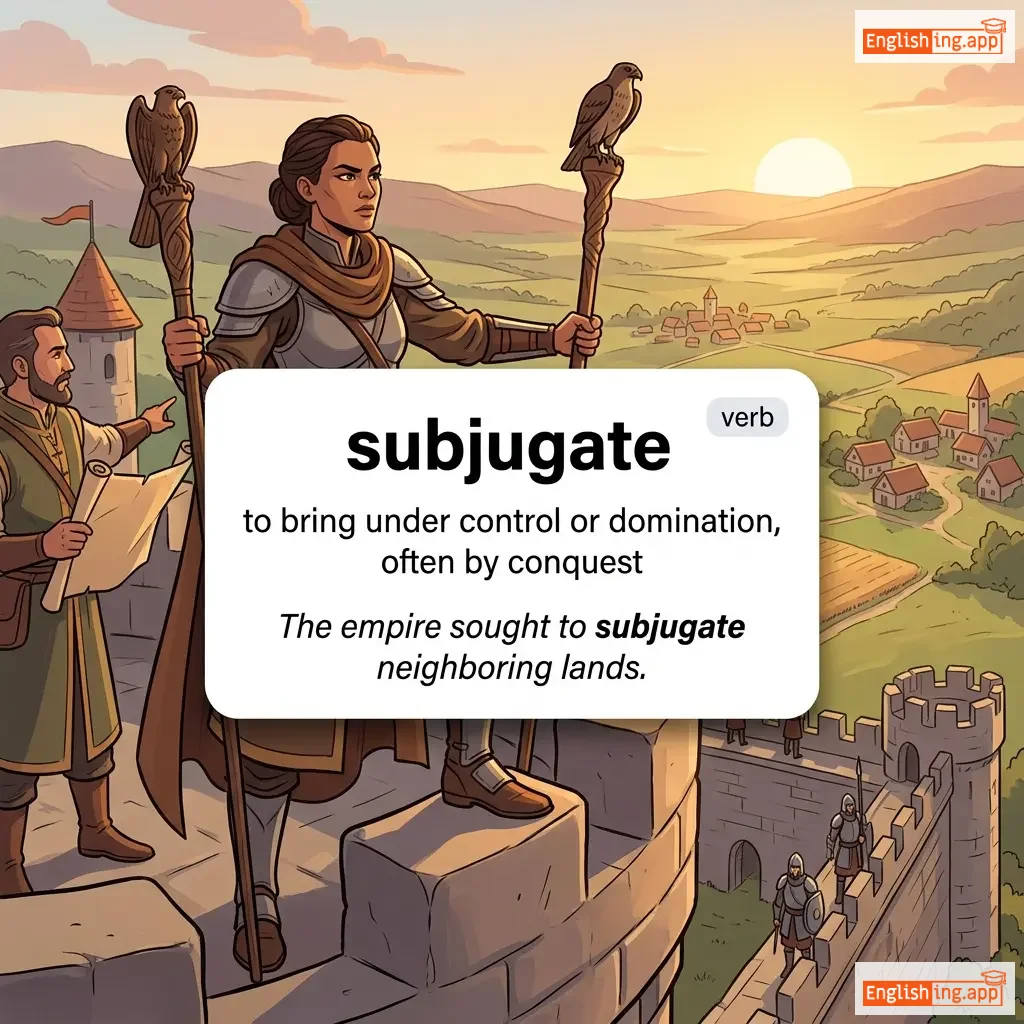
subjugate definition card — visual illustration of the meaning
verb
/ˈsʌbdʒʊˌɡeɪt/
अधीन करना (adhin karna)

to bring under control or domination, often by conquest

"The empire sought to subjugate neighboring lands."

"साम्राज्य ने पड़ोसी भूमि को अधीन करने का प्रयास किया।" (Samrajya ne padosi bhumi ko adheen karne ka prayaas kiya.)
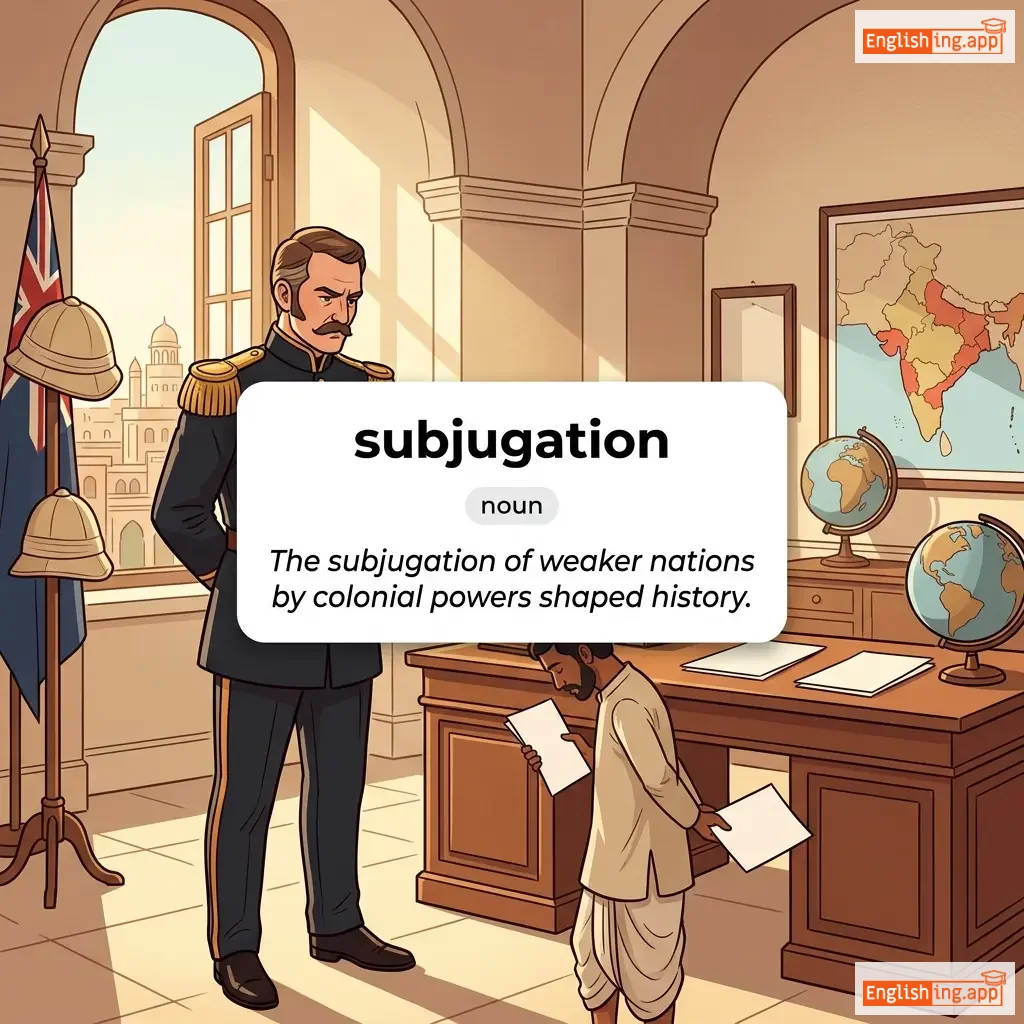
subjugation definition card — visual illustration of the meaning
noun
ˌsʌb.dʒʊˈɡeɪ.ʃən
वर्चस्व या अधीनता (varchasv ya adheenta)

The action of bringing someone or something under domination or control, especially by force.

"The subjugation of weaker nations by colonial powers shaped history."

"औपनिवेशिक शक्तियों द्वारा कमजोर देशों का वर्चस्व इतिहास को आकार देता है।" (Aupniveshik shaktiyon dwara kamzor deshon ka varchasv itihas ko aakar deta hai.)
verb
/ˈsʌblɪmeɪt/
उच्चतर गतिविधियों में रूपांतरित करना (uchchtar gatividhiyon mein roopantarit karna)

to redirect strong emotions or desires into socially acceptable activities or channels

"She sublimated her anger into painting beautiful landscapes."

"उसने अपने गुस्से को खूबसूरत लैंडस्केप्स पेंट करने में सब्लीमेट किया।" (Usne apne gusse ko khoobsurat landscape paint karne mein sublimate kiya.)
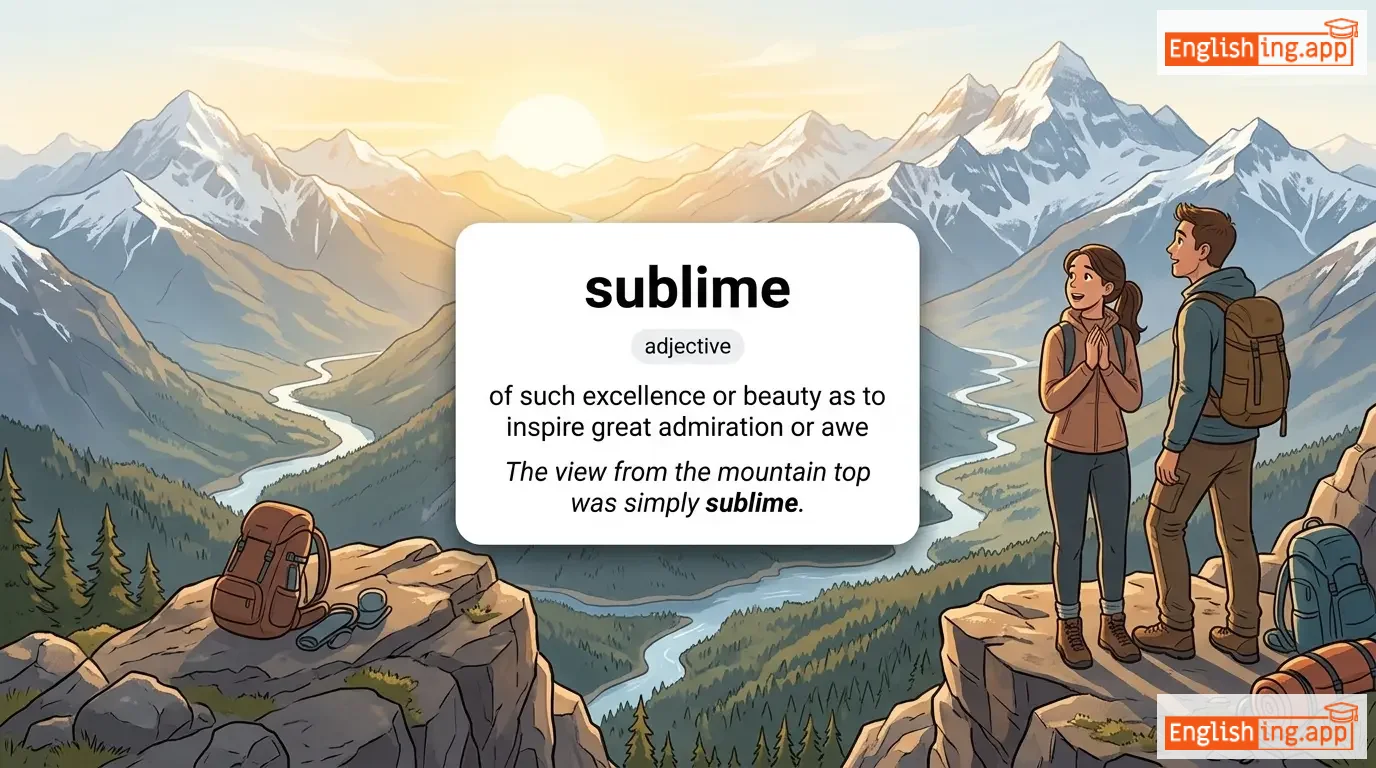
sublime definition card — visual illustration of the meaning
adjective
/səˈblaɪm/
अतुलनीय (atulniya)

of such excellence or beauty as to inspire great admiration or awe

"The view from the mountain top was simply sublime."

"पहाड़ की चोटी से दृश्य सच में अतुलनीय था।" (Pahad ki choti se drishya sach mein atulniya tha.)
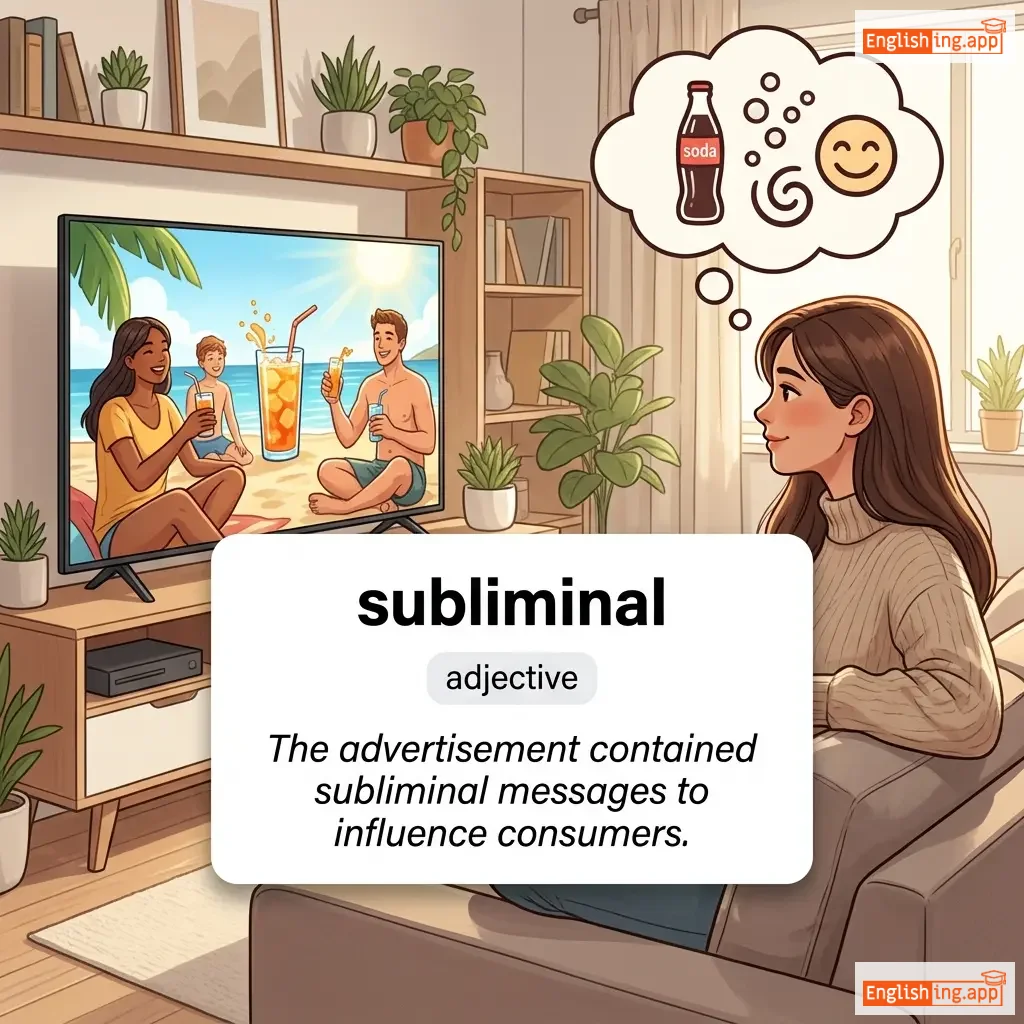
subliminal definition card — visual illustration of the meaning
adjective
/sʌbˈlɪmɪnəl/
अवचेतन (avchetan)

below the threshold of conscious perception but still influencing behavior or feelings

"The advertisement contained subliminal messages to influence consumers."

"विज्ञापन में उपभोक्ताओं को प्रभावित करने के लिए अवचेतन संदेश थे।" (Vigyaapan mein upbhoktaon ko prabhavit karne ke liye avchetan sandesh the.)
adjective
/sʌbˈlɪŋɡwəl/
जीभ के नीचे (jeebh ke neeche)

situated or applied under the tongue

"The doctor prescribed a sublingual tablet for faster absorption."

"डॉक्टर ने तेज अवशोषण के लिए एक सबलिंग्वल टैबलेट निर्धारित की।" (Doktar ne tez avshoshan ke liye ek sublingual tablet nirdharit ki.)
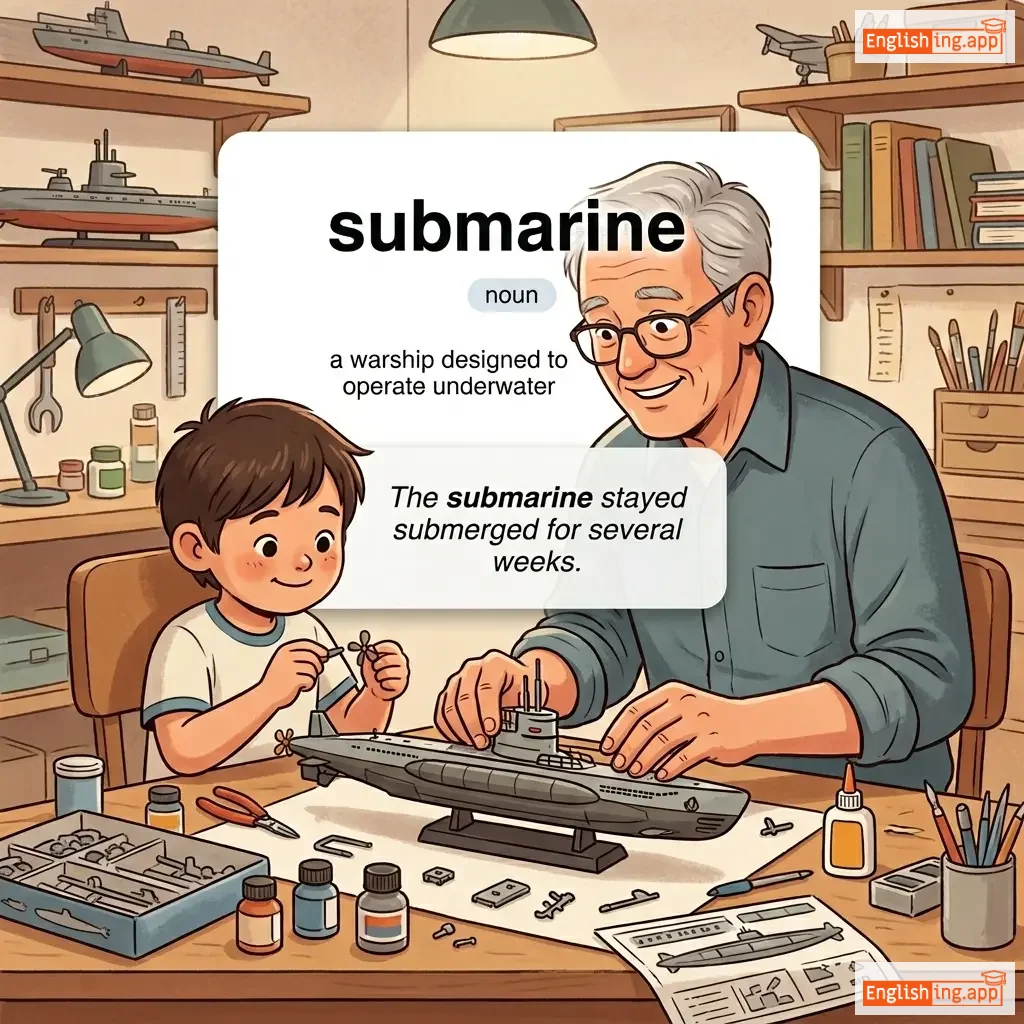
submarine definition card — visual illustration of the meaning
noun
/ˈsʌbməriːn/
पनडुब्बी (pandubbi)

a warship designed to operate underwater

"The submarine stayed submerged for several weeks."

"पनडुब्बी कई हफ्तों तक पानी के नीचे डुबो रही थी।" (Pandubbi kai hafton tak paani ke neeche dubo rahi thi.)
verb
/səbˈmɜːrdʒ/
डुबोना (dubona)

to put under water or cover with liquid

"The floodwaters threatened to submerge the village."

"बाढ़ के पानी ने गाँव को डुबोने की धमकी दी थी।" (baadh ke pani ne gaanv ko dubone ki dhamki di thi.)
noun
/səbˈmɜːrdʒəns/
जलमग्नता (jalmagnata)

the act or process of being submerged or going underwater

"The submergence of coastal areas is a major concern due to rising sea levels."

"समुद्र स्तर में वृद्धि के कारण तटीय क्षेत्रों का जलमग्न होना एक प्रमुख चिंता है।" (samudra sttar mein vruddhi ke karan tatiya kshetron ka jalmagnta hona ek pramukh chinta hai)
adjective, noun
/səbˈmɜːrsəbl/
जलमग्न यान (jalmagn yan)

capable of being submerged; a small underwater craft

"The scientists explored the deep ocean using a submersible."

"वैज्ञानिकों ने एक जलमग्न यान का उपयोग करके गहरे महासागर की खोज की।" (vaigyanikon ne ek jalmagn yan ka upyog karke gahre mahasagar ki khoj ki.)
noun
/səbˈmɜːrʒən/
जलमग्नता (jalmagnata)

the state of being under water

"The submersion of the fields lasted for several days after the heavy rain."

"भारी बारिश के बाद खेतों की जलमग्नता कई दिनों तक चली।" (bhaari baarish ke baad kheton ki jalmagnata kai dinon tak chali.)
noun
/səbˈmɪʃən/
समर्पण, प्रस्तुत करना (samarpan, prastut karna)

the act of yielding to authority or presenting something for consideration

"Her submission of the report was appreciated by the manager."

"उसकी रिपोर्ट की समर्पण प्रबंधक द्वारा सराही गई थी।" (uski report ki samarpan prabandhak dwara sarahi gayi thi.)
adjective
/səbˈmɪsɪv/
नम्र (namra)

ready to conform to the authority or will of others; meekly obedient or passive

"She was too submissive to challenge her boss's unfair decision."

"वह अपने बॉस के अनुचित निर्णय को चुनौती देने के लिए बहुत नम्र थी।" (Vah apne boss ke anuchit nirnay ko chunauti dene ke liye bahut namra thi.)
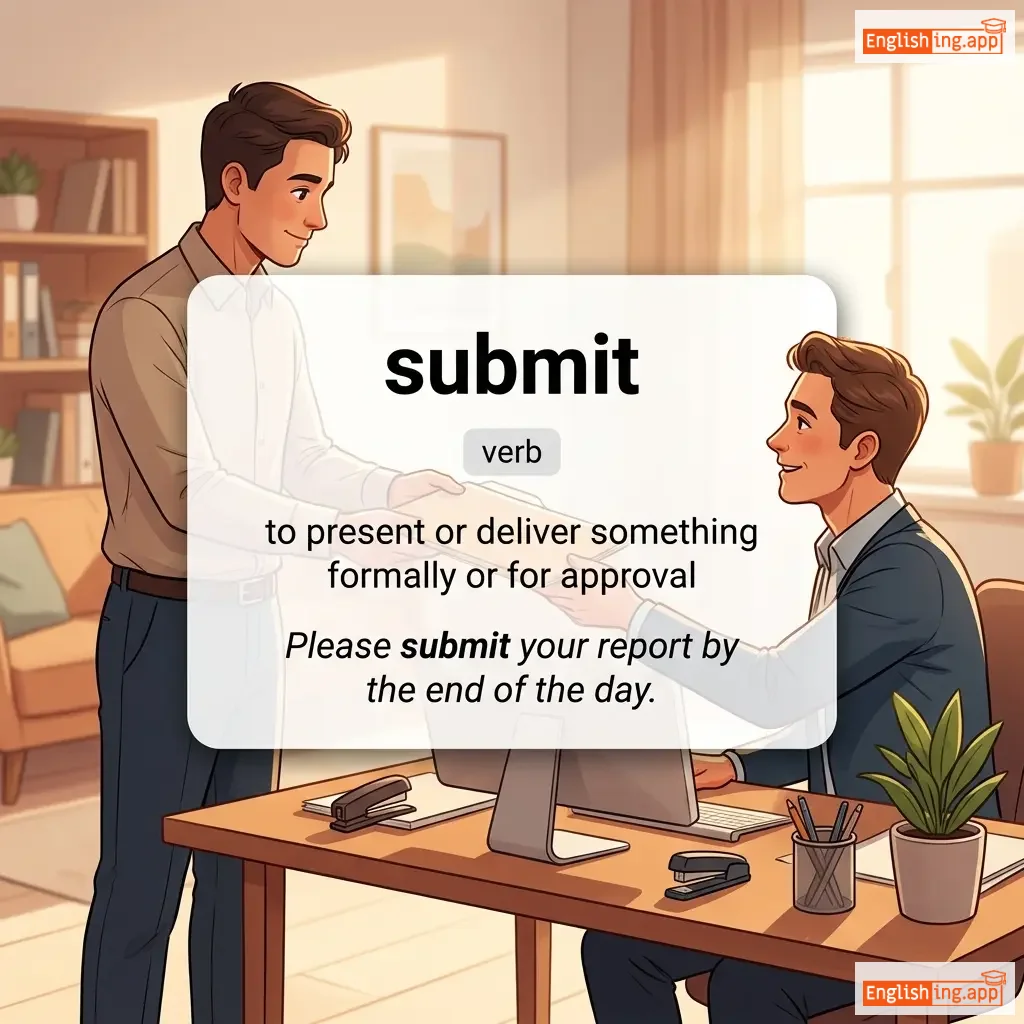
submit definition card — visual illustration of the meaning
verb
/səbˈmɪt/
जमा करना (jama karna)

to present or deliver something formally or for approval

"Please submit your report by the end of the day."

"कृपया अपना रिपोर्ट दिन के अंत तक जमा करें।" (Kripya apna report din ke ant tak jama karen.)
noun
/səbˈmɪtəl/
जमा (juma)

the act of submitting something, especially a document for consideration or approval

"The contractor sent the submittal to the client for approval."

"ठेकेदार ने स्वीकृति के लिए सबमिटाल को क्लाइंट को भेजा।" (Thekedar ne sweekriti ke liye submittal ko client ko bheja.)