वोकैबुलरीज

इंग्लिश वोकैबुलरी डिस्कवर, लर्न और मास्टर करें

noun
/stæns/
स्थिति (sthiti)

a person's attitude, opinion, or position on an issue

"The company took a strong stance on environmental protection."

"कंपनी ने पर्यावरण संरक्षण पर एक मजबूत स्थिति अपनाई।" (Company ne paryavaran sanrakshan par ek majboot sthiti apnaayi.)
verb
/stɑːntʃ/
रक्तस्राव को रोकना (raktasraav ko rokna)

to stop the flow of blood or liquid from a wound or source

"The nurse quickly stanched the bleeding from the cut."

"नर्स ने कट से रक्तस्राव को जल्दी रोक लिया।" (Nars ne kat se raktasraav ko jaldi rok liya.)
noun
/ˈstænʃən/
स्तंभ (stambh)

a strong upright bar or post used as support or to control movement

"The red rope was attached to the stanchions to guide the crowd."

"लाल रस्सी स्टैंशनों से जुड़ी थी ताकि भीड़ को मार्गदर्शन किया जा सके।" (Lal rassi stanshano se judi thi taki bhid ko margdarshan kiya ja sake.)
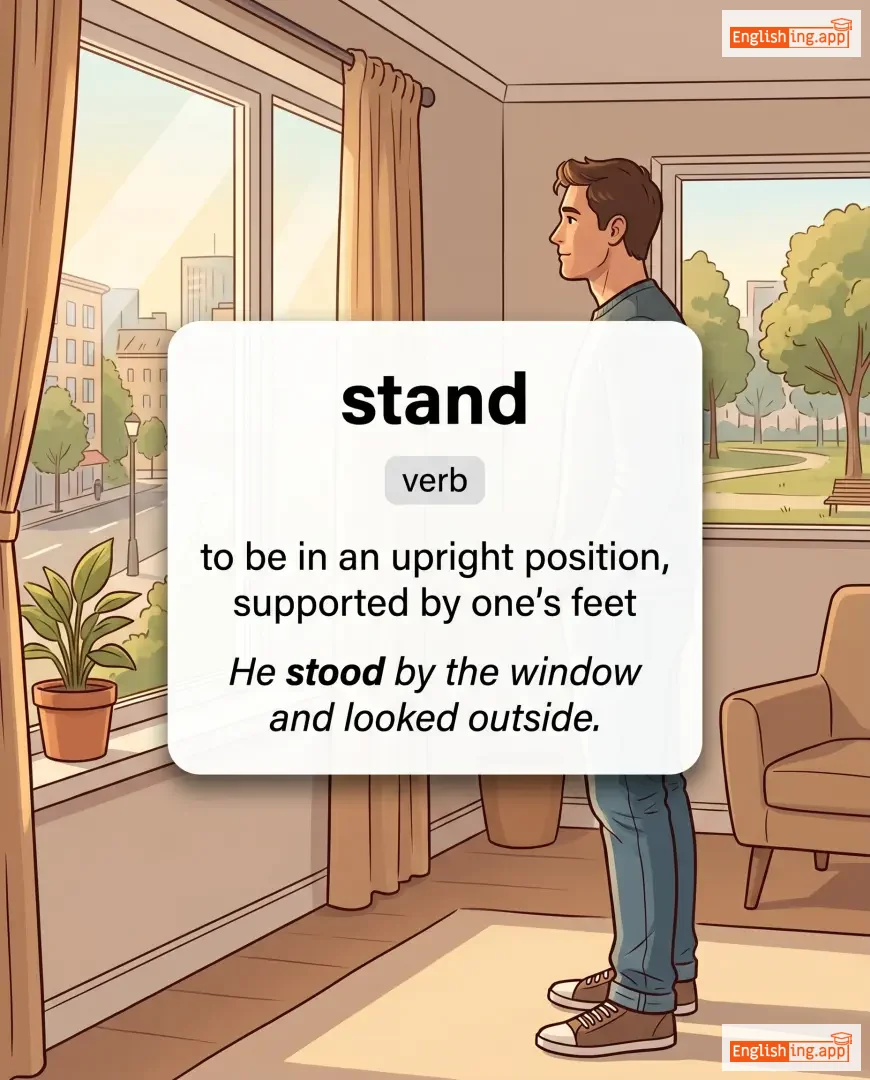
stand definition card — visual illustration of the meaning
verb
/stænd/
खड़ा होना (khada hona)

to be in an upright position, supported by one's feet

"He stood by the window and looked outside."

"वह खिड़की के पास खड़ा था और बाहर देख रहा था।" (Vah khidki ke paas khada tha aur baahar dekh raha tha.)
noun
/ˈstændərd/
मानक (maanak)

a level of quality or achievement, or a measure of comparison

"This car meets all the safety standards."

"यह कार सभी सुरक्षा मानकों को पूरा करती है।" (Yah kar sabhi suraksha maanakon ko poora karti hai.)
standards definition card — visual illustration of the meaning
noun
ˈstæn.dədz
मानक (maanak)

A level of quality or attainment.

"Institutions must meet international standards."

"संस्थाओं को अंतर्राष्ट्रीय मानकों को पूरा करना होगा।" (Sansthaon ko antarraashtreey maanakon ko poora karna hoga.)
noun/adjective
/ˈstændɪŋ/
स्थान / प्रतिष्ठा (sthan / pratishtha)

status, reputation, or position; also the act of being upright on the feet

"He has high standing in the community for his charity work."

"उसकी चैरिटी कार्य के लिए समुदाय में उच्च प्रतिष्ठा है।" (Uski charity kary ke liye samudaay mein uchch pratishtha hai.)
noun
/ˈstændˌstɪl/
स्थिरता (sthirata)

a situation in which all movement or activity stops

"The traffic came to a standstill after the accident."

"दुर्घटना के बाद यातायात स्थिरता में आ गया।" (Durghatna ke baad yatayat sthirata mein aa gaya.)
noun
/ˈstænzə/
कविता का पैरा (kavita ka para)

a group of lines forming a unit in a poem or song

"The poem begins with a stanza describing nature."

"कविता एक पैरे से शुरू होती है जो प्रकृति का वर्णन करता है।" (Kavita ek paare se shuru hoti hai jo prakriti ka varnan karta hai.)
noun
/stɑːr/
तारा (tārā)

a luminous point in the night sky, a famous person

"The movie star smiled for the cameras."

"मूवी स्टार कैमरों के लिए मुस्कराए।" (Mūvī star kēmron ke liye muskarāe.)
noun
/stɑːr ˈæn.ɪs/
तारा सौंठ (tara saunth)

star-shaped spice pod with a licorice-like flavor used in cooking

"She added star anise to the soup for aromatic flavor."

"उसने सूप में खुशबूदार स्वाद के लिए तारा सौंठ डाली।" (usne soop mein khushboo-daar swaad ke liye tara saunth daali.)
noun
/stɑːr fɪʃ/
समुद्री तारा (samudri tara)

a marine echinoderm with five or more radiating arms, typically found on the sea floor

"The starfish slowly moved across the ocean floor searching for food."

"समुद्री तारा धीरे-धीरे समुद्र के तल पर भोजन की तलाश में चलता रहा।" (samudri tara dhire dhire samudr ke tal par bhojan ki talash mein chalta raha)
noun
/stɑːr fruːts/
तारा फल (tara phal)

yellow tropical fruits that form a star shape when sliced crosswise; tangy and crisp taste

"When you slice star fruits, they look like beautiful yellow stars on your plate."

"जब आप तारा फल काटते हैं, तो वे आपके प्लेट पर सुंदर पीले तारे की तरह दिखते हैं।" (jab aap tara phal kaatate hain, to ve aapke plet par sundar peele taare ki tarah dikhte hain。)
verb
/stɛə/
घूरना (ghoornā)

to look at something with a fixed gaze

"She stared at the painting for hours."

"वह घंटों तक पेंटिंग को घूरती रही।" (Vah ghanton tak painting ko ghoorti rahi.)
adjective
/stɑːrk/
तीव्र, कठोर (teevr, kathor)

Severe, sharp, or clearly defined; plain and without any decoration.

"The stark contrast between poverty and wealth was evident in the city."

"शहर में गरीबी और संपत्ति के बीच स्पष्ट अंतर था।" (Sheher mein gareebi aur sampatti ke beech spashth antar tha.)
adjective
/ˈstɑː.ri/
तारों से भरा हुआ; चमकदार; (stari)

full of stars; shining like stars; relating to stars

"We enjoyed the starry night sky while camping in the mountains."

"हमने पहाड़ों में कैम्पिंग करते हुए तारों से भरे रात के आसमान का आनंद लिया।" (hamne pahadon mein camping karte hue sitaron se bhare raat ke asman ka anand liya.)
start definition card — visual illustration of the meaning
verb
/stɑːrt/
शुरू करना (shuru karna)

To begin doing something; to commence.

"They will start the meeting at 10 a.m."

"वे मीटिंग 10 बजे शुरू करेंगे।" (Ve meeting 10 baje shuru karenge.)
noun
/ˈstɑːrtər/
शुरुआत करने वाला या भोजन का पहला व्यंजन (shuruat karne wala ya bhojan ka pehla vyanjan)

a person or thing that starts something; the first course of a meal

"The starter of the meal was a fresh salad."

"भोजन का स्टार्टर एक ताजगी से भरी सलाद थी।" (Bhojan ka starter ek tajgi se bhari salad thi.)
verb
/ˈstɑːtɪŋ/
शुरू करना (shuru karna)

beginning to do or experience something

"She is starting a new job next week."

"वह अगले हफ्ते एक नई नौकरी शुरू कर रही है।" (Wah agle hafte ek nayi naukri shuru kar rahi hai.)
verb
/ˈstɑːrtl/
चौंका देना (chaunka dena)

To surprise or frighten someone suddenly.

"The loud noise startled the children."

"ऊंची आवाज़ ने बच्चों को चौंका दिया।" (Unchi awaaz ne bachchon ko chaunka diya.)
adjective
/ˈstɑːrtəld/
हैरान (hairan)

suddenly shocked or surprised by something unexpected

"She was startled by the loud noise outside."

"वह बाहर की तेज़ आवाज़ से हैरान हो गई।" (Vah baahar ki tez awaaz se hairan ho gayi.)
startup definition card — visual illustration of the meaning
noun
ˈstɑːtʌp
नई कंपनी, व्यवसायिक उद्यम (nai company, vyavsayik udyam)

New company, business venture.

"The startup grew into a global brand."

"द स्टार्टअप एक वैश्विक ब्रांड में बदल गया।" (Da startup ek vaishvik brand mein badal gaya.)
noun
/stɑːˈveɪ.ʃən/
भूखमरी (bhookhmari)

suffering or death caused by lack of food; extreme hunger

"Many people died of starvation during the famine."

"बहुत से लोग अकाल के दौरान भूख से मर गए।" (bahut se log akaal ke dauran bhukh se mar gaye.)
verb
/stɑːv/
भूख से मरना (bhukh se marna)

to suffer or die from lack of food

"He was left to starve in the desert."

"उसे रेगिस्तान में भूख से मरने के लिए छोड़ दिया गया था।" (Use registan mein bhukh se marne ke liye chhod diya gaya tha.)
noun
/ˈsteɪsɪs/ or /ˈstæsɪs/
स्थिरता (sthirata)

A state of inactivity or equilibrium; a situation where nothing changes.

"The negotiations reached a state of stasis with no progress made."

"सहमति की स्थिति में कोई प्रगति नहीं हुई।" (Sahamati ki sthiti mein koi pragati nahi hui.)
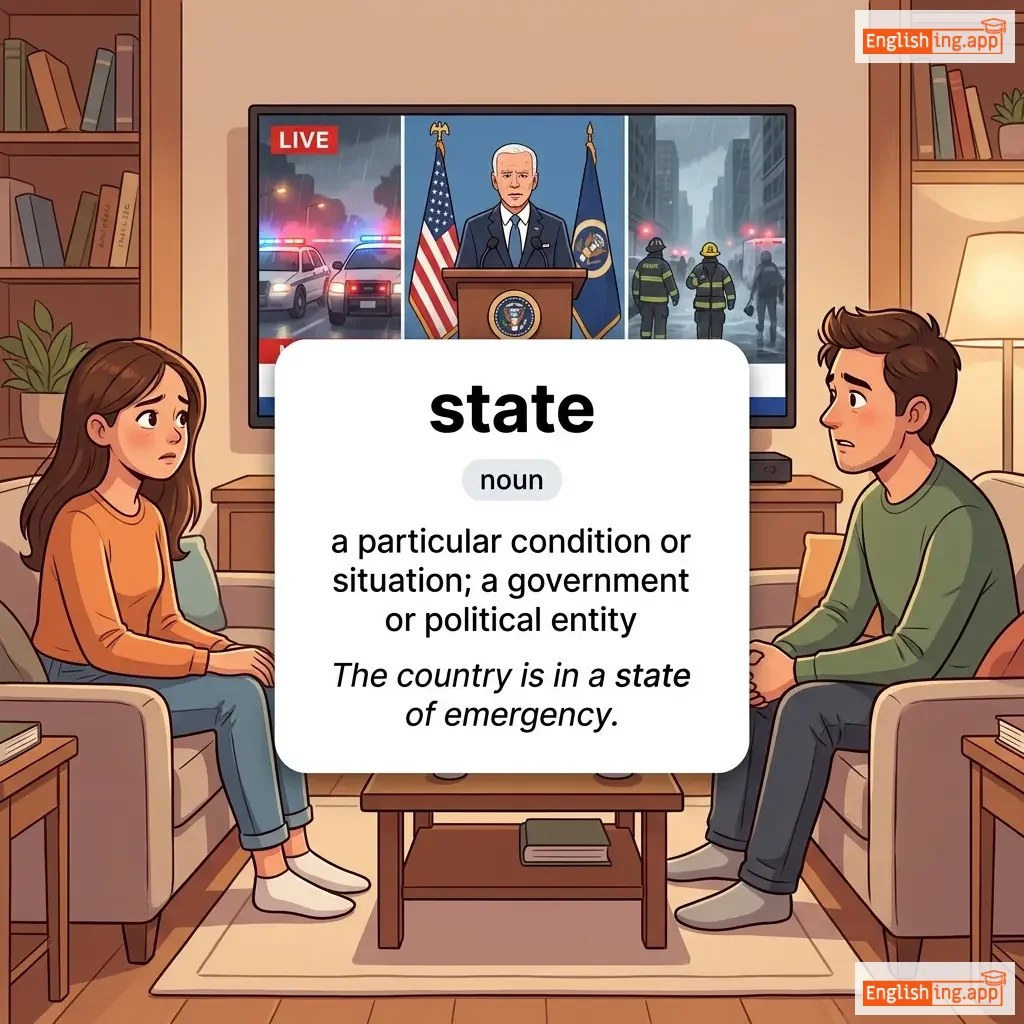
state definition card — visual illustration of the meaning
noun
/steɪt/
राज्य (rājya)

a particular condition or situation; a government or political entity

"The country is in a state of emergency."

"देश आपातकाल की स्थिति में है।" (Deś āpātakāl kī sthiti meṁ hai.)
noun
/ˈsteɪtkraft/
राज्यशास्त्र (rajyashastra)

The art of governing and managing state affairs effectively.

"The leader was praised for his exceptional statecraft in handling international relations."

"नेता को अंतरराष्ट्रीय संबंधों को संभालने में अपनी असाधारण राज्यशास्त्र के लिए सराहा गया।" (Neta ko antarraashtreey sambandhon ko sambhalne mein apni asaadharan rajyashastra ke liye saraha gaya.)
adjective
/ˈsteɪtli/
गंभीर और भव्य (gambhir aur bhavya)

Having a dignified, majestic, and impressive appearance or manner.

"The stately mansion stood at the end of the long driveway."

"गंभीर हवेली लंबी ड्राइववे के अंत में खड़ी थी।" (Gambhir haveli lambi driveway ke ant mein khadi thi.)
noun
/ˈsteɪtmənt/
बयान (bayan)

a clear expression of something in speech or writing

"She made a statement about the company's new policies."

"उसने कंपनी की नई नीतियों के बारे में एक बयान दिया।" (Usne company ki nai neetiyon ke baare mein ek bayan diya.)
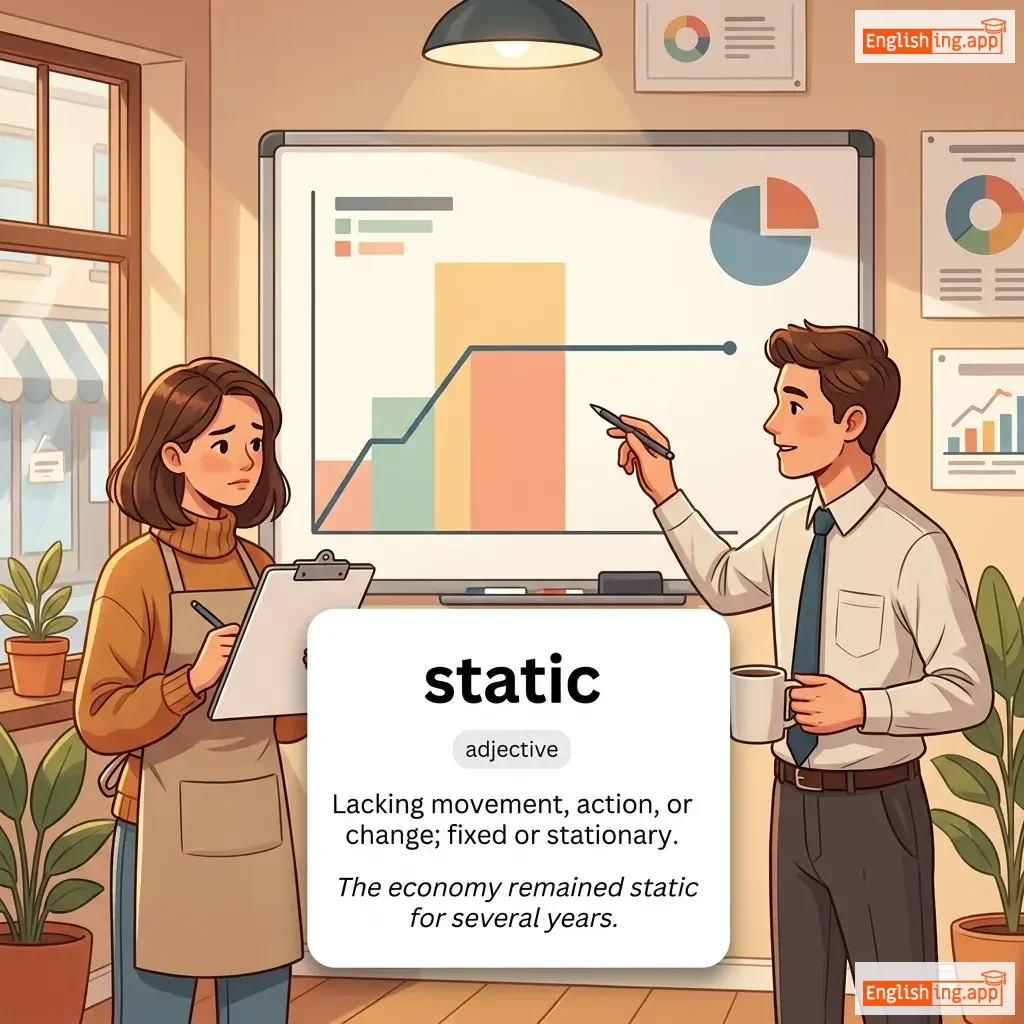
static definition card — visual illustration of the meaning
adjective
/ˈstætɪk/
स्थिर (sthir)

Lacking movement, action, or change; fixed or stationary.

"The economy remained static for several years."

"अर्थव्यवस्था कई वर्षों तक स्थिर रही।" (Arthvyavastha kai varsho tak sthir rahi.)
noun
/ˈstætɪks/
स्थैतिकी (sthaetikī)

The branch of mechanics dealing with bodies at rest and forces in equilibrium.

"She is studying statics as part of her engineering course."

"वह अपने इंजीनियरिंग पाठ्यक्रम का हिस्सा के रूप में स्थैतिकी पढ़ रही है।" (vah apne injiniyaring pathyakram kā hissa ke rūp mein sthāetiki paṛh rahī hai.)
noun
/ˈsteɪʃən/
स्टेशन (station)

a place where a particular service is provided, especially for transportation

"We arrived at the station just in time for the train."

"हम ट्रेन के लिए स्टेशन ठीक समय पर पहुँच गए।" (ham train ke liye steshan theek samay par pahunch gaye)
adjective
/ˈsteɪʃəˌneri/
स्थिर (sthir)

Not moving or not intended to be moved.

"The car remained stationary at the red light."

"कार लाल बत्ती पर स्थिर रही।" (kaar laal batti par sthir rahi.)
noun
/ˈsteɪ.ʃən.ər/
स्टेशनरी विक्रेता (stationery vikreta)

a person who sells paper, pens, pencils, and other office supplies

"The stationer recommended the best pens for writing exams."

"द स्टेशनर ने परीक्षा के लिए सबसे अच्छे पेन की सिफारिश की।" (d stationer ne pariksha ke liye sabse achhe pen ki sifaarish ki)
adjective
/stəˈtɪstɪkəl/
सांख्यिकीय (sankhyikiya)

relating to the use or analysis of numerical data

"The report provides statistical data about population growth."

"रिपोर्ट में जनसंख्या वृद्धि के बारे में सांख्यिकीय डेटा प्रदान किया गया है।" (Report mein jansankhya vruddhi ke baare mein sankhyikiya data pradan kiya gaya hai.)
noun
/ˌstætɪˈstɪʃən/
सांख्यिकी विशेषज्ञ (sankhyiki visheshagya)

A person who specializes in collecting, analyzing, and interpreting numerical data.

"The statistician presented the survey results with great clarity."

"सांख्यिकी विशेषज्ञ ने सर्वेक्षण के परिणामों को स्पष्टता से प्रस्तुत किया।" (Sankhyiki visheshagya ne survey ke parinaamon ko spashtata se prastut kiya.)
noun
/stəˈtɪstɪks/
सांख्यिकी (sāṅkhyikī)

the practice or science of collecting and analyzing numerical data

"The statistics showed an increase in the number of users last year."

"आखिरी साल में उपयोगकर्ताओं की संख्या में वृद्धि को दिखाने वाले आँकड़े।" (Ākhirī sāl meṁ upayogkartāoṁ kī sankhyā meṁ vr̥ddhi ko dikhāne vāle āṅkṛe.)
noun
/ˈstætʃuː/
प्रतिमा (pratima)

a carved or cast figure of a person or animal, especially one that is life-size or larger

"They built a statue of the national hero in the city square."

"उन्होंने शहर के चौक में राष्ट्रीय नायक की एक प्रतिमा बनाई।" (Unhone shahar ke chauk mein rashtriya nayak ki ek pratima banayi.)
adjective
/ˌstætʃuˈɛsk/
प्रतिमा जैसी (pratima jaisi)

Having the grace, beauty, or dignity of a statue; tall and attractively proportioned.

"She had a statuesque figure that turned heads wherever she went."

"उसका प्रतिमा जैसी शरीर था जो हर जगह सिर घुमा देता था।" (uska pratima jaisi sharir tha jo har jagah sir ghuma deta tha.)
noun
/ˌstætʃuˈɛt/
छोटी मूर्ति (chhoti moorti)

A small statue, usually decorative or artistic.

"The artist won a gold statuette for his work."

"कलाकार ने अपने काम के लिए एक स्वर्णिम छोटी मूर्ति जीती।" (kalakaar ne apne kaam ke liye ek swarnim chhoti moorti jeeti.)
noun
/ˈstætʃər/
प्रतिष्ठा, कद (pratishtha, kad)

A person's natural height or their reputation and importance.

"Her intellectual stature made her a respected figure in academia."

"उनकी बौद्धिक प्रतिष्ठा ने उन्हें शिक्षा जगत में सम्मानित व्यक्तित्व बनाया।" (unki bauddhik pratishtha ne unhe shiksha jagat mein sammannit vyaktitv banaya.)
noun
/ˈsteɪtəs/
स्थिति (stithi)

the social or professional position or condition of someone or something

"His social status improved after the promotion."

"उसकी सामाजिक स्थिति पदोन्नति के बाद सुधरी।" (Uski samajik sthiti padonnati ke baad sudhri.)
noun
/ˈsteɪtəs kwoʊ/
स्थिति quo (stithi quo)

The existing state of affairs, especially regarding social or political issues.

"The government decided to maintain the status quo until further review."

"सरकार ने आगे की समीक्षा तक स्थिति quo बनाए रखने का निर्णय लिया।" (sarkar ne aage ki samiksha tak sthiti quo banaye rakhne ka nirnay liya.)
noun
/ˈstætʃuːt/
कानून (kanun)

A written law passed by a legislative body.

"The new statute protects workers' rights."

"नया कानून श्रमिकों के अधिकारों की रक्षा करता है।" (naya kanun shramikon ke adhikaron ki raksha karta hai.)
adjective
/ˈstætʃətɔːri/
कानूनी (kanuni)

Required, permitted, or enacted by law.

"The company must comply with all statutory regulations."

"कंपनी को सभी कानूनी नियमों का पालन करना चाहिए।" (Kampani ko sabhi kanuni niyamon ka paalan karna chahiye.)
adjective
/stɔːntʃ/
स्थिर, वफादार (sthir, vafaadaar)

Loyal, committed, and firm in support.

"She is a staunch supporter of environmental protection."

"वह पर्यावरण संरक्षण की एक मजबूत समर्थक है।" (Woh paryavaran sanrakshan ki ek majboot samarthak hai.)
stay definition card — visual illustration of the meaning
verb
/steɪ/
रहना (rahna)

to remain in a particular place or state

"We decided to stay at home during the storm."

"हमने तूफान के दौरान घर पर रहने का फैसला किया।" (Hamne toofan ke dauran ghar par rehne ka faisla kiya.)
adjective
/ˈstɛdfæst/
अडिग, दृढ़ (adig, dridh)

Firm, loyal, and unwavering in purpose or support.

"He remained steadfast in his determination to succeed."

"वह सफलता पाने के अपने संकल्प में अडिग रहा।" (Vah safalta pane ke apne sankalp mein adig raha.)
adverb
/ˈstɛdɪli/
नियमित रूप से (niyamit roop se)

in a regular and continuous way; without stopping or changing

"The company's profits have been increasing steadily."

"कंपनी का मुनाफा लगातार बढ़ रहा है।" (Company ka munafa lagatar badh raha hai.)
adjective
/ˈstɛdi/
स्थिर (sthir)

firm, stable, and not likely to change suddenly

"He kept his hand steady while painting the picture."

"उसने चित्र बनाते समय अपने हाथ को स्थिर रखा।" (Usne chitra banate samay apne haath ko sthir rakha.)