वोकैबुलरीज

इंग्लिश वोकैबुलरी डिस्कवर, लर्न और मास्टर करें

adjective
/ˈspaɪn.ləs/
निर्धन; कमजोर इरादा; कायर; (spinles)

lacking courage or determination; weak-willed

"He was too spineless to stand up for his beliefs."

"वह अपने विश्वासों के लिए खड़ा होने के लिए बहुत निःस्संकोच था।" (vah apne vishwason ke liye khada hone ke liye bahut nissankoch tha.)
adjective
/ˈspaɪnəs/
काँटेदार (kaantedaar)

Having spines or thorn-like projections

"The spinous cactus was difficult to handle without gloves."

"काँटेदार कैक्टस को दस्ताने के बिना पकड़ना मुश्किल था।" (Kaantedaare cactus ko dastane ke bina pakadna mushkil tha.)
noun
/ˈspɪnstər/
अविवाहित महिला (avivaahit mahila)

An unmarried woman, often one who is older and considered unlikely to marry

"The novel featured a kind-hearted spinster who cared for the village children."

"उपन्यास में एक kind-hearted स्पिन्स्टर को दिखाया गया जो गांव के बच्चों की देखभाल करती थी।" (Upanyaas mein ek kind-hearted spinster ko dikhaya gaya jo gaon ke bachchon ki dekhbhal karti thi.)
adjective
/ˈspaɪni/
काँटेदार (kaantedaar)

covered with or full of spines; having sharp points

"The spiny cactus stood tall in the desert."

"काँटेदार कैक्टस रेगिस्तान में ऊँचा खड़ा था।" (Kaantedaar cactus registan mein uncha khada tha.)
adjective
/ˈspaɪ.rəl/
सर्पिल (sarpil)

winding in a continuous curve; helical

"The spiral staircase led to the top floor."

"सर्पिल सीढ़ी ऊपर की मंजिल तक गई।" (sarpil seedhi upar ki manzil tak gayi.)
noun
/ˈspaɪər/
मीनार (minar)

a tall, pointed structure on top of a building, especially a church

"The church spire could be seen from miles away."

"चर्च की मीनार दूर से देखी जा सकती थी।" (Church ki minar door se dekhi ja sakti thi.)
noun
/ˈspɪrɪt/
आत्मा (atma)

the non-physical part of a person, regarded as their true self

"Her spirit remained unbroken despite the hardships."

"उसकी आत्मा कड़ी मेहनत के बावजूद अडिग रही।" (Uski atma kadi mehnat ke bawajood adig rahi.)
adjective
/ˈspɪrɪtʃuəl/
आध्यात्मिक (adhyatmik)

relating to or affecting the human spirit or soul

"She practices spiritual meditation every morning."

"वह हर सुबह आध्यात्मिक ध्यान अभ्यास करती है।" (Woh har subah adhyatmik dhyan abhyas karti hai.)
verb
/spɪt/
थूकना (thookna)

to force liquid, especially saliva, out of the mouth

"He spat on the ground in anger."

"उसने गुस्से में ज़मीन पर थूक दिया।" (Usne gusse mein zameen par thook diya.)
noun
/spaɪt/
द्वेष (dwesh)

a desire to hurt, annoy, or offend someone

"She refused the gift out of spite."

"उसने द्वेषवश उपहार को ठुकरा दिया।" (Usne dweshvash uphaar ko thukra diya.)
noun
/spliːn/
प्लीहा; क्रोध (pliha; krodh)

an organ in the body that produces lymphocytes and filters blood; also refers to bad temper or spite

"He vented his spleen on his coworkers after the meeting."

"उसने बैठक के बाद अपने सहकर्मियों पर अपना गुस्सा निकाला।" (Usne baithak ke baad apne sahakarmiyon par apna gussa nikala.)
adjective
/ˈsplendɪd/
शानदार; उत्कृष्ट; बहुत प्रभावशाली (shandar; utkrsht; bahut prabhavshali)

magnificent; excellent; very impressive

"The castle looked splendid in the sunset."

"महल सूर्योदय में शानदार लग रहा था।" (mahal suryoday mein shandar lag raha tha.)
adjective
/splɪˈnɛtɪk/
चिड़चिड़ा, खुन्नस रखने वाला (chidchida, khunnas rakhne wala)

bad-tempered, irritable, spiteful

"His splenetic remarks offended everyone in the room."

"उसकी चिड़चिड़ी टिप्पणियाँ कमरे में सभी को आहत कर गईं।" (Uski chidchidi tippaniyan kamre mein sabhi ko aahat kar gayi.)
verb
/splaɪs/
जोड़ना (jodna)

to join two pieces of rope, film, or other material by weaving or attaching them together

"The technician spliced the two wires to restore the connection."

"टेक्नीशियन ने दो तारों को जोड़कर कनेक्शन बहाल किया।" (Technician ne do taaron ko jodkar connection bahaal kiya.)
/splɪnt/
स्प्लिंट (splint)

A rigid device used to support and immobilize a broken or injured body part.

"The doctor applied a splint to stabilize the patient's broken arm."

"डॉक्टर ने मरीज के टूटे हुए हाथ को स्थिर करने के लिए स्प्लिंट लगाया।" (Doktor ne mareez ke toote hue haath ko sthir karne ke liye splint lagaya.)
verb
/splɪt/
विभाजित करना (vibhajit karna)

to divide or separate into parts or groups

"He split the log in two with an axe."

"उसने कुल्हाड़ी से लकड़ी को दो हिस्सों में काट दिया।" (Usne kulhadi se lakdi ko do hisso mein kaat diya.)
verb
/spɔɪl/
नष्ट करना (naṣṭ karna)

to damage or ruin something

"The rain spoiled the outdoor event."

"बारिश ने आउटडोर इवेंट को खराब कर दिया।" (Bāriś nē ā'ūṭḍōr īvēnṭ kō khrāb kar diyā.)
noun
/ˈspɔɪlˌspɔːrt/
मज़ा ख़त्म करने वाला (maza khatm karne wala)

A person who ruins other people's enjoyment or fun.

"Don't be a spoilsport and let us enjoy the party."

"मज़ा ख़त्म करने वाला मत बनो और हमें पार्टी का आनंद लेने दो।" (Maza khatm karne wala mat bano aur humein party ka anand lene do.)
noun, verb
/spoʊk/
स्पोक / कहा (spok / kaha)

As a noun, a bar connecting the center of a wheel to its rim; as the past tense of 'speak'.

"The bicycle's spoke was bent after the accident."

"दुर्घटना के बाद साइकिल का स्पोक मुड़ा हुआ था।" (Durghatna ke baad cycle ka spoke mudha hua tha.)
noun
/ˈspəʊksmən/
प्रवक्ता (pravakta)

a person who speaks on behalf of others, especially for a group or organization

"The spokesman addressed the crowd during the rally."

"प्रवक्ता ने रैली के दौरान भीड़ को संबोधित किया।" (Pravakta ne rally ke dauran bheed ko sambodhit kiya.)
noun
/ˈspəʊkspɜːrsən/
वक्तव्यकर्ता (vaktavyakarta)

a person who speaks on behalf of others or an organization

"The spokesperson addressed the press conference on behalf of the company."

"वक्तव्यकर्ता ने कंपनी की ओर से प्रेस कांफ्रेंस को संबोधित किया।" (Vaktavyakarta ne company ki or se press conference ko sambodhit kiya.)
noun
/ˈspəʊkswɪmən/
प्रवक्ता महिला (pravakta mahila)

a woman who speaks on behalf of a group or organization

"The spokeswoman for the company announced the new product."

"कंपनी की प्रवक्ता महिला ने नए उत्पाद की घोषणा की।" (Kampani ki pravakta mahila ne naye utpad ki ghoshna ki.)
noun
/ˌspoʊliˈeɪʃən/
विनाश (vinaash)

The act of destroying or ruining something, often evidence or property.

"The court punished the company for the spoliation of evidence."

"कोर्ट ने सबूतों के विनाश के लिए कंपनी को दंडित किया।" (Kourt ne sabooton ke vinaash ke liye company ko dandit kiya.)
adjective
/ˈspʌndʒi/
स्पंज जैसा, छिद्रपूर्ण (spanj jaisa, chidrapurn)

soft and full of holes like a sponge; porous

"The cake had a light and spongy texture."

"केक का हल्का और स्पॉन्जी बनावट थी।" (kek ka halka aur spongi banawat thi.)
noun
/spʌndʒ ɡɔːrd/
स्पॉन्ज लौकी (sponj lauki)

a fibrous gourd that becomes sponge-like when dried, used for cleaning and in cooking when young

"The sponge gourd can be eaten when young or dried to make natural scrubbers."

"स्पॉन्ज लौकी को कच्ची अवस्था में खाया जा सकता है या इसे सुखाकर प्राकृतिक स्क्रबर बनाने के लिए इस्तेमाल किया जा सकता है।" (sponj lauki ko kacchi avastha mein khaya ja sakta hai ya ise sookhakar prakritik scrubber banane ke liye istemal kiya ja sakta hai.)
noun
/ˈspɒnsər/
प्रायोजक (prayojak)

a person or organization that provides funds for a project or activity in exchange for publicity or support

"The company became the main sponsor of the event."

"कंपनी इस कार्यक्रम का मुख्य प्रायोजक बन गई।" (Company is karyakram ka mukhya prayojak ban gayi.)
noun
/ˈspɒnsəʃɪp/
प्रायोजन (prayojan)

the act of supporting an event, activity, person, or organization financially or through other resources

"The event was made possible due to the sponsorship of several big companies."

"ईवेंट को कई बड़ी कंपनियों के प्रायोजन के कारण संभव बनाया गया।" (Event ko kai badi kampaniyon ke prayojan ke kaaran sambhav banaya gaya.)
spontaneity definition card — visual illustration of the meaning
noun
/ˌspɑːntəˈneɪəti/
स्वतःस्फूर्तता (swatah sfoortata)

The quality of being natural, impulsive, and unplanned.

"Her spontaneity made the trip more exciting."

"उसकी स्वतःस्फूर्तता ने यात्रा को और रोमांचक बना दिया।" (uski swatah sfoortata ne yatra ko aur romanchak bana diya.)
adjective
/spɒnˈteɪniəs/
स्वतःस्फूर्त (svatahsfurt)

Happening naturally without planning or external cause; impulsive or unplanned.

"Their spontaneous trip to the mountains turned out to be the highlight of the summer."

"उनकी स्वाभाविक यात्रा पहाड़ों की ओर इस ग्रीष्मकाल का मुख्य आकर्षण बन गई।" (unki svabhavik yatra paharoon ki or is grishmkaal ka mukhya aakarshan ban gayi.)
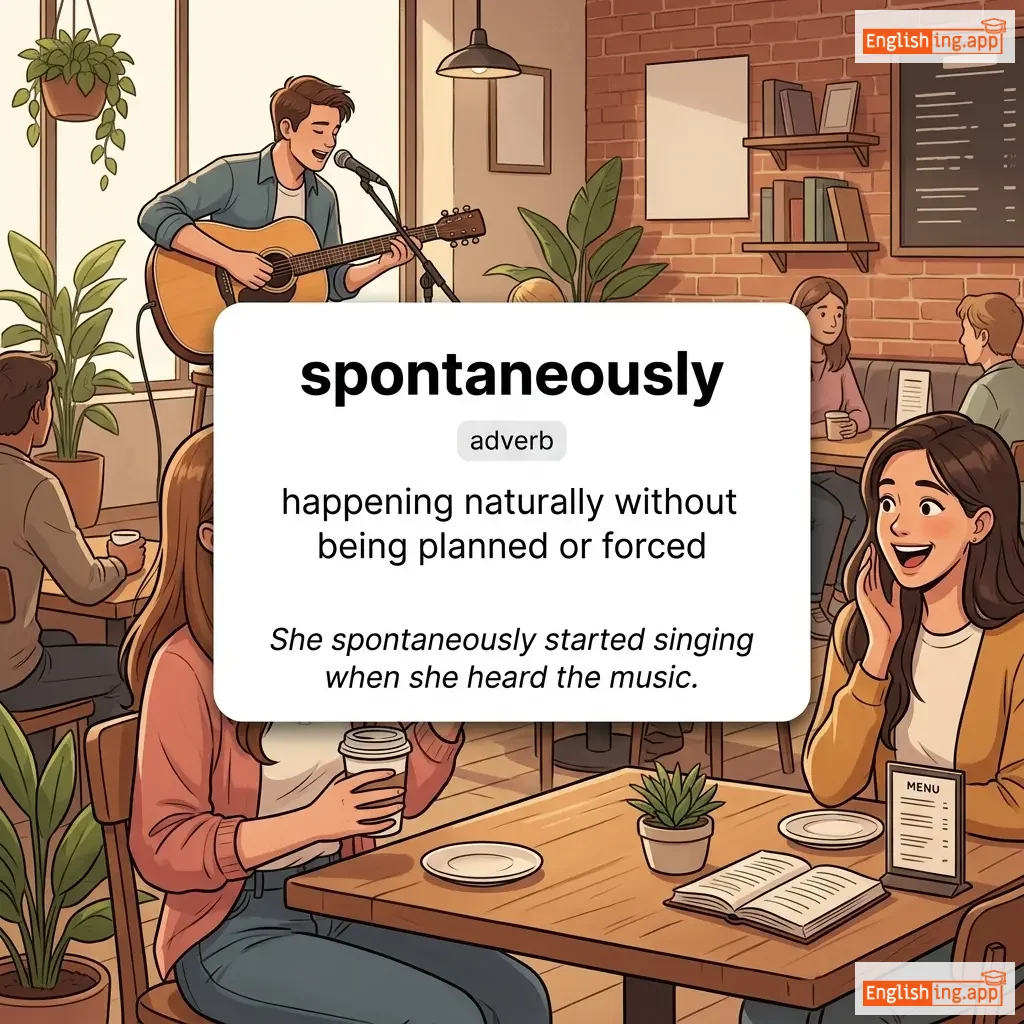
spontaneously definition card — visual illustration of the meaning
adverb
/spɒnˈteɪ.ni.əs.li/
स्वत:स्फूर्त रूप से (svat:asphurt roop se)

happening naturally without being planned or forced

"She spontaneously started singing when she heard the music."

"जब उसने संगीत सुना, तो वह स्वत:स्फूर्त रूप से गाने लगी।" (jab usne sangeet suna, to vah svat:asphurt roop se gaane lagi.)
noun/verb
/spuːf/
मज़ाकिया अनुकरण (mazaakiya anukaran)

A humorous imitation of something, or to trick or parody someone or something.

"The comedian spoofed the politician’s speech to entertain the audience."

"कॉमेडियन ने राजनेता के भाषण का मजाक उड़ाने के लिए नकल की।" (comedian ne rajneta ke bhashan ka mazaak udane ke liye anukaran ki.)
noun
/spuːn/
चम्मच (chammach)

a utensil consisting of a small shallow bowl with a handle, used for eating, stirring, or serving food

"She stirred her coffee with a silver spoon."

"उसने चांदी के चम्मच से अपनी कॉफी को हिलाया।" (Usne chaandee ke chammach se apni coffee ko hilaaya.)
noun
/ˈspuːnərɪzəm/
स्पूनरीज़म (spoonarizm)

A verbal error in which the initial sounds of words are swapped to create a humorous effect.

"He made a spoonerism by saying 'queer old dean' instead of 'dear old queen'."

"उसने 'क्वीर ओल्ड डीन' कहने में एक स्पूनरिज़म किया, जो कि 'डियर ओल्ड क्वीन' होना चाहिए था।" (Usne 'queer old dean' kehne mein ek spoonarizm kiya, jo ki 'dear old queen' hona chahiye tha.)
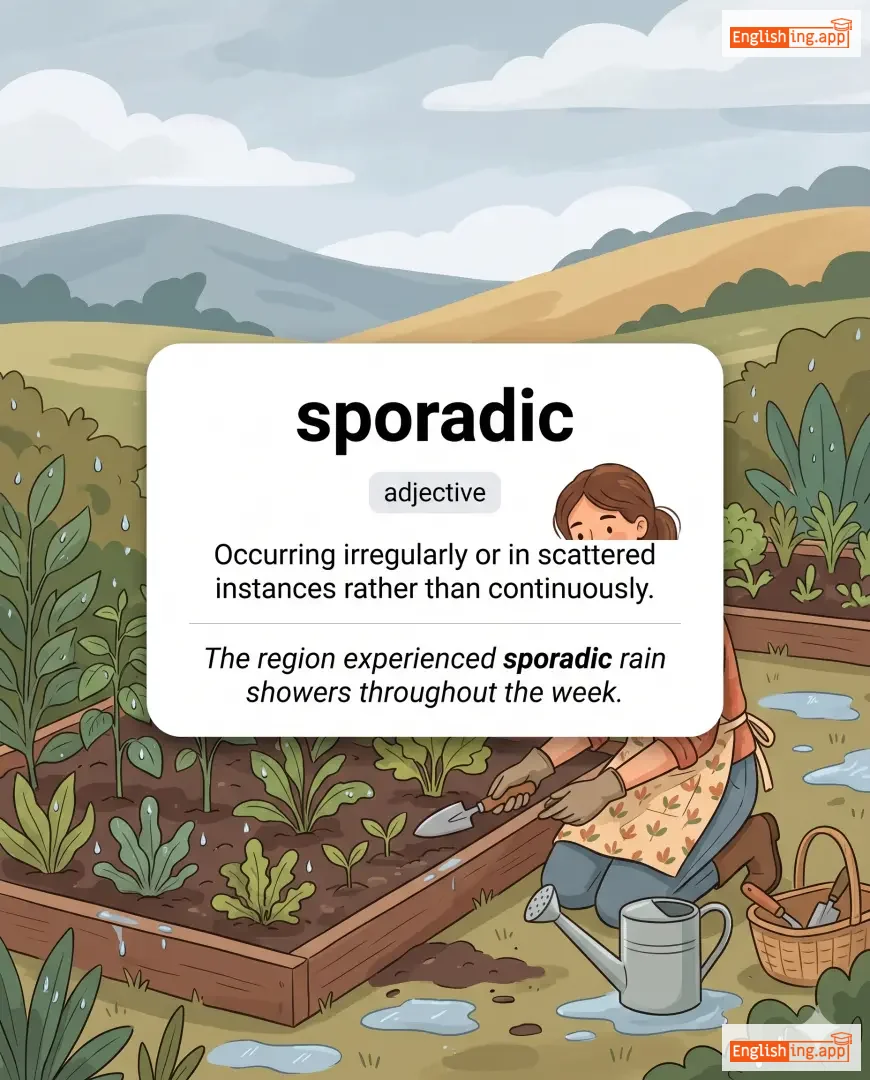
sporadic definition card — visual illustration of the meaning
adjective
/spəˈrædɪk/
अप्रत्याशित (apratyashit)

Occurring irregularly or in scattered instances rather than continuously.

"The region experienced sporadic rain showers throughout the week."

"क्षेत्र ने सप्ताह भर अप्रत्याशित बारिश के बौछारें देखी।" (kshetra ne saptah bhar apratyashit barish ke bouchare dekhi.)
noun
/spɔːt/
खेल (khel)

an activity involving physical exertion and skill in which an individual or team competes against another or others for entertainment

"Football is a popular sport around the world."

"फुटबॉल दुनिया भर में एक लोकप्रिय खेल है।" (Phutbol duniya bhar mein ek lokpriya khel hai.)
adjective
/ˈspɔːrtɪv/
खेल कूद से संबंधित (khel kood se sambandhit)

Playful, lively, or full of fun.

"The children were in a sportive mood during the picnic."

"पिकनिक के दौरान बच्चे खेल कूद से संबंधित मूड में थे।" (piknik ke dauran bachche khel kood se sambandhit mood mein the.)
noun
/ˈspɔːrtsmən/
खिलाड़ी (khiladi)

A person who is skilled in sports or enjoys participating in athletic activities.

"He is a true sportsman, always fair and respectful to his opponents."

"वह एक सच्चा खिलाड़ी है, हमेशा अपने प्रतिद्वंद्वियों के प्रति निष्पक्ष और सम्मानजनक।" (Vah ek sachcha khiladi hai, hamesha apne pratiddvandviyon ke prati nispaksh aur sammaanjanak.)
noun
/spɒt/
स्थान (sthan)

a particular place or position

"I found a great spot for a picnic in the park."

"मैंने पार्क में पिकनिक के लिए एक बेहतरीन स्थान पाया।" (Maine park mein picnic ke liye ek behtareen sthan paaya.)
noun
/ˈspɒt.laɪt/
स्पॉटलाइट (spotlait)

a strong beam of light directed onto a particular area; figuratively, public attention

"The singer stood proudly in the spotlight."

"गायिका गर्व से स्पॉटलाइट में खड़ी थी." (gayika garv se spotlait mein khadi thi)
adjective
/ˈspɒtɪd/
धब्बेदार; चिन्हित; देखा गया (dhabbedar; chinhit; dekha gaya)

having spots or marks; noticed or seen

"The spotted leopard moved silently through the jungle."

"धब्बेदार तेंदुआ जंगल में चुपचाप चला गया।" (dhabbedar tendua jangal mein chupchaap chala gaya.)
noun
/ˈspɒt.ɪd sneɪk hed/
चन्ना पंक्टाटा (channa punctata)

a type of freshwater fish with spotted markings and an elongated head resembling a snake

"The spotted snake head is a popular fish for aquaculture in South Asia."

"स्पॉटेड स्नेक हेड दक्षिण एशिया में जलीय कृषि के लिए एक लोकप्रिय मछली है।" (spotted snake head dakshin eshiya me jaliye krishi ke liye ek lokpriya machhli hai)
noun
/spaʊs/
जीवनसाथी (jeevansathi)

a person's husband or wife

"Each employee may include their spouse in the health insurance plan."

"प्रत्येक कर्मचारी अपनी पत्नी या पति को स्वास्थ्य बीमा योजना में शामिल कर सकता है।" (Pratyek karmchari apni patni ya pati ko swasthya beema yojna mein shaamil kar sakta hai.)
noun, verb
/spreɪn/
मचका देना (machka dena)

an injury to a joint in which the ligaments are stretched or torn

"She sprained her ankle while running in the park."

"वह पार्क में दौड़ते हुए अपने टखने को मोच दे बैठी।" (Wah park mein daudte hue apne takhne ko moch de baithi.)
verb
/spreɪ/
स्प्रे करना (spre karna)

to apply liquid to something in a fine mist

"She sprayed perfume on her wrist before leaving."

"वह बाहर जाने से पहले अपनी कलाई पर परफ्यूम स्प्रे करती थी।" (Woh bahar jaane se pehle apni kalaai par perfume spre karti thi.)
verb
/sprɛd/
फैलाना (phailana)

to open or extend something over an area

"She spread the blanket on the grass for a picnic."

"उसने घास पर पिकनिक के लिए चादर बिछाई।" (Usne ghas par picnic ke liye chadar bichai.)
adjective
/ˈspraɪtli/
उत्साही (utsahi)

full of energy and life; lively

"The sprightly old man danced with joy at the wedding."

"उत्साही बूढ़ा आदमी शादी में खुशी से नाच रहा था।" (Utsahi budha aadmi shaadi mein khushi se naach raha tha.)
noun
/sprɪŋ/
वसंत (vasant)

the season between winter and summer when plants begin to grow

"Flowers bloom in the spring."

"वसंत में फूल खिलते हैं।" (Vasant mein phool khilte hain.)
verb
/ˈsprɪŋkəl/
छिड़कना (chhidkana)

to scatter small drops or particles of a substance over a surface

"She sprinkled sugar on top of the cake."

"उसने केक के ऊपर चीनी छिड़की।" (Usne kek ke upar cheeni chhidki.)
verb, noun
/spraʊt/
अंकुरित होना (ankurit hona)

to begin to grow; to produce new leaves or shoots

"The seeds began to sprout after a few days of rain."

"बीजों ने कुछ दिनों की बारिश के बाद अंकुरित होना शुरू कर दिया।" (Beejon ne kuch dinon ki barish ke baad ankurit hona shuru kar diya.)
verb, adjective, noun
/spruːs/
साफ़ करना / एक प्रकार का पेड़ (saaf karna / ek prakar ka ped)

to make neat or tidy in appearance; also refers to an evergreen tree

"He spruced up his room before the guests arrived."

"उसने मेहमानों के आने से पहले अपने कमरे को सुंदर बनाया।" (Usne mehmanon ke aane se pehle apne kamre ko sundar banaya.)