वोकैबुलरीज

इंग्लिश वोकैबुलरी डिस्कवर, लर्न और मास्टर करें

adjective
/ˈsɛksi/
आकर्षक (aakarshak)

sexually attractive or exciting

"She wore a sexy red dress to the party."

"वह पार्टी में एक आकर्षक लाल ड्रेस पहने हुए थी।" (Wah party mein ek aakarshak laal dress pehne hui thi.)
adjective
/ˈʃæbi/
फटेहाल (phatehaal)

In poor condition through long use or lack of care; of low quality.

"The hotel room looked shabby and old-fashioned."

"होटल का कमरा फटेहाल और पुराने अंदाज का लग रहा था।" (Hotel ka kamra phatehaal aur purane andaaz ka lag raha tha.)
noun
/ʃæk/
झोपड़ी (jhopdi)

a small, roughly built house or hut, often poor or temporary

"They spent the weekend in a small wooden shack by the river."

"उन्होंने नदी के किनारे एक छोटे लकड़ी के झोपड़े में सप्ताहांत बिताया।" (Unhone nadi ke kinare ek chhote lakdi ke jhopde mein saptahant bitaya.)
verb
/ˈʃækəl/
बंधन लगाना (bandhan lagana)

to chain or restrain; to restrict someone’s actions or freedom

"Outdated regulations shackle small businesses and slow innovation."

"पुरानी नियमन छोटे व्यवसायों को बंधन में डालते हैं और नवाचार को धीमा करते हैं।" (Purani niyaman chhote vyavasayon ko bandhan mein daalte hain aur navaachar ko dheema karte hain.)
noun
/ˈʃæd.ək/
शैडोक (shaidak)

a large citrus fruit similar to grapefruit; pomelo

"The shaddock is the largest citrus fruit in the world."

"शैडोक दुनिया का सबसे बड़ा खट्टा फल है।" (shaidak duniya ka sabse bada khatta phal hai.)
noun, verb
/ʃeɪd/
छांव (chaav)

a sheltered or darker area where direct light is blocked; to block light from something

"We sat under the tree for some shade."

"हम कुछ छांव के लिए पेड़ के नीचे बैठे थे।" (Hum kuch chaav ke liye ped ke neeche baithe the.)
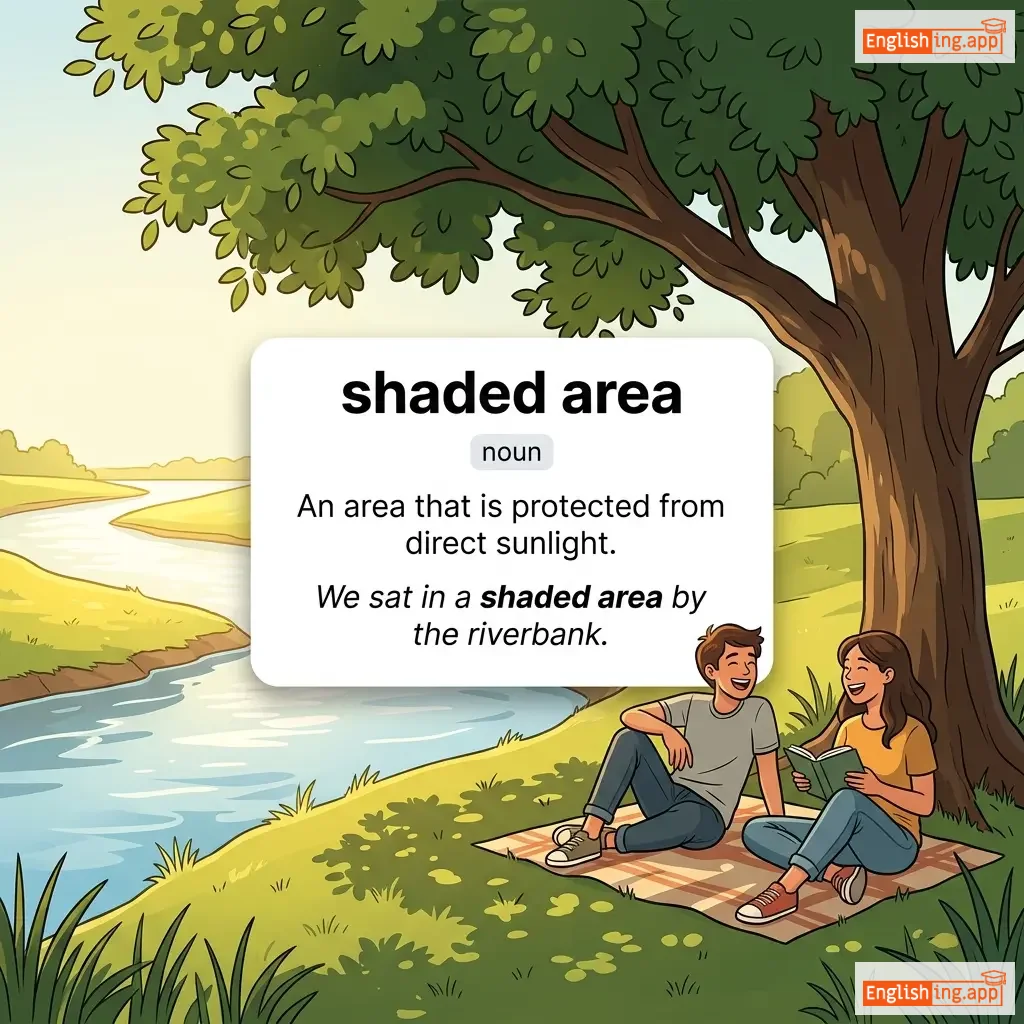
shaded area definition card — visual illustration of the meaning
noun
ˈʃeɪdɪd ˈɛəriə
छायादार क्षेत्र (chayadar kshetra)

An area that is protected from direct sunlight.

"We sat in a shaded area by the riverbank."

"हम नदी के किनारे छायादार क्षेत्र में बैठे थे।" (Hum nadi ke kinare chayadar kshetra mein baithe the.)
noun, verb
/ˈʃæd.oʊ/
छाया (chhaya)

a dark area or shape made when something blocks light; to follow or observe secretly

"His shadow stretched long in the evening sun."

"संध्या के सूरज में उसकी छाया लंबी हो गई थी।" (Sandhya ke suraj mein uski chhaya lambi ho gayi thi.)
adjective
/ˈʃeɪ.di/
छायादार; संदिग्ध; धोखेबाज़; (chayadar; sandigdh; dhokhebaaz;)

providing shade; dishonest; suspicious

"The shady businessman made a suspicious deal."

"उस शेडी व्यापारी ने संदिग्ध सौदा किया।" (Us shady vyapaari ne sandigdh sauda kiya.)
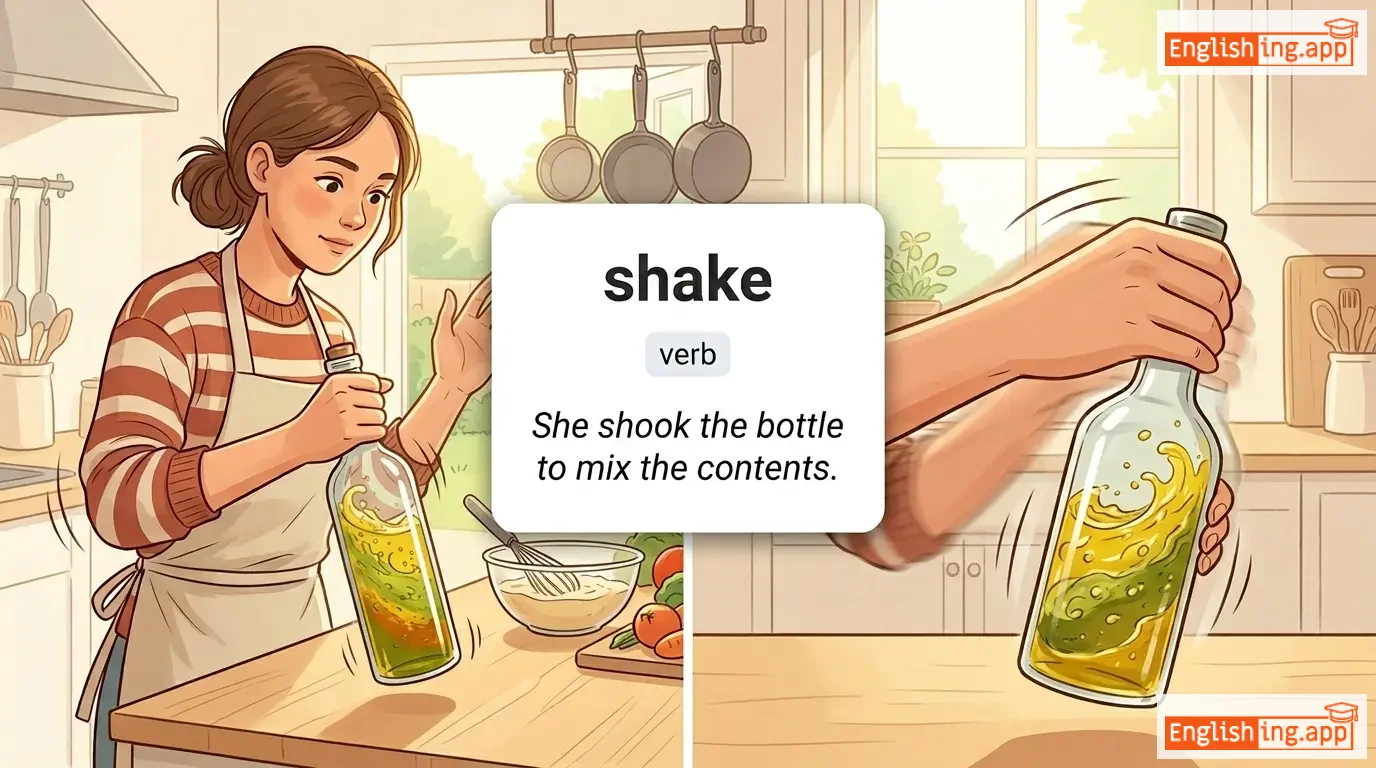
shake definition card — visual illustration of the meaning
verb
/ʃeɪk/
झटका देना (jhatka dena)

to move or cause to move up and down or from side to side with rapid, short movements

"She shook the bottle to mix the contents."

"उसने बोतल को सामग्री को मिलाने के लिए हिलाया।" (Usne botal ko samagri ko milane ke liye hilaya.)
adjective
/ˈʃeɪ.ki/
अस्थिर; कांपता हुआ; अविश्वसनीय; कमजोर (asthir; kaampata hua; avishwasneey; kamzor)

unstable; trembling; unreliable; weak

"His voice was shaky with nervousness."

"उसकी आवाज़ घबराहट के कारण कांप रही थी।" (uski aawaaz ghabrahat ke kaaran kaamp rahi thi.)
noun
/ʃeɪl/
शेल शेली (shel sheli)

a fine-grained sedimentary rock that can be split into thin layers

"The region is rich in shale and natural gas deposits."

"यह क्षेत्र शेल और प्राकृतिक गैस के भंडार से समृद्ध है।" (Yah kshetra shel aur prakritik gas ke bhandar se samriddh hai.)
modal verb
/ʃæl/
होना (hona)

used to express the future or indicate an intention or determination

"I shall return before sunset."

"मैं सूर्यास्त से पहले लौट आऊँगा।" (Main suryast se pehle laut aunga.)
adjective
/ˈʃæl.oʊ/
उथला (uthla)

not deep; lacking depth of thought or feeling

"The children played in the shallow water near the shore."

"बच्चे किनारे के पास उथले पानी में खेल रहे थे।" (Bacche kinare ke paas uthle paani mein khel rahe the.)
noun, adjective, verb
/ʃæm/
झूठ (jhoot)

something that is not what it appears to be; a false or fake thing; to pretend

"The deal turned out to be a sham."

"सौदा एक झूठ साबित हुआ।" (Sauda ek jhoot sabit hua.)
noun
/ˈʃæmbəlz/
अराजकता (arajaktaa)

a state of complete disorder or ruin

"After the storm, the whole town was in shambles."

"आंधी के बाद, पूरा शहर अराजकता में था।" (Aandhi ke baad, poora sheher arajakta mein tha.)
noun
/ʃeɪm/
लज्जा (lajja)

a painful feeling of humiliation or distress caused by the consciousness of wrong or foolish behavior

"He felt deep shame after lying to his friend."

"अपने दोस्त से झूठ बोलने के बाद उसे गहरी लज्जा महसूस हुई।" (Apne dost se jhooth bolne ke baad use gehri lajja mehsoos hui.)
adjective
/ˈʃeɪm.fəl/
शर्मनाक; अपमानजनक; चिढ़ानेवाला (sharmnak; apmanjanak; chidhanevala)

causing shame; disgraceful; embarrassing

"His shameful behavior embarrassed the entire family."

"उसका शर्मनाक व्यवहार पूरे परिवार को शर्मिंदा कर दिया।" (uska sharmnak vyavhaar pure parivaar ko sharminda kar diya.)
adjective
/ˈʃeɪm.ləs/
बेशर्म (shameless)

having no shame; bold and rude; impudent

"The shameless politician refused to apologize for his mistakes."

"बेशर्म राजनीतिज्ञ ने अपनी गलतियों के लिए माफ़ी मांगने से इनकार कर दिया।" (besharm rajnetijna ne apni galtiyon ke liye maafi maangne se inkaar kar diya)
noun
/ˌʃæŋɡriˈlɑː/
कल्पित स्वर्ग (kalpit swarg)

a remote, beautiful, imaginary place where life is perfect and peaceful

"They described the island as a modern-day Shangri-La."

"उन्होंने द्वीप को एक आधुनिक काल्पनिक स्वर्ग के रूप में वर्णित किया।" (Unhone dweep ko ek aadhunik kalpnik swarg ke roop mein varnit kiya.)
noun
/ʃeɪp/
आकृति (aakriti)

the external form, contours, or outline of someone or something

"The shape of the mountain was clearly visible from the valley."

"पहाड़ी का आकार घाटी से स्पष्ट रूप से दिखाई दे रहा था।" (Pahaadi ka aakaar ghaati se spashṭ roop se dikhai de raha tha.)
adjective
/ʃeɪpt/
आकृति में ढला हुआ (aakriti mein dhala hua)

having a particular form or appearance

"The sculpture was shaped like a human figure."

"मूर्ति को मानव आकृति की तरह आकार दिया गया था।" (Moorti ko maanav aakriti ki tarah aakaar diya gaya tha.)
adjective
/ˈʃeɪp.ləs/
आकृतिहीन (akrithihin)

having no definite or well-defined shape or form

"The fog created a shapeless mass in the distance."

"कोहरे ने दूरी में एक आकृतिहीन ढेर बना दिया।" (kohare ne doori mein ek akritihin dher bana diya.)
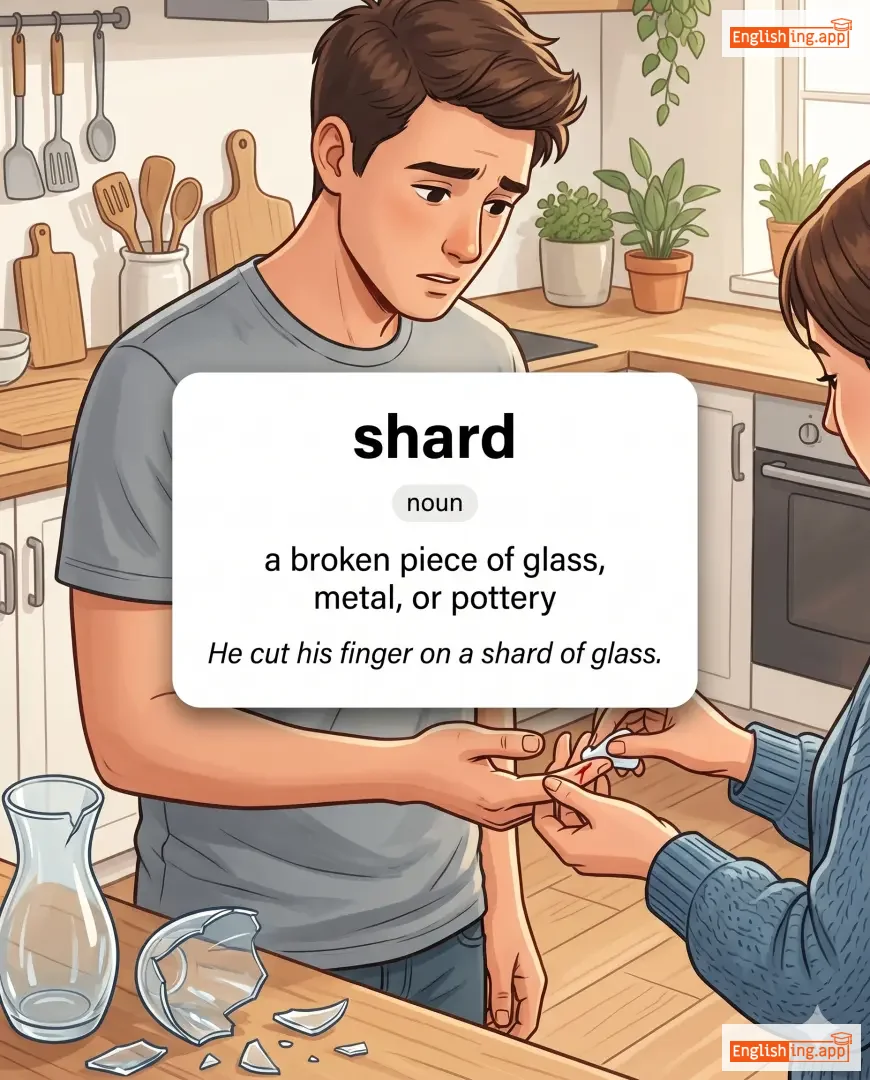
shard definition card — visual illustration of the meaning
noun
/ʃɑːrd/
टुकड़ा (tukda)

a broken piece of glass, metal, or pottery

"He cut his finger on a shard of glass."

"उसने कांच के टुकड़े पर अपनी अंगुली काट ली।" (Usne kaanch ke tukde par apni anguli kaat li.)
verb
/ʃɛər/
साझा करना (saajha karna)

to give a portion of (something) to others or allow others to use or enjoy it

"She decided to share her lunch with her friends."

"उसने अपने दोस्तों के साथ अपना लंच साझा करने का निर्णय लिया।" (Usne apne doston ke saath apna lunch saajha karne ka nirnay liya.)
adjective
/ʃɛrd/
साझा (saajha)

used, done, or experienced by two or more people together

"They live in a shared apartment near the university."

"वे विश्वविद्यालय के पास एक साझा अपार्टमेंट में रहते हैं।" (Ve vishwavidyalay ke paas ek saajha apartment mein rehte hain.)
noun
/ˈʃɛərˌhoʊldər/
शेयरधारक (sheyar dharak)

an individual or organization that owns shares in a company

"Each shareholder has the right to vote at the annual meeting."

"हर शेयरधारक को वार्षिक बैठक में मतदान का अधिकार है।" (Har sheyar dharak ko varshik baithak mein matdan ka adhikar hai.)
noun
/ʃɑːrk/
शार्क (shark)

a large fish with sharp teeth known for being a strong predator in the ocean

"The shark swam silently beneath the boat."

"शार्क नाव के नीचे चुपचाप तैरी जा रही थी।" (shark naav ke neeche chupchaap tairi ja rahi thi.)
noun
/ˈʃær.ən fruːt/
शेरॉन फल (Sheron phal)

a sweet orange persimmon fruit that can be eaten when firm

"The Sharon fruit is sweet and can be eaten like an apple."

"द शेरॉन फ्रूट स्वीट है और इसे एक सेब की तरह खाया जा सकता है।" (Da Sheron fruit sweet hai aur ise ek seb ki tarah khaya ja sakta hai.)
adjective
/ʃɑːrp/
तीखा (teekha)

having a fine edge or point; keen

"The knife is sharp enough to cut through the meat easily."

"चाकू इतना तीखा है कि मांस को आसानी से काट सकता है।" (Chaku itna teekha hai ki maans ko aasani se kaat sakta hai.)
adverb
/ˈʃɑːrpli/
तेज़ी से (tezī se)

suddenly and strongly; in a cutting or intense way

"Prices rose sharply after the announcement."

"घोषणा के बाद कीमतें तेज़ी से बढ़ीं।" (Ghoṣaṇā ke bād kīmaten tezī se baṛhīṁ.)
verb
/ˈʃætər/
टूटना (tootna)

To break suddenly into many small pieces.

"The glass will shatter if you drop it."

"ग्लास गिरने पर टूट जाएगा।" (Glass girne par toot jayega.)
verb, noun
/ʃeɪv/
दाढ़ी या बाल काटना (daadhi ya baal kaatna)

To remove hair from the body, typically using a razor; the act of removing hair

"He likes to shave every morning before work."

"वह हर सुबह काम से पहले शेव करना पसंद करता है।" (vah har subah kaam se pehle shave karna pasand karta hai)
noun
/ˈʃeɪvɪŋ/
सुख (sukh)

the act of removing hair with a razor; a thin strip or piece shaved from something

"He bought a new cream for shaving."

"उसने शेविंग के लिए एक नई क्रीम खरीदी।" (Usne shaving ke liye ek nai cream kharidi.)
pronoun
/ʃi/
वह (woh)

a female person or animal previously mentioned or easily identified

"She is going to the market to buy vegetables."

"वह बाजार में सब्जियाँ खरीदने जा रही है।" (Woh bazaar mein sabziyan kharidne ja rahi hai.)
noun
/ʃiːf/
गेहूं की बंडल (gehun ki bundel)

a bundle of grain stalks laid lengthwise and tied together after reaping; a bundle of objects tied together

"The farmer carried a sheaf of wheat on his shoulder."

"किसान अपने कंधे पर गेहूं का शीफ़ ले कर चल रहा था।" (Kisan apne kandhe par gehun ka sheaf le kar chal raha tha.)
verb
/ʃɪə/
काटना (katna)

to cut the wool off a sheep or to cut something with sharp tools like scissors or shears

"The farmer will shear the sheep in the spring."

"किसान बसंत में भेड़ की ऊन काटेंगे।" (Kisan basant mein bhed ki un katenge.)
noun
/ʃiːt fɪʃ/
बोयल मछली (boayal machhli)

A large freshwater catfish with a broad flat head and long barbels

"The sheat-fish is one of the largest freshwater fish in South Asia."

"बोयल मछली दक्षिण एशिया की सबसे बड़ी मीठे पानी की मछलियों में से एक है।" (boayal machhli dakshin ashiya ki sabse badi meethe pani ki machhliyon mein se ek hai)
verb
/ʃiːð/
खाप में डालना (khap mein daalna)

to put a sword or knife back into its cover

"He quickly sheathed his sword after the duel."

"वह द्वंद्वयुद्ध के बाद जल्दी से अपनी तलवार खापे में डाल दी।" (Vah dvandvayudh ke baad jaldi se apni talwar khape mein daal di.)
verb
/ʃɛd/
झड़ना (jhadna)

to let something fall off naturally, such as leaves, hair, or tears

"Trees shed their leaves in autumn."

"पेड़ पतझड़ में अपने पत्ते झड़ते हैं।" (Ped patjhad mein apne patte jhadte hain.)
noun
/ʃiːp/
भेड़ (bhed)

a farm animal with thick wool that is raised for its wool, meat, and milk

"The farmer keeps a large flock of sheep."

"किसान एक बड़ी भेड़-बकरियों की झुंड रखते हैं।" (Kisaan ek badi bhed-bakriyon ki jhund rakhte hain.)
adjective
/ʃɪə/
पूर्ण (poorn)

complete and utter; very steep or transparent

"The cliff was a sheer drop into the sea."

"चट्टान समुद्र में एक पूरी ढलान थी।" (Chattan samudra mein ek poori dhalan thi.)
noun
/ʃiːt/
चादर (chadar)

a large piece of cloth or paper, typically used to cover or protect something

"I need a clean sheet to cover the bed."

"मुझे बिस्तर को ढकने के लिए एक साफ़ शीट चाहिए।" (Mujhe bistar ko dhakne ke liye ek saaf sheet chahiye.)
noun
/ʃɛlf/
शेल्फ (shelf)

a flat surface used for storing or displaying things, typically fixed to a wall or inside a cabinet

"I placed the books on the shelf next to the window."

"मैंने खिड़की के पास शेल्फ पर किताबें रखी।" (Maine khidki ke paas shelf par kitaabein rakhi.)
noun
/ʃɛl/
शंख (shankh)

the hard outer covering of a mollusk or a crustacean, or something similar

"She picked up a beautiful seashell on the beach."

"उसने समुद्र तट पर एक सुंदर शंख उठाया।" (Usne samudra tat par ek sundar shankh uthaya.)
noun
/ˈʃɛltər/
आश्रय (ashray)

a place giving temporary protection from bad weather or danger

"They found shelter from the storm in the nearby barn."

"उन्होंने आंधी से बचने के लिए पास के गोशाला में शरण ली।" (Unhone aandhi se bachne ke liye paas ke goshala mein sharan li.)
noun
/ˈʃepərd/
चरवाहा (charwaha)

a person who tends and guards sheep

"The shepherd guided his flock to the green pasture."

"चरवाहा ने अपने झुंड को हरे चरागाह में ले जाया।" (charwaha ne apne jhund ko hare charagah mein le jaya.)
noun
/ˈʃɜːrbət/
शरबत (sharbat)

a sweet flavored drink or a frozen dessert made from sweetened fruit juice

"On hot days, she enjoys a glass of lemon sherbet."

"गर्मियों में, वह एक गिलास नींबू शरबत का आनंद लेती है।" (Garmiyon mein, vah ek gilas neemboo sharbat ka anand leti hai.)
noun
/ˈʃɪbəˌlɛθ/
विशिष्ट समूह को पहचानने के लिए प्रयोग होने वाला वाक्य या विश्वास (vishisht samuh ko pahchanne ke liye prayog hone wala vaakya ya vishwas)

A custom, phrase, or belief distinguishing a particular group of people, often used to identify outsiders.

"The phrase became a political shibboleth during the campaign."

"यह वाक्य चुनावी प्रचार के दौरान एक राजनीतिक शिब्बोलेथ बन गया था।" (Yeh vaakya chunaavi prachaar ke dauraan ek raajneetik shibboleth ban gaya tha.)
verb
/ʃɪft/
स्थानांतरित करना (sthanantarit karna)

To move or change from one place, position, or situation to another.

"She had to shift her focus to the new project."

"उसे नए प्रोजेक्ट पर ध्यान केंद्रित करने के लिए शिफ्ट करना पड़ा।" (Use naye project par dhyan kendrit karne ke liye shift karna pada.)