वोकैबुलरीज

इंग्लिश वोकैबुलरी डिस्कवर, लर्न और मास्टर करें

adjective
/rɪˈlaɪ.ənt/
निर्भर (nirbhar)

depending on someone or something for support

"The country is too reliant on imported goods."

"देश आयातित वस्तुओं पर बहुत निर्भर है।" (Desh aayatit vastuon par bahut nirbhar hai.)
noun
/ˈrɛl.ɪk/
स्मृति (smriti)

an object surviving from an earlier time, often of historical or religious interest

"The museum displayed relics from the ancient civilization."

"संग्रहालय में प्राचीन सभ्यता की स्मृतियाँ प्रदर्शित की गईं।" (Sangrahalay mein prachin sabhyata ki smritiyan pradarshit ki gayi.)
noun
/rɪˈliːf/
राहत (rilif)

a feeling of reassurance and comfort after stress or discomfort

"She felt a huge sense of relief after hearing the good news."

"अच्छी खबर सुनने के बाद उसे बहुत बड़ी राहत महसूस हुई." (acchi khabar sunne ke baad use bahut badi rahat mehsoos hui.)
noun
/rɪˈliːf treɪn/
राहत ट्रेन (raahat train)

a train that carries emergency supplies and aid to disaster-affected areas

"The relief train arrived with food and medical supplies for the flood victims."

"राहत ट्रेन बाढ़ पीड़ितों के लिए खाद्य और चिकित्सा आपूर्ति लेकर आई।" (raahat train baadh peediton ke liye khadya aur chikitsa aapurti lekar aayi)
verb
/rɪˈliːv/
कम करना (kam karna)

to make pain, distress, or difficulty less severe or serious

"The medicine helped relieve his headache."

"दवाई ने उसके सिरदर्द को कम करने में मदद की।" (Dawai ne uske sirdard ko kam karne mein madad ki.)
adjective
/rɪˈliːvd/
मुक्त (mukta)

feeling happy and less worried after something stressful has been removed or resolved

"She felt relieved after hearing the good news."

"अच्छी खबर सुनने के बाद वह राहत महसूस कर रही थी।" (Acchi khabar sunne ke baad vah raahat mahsus kar rahi thi.)
noun
/rɪˈlɪdʒ.ən/
धर्म (dharm)

a system of faith and worship involving belief in a higher power

"Freedom of religion is a fundamental human right."

"धर्म की स्वतंत्रता एक मौलिक मानव अधिकार है।" (Dharm ki svatantrata ek maulik manav adhikar hai.)
adjective
/rɪˈlɪdʒəs/
धार्मिक (dharmik)

relating to or believing in a religion or faith

"She is a very religious woman who prays every day."

"वह एक बहुत धार्मिक महिला है जो हर दिन प्रार्थना करती है।" (Vah ek bahut dharmik mahila hai jo har din prarthna karti hai.)
relinquish definition card — visual illustration of the meaning
verb
/rɪˈlɪŋkwɪʃ/
त्याग करना (tyag karna)

to give up or let go of something voluntarily

"He had to relinquish control of the company after the merger."

"विलय के बाद उसे कंपनी का नियंत्रण त्याग करना पड़ा।" (Vilyay ke baad use company ka niyantran tyag karna pada.)
noun
/ˈrɛlɪkwɛri/
पवित्र अवशेषों का पात्र (pavitra avasheshon ka patra)

a container for holy relics

"The ancient reliquary was decorated with gold and precious stones."

"प्राचीन रेलिक्वेरी को सोने और कीमती पत्थरों से सजाया गया था।" (Prachin reliquery ko sone aur keemti patharon se sajaya gaya tha.)
verb/noun
/ˈrɛlɪʃ/
आनंद लेना / चटनी (anand lena / chatni)

to greatly enjoy; also a condiment or sauce

"She relished the opportunity to travel abroad."

"वह विदेश यात्रा का अवसर बहुत आनंद से ले रही थी।" (Vah videsh yatra ka avsar bahut anand se le rahi thi.)
noun
/rɪˈlʌktəns/
अलमनीयता (almaniyata)

unwillingness or hesitation to do something

"His reluctance to speak made the meeting awkward."

"उसकी बोलने की अनिच्छा ने मीटिंग को अजीब बना दिया।" (Uski bolne ki anichchha ne meeting ko ajeeb bana diya.)
adjective
/rɪˈlʌktənt/
अनिच्छुक (anichchhuk)

unwilling or hesitant to do something

"She was reluctant to speak in front of the large audience."

"वह बड़े दर्शकों के सामने बोलने में अनिच्छुक थी।" (Vah bade darshako ke samne bolne mein anichchhuk thi.)
adverb
/rɪˈlʌk.tənt.li/
अनिच्छापूर्वक (anichchhapurvak)

in an unwilling manner; with hesitation or resistance

"She reluctantly agreed to help with the project."

"वह परियोजना में मदद करने के लिए अनिच्छा से सहमत हो गई।" (vah pariyojna mein madad karne ke liye anichchha se sahmat ho gayi.)
verb
/rɪˈlaɪ/
भरोसा करना (bharosa karna)

to depend on with confidence

"You can always rely on her to help you out."

"तुम हमेशा उस पर भरोसा कर सकते हो कि वह तुम्हारी मदद करेगी।" (Tum hamesha us par bharosa kar sakte ho ki wah tumhari madad karegi.)
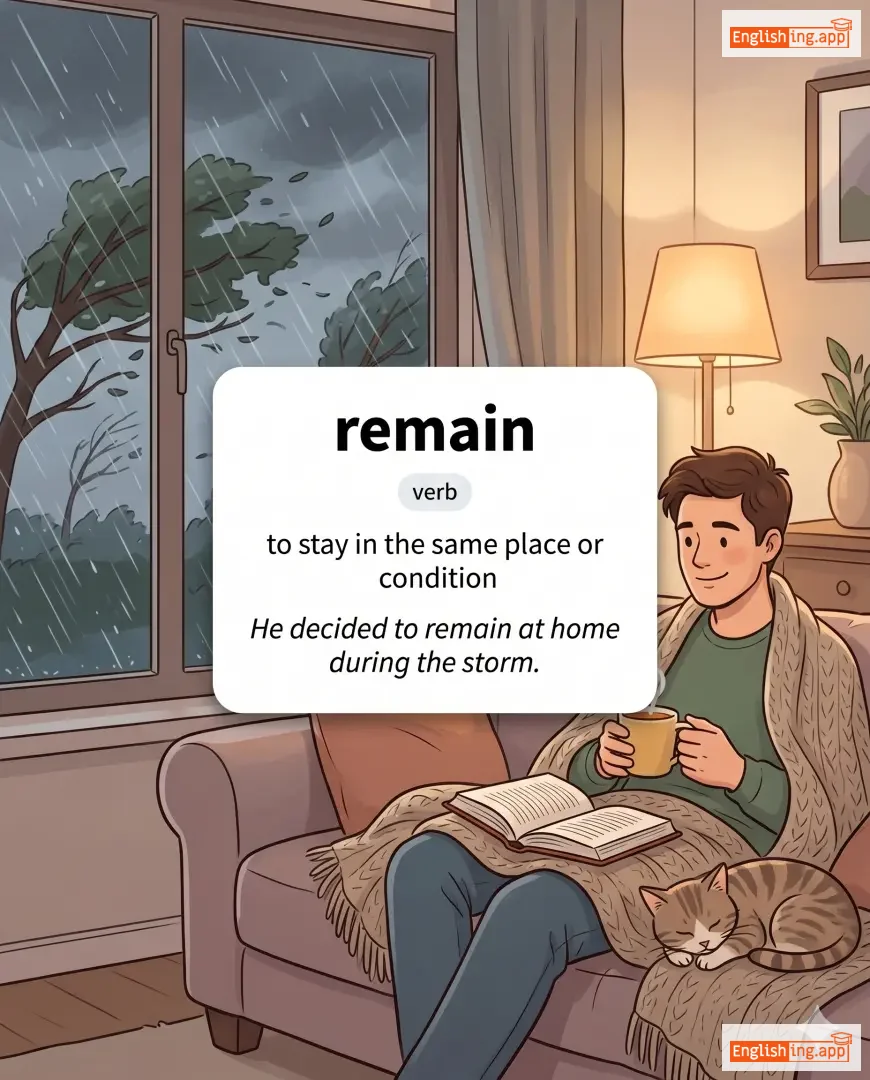
remain definition card — visual illustration of the meaning
verb
/rɪˈmeɪn/
रहना (rahna)

to stay in the same place or condition

"He decided to remain at home during the storm."

"उसने तूफान के दौरान घर पर रहने का निर्णय लिया।" (Usne toofan ke dauran ghar par rehne ka nirnay liya.)
noun
/rɪˈmeɪndər/
अवशिष्ट (avashisht)

the part that is left after the main part is gone or used

"He ate most of the cake and left the remainder on the plate."

"वह केक का अधिकांश हिस्सा खा चुका था और प्लेट पर अवशिष्ट छोड़ दिया था।" (Vah kek ka aksar hissa kha chuka tha aur plete par avashisht chhod diya tha.)
adjective
/rɪˈmeɪnɪŋ/
बाकी (baaki)

still existing or left after others are gone or dealt with

"There were only a few remaining tickets for the concert."

"संगीत कार्यक्रम के लिए केवल कुछ ही टिकट बाकी थे।" (Sangeet karyakram ke liye keval kuch hi tiket baaki the.)
noun
/rɪˈmeɪnz/
अवशेष (avashes)

the parts, pieces, or substances that are left after the rest has been used or removed

"The remains of the meal were left on the table."

"खाने के अवशेष मेज पर छोड़ दिए गए थे।" (Khaane ke avashes mej par chhod diye gaye the.)
noun/verb
/rɪˈmɑːrk/
टिप्पणी (tippani)

something that is said; a comment

"She made a remark about the weather."

"उसने मौसम के बारे में एक टिप्पणी की।" (Usne mausam ke baare mein ek tippani ki.)
adjective
/rɪˈmɑːrkəbl/
अत्यंत ध्यान देने योग्य (atyant dhyaan dene yogya)

worthy of attention; striking

"Her remarkable performance impressed everyone."

"उसकी रिमार्केबल प्रदर्शन ने सभी को प्रभावित किया।" (uski remarkable pradarshan ne sabhi ko prabhavit kiya.)
adverb
/rɪˈmɑːrkəbli/
असाधारण रूप से (asadharan roop se)

in a way that is worthy of attention or notice; surprisingly

"She did remarkably well in the competition."

"वह प्रतियोगिता में असाधारण रूप से अच्छा किया।" (Vah pratiyogita mein asadharan roop se accha kiya.)
adjective
/rɪˈmiːdiəbl/
ठीक किया जा सकता है (theek kiya ja sakta hai)

capable of being corrected or cured

"The mistake was serious but still remediable."

"गलती गंभीर थी लेकिन अभी भी ठीक किया जा सकता था।" (Galti gambheer thi lekin abhi bhi theek kiya ja sakta tha.)
adjective
/rɪˈmiːdiəl/
सुधारात्मक (sudharatmak)

intended to correct or improve a situation, especially related to learning or health

"The school offers remedial classes in mathematics."

"स्कूल गणित में सुधारात्मक कक्षाएँ प्रदान करता है।" (School ganit mein sudharatmak kakshaayein pradan karta hai.)
noun
/ˈrɛmɪdi/
उपचार (upchaar)

a treatment or solution for a problem or illness

"The doctor prescribed a remedy for the cough."

"डॉक्टर ने खांसी के लिए एक उपचार लिखा।" (Doktor ne khansi ke liye ek upchaar likha.)
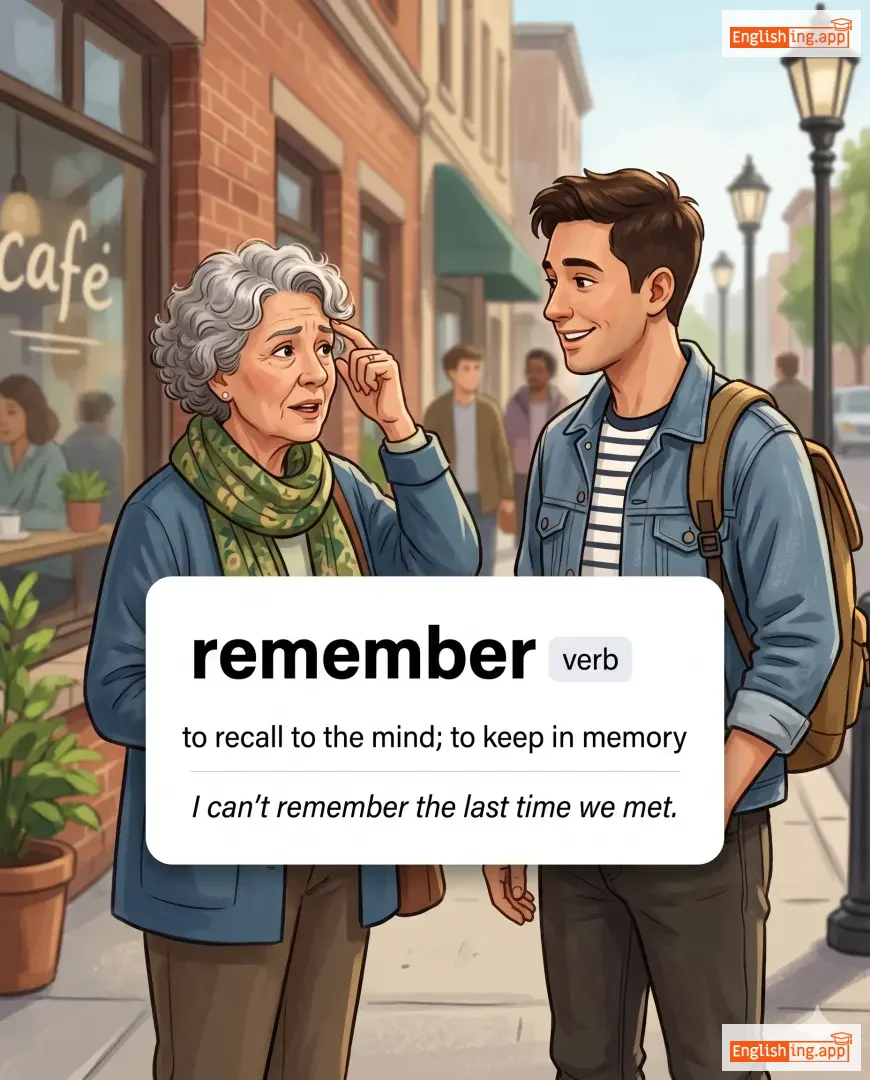
remember definition card — visual illustration of the meaning
verb
/rɪˈmɛmbər/
याद रखना (yaad rakhna)

to recall to the mind; to keep in memory

"I can't remember the last time we met."

"मैं आखिरी बार हमें मिले हुए याद नहीं कर पा रहा हूँ।" (main aakhiri baar humein mile hue yaad nahin kar paa raha hoon.)
noun
/rɪˈmɛmbrəns/
स्मृति (smriti)

the act of remembering or honoring someone or something

"A service was held in remembrance of the fallen soldiers."

"गिरते हुए सैनिकों की स्मृति में एक सेवा आयोजित की गई थी।" (Girate hue sainiko ki smriti mein ek seva aayojit ki gayi thi.)
verb
/rɪˈmaɪnd/
याद दिलाना (yaad dilana)

to cause someone to remember something

"Please remind me to call her tomorrow."

"कृपया मुझे कल उसे कॉल करने के लिए याद दिलाना।" (kripya mujhe kal use call karne ke liye yaad dilana.)
noun
/rɪˈmaɪndər/
याद दिलानेवाला (yaad dilane wala)

something that helps you remember a fact, event, or action that you need to do or recall

"He set a reminder to call his mother on her birthday."

"उसने अपनी माँ को जन्मदिन पर कॉल करने के लिए एक याद दिलानेवाला सेट किया।" (Usne apni maan ko janmadin par kol karne ke liye ek yaad dilane wala set kiya.)
noun
/ˌrɛmɪˈnɪsəns/
स्मृतिचित्र (smritichitra)

a story or memory about past events

"He shared a reminiscence of his childhood days in the village."

"उसने गांव में अपने बचपन के दिनों की एक स्मृतिचित्र साझा की।" (Usne gaon mein apne bachpan ke dinon ki ek smritichitra saanjha ki.)
adjective
/ˌrɛmɪˈnɪsənt/
स्मृतिपूरक (smritipoorak)

Tending to remind one of something; suggestive of something in the past.

"The smell of rain is reminiscent of my childhood in the village."

"बारिश की खुशबू मेरे बचपन की याद दिलाती है जो गाँव में था।" (Barish ki khushboo mere bachpan ki yaad dilati hai jo gaon mein tha.)
adjective
/rɪˈmɪs/
लापरवाह (laparwah)

Negligent in performing a duty or responsibility.

"The manager was remiss in not checking the financial reports carefully."

"प्रबंधक ने वित्तीय रिपोर्टों को सावधानी से चेक करने में लापरवाही की थी।" (Prabandhak ne vittiya reporton ko saavdhaani se check karne mein laparwahi ki thi.)
noun
/rɪˈmɪʃən/
उपशमन (rimishan)

A temporary or permanent decrease or disappearance of disease symptoms; forgiveness of sins or debts.

"The patient’s cancer is in remission after the treatment."

"उपचार के बाद रोगी के कैंसर में कमी आ गई है।" (upchar ke baad rogi ke kaainsar mein kami aa gai hai)
verb
/rɪˈmɪt/
भुगतान भेजना / माफ करना (bhugtan bhejna / maaf karna)

To send money in payment or as a gift; to cancel or refrain from exacting a debt or punishment.

"He promised to remit the payment by the end of the week."

"उसने वादा किया था कि सप्ताह के अंत तक भुगतान भेज देगा।" (Usne wada kiya tha ki saptah ke ant tak bhugtan bhej dega.)
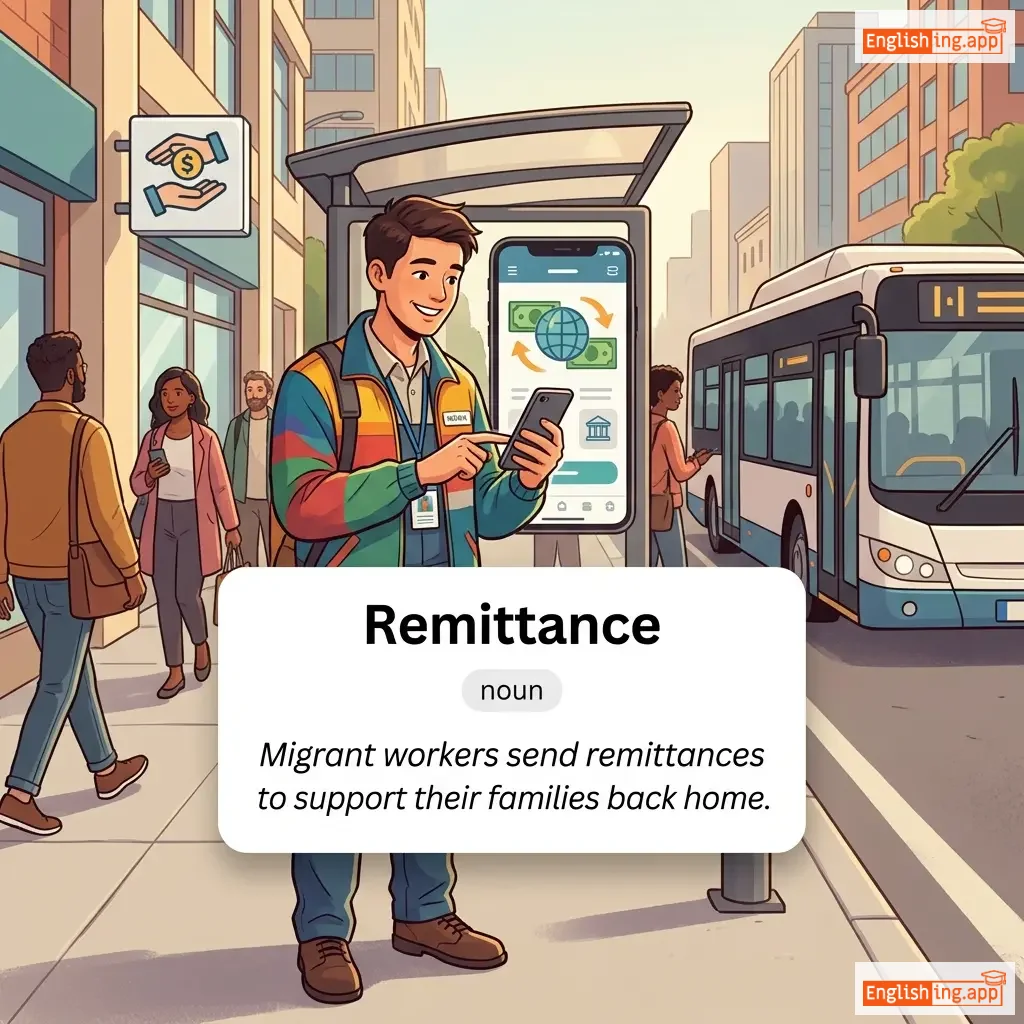
Remittance definition card — visual illustration of the meaning
noun
/rɪˈmɪtəns/
रेमिटेंस / धन स्थानांतरण (remittance / dhan sthanantran)

A sum of money sent, especially by mail or electronic transfer, as payment or gift.

"Migrant workers send remittances to support their families back home."

"माइग्रेंट कामकाजी लोग अपने परिवारों को समर्थन देने के लिए रेमिटेंस भेजते हैं।" (Migrant kaamkaji log apne parivaron ko samarthan dene ke liye remittance bhejte hain.)
noun
/ˈrɛmnənt/
अवशेष (avashes)

A small remaining part of something that once existed or was larger.

"The old house still had remnants of its former glory."

"पुराना घर अब भी अपनी पूर्व महिमा के अवशेष रखता था।" (Purana ghar ab bhi apni purv mahima ke avashes rakhta tha.)
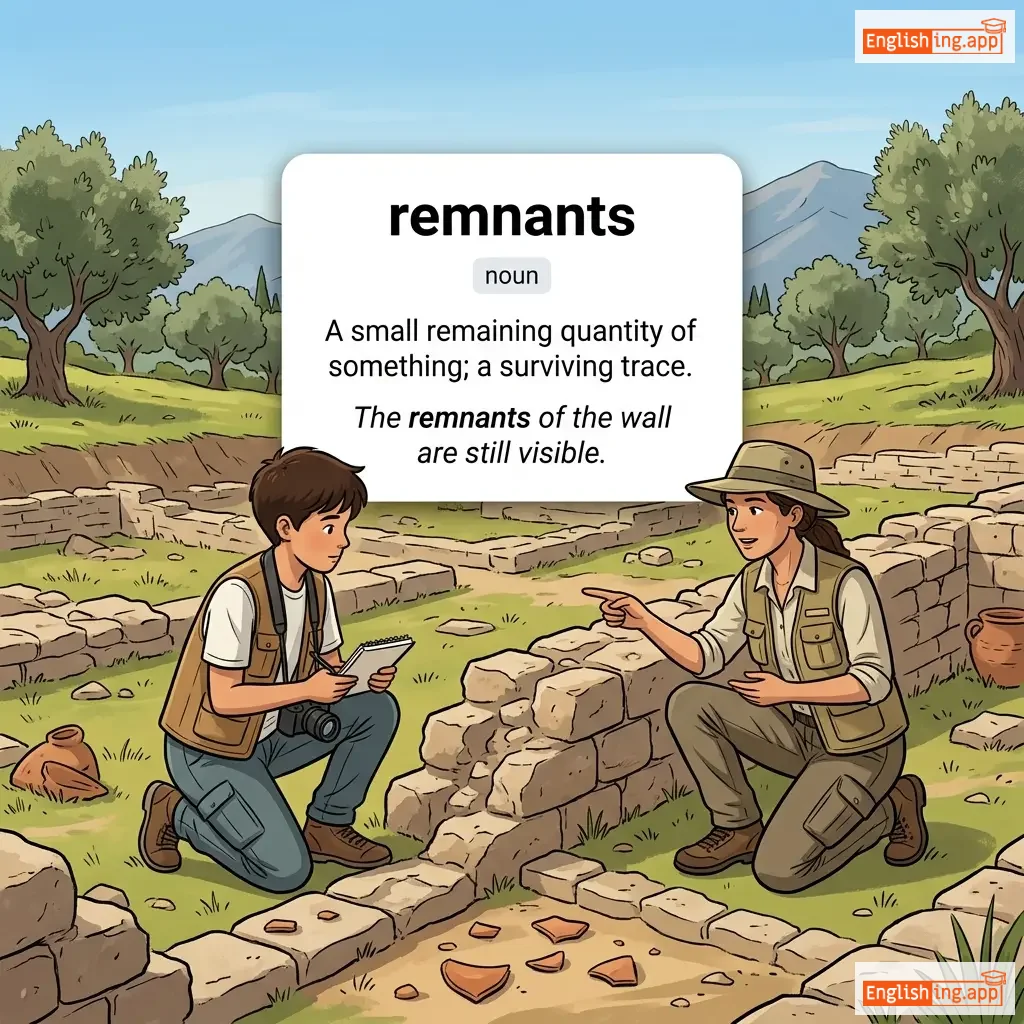
remnants definition card — visual illustration of the meaning
noun
ˈremnənts
अवशेष (avshesh)

A small remaining quantity of something; a surviving trace.

"The remnants of the wall are still visible."

"दीवार के अवशेष अभी भी दिखाई दे रहे हैं।" (Deewaar ke avshesh abhi bhi dikhai de rahe hain.)
verb
/ˌriːˈmɒdəl/
फिर से मॉडल बनाना (phir se model banana)

To change the structure or form of something, especially a building.

"They decided to remodel their kitchen last summer."

"उन्होंने पिछले ग्रीष्म में अपनी रसोई को फिर से मॉडल करने का निर्णय लिया।" (Unhone pichle grishm mein apni rasoi ko phir se model karne ka nirnay liya.)
noun
/rɪˈmɒnstrəns/
विरोध (virodh)

A forceful protest or objection.

"The workers’ remonstrance against unfair treatment was ignored."

"श्रमिकों का अनुचित व्यवहार के खिलाफ विरोध अनदेखा कर दिया गया था।" (Shramikon ka anuchit vyavhaar ke khilaf virodh andekha kar diya gaya tha.)
noun/adjective
/rɪˈmɒnstrənt/
विरोधी (virodhi)

A person who makes a forceful protest (noun); protesting or objecting (adjective).

"He was a remonstrant voice in the assembly."

"वह सभा में एक विरोधी स्वर था।" (Wah sabha mein ek virodhi swar tha.)
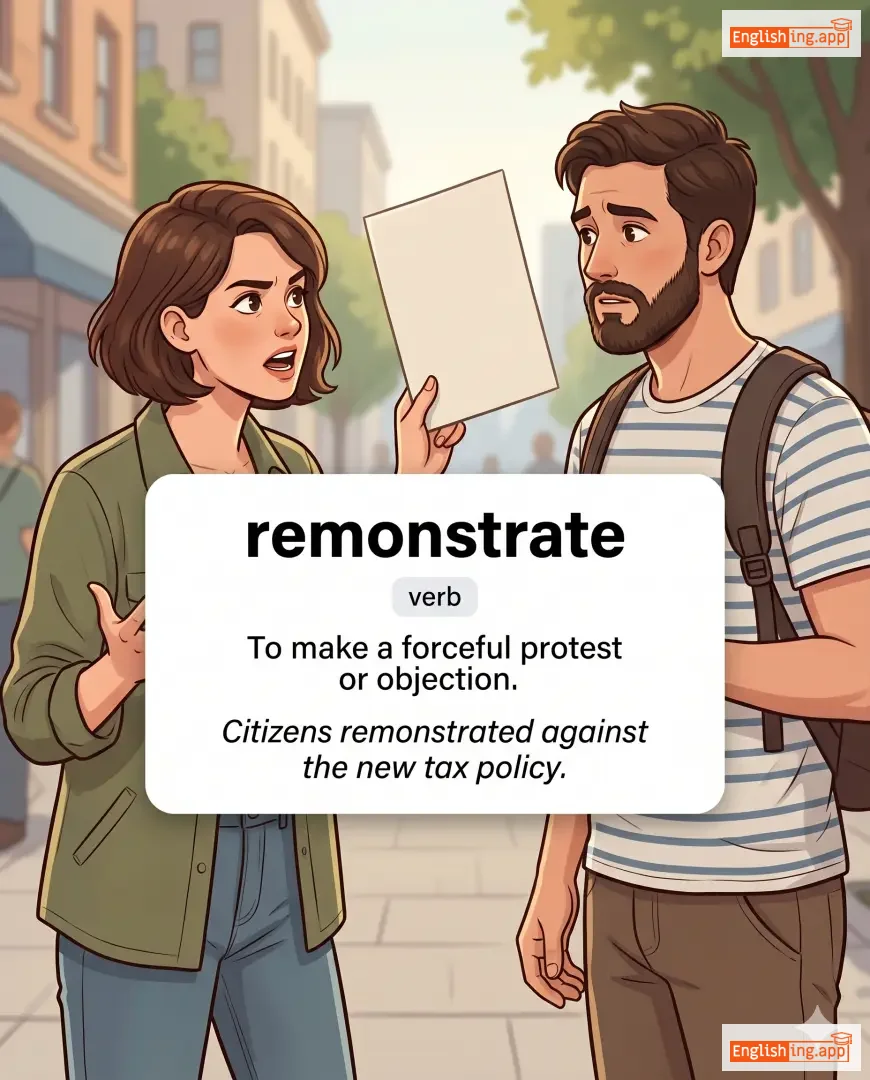
remonstrate definition card — visual illustration of the meaning
verb
/rɪˈmɒnstreɪt/
विरोध करना (virodh karna)

To make a forceful protest or objection.

"Citizens remonstrated against the new tax policy."

"नागरिकों ने नई कर नीति के खिलाफ विरोध किया।" (Nagrikon ne nayi kar niti ke khilaf virodh kiya.)
noun
/rɪˈmɔːrs/
पछतावा (pachtava)

A deep feeling of regret or guilt for a wrong committed.

"He was filled with remorse after lying to his friend."

"उसने अपने दोस्त से झूठ बोलने के बाद पछतावे से महसूस किया।" (Usne apne dost se jhooth bolne ke baad pachtave se mehsoos kiya.)
adjective
/rɪˈmoʊt/
दूरस्थ (dursth)

Situated far from the main centers of population; distant.

"They stayed in a remote village during their trip."

"वे अपनी यात्रा के दौरान एक दूरस्थ गांव में रुके थे।" (ve apni yatra ke dauran ek dursth gaon mein ruke the.)
adjective
/rɪˈmoʊtɪd/
दूरस्थ किया हुआ (doorasth kiya hua)

placed at a distance; made remote

"The system was remoted to a secure location."

"सिस्टम को एक सुरक्षित स्थान पर दूरस्थ किया गया था।" (System ko ek surakshit sthan par doorasth kiya gaya tha.)
adjective
/rɪˈmuːvəbəl/
हटाने योग्य (hatane yogya)

able to be removed or taken away

"This phone has a removable battery."

"इस फोन की एक हटाने योग्य बैटरी है।" (Is phone ki ek hatane yogya battery hai.)
noun
/rɪˈmuːvəl/
हटाना (hatana)

the act of taking something or someone away or out of a place

"The removal of old furniture made the room look spacious."

"पुरानी फर्नीचर को हटाने से कमरा बड़ा दिखने लगा।" (Purani furniture ko hatane se kamra bada dikhne laga.)
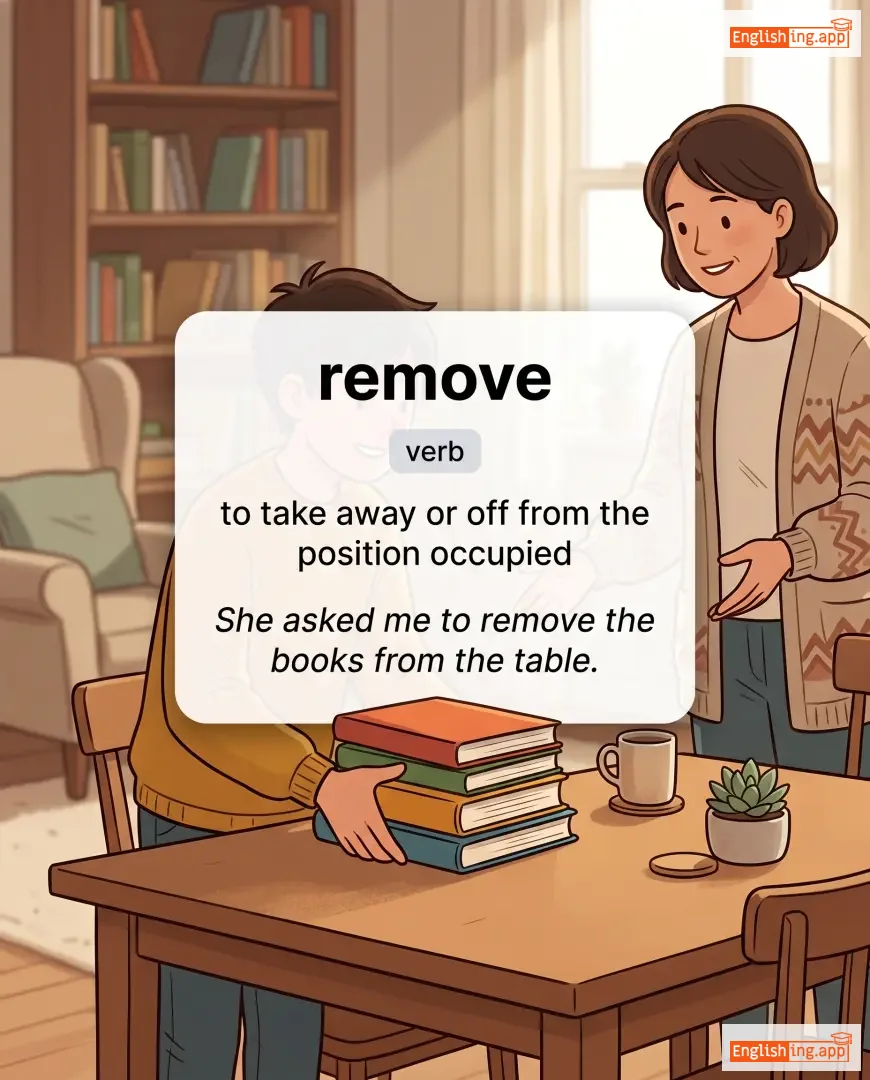
remove definition card — visual illustration of the meaning
verb
/rɪˈmuːv/
हटाना (hatana)

to take away or off from the position occupied

"She asked me to remove the books from the table."

"उसने मुझसे मेज से किताबें हटाने को कहा।" (usne mujhse mej se kitaabein hatane ko kaha.)
verb
/rɪˈmjuːnəreɪt/
भुगतान करना (bhugtan karna)

To pay someone for services or work done.

"The company will remunerate employees fairly for their overtime."

"कंपनी अपने कर्मचारियों को उनके ओवरटाइम के लिए उचित रूप से भुगतान करेगी।" (Company apne karmachariyon ko unke overtime ke liye uchit roop se bhugtan karegi.)
noun
/rɪˌmjuːnəˈreɪʃən/
प्रतिफल (pratiphal)

Money paid for work or a service.

"The remuneration for this job is quite generous."

"इस नौकरी का प्रतिफल काफ़ी उदार है।" (Is naukari ka pratiphal kaafi udar hai.)
adjective
/rɪˈmjuːnərətɪv/
लाभकारी (labhkaari)

Financially rewarding or profitable.

"He chose a remunerative career in medicine."

"उसने चिकित्सा में एक लाभकारी करियर चुना।" (Usne chikitsa mein ek labhkaari career chuna.)