वोकैबुलरीज

इंग्लिश वोकैबुलरी डिस्कवर, लर्न और मास्टर करें

noun
/ruːˈtiːn/
रूटीन, नियमित क्रियाओं की श्रृंखला (rutin, niyamit kriyaon ki shrinkhala)

a sequence of actions regularly followed; a fixed program

"She follows a strict morning routine before work."

"वह काम से पहले एक सख्त सुबह की रूटीन का पालन करती है।" (Vah kaam se pehle ek sakht subah ki rutin ka paalan karti hai.)
adverb
/ruːˈtiːnli/
नियमित रूप से (niyamit roop se)

as part of a regular procedure; habitually

"The staff routinely checks the equipment for safety."

"कर्मचारी नियमित रूप से सुरक्षा के लिए उपकरण की जांच करते हैं।" (Karmchari niyamit roop se suraksha ke liye upkaran ki jaanch karte hain.)
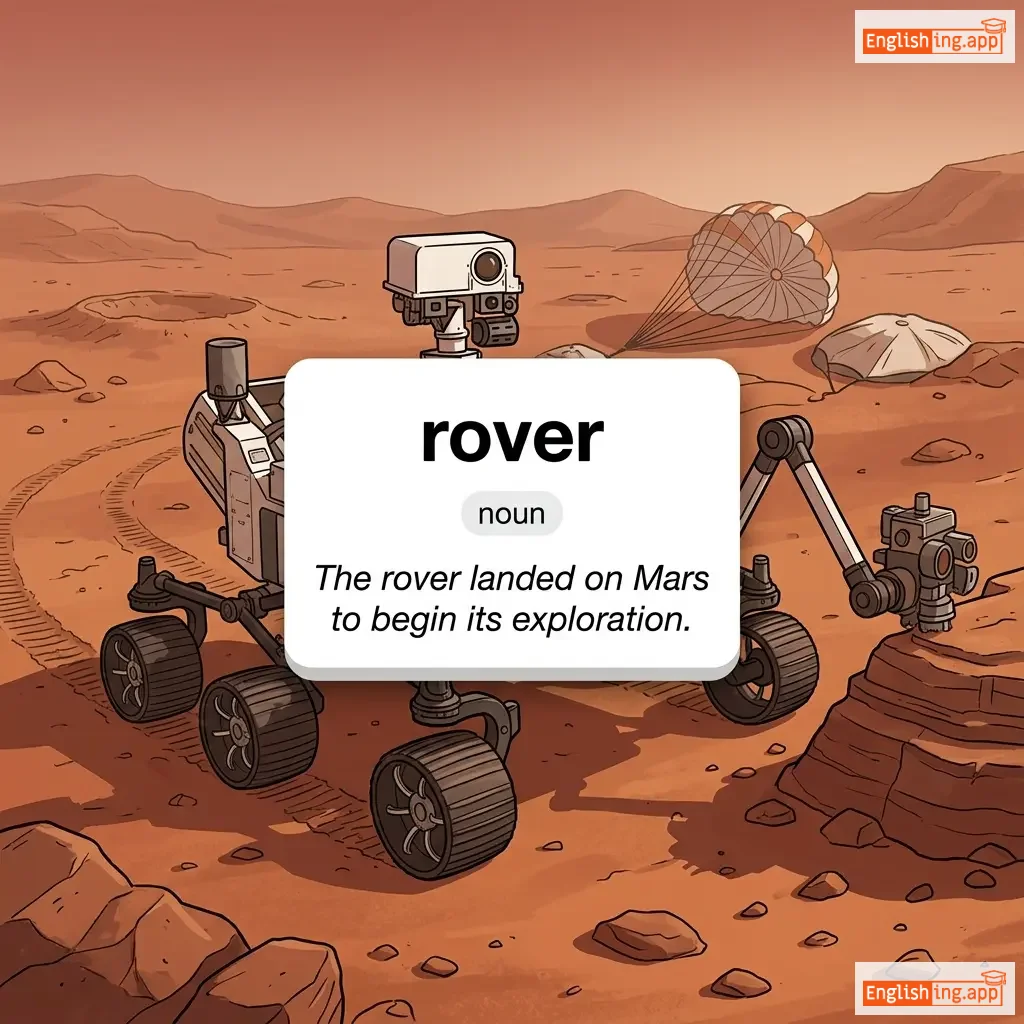
rover definition card — visual illustration of the meaning
noun
ˈrəʊvə
रोवर (rover)

A vehicle for driving over rough terrain, especially one driven by remote control over extraterrestrial terrain.

"The rover landed on Mars to begin its exploration."

"रोवर मंगल ग्रह पर लैंड हुआ और अपनी अन्वेषण प्रक्रिया शुरू की।" (Rover mangal grah par land hua aur apni anvikshan prakriya shuru ki.)
noun, verb
/raʊ/ (argument), /roʊ/ (line of things)
सारी / झगड़ा (saari / jhagra)

A line of things or people; also, a noisy quarrel; to propel a boat with oars.

"They had a loud row about money."

"वे पैसे के बारे में ज़ोर से झगड़ रहे थे।" (ve paise ke baare mein zor se jhagra kar rahe the.)
adjective
/ˈraʊdi/
हंगामेदार (hungamedar)

Noisy and disorderly; rough and disruptive

"The rowdy crowd made it hard to hear the speaker."

"हंगामेदार भीड़ के कारण वक्ता की आवाज़ सुनना मुश्किल था।" (hungamedar bheed ke kaaran vakta ki awaaz sunna mushkil tha.)
adjective
/ˈrɔɪəl/
राजसी (raajsee)

relating to a king, queen, or other member of a royal family

"They attended a royal ceremony at the palace."

"वे महल में एक राजसी समारोह में शामिल हुए।" (Ve mahal mein ek raajsee samaaroah mein shaamil hue.)
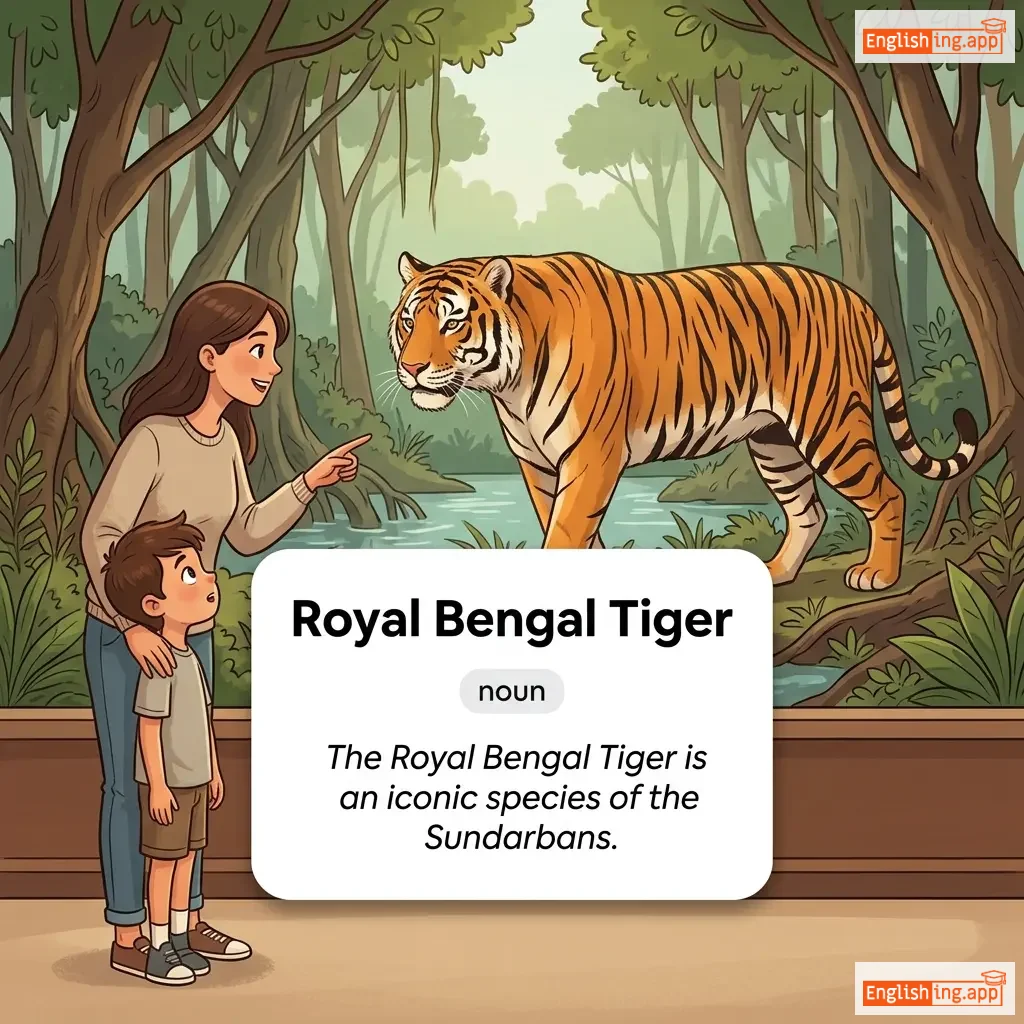
Royal Bengal Tiger definition card — visual illustration of the meaning
noun
ˈrɔɪəl ˈbɛŋɡəl ˈtaɪɡər
रॉयल बंगाल टाइगर (royal bengal tiger)

A subspecies of tiger found primarily in India and Bangladesh, known for its distinctive orange coat with black stripes.

"The Royal Bengal Tiger is an iconic species of the Sundarbans."

"रॉयल बंगाल टाइगर सुंदरबन का एक प्रतीकात्मक प्रजाति है।" (Royal bengal tiger Sundarban ka ek pratikatmak prajati hai.)
noun
/ˈrɔɪəlti/
शाही परिवार / रॉयल्टी (लेखक की आय) (royalty)

Members of a royal family or payment made to the owner of a patent, copyright, or natural resource.

"The author receives a royalty for every book sold."

"लेखक को हर बिके हुए किताब से रॉयल्टी मिलती है।" (lekhak ko har bike hue kitab se royalty milti hai.)
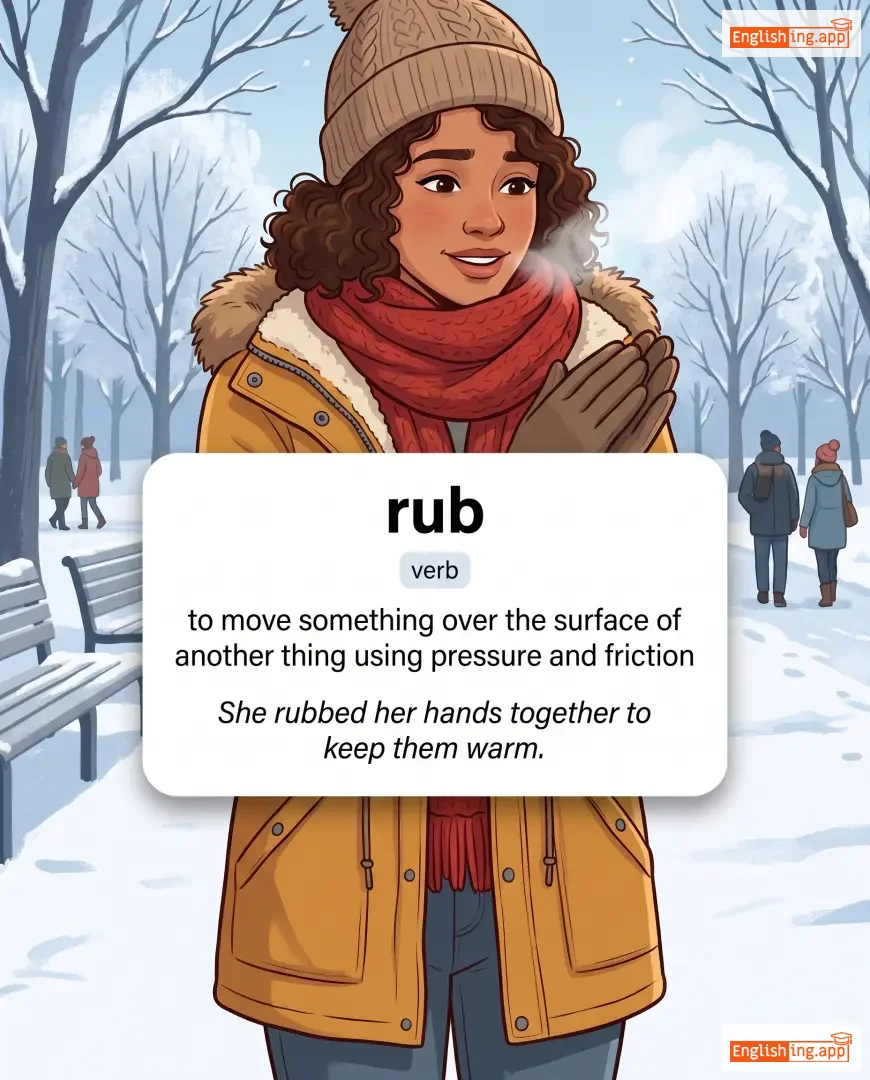
rub definition card — visual illustration of the meaning
verb
/rʌb/
रगड़ना (ragarna)

to move something over the surface of another thing using pressure and friction

"She rubbed her hands together to keep them warm."

"वह अपने हाथ एक साथ रगड़ती थी ताकि वे गर्म रहें।" (Wah apne haath ek saath ragarhti thi taaki ve garm rahein.)
noun
/ˈrʌbər/
खुशी (khushi)

a tough elastic substance made from the latex of tropical plants or synthetically, used for making tires, boots, and other products.

"The tires are made of natural rubber."

"जब उसे पुरस्कार मिला तो वह अपनी खुशी को छिपा नहीं सकी।" (Jab use puraskar mila to vah apni khushi ko chhupa nahi saki.)
noun
/ˈrʌbɪʃ/
कचरा (kachra)

Waste material or unwanted things; something worthless

"He threw the broken toys into the rubbish bin."

"उसने टूटी हुई खिलौनों को कचरे के डिब्बे में फेंक दिया।" (Usne tooti hui khilonon ko kachre ke dibbe mein fenk diya.)
noun
/ˈrʌbəl/
मलबा (malba)

Broken stone, bricks, or debris from a collapsed building or structure.

"The rescue team searched through the rubble after the earthquake."

"आपदा के बाद बचाव दल मलबे में खोज रहा था।" (aapda ke baad bachav dal malbe mein khoj raha tha.)
adjective
/ˈruːbɪkənd/
लालिमा से भरा चेहरा (rubicund)

Having a healthy reddish complexion.

"The old man’s rubicund face showed he was in good health."

"वृद्ध व्यक्ति का लालिमा से भरा चेहरा यह दिखा रहा था कि वह अच्छे स्वास्थ्य में थे।" (vruddh vyakti kā lālimā se bharā cheharā yah dikhā rahā thā ki vah acchhe swāsthya mein the.)
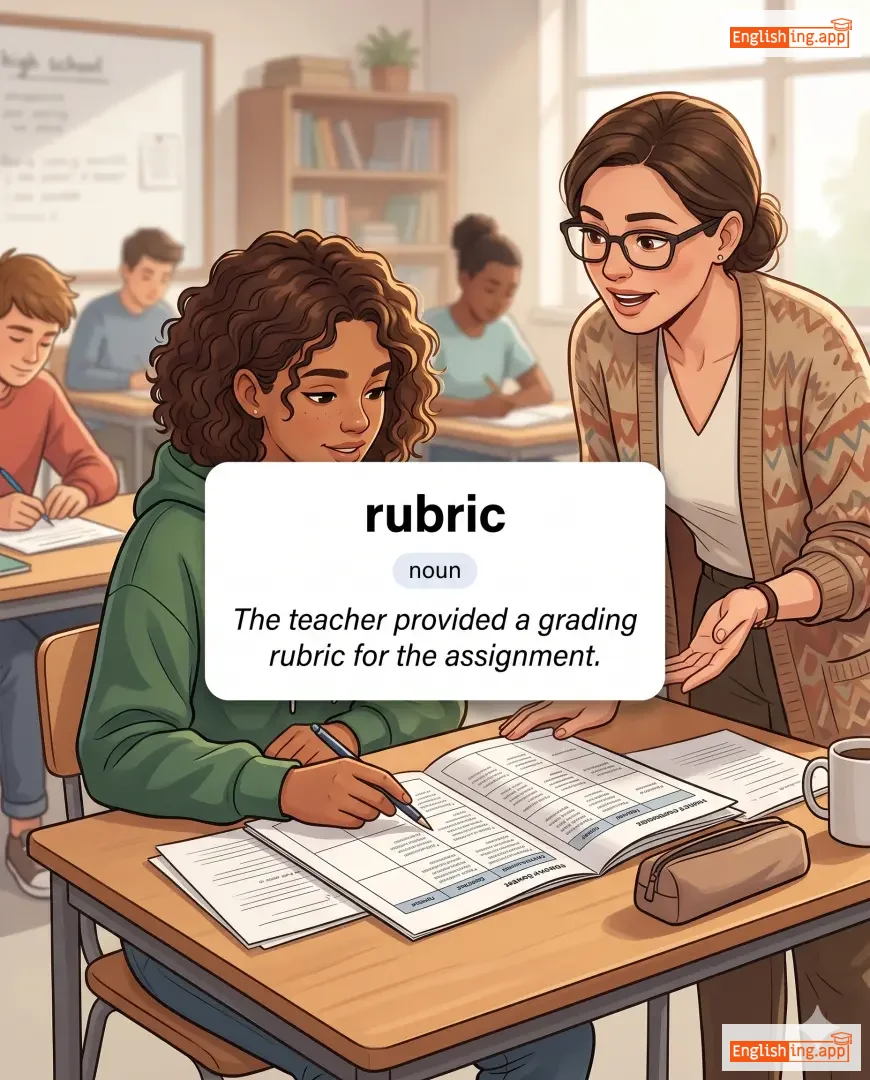
rubric definition card — visual illustration of the meaning
noun
/ˈruːbrɪk/
नियमावली / निर्देशिका (rubrik)

A set of instructions, rules, or a heading in a document, often used for grading criteria.

"The teacher provided a grading rubric for the assignment."

"शिक्षक ने असाइनमेंट के लिए एक ग्रेडिंग निर्देशिका प्रदान की।" (shikshak ne assignment ke liye ek grading nirdeshika pradan ki.)
noun
/ˈruː.bi/
रूबी (roobi)

a precious red gemstone; a deep red variety of corundum

"The ruby ring was her most treasured possession."

"रूबी की अंगूठी उसकी सबसे कीमती संपत्ति थी." (roobi ki anguthi uski sabse keemti sampatti thi.)
noun
/rʌk/
धक्का-मुक्की; अव्यवस्थित भीड़ (dhakka-mukki; avyavasthit bheed)

a situation where a crowd of people are pushing against each other; a disorderly crowd

"There was a ruck at the football match."

"फुटबॉल मैच में एक धक्का-मुक्की थी।" (football match mein ek dhakka-mukki thi)
adjective
/ˈrʌdi/
लालिमा (radii)

Having a healthy red color in the face.

"She had a ruddy complexion from working outdoors."

"वह बाहर काम करने से लालिमा से भरी हुई थी।" (vah baahar kaam karne se laalima se bhari hui thi.)
adjective
/ruːd/
असभ्य (asabhya)

Not having or showing respect; impolite

"It was rude of him to interrupt the conversation."

"उसके लिए बातचीत में बाधा डालना असभ्य था।" (uske liye baatcheet mein baadha daalna asabhya tha.)
adverb
/ˈruːdli/
असभ्य तरीके से (asabhya tarike se)

in an impolite or discourteous manner

"He rudely interrupted the speaker during the presentation."

"उसने प्रस्तुति के दौरान वक्ता को असभ्य तरीके से टोक दिया।" (Usne prastuti ke dauran vakta ko asabhya tarike se tok diya.)
noun
/ˈruːdnəs/
अशिष्टता (rud-ness)

the quality of being impolite, discourteous, or offensive in behavior or speech

"His rudeness shocked everyone at the dinner party."

"उसकी अशिष्टता ने डिनर पार्टी में सभी को चौंका दिया।" (uski asishtata ne dinner party mein sabhi ko chauka diya.)
noun
/ˈruːdɪmənt/
मूलभूत शिक्षा (moolbhoot shiksha)

A basic principle, element, or fundamental part of something.

"He learned the rudiments of music before joining the band."

"उसने बैंड में शामिल होने से पहले संगीत की मौलिक शिक्षा सीखी।" (Usne band mein shamil hone se pehle sangeet ki moolbhoot shiksha seekhi.)
adjective
/ˌruːdɪˈmɛntəri/
मूलभूत (moolbhoot)

Involving or limited to basic principles; elementary or simple.

"The village school provided only a rudimentary education."

"गाँव के स्कूल ने केवल एक मौलिक शिक्षा प्रदान की।" (Gaav ke school ne keval ek moolbhoot shiksha pradan ki.)
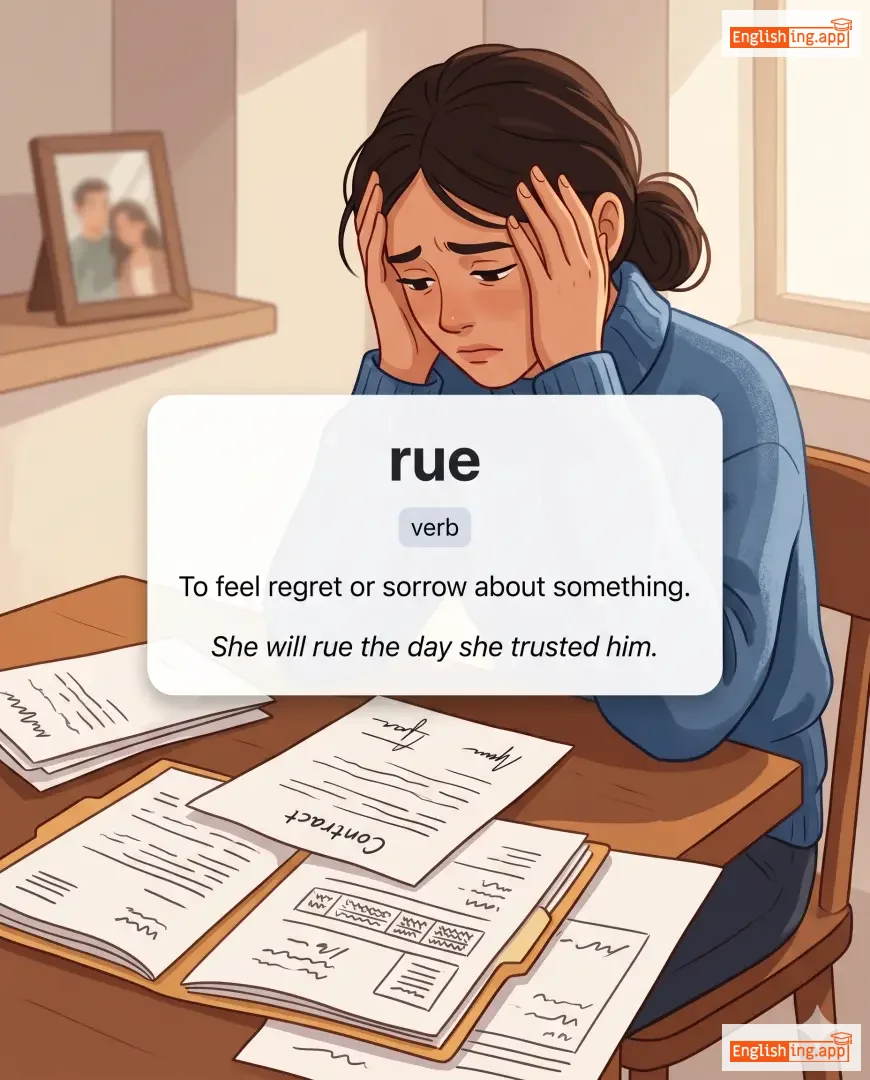
rue definition card — visual illustration of the meaning
verb
/ruː/
पछताना (pachtana)

To feel regret or sorrow about something.

"She will rue the day she trusted him."

"वह उस दिन पछताएगी जब उसने उसे भरोसा किया था।" (Vah us din pachhtayegi jab usne use bharosa kiya tha.)
adjective
/ˈruːfəl/
दुःखित (dukhit)

Expressing sorrow, regret, or pity.

"He gave a rueful smile after losing the match."

"उसने मैच हारने के बाद एक दुःखभरी मुस्कान दी।" (Usne match haarne ke baad ek dukhbhari muskaan di.)
noun
/ˈrʌfiən/
उच्चार (uchchar)

A violent or lawless person; a bully.

"The ruffians vandalized the shop late at night."

"रात में गुंडों ने दुकान को नष्ट कर दिया।" (Raat mein gundo ne dukaan ko nasht kar diya.)
verb
/ˈrʌf.l̩/
उलझाना, परेशान करना (uljhana, pareshan karna)

to disturb the smoothness of something; to annoy or upset someone

"The wind ruffled her hair."

"हवा ने उसके बाल उलझा दिए।" (Hawa ne uske baal uljha diye.)
adjective
/ˈrʌɡ.ɪd/
कठोर और असमान; असमान सतह वाला; कठोर और मजबूत (kathor aur asamaan; asamaan satah wala; kathor aur majboot)

rough and uneven; having a rough irregular surface; tough and strong

"The hikers crossed the rugged mountain terrain."

"पदयात्री ने कठोर पहाड़ी इलाके को पार किया।" (padyatri ne kathor pahaadi ilaake ko paar kiya.)
verb
/ˈruːɪn/
विनाश करना (vinash karna)

to destroy or severely damage something so that it no longer works or is of no use.

"Heavy rain ruined the wedding decorations."

"भारी बारिश ने शादी की सजावट को नष्ट कर दिया।" (Bhaari baarish ne shaadi ki saajawat ko nasht kar diya.)
noun
/ruːl/
नियम (niyam)

an accepted principle or instruction that states what is allowed or what must be done.

"There are strict rules about safety in the lab."

"प्रयोगशाला में सुरक्षा के बारे में कड़े नियम हैं।" (prayogshala mein suraksha ke baare mein kadhe niyam hain.)
noun
/ˈruːlər/
शासक; मापने वाली रेखा (shasak; mapne wali rekha)

A person who governs or controls a country; a straight-edged tool used for measuring or drawing lines

"The ruler drew a straight line on the paper while the king was a powerful ruler of his kingdom."

"रूलर ने कागज़ पर सीधी रेखा खींची और राजा अपने राज्य का शक्तिशाली शासक था।" (rular ne kagaz par seedhi rekha kheenchii aur raja apne rajya ka shaktishaali shasak tha.)
noun
/ruːlz/
नियम (niyam)

explicit principles or regulations governing conduct or procedure within a particular area of activity

"The teacher reminded the students to follow the classroom rules."

"शिक्षक ने छात्रों को कक्षा के नियमों का पालन करने की याद दिलाई।" (Shikshak ne chhatron ko kaksha ke niyamon ka paalan karne ki yaad dilayi.)
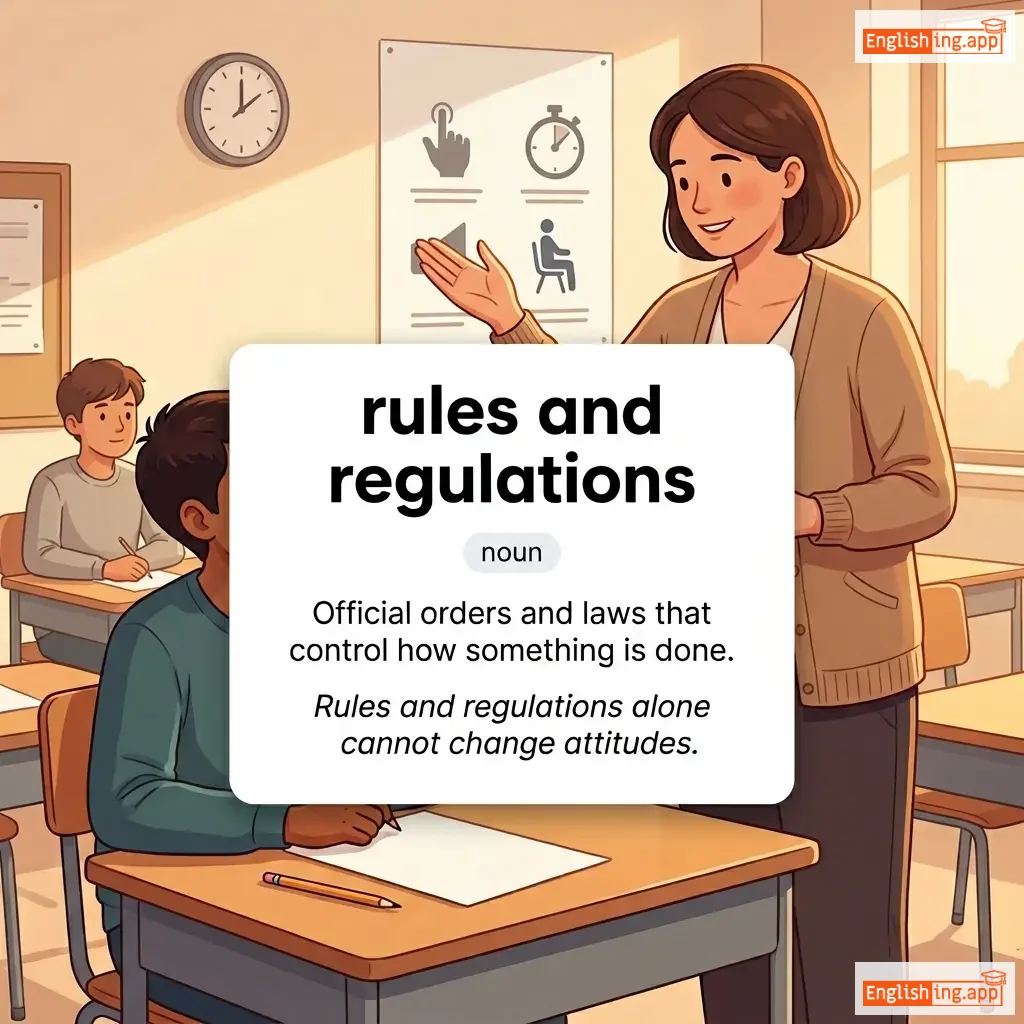
rules and regulations definition card — visual illustration of the meaning
noun
ruːlz ənd ˌrɛɡjʊˈleɪʃənz
नियम और विनियम (niyam aur niyam)

Official orders and laws that control how something is done.

"Rules and regulations alone cannot change attitudes."

"नियम और विनियम अकेले दृष्टिकोण बदल नहीं सकते।" (niyam aur niyam akele drishtikon badal nahin sakte.)
noun
/ˈruːlɪŋ/
फैसला (faisla)

an official decision made by a judge or authority.

"The court’s ruling favored the defendant."

"कोर्ट का फैसला अभियुक्त के पक्ष में था।" (Kourt ka faisla abhiyukt ke paksh mein tha.)
verb
/ˈrʌm.bəl/
ख़ुशी (khushi)

to make a continuous deep, resonant sound

"Thunder rumbled in the distance."

"जब उसे पुरस्कार मिला, तो वह अपनी ख़ुशी छुपा नहीं सकी।" (Jab use puraskaar mila, to vah apni khushi chhupa nahin sakee.)
noun
/ˈruː.mɪ.nənt/
रुमिनेंट (ruminent)

a cud-chewing mammal, such as a cow or sheep

"Cows are ruminants that chew cud."

"गायें रुमिनेंट हैं जो कूड़ चबाती हैं।" (Gaayein ruminent hain jo kud chabaati hain.)
verb
/ˈruː.mɪ.neɪt/
गहरे विचार करना, जाबर चबाना (gahre vichar karna, jabar chabana)

to think deeply about something; to chew cud (for animals)

"She sat alone to ruminate on her decision."

"वह अपने निर्णय पर गहरे विचार करने के लिए अकेले बैठी।" (Vah apne nirnay par gahre vichar karne ke liye akela baithi.)
verb
/ˈrʌm.ɪdʒ/
अराजक तरीके से खोजना (arajak tareeke se khojna)

to search through something in a disorderly way

"He rummaged through the drawer for his keys."

"वह ड्रॉवर में अपनी चाबियाँ खोजने के लिए अराजक तरीके से खा रहा था।" (Vah drawer mein apni chaabiyan khojne ke liye arajak tareeke se kho raha tha.)
noun
/ˈruːmər/
अफवाह (afwah)

a currently circulating story or report of uncertain or doubtful truth.

"There’s a rumor that the company will merge next year."

"कंपनी अगले साल मिल जाने की अफवाह है।" (kampani agle saal mil jaane ki afwah hai.)
noun
/ˈruːmər/
अफवाह; गपशप; समाचार (rumar)

a currently circulating story or report of uncertain or doubtful truth; gossip

"There's a rumour that the company will close next month."

"वह अफवाह है कि कंपनी अगले महीने बंद हो जाएगी।" (vah afwah hai ki kampani agle mahine band ho jayegi)
noun
/rʌmp/
नितंब; पिछवाड़ा; पीठ के निचले हिस्से (ramp)

the hindquarters or buttocks; the lower back area

"The horse injured its rump during the fall."

"घोड़े ने गिरने के दौरान अपनी नितंब को चोट पहुंचाई।" (ghode ne girne ke dauran apni nitamb ko chot pahunchai.)
verb
/ˈrʌmpəl/
कुचला (kuchla)

to make something untidy or wrinkled by creasing or crumpling

"She accidentally rumpled her dress while packing."

"वह पॅक करते समय अपनी ड्रेस को गलती से क़ुंचक लिया।" (Woh pack karte samay apni dress ko galti se kuchla liya.)
noun
/ˈrʌmpəs/
गड़बड़; हंगामा; शोर (gadbadd; hungama; shor)

a noisy disturbance; an uproar or commotion

"The children caused quite a rumpus in the playground."

"बच्चों ने खेल के मैदान में काफी शोर मचाया।" (bachcho ne khel ke maidan mein kaafi shor machaya.)
run definition card — visual illustration of the meaning
verb
/rʌn/
सुख (sukh)

to move swiftly on foot by taking steps faster than walking

"He runs every morning to stay fit."

"जब उसे पुरस्कार मिला, तो वह अपनी खुशी छुपा नहीं पाई।" (Jab use puraskar mila, to vah apni khushi chhupa nahin paayi.)
adjective
/ˈrʌn daʊn/
जीर्ण (jeern)

in a poor condition; worn out or neglected

"They live in a run-down house at the edge of town."

"वे शहर के किनारे एक जीर्ण घर में रहते हैं।" (Ve shahar ke kinare ek jeern ghar mein rehte hain.)
adjective
/ˈruːnɪk/
रून संबंधित (run sambandhit)

relating to or consisting of runes; mysterious or magical

"The old stone had strange runic carvings on it."

"पुरानी पत्थर पर अजीब रुनिक नक्काशी थी।" (Purani pathar par ajeeb runic nakashi thi.)
noun
/ˈrʌnər/
खुशी (khushi)

a person who runs, especially in races or for exercise

"The runner crossed the finish line with a big smile."

"उसने जब पुरस्कार प्राप्त किया तो वह अपनी खुशी छिपा नहीं पाई।" (Usne jab puraskaar praapt kiya to wah apni khushi chhupa nahi paayi.)
noun
/ˈrʌnɪŋ/
दौड़ना (daudna)

the action or sport of running

"Running every morning keeps me healthy."

"हर सुबह दौड़ना मुझे स्वस्थ रखता है।" (Har subah daudna mujhe swasth rakhta hai.)
noun/verb
/ˈrʌptʃər/
चीरना (cheerna)

to break or burst suddenly; a crack, split, or break in something

"The pipe ruptured due to high pressure."

"पाइप उच्च दबाव के कारण फट गया।" (pipe uchch dabaav ke kaaran fat gaya.)
adjective
/ˈrʊərəl/
ग्रामीण (gramin)

relating to the countryside rather than the town

"He prefers the peaceful life of a rural village."

"वह एक ग्रामीण गाँव की शांतिपूर्ण जीवनशैली पसंद करता है।" (Vah ek gramin gaanv ki shaantipoorn jeevanshailee pasand karta hai.)
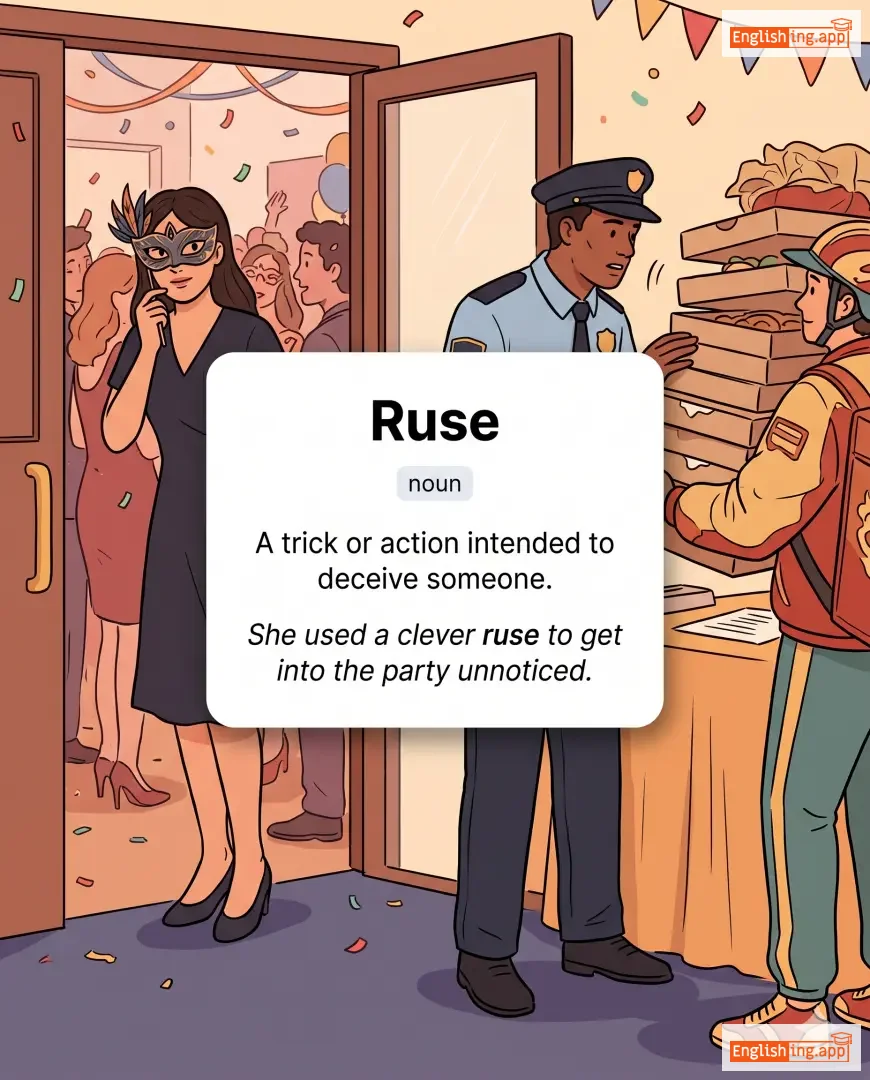
Ruse definition card — visual illustration of the meaning
noun
/ruːz/
चाल (chaal)

A trick or action intended to deceive someone.

"She used a clever ruse to get into the party unnoticed."

"उसने पार्टी में बिना देखे घुसने के लिए एक चालाक चाल का इस्तेमाल किया।" (Usne party mein bina dekhe ghusne ke liye ek chaalak chaal ka istemal kiya.)