वोकैबुलरीज

इंग्लिश वोकैबुलरी डिस्कवर, लर्न और मास्टर करें

noun
/rɪˈvaɪvəl/
पुनरुद्धार (punaruddhar)

an improvement in the condition or strength of something

"The revival of the old traditions brought a sense of nostalgia."

"पुरानी परंपराओं का पुनरुद्धार एक प्रकार की पुरानी यादों को लेकर आया।" (Purani paramparaon ka punaruddhar ek prakar ki purani yaadon ko lekar aaya.)
verb
/rɪˈvaɪv/
पुनर्जीवित करना (punarjeevit karna)

To bring back to life, consciousness, or activity.

"The paramedics managed to revive the unconscious man."

"पैरा-मेडिक्स ने अचेत आदमी को पुनर्जीवित करने में सफलता प्राप्त की।" (Para-medics ne achhet aadmi ko punarjeevit karne mein safalta prapt ki.)
noun
/ˌrɛv.əˈkeɪ.ʃən/
रद्दीकरण (raddikaran)

The act of officially canceling or withdrawing something.

"The court ordered the revocation of his license."

"कोर्ट ने उनके लाइसेंस का रद्दीकरण करने का आदेश दिया।" (Kort ne unke license ka raddikaran karne ka aadesh diya.)
verb
/rɪˈvoʊk/
रद्द करना (radd karna)

To officially cancel or withdraw a decision, privilege, or right.

"The government decided to revoke his passport."

"सरकार ने उसका पासपोर्ट रद्द करने का निर्णय लिया।" (Sarkar ne uska passport radd karne ka nirnay liya.)
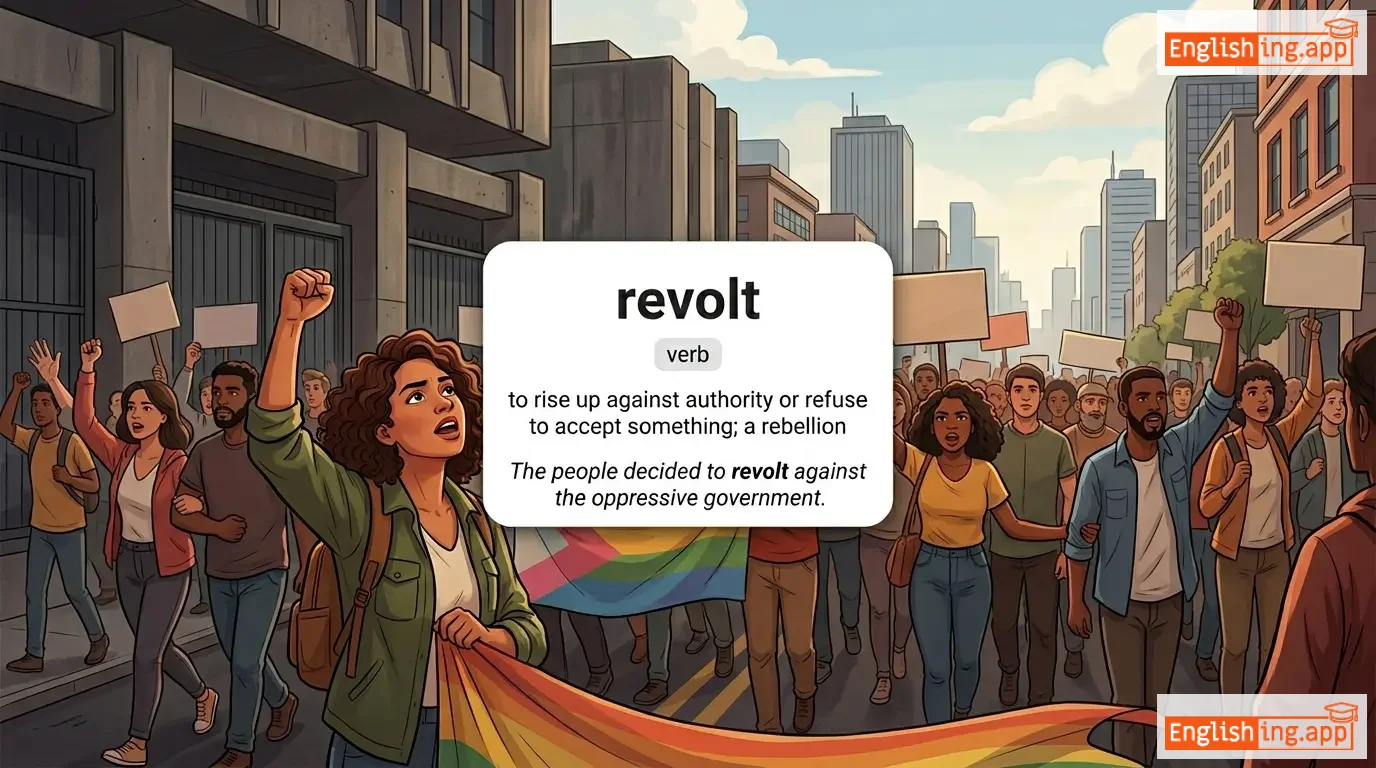
revolt definition card — visual illustration of the meaning
verb
/rɪˈvoʊlt/
विद्रोह (vidroh)

to rise up against authority or refuse to accept something; a rebellion

"The people decided to revolt against the oppressive government."

"लोगों ने दमनकारी सरकार के खिलाफ विद्रोह करने का निर्णय लिया।" (Logon ne damankari sarkar ke khilaf vidroh karne ka nirnay liya.)
adjective
/rɪˈvoʊltɪŋ/
घृणित (ghrinith)

extremely unpleasant or disgusting

"The smell of the garbage was revolting."

"कचरे की बदबू घृणित थी।" (kachre ki badboo ghrinith thi)
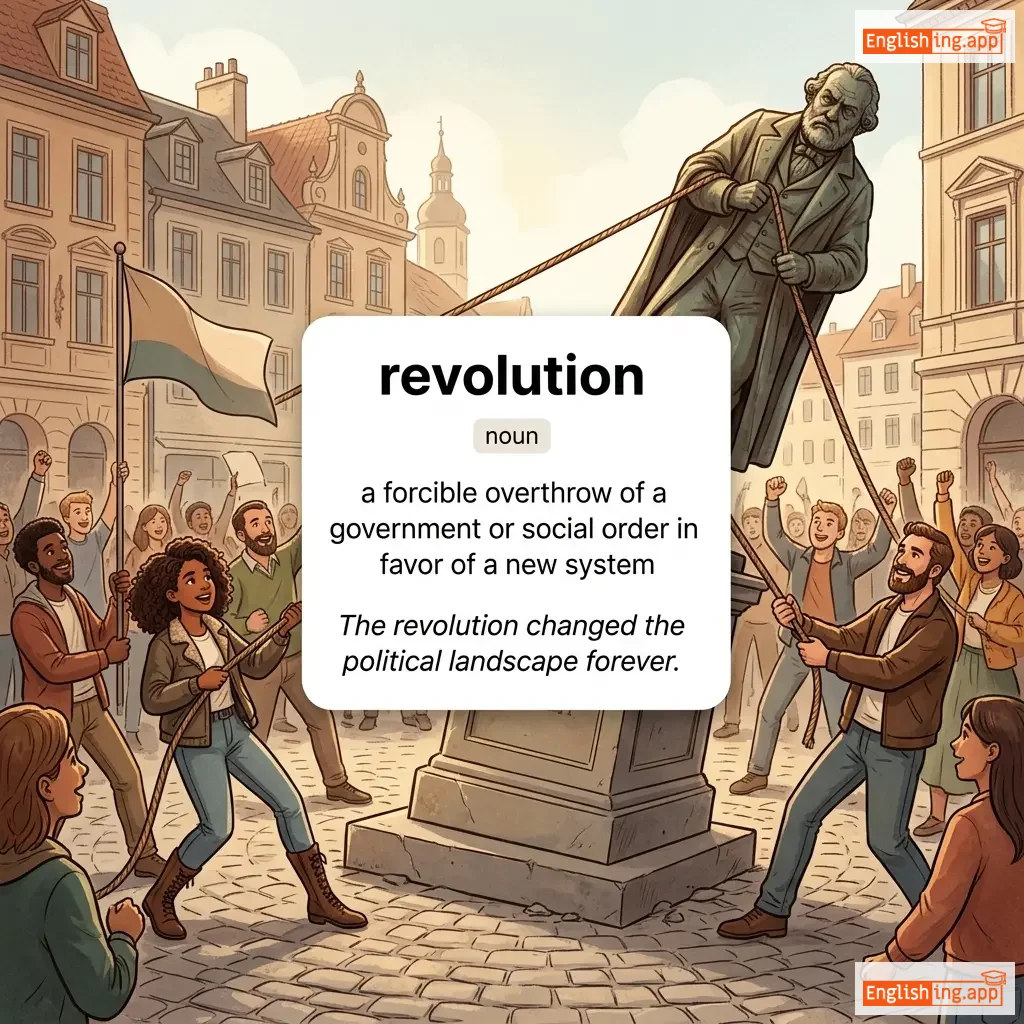
revolution definition card — visual illustration of the meaning
noun
/ˌrɛvəˈluːʃən/
क्रांति (kranti)

a forcible overthrow of a government or social order in favor of a new system

"The revolution changed the political landscape forever."

"क्रांति ने राजनीतिक परिदृश्य को हमेशा के लिए बदल दिया।" (Kranti ne rajneetik paridrishya ko hamesha ke liye badal diya.)
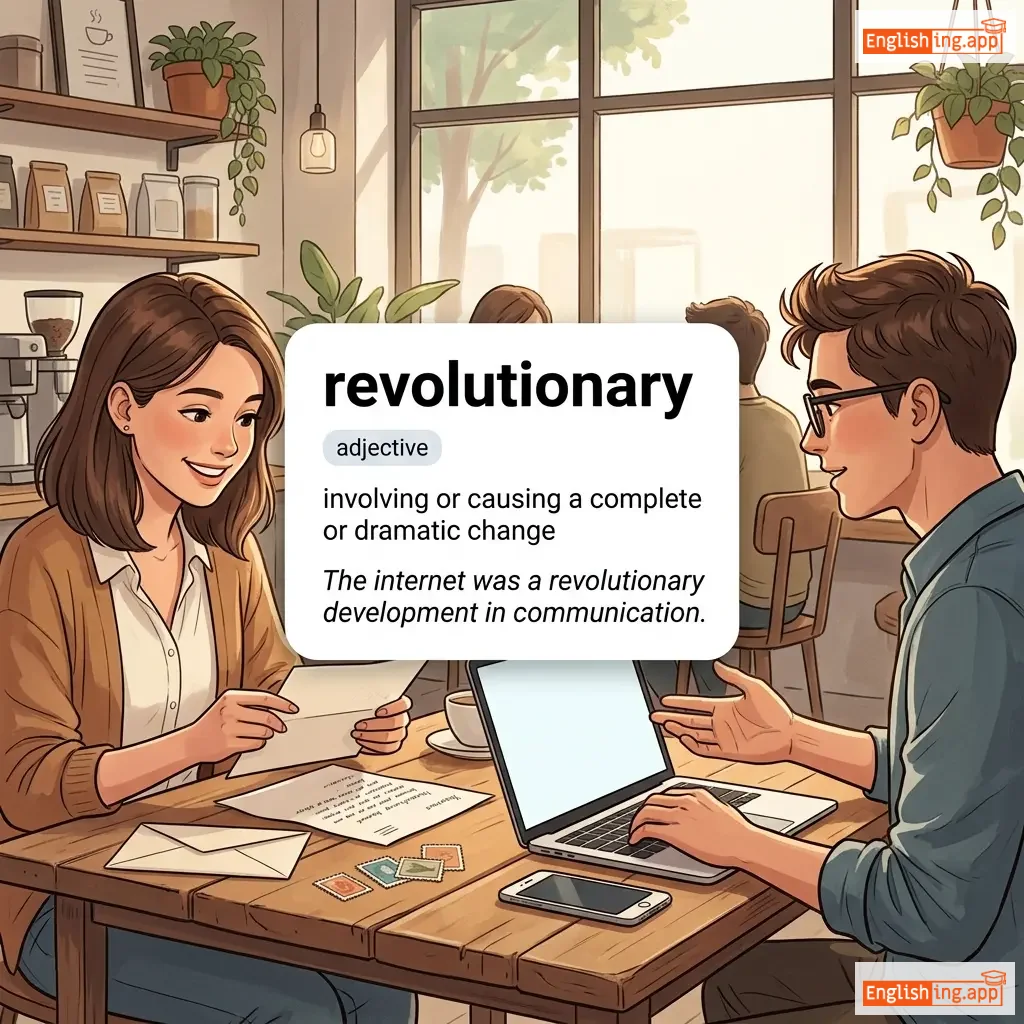
revolutionary definition card — visual illustration of the meaning
adjective
/ˌrɛvəˈluːʃəˌnɛri/
क्रांतिकारी (krantikari)

involving or causing a complete or dramatic change

"The internet was a revolutionary development in communication."

"इंटरनेट संचार में एक क्रांतिकारी विकास था।" (Internet sanchar mein ek krantikari vikas tha.)
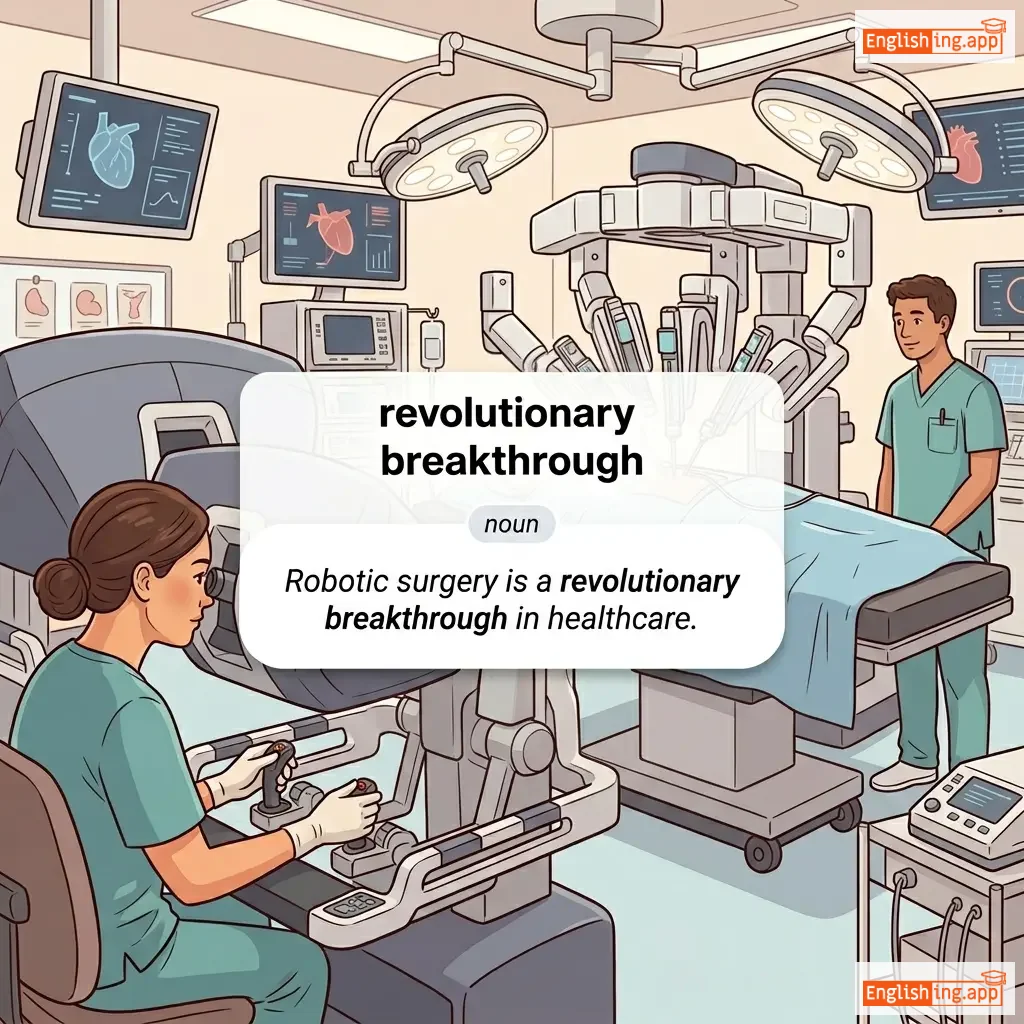
revolutionary breakthrough definition card — visual illustration of the meaning
noun
/ˌrev.əˈluː.ʃən.ər.i ˈbreɪk.θruː/
क्रांतिकारी अविष्कार (krantikari avishkar)

A sudden, dramatic, and important discovery or development that changes everything.

"Robotic surgery is a revolutionary breakthrough in healthcare."

"रोबोटिक सर्जरी स्वास्थ्य देखभाल में एक क्रांतिकारी अविष्कार है।" (Robotik surgery swasthya dekhbhal mein ek krantikari avishkar hai.)
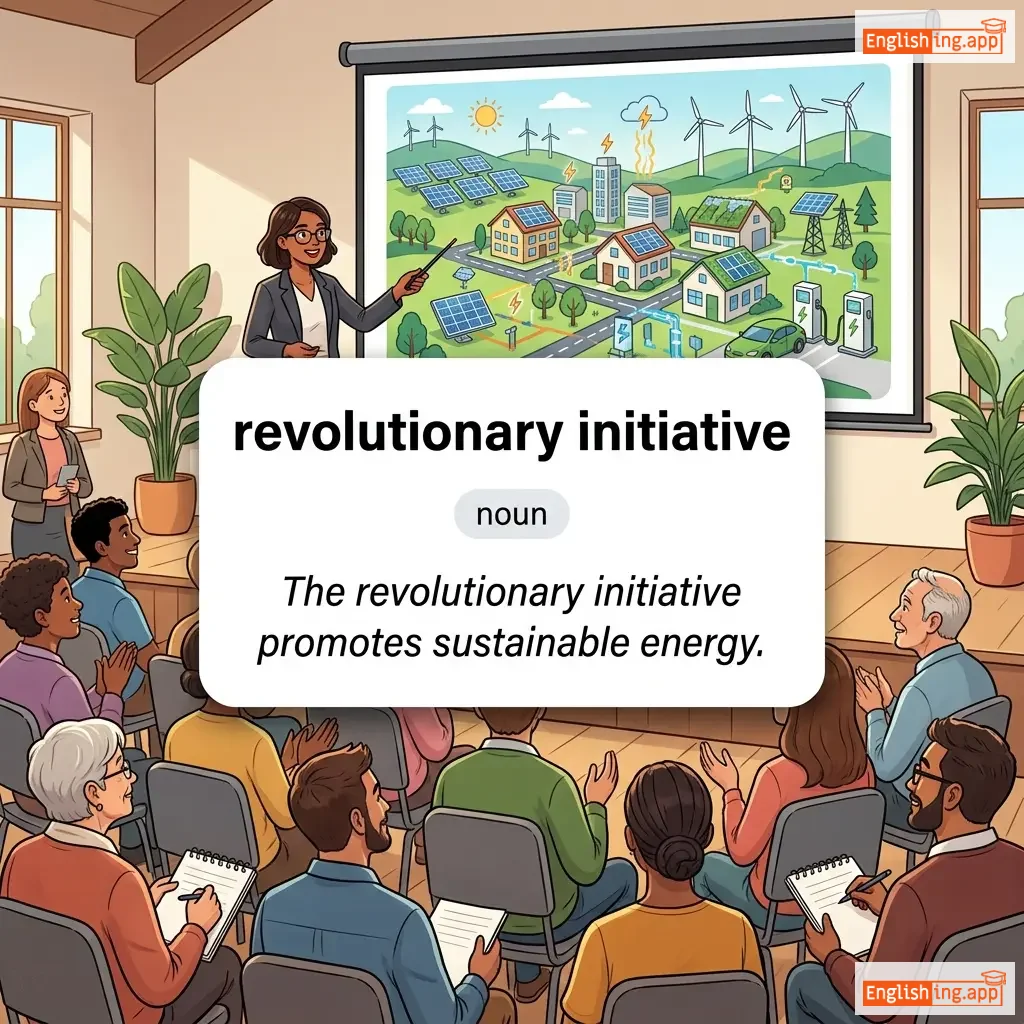
revolutionary initiative definition card — visual illustration of the meaning
noun
ˌrev.əˈluː.ʃən.ər.i ɪˈnɪʃ.ə.tɪv
क्रांतिकारी पहल (krantikari pahal)

A groundbreaking action or plan that brings about significant change or transformation.

"The revolutionary initiative promotes sustainable energy."

"क्रांतिकारी पहल सतत ऊर्जा को बढ़ावा देती है।" (Krantikari pahal satat urja ko badhawa deti hai.)
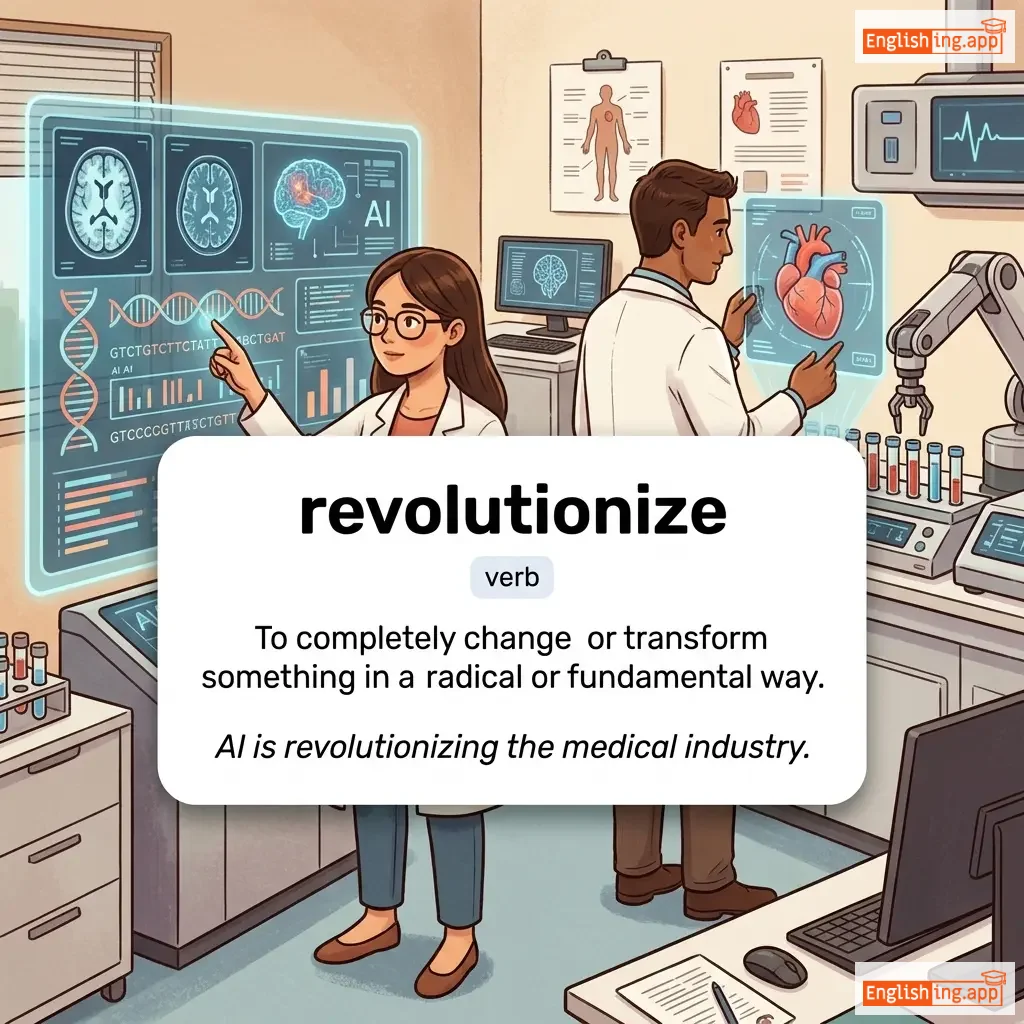
revolutionize definition card — visual illustration of the meaning
verb
ˌrev.əˈluː.ʃən.aɪz
क्रांतिकारी बदलाव करना (krantikari badlav karna)

To completely change or transform something in a radical or fundamental way.

"AI is revolutionizing the medical industry."

"एआई चिकित्सा उद्योग में क्रांतिकारी बदलाव कर रहा है।" (AI chikitsa udyog mein krantikari badlav kar raha hai.)
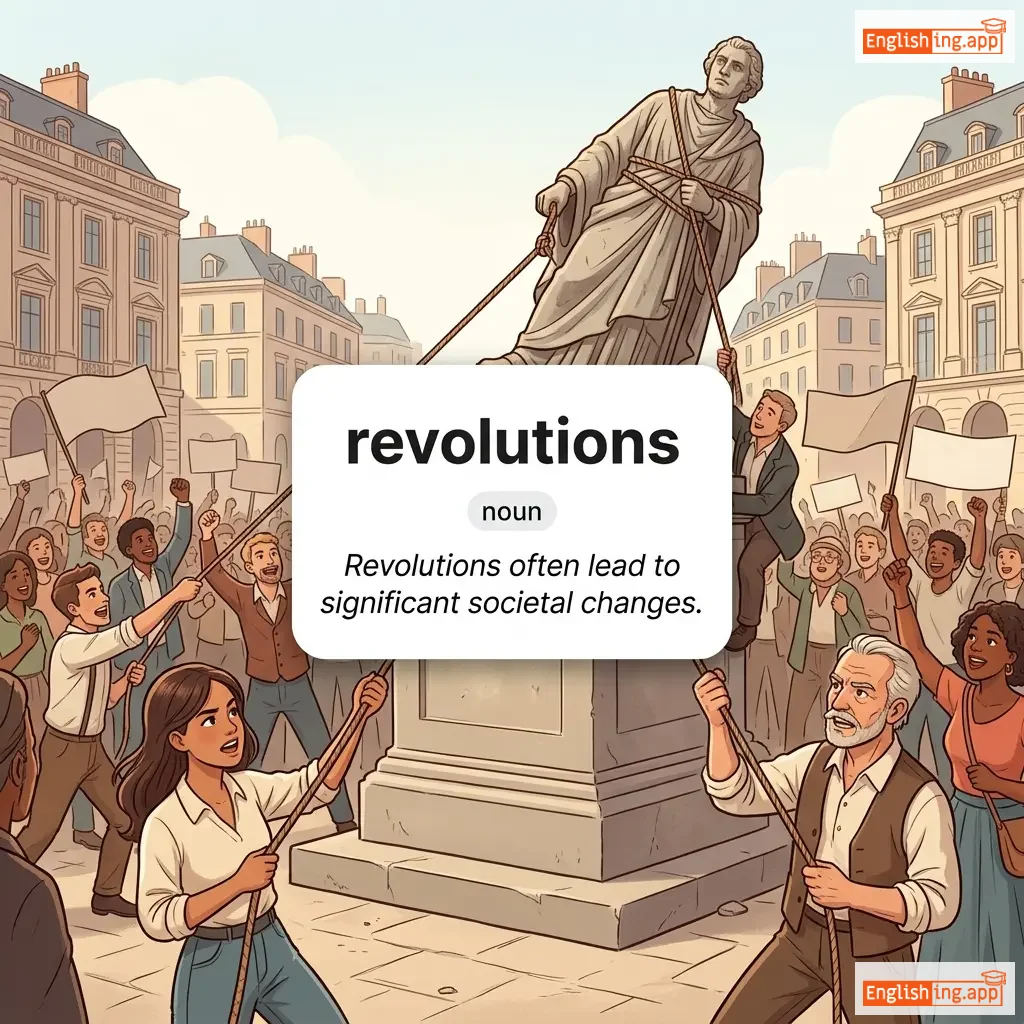
revolutions definition card — visual illustration of the meaning
noun
ˌrev.əˈluː.ʃənz
क्रांति (kranti)

Dramatic and wide-reaching changes in political, social, or economic systems, often involving the overthrow of a government or social order.

"Revolutions often lead to significant societal changes."

"क्रांतियाँ अक्सर महत्वपूर्ण सामाजिक बदलावों की ओर ले जाती हैं।" (Krantiyan aksar mahatvapurn samajik badlavon ki or le jaati hain.)
noun
/rɪˈvɒl.vər/
रिवॉल्वर (rivolvar)

a pistol with revolving chambers enabling several shots to be fired without reloading

"The detective drew his revolver from its holster."

"जांचकर्ता ने अपनी रिवॉल्वर को होल्स्टर से बाहर निकाला।" (janchkarta ne apni rivolvar ko holstar se baahar nikaala.)
noun
/rɪˈvʌlʃən/
घृणा (ghrina)

a strong feeling of disgust or repulsion

"She felt revulsion at the sight of the cruel act."

"वह क्रूर कृत्य को देखकर घृणा महसूस कर रही थी।" (Vah krur kritya ko dekhkar ghrina mahsus kar rahi thi.)
noun
/rɪˈwɔːd/
इनाम (inaam)

something given in recognition of service, effort, or achievement

"He received a reward for returning the lost wallet."

"उसे खोए हुए बटुए को लौटाने के लिए इनाम मिला।" (Use khoe huye batue ko lautane ke liye inaam mila.)
verb
/ˈræpsəˌdaɪz/
प्रशंसा करना (prashamsa karna)

to speak or write with great enthusiasm and admiration

"He would often rhapsodize about his travels to Europe."

"वह अक्सर अपने यूरोप यात्रा के बारे में अत्यधिक प्रशंसा करता था।" (Wah aksar apne Europe yatra ke baare mein atyadhik prashamsa karta tha.)
noun
/ˈræpsədi/
उल्लासित गीत/प्रशंसा (ullasita geet/prashamsa)

an expression of great enthusiasm or an epic musical composition

"The singer’s performance was a rhapsody of emotions."

"गायक का प्रदर्शन भावनाओं का एक रैप्सोडी था।" (Gaayak ka pradarshan bhavnaon ka ek rhapsody tha.)
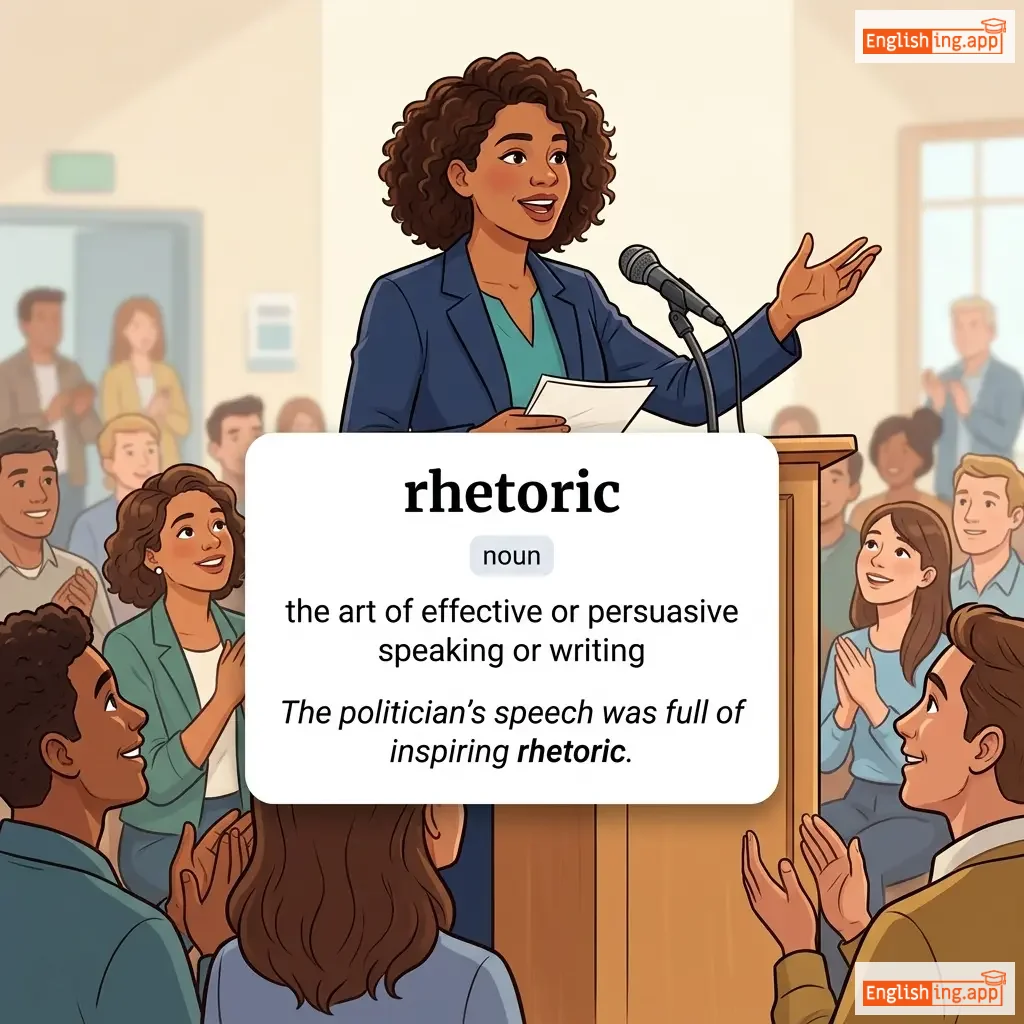
rhetoric definition card — visual illustration of the meaning
noun
/ˈrɛtərɪk/
भाषाशास्त्र (bhaashashastra)

the art of effective or persuasive speaking or writing

"The politician’s speech was full of inspiring rhetoric."

"राजनेता का भाषण प्रेरणादायक भाषाशास्त्र से भरा हुआ था।" (raajneeta ka bhashan preranaadayak bhaashashastra se bhara hua tha.)
adjective
/rɪˈtɔːrɪkəl/
वचनात्मक (vachanatmak)

relating to the art of effective or persuasive speaking or writing; often a question asked to make a point rather than get an answer

"He asked a rhetorical question during the debate."

"उसने बहस के दौरान एक वचनात्मक प्रश्न पूछा।" (Usne bahas ke dauran ek vachanatmak prashna poocha.)
noun
/ˌrɛtəˈrɪʃən/
वक्तव्यकर्ता (vaktavyakarta)

A person who is skilled in the art of rhetoric or persuasive speaking/writing.

"The rhetorician captivated the audience with his eloquence."

"वक्तव्यकर्ता ने अपनी वाक्पटुता से श्रोताओं को मंत्रमुग्ध कर दिया।" (Vaktavyakarta ne apni vakpatuta se shrotayon ko mantramugdh kar diya.)
adjective
/ˈruːmi/
पानीदार (panidar)

Watery, especially referring to the eyes.

"His rheumy eyes showed signs of age and fatigue."

"उसकी पानीदार आँखों में उम्र और थकावट के संकेत थे।" (Uski panidar aankhon mein umra aur thakawat ke sanket the.)
noun
/raɪˈnɒs.ər.əs/
गैंडा (gainda)

a large, heavy animal with thick skin and one or two horns on its nose

"The rhinoceros charged through the grassland."

"गैंडा घास के मैदान में दौड़ रहा था।" (gainda ghas ke maidan mein daud raha tha.)
noun
/ˈrɪðəm/
लय (lay)

a strong, regular, repeated pattern of movement or sound

"The rhythm of the music made everyone want to dance."

"संगीत की लय ने सभी को नाचने के लिए प्रेरित किया।" (Sangeet ki lay ne sabhi ko nachne ke liye prerith kiya.)
noun
/rɪb/
पंजर (panjar)

one of the curved bones that form the rib cage in humans and animals, protecting the chest organs

"He broke a rib while playing football."

"वह फुटबॉल खेलते वक्त एक पंजर तोड़ बैठा।" (vah football khelte waqt ek panjar tod baitha)
adjective
/ˈrɪbɔːld/
अश्लील हास्यपूर्ण (ashleel hasyapurn)

Referring to sexual matters in a humorous or vulgar way.

"The comedian’s ribald jokes made the audience laugh uncomfortably."

"कॉमेडियन के अश्लील मजाक ने दर्शकों को असहज तरीके से हंसी में डाल दिया।" (Comedian ke ashleel mazak ne darshako ko asahaj tareeke se hasi mein daal diya.)
noun
/ˈrɪb.ən/
रिबन (riban)

a long, narrow strip of fabric used for tying or decoration

"She tied her hair with a red ribbon."

"उसने अपने बालों को एक लाल रिबन से बांधा।" (Usne apne balon ko ek lal riban se bandha.)
noun
/raɪs/
चावल (chaaval)

a cereal grain that is the staple food of many countries

"Rice is an important part of the daily diet in many countries."

"चावल कई देशों में दैनिक आहार का एक महत्वपूर्ण हिस्सा है।" (Chaawal kai deshon mein dainik aahaar ka ek mahatvapurn hissa hai.)
noun
/raɪs ˈkʊkər/
चावल पकाने की इलेक्ट्रिक डिवाइस (chaawal pakaane ki electric device)

an electric appliance designed to cook rice automatically

"The rice cooker automatically switches off when the rice is perfectly cooked."

"चावल पूरी तरह से पकने पर राइस कूकर अपने आप बंद हो जाता है।" (chaawal poori tarah se pakne par rice cooker apne aap band ho jata hai)
adjective
/rɪʧ/
धनी (dhani)

having a great deal of money or assets

"He became rich after his successful business venture."

"वह अपने सफल व्यवसायिक उद्यम के बाद धनी हो गया।" (Vah apne safal vyavsayik udyam ke baad dhani ho gaya.)
adjective
/ˈrɪkɪti/
कमज़ोर (kamzor)

Poorly made and likely to collapse; shaky.

"They crossed a rickety wooden bridge over the river."

"उन्होंने नदी पर एक कमज़ोर लकड़ी का पुल पार किया।" (Unhone nadi par ek kamzor lakdi ka pul paar kiya.)
noun
/ˈrɪk.ʃɔː/
रिक्शा (riksha)

a light two-wheeled passenger vehicle drawn by one or more people

"We took a rickshaw to reach the busy marketplace."

"हमने व्यस्त बाजार तक पहुँचने के लिए रिक्शा लिया।" (hamne vyast bazar tak pahuchne ke liye riksha liya.)
verb
/rɪd/
मुक्त करना (mukt karna)

to remove or get rid of something

"I need to rid the house of all the clutter."

"मुझे घर को सभी बकवास से मुक्त करने की जरूरत है।" (Mujhe ghar ko sabhi bakwaas se mukt karne ki zaroorat hai.)
noun
/ˈrɪdəns/
मुक्ति (mukti)

The action of getting rid of something unwanted or unpleasant.

"His departure was considered a welcome riddance by the team."

"उसकी विदाई को टीम ने एक स्वागत योग्य मुक्ति माना।" (Uski vidaai ko team ne ek swagat yogya mukti maana.)
adjective
/ˈrɪdən/
अलंकृत (alankrit)

Full of or dominated by something unpleasant.

"The country was ridden with corruption."

"देश भ्रष्टाचार से अलंकृत था।" (Desh bhrashtachar se alankrit tha.)
noun
/ˈrɪdəl/
पहेली (paheli)

A question or statement designed to test ingenuity or puzzle the mind.

"The children enjoyed solving the riddle."

"बच्चों को पहेली हल करना बहुत पसंद था।" (bachon ko paheli hal karna bahut pasand tha.)
verb
/raɪd/
सवारी करना (savaari karna)

to sit on and control the movement of something, typically a vehicle or animal

"She loves to ride her bike around the park."

"वह पार्क में अपनी साइकिल चलाना पसंद करती है।" (Vah park mein apni cycle chalana pasand karti hai.)
noun
/ˈraɪdər/
सवार (sawar)

A person who rides a horse, bicycle, motorcycle, or other vehicle.

"The rider fell off the horse."

"सवार घोड़े से गिर गया।" (Sawar ghode se gir gaya.)
noun
/rɪdʒ/
पहाड़ी की चोटी या लंबी और संकीर्ण पहाड़ी (pahaadi ki chhoti ya lambi aur sankirn pahaadi)

a long, narrow hilltop, mountain range, or raised strip

"We walked along the mountain ridge."

"हम पहाड़ी की चोटियों के किनारे चल रहे थे।" (Hum pahaadi ki chhotiyaan ke kinare chal rahe the.)
verb
/ˈrɪdɪkjuːl/
उपहास करना (upohas karna)

To make fun of someone or something in a cruel or dismissive way.

"He was ridiculed for his strange ideas."

"उसके अजीब विचारों के लिए उसे उपहासित किया गया।" (Uske ajeeb vicharon ke liye use upohasit kiya gaya.)
adjective
/rɪˈdɪkjʊləs/
मजाकिया (majaakiya)

Deserving mockery; absurd or unreasonable.

"The idea of flying pigs is ridiculous."

"उड़ते सूअर का विचार मजाकिया है।" (Udte sooar ka vichar majaakiya hai.)
adjective
/raɪf/
व्यापक (vyapak)

widespread or common, often in a negative sense

"Corruption was rife in the old government system."

"पुरानी सरकार व्यवस्था में भ्रष्टाचार व्यापक था।" (Purani sarkar vyavastha mein bhrashtachar vyapak tha.)
noun
/ˈraɪfəl/
राइफल (raifel)

a type of long-barreled gun designed for accurate shooting

"The hunter carried a rifle to catch game."

"शिकारी ने शिकार करने के लिए राइफल ले ली।" (shikaari ne shikar karne ke liye raifel le li)
noun
/rɪft/
दरार (daraar)

a serious break in a relationship; a split or crack

"A rift developed between the two friends after the argument."

"तर्क के बाद दो दोस्तों के बीच एक दरार विकसित हो गई थी।" (Tark ke baad do doston ke beech ek daraar viksit ho gayi thi.)
verb
/rɪɡ/
धोखाधड़ी करना (dhokhadhadi karna)

to manipulate or control something dishonestly; to set up equipment

"The election was rigged by corrupt officials."

"चुनाव भ्रष्ट अधिकारियों द्वारा रिग्ड किया गया था।" (Chunav bhrasht adhikariyon dwara rigged kiya gaya tha.)
noun, adjective, adverb
/raɪt/
अधिकार (adhikar)

something that is morally good, fair, or just; or a legal/entitled claim

"Everyone has the right to free speech."

"हर किसी को स्वतंत्रता की बात करने का अधिकार है।" (Har kisi ko svatantrata ki baat karne ka adhikar hai.)
adjective
/ˈraɪtʃəs/
न्यायप्रिय (nyaypriya)

morally right or justifiable; virtuous

"She is known for her righteous actions and honesty."

"वह अपने न्यायप्रिय कार्यों और ईमानदारी के लिए जानी जाती है।" (Vah apne nyaypriya karyon aur imandari ke liye jani jati hai.)
noun
/ˈraɪtʃəsnəs/
धर्मिता (dharmita)

the quality of being morally right or justifiable

"His life was dedicated to righteousness and truth."

"उसका जीवन धर्मिता और सत्य के प्रति समर्पित था।" (Uska jeevan dharmita aur satya ke prati samarpit tha.)
adjective
/ˈraɪtfəl/
वैध (vaid)

having a legitimate or just claim; proper or lawful

"She is the rightful owner of the property."

"वह संपत्ति की वैध मालिक है।" (Vah sampatti ki vaidh malik hai.)
adverb
/ˈraɪtli/
सही ढंग से; उचित रूप से; न्यायसंगत (sahi dhang se; uchit roop se; nyayasangat)

correctly; properly; justly

"She rightly pointed out the mistakes in the report."

"उसने सही ढंग से रिपोर्ट में गलतियों को उजागर किया।" (Usne sahi dhang se report mein galtiyon ko ujagar kiya.)
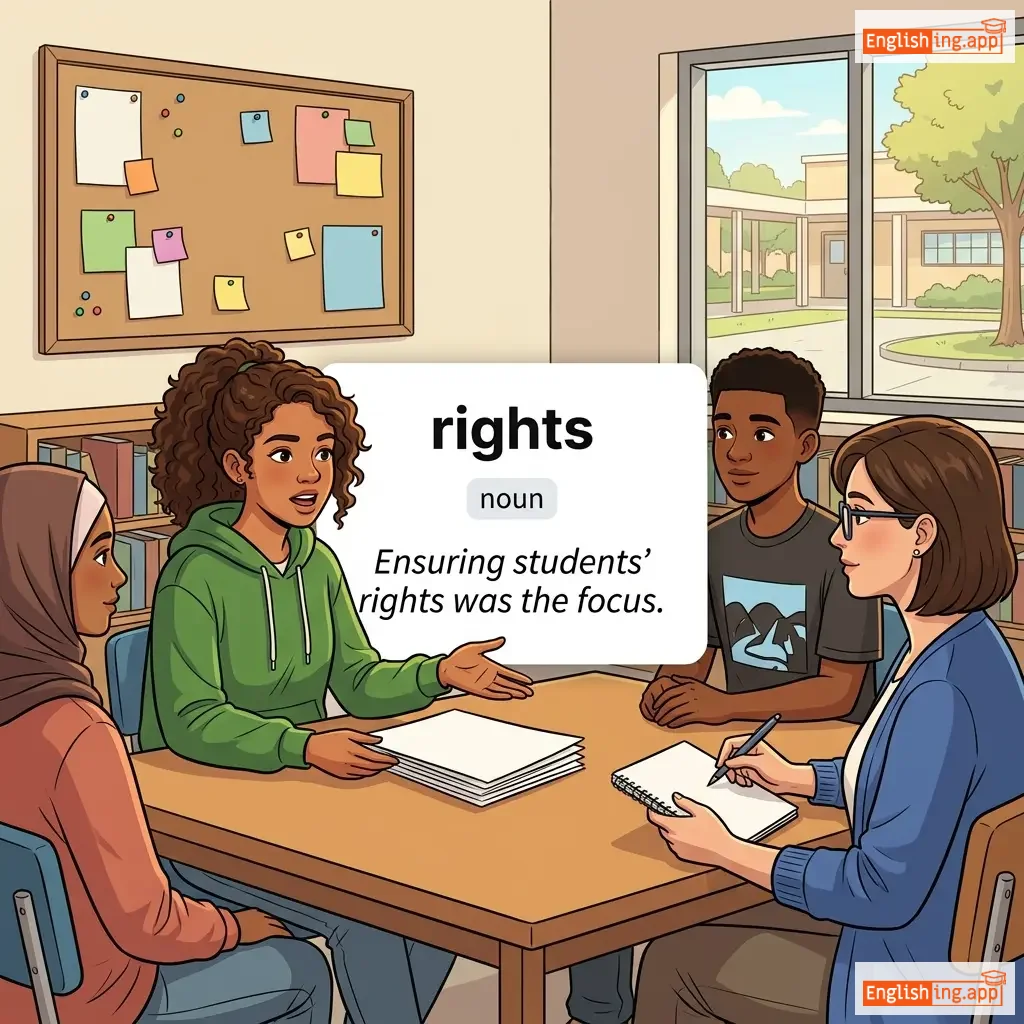
rights definition card — visual illustration of the meaning
noun
raɪts
अधिकार (adhikar)

Things to which one has a just claim; the authority or power of having something.

"Ensuring students' rights was the focus."

"छात्रों के अधिकार सुनिश्चित करना मुख्य उद्देश्य था।" (Chhatron ke adhikar sunishchit karna mukhya uddeshya tha.)