वोकैबुलरीज

इंग्लिश वोकैबुलरी डिस्कवर, लर्न और मास्टर करें

noun
/ˌrɛspɪˈreɪʃən/
श्वसन (shvasan)

The process of breathing or the exchange of gases in living organisms.

"Respiration is essential for all living beings."

"श्वसन सभी जीवित प्राणियों के लिए आवश्यक है।" (shvasan sabhi jeevit praniyon ke liye aavashyak hai)
verb
/rɪˈspaɪər/
श्वास लेना (shwas lena)

To breathe in and out; to inhale and exhale.

"Plants also respire to release energy."

"प्लांट्स भी ऊर्जा छोड़ने के लिए श्वास लेते हैं।" (Plants bhi urja chodne ke liye shwas lete hain.)
noun
/ˈrɛspɪt/
विश्राम (vishram)

A short period of rest or relief from something difficult or unpleasant.

"The weekend provided a welcome respite from work."

"सप्ताहांत ने काम से एक स्वागत योग्य विश्राम प्रदान किया।" (Saptahant ne kaam se ek swāgat yogya vishram pradan kiya.)
adjective
/rɪˈsplɛndənt/
चमकदार (chamakdaar)

Shining brilliantly; dazzling in appearance or effect

"The bride looked resplendent in her wedding gown."

"दुल्हन अपनी शादी की साड़ी में शानदार दिख रही थी।" (Dulhan apni shaadi ki saadi mein shandaar dikh rahi thi.)
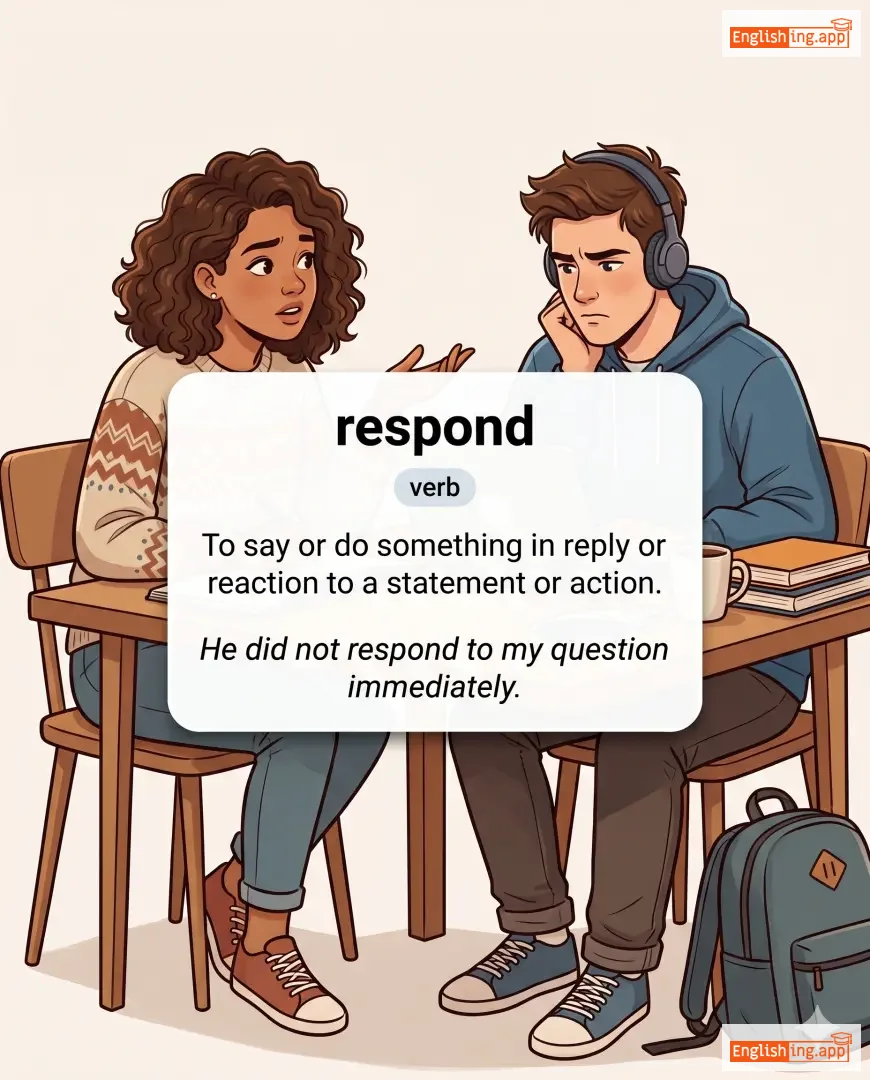
respond definition card — visual illustration of the meaning
verb
/rɪˈspɒnd/
उत्तर देना (uttar dena)

To say or do something in reply or reaction to a statement or action.

"He did not respond to my question immediately."

"उसने मेरे सवाल का तुरंत जवाब नहीं दिया।" (Usne mere sawal ka turant jawab nahi diya.)
noun
/rɪˈspɒndənt/
प्रतिक्रियादाता (pratikriyadata)

A person who replies to something, especially in a survey or legal case

"The survey had over 1,000 respondents."

"सर्वे में 1000 से अधिक प्रतिक्रियादाता थे।" (Survey mein 1000 se adhik pratikriyadata the.)
noun
/rɪˈspɒns/
प्रतिक्रिया (pratikriya)

a reaction to something that has been said or done

"Her response to the question was both thoughtful and clear."

"उसका सवाल का उत्तर विचारशील और स्पष्ट था।" (Uska sawal ka uttar vicharshil aur spasht tha.)
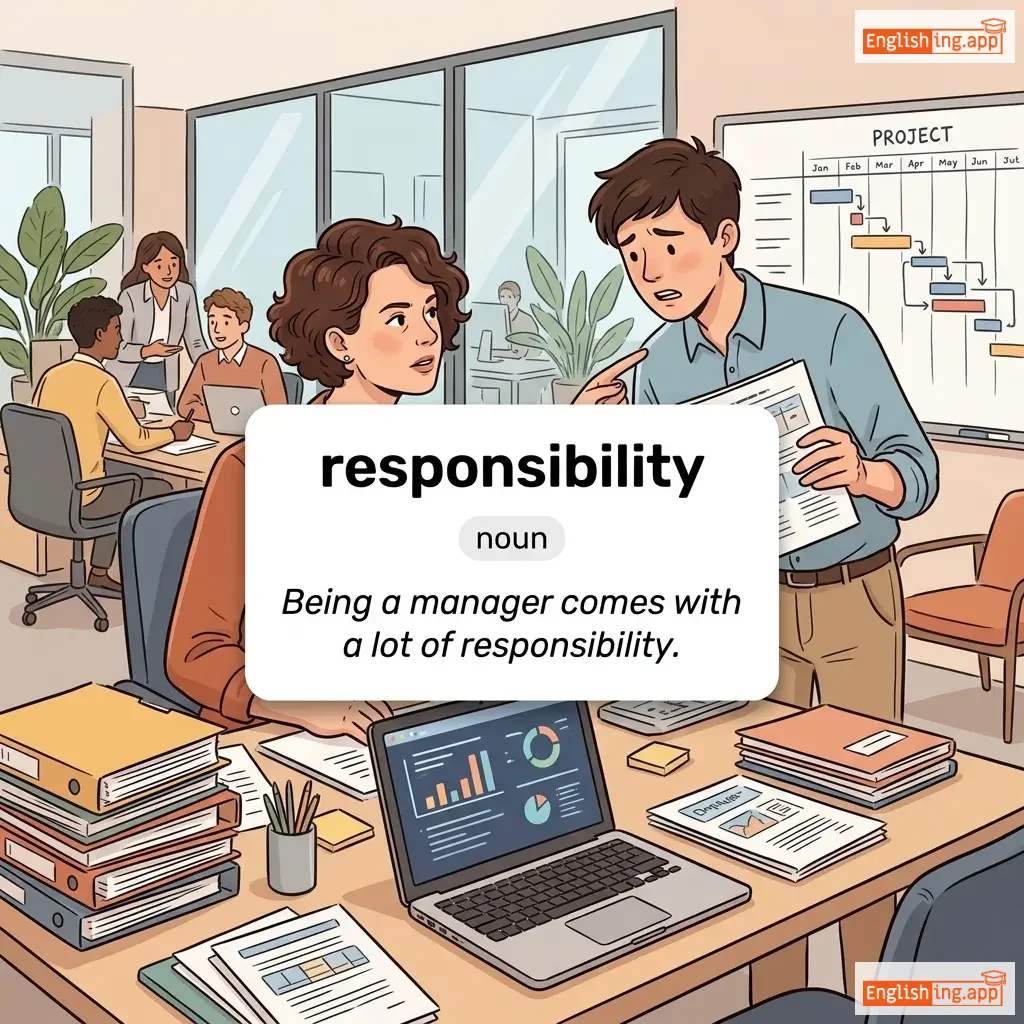
responsibility definition card — visual illustration of the meaning
noun
/rɪˌspɒnsɪˈbɪləti/
जिम्मेदारी (jimmedari)

the state or fact of having a duty to deal with something or having control over someone

"Being a manager comes with a lot of responsibility."

"एक मैनेजर होने के साथ बहुत सारी जिम्मेदारी आती है।" (Ek manager hone ke sath bahut sari jimmedari aati hai.)
adjective
/rɪˈspɒnsɪbl/
जिम्मेदार (zimmedar)

having an obligation to do something or being the cause of something

"She is responsible for managing the project."

"वह परियोजना को प्रबंधित करने के लिए जिम्मेदार है।" (Wah pariyojana ko prabandhit karne ke liye zimmedar hai.)
adjective
/rɪˈspɒnsɪv/
प्रतिक्रियाशील (pratikriyaashil)

Reacting quickly and positively to something

"The website is fully responsive on all devices."

"वेबसाइट सभी डिवाइसों पर पूरी तरह से प्रतिक्रियाशील है।" (Website sabhi devices par puri tarah se pratikriyaashil hai.)
noun
/rɪˈspɒnsɪvnəs/
प्रतिक्रियाशीलता (pratikriyashilta)

The quality of reacting quickly and positively

"The manager appreciated her responsiveness to customer feedback."

"प्रबंधक ने ग्राहक की प्रतिक्रिया के प्रति उसकी प्रतिक्रियाशीलता की सराहना की।" (Prabandhak ne grahak ki pratikriya ke prati uski pratikriyashilta ki sarahna ki.)
noun, verb
/rɛst/
आराम (aaram)

to cease work or movement in order to relax or recover strength

"He needs to rest after the long journey."

"उसे लंबी यात्रा के बाद आराम करने की जरूरत है।" (Use lambi yatra ke baad aaram karne ki zaroorat hai.)
noun
/ˈrɛst(ə)rɒnt/
रेस्टोरेंट (restorent)

a place where meals are prepared and served to customers

"We went to the restaurant for dinner."

"हम रात के खाने के लिए रेस्टोरेंट गए थे।" (Hum raat ke khane ke liye restorent gaye the.)
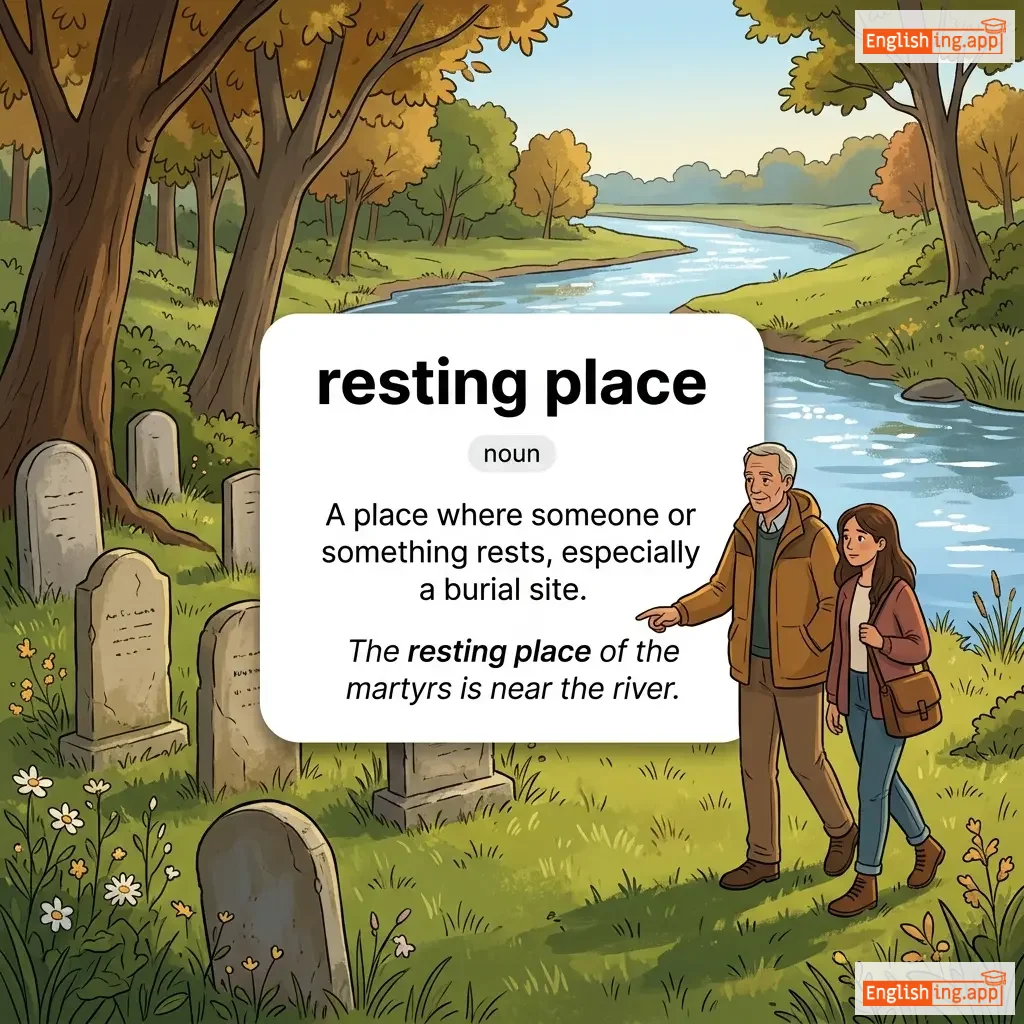
resting place definition card — visual illustration of the meaning
noun
ˈrɛstɪŋ pleɪs
विश्राम स्थल (vishraam sthal)

A place where someone or something rests, especially a burial site.

"The resting place of the martyrs is near the river."

"शहीदों का विश्राम स्थल नदी के पास है।" (Shaheedo ka vishraam sthal nadi ke paas hai.)
noun
/ˌrɛstɪˈtjuːʃən/
क्षतिपूर्ति (kshotipurti)

The act of restoring something to its rightful owner or compensating for loss

"The court ordered restitution to the victims of the fraud."

"कोर्ट ने धोखाधड़ी के शिकारों को क्षतिपूर्ति का आदेश दिया।" (Kourt ne dhokhaadhadi ke shikaron ko kshotipurti ka aadesh diya.)
adjective
/ˈrɛstɪv/
अस्थिर (asthir)

unable to stay still or silent; restless and impatient

"The crowd grew restive as they waited for the concert to begin."

"कनसर्ट शुरू होने का इंतजार करते हुए भीड़ अस्थिर हो गई।" (Concert shuru hone ka intezaar karte hue bheed asthir ho gayi.)
adjective
/ˈrɛstləs/
खुशी (khushi)

unable to relax or remain still; constantly in motion

"He felt restless during the long meeting."

"जब उसने पुरस्कार प्राप्त किया, तो वह अपनी खुशी को छुपा नहीं सकी।" (Jab usne puraskaar praapt kiya, to woh apni khushi ko chhupa nahi saki.)
noun
/ˈrest.ləs.nəs/
बेचैनी (bechaini)

the inability to rest or relax as a result of anxiety or boredom

"His restlessness during the long meeting was obvious to everyone."

"लंबी बैठक के दौरान उसकी बेचैनी सभी को स्पष्ट थी।" (lambi baithak ke dauraan uski bechaini sabhi ko spasht thi.)
restoration definition card — visual illustration of the meaning
noun
/ˌrɛstəˈreɪʃən/
पुनर्स्थापन (punarsthapna)

the act of returning something to its former condition or state

"The building is undergoing restoration to preserve its historical value."

"इमारत का ऐतिहासिक मूल्य बनाए रखने के लिए पुनर्स्थापन चल रहा है।" (Imarat ka aitihasik moolya banaye rakhne ke liye punarsthapna chal raha hai.)
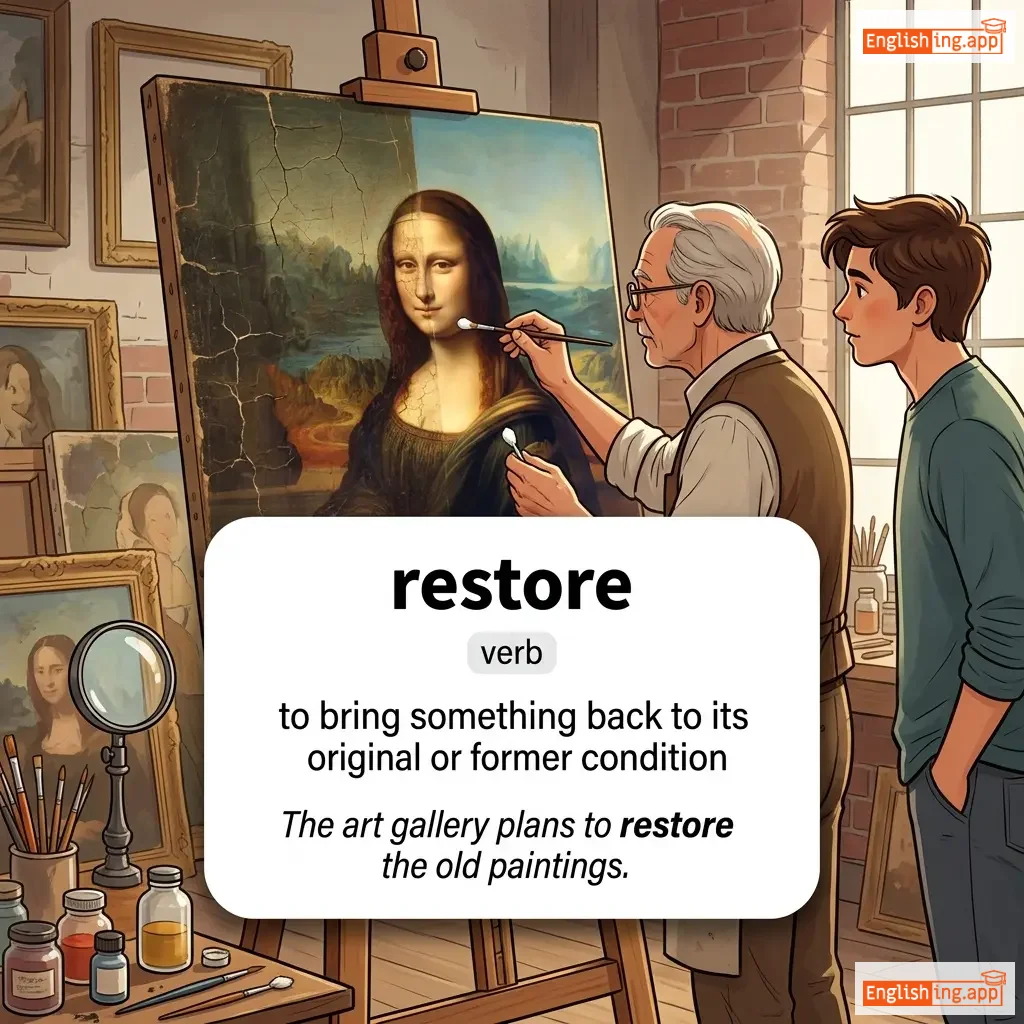
restore definition card — visual illustration of the meaning
verb
/rɪˈstɔː/
पुनर्स्थापित करना (punarsthapit karna)

to bring something back to its original or former condition

"The art gallery plans to restore the old paintings."

"आर्ट गैलरी पुराने चित्रों को बहाल करने की योजना बना रही है।" (Art gallery purane chitron ko bahal karne ki yojana bana rahi hai.)
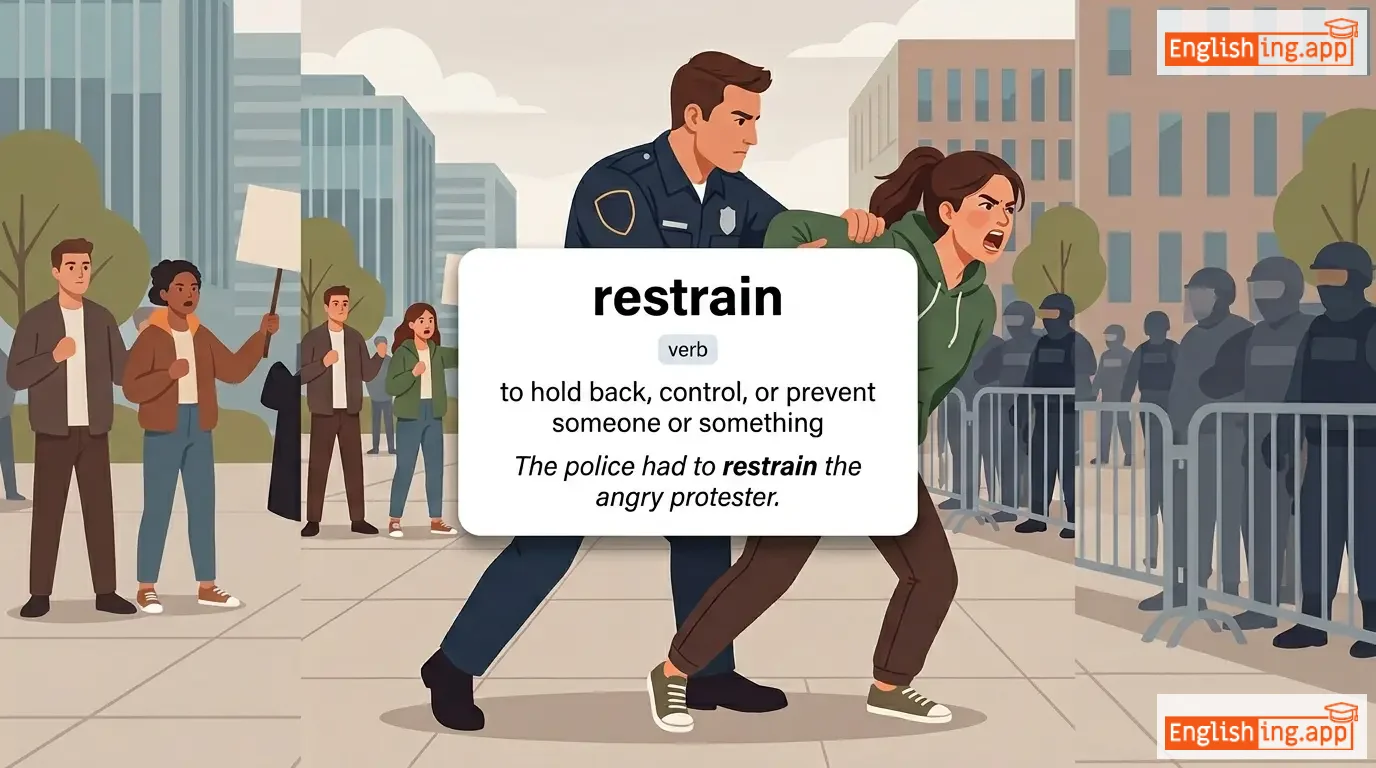
restrain definition card — visual illustration of the meaning
verb
/rɪˈstreɪn/
रोकना (rokna)

to hold back, control, or prevent someone or something

"The police had to restrain the angry protester."

"पुलिस को गुस्साए प्रदर्शनकारी को रोकना पड़ा।" (Police ko gussaaye pradarshankari ko rokna pada.)
adjective
/rɪˈstreɪnd/
संयमित (sanyamit)

characterized by reserve or self-control; held back

"Her restrained reaction surprised everyone."

"उसकी संयमित प्रतिक्रिया ने सभी को चौंका दिया।" (Uski sanyamit pratikriya ne sabhi ko chonka diya.)
noun
/rɪˈstreɪnt/
संयम (sanyam)

the act of holding back or controlling; self-control

"He showed great restraint in not responding to the insult."

"उसने गाली का जवाब न देकर बड़ा संयम दिखाया।" (Usne gaali ka jawab na dekar bada sanyam dikhaya.)
verb
/rɪˈstrɪkt/
सीमित करना (seemit karna)

To limit the size, amount, or range of something.

"The government decided to restrict the use of plastic bags."

"सरकार ने प्लास्टिक बैग्स के उपयोग को सीमित करने का निर्णय लिया।" (Sarkar ne plastic bags ke upyog ko seemit karne ka nirnay liya.)
adjective
/rɪˈstrɪk.tɪd/
सीमित या नियंत्रित; प्रतिबंधों के अधीन (seemit ya niyantrit; pratibandhon ke adheen)

limited or controlled; subject to restrictions

"Access to this area is restricted to authorized personnel only."

"इस क्षेत्र में प्रवेश केवल अधिकृत कर्मचारियों के लिए सीमित है।" (is kshetra mein pravesh keval adhikrit karmachariyon ke liye seemit hai.)
noun
/rɪˈstrɪkʃən/
प्रतिबंध (pratibandh)

a rule or law that limits or controls something

"The new restrictions will affect the business hours."

"नए प्रतिबंध व्यापार के घंटे प्रभावित करेंगे।" (Naye pratibandh vyapar ke ghante prabhavit karenge.)
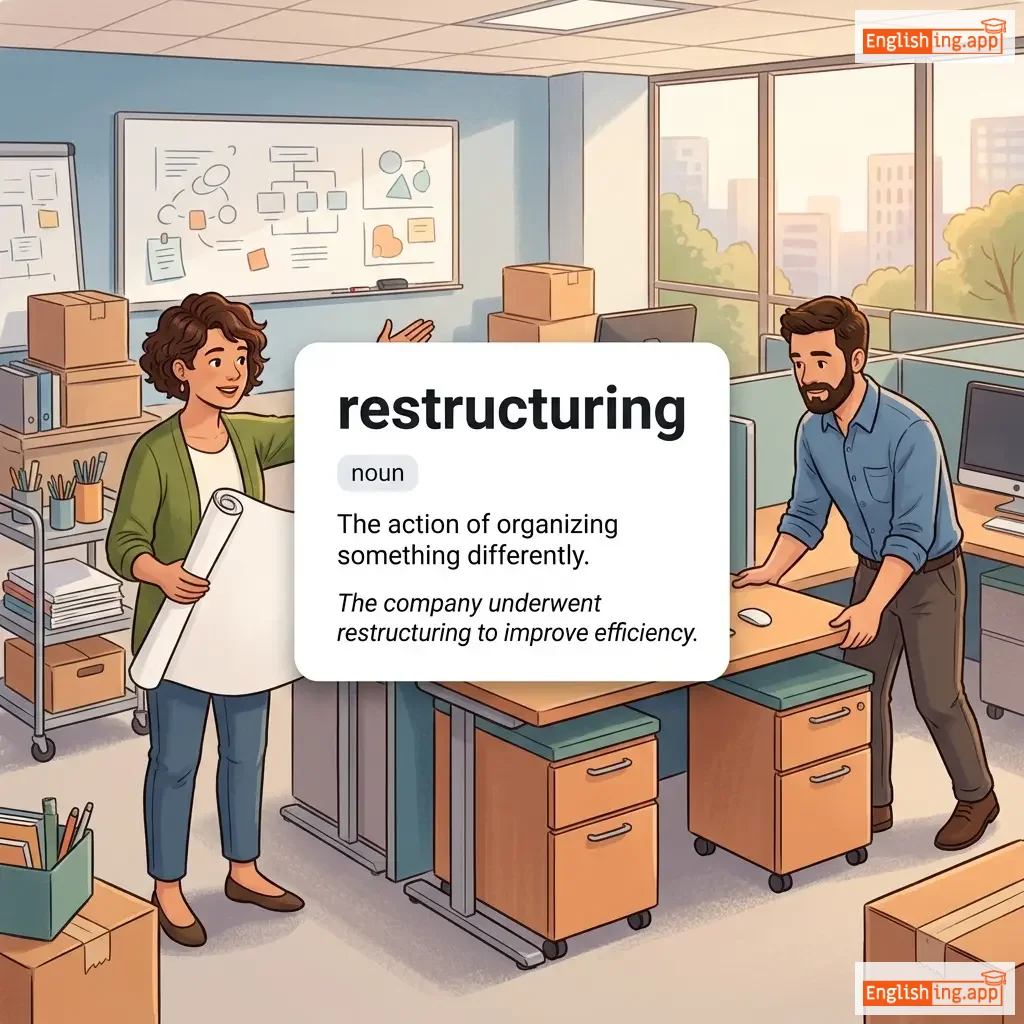
restructuring definition card — visual illustration of the meaning
noun
ˌriːˈstrʌk.tʃər.ɪŋ
पुनर्गठन (punargathan)

The action of organizing something differently.

"The company underwent restructuring to improve efficiency."

"कंपनी ने दक्षता में सुधार लाने के लिए पुनर्गठन किया।" (Company ne dakshata mein sudhaar laane ke liye punargathan kiya.)
noun
/rɪˈzʌlt/
परिणाम (parinaam)

a consequence, effect, or outcome of something

"The result of the test was excellent."

"परीक्षण का परिणाम उत्कृष्ट था।" (Parikshan ka parinaam utkṛṣhṭh thā.)
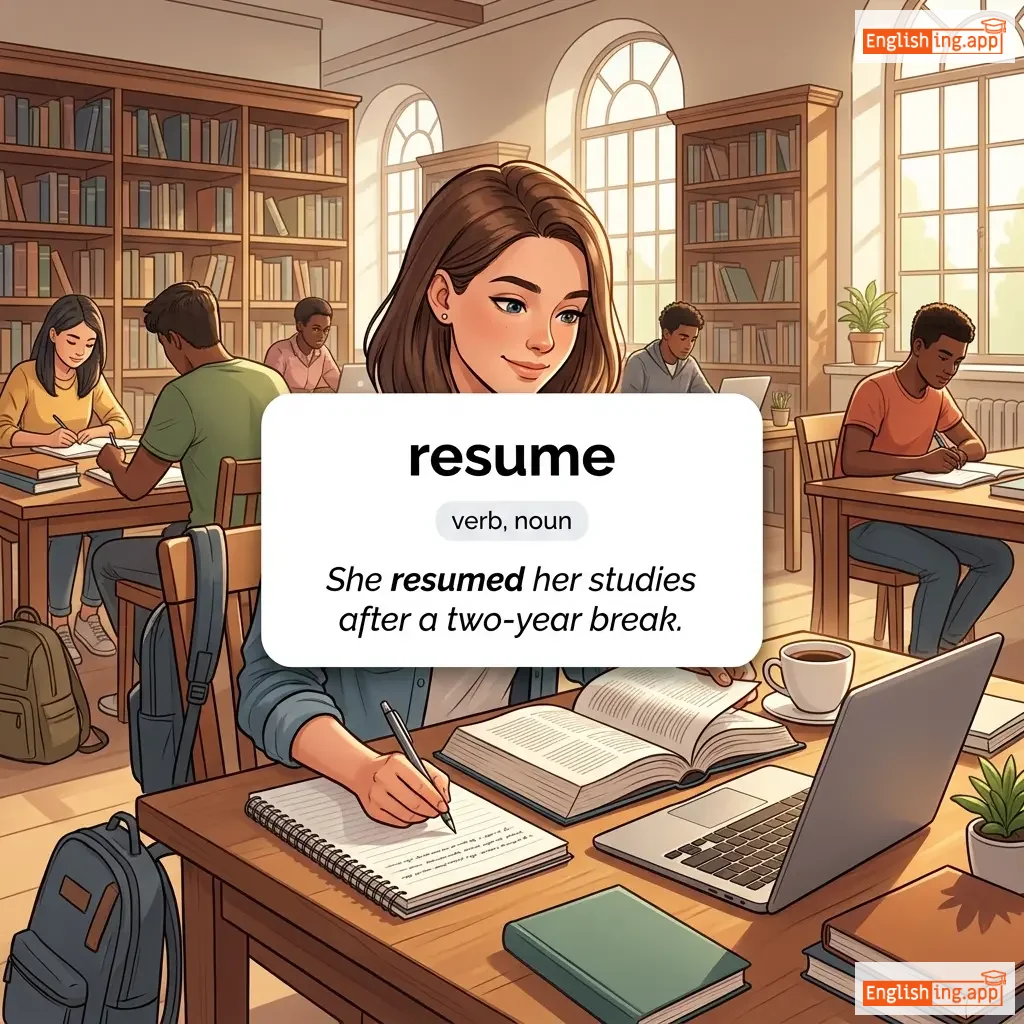
resume definition card — visual illustration of the meaning
verb, noun
/rɪˈzjuːm/ (verb), /ˈrɛzjʊmeɪ/ (noun)
फिर से शुरू करना / रिज़्यूमे (phir se shuru karna / resume)

to begin again after a pause; or a summary of one’s qualifications and work experience

"She resumed her studies after a two-year break."

"वह दो साल के ब्रेक के बाद अपनी पढ़ाई फिर से शुरू करती है।" (Woh do saal ke break ke baad apni padhai phir se shuru karti hai.)
noun
/rɪˈzʌmpʃən/
पुनरारंभ (punarambh)

The act of starting something again after a pause or interruption.

"The resumption of classes after the holidays brought excitement among students."

"छुट्टियों के बाद कक्षाओं का पुनरारंभ छात्रों में उत्साह लेकर आया।" (Chhuttiyon ke baad kakshaon ka punarambh chhatron mein utsaah lekar aaya.)
verb
/rɪˈsɜːrdʒ/
पुनरुत्थान (punarutthan)

To rise, increase, or become active again after a decline.

"Interest in traditional crafts has begun to resurge."

"पारंपरिक शिल्प में रुचि फिर से बढ़ने लगी है।" (Paaramparik shilp mein ruchi phir se badhne lagi hai.)
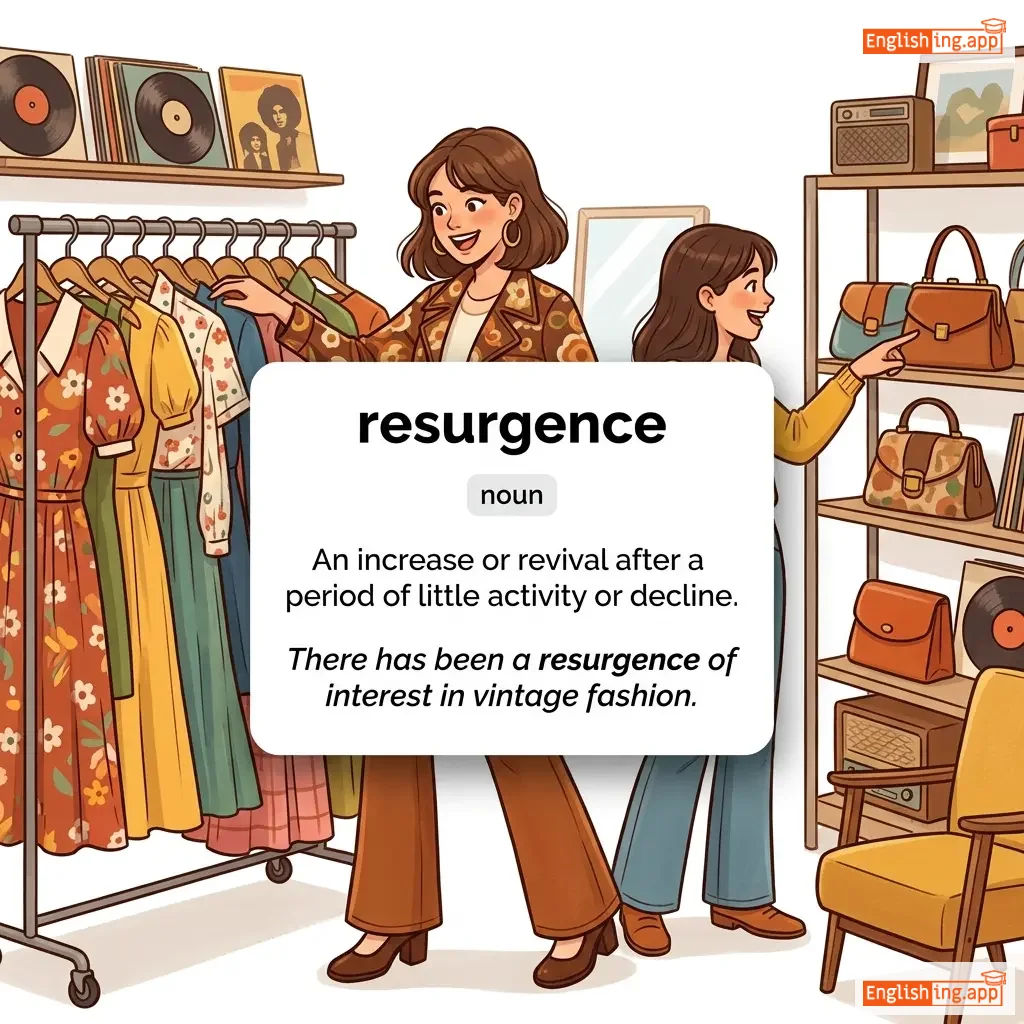
resurgence definition card — visual illustration of the meaning
noun
/rɪˈsɜːrdʒəns/
पुनरुत्थान (punarutthan)

An increase or revival after a period of little activity or decline.

"There has been a resurgence of interest in vintage fashion."

"विंटेज फैशन में रुचि का पुनरुत्थान हुआ है।" (Vintage fashion mein ruchi ka punarutthan hua hai.)
adjective
/rɪˈsɜːrdʒənt/
पुनर्जीवित (punarjivit)

Becoming strong, active, or popular again.

"The resurgent economy gave hope to many businesses."

"पुनर्जीवित अर्थव्यवस्था ने कई व्यवसायों को आशा दी।" (Punarjivit arthavyavastha ne kai vyavsayon ko asha di.)
verb
/ˌrɛzəˈrɛkt/
पुनर्जीवित करना (punarjivit karna)

To bring back to life or revive something from the past.

"The director decided to resurrect the old play for a new audience."

"निर्देशक ने पुराने नाटक को नए दर्शकों के लिए फिर से जीवित करने का निर्णय लिया।" (Nirdeshak ne purane natak ko naye darshako ke liye phir se jivit karne ka nirnay liya.)
verb
/rɪˈsʌsɪteɪt/
पुनर्जीवित करना (punarjeevit karna)

to revive someone from unconsciousness or apparent death

"The doctors tried to resuscitate the patient after the heart attack."

"डॉक्टरों ने दिल के दौरे के बाद मरीज को पुनर्जीवित करने की कोशिश की।" (Doktaron ne dil ke daure ke baad mareez ko punarjeevit karne ki koshish ki.)
noun, verb
/ˈriːteɪl/
खुदरा बिक्री (khudra bikri)

the sale of goods to the public in small quantities for use or consumption rather than for resale

"The company specializes in the retail of clothing and accessories."

"कंपनी वस्त्र और सहायक उपकरणों के खुदरा बिक्री में विशेषज्ञ है।" (Kampani vastra aur sahayak upkaranon ke khudra bikri mein visheshagya hai.)
noun
/ˈriːteɪlər/
खुदरा विक्रेता (khudra vikreta)

a person or business that sells goods to consumers rather than to other businesses

"The retailer offers discounts on electronic products."

"रिटेलर इलेक्ट्रॉनिक उत्पादों पर छूट प्रदान करता है।" (Ritailer electronic utpadon par chhoot pradan karta hai.)
verb
/rɪˈteɪn/
रखना / बनाए रखना (rakhna / banaye rakhna)

to keep possession of something

"The company decided to retain its experienced employees."

"कंपनी ने अपने अनुभवी कर्मचारियों को बनाए रखने का निर्णय लिया।" (Company ne apne anubhavi karmachariyon ko banaye rakhne ka nirnay liya.)
noun
/rɪˈteɪnər/
अग्रिम शुल्क / दांतों का ब्रेसेस (agrim shulk / daanton ka braces)

a fee paid in advance to secure someone's services, or a device that holds something in place

"The lawyer asked for a retainer before taking the case."

"वकील ने मामले को लेने से पहले अग्रिम शुल्क मांगा।" (Vakil ne mamle ko lene se pehle agrim shulk maanga.)
verb
/rɪˈtælieɪt/
प्रतिशोध लेना (pratishodh lena)

to make an attack in return for a similar attack

"The army retaliated after the enemy attack."

"सैनिकों ने दुश्मन के हमले के बाद प्रतिशोध लिया।" (Sainikon ne dushman ke hamle ke baad pratishodh liya.)
noun
/rɪˌtæl.iˈeɪ.ʃən/
प्रतिशोध (pratishodh)

the action of returning a military attack; counterattack; revenge for an injury or wrong

"The country threatened retaliation against any act of aggression."

"देश ने किसी भी आक्रामकता के खिलाफ प्रतिशोध की धमकी दी।" (desh ne kisi bhi akramakta ke khilaf pratishodh ki dhamki di.)
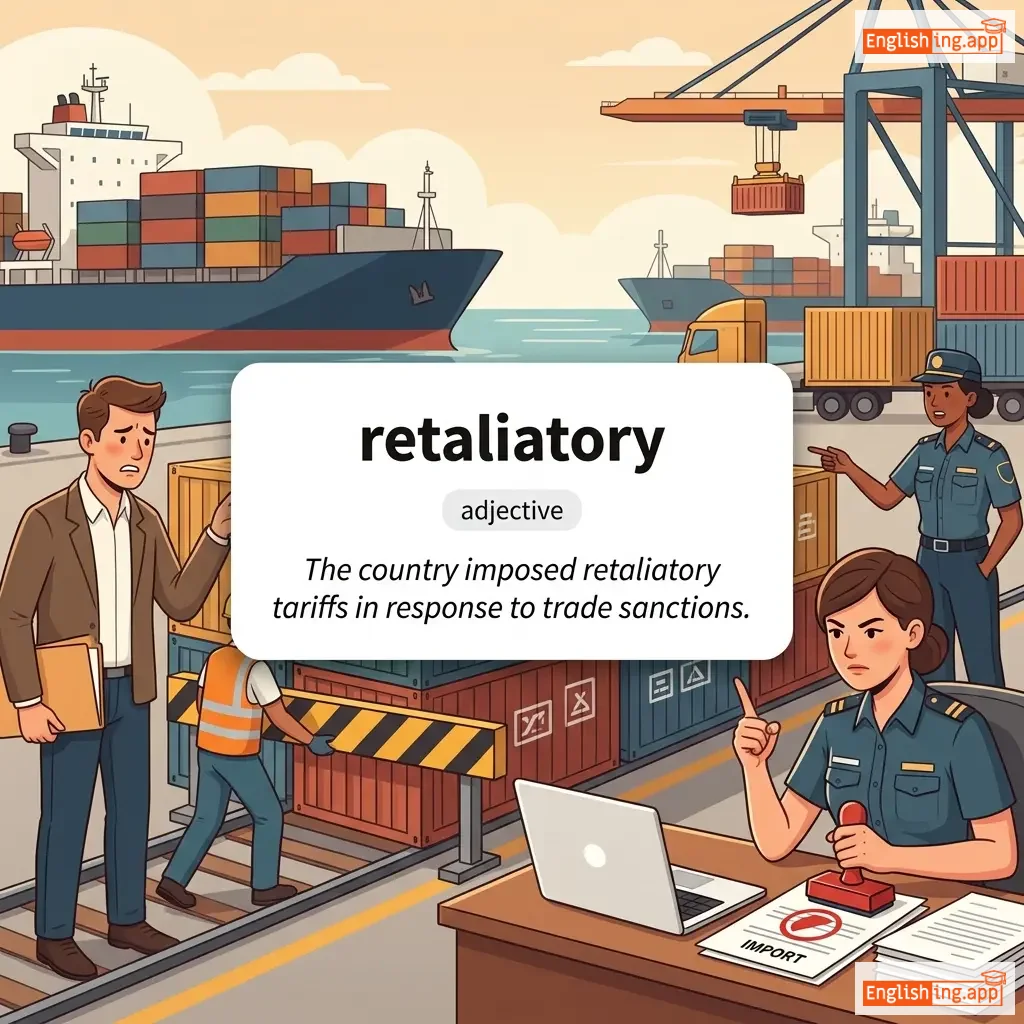
retaliatory definition card — visual illustration of the meaning
adjective
/rɪˈtæl.i.ə.tɔːr.i/
प्रतिशोधात्मक (pratishodhatmak)

Taking action in response to another's action, characterized as punitive, revengeful, or counteractive.

"The country imposed retaliatory tariffs in response to trade sanctions."

"देश ने व्यापार प्रतिबंधों के जवाब में प्रतिशोधात्मक शुल्क लगाए।" (Desh ne vyapar pratibandhon ke jawab mein pratishodhatmak shulk lagaye.)
verb
/rɪˈtɑːrd/
विलंबित करना / धीमा करना (vilambit karna / dheema karna)

to delay or slow down the progress of something

"Lack of funds may retard the development of the project."

"फंड्स की कमी परियोजना के विकास को धीमा कर सकती है।" (Funds ki kami pariyojana ke vikas ko dheema kar sakti hai.)
verb
/rɛtʃ/
खुशी (khushi)

to make the sound and movement of vomiting without bringing anything up

"The smell of spoiled food made him retch violently."

"वह पुरस्कार मिलने पर अपनी खुशी को छुपा नहीं पाई।" (Wah puraskar milne par apni khushi ko chhupa nahin pai.)
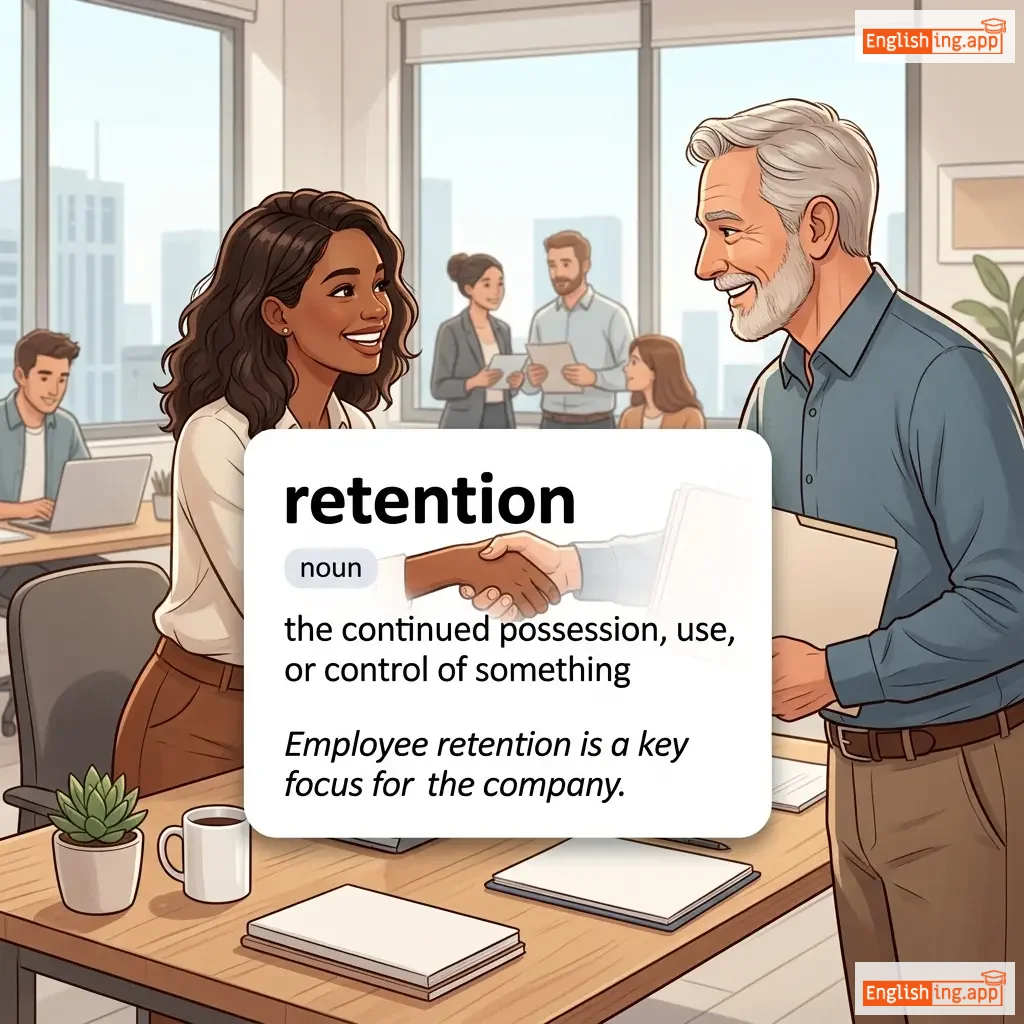
retention definition card — visual illustration of the meaning
noun
/rɪˈtɛnʃən/
रखाव (rakhav)

the continued possession, use, or control of something

"Employee retention is a key focus for the company."

"कर्मचारी रखाव कंपनी का एक मुख्य ध्यान है।" (Karmachari rakhav kampani ka ek mukhya dhyan hai.)
retentive definition card — visual illustration of the meaning
adjective
/rɪˈtɛntɪv/
याद रखने की क्षमता रखने वाला (yaad rakhne ki kshamata rakhne wala)

having the ability to remember things easily or keep something for a long time

"She has a highly retentive memory."

"उसकी याददाश्त बहुत तेज है।" (Uski yaaddasht bahut tez hai.)
noun
/ˈrɛtɪsəns/
मौनता (maunta)

the quality of being reserved or unwilling to speak freely

"His reticence made it difficult to know what he was thinking."

"उसकी मौनता ने यह जानना कठिन बना दिया कि वह क्या सोच रहा था।" (Uski maunta ne yeh jaanana kathin bana diya ki vah kya soch raha tha.)
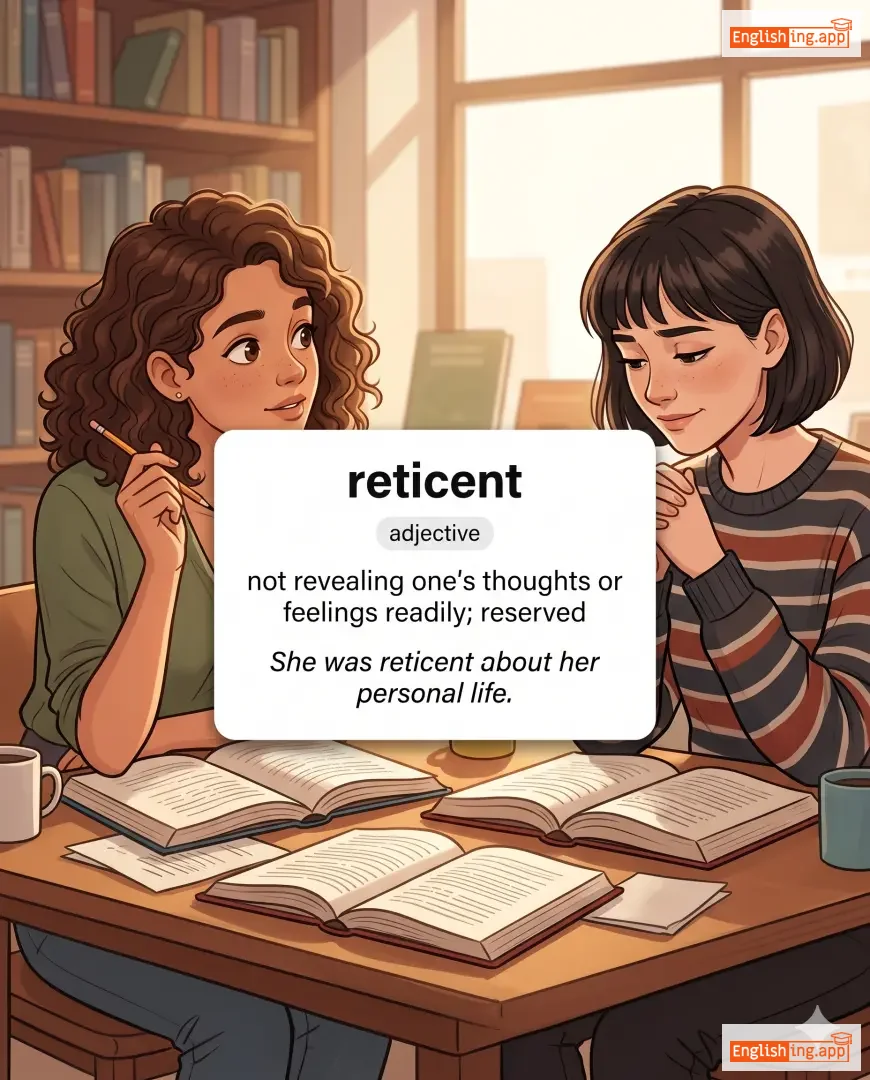
reticent definition card — visual illustration of the meaning
adjective
/ˈrɛtɪsənt/
संकोचपूर्ण (sankochpoorn)

not revealing one's thoughts or feelings readily; reserved

"She was reticent about her personal life."

"वह अपनी व्यक्तिगत ज़िन्दगी के बारे में संकोचपूर्ण थी।" (Wah apni vyaktigat zindagi ke baare mein sankochpoorn thi.)
adjective
/rɪˈtɪkjʊlət/
जाल जैसी संरचना (jaal jaisi sanrachna)

Having a net-like pattern or structure.

"The leaf had a reticulate pattern of veins."

"पत्ते में शिराओं का जाल जैसी संरचना थी।" (Patte mein shirahon ka jaal jaisi sanrachna thi.)
noun
/ˈrɛtɪnjuː/
अनुचर (anuchar)

A group of attendants or followers accompanying an important person.

"The king entered the hall followed by his retinue."

"राजा अपनी अनुचर के साथ हॉल में प्रवेश किया।" (raja apni anuchar ke saath hall mein pravesh kiya.)