वोकैबुलरीज

इंग्लिश वोकैबुलरी डिस्कवर, लर्न और मास्टर करें

noun
/ˈpɛnəlti/
सजा (saza)

A punishment imposed for breaking a law, rule, or contract.

"He had to pay a heavy penalty for breaking the traffic rules."

"उसको ट्रैफिक नियम तोड़ने के लिए भारी सजा भुगतनी पड़ी।" (Usko traffic niyam todne ke liye bhari saza bhugatni padi.)
noun
/ˈpɛnəns/
खुशी (khushi)

Voluntary self-punishment as an expression of repentance for wrongdoing.

"He fasted for a week as a penance for his mistakes."

"उसे पुरस्कार मिलने पर अपनी खुशी छिपाना मुश्किल था।" (Use puraskar milne par apni khushi chhupana mushkil tha.)
penchant definition card — visual illustration of the meaning
noun
/ˈpɒ̃ʃɒ̃/
झुकाव (jhukav)

a strong or habitual liking for something or tendency to do something

"She has a penchant for collecting rare books."

"उसे दुर्लभ किताबें इकट्ठा करने का झुकाव है।" (use durlabh kitaabein ikattha karne ka jhukav hai.)
noun
/ˈpɛnsəl/
पेंसिल (pencil)

an instrument for writing or drawing, typically made of wood with a graphite core

"He drew a picture with a pencil."

"उसने पेंसिल से एक तस्वीर खींचा।" (usne pencil se ek tasveer kheenchaa)
noun
/ˈpɛndənt/
लॉकेट (loket)

a piece of jewelry that hangs from a chain worn around the neck

"She wore a silver pendant around her neck."

"उसने अपनी गर्दन में एक चांदी का लॉकेट पहना था।" (usne apni gardan mein ek chaandee ka loket pehna tha.)
adjective
/ˈpɛndənt/
लटकता हुआ (latakta hua)

hanging down or suspended

"The pendent branches touched the ground."

"लटकती हुई शाखाएँ ज़मीन से छू रही थीं।" (latakti hui shaakhayen zameen se chhoo rahi thiin.)
adjective
/ˈpɛndɪŋ/
लंबित (lambit)

awaiting decision or settlement

"The case is still pending in court."

"मामला अदालत में अभी भी लंबित है।" (mamla adalat mein abhi bhi lambit hai.)
adjective
/ˈpɛndjʊləs/
खुशी (khushi)

hanging down loosely; drooping

"The pendulous fruit weighed down the branch."

"जब उसे पुरस्कार मिला तो वह अपनी खुशी छुपा नहीं पाई।" (Jab use puraskar mila to vah apni khushi chhupa nahi pai.)
noun
/ˈpɛndjələm/
झूला (jhoola)

A weight suspended from a pivot so that it swings freely, often used to regulate clocks.

"The pendulum swung back and forth inside the clock."

"घड़ी के अंदर झूला आगे और पीछे झूल रहा था।" (ghadi ke andar jhoola aage aur peeche jhool raha tha.)
adjective
/ˈpɛnɪtrəbl/
अवगम्य (avagamya)

Capable of being passed through or entered.

"The thin wall was easily penetrable."

"पतला दीवार आसानी से अवगम्य था।" (Patla deewar aasani se avagamya tha.)
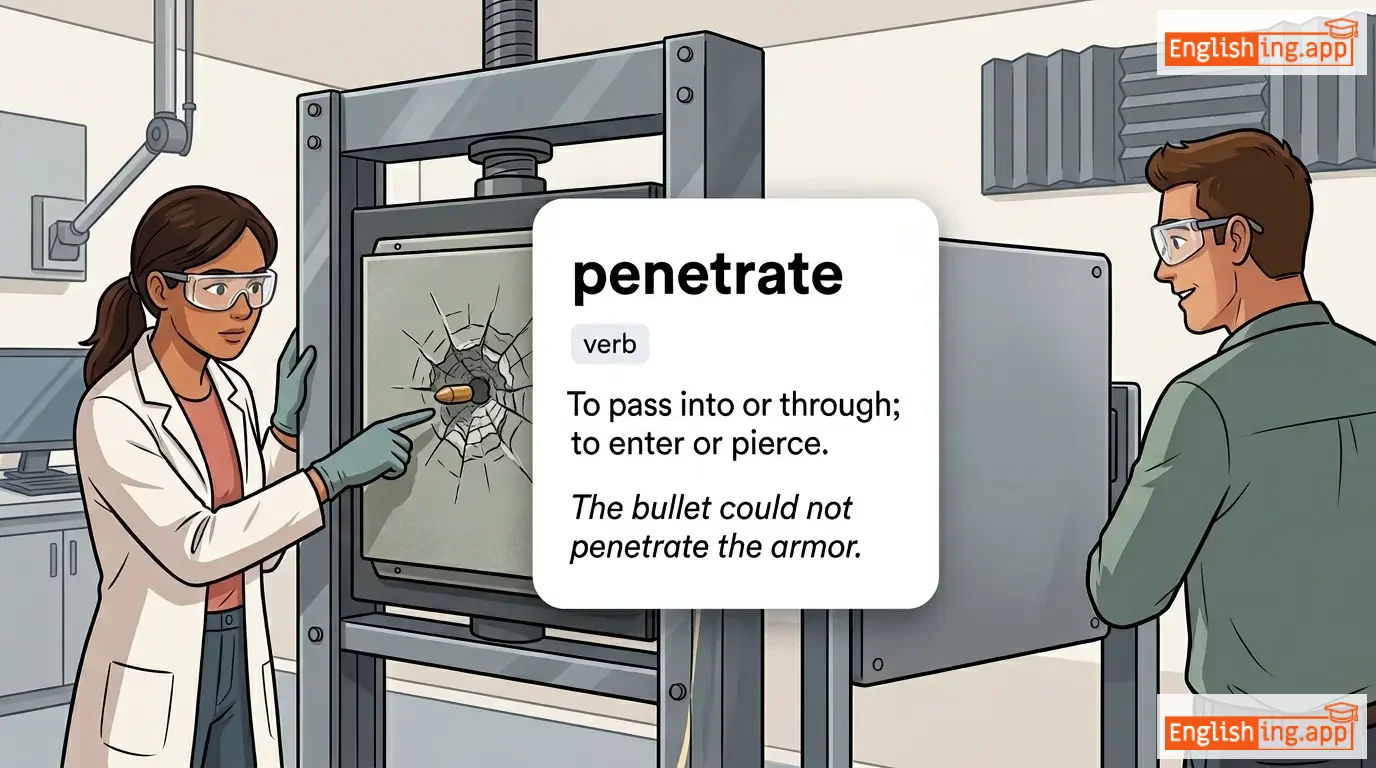
penetrate definition card — visual illustration of the meaning
verb
/ˈpɛnɪtreɪt/
भेदना (bhedna)

To pass into or through; to enter or pierce.

"The bullet could not penetrate the armor."

"बुलेट ने आर्मर को भेद नहीं किया।" (Bullet ne armor ko bhed nahi kiya.)
noun
/ˌpɛnɪˈtreɪʃən/
प्रवेश (pravesh)

The act of piercing or entering into something.

"The company's market penetration grew rapidly."

"कंपनी का बाजार में प्रवेश तेजी से बढ़ा।" (Company ka bazaar mein pravesh tezi se badha.)
noun
/pəˈnɪn.sjə.lə/
प्रायद्वीप (praayadveep)

a piece of land that is almost completely surrounded by water but connected to the mainland

"The Korean Peninsula is located in East Asia."

"कोरियाई प्रायद्वीप पूर्वी एशिया में स्थित है।" (koriyaai praayadveep purvi eshiya mein sthit hai.)
adjective
/pəˈnɪnsjələr/
आधारभूमि जैसा (aadharbhumi jaisa)

Relating to or resembling a peninsula.

"The peninsular region is surrounded by water on three sides."

"आधारभूमि जैसा क्षेत्र तीन ओर पानी से घिरा हुआ है" (Aadharbhumi jaisa kshetra teen or paani se ghirah hua hai)
noun
/ˈpɛnɪtəns/
पश्चाताप (pashchatap)

The action or feeling of showing sorrow and regret for having done wrong.

"His eyes were full of penitence after realizing his mistake."

"अपनी गलती का एहसास होने के बाद उसकी आँखों में पछतावे का भाव था।" (Apni galti ka ehsaas hone ke baad uski aankhon mein pachhtave ka bhav tha.)
adjective
/ˈpɛnɪtənt/
पछताया हुआ (pachtaya hua)

Feeling or showing sorrow and regret for having done wrong.

"She was penitent after shouting at her friend."

"वह अपनी दोस्त पर चिल्लाने के बाद पछताया था।" (Vah apni dost par chillane ke baad pachtaya tha.)
adjective
/ˌpɛnɪˈtɛnʃəl/
पश्चातापपूर्ण (pashchatappoorn)

Relating to or expressing penitence or penance.

"The priest delivered a penitential sermon on forgiveness."

"पादरी ने माफी पर एक पश्चातापपूर्ण उपदेश दिया।" (Padri ne maafi par ek pashchatappoorn updesh diya.)
noun
/ˈpɛnənt/
ध्वज (dhwaj)

A tapering flag used for signaling or as an emblem of victory or achievement.

"The team raised the championship pennant proudly."

"टीम ने गर्व से चैंपियनशिप ध्वज लहराया।" (Team ne garv se championship dhwaj lahraaya.)
adjective
/ˈpɛneɪt/
पंख जैसे (pankh jaise)

Having parts or structures arranged like a feather; feather-shaped.

"The fern has a pennate leaf structure."

"फर्न के पत्ते का आकार पंख जैसा है।" (Fern ke patte ka aakaar pankh jaisa hai.)
adjective
/ˈpen.ɪ.ləs/
निर्धन; बहुत गरीब; पैसे के बिना (nirdhan; bahut gareeb; paise ke bina)

having no money; extremely poor; completely without funds

"After losing his job, he became penniless."

"अपना नौकरी खोने के बाद, वह निर्धन हो गया।" (apna naukri khone ke baad, wah nirdhan ho gaya.)
noun
/ˈpɛni/
पेनी (peni)

a small coin of low value; a very small amount of money

"He found a penny on the sidewalk and smiled."

"उसे फुटपाथ पर एक पेनी मिली और वह मुस्कुरा दिया।" (use footpath par ek peni mili aur vah muskura diya)
noun
/pɪˈnɒlədʒi/
कारागारविज्ञान (karagarvigyan)

The study of prison management and criminal rehabilitation.

"He decided to specialize in penology to help improve the prison system."

"उन्होंने जेल प्रणाली को सुधारने के लिए कारागारविज्ञान में विशेषज्ञता प्राप्त करने का निर्णय लिया।" (Unhone jail pranali ko sudharne ke liye karagarvigyan mein visheshagya banne ka nirnay liya.)
noun
/ˈpɛnʃən/
पेंशन (pension)

A regular payment made during a person's retirement from an investment fund or employer.

"After 30 years of service, he received a monthly pension."

"30 वर्षों की सेवा के बाद, उसे मासिक पेंशन मिली।" (30 varsho ki seva ke baad, use masik pension mili.)
adjective
/ˈpɛnsɪv/
चिंतामग्न (chintamagn)

Engaged in deep or serious thought.

"She looked pensive as she stared out of the window."

"वह खिड़की से बाहर देखते हुए चिंतामग्न दिख रही थी।" (Vah khidki se baahar dekhte huye chintamagn dikh rahi thi.)
adjective
/ˈpent ʌp/
दबाया हुआ; सीमित; बंधा हुआ (dabaya hua; seemit; bandha hua)

suppressed; restrained; confined

"He had pent-up anger that finally exploded."

"उसके पास दबाया हुआ गुस्सा था जो अंततः फट पड़ा।" (uske paas dabaya hua gussa tha jo antatah fat pada.)
noun
/ˈpɛntæd/
पाँच का समूह (paanch ka samuh)

A group or set of five things.

"The committee was divided into a pentad of working groups."

"कमिटी पाँच कार्य समूहों में विभाजित थी।" (Committee paanch kary samuhon mein vibhajit thi.)
noun
/ˈpɛntəɡən/
पंचभुज (pentagan)

A plane figure with five straight sides and five angles; also refers to the US Department of Defense building.

"The Pentagon is one of the most iconic government buildings in the United States."

"पेंटागन संयुक्त राज्य अमेरिका की सबसे प्रसिद्ध सरकारी इमारतों में से एक है।" (Pentagan sanyukt rajya amerika ki sabse prasiddh sarkaari imaaraton mein se ek hai.)
noun
/ˈpɛntəˌɡræm/
पेंटाग्राम (pentagram)

A five-pointed star often used as a symbol in magic, mysticism, or religion.

"The wizard drew a pentagram on the floor as part of the ritual."

"जादूगर ने अनुष्ठान के हिस्से के रूप में फर्श पर एक पेंटाग्राम खींचा।" (Jadugar ne anushthan ke hisse ke roop mein farsh par ek pentagram kheencha.)
noun
/ˌpɛntəˈhiːdrən/
पेंटाहेड्रोन (pentahedron)

A solid geometric figure with five faces.

"In geometry class, the teacher explained the structure of a pentahedron."

"गणित वर्ग में, शिक्षक ने पेंटाहेड्रोन की संरचना समझाई।" (Ganit varg mein, shikshak ne pentahedron ki sanrachna samjhayi.)
noun
/pɛnˈtæmɪtər/
पेंटामीटर (pentameter)

A line of verse consisting of five metrical feet.

"Shakespeare often wrote his plays in iambic pentameter."

"शेक्सपियर अक्सर अपनी नाटकों को आयाम्बिक पेंटामीटर में लिखते थे।" (Shakespeare aksar apni natako ko iambic pentameter mein likhte the.)
noun
/pɛnˈtæθlɒn/
पेंटथलॉन (pentathlon)

An athletic contest featuring five different events.

"She trained hard to compete in the modern pentathlon."

"वह आधुनिक पेंटथलॉन में प्रतिस्पर्धा करने के लिए कड़ी मेहनत कर रही थी।" (Vah aadhunik pentathlon mein pratispardha karne ke liye kadhi mehnat kar rahi thi.)
adjective
/ˌpɛntəˈveɪlənt/
पेंटावैलेंट (pentavalent)

Having a valence of five, especially in chemistry.

"Phosphorus can exist in a pentavalent state."

"फॉस्फोरस पेंटावैलेंट अवस्था में हो सकता है।" (Phosphorus pentavalent avastha mein ho sakta hai.)
adjective
/pəˈnʌltɪmət/
अंतिम से पहले (antim se pehle)

second to the last in a sequence or series

"She finished the penultimate chapter before going to sleep."

"वह सोने जाने से पहले अंतिम से पहले अध्याय समाप्त कर चुकी थी।" (Vah sone jane se pehle antim se pehle adhyay samaapt kar chuki thi.)
noun
/pəˈnʌmbrə/
आंशिक छाया (aanshik chhaya)

a partially shaded area around the shadow of an object, especially during an eclipse

"The moon’s penumbra created a dim shadow over the Earth."

"चाँद की पेनम्ब्राह ने पृथ्वी पर एक मंद छाया बनाई।" (Chaand ki penumbra ne prithvi par ek mand chhaya banayi.)
adjective
/pəˈnjʊəriəs/
बेहद गरीब (behad gareeb)

extremely poor; poverty-stricken; miserly

"The penurious family struggled to buy food."

"बेहद गरीब परिवार को खाना खरीदने में मुश्किल हो रही थी।" (behad gareeb parivaar ko khaana kharidne mein mushkil ho rahi thi.)
penury definition card — visual illustration of the meaning
noun
/ˈpɛnjʊri/
गंभीर गरीबी (gambhir gareebi)

extreme poverty or destitution

"He grew up in penury but became successful later in life."

"वह पेन्यूरी में पला-बढ़ा लेकिन जीवन में बाद में सफल हुआ।" (Vah penury mein pala-badha lekin jeevan mein baad mein safal hua.)
noun
/ˈpiːɒn/
पीऑन (pion)

a low-ranking worker, often performing menial tasks

"The office peon delivered the files to each department."

"ऑफिस का पीऑन प्रत्येक विभाग में फाइलें पहुँचाता था।" (Offis ka pion pratyek vibhag mein filein pahuchata tha.)
noun
/ˈpiːpl/
लोग (log)

a group of human beings collectively

"The people in the town gathered for the festival."

"शहर में लोग उत्सव के लिए इकट्ठा हुए।" (Sheher mein log utsav ke liye ikattha hue.)
noun
/ˈpɛpər/
मिर्च (mirch)

a pungent spice obtained from pepper plants, used to flavor food

"I like to add pepper to my soup."

"मुझे अपना सूप में मिर्च डालना पसंद है।" (Mujhe apna soup mein mirch daalna pasand hai.)
preposition
/pɜːr/
प्रति (prati)

for each, according to

"The tickets are priced at $20 per person."

"टिकटों की कीमत $20 प्रति व्यक्ति है।" (Tikton ki keemat 20 dollar prati vyakti hai.)
noun
/pɜːr bɔɪld raɪs/
पारबॉयल्ड चावल (parboiled chawal)

Rice that has been partially boiled in the husk before milling; parboiled rice

"Per boiled rice retains more nutrients than regular white rice."

"पारबॉयल्ड चावल सामान्य सफेद चावल से अधिक पोषक तत्वों को बनाए रखता है।" (parboiled chawal samanya safed chawal se adhik poshak tatvon ko banaye rakhta hai.)
adverb
/pɜːr ˈseɪ/
खुद में (khud mein)

By or in itself; intrinsically.

"The idea is not bad per se, but it needs improvement."

"विचार खुद में बुरा नहीं है, लेकिन इसे सुधारने की जरूरत है।" (Vichar khud mein bura nahi hai, lekin ise sudharne ki zarurat hai.)
verb
/pəˈræmbjʊˌleɪt/
घूमना (ghoomna)

To walk through or travel around, especially for leisure.

"They perambulated the old town, enjoying the sights."

"वे पुराने शहर में घूमें, दृश्यों का आनंद लिया।" (Ve purane shahar mein ghoomne, drishyoon ka anand liya.)
noun
/pəˈræm.bjə.leɪ.tər/
बेबी कैरिज (perambulator)

a four-wheeled carriage for a baby; baby stroller or pram

"She pushed the perambulator through the park while the baby slept peacefully."

"वह शिशु को सुलाते हुए पेरेम्बुलेटर को पार्क के रास्ते धकेल रही थी।" (vah shishu ko sulate huye perambulator ko park ke raaste dhakel rahi thi.)
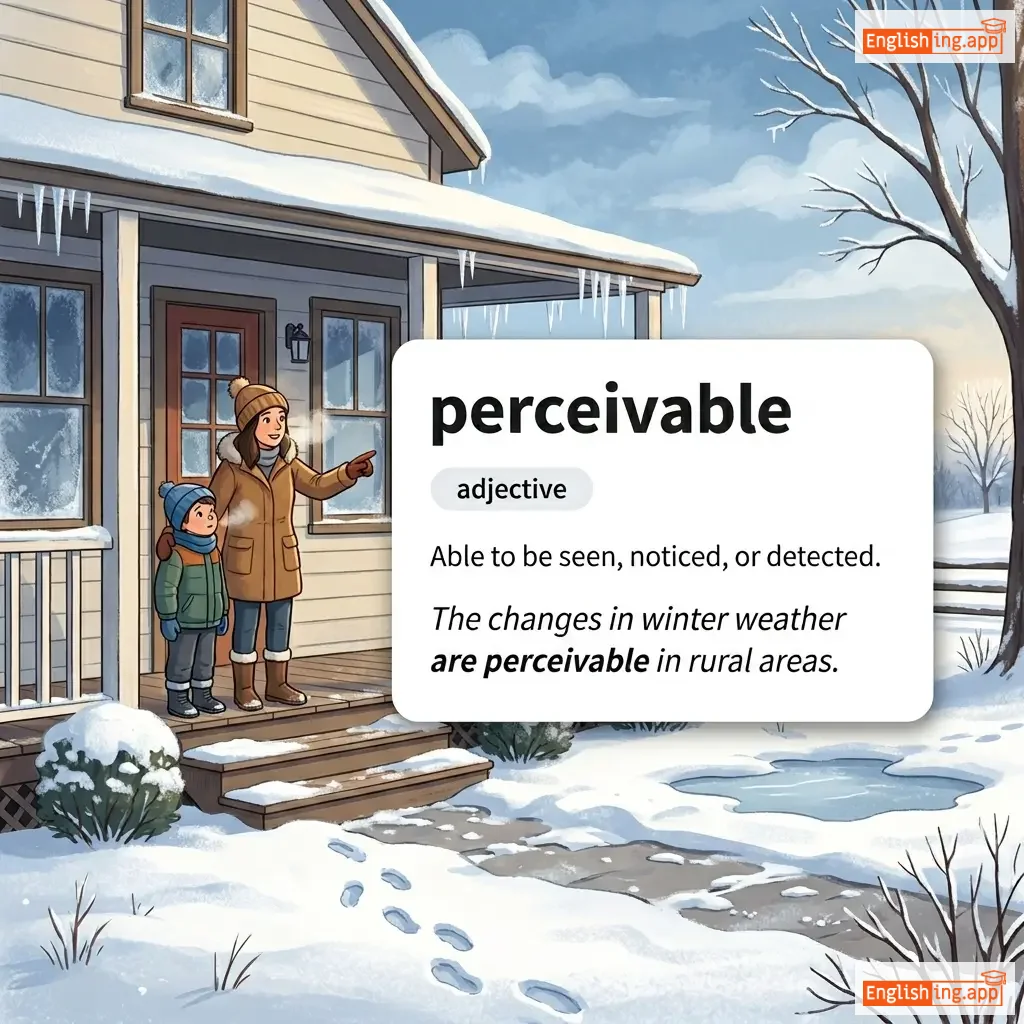
perceivable definition card — visual illustration of the meaning
adjective
পারসিভেবল
दृश्यमान (drishyamaan)

Able to be seen, noticed, or detected.

"The changes in winter weather are perceivable in rural areas."

"सर्दियों के मौसम में बदलाव ग्रामीण क्षेत्रों में दृश्यमान होते हैं।" (Sardiyon ke mausam mein badlav grameen kshetron mein drishyamaan hote hain.)
perceive definition card — visual illustration of the meaning
verb
/pərˈsiːv/
समझना (samajhna)

To become aware of or recognize something through the senses or the mind.

"She perceived a change in his tone of voice."

"उसने उसकी आवाज़ में बदलाव महसूस किया।" (Usne uski awaaz mein badlaav mehsoos kiya.)
👁️

perceived

verb
/pərˈsiːvd/
खुशी (khushi)

to become aware of something through the senses or the mind; to understand or interpret

"She perceived a hint of sadness in his voice."

"जब उसे पुरस्कार मिला, तो वह अपनी खुशी छिपा नहीं पाई।" (Jab use puraskar mila, to vah apni khushi chhupa nahin paayi.)
noun; adverb
/pərˈsɛnt/
प्रतिशत (pratishat)

a proportion out of one hundred; by each hundred

"Sales increased by ten percent this year."

"इस साल बिक्री दस प्रतिशत बढ़ी।" (is saal bikri das pratishat badhi)
noun
/pərˈsɛntɪdʒ/
प्रतिशत (pratishat)

a proportion or share in relation to a whole

"The percentage of students who passed the exam was high."

"जो छात्र परीक्षा में पास हुए, उनका प्रतिशत उच्च था।" (Jo chhatra pariksha mein paas huye, unka pratishat uchch tha.)
adjective
/pərˈsɛptəbl̩/
साध्य (saadhya)

Able to be noticed or recognized by the senses or the mind.

"There was a perceptible change in the atmosphere."

"वायुमंडल में एक साध्य परिवर्तन था।" (Vayumandal mein ek saadhya parivartan tha.)