वोकैबुलरीज

इंग्लिश वोकैबुलरी डिस्कवर, लर्न और मास्टर करें

noun, verb, adjective
/ˈpeɪtənt/ or /ˈpætənt/
पेटेंट (petent)

a government license granting exclusive rights to an inventor; also to obtain such rights

"He patented his new invention to protect it from being copied."

"उसने अपनी नई खोज को कॉपी होने से बचाने के लिए पेटेंट कराया।" (Usne apni nayi khoj ko copy hone se bachane ke liye petent karaya.)
adjective
/pəˈtɜːrnəl/
पितृसुलभ (pitrusulabh)

Relating to or characteristic of a father.

"He took a paternal interest in the boy’s education."

"उसने लड़के की शिक्षा में पितृसुलभ रुचि दिखाई।" (Usne ladke ki shiksha mein pitrusulabh ruchi dikhayi.)
noun
/pəˈtɜːrnəti/
पितृत्व (pitrutva)

The state of being someone's father.

"He demanded a paternity test to confirm his relationship with the child."

"उसने बच्चे के साथ अपने रिश्ते की पुष्टि करने के लिए पितृत्व परीक्षण की मांग की।" (Usne bachche ke saath apne rishte ki pushti karne ke liye pitrutva parikshan ki maang ki.)
noun
/pæθ/
पथ (path)

a way or track laid down for walking or made by continual treading

"She walked along the narrow path through the forest."

"वह जंगल में संकरी पथ पर चली।" (vah jangal mein sankari path par chali.)
adjective
/pəˈθɛtɪk/
दीन-हीन (deen-heen)

Causing feelings of pity, sadness, or sometimes contempt.

"The team’s performance in the match was simply pathetic."

"टीम का प्रदर्शन मैच में बिल्कुल दीन-हीन था।" (Team ka pradarshan match mein bilkul deen-heen tha.)
adjective
/ˌpæθəˈdʒɛnɪk/
रोगजनक (rogjanak)

Capable of causing disease.

"Some bacteria are harmless, while others are highly pathogenic."

"कुछ बैक्टीरिया हानिरहित होते हैं, जबकि अन्य अत्यधिक रोगजनक होते हैं।" (Kuch bacteria hanirhit hote hain, jabki anya atyadhik rogjanak hote hain.)
pathological definition card — visual illustration of the meaning
adjective
/ˌpæθəˈlɑːdʒɪkəl/
रोगजनित, असामान्य (rogjanit, asamanya)

Relating to disease; extreme or obsessive in a way that is abnormal.

"He has a pathological fear of failure."

"उसके पास विफलता का एक रोगजनित डर है।" (Uske paas viphalta ka ek rogjanit dar hai.)
noun
/pəˈθɒlədʒi/
रोगविज्ञान (rogvigyan)

the scientific study of diseases, their causes, processes, and effects on the body

"Advances in pathology helped the doctors identify the rare infection quickly."

"रोगविज्ञान में उन्नति ने डॉक्टरों को दुर्लभ संक्रमण को जल्दी पहचानने में मदद की।" (rogvigyan mein unnati ne doktoron ko durlabh sankraman ko jaldi pehchanne mein madad ki.)
noun
/ˈpeɪθɒs/
पैथोस (pathos)

a quality in speech, writing, or events that evokes pity or deep emotion

"The documentary balanced pathos with hope, making the audience both weep and think."

"डॉक्यूमेंट्री ने आशा के साथ पैथोस का संतुलन किया, जिससे दर्शक रोए और सोचे।" (Documentary ne asha ke saath pathos ka santulan kiya, jisse darshak roye aur soche.)
noun
/ˈpæθweɪ/
मार्ग (marg)

a route or course along which something travels or progresses

"The narrow pathway led to the hidden garden."

"संकीर्ण पाथवे छुपे हुए बाग़ीचे तक ले गए थे।" (Sankirn pathway chhupay huye baagiche tak le gaye the.)
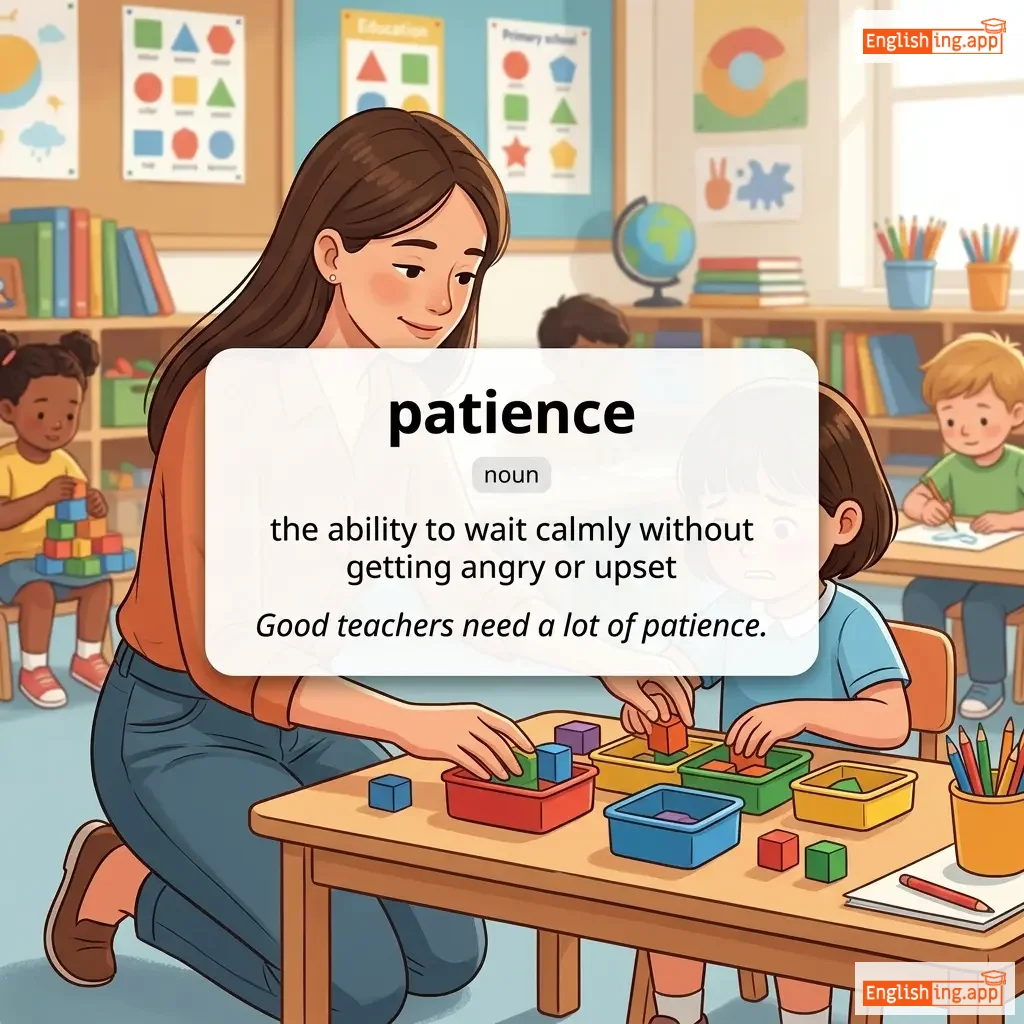
patience definition card — visual illustration of the meaning
noun
/ˈpeɪ.ʃəns/
धैर्य (dhairya)

the ability to wait calmly without getting angry or upset

"Good teachers need a lot of patience."

"अच्छे शिक्षकों को बहुत धैर्य की आवश्यकता होती है।" (Achhe shikshakon ko bahut dhairya ki aavashyakta hoti hai.)
adjective
/ˈpeɪʃənt/
धैर्यवान (dhairyawan)

able to accept or tolerate delays, problems, or suffering without becoming annoyed or anxious

"She remained patient despite the long wait."

"वह लंबी प्रतीक्षा के बावजूद धैर्यवान बनी रही।" (vah lambi pratiksha ke bawajood dhairyawan bani rahi.)
noun
/pəˈtiːnə/
धातु, पत्थर या लकड़ी पर उम्र या उपयोग के कारण बनने वाली एक परत; साथ ही, एक सतही रूप (dhatu, pathar ya lakdi par umra ya upyog ke karan banne wali ek parat; saath hi, ek satha roop)

a surface film or sheen on metal, stone, or wood due to age or use; also, a superficial appearance

"The bronze statue developed a green patina after years in the sea air."

"सालों तक समुद्र की हवा में रहने के बाद कांस्य की मूर्ति में हरा पैटीना विकसित हो गया।" (Saalon tak samudra ki hawa mein rehne ke baad kaansy ki murti mein hara patina viksit ho gaya.)
noun
/ˈpætwɑː/
क्षेत्रीय उपभाषा (kshetriya upabhasha)

a regional or social dialect, especially one considered nonstandard or informal

"The guide slipped into local patois when chatting with the fishermen."

"गाइड मछुआरों के साथ बातचीत करते समय स्थानीय पटुआ में बात करने लगा।" (guide machhuaron ke saath baatcheet karte samay sthanīya patoā mein baat karne laga.)
noun
/ˈpeɪtriɑːrk/
पारिवारिक प्रमुख (parivarik pramukh)

a male head of a family or tribe; an older respected man who leads a group

"As the family patriarch, he mediated disputes and kept long traditions alive."

"पारिवारिक प्रमुख के रूप में, उन्होंने विवादों का समाधान किया और दीर्घकालिक परंपराओं को जीवित रखा।" (parivarik pramukh ke roop mein, unhone vivadon ka samadhan kiya aur deerghkalik paramparayon ko jeevit rakha.)
noun, adjective
/pəˈtrɪʃən/
पट्रीशियन (patrishiyan)

A person of noble rank or high social standing; relating to aristocracy.

"The patrician families of Rome wielded great power in politics."

"रोम के पट्रीशियन परिवारों का राजनीति में महत्वपूर्ण प्रभाव था।" (Rom ke patrishiyan parivaron ka rajniti mein mahatvapurn prabhav tha.)
noun
/ˈpætrɪsaɪd/
पितृहत्या (pitrhatya)

The act of killing one's own father.

"The ancient myth describes a son committing patricide to take the throne."

"प्राचीन मिथक में वर्णित है कि एक बेटे ने सिंहासन लेने के लिए पितृहत्या की।" (Prachin mithak mein varnit hai ki ek bete ne singhasan lene ke liye pitrhatya ki.)
noun
/ˈpætrɪˌmoʊni/
पितृधन (pitradhan)

Property or inheritance passed down from one's father or ancestors.

"The castle was part of his patrimony from his noble ancestors."

"महल उनके पितृधन का हिस्सा था जो उनके महान पूर्वजों से प्राप्त हुआ था।" (Mahal unke pitrdhan ka hissa tha jo unke mahaan purvajon se prapt hua tha.)
noun
/ˈpeɪtriət/
देशभक्त (deshbhakt)

A person who loves and strongly supports their country.

"The patriot stood proudly under the national flag."

"देशभक्त राष्ट्रीय ध्वज के नीचे गर्व से खड़ा था।" (Deshbhakt rashtriya dhwaj ke neeche garv se khada tha.)
adjective
/ˌpeɪ.triˈɑː.tɪk/
देशभक्त (deshbhakt)

showing love for one's country

"The patriotic citizens celebrated Independence Day with great enthusiasm."

"देशभक्त नागरिकों ने स्वतंत्रता दिवस को बड़े उत्साह के साथ मनाया।" (deshbhakt nagrikon ne svatantrata divas ko bade utsah ke saath manaya.)
patriotism definition card — visual illustration of the meaning
noun
/ˈpeɪtriətɪzəm/
देशभक्ति (deshbhakti)

Love for and devotion to one's country.

"His patriotism was evident when he volunteered for military service."

"जब उन्होंने सैन्य सेवा के लिए स्वेच्छा से काम किया, तो उनकी देशभक्ति स्पष्ट थी।" (Jab unhone sainik seva ke liye swichchha se kaam kiya, to unki deshbhakti spasht thi.)
verb
/pəˈtroʊl/
गश्त लगाना (gasht lagana)

to move around an area to watch or guard it

"The police patrol the streets at night to ensure safety."

"पुलिस रात में सड़कों पर गश्त लगाती है ताकि सुरक्षा सुनिश्चित की जा सके।" (Police raat mein sadakon par gasht lagati hai taaki suraksha sunishchit ki ja sake.)
noun
/ˈpeɪtrən/
सहायक व्यक्ति (sahayak vyakti)

a person who gives financial or other support to a person, organization, or cause

"The library is supported by generous patrons."

"पुस्तकालय उदार सहायकों द्वारा समर्थित है।" (Pustakalay udar sahayakoon dwara samarthit hai.)
patronize definition card — visual illustration of the meaning
verb
/ˈpeɪtrənaɪz/
समर्थन करना / तुच्छ तरीके से व्यवहार करना / नियमित ग्राहक होना (samarthan karna / tuchchh tareeke se vyavhaar karna / niyamit grahak hona)

to support or sponsor; to treat someone with apparent kindness that betrays a sense of superiority; to be a regular customer of a business

"She promised to patronize local businesses during the holiday season."

"उसने छुट्टियों के मौसम में स्थानीय व्यापारों का समर्थन करने का वादा किया।" (Usne chhuttiyon ke mausam mein sthaaneey vyapaaron ka samarthan karne ka wada kiya.)
adjective
/ˈpeɪtrənaɪzɪŋ/
घमंडी (ghamandi)

showing kindness that is perceived as condescending or superior

"His patronizing tone offended the audience."

"उसका घमंडी स्वर श्रोताओं को आहत कर गया।" (Uska ghamandi swar shrotaon ko aahat kar gaya.)
noun
/ˌpætrəˈnɪmɪk/
पितृनाम (pitrnaam)

a name derived from the name of a father or ancestor

"In many cultures, surnames are patronymic in origin."

"कई संस्कृतियों में, उपनाम पितृनाम से उत्पन्न होते हैं।" (Kai sanskritiyon mein, upnaam pitranam se utpann hote hain.)
verb
/ˈpætər/
हल्का टपकने की आवाज करना / यांत्रिक तरीके से जल्दी बोलना (halka tapakne ki awaaz karna / yantrik tareeke se jaldi bolna)

to make a repeated light tapping sound; to talk quickly in a rehearsed or mechanical way

"Rain pattered softly on the window."

"बारिश खिड़की पर हल्की आवाज में गिर रही थी।" (Barish khidki par halki awaaz mein gir rahi thi.)
/ˈpæt.ən/
रूपरेखा / ढांचा (rooprekha / dhancha)

A repeated decorative design or a regular way in which something happens or is done.

"The dress had a beautiful floral pattern."

"साड़ी में एक सुंदर पुष्प रूपरेखा थी।" (Saadi mein ek sundar pushp rooprekha thi.)
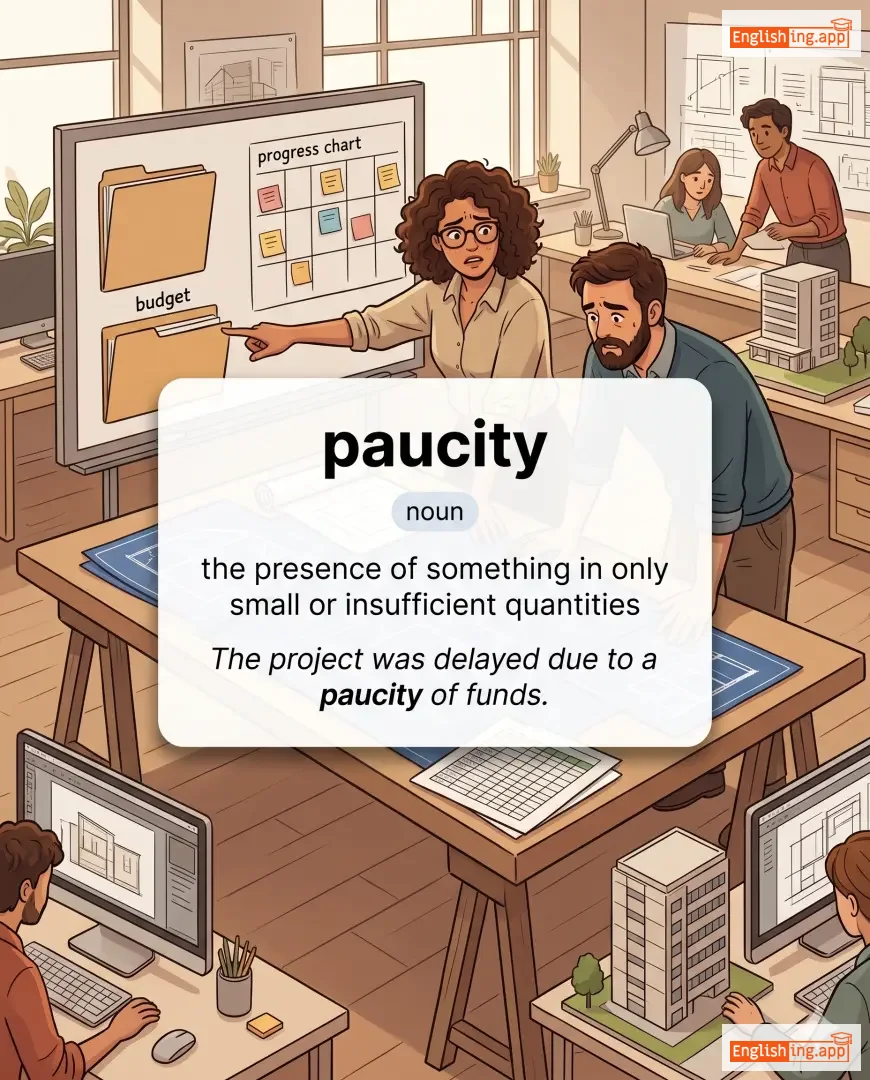
paucity definition card — visual illustration of the meaning
noun
/ˈpɔːsɪti/
कमी / अभाव (kami / abhav)

the presence of something in only small or insufficient quantities

"The project was delayed due to a paucity of funds."

"प्रोजेक्ट धन की कमी के कारण देरी से हुआ।" (Project dhan ki kami ke karan deri se hua.)
adjective
/ˈpɔːntʃi/
पेट वाला (pet wala)

Having a large or protruding belly.

"The paunchy man struggled to button his shirt."

"पेट वाला आदमी अपनी शर्ट का बटन लगाने में संघर्ष कर रहा था।" (Pet wala aadmi apni shirt ka button lagane mein sangharsh kar raha tha.)
noun
/ˈpɔːpər/
भिखारी (bhikhari)

A very poor person.

"The pauper begged for food on the street corner."

"भिखारी ने सड़क के कोने पर भोजन के लिए भीख मांगी।" (bhikhari ne sadak ke kone par bhojan ke liye bhikh maangi.)
noun
/ˈpɔːpərɪzəm/
दरिद्रता (daridrata)

The state of being extremely poor.

"The country struggled with rising pauperism in the 19th century."

"देश ने 19वीं सदी में बढ़ती हुई दरिद्रता से संघर्ष किया।" (Desh ne 19vi sadi mein badhti hui daridrata se sangharsh kiya.)
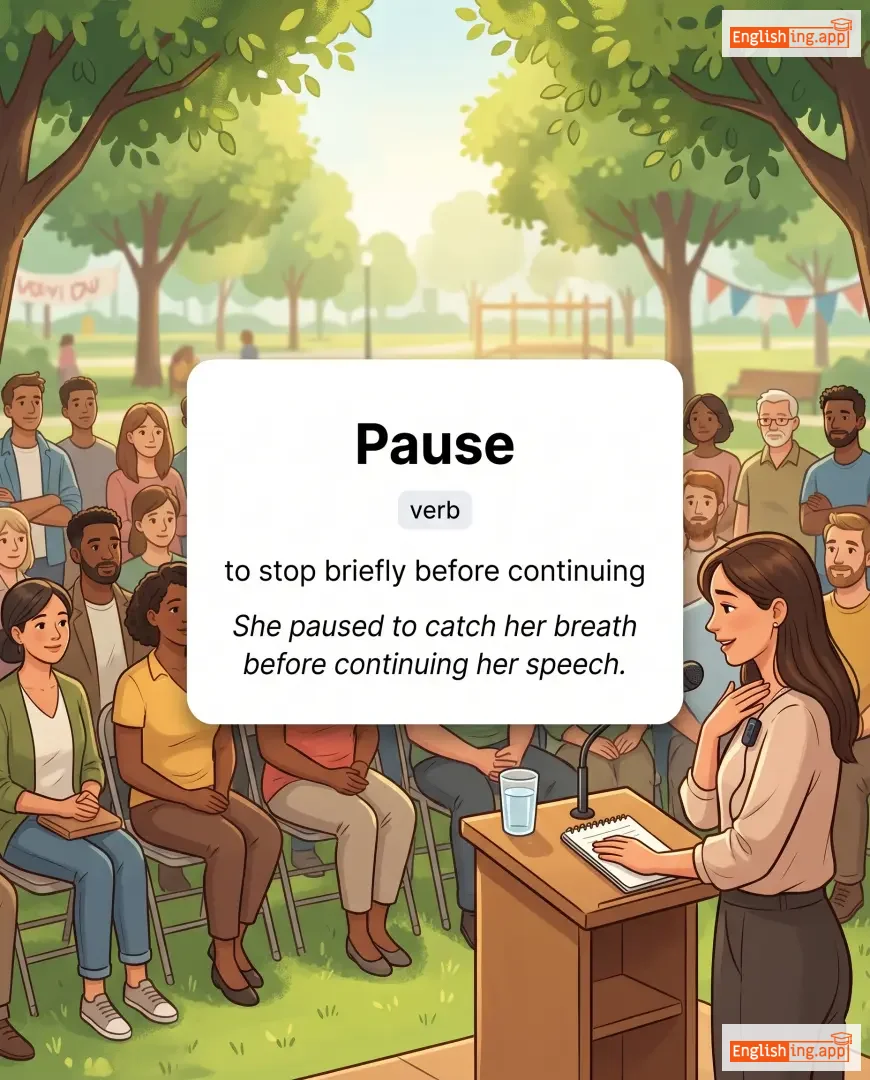
Pause definition card — visual illustration of the meaning
verb
/pɔːz/
विराम (viraam)

to stop briefly before continuing

"She paused to catch her breath before continuing her speech."

"उसने अपनी सांस पकड़ने के लिए थोड़ी देर के लिए विराम लिया।" (Usne apni saans pakadna ke liye thodi der ke liye viraam liya.)
noun
/ˈpeɪvmənt/
फुटपाथ (footpath)

a hard paved surface such as a road or sidewalk; the act or result of paving

"She walked along the pavement to reach the bus stop."

"वह बस स्टॉप तक पहुँचने के लिए फुटपाथ पर चली।" (vah bus stop tak pahunchne ke liye footpath par chali)
noun
/pəˈvɪliən/
पंडाल (pandal)

A large tent or temporary building, often used for events or exhibitions.

"The wedding reception was held in a decorated pavilion."

"वेडिंग रिसेप्शन एक सजे हुए पंडाल में आयोजित किया गया था।" (Wedding reception ek saje huye pandal mein aayojit kiya gaya tha.)
pay definition card — visual illustration of the meaning
verb
/peɪ/
भुगतान करना (bhugtan karna)

to give money in exchange for goods or services

"I need to pay for the groceries."

"मुझे किराने का सामान खरीदने के लिए भुगतान करना होगा।" (Mujhe kirane ka samaan kharidne ke liye bhugtan karna hoga.)
adjective
/ˈpeɪ.ə.bəl/
भुगतान योग्य (bhugtan yogya)

required to be paid; owed as a debt

"The amount is payable within thirty days of the invoice date."

"रकम चालान की तिथि से तीस दिनों के भीतर भुगतान योग्य है।" (rakm chalan ki tithi se tees dinon ke bhitar bhugtan yogya hai)
noun
/peɪˈiː/
प्राप्तकर्ता (praptakarta)

A person to whom money is paid or is to be paid.

"The payee must sign the check before cashing it."

"पेयी को चेक नकद करने से पहले साइन करना होगा।" (Peyi ko chek nakad karne se pehle sign karna hoga.)
noun
/ˈpeɪmənt/
पेमेंट (payment)

the action or process of paying money for something

"The payment for the order was received yesterday."

"ऑर्डर का पेमेंट कल प्राप्त हुआ था।" (Order ka payment kal prapt hua tha.)
noun
/ˈpiːˈsi/
पर्सनल कंप्यूटर (personal computer)

abbreviation for 'personal computer', a machine for performing digital operations

"I just bought a new PC for work."

"मैंने काम के लिए एक नया पीसी खरीदा।" (Maine kaam ke liye ek naya PC khareeda.)
noun
/piː/
मटर (matar)

a small round green seed eaten as a vegetable

"The children enjoyed eating sweet peas with dinner."

"बच्चों ने रात के खाने में मीठी मटर खाना पसंद किया।" (bachcho ne raat ke khane mein meethi matar khana pasand kiya)
noun
/piːs/
शांति (shanti)

a state of tranquility or quiet, freedom from disturbance

"They hope for peace in the region."

"वे क्षेत्र में शांति की कामना करते हैं।" (Ve kshetra mein shanti ki kaamna karte hain.)
adjective
/ˈpiːsəbl/
शांतिपूर्ण (shantipoorn)

inclined to avoid conflict; friendly and non-violent in nature

"She is a peaceable neighbor who never quarrels with anyone."

"वह एक शांतिपूर्ण पड़ोसी है जो कभी किसी से झगड़ा नहीं करती।" (Vah ek shantipurn padosi hai jo kabhi kisi se jhagda nahi karti.)
adjective
/ˈpiːsfl/
सुख (sukh)

free from disturbance; calm and tranquil

"The village remained peaceful even during the festival."

"जब उसे पुरस्कार मिला, तो वह अपनी खुशी छिपा नहीं पाई।" (Jab use puraskaar mila, to vah apni khushi chhupa nahi paayi.)
noun
/piːtʃ/
पीच (peech)

a soft round fruit with fuzzy skin, sweet flesh, and a large pit in the center

"The peach was perfectly ripe and juicy when I bit into it."

"पीच पूरी तरह से पका और रसीला था जब मैंने इसे काटा।" (peech pūrī tarah se pakā aur raseelā thā jab maine ise kāṭā.)
noun
/ˈpiː.kɒk/
मोर (mor)

a large bird with beautiful colorful tail feathers that can spread out like a fan

"The magnificent peacock displayed its colorful feathers to attract attention."

"उस शानदार मोर ने ध्यान आकर्षित करने के लिए अपने रंगीन पंख फैलाए।" (us shandaar mor ne dhyaan aakarshit karne ke liye apne rangeen pankh phailaaye.)
noun
/ˈpiː.kɒk ˈflaʊ.ər/
मोर का फूल (mor ka phool)

a tropical tree with bright orange and red flowers that resemble a peacock's tail

"The peacock flower tree blooms with stunning orange flowers in summer."

"मोर का फूल पेड़ ग्रीष्म में शानदार नारंगी फूलों के साथ खिलता है।" (mor ka phool ped grishm mein shandaar naaree phoolon ke saath khilta hai)
noun
/ˈpiː.hən/
मोरनी (morni)

female peacock

"The peahen is less colorful than the male peacock."

"मोरनी मेल मोर के मुकाबले कम रंगीन है।" (morni mel mor ke mukable kam rangeen hai.)
noun
/piːk/
चोटी (choti)

the pointed top of a mountain or hill, or the highest point of something

"They reached the peak of the mountain after hours of hiking."

"उन्होंने घंटों की चढ़ाई के बाद पहाड़ की चोटी तक पहुँचने में सफलता प्राप्त की।" (Unhone ghanton ki chadhai ke baad pahad ki choti tak pahuchne mein safalta prapt ki.)
noun
/ˈpiːnʌt/
मूँगफली (moongphali)

a small seed with a thin shell, eaten as a snack or used to make oil and butter

"He loves eating roasted peanuts during the evening."

"वह शाम को भुनी हुई मूँगफली खाना पसंद करता है।" (Woh shaam ko bhuni hui moongphali khana pasand karta hai.)