वोकैबुलरीज

इंग्लिश वोकैबुलरी डिस्कवर, लर्न और मास्टर करें

noun
/ˈpærəmʊr/
प्रेमी (premee)

a lover, especially an illicit one

"The secret paramour was finally revealed."

"गुप्त प्रेमी अंततः प्रकट हुआ।" (Gupt premee antatah prakat hua.)
noun
/ˌpærəˈnɔɪə/
अवास्तविक और लगातार यह महसूस होना कि लोग आपको नुकसान पहुँचाने की कोशिश कर रहे हैं या हमेशा आपको देख रहे हैं (avasthavik aur lagatar yah mahsus hona ki log aapko nuksan pahunchane ki koshish kar rahe hain ya hamesha aapko dekh rahe hain)

an irrational and persistent feeling that people are 'out to get you' or are constantly watching you

"His constant paranoia made it hard for him to trust anyone."

"उसका लगातार डर उसे किसी पर भी विश्वास करने नहीं देता था।" (Uska lagatar dar use kisi par bhi vishwas karne nahi deta tha.)
noun
/ˌpærəˈnɔɪæk/
पागलपंथी व्यक्ति (paganpanthi vyakti)

A person who suffers from paranoia or exhibits extreme, irrational distrust and suspicion.

"The paranoiac refused to leave his house, fearing everyone was against him."

"पागलपंथी व्यक्ति अपने घर से बाहर जाने से इनकार कर दिया, क्योंकि उसे डर था कि सभी लोग उसके खिलाफ थे।" (Paganpanthi vyakti apne ghar se bahar jane se inkar kar diya, kyonki use dar tha ki sabhi log uske khilaf the.)
adjective
/ˈpær.ə.nɔɪd/
अवास्तविक डर या संदेह होना (avastavik dar ya sandeh hona)

having an unreasonable fear or suspicion of others

"She became paranoid after hearing strange noises outside."

"अजीब आवाजें सुनने के बाद वह डर से भर गई।" (ajeeb aawazein sunne ke baad vah dar se bhar gayi.)
noun
/ˈpærəpɛt/
सुरक्षात्मक दीवार (surakshatmak deewar)

A low protective wall along the edge of a roof, balcony, or bridge.

"The soldier hid behind the parapet for protection."

"सैनिक सुरक्षा के लिए पैरापेट के पीछे छिप गया था।" (Sainik suraksha ke liye parapet ke peeche chhip gaya tha.)
noun
/ˌpærəfəˈneɪliə/
सामग्री (saamagri)

Miscellaneous articles, especially equipment needed for a particular activity.

"The fisherman carried all his fishing paraphernalia in a large box."

"मछुआरे ने अपना सारा मछली पकड़ने का सामान एक बड़े बॉक्स में रखा था।" (Machhuaare ne apna saara machhli pakadne ka saamaan ek bade box mein rakha tha.)
verb
/ˈpærəfreɪz/
सुख (sukh)

To express the meaning of something using different words, often to make it clearer.

"The teacher asked the students to paraphrase the poem in their own words."

"वह पुरस्कार मिलने पर अपनी खुशी को छिपा नहीं सकी।" (vah puraskar milne par apni khushi ko chhupa nahi sakee.)
noun
/ˈpærəsaɪt/
परजीवी (parjivi)

An organism that lives in or on another organism and benefits at the host’s expense.

"The parasite weakened the tree by feeding on its nutrients."

"परजीवी ने अपने पोषक से पोषक तत्व खाकर पेड़ को कमजोर कर दिया" (Parjivi ne apne poshak se poshak tatva khakar ped ko kamzor kar diya)
noun
/ˈpɑr.bəl/
पारबल (parbal)

A green vegetable also known as pointed gourd, commonly used in South Asian cuisine

"Mother prepared parbal curry with fish."

"माँ ने मछली के साथ पारबल करी तैयार की।" (ma ne machhli ke saath parbal kari tayar ki)
noun
/ˈpɑr.səl/
पार्सल; पैकेट (paarsal; paaket)

an object or collection of objects wrapped in paper for carrying or sending by mail; a piece of land

"The postman delivered a parcel to our door."

"पोस्टमैन ने हमारे दरवाजे तक एक पार्सल पहुँचाया।" (postman ne hamare darwaje tak ek paarsal pahunchaya.)
verb
/pɑːrtʃ/
सूखा देना (sookha dena)

to make something extremely dry, especially by exposure to heat

"The scorching sun began to parch the fields."

"तपती धूप ने खेतों को सूखा देना शुरू कर दिया।" (tapti dhoop ne kheton ko sookha dena shuru kar diya.)
adjective
/pɑːrtʃt/
बेहद प्यासा (behad pyasa)

extremely dry, especially because of heat or thirst

"After walking in the desert, he was parched with thirst."

"मरुस्थल में चलने के बाद, वह प्यास से बेहद प्यासा था।" (Marusthal mein chalne ke baad, wah pyas se behad pyasa tha.)
noun
/ˈpɑːrtʃmənt/
चर्मपत्र (charmapatra)

a thin material made from animal skin, used in the past for writing

"The ancient manuscript was written on parchment."

"प्राचीन पांडुलिपि चर्मपत्र पर लिखी गई थी।" (Prachin pandulipi charmpatra par likhi gayi thi.)
noun
/ˈpɑr.dən/
माफी; क्षमा; (maafi)

forgiveness; the action of forgiving or being forgiven for an error or offense

"I beg your pardon for interrupting the meeting."

"बैठक को बाधित करने के लिए मैं आपसे माफी चाहता हूँ।" (baithak ko baadhit karne ke liye main aapse maafi chahta hoon.)
adjective
/ˈpɑːr.dən.ə.bəl/
क्षमापनीय (kshamapneey)

able to be forgiven; excusable

"His mistake was pardonable given the difficult circumstances."

"उसकी गलती माफ की जा सकती थी, क्योंकि परिस्थितियाँ कठिन थीं।" (uski galti maaf ki ja sakti thi, kyunki paristhitiyan kathin thi.)
verb
/per/
छीलना (cheelna)

to cut away the outer covering or reduce something gradually

"She pared the apple before eating it."

"वह खाने से पहले सेब का छिलका उतार रही थी।" (Vah khane se pehle seb ka chilka utar rahi thi.)
noun
/ˌpærəˈɡɔːrɪk/
ओपियम युक्त औषधि (opiyam yukt aushadhi)

a medicine containing opium, once used to relieve pain and diarrhea

"Doctors once prescribed paregoric to treat diarrhea in children."

"डॉक्टर पहले बच्चों को दस्त के इलाज के लिए पैरेगोरिक लिखते थे।" (Doktor pehle bachchon ko dast ke ilaaj ke liye paregoric likhte the.)
noun
/ˈpɛərənt/
माता-पिता (mata-pita)

a mother or father of a person or animal

"Both of his parents are teachers."

"उसके दोनों माता-पिता शिक्षक हैं।" (Uske dono mata-pita shikshak hain.)
noun
/ˈpɛrəntɪdʒ/
वंशावली (vanshavali)

The identity and origins of one's parents; descent or lineage.

"Her noble parentage gave her access to the royal court."

"उसकी शाही वंशावली ने उसे शाही दरबार में प्रवेश का अवसर दिया।" (Uski shahī vanshavali ne use shahī darbar mein pravesh ka avsar diya.)
adjective
/pəˈrɛntəl/
मातापिता से संबंधित (matapita se sambandhit)

relating to a parent or parents; characteristic of a mother or father

"Parental guidance is important for a child's development."

"बच्चे के विकास के लिए माता-पिता का मार्गदर्शन महत्वपूर्ण है।" (Bacche ke vikas ke liye mata-pita ka margdarshan mahatvapurn hai.)
noun
/pəˈrɛnθəsɪs/
कोष्ठक (koshthak)

A pair of curved marks ( ) used to enclose words or numbers; also an interruption or digression in speech or writing.

"The explanation was given in a parenthesis within the text."

"व्याख्या पाठ में कोष्ठक के भीतर दी गई थी।" (vyakhya path mein koshthak ke bhitar di gayi thi.)
adjective
/ˌpɛrənˈθɛtɪkəl/
सन्निविष्ट टिप्पणी (sannivishṭ tippanī)

Relating to or expressed in parentheses; a side remark or digression.

"He added a parenthetical comment during the lecture."

"उसने व्याख्यान के दौरान एक सन्निविष्ट टिप्पणी जोड़ी।" (usne vyākhyān ke daurān ek sannivishṭ tippanī joṛī.)
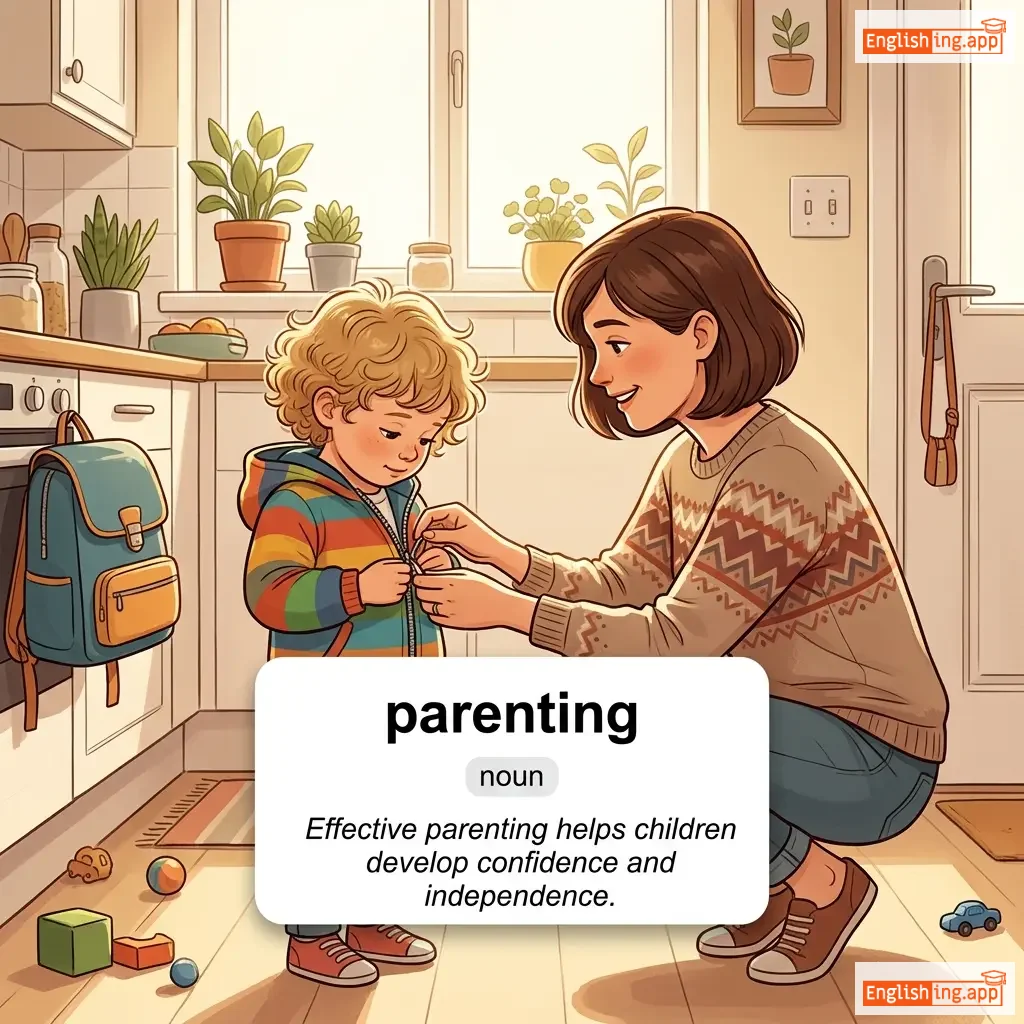
parenting definition card — visual illustration of the meaning
noun
/ˈpeə.rən.tɪŋ/
पालन-पोषण (paalan-poshan)

The care and training a child receives while growing up, involving the development of their mental, physical, and social aspects.

"Effective parenting helps children develop confidence and independence."

"प्रभावी पेरेंटिंग बच्चों को आत्मविश्वास और स्वतंत्रता विकसित करने में मदद करती है।" (Prabhavi parenting bachon ko atmvishwas aur svatantrata viksit karne mein madad karti hai.)
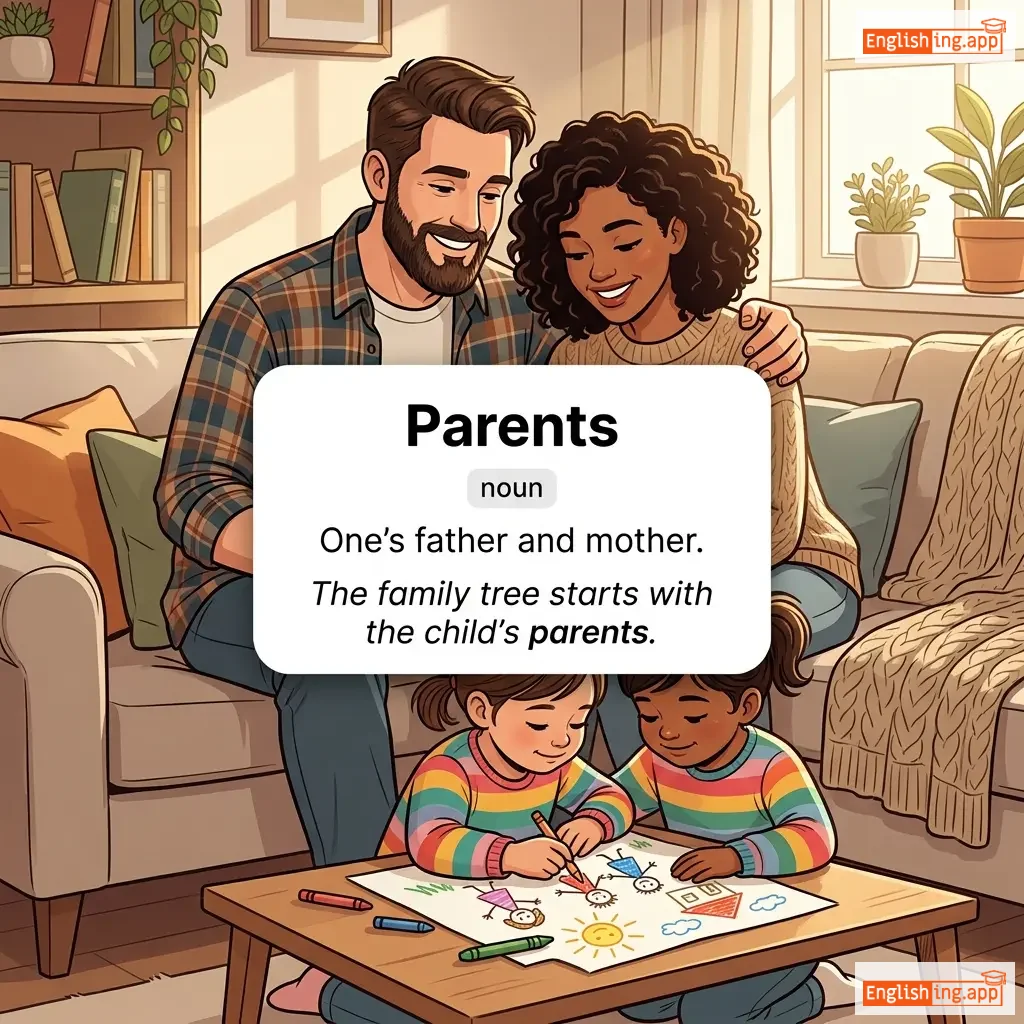
Parents definition card — visual illustration of the meaning
noun
ˈpɛrənts
माता-पिता (maataa-pitaa)

One's father and mother.

"The family tree starts with the child's parents."

"परिवार वृक्ष बच्चे के माता-पिता से शुरू होता है।" (Parivaar vriksh bachche ke maataa-pitaa se shuru hota hai.)
noun
/pəˈraɪə/
पराया (paraya)

An outcast; someone who is rejected by society or a social group.

"After the scandal, he became a social pariah."

"स्कैंडल के बाद, वह एक सामाजिक पराया बन गया।" (skandal ke baad, vah ek samajik paraya ban gaya.)
noun
/ˈpærɪʃ/
पारिश (parish)

A local church community or the area served by a parish church.

"The parish gathered for Sunday service."

"पारिश रविवार की सेवा के लिए एकत्रित हुई थी।" (parish ravivaar ki seva ke liye ekatrit hui thi.)
adjective
/pəˈrɪʒən/
पेरिस से संबंधित (peris se sambandhit)

relating to Paris or its people

"She wore a Parisian style dress at the party."

"उसने पार्टी में पेरिसियन स्टाइल की ड्रेस पहनी थी।" (Usne party mein parisian style ki dress pehni thi.)
noun
/ˈpærɪti/
समानता (samaanta)

the state or condition of being equal, especially in status or pay

"The campaign aims to achieve pay parity between men and women."

"अभियान का उद्देश्य पुरुषों और महिलाओं के बीच वेतन समानता प्राप्त करना है।" (Abhiyaan ka uddeshya purushon aur mahilaon ke beech vetan samaanta prapt karna hai.)
noun
/pɑːrk/
पार्क (park)

a large public area of land with grass, trees, and paths, where people can walk or relax

"The children were playing in the park."

"बच्चे पार्क में खेल रहे थे।" (Bachche park mein khel rahe the.)
noun
/ˈpɑːrkɪŋ/
पार्किंग (parking)

the action or practice of leaving a vehicle in a particular place for a period of time

"There was no available parking near the restaurant."

"रेस्तरां के पास कोई पार्किंग उपलब्ध नहीं थी।" (Restoran ke paas koi parking uplabdh nahi thi.)
noun
/ˈpɑːrləns/
भाषा प्रयोग (bhasha prayog)

a particular way of speaking or using words, common to a group

"In legal parlance, the term has a different meaning."

"कानूनी भाषा में, इस शब्द का अर्थ अलग है।" (Kanooni bhasha mein, is shabd ka arth alag hai.)
noun, verb
/ˈpɑːrli/
बातचीत (baatcheet)

a discussion between opposing sides, especially to negotiate terms

"The generals met to parley over the terms of surrender."

"जनरलों ने आत्मसमर्पण की शर्तों पर बातचीत करने के लिए मुलाकात की।" (Janralon ne aatmasamarpan ki sharton par baatcheet karne ke liye mulaqat ki.)
noun
/ˈpɑːrləmənt/
संसद (sansad)

the highest legislative body in a country

"The bill was passed in parliament after a long debate."

"बिल संसद में लंबी बहस के बाद पास हुआ।" (Bil sansad mein lambi bahas ke baad paas hua.)
adjective
/ˌpɑːrləˈmɛntri/
संसदीय (sansadiya)

relating to a parliament or its members; relating to a system of government with parliamentary authority

"The country follows a parliamentary form of government."

"देश संसदीय शासन प्रणाली का पालन करता है।" (desh sansadiya shasan pranali ka palan karta hai)
noun
/ˈpɑːrlər/
बैठने का कमरा, दुकान (parlor)

A sitting room in a private house, or a shop providing specified services.

"They welcomed the guests into the front parlor."

"उन्होंने मेहमानों का स्वागत फ्रंट पार्लर में किया।" (Unhone mehmanon ka swagat front parlor mein kiya.)
adjective
/ˈpɑːrləs/
संकटपूर्ण (parlas)

Full of danger or risk; precarious.

"The company is in a parlous financial state."

"कंपनी एक संकटग्रस्त वित्तीय स्थिति में है।" (Company ek sankatgrast vittiya sthiti mein hai.)
adjective
/pəˈroʊkiəl/
संकीर्ण (parokial)

Having a limited or narrow outlook; relating to a parish.

"His parochial view prevented him from understanding global issues."

"उसका संकीर्ण दृष्टिकोण उसे वैश्विक मुद्दों को समझने से रोकता था।" (Uska sankeern drishtikon use vaishwik muddon ko samjhne se rokta tha.)
noun
/ˈpærədi/
व्यंग्यात्मक अनुकरण (parodi)

A humorous or satirical imitation of a serious piece of literature, music, or style.

"The comedian performed a parody of the president’s speech."

"कॉमेडियन ने राष्ट्रपति के भाषण की एक पैरोडी प्रस्तुत की।" (comedian ne rashtrapati ke bhashan ki ek parody prastut ki.)
adjective
/pəˈrɒnɪməs/
समांशब्द (paronimas)

Words that are derived from the same root or sound alike.

"The words 'effect' and 'effective' are paronymous."

"‘Effect’ और ‘Effective’ शब्द पारोणिमस हैं।" ('Effect' aur 'Effective' shabd paronimas hain.)
noun
/ˈpær.əkˌsɪz.əm/
अचानक तीव्र उत्तेजना (achanak teevra uttejana)

A sudden, violent outburst of emotion or activity.

"She was seized by a paroxysm of laughter."

"वह अचानक हंसी का एक तिव्र उभार से ग्रसित हो गई।" (Vah achanak hasi ka ek teevra ubhaar se grasit ho gayi.)
noun
/ˈpɑːr.keɪ/
लकड़ी की बनी मंजिल (lakdi ki banni manjil)

A floor made of wooden blocks arranged in a geometric pattern.

"The old mansion had a beautiful parquet floor."

"पुरानी हवेली में एक खूबसूरत लकड़ी की मंजिल थी।" (Puraani haveli mein ek khoobsurat lakdi ki manjil thi.)
noun
/ˈpɑːr.kə.tri/
पार्केट फ्लोर बनाने की कला (parket floor banane ki kala)

The art or technique of laying parquet floors.

"The craftsman specialized in parquetry for luxury homes."

"कारीगर लक्ज़री घरों के लिए पार्केट्री में विशेषज्ञ थे।" (Karigar luxury gharon ke liye parquetry mein visheshagya the.)
noun
/ˈpær.ɪ.saɪd/
पितृहत्यार (pitrihatya)

The act of killing one's father, mother, or other close relative.

"The court tried him for parricide after the tragic incident."

"न्यायालय ने दुखद घटना के बाद उसे पितृहत्यार के आरोप में मुकदमा चलाया।" (Nyayalay ne dukhad ghatna ke baad use pitrihatya ke aarop mein mukadma chalaya.)
noun/verb
/ˈpær.ət/
तोता (tota)

A brightly colored bird that can imitate human speech; to repeat words mechanically without understanding.

"The child parroted the teacher's words without thinking."

"बच्चे ने शिक्षक के शब्दों को बिना सोचे समझे तोता की तरह दोहराया।" (Bacche ne shikshak ke shabdon ko bina soche samjhe tota ki tarah dohraya.)
noun
/ˈpær.ət biːk/
पैरेट बीक (pairat beek)

a climbing plant with curved red and orange flowers resembling a parrot's beak

"The parrot beak flower's unique curved shape makes it a fascinating addition to any garden."

"द पैरेट बीक फ्लावर का अद्वितीय घुमावदार आकार इसे किसी भी बागीचे में एक आकर्षक अतिरिक्त बनाता है।" (da pairat beek phlower ka advitiy ghumaavdaar aakaar ise kisi bhi baageeche mein ek aakarshak atirikt banata hai.)
verb
/ˈpæri/
हमला टालना (hamla talna)

to ward off or deflect an attack, especially in fencing or conversation

"He managed to parry the opponent’s sword with quick reflexes."

"वह तेज़ प्रतिक्रिया से विरोधी की तलवार को टालने में सफल रहा।" (Woh tez pratikriya se virodhi ki talwar ko talne mein safal raha.)
verb
/pɑːrs/
व्याकरण विश्लेषण करना (vyakaran vishleshan karna)

to analyze a sentence or text grammatically or logically

"The software can parse large amounts of text data efficiently."

"सॉफ़्टवेयर बड़े पैमाने पर टेक्स्ट डेटा को कुशलता से पार्स कर सकता है।" (Software bade paimane par text data ko kushalta se parse kar sakta hai.)
adjective
/ˌpɑːrsɪˈmoʊniəs/
कंजूस (kanjoos)

unwilling to spend money or use resources; stingy

"The company was too parsimonious to invest in better equipment."

"कंपनी बेहतर उपकरण में निवेश करने के लिए बहुत कंजूस थी।" (Kampani behtar upkaran mein nivesh karne ke liye bahut kanjoos thi.)
noun
/ˈpɑːrsɪmoʊni/
कंजूसी (kanjoosi)

extreme unwillingness to spend money or use resources

"His parsimony was evident in the way he avoided any unnecessary expenses."

"उसकी कंजूसी इस बात से स्पष्ट थी कि वह किसी भी अनावश्यक खर्च से बचता था।" (Uski kanjoosi is baat se spasht thi ki vah kisi bhi anavashyak kharch se bachta tha.)
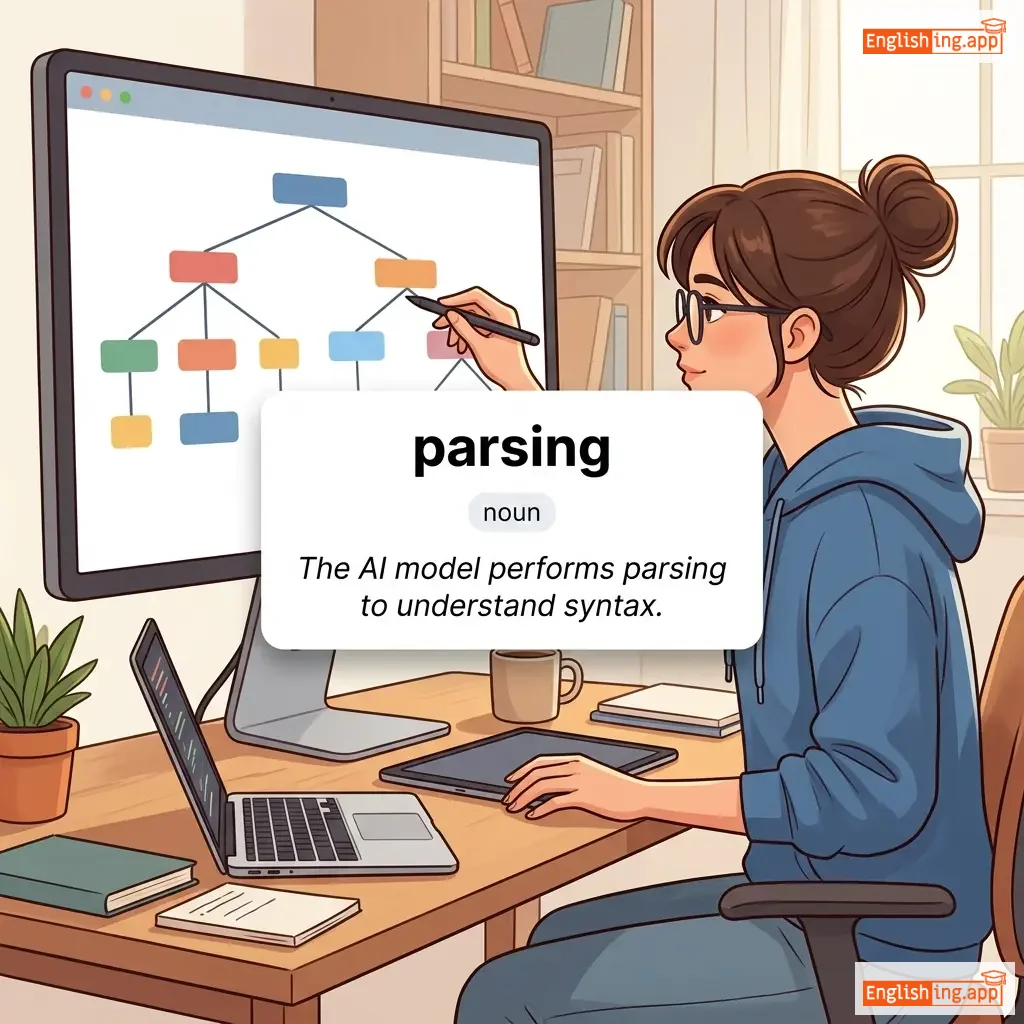
parsing definition card — visual illustration of the meaning
noun
ˈpɑː.sɪŋ
वाक्य संरचना का विश्लेषण (parsing)

The process of analyzing sentence structure to understand grammatical relationships.

"The AI model performs parsing to understand syntax."

"एआई मॉडल सिंटैक्स समझने के लिए पार्सिंग करता है।" (AI model syntax samajhne ke liye parsing karta hai.)