वोकैबुलरीज

इंग्लिश वोकैबुलरी डिस्कवर, लर्न और मास्टर करें

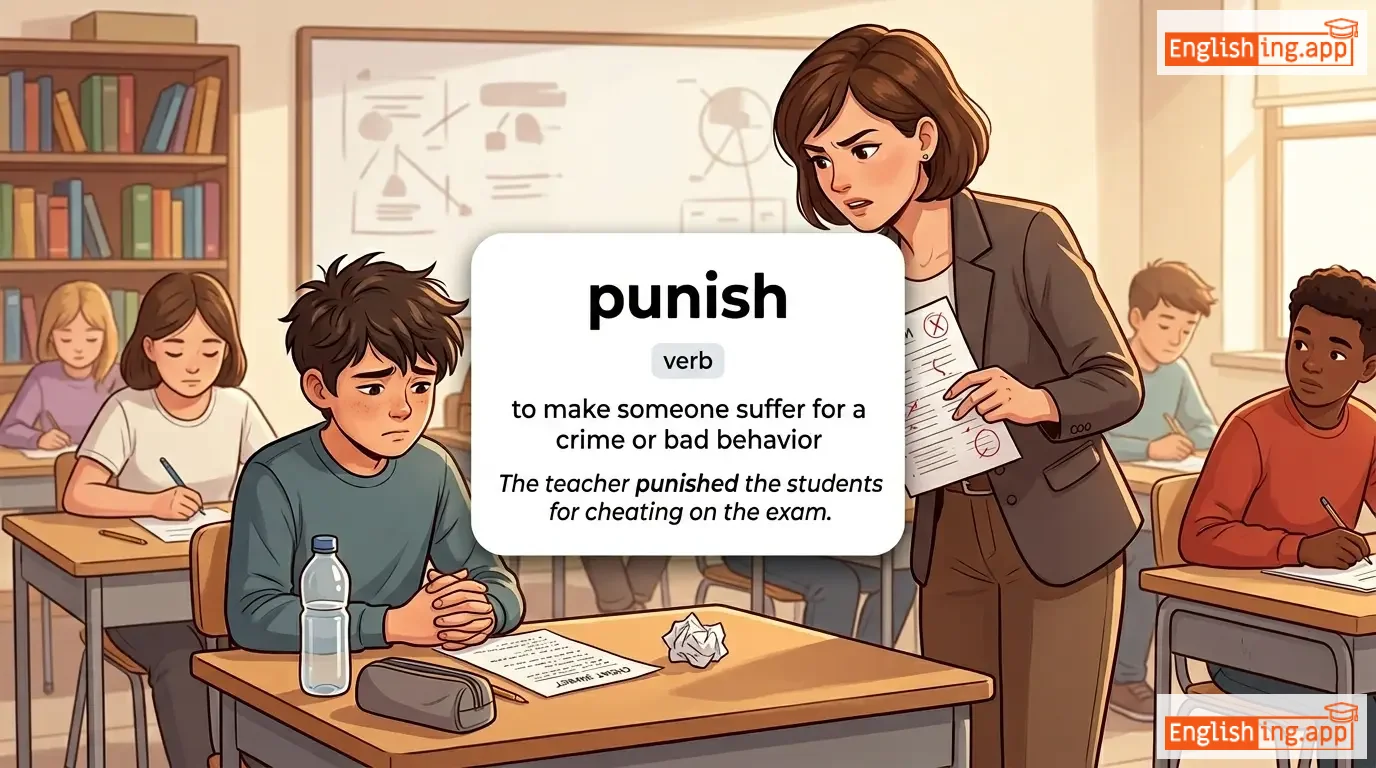
punish definition card — visual illustration of the meaning
verb
/ˈpʌnɪʃ/
सजा देना (saza dena)

to make someone suffer for a crime or bad behavior

"The teacher punished the students for cheating on the exam."

"अध्यापक ने परीक्षा में धोखाधड़ी के लिए छात्रों को सजा दी।" (Adhyapak ne pareeksha mein dhokhaadhadi ke liye chatron ko saza di.)
noun
/ˈpʌnɪʃmənt/
सजा (saza)

the infliction of a penalty as retribution for an offense or wrongdoing

"The criminal received a harsh punishment for his crime."

"अपराधी ने अपने अपराध के लिए कठोर सजा प्राप्त की।" (Aparadhi ne apne aparadh ke liye kathor saza praapt ki.)
adjective
/ˈpjuː.nɪ.tɪv/
दंडात्मक (dantatmak)

Inflicting or intended as punishment.

"The company faced punitive measures for violating the law."

"कंपनी को कानून का उल्लंघन करने के लिए दंडात्मक कदमों का सामना करना पड़ा।" (Kampani ko kanoon ka ullanghan karne ke liye dantatmak kadmon ka samna karna pada.)
noun
/pʌnˈdʒɑː.bi/
पंजाबी (punjabi)

a traditional long shirt worn in South Asia, typically loose-fitting

"He wore a white punjabi for the festival celebration."

"उसने त्योहार के अवसर पर सफेद पंजाबी पहना।" (usne tyohaar ke avsar par safed punjabi pehna.)
noun
/pʌŋk/
पंक (punk)

a type of popular music, or the culture associated with it, characterized by loud, fast rhythms and rebellious attitudes

"He’s always been into punk music and fashion."

"वह हमेशा पंक संगीत और फैशन में रुचि रखते थे।" (Woh hamesha punk sangeet aur fashion mein ruchi rakhte the.)
adjective
/ˈpjuː.ni/
निगूड़ा (niguda)

Small, weak, or insignificant.

"He felt puny compared to his stronger classmates."

"वह अपने मजबूत सहपाठियों की तुलना में खुद को कमजोर महसूस कर रहा था।" (Vah apne majboot sahapathiyon ki tulna mein khud ko kamzor mehsoos kar raha tha.)
noun
/ˈpjuːpəl/
विद्यार्थी; आँख की पुतली (vidyarthi; aankh ki putli)

a student, especially a young one; the central opening of the eye that lets in light

"The pupil listened carefully to the teacher during class."

"विद्यार्थी ने कक्षा में शिक्षक की बात ध्यान से सुनी।" (vidyarthi ne kaksha mein shikshak ki baat dhyan se suni)
noun
/ˈpjuː.pɪ.lɪdʒ/
शिक्षानवीस स्थिति (shikshanavis sthiti)

The state of being a pupil or under instruction.

"During his pupilage, he studied law under a senior barrister."

"उनकी शिक्षानवीस स्थिति में, उन्होंने एक वरिष्ठ बैरिस्टर के अधीन कानून का अध्ययन किया।" (Unki shikshanavis sthiti mein, unhone ek varishth barrister ke adheen kanoon ka adhyayan kiya.)
noun
/ˈpʌp.i/
पिल्ला (pilla)

a young dog

"The puppy wagged its tail when it saw its owner."

"पिल्ले ने अपनी पूंछ हिलाई जब उसने अपने मालिक को देखा।" (pille ne apni poochh hilaayi jab usne apne maalik ko dekha.)
adjective
/ˈpɜːˌblaɪnd/
अंधा या अज्ञ (andha ya ajna)

Having impaired or defective vision; lacking insight or understanding.

"The purblind approach to the problem led to many mistakes."

"समस्या के प्रति अज्ञ दृष्टिकोण से कई गलतियाँ हुईं।" (Samasya ke prati ajna drishtikon se kai galtiyan huin.)
purchase definition card — visual illustration of the meaning
verb
/ˈpɜː.tʃəs/
खरीदना (khareedna)

To buy something by paying money for it.

"She purchased a new laptop from the store."

"उसने स्टोर से एक नया लैपटॉप खरीदा।" (Usne store se ek naya laptop khareeda.)
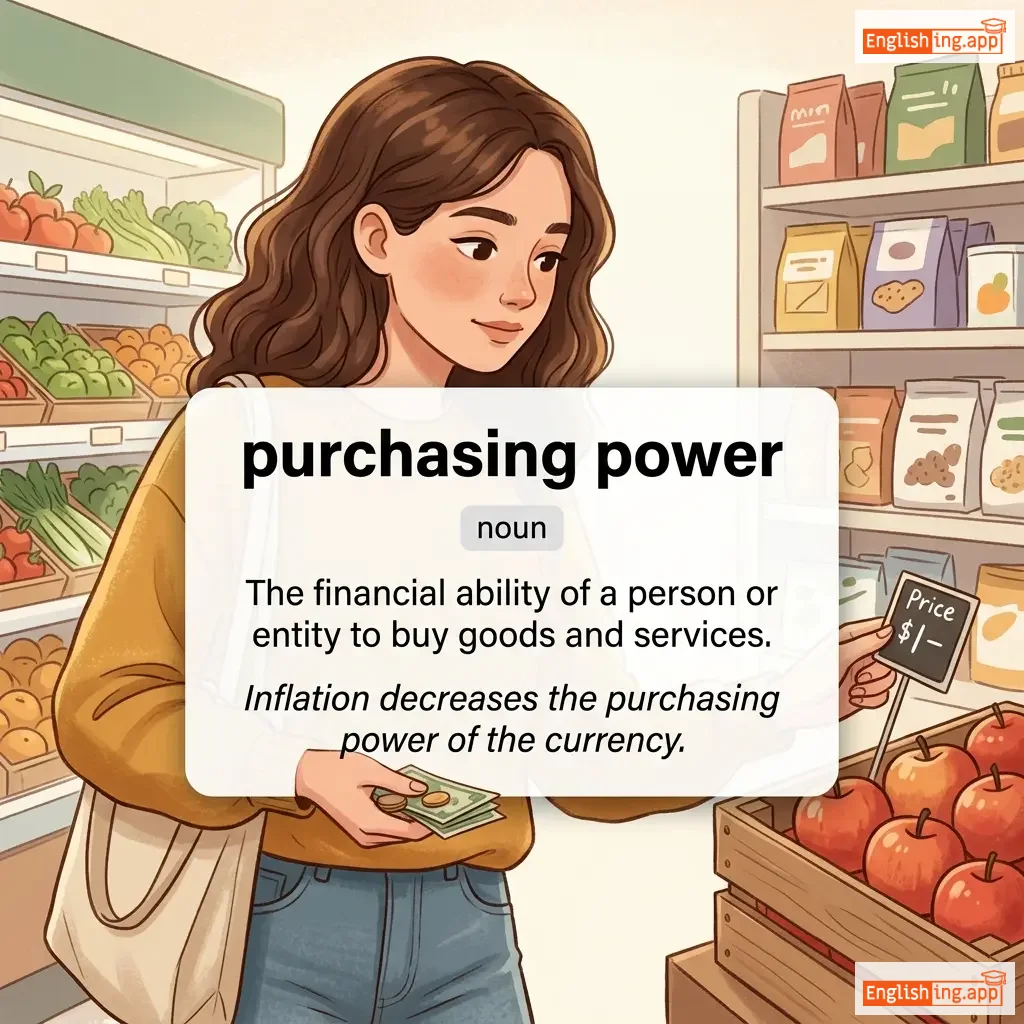
purchasing power definition card — visual illustration of the meaning
noun
ˈpɜːtʃəsɪŋ ˈpaʊər
खरीद क्षमता (khareed kshamata)

The financial ability of a person or entity to buy goods and services.

"Inflation decreases the purchasing power of the currency."

"मुद्रास्फीति मुद्रा की खरीद क्षमता को कम कर देती है।" (Mudrasphiti mudra ki khareed kshamata ko kam kar deti hai.)
adjective
/pjʊə(r)/
शुद्ध (shuddh)

free from anything that contaminates or taints; clean

"She has a pure heart and always helps others."

"उसका एक शुद्ध हृदय है और वह हमेशा दूसरों की मदद करती है।" (Uska ek shuddh hriday hai aur wah hamesha doosron ki madad karti hai.)
adverb
/ˈpjʊərli/
केवल (keval)

only and completely; entirely

"The decision was purely based on economic factors."

"निर्णय पूरी तरह से आर्थिक कारकों पर आधारित था।" (Nirnay puri tarah se aarthik kaarkon par aadharit tha.)
noun
/ˈpɜːrɡəˌtɔːri/
पापियों द्वारा अपने पापों का प्रायश्चित करने से पहले आत्माओं द्वारा पीड़ा का स्थान (paapiyon dwara apne paapon ka prayashchit karne se pehle aatmon dwara peeda ka sthan)

A place or state of suffering inhabited by the souls of sinners who are expiating their sins before going to heaven; a temporary condition of torment or suffering.

"After the accident, the long recovery felt like a kind of purgatory."

"दुर्घटना के बाद, लंबी रिकवरी एक प्रकार का पुर्गेटरी जैसा महसूस हुआ।" (Durghatna ke baad, lambi recovery ek prakaar ka purgatory jaisa mehsoos hua.)
verb
/pɜːrdʒ/
हटाना (hatana)

To remove unwanted feelings, people, or things; to cleanse or purify.

"The new leader promised to purge corruption from the government."

"नए नेता ने सरकार से भ्रष्टाचार को समाप्त करने का वादा किया।" (Naye neta ne sarkar se bhrashtachar ko samaapt karne ka vada kiya.)
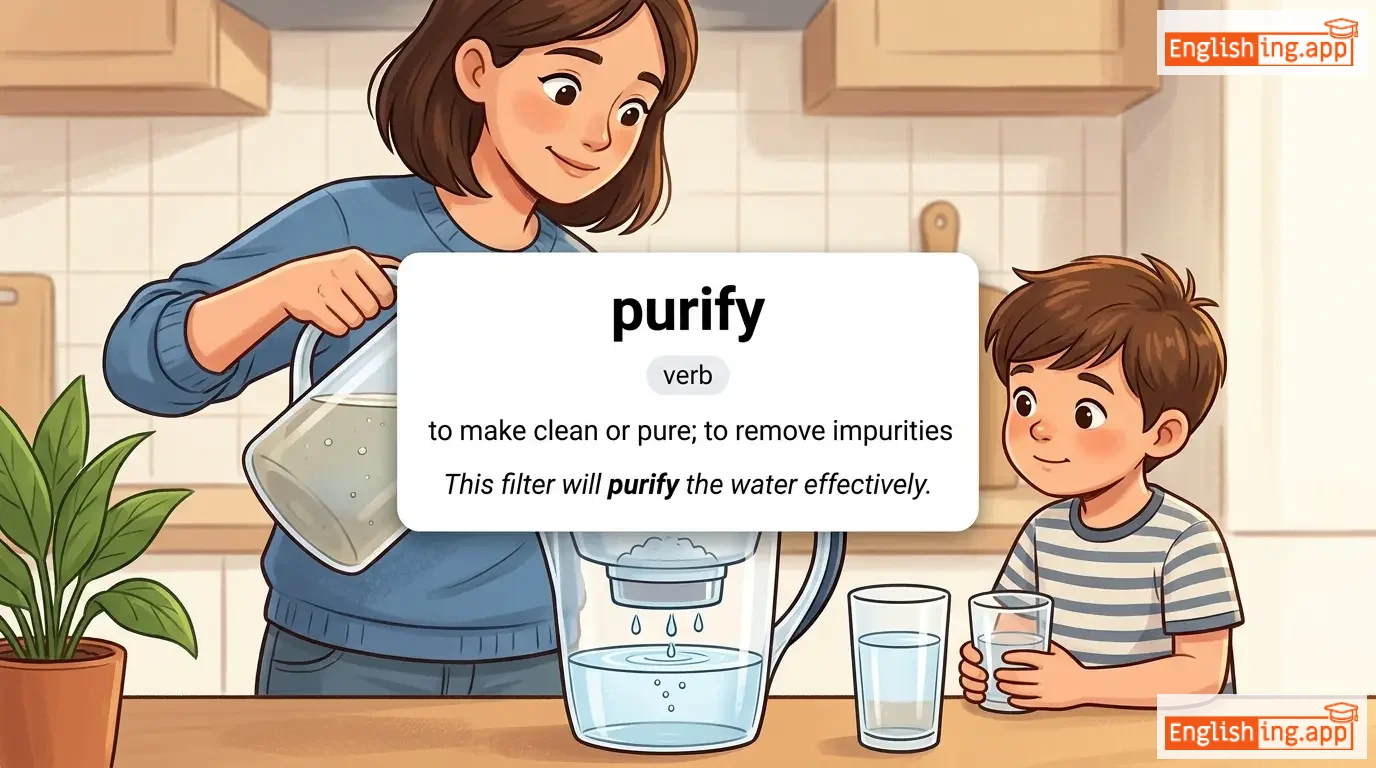
purify definition card — visual illustration of the meaning
verb
/ˈpjʊərɪfaɪ/
शुद्ध करना (shuddh karna)

to make clean or pure; to remove impurities

"This filter will purify the water effectively."

"यह फ़िल्टर पानी को प्रभावी ढंग से शुद्ध करेगा।" (Yeh filter paani ko prabhavi dhang se shuddh karega)
noun
/ˈpjʊrəti/
पवित्रता (pavitrata)

The quality or state of being pure; freedom from contamination or sin.

"The mountain air was admired for its purity."

"पहाड़ की हवा को उसकी पवित्रता के लिए सराहा गया था।" (Pahaad ki hawa ko uski pavitrata ke liye saraha gaya tha.)
verb
/pɜːrl/
मृदु ध्वनि में बहना (mridu dhvani mein behna)

To knit with a purl stitch; to flow with a murmuring sound (as a stream).

"The brook purled softly through the meadow."

"नदी ने घास के मैदान से धीरे-धीरे मृदु ध्वनि में बहते हुए प्रवाह किया।" (Nadi ne ghas ke maidan se dheere-dheere mridu dhvani mein behte hue pravah kiya.)
noun
/ˈpɜːrljuː/
पार्श्व क्षेत्र (parshv kshetra)

The area near or surrounding a place; an outlying or neighboring district.

"They spent the afternoon exploring the purlieus of the ancient city."

"वे प्राचीन शहर के पर्लियू का अन्वेषण करते हुए दोपहर बिताए।" (Ve prachin shahar ke parliyu ka anvexhan karte hue dopahar bitaye.)
verb
/pərˈlɔɪn/
चोरी करना (chori karna)

to steal something, often in a sneaky or dishonest way

"He tried to purloin a book from the library without being noticed."

"उसने लाइब्रेरी से एक किताब चोरी करने की कोशिश की थी।" (Usne library se ek kitaab chori karne ki koshish ki thi.)
adjective
/ˈpɜː.pəl/
बैंगनी (baingani)

a color that is a mix of red and blue

"She wore a beautiful purple dress to the party."

"वह पार्टी में एक सुंदर बैंगनी ड्रेस पहने हुए थी।" (vah party mein ek sundar baingani dress pehane hue thi.)
verb
/ˈpɜːrpɔːrt/
दावा करना (daava karna)

to claim or profess something, often falsely

"The document purports to be an official government report."

"दस्तावेज़ का दावा है कि यह एक सरकारी रिपोर्ट है।" (Dastavez ka daava hai ki yah ek sarkari report hai.)
adjective
/pərˈpɔːrtɪd/
आरोपित (aaropit)

alleged or claimed to be true, often without proof

"The purported evidence was later proven false."

"आरोपित सबूत बाद में गलत साबित हुआ।" (Aaropit saboot baad mein galat saabit hua.)
noun
/ˈpɜːpəs/
उद्देश्य (uddeshya)

the reason for which something is done or created

"The purpose of this meeting is to discuss the new project."

"इस बैठक का उद्देश्य नए परियोजना पर चर्चा करना है।" (Is baithak ka uddeshya naye pariyojna par charcha karna hai.)
noun
/pɜːrs/
पर्स (pers)

a small bag used by women to carry money and personal items

"She kept her wallet in her purse."

"वह अपने बटुए को पर्स में रखती थी।" (Vah apne batue ko pers mein rakhti thi.)
adjective
/pərˈsuːənt/
कानूनी रूप से (kanuni roop se)

in accordance with or following something, especially a law or rule

"The decision was made pursuant to the regulations."

"निर्णय नियमों के अनुसार लिया गया था।" (Nirnaya niyamon ke anusar liya gaya tha.)
verb
/pərˈsuː/
अनुसरण करना (anusaran karna)

to follow or chase with the intent to catch or achieve something

"She decided to pursue her dreams of becoming a doctor."

"उसने डॉक्टर बनने के अपने सपनों का पीछा करने का फैसला किया।" (Usne doctor banne ke apne sapno ka peecha karne ka faisla kiya.)
noun
/pəˈsjuːt/
अनुसरण, प्रयास (anusaran, prayaas)

the act of chasing or trying to achieve something

"He dedicated his life to the pursuit of happiness."

"उसने अपने जीवन को खुशी की प्राप्ति के प्रयास में समर्पित किया।" (Usne apne jeevan ko khushi ki prapti ke prayaas mein samarpit kiya.)
verb
/pərˈveɪ/
आपूर्ति करना (aapoorti karna)

to supply or provide goods, services, or information, often as a business

"The company purveys organic food to health-conscious customers."

"कंपनी स्वास्थ्य जागरूक ग्राहकों को जैविक खाद्य प्रदान करती है।" (Company swasthya jaagruk graahako ko jaivik khadya pradan karti hai.)
noun
/pərˈveɪər/
आपूर्तिकर्ता (aapoortikartaa)

a person or business that supplies goods, services, or information

"He is a well-known purveyor of fine wines."

"वह उत्तम वाइनों के प्रसिद्ध आपूर्तिकर्ता हैं।" (hee iz a vel-non parveyar of fain vains)
noun
/ˈpɜːrvjuː/
दायरा (daayra)

the scope or range of authority, responsibility, or knowledge

"The case does not fall within the purview of this court."

"यह मामला इस अदालत के दायरे में नहीं आता।" (Yeh mamla is adalat ke daayre mein nahin aata.)
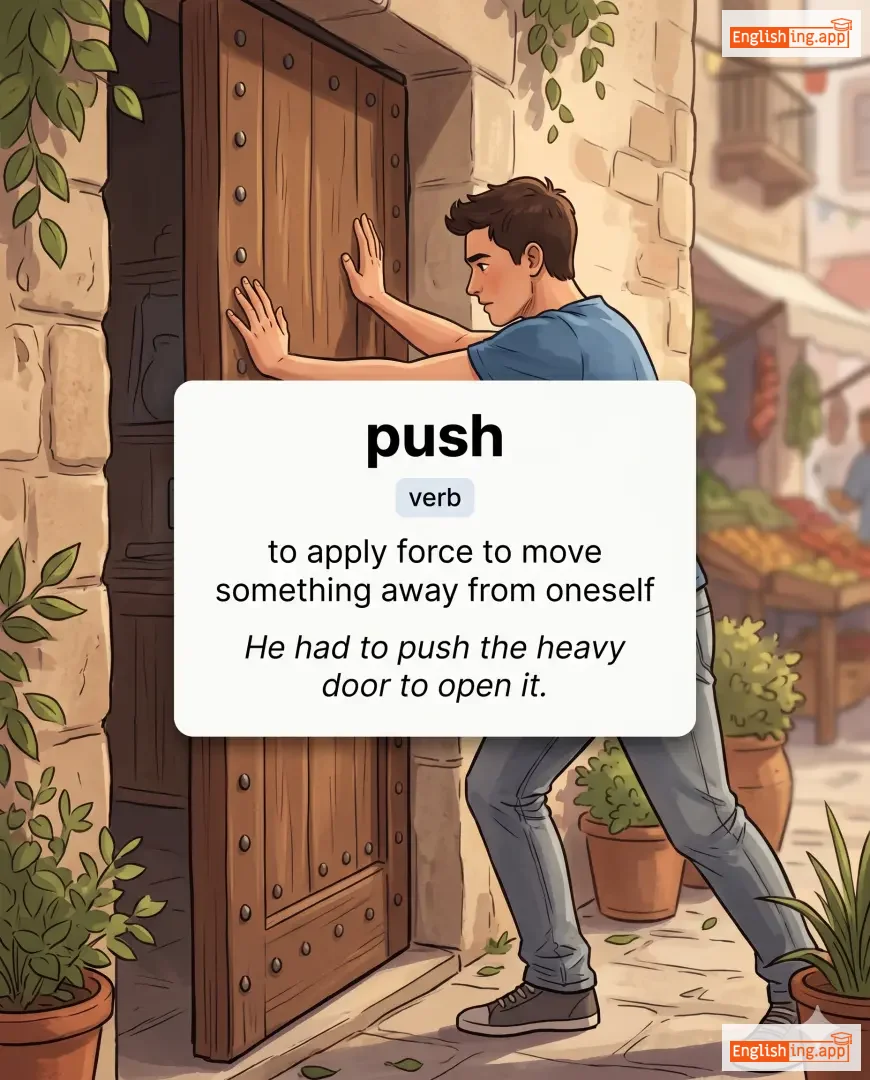
push definition card — visual illustration of the meaning
verb
/pʊʃ/
धकेलना (dhakelna)

to apply force to move something away from oneself

"He had to push the heavy door to open it."

"उसे भारी दरवाजे को खोलने के लिए धकेलना पड़ा।" (Use bhari darwaje ko kholne ke liye dhakelna pada.)
adjective
/ˈpʊʃi/
आक्रामक (aakramak)

excessively assertive or aggressive, often annoyingly so

"The salesperson was too pushy, which drove customers away."

"विक्रेता बहुत आक्रामक था, जिससे ग्राहक दूर भाग गए।" (Vikreta bahut aakramak tha, jisse grahak door bhag gaye.)
adjective
/ˌpjuːsɪˈlænɪməs/
नपुंसक (napunsak)

showing a lack of courage or determination; timid

"The pusillanimous leader avoided making tough decisions."

"नपुंसक नेता कठिन निर्णय लेने से बचते थे।" (Napunsak neta kathin nirnay lene se bachte the.)
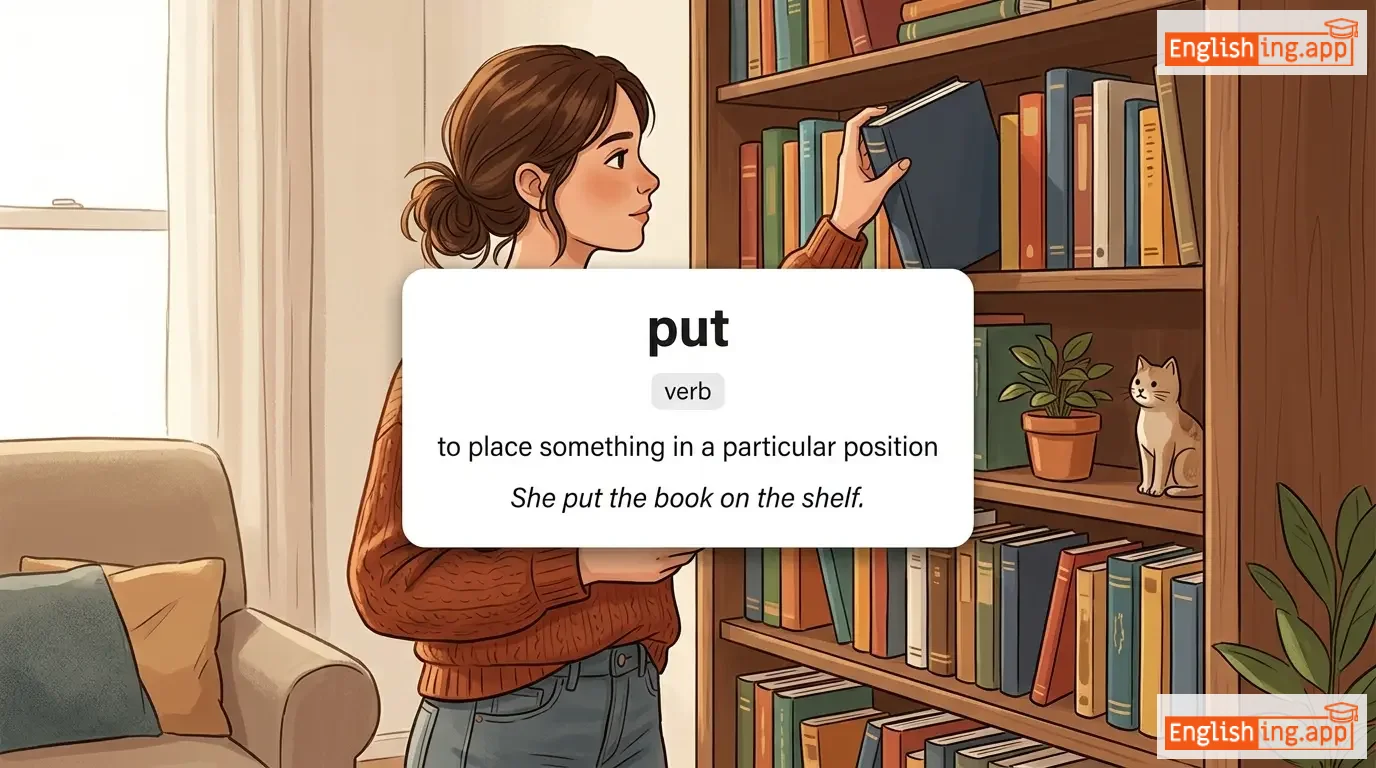
put definition card — visual illustration of the meaning
verb
/pʊt/
रखना (rakhna)

to place something in a particular position

"She put the book on the shelf."

"उसने किताब को शेल्फ पर रखा।" (Usne kitaab ko shelf par rakha.)
adjective
/ˈpjuːtətɪv/
अनुमानित (anumanit)

commonly accepted or supposed; generally regarded as such

"He is the putative father of the child."

"वह बच्चे का अनुमानित पिता है।" (Vah bachche ka anumanit pita hai.)
verb
/ˈpjuːtrɪfaɪ/
सड़ना (sadna)

to decay or rot, producing a foul smell

"The meat began to putrefy in the heat."

"मांस गर्मी में सड़ने लगा।" (Mans garmi mein sadne laga.)
adjective
/pjuːˈtrɛsənt/
पक्ष्मशील (pakshmeesheel)

undergoing the process of decay; rotting

"The putrescent odor made everyone leave the room."

"पक्ष्मशील गंध ने सभी को कमरे से बाहर कर दिया।" (Pakshmeesheel gandh ne sabhi ko kamre se bahar kar diya.)
adjective
/ˈpjuːtrɪd/
सड़ा हुआ (sadā hu'ā)

decayed and emitting a foul smell

"The garbage smelled putrid after days in the sun."

"सूरज की तपन में कुछ दिनों बाद कूड़ा सड़ा हुआ महकने लगा।" (Suraj ki tapan mein kuch dinon baad kooda sadā hu'ā mahakne lagā.)
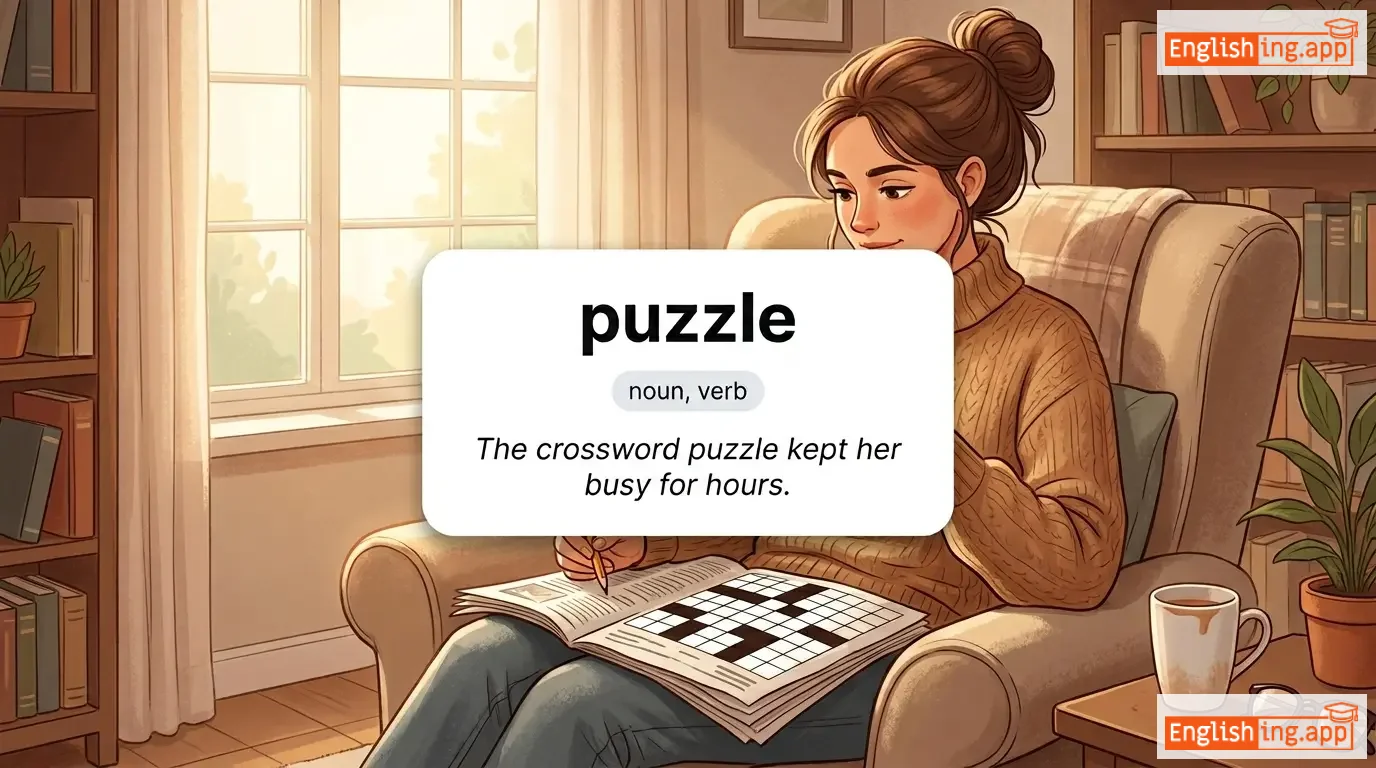
puzzle definition card — visual illustration of the meaning
noun, verb
/ˈpʌzl/
पहेली / भ्रमित करना (paheli / bhramit karna)

a game, toy, or problem designed to test ingenuity; to cause someone to be confused

"The crossword puzzle kept her busy for hours."

"क्रॉसवर्ड पहेली ने उसे घंटों तक व्यस्त रखा।" (Crossword paheli ne use ghanton tak vyast rakha.)
adjective
/ˈpʌz.lɪŋ/
पेचीदा (pazling)

confusing; perplexing;

"The scientist found the results puzzling."

"वैज्ञानिक ने परिणामों को पेचीदा पाया।" (vaigyanik ne parinaamon ko peechida paaya.)
noun
/paɪər/
चिता (chita)

A heap of combustible material, especially one used for burning a corpse as part of a funeral ceremony.

"The villagers built a pyre to honor the deceased."

"गाँववालों ने मृतक को सम्मान देने के लिए एक चिता बनाई।" (Gaanwalon ne mrtak ko samman dene ke liye ek chita banayi.)
noun
/ˌpaɪrəˈmeɪniə/
आग लगाने की अनियंत्रित इच्छा (aag lagane ki aniyantrit ichcha)

An uncontrollable desire to set things on fire.

"The suspect was diagnosed with pyromania after repeated incidents of arson."

"संदिग्ध को बार-बार आगजनी की घटनाओं के बाद पाइरोमेनिया का निदान किया गया था।" (Sandigdh ko bar-bar aagjani ki ghatnaon ke baad pyromania ka nidhan kiya gaya tha.)
noun
/ˌpaɪroʊˈmeɪniæk/
आगजनी का आदी व्यक्ति (aagjani ka aadi vyakti)

A person with an uncontrollable desire to set things on fire.

"The pyromaniac was arrested for setting several buildings ablaze."

"आगजनी के आदी व्यक्ति को कई इमारतों में आग लगाने के लिए गिरफ्तार किया गया।" (Aagjani ke aadi vyakti ko kai imaaraton mein aag lagane ke liye giraftaar kiya gaya.)
adjective
/ˌpaɪroʊˈtɛknɪk/
आतिशबाज़ी से संबंधित (atishbazi se sambandhit)

Relating to fireworks or spectacular displays involving fire.

"The city celebrated with a grand pyrotechnic display on New Year's Eve."

"शहर ने नए साल की पूर्व संध्या पर एक शानदार आतिशबाज़ी प्रदर्शनी का आयोजन किया।" (Shahar ne naye saal ki poorv sandhya par ek shandaar atishbazi pradarshani ka aayojan kiya.)
adjective
/ˈpɪrɪk/
पीर्रिक विजय (pirrik vijay)

A victory won at such a great cost that it is almost equivalent to defeat.

"The general declared the battle a pyrrhic victory due to heavy losses."

"जनरल ने भारी नुकसान के कारण युद्ध को एक पीर्रिक विजय घोषित किया।" (Janral ne bhaari nuksan ke karan yudh ko ek pirrik vijay ghoshit kiya.)
noun
/ˈpaɪ.θən/
अजगर (ajgar)

a large non-venomous snake that kills prey by constriction

"The python wrapped around its prey tightly."

"पाइथन ने अपने शिकार को कसकर लपेट लिया।" (python ne apne shikar ko kaskar lapet liya.)
noun
/pɪks/
पवित्र रोटी रखने का छोटा बर्तन (pavitra roti rakhne ka chhota bartan)

a small container, often used in Christian liturgy to carry the consecrated host

"The priest placed the consecrated host into the pyx before visiting the sick."

"पुजारी ने बीमारों के पास जाने से पहले पवित्र रोटी पिक्स में रखी।" (Pujari ne beemaron ke paas jaane se pehle pavitra roti pyx mein rakhi.)