वोकैबुलरीज

इंग्लिश वोकैबुलरी डिस्कवर, लर्न और मास्टर करें

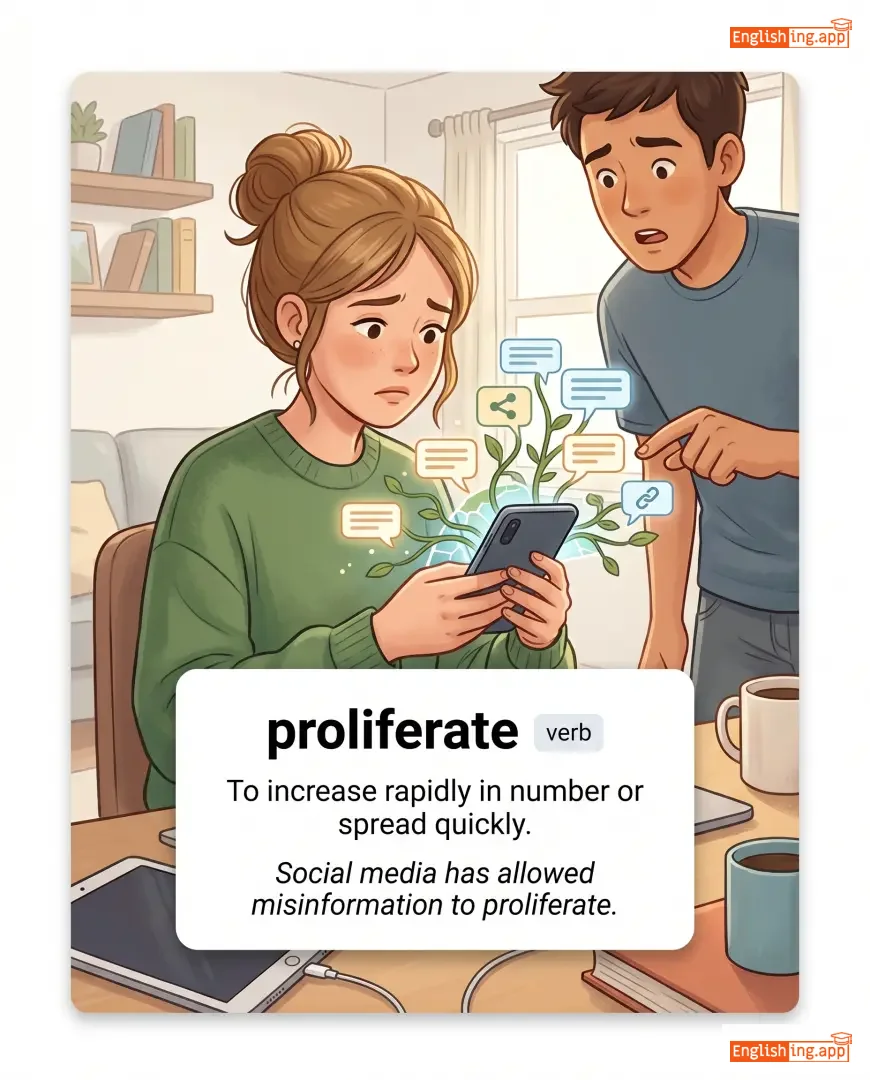
proliferate definition card — visual illustration of the meaning
verb
/prəˈlɪfəreɪt/
बढ़ना (badhna)

To increase rapidly in number or spread quickly.

"Social media has allowed misinformation to proliferate."

"सोशल मीडिया ने गलत सूचना को तेजी से फैलने दिया।" (Social media ne galat soochna ko tezi se phailne diya.)
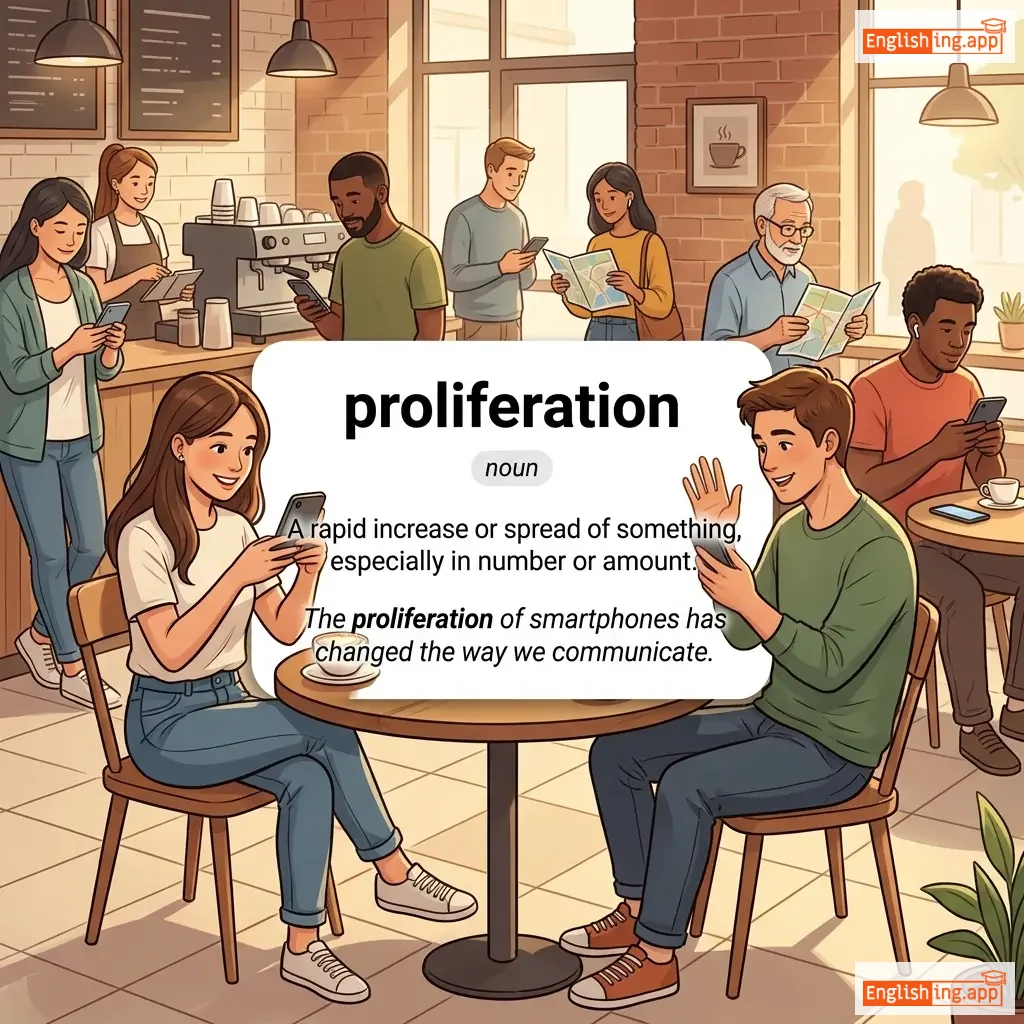
proliferation definition card — visual illustration of the meaning
noun
/prəˌlɪfəˈreɪʃən/
वृद्धि, प्रसार (vruddhi, prasar)

A rapid increase or spread of something, especially in number or amount.

"The proliferation of smartphones has changed the way we communicate."

"स्मार्टफ़ोन का प्रसार हमारे संवाद करने के तरीके को बदल चुका है।" (Smartphone ka prasar hamare samvad karne ke tareeke ko badal chuka hai.)
prolific definition card — visual illustration of the meaning
adjective
/prəˈlɪfɪk/
उत्पादक (utpadak)

producing many works, results, or offspring; highly productive

"She is a prolific writer who publishes several books a year."

"वह एक उत्पादक लेखक हैं जो हर साल कई किताबें प्रकाशित करती हैं।" (Vah ek utpadak lekhak hain jo har saal kai kitaabein prakaashit karti hain.)
adjective
/ˈprəʊ.lɪks/
अत्यधिक लंबा (atyadhik lamba)

using too many words; tediously lengthy

"The professor’s prolix lecture put many students to sleep."

"प्रोफेसर का अत्यधिक लंबा व्याख्यान कई छात्रों को सोने पर मजबूर कर दिया।" (Professor ka atyadhik lamba vyakhyan kai chatron ko sone par majboor kar diya.)
noun
/prəˈlɪksɪti/
अत्यधिक शब्दजालिता (atyadhik shabdajalita)

the quality of being tediously wordy and long

"The book’s prolixity made it difficult to read in one sitting."

"पुस्तक की अत्यधिक शब्दजालिता ने इसे एक ही बैठक में पढ़ना कठिन बना दिया।" (Pustak ki atyadhik shabdajalita ne ise ek hi baithak mein padhna kathin bana diya.)
noun
/ˈprəʊ.lɒɡ/
प्रस्तावना (prastavna)

an introduction to a book, play, or event

"The novel begins with a short prologue set in the past."

"उपन्यास अतीत में सेट एक छोटी प्रस्तावना के साथ शुरू होता है।" (Upanyas atit mein set ek chhoti prastavna ke saath shuru hota hai.)
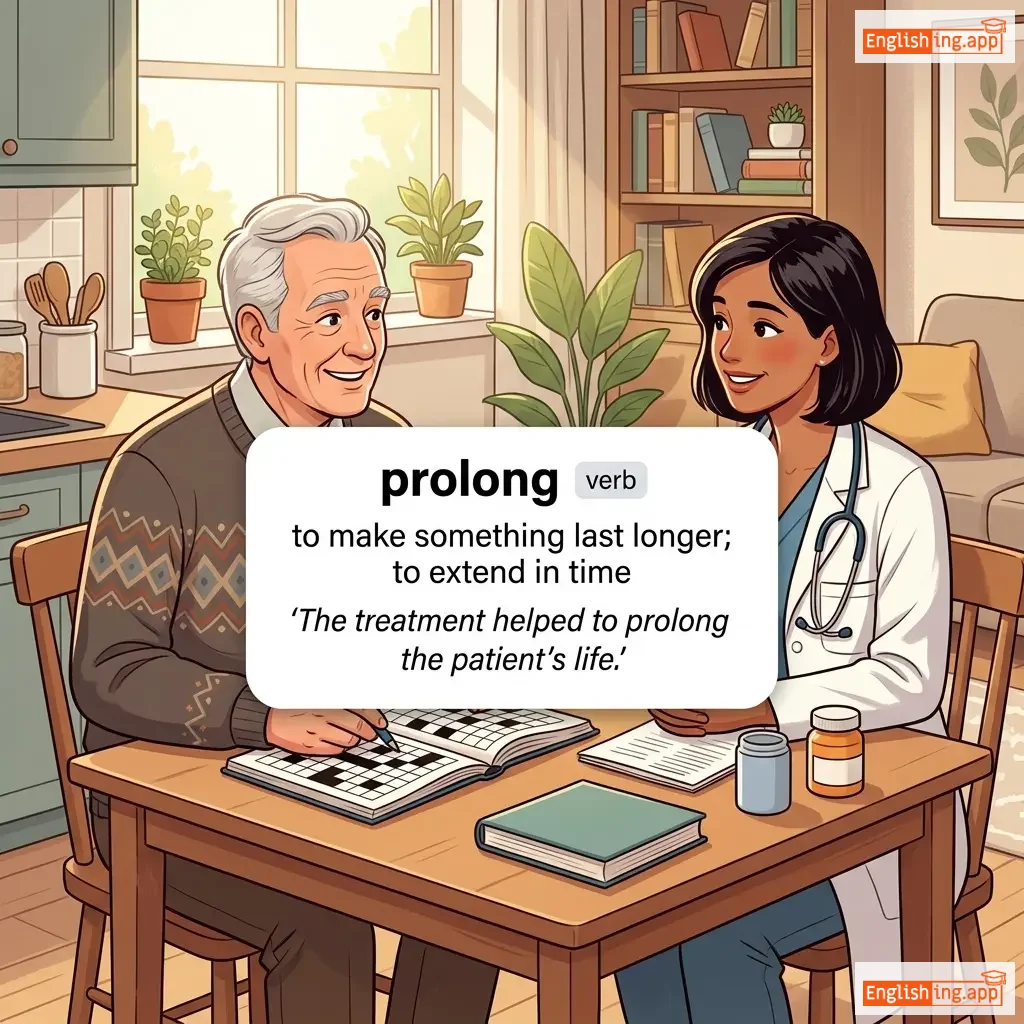
prolong definition card — visual illustration of the meaning
verb
/prəˈlɒŋ/
विस्तारित करना (vistarit karna)

to make something last longer; to extend in time

"The treatment helped to prolong the patient’s life."

"इलाज ने रोगी की जीवन को लंबा करने में मदद की।" (ilaj ne rogi ki jeevan ko lamba karne mein madad ki.)
prolonged definition card — visual illustration of the meaning
adjective
prəˈlɒŋd
दीर्घकालिक (dirghkalik)

Something that continues for longer than normal

"Prolonged sleep deprivation affects overall well-being."

"दीर्घकालिक नींद की कमी समग्र कल्याण को प्रभावित करती है।" (Dirghkalik neend ki kami samagra kalyan ko prabhavit karti hai.)
noun, verb
/ˌprɒməˈneɪd/
घूमना (ghoomna)

A leisurely walk or stroll, especially in a public place for pleasure or display.

"They went for a promenade along the seaside."

"वे समुद्र तट पर एक प्रोमेनेड के लिए गए थे।" (ve samudra tat par ek promenade ke liye gaye the.)
noun
/ˈprɒmɪnəns/
प्रसिद्धि (prasiddhi)

The state of being important, famous, or easily noticed.

"Her work gained prominence after the award."

"उसका काम पुरस्कार के बाद प्रसिद्धि पा गया।" (Uska kaam puraskar ke baad prasiddhi paa gaya.)
adjective
/ˈprɒmɪnənt/
प्रमुख (pramukh)

Important, famous, or easily noticeable.

"He is a prominent leader in the community."

"वह समुदाय में एक प्रमुख नेता है।" (vah samudaay mein ek pramukh neta hai.)
adjective
/prəˈmɪskjuəs/
असंयमी (asanaymi)

Having or showing a casual and unselective approach, often used to describe indiscriminate sexual relationships.

"The novel depicts a character with a promiscuous lifestyle."

"उपन्यास एक ऐसे पात्र को चित्रित करता है जो एक असंयमी जीवनशैली जीता है।" (Upanyas ek aise patra ko chhitrit karta hai jo ek asanaymi jeevanshailee jeeta hai.)
noun
/ˈprɒmɪs/
वादा (vada)

a statement that one will definitely do something or that something will happen

"I made a promise to help her with the project."

"मैंने प्रोजेक्ट में उसकी मदद करने का वादा किया।" (Maine project mein uski madad karne ka vada kiya.)
adjective
/ˈprɒmɪsɪŋ/
आशापूर्ण (aashapurn)

showing signs of future success or potential

"She is a promising young scientist with great ideas."

"वह एक आशापूर्ण युवा वैज्ञानिक है जिसके पास बेहतरीन विचार हैं।" (Vah ek aashapurn yuva vaigyanik hai jiske paas behatarin vichar hain.)
adjective
/ˈprɒmɪsəri/
प्रति‌श्रुतिमूलक (pratishrutimulak)

Containing or conveying a promise, especially in writing.

"He signed a promissory note to repay the loan."

"उसने ऋण चुकाने के लिए एक प्रति‌श्रुतिमूलक नोट पर हस्ताक्षर किए।" (Usne rin chukane ke liye ek pratishrutimulak note par hastakshar kiye.)
noun
/ˈprɒm.ən.tɔːr.i/
कटी हुई भूमि (kati hui bhumi)

A high point of land or rock projecting into a body of water.

"The lighthouse stood on a promontory overlooking the sea."

"灯塔 खाड़ी के ऊपर एक कटी हुई भूमि पर खड़ा था।" (Dengta khadi ke upar ek kati hui bhumi par khada tha.)
promote definition card — visual illustration of the meaning
verb
/prəˈmoʊt/
बढ़ावा देना / प्रचार करना (badhaava dena / prachaar karna)

To support or encourage the growth, sale, or acceptance of something.

"The company worked hard to promote its new product."

"कंपनी ने अपने नए उत्पाद को बढ़ावा देने के लिए कड़ी मेहनत की।" (Kampani ne apne naye utpad ko badhawa dene ke liye kadi mehnat ki.)
noun
/prəˈmoʊ.tər/
प्रचारक (pracharok)

A person or organization that helps to organize or finance an event, business, or product launch.

"The promoter organized a concert for the new band."

"प्रचारक ने नए बैंड के लिए एक कंसर्ट आयोजित किया।" (Pracharok ne naye band ke liye ek concert aayojit kiya.)
promoting definition card — visual illustration of the meaning
verb
prəˈmoʊtɪŋ
प्रचार करना (prachar karna)

To support or actively encourage a cause, venture, or aim; to help or encourage the progress or development of something.

"Promoting education can significantly improve children's lives."

"शिक्षा को बढ़ावा देना बच्चों के जीवन को महत्वपूर्ण रूप से सुधार सकता है।" (Shiksha ko badhawa dena bachon ke jeevan ko mahatvapurn roop se sudhar sakta hai.)
noun
/prəˈmoʊʃən/
पदोन्नति, प्रचार (podonnati, prachar)

the act of raising someone to a higher position or of marketing something to increase sales or awareness

"The company announced a big promotion campaign for their new product."

"कंपनी ने अपने नए उत्पाद के लिए एक बड़ा प्रचार अभियान घोषित किया।" (Company ne apne naye utpad ke liye ek bada prachar abhiyan ghoshit kiya.)
verb, noun, adjective
/prɑːmpt/
प्रेरित करना / तुरंत (prerit karna / turant)

To cause someone to take action; done without delay.

"His speech prompted the audience to ask questions."

"उसकी स्पीच ने श्रोताओं को सवाल पूछने के लिए प्रेरित किया।" (Uski speech ne shrotaon ko sawal poochne ke liye prerith kiya.)
verb
/ˈprɑː.məl.ɡeɪt/
घोषित करना (ghoshit karna)

To announce or make a law, decree, or idea officially known.

"The government promulgated new regulations on data privacy."

"सरकार ने डेटा प्राइवेसी पर नए नियम घोषित किए।" (Sarkar ne data privacy par naye niyam ghoshit kiye.)
adjective
/proʊn/
संवेदनशील (sanvedansheel)

likely to suffer from or experience something, especially something unfortunate

"He is prone to headaches when he works too long."

"वह ज्यादा काम करने पर सिरदर्द के लिए संवेदनशील होता है।" (Vah zyada kaam karne par sirdard ke liye sanvedansheel hota hai.)
noun
/prɔːŋ/
चमच की नोक (chamach ki nok)

a projecting pointed part, such as one of the pointed ends of a fork

"The fork has four prongs."

"चमच में चार नोकें होती हैं।" (Chamach mein chaar nokein hoti hain.)
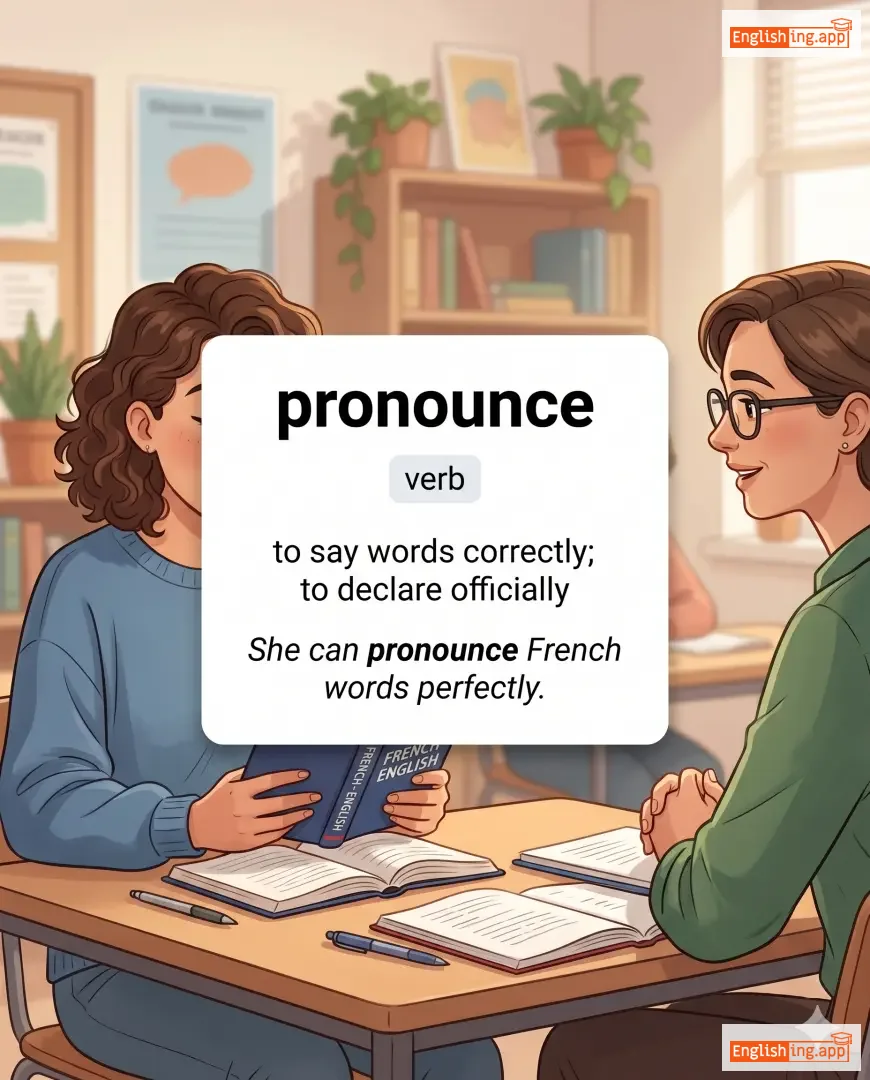
pronounce definition card — visual illustration of the meaning
verb
/prəˈnaʊns/
उच्चारण करना (uccharan karna)

to say words correctly; to declare officially

"She can pronounce French words perfectly."

"वह फ्रेंच शब्दों को सही ढंग से उच्चारण कर सकती है।" (Woh french shabdon ko sahi dhang se uccharan kar sakti hai)
adjective
/prəˈnaʊnst/
स्पष्ट (spasht)

very noticeable or strongly marked

"There is a pronounced difference between the two styles."

"दो शैलियों के बीच एक स्पष्ट अंतर है।" (Do shailiyon ke beech ek spasht antar hai.)
noun
/prəˌnʌnsiˈeɪʃən/
उच्चारण (uccharan)

the way a word or language is spoken; the act or result of pronouncing words

"Her pronunciation of French words has improved significantly."

"उसका फ्रेंच शब्दों का उच्चारण काफी बेहतर हो गया है।" (uska french shabdon ka uccharan kaafi behtar ho gaya hai)
noun
/pruːf/
साक्ष्य (saakshya)

evidence or argument establishing a fact or the truth of a statement

"The detective presented proof of the suspect's guilt."

"जासूस ने संदिग्ध की दोषी होने का प्रमाण प्रस्तुत किया।" (Jaasoos ne sandigdh ki doshi hone ka pramaan prastut kiya.)
verb
/ˈpruːfˌriːd/
प्रूफ़रीड करना (proofread karna)

to read written material and mark any errors

"She proofread the report before submission."

"वह सबमिशन से पहले रिपोर्ट को प्रूफ़रीड करती थी।" (Wah submission se pehle report ko proofread karti thi.)
noun
/prɒp/
पार्श्व वस्तु (parshv vastu)

an object used on stage by actors during a performance; something that supports or holds up

"The actor forgot his prop on stage."

"अभिनेता मंच पर अपना प्रॉप भूल गया।" (Abhineta manch par apna prop bhool gaya.)
noun
/ˌprɒpəˈɡændə/
प्रचार (prachar)

Information, especially biased or misleading, used to promote a political cause or point of view.

"The regime spread propaganda to control public opinion."

"शासन ने जनमत को नियंत्रित करने के लिए प्रचार फैलाया।" (shasan ne janmat ko niyantrit karne ke liye prachar phailaya.)
verb
/ˈprɒpəɡeɪt/
प्रचार करना (prachar karna)

To spread or transmit an idea, belief, or information widely; also to reproduce in plants or animals.

"Scientists work to propagate the species in captivity."

"वैज्ञानिक बंदी में प्रजातियों को फैलाने के लिए काम करते हैं।" (Vaigyanik bandi mein prajatiyon ko phailane ke liye kaam karte hain.)
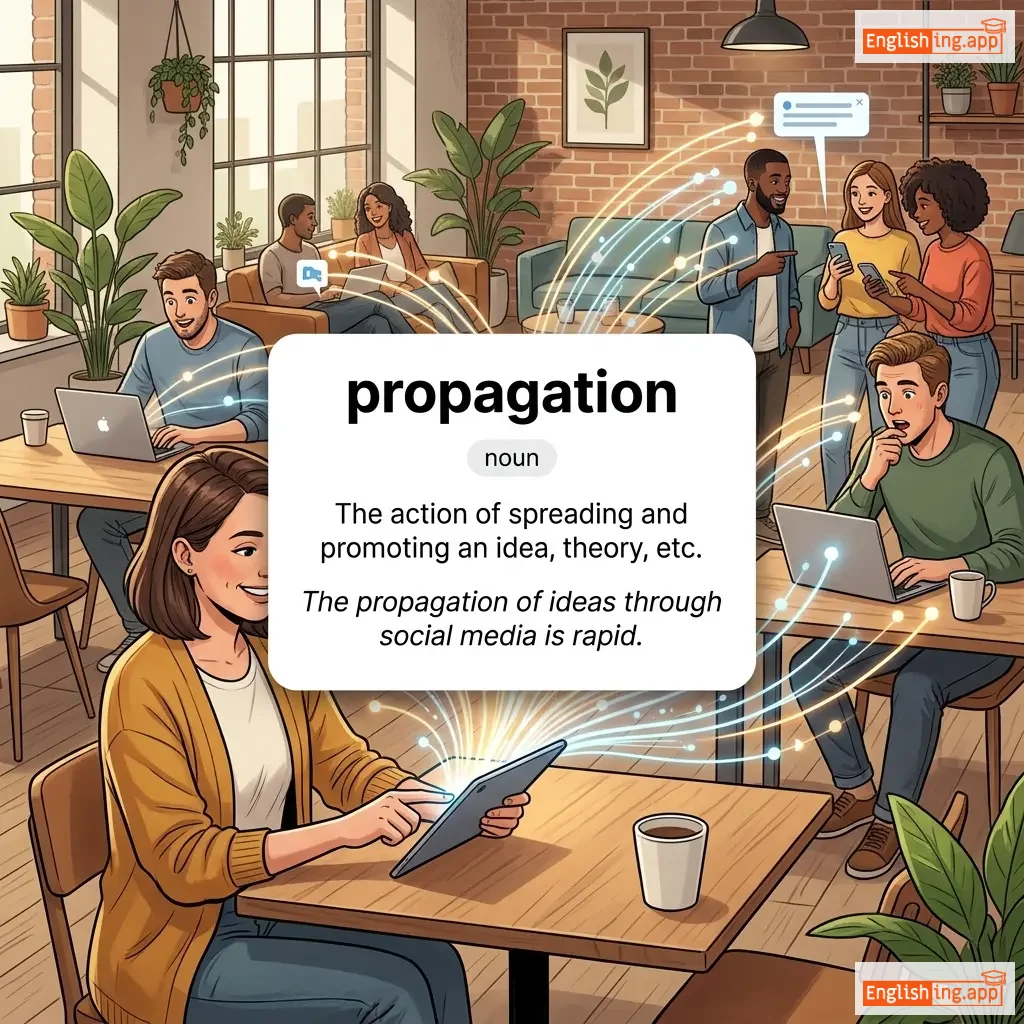
propagation definition card — visual illustration of the meaning
noun
/ˌprɒpəˈɡeɪʃən/
प्रचार, प्रसार (prachar, prasar)

The action of spreading and promoting an idea, theory, etc.

"The propagation of ideas through social media is rapid."

"सोशल मीडिया के जरिए विचारों का प्रचार तेज़ी से हो रहा है।" (Social media ke jariye vicharon ka prachar tez se ho raha hai.)
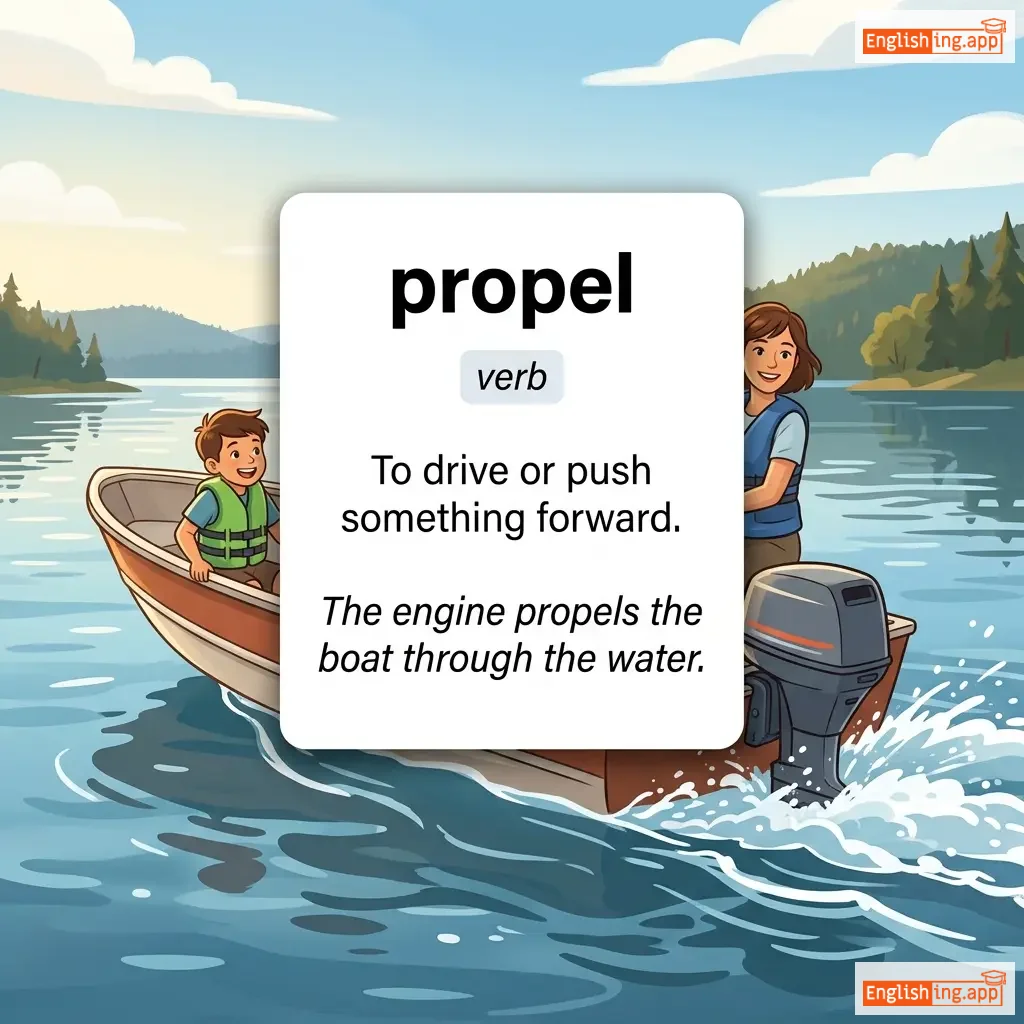
propel definition card — visual illustration of the meaning
verb
/prəˈpɛl/
आगे बढ़ाना (aage badhana)

To drive or push something forward.

"The engine propels the boat through the water."

"इंजन बोट को पानी में से बाहर की ओर धकेलता है।" (engine boat ko pani mein se baahar ki or dhakelta hai.)
noun
/prəˈpɛlənt/
प्रोपेलेंट (propelent)

A substance that drives or pushes something forward, especially fuel in rockets or engines.

"The rocket uses a liquid propellant to launch into space."

"रॉकेट अंतरिक्ष में लॉन्च करने के लिए तरल प्रोपेलेंट का उपयोग करता है।" (rocket antariksh mein launch karne ke liye taral propellent ka upyog karta hai.)
noun
/prəˈpɛlər/
प्रोपेलर (propeller)

A mechanical device with blades that rotates to drive a ship, aircraft, or other vehicle forward.

"The airplane’s propeller cut through the air with great speed."

"विमान के प्रोपेलर ने हवा को तेज़ी से काटा।" (vimaan ke propeller ne hawa ko tezī se kaṭā.)
propensity definition card — visual illustration of the meaning
noun
/prəˈpɛnsəti/
प्रवृत्ति (pravritti)

a natural tendency or inclination to behave in a particular way

"She has a propensity to trust people too easily."

"वह लोगों को बहुत आसानी से विश्वास करने की प्रवृत्ति रखती है।" (vah logon ko bahut aasanai se vishwas karne ki pravritti rakhti hai.)
adjective
/ˈprɒpər/
उचित (uchit)

conforming to accepted standards of behavior or morality

"He made sure to wear proper attire for the interview."

"उसने इंटरव्यू के लिए उचित पोशाक पहनी।" (Usne interview ke liye uchit poshak pehni.)
adverb
/ˈprɒpərli/
सही तरीके से (sahi tareeke se)

in the correct or suitable manner

"He performed the task properly to avoid mistakes."

"उसने गलती से बचने के लिए कार्य को ठीक से किया।" (Usne galti se bachne ke liye kaary ko theek se kiya.)
noun
/ˈprɒpərti/
संपत्ति (sampatti)

a thing or things that belong to someone; possessions or real estate

"The old mansion is his family’s property."

"पुराना महल उसके परिवार की संपत्ति है।" (purana mahal uske parivar ki sampatti hai.)
noun
/ˈprɒfəsi/
भविष्यवाणी (bhavishyavani)

a prediction or message about the future, often believed to be divinely inspired

"The prophecy foretold the rise of a great leader."

"भविष्यवाणी ने एक महान नेता के उदय की भविष्यवाणी की थी।" (bhavishyavani ne ek mahaan neta ke uday ki bhavishyavani ki thi)
verb
/ˈprɒfəsaɪ/
भविष्यवाणी करना (bhavishyavani karna)

to state or predict that something will happen in the future, especially as if divinely inspired

"The monk prophesied that peace would return to the land."

"साधु ने भविष्यवाणी की थी कि शांति देश में लौटेगी।" (saadhu ne bhavishyavani ki thi ki shanti desh mein lautegi.)
adjective
/prəˈfɛtɪk/
भविष्यवाणी से संबंधित (bhavishyavani se sambandhit)

accurately predicting or describing what will happen in the future

"His prophetic words came true after many years."

"उसके भविष्यवाणी से संबंधित शब्द कई सालों बाद सच हो गए।" (uske bhavishyavani se sambandhit shabdon ka kai salon baad sach ho gaye.)
adjective
/ˌprɒfɪˈlæktɪk/
रोकथाम करने वाला (roktam karne wala)

intended to prevent disease or an unwanted outcome; protective

"The doctor prescribed a prophylactic treatment to prevent infection."

"डॉक्टर ने संक्रमण को रोकने के लिए एक रोकथाम उपचार निर्धारित किया।" (Daktar ne sankraman ko rokne ke liye ek roktam upchar nirdharit kiya.)
noun
/prəˈpɪŋkwɪti/
निकटता (nikatata)

the state of being close to someone or something; proximity

"The propinquity of their houses made them close friends."

"उनके घरों की निकटता ने उन्हें करीबी दोस्त बना दिया।" (Unke gharon ki nikatata ne unhe kareebi dost bana diya.)
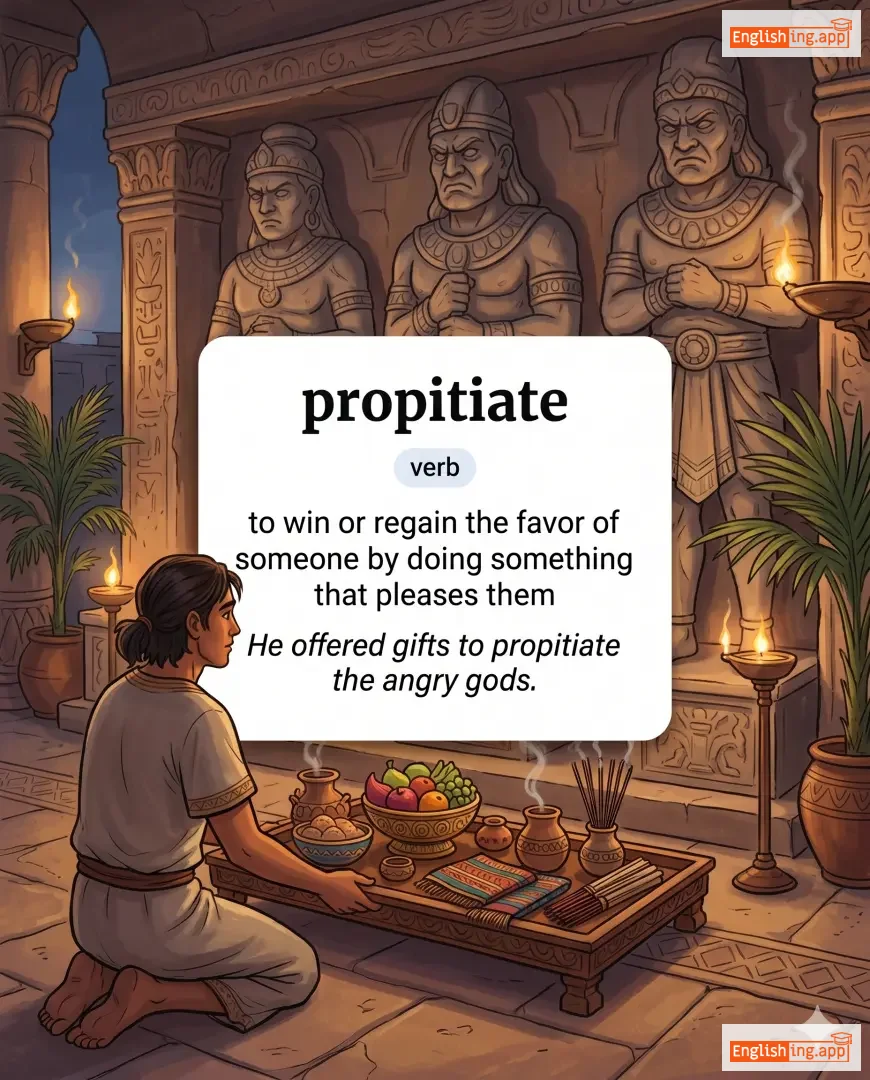
propitiate definition card — visual illustration of the meaning
verb
/prəˈpɪʃieɪt/
किसी को प्रसन्न करने के लिए उसका आशीर्वाद प्राप्त करना (kisi ko prasann karne ke liye uska aashirwad prapt karna)

to win or regain the favor of someone by doing something that pleases them

"He offered gifts to propitiate the angry gods."

"उसने गुस्साए हुए देवताओं को प्रसन्न करने के लिए उपहार दिए।" (Usne gussaaye huye devtaon ko prasann karne ke liye uphaar diye.)
adjective
/prəˈpɪʃəs/
शुभ, अनुकूल (shubh, anukul)

giving or indicating a good chance of success; favorable

"The sunny weather was a propitious start to the picnic."

"सनी मौसम पिकनिक के लिए शुभ शुरुआत थी।" (Sani mausam picnic ke liye shubh shuruat thi.)
noun
/prəˈpoʊnənt/
समर्थक, प्रस्तावक (samarthak, prastavak)

a person who advocates for or supports a particular idea, cause, or plan

"She is a strong proponent of renewable energy."

"वह नवीकरणीय ऊर्जा की एक मजबूत समर्थक है।" (vah navikaranīya ūrgā kī ek majabūt samarthak hai.)
noun
/prəˈpɔːʃən/
अनुपात (anupat)

a part, share, or number considered in comparative relation to a whole

"The proportion of students passing the exam was high."

"परीक्षा में पास होने वाले छात्रों का अनुपात उच्च था." (pareeksha mein paas hone wale chhatron ka anupat uchcha tha)
adjective
/prəˈpɔːrʃənət/
सामान्य अनुपाती (samanjya anupati)

Corresponding in size, degree, or intensity; balanced in relation.

"The punishment should be proportionate to the crime."

"सजा अपराध के अनुसार सामान्य अनुपाती होनी चाहिए।" (Saja aparadh ke anusar samanjya anupati honi chahiye.)