वोकैबुलरीज

इंग्लिश वोकैबुलरी डिस्कवर, लर्न और मास्टर करें

adjective
/ˈprɛvələnt/
व्यापक (vyapak)

widespread or commonly occurring

"Flu is prevalent during the winter season."

"सर्दी के मौसम में फ्लू प्रचलित है।" (sardi ke mausam mein flu prachalit hai.)
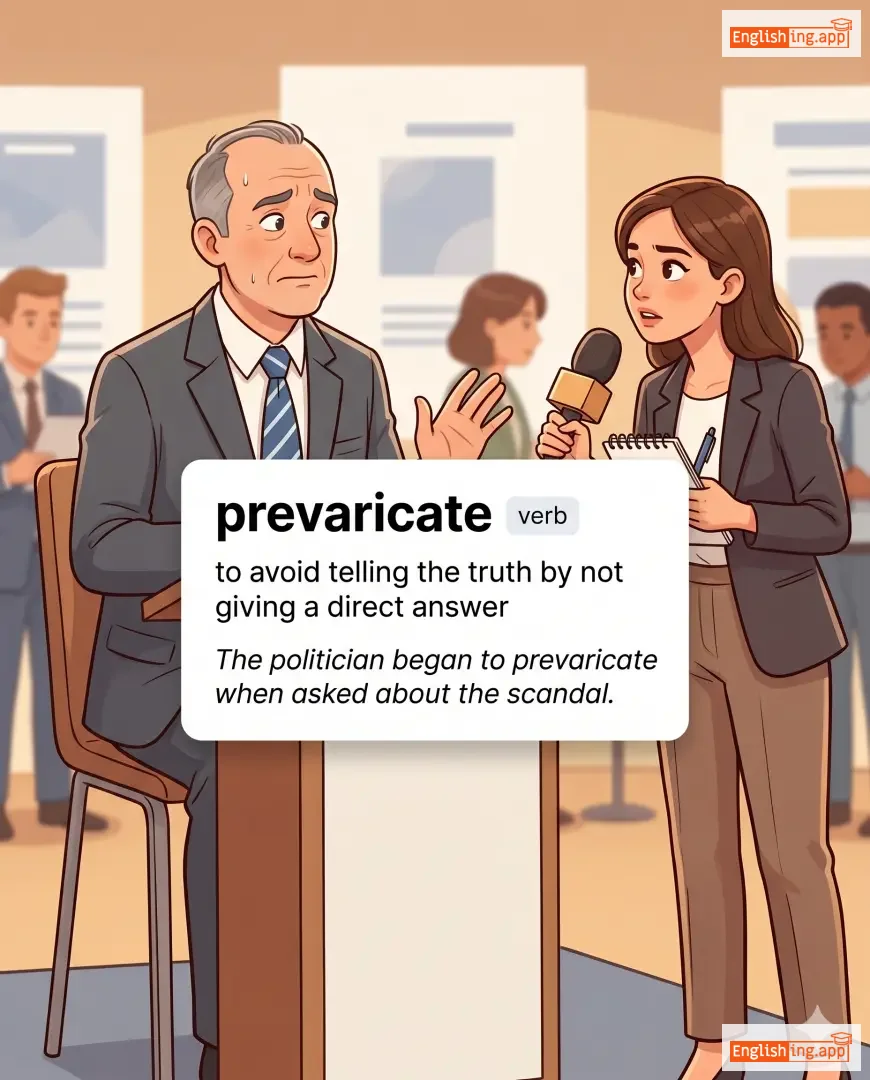
prevaricate definition card — visual illustration of the meaning
verb
/prɪˈværɪkeɪt/
सच न बताना (sach na batana)

to avoid telling the truth by not giving a direct answer

"The politician began to prevaricate when asked about the scandal."

"राजनेता ने स्कैंडल के बारे में पूछे जाने पर सच बताने से बचना शुरू कर दिया।" (raajneeta ne scandal ke baare mein pooche jaane par sach batane se bachna shuru kar diya.)
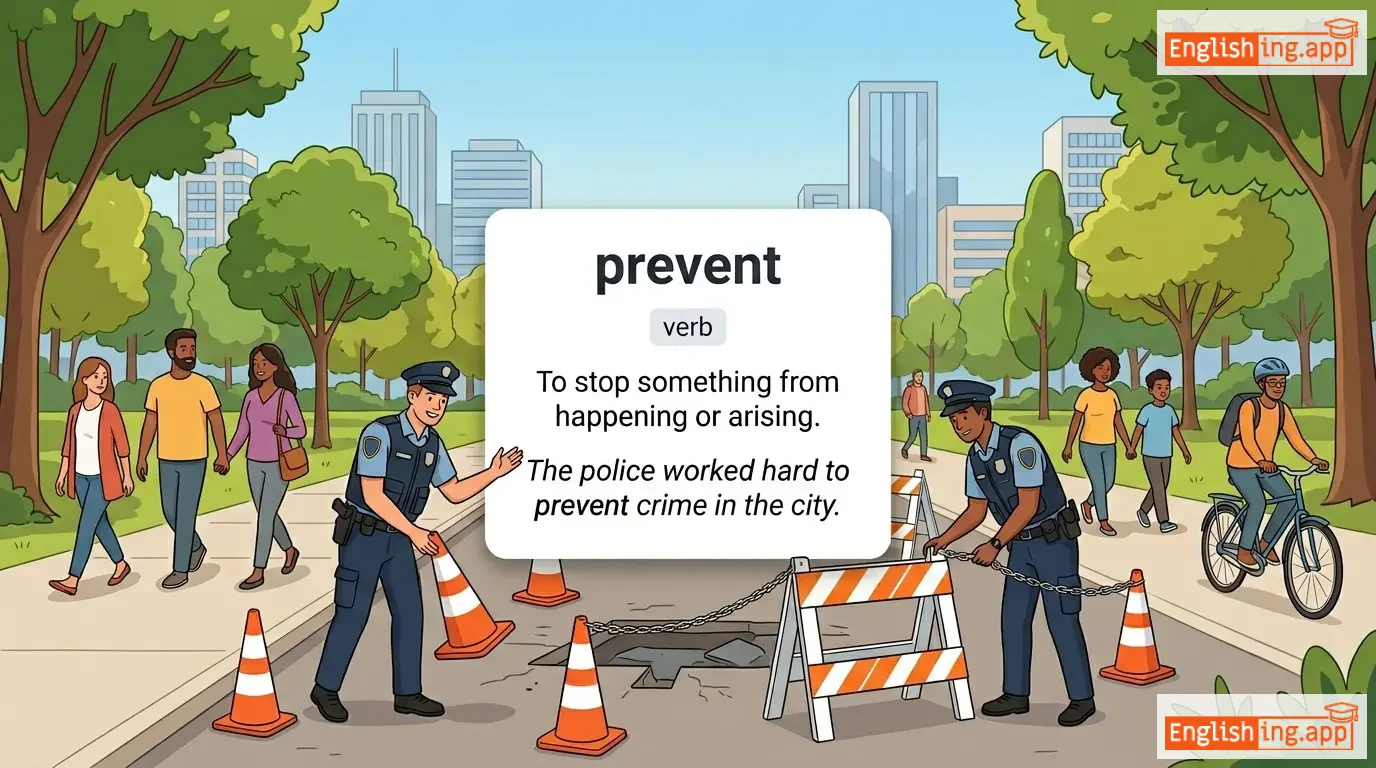
prevent definition card — visual illustration of the meaning
verb
/prɪˈvɛnt/
रोकना (rokna)

To stop something from happening or arising.

"The police worked hard to prevent crime in the city."

"पुलिस ने शहर में अपराध रोकने के लिए कड़ी मेहनत की।" (Police ne shahar mein aparadh rokne ke liye kadi mehnat ki.)
prevention definition card — visual illustration of the meaning
noun
/prɪˈvɛnʃən/
रोकथाम (roktham)

the act of stopping something from happening

"Exercise is important for the prevention of heart disease."

"हृदय रोग की रोकथाम के लिए व्यायाम महत्वपूर्ण है।" (hriday rog ki roktham ke liye vyayam mahatvapurn hai.)
adjective
/prɪˈventɪv/
रोकथाम करनेवाला; रोगों से बचाव के लिए डिज़ाइन किया गया (priventiv)

designed to prevent something from happening; protective against disease

"Regular exercise is a preventive measure against heart disease."

"नियमित व्यायाम दिल की बीमारी से बचाव के लिए एक रोकथाम उपाय है।" (niyamit vyaayam dil ki bimari se bachav ke liye ek roktham upay hai)
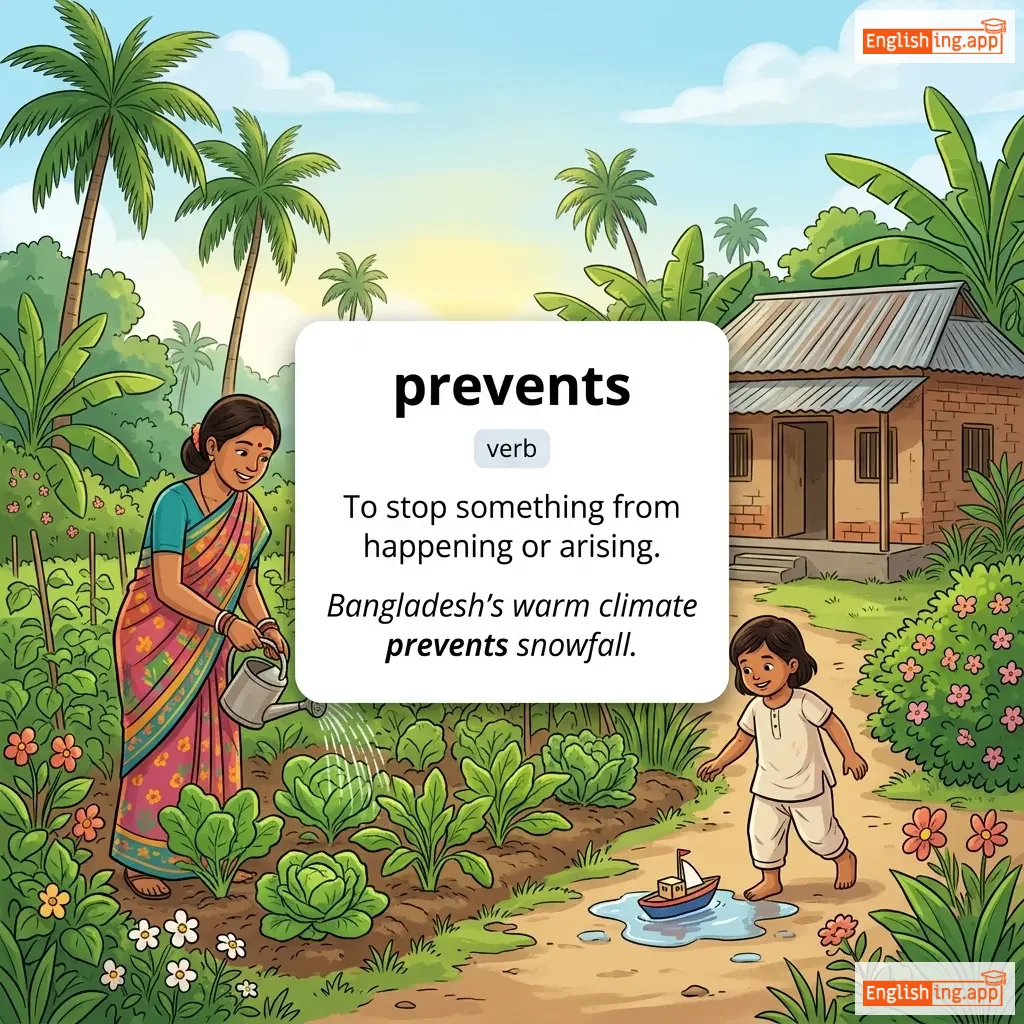
prevents definition card — visual illustration of the meaning
verb
প্রিভেন্টস
रोकता है (rokta hai)

To stop something from happening or arising.

"Bangladesh's warm climate prevents snowfall."

"बांगलादेश की गर्म जलवायु हिमपात को रोकती है।" (Bangladesh ki garm jalvayu himpaat ko rokti hai.)
adjective
/ˈpriːviəs/
पूर्ववर्ती (purvavarti)

Existing or happening before the present time.

"He referred to the previous meeting to explain his point."

"वह अपनी बात समझाने के लिए पिछले बैठक का संदर्भ दे रहा था।" (Vah apni baat samjhane ke liye pichle baithak ka sandarbh de raha tha.)
adverb
/ˈpriːviəsli/
पूर्व में (purv mein)

at an earlier time or before now

"She had previously worked at a bank before starting her own business."

"वह एक बैंक में पहले काम कर चुकी थी, अपने खुद के व्यवसाय की शुरुआत करने से पहले।" (Vah ek bank mein pahle kaam kar chuki thi, apne khud ke vyavsay ki shuruat karne se pahle.)
noun/verb
/preɪ/
शिकार (shikar)

an animal hunted by another for food; to hunt and feed on

"Lions prey on zebras in the wild."

"सिंह जंगली में ज़ेब्राओं का शिकार करते हैं।" (Singh jangli mein zebron ka shikar karte hain.)
noun
/praɪs/
कीमत (keemat)

the amount of money expected, required, or given for something

"The price of the car has increased recently."

"कार की कीमत हाल ही में बढ़ी है।" (Car ki keemat haal hi mein badhi hai.)
adjective
/ˈpraɪs.ləs/
मूल्यहीन; अत्यधिक मूल्यवान (mulyahin; atyadhik mulyavan)

extremely valuable; invaluable; beyond price

"Her grandmother's antique jewelry is absolutely priceless."

"उसकी दादी की प्राचीन गहनों की कीमत अविश्वसनीय है।" (uski dadi ki pracheen gahon ki keemat avishwasniya hai.)
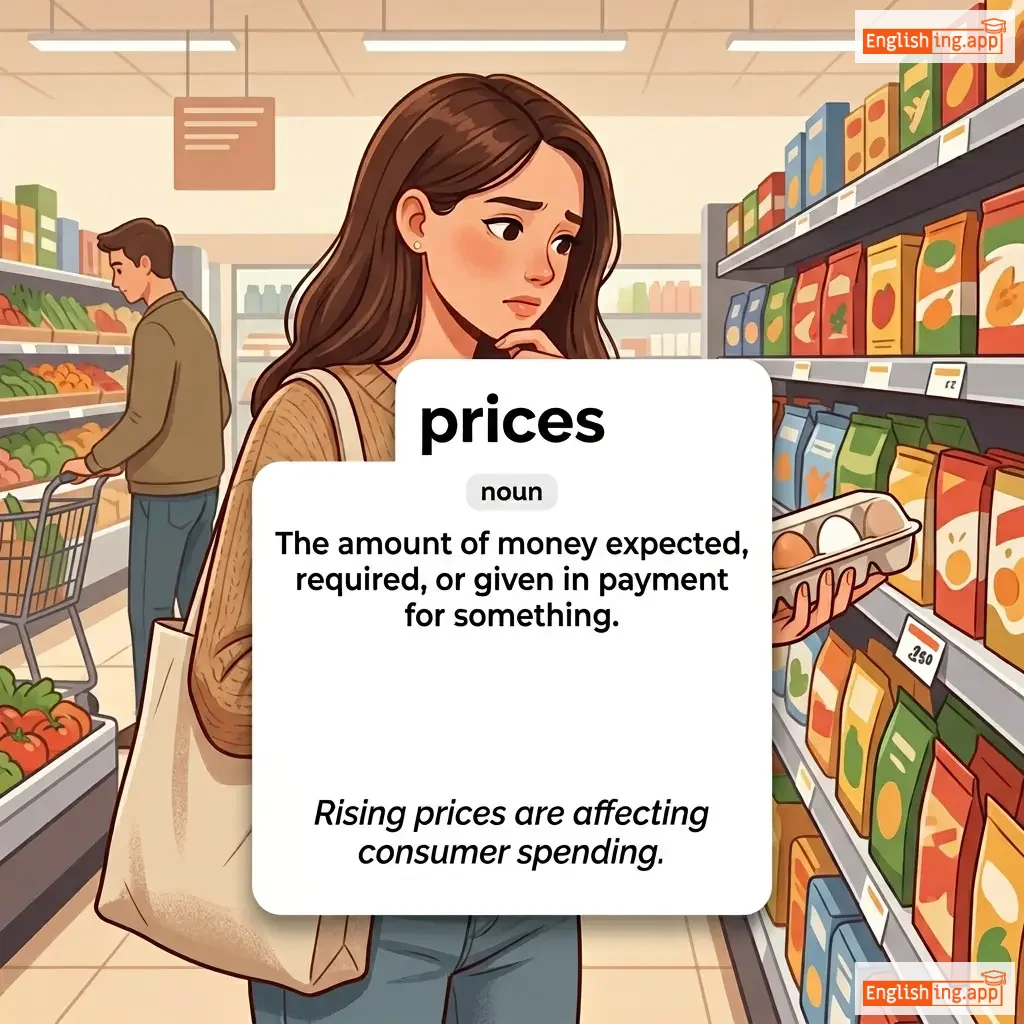
prices definition card — visual illustration of the meaning
noun
ˈpraɪsɪz
कीमतें, दाम (keematain, daam)

The amount of money expected, required, or given in payment for something.

"Rising prices are affecting consumer spending."

"बढ़ती कीमतें उपभोक्ता खर्च को प्रभावित कर रही हैं।" (Badhati keematein upbhokta kharch ko prabhavit kar rahi hain.)
verb
/ˈprɪkəl/
चुभना (chubhna)

to cause a slight stinging or tingling sensation on the skin

"Her skin began to prickle in the cold wind."

"ठंडी हवा में उसकी त्वचा चुभने जैसी लगने लगी।" (Thandi hawa mein uski twacha chubhne jaisi lagne lagi.)
pride definition card — visual illustration of the meaning
noun
/praɪd/
अहम् (aham)

a feeling of deep pleasure or satisfaction derived from one's own achievements

"He took pride in his work and always aimed for perfection."

"वह अपने काम पर गर्व करता था और हमेशा परिपूर्णता के लिए लक्ष्य करता था।" (Vah apne kaam par garv karta tha aur hamesha paripurnata ke liye lakshya karta tha.)
noun
/priːst/
पादरी (padri)

a person who performs religious duties and ceremonies

"The priest blessed the congregation during the Sunday service."

"पादरी ने रविवार की सेवा के दौरान समुदाय को आशीर्वाद दिया।" (Padri ne ravivaar ki seva ke dauran samudaay ko aashirvaad diya.)
adjective
/ˈprɪɡɪʃ/
अत्यधिक नैतिक और आत्मनिर्भर (atyadhik naitik aur aatmanirbhar)

self-righteously moralistic and superior

"He came across as priggish when correcting everyone's manners."

"वह जब सभी के शिष्टाचार को सुधारने की कोशिश करता था, तो वह अत्यधिक नैतिक और आत्मनिर्भर लगता था।" (Vah jab sabhi ke shishtachar ko sudharne ki koshish karta tha, to vah atyadhik naitik aur aatmanirbhar lagta tha.)
adjective
/prɪm/
अत्यधिक शालीन और उचित (atyadhik shaleen aur uchit)

stiffly formal and proper in appearance or behavior

"She looked prim in her neatly pressed dress."

"वह अपनी सलीके से प्रेस की हुई ड्रेस में प्रिम दिख रही थी।" (Vah apni salike se press ki hui dress mein prim dikh rahi thi.)
adjective
/ˈpriːmə/
प्रमुख, श्रेष्ठ (pramukh, shreshth)

first or most important; excellent

"She was treated as the prima ballerina of the troupe."

"उसे दल की प्रमुख बैलेरीना के रूप में माना गया था।" (Use dal ki pramukh ballerina ke roop mein maana gaya tha.)
noun
/ˈpraɪməsi/
प्रमुखता (pramukhta)

the state of being first in importance or authority

"The primacy of education cannot be denied."

"शिक्षा की प्रमुखता को नकारा नहीं जा सकता।" (Shiksha ki pramukhta ko nakara nahi ja sakta.)
adjective
/ˈpraɪ.məl/
प्रारंभिक, मौलिक (prarambhik, maulik)

Relating to the earliest stage of development; essential or fundamental.

"Fear is one of the most primal emotions humans experience."

"डर इंसानों के सबसे प्राइमल इमोशंस में से एक है।" (Dar insano ke sabse primal emotions mein se ek hai.)
adverb
/praɪˈmɛrɪli/
मुख्य रूप से (mukhya roop se)

for the most part; mainly

"She is primarily responsible for managing the finances."

"वह मुख्य रूप से वित्तीय प्रबंधन के लिए जिम्मेदार है।" (Vah mukhya roop se vittiya prabandhan ke liye jimmedar hai.)
adjective
/ˈpraɪ.mɛr.i/
प्राथमिक, प्रमुख (prathamik, pramukh)

Most important; main; happening first.

"Education is a primary factor in economic growth."

"शिक्षा आर्थिक वृद्धि में एक प्राथमिक तत्व है।" (Shiksha aarthik vruddhi mein ek prathamik tatva hai.)
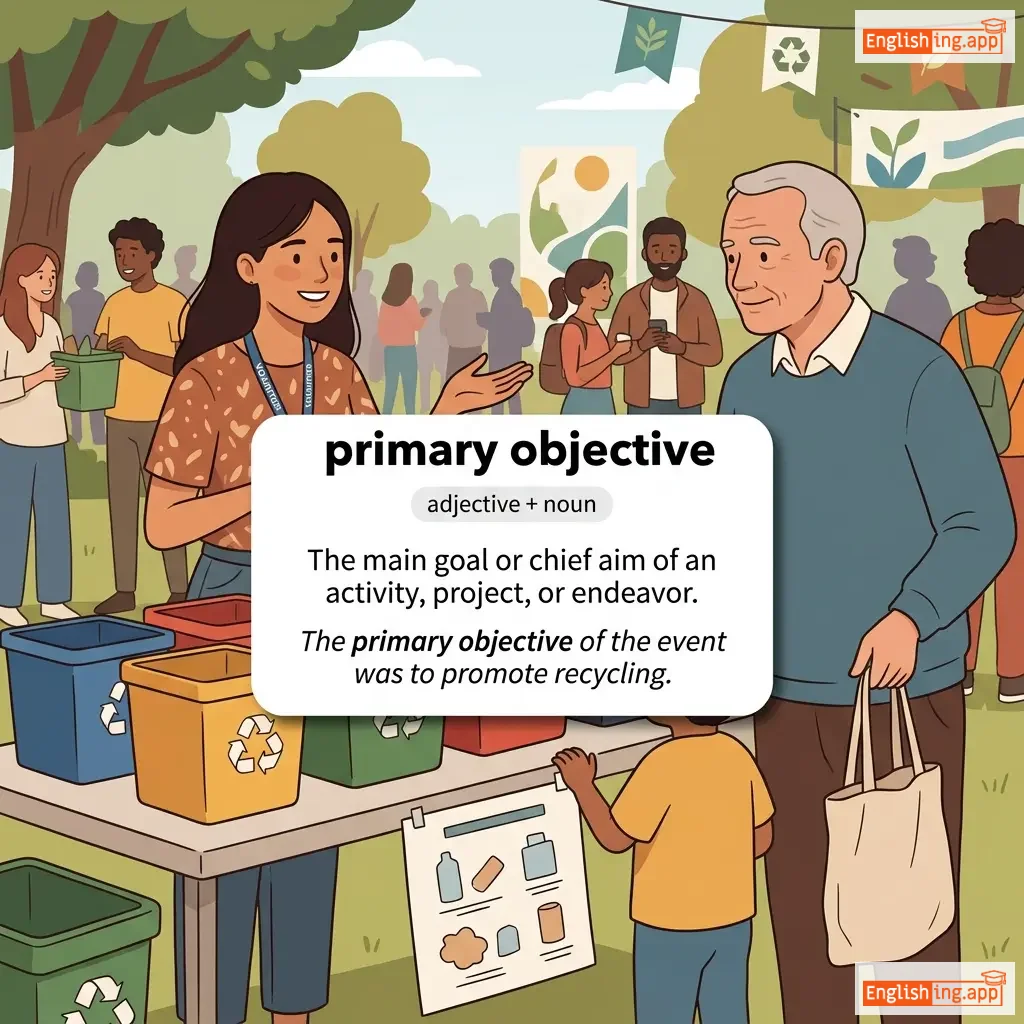
primary objective definition card — visual illustration of the meaning
adjective + noun
ˈpraɪməri əbˈdʒektɪv
प्राथमिक उद्देश्य (prathamik uddeshya)

The main goal or chief aim of an activity, project, or endeavor.

"The primary objective of the event was to promote recycling."

"कार्यक्रम का प्राथमिक उद्देश्य पुनर्चक्रण को बढ़ावा देना था।" (Kaaryakram ka prathamik uddeshya punarchakran ko badhawa dena tha.)
noun
/ˈpraɪ.meɪt/
प्राइमेट, बंदर जाति का जानवर (primate, bander jati ka janwar)

A member of the group of animals including humans, apes, and monkeys.

"Humans are classified as primates."

"मानवों को प्राइमेट के रूप में वर्गीकृत किया जाता है।" (Manavon ko primate ke roop mein vargeekrit kiya jata hai.)
adjective
/praɪm/
श्रेष्ठ, प्रमुख (shreshth, pramukh)

Of the best quality; most important; peak condition.

"She is in the prime of her career."

"वह अपने करियर के सर्वोत्तम समय में है।" (Wah apne career ke sarvottam samay mein hai.)
noun
/ˈpraɪ.mər/ (US), /ˈprɪm.ər/ (UK)
प्रारंभिक किताब, प्राइमर (prarambhik kitaab, primer)

A basic introductory book or a substance used to prepare a surface for painting.

"He read a primer on programming before starting his course."

"उसने अपने कोर्स को शुरू करने से पहले प्रोग्रामिंग पर एक प्राइमर पढ़ा।" (Usne apne course ko shuru karne se pehle programming par ek primer padha.)
adjective
/praɪˈmiːvəl/
प्राचीन (praacheen)

Relating to the earliest ages in history; ancient and primitive.

"The explorers ventured into the primeval forest untouched by humans."

"अन्वेषकों ने उस प्राचीन जंगल में प्रवेश किया जो मनुष्यों द्वारा अपरिवर्तित था।" (Anveshako ne us praacheen jangal mein pravesh kiya jo manushyon dwara aparivartit tha.)
adjective
/ˈprɪmətɪv/
प्राचीन (prachin)

Relating to an early stage of development; simple and basic.

"The tribe lived in primitive huts made of mud and straw."

"जनजाति माटी और घास से बने प्राचीन झोपड़ों में रहती थी।" (Janjati maati aur ghas se bane prachin jhopdon mein rahti thi.)
noun
/ˌpraɪmoʊˈdʒɛnɪtʃər/
प्रथम पुत्राधिकार (pratham putroadhikar)

The right of the firstborn child to inherit the family estate or title.

"Under primogeniture, the eldest son inherited the entire estate."

"प्रथम पुत्राधिकार के तहत, सबसे बड़े बेटे ने सम्पत्ति का पूरा अधिकार प्राप्त किया।" (Pratham putroadhikar ke tahat, sabse bade bete ne sampatti ka poora adhikar prapt kiya.)
adjective
/praɪˈmɔːrdiəl/
प्रारंभिक (prarambhik)

Existing at or from the beginning of time; fundamental and original.

"Scientists study the primordial soup from which life emerged."

"वैज्ञानिक प्रारंभिक सूप का अध्ययन करते हैं जिससे जीवन उत्पन्न हुआ।" (Vaigyanik prarambhik soup ka adhyayan karte hain jisse jeevan utpann hua.)
verb
/prɪmp/
खुशी (khushi)

To spend time making minor adjustments to one's appearance.

"She primped in front of the mirror before the party."

"वह पुरस्कार मिलने पर अपनी खुशी छुपा नहीं पाई।" (Wah puraskaar milne par apni khushi chhupa nahi paayi.)
noun
/prɪns/
राजकुमार (rajakumar)

a male member of a royal family, especially the son of a king or queen; a ruler of a principality

"The prince addressed the nation on his birthday."

"राजकुमार ने अपने जन्मदिन पर राष्ट्र को संबोधित किया।" (rajakumar ne apne janmadin par rashtra ko sambodhit kiya)
noun
/ˈprɪn.ses/
राजकुमारी (rajkumari)

a female royal family member, especially the daughter of a king or queen; a woman regarded as noble, cherished, or elegant

"The princess waved to the crowd from the palace balcony."

"राजकुमारी ने महल की बालकनी से भीड़ की ओर हाथ हिलाया।" (rajkumari ne mahal ki balcony se bheed ki or haath hilaya)
noun, adjective
/ˈprɪnsəpəl/
प्रधान, प्रधान विद्यालय अधिकारी (pradhan, pradhan vidyalay adhikari)

the person with the highest authority or most important position; main or most important

"The school principal addressed the students in the auditorium."

"विद्यालय के प्रधान ने ऑडिटोरियम में छात्रों को संबोधित किया।" (vidyalay ke pradhan ne auditorium mein chhatron ko sambodhit kiya.)
noun
/ˌprɪnsɪˈpæləti/
राज्य (rajya)

a state ruled by a prince

"Monaco is a famous principality in Europe."

"मोनाको यूरोप का एक प्रसिद्ध राज्य है।" (Monaco Europe ka ek prasiddh rajya hai.)
principle definition card — visual illustration of the meaning
noun
/ˈprɪnsəpəl/
सिद्धांत (siddhant)

a fundamental truth, law, or rule that serves as the foundation for a system of belief or behavior

"She refused to lie because it was against her principles."

"उसने झूठ बोलने से इनकार कर दिया क्योंकि यह उसके सिद्धांतों के खिलाफ था।" (Usne jhooth bolne se inkar kar diya kyunki yeh uske siddhanton ke khilaf tha.)
adjective
/ˈprɪnsəpəld/
सिद्धांतवादी (siddhantvadi)

acting in accordance with moral or ethical standards

"He is a principled leader who always puts honesty first."

"वह एक सिद्धांतवादी नेता है जो हमेशा ईमानदारी को पहले रखता है।" (Vah ek siddhantvadi neta hai jo hamesha imaandari ko pehle rakhta hai.)
verb
/prɪnt/
मुद्रण (mudran)

to produce text or images on paper or other materials using a machine

"He will print the report tomorrow morning."

"वह रिपोर्ट कल सुबह प्रिंट करेगा।" (Vah report kal subah print karega.)
noun
/ˈprɪn.tər/
मुद्रक (mudrak)

a person whose job is printing books, newspapers, or other materials; a machine that prints documents

"The printer delivered the wedding invitations on time."

"मुद्रक ने समय पर शादी के निमंत्रण भेजे।" (mudrak ne samay par shaadi ke nimantran bheje.)
adjective
/ˈpraɪər/
पूर्व (purv)

existing or coming before something in time or order

"He had no prior knowledge of the event."

"उसे इस घटना के बारे में पहले से कोई जानकारी नहीं थी।" (Use is ghatna ke baare mein pehle se koi jaankari nahi thi.)
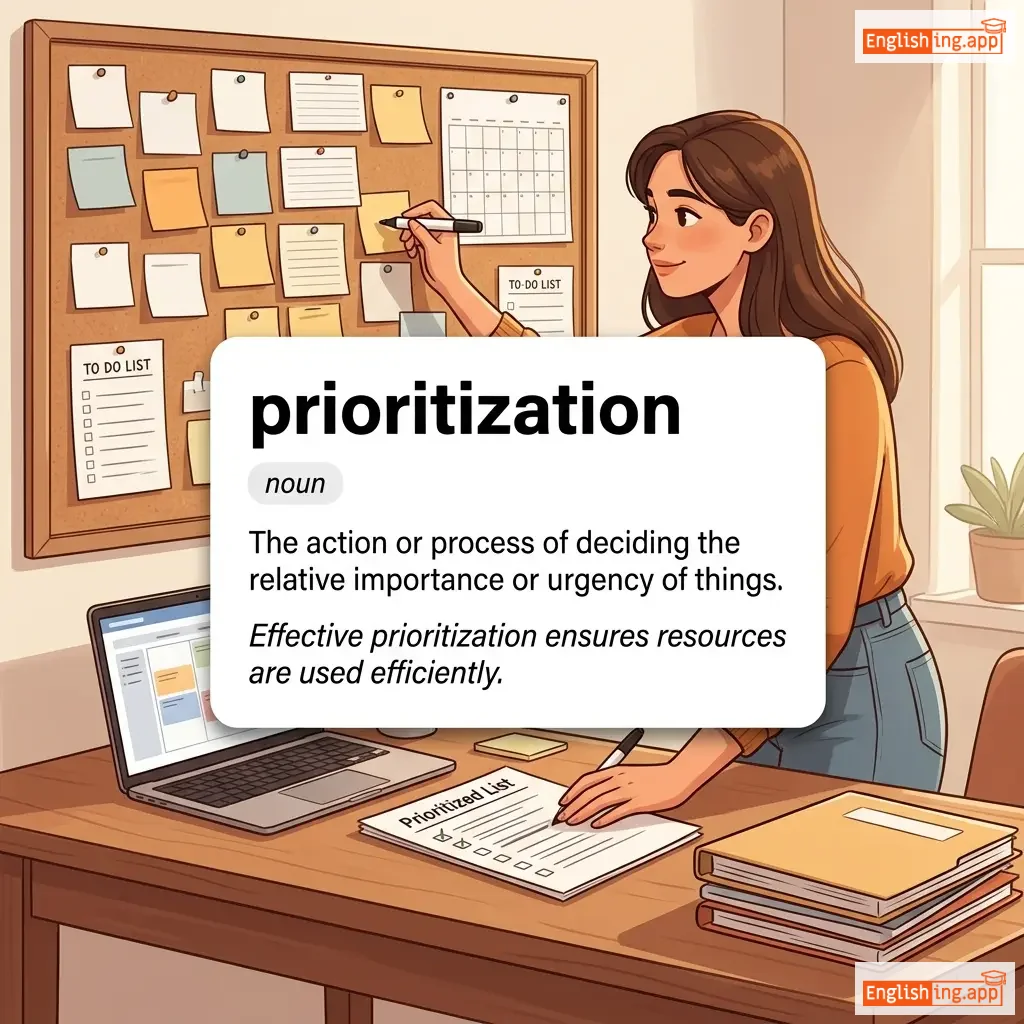
prioritization definition card — visual illustration of the meaning
noun
ˌpraɪɔːrɪtaɪˈzeɪʃən
प्राथमिकता निर्धारण (prathmikta nirdharan)

The action or process of deciding the relative importance or urgency of things.

"Effective prioritization ensures resources are used efficiently."

"प्रभावी प्राथमिकता निर्धारण सुनिश्चित करता है कि संसाधन कुशलतापूर्वक उपयोग किए जा रहे हैं।" (Prabhavi prathmikta nirdharan sunishchit karta hai ki sansadhan kushaltapurvak upyog kiye ja rahe hain.)
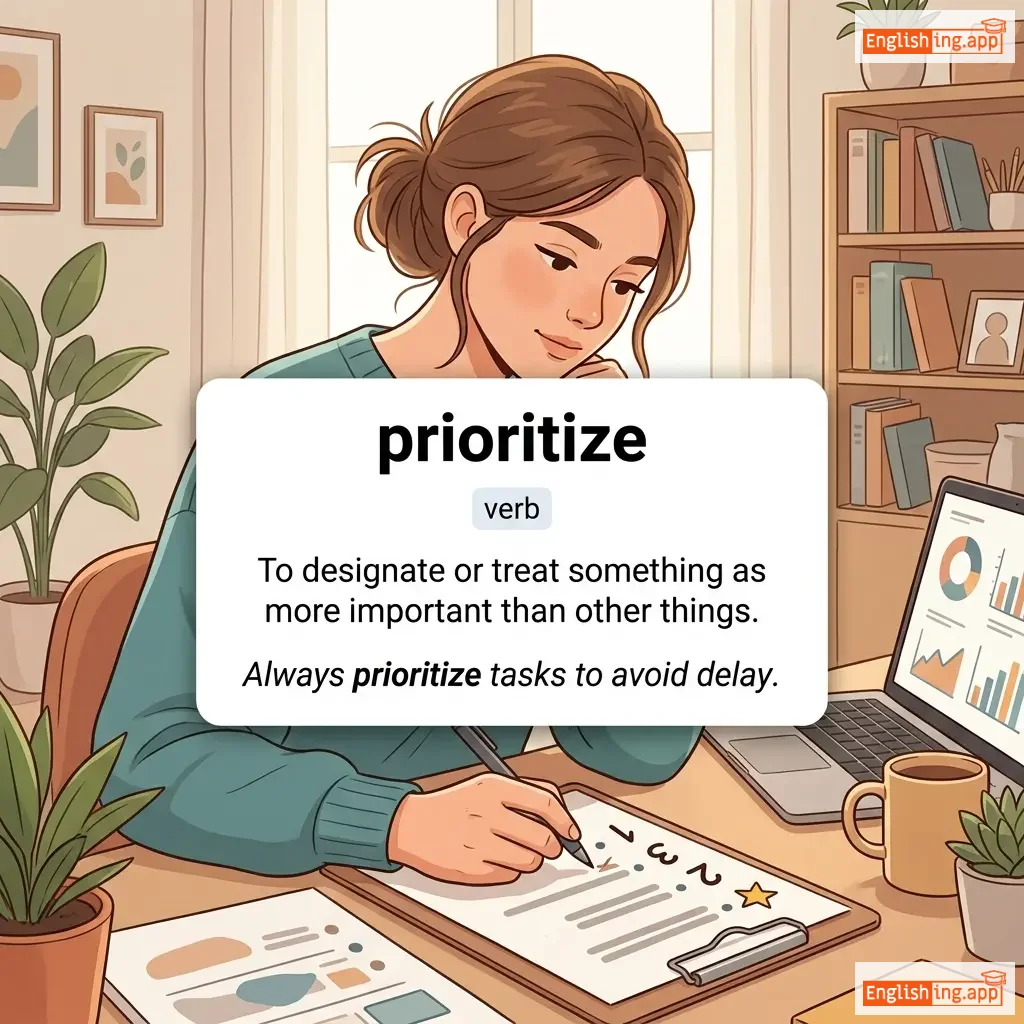
prioritize definition card — visual illustration of the meaning
verb
/praɪˈɔːrətaɪz/
प्राथमिकता देना (prathmikta dena)

To designate or treat something as more important than other things.

"Always prioritize tasks to avoid delay."

"हमेशा कामों को प्राथमिकता दें ताकि कोई देरी न हो।" (Hamesha kaamon ko prathmikta den taaki koi deri na ho.)
noun
/praɪˈɒrɪti/
प्राथमिकता (prathmikta)

Something that is regarded as more important than other things.

"Safety is the top priority in this company."

"इस कंपनी में सुरक्षा सबसे महत्वपूर्ण प्राथमिकता है।" (Is company mein suraksha sabse mahatvapurn prathmikta hai.)
noun
/ˈpraɪəri/
मठ (math)

a small monastery or convent governed by a prior or prioress

"The old priory was converted into a museum."

"पुराना प्रायोरी एक संग्रहालय में बदल दिया गया था।" (Purana priory ek sangrahalay mein badal diya gaya tha.)
noun
/ˈprɪzən/
जेल (jel)

a building where people are kept as punishment for a crime or while waiting for trial

"He was sent to prison for his crimes."

"उसे उसके अपराधों के लिए जेल भेजा गया था।" (Use uske apradhon ke liye jel bheja gaya tha.)
noun
/ˈprɪzənər/
कैदी (kaidi)

a person who is in prison

"The prisoner was granted parole after serving 10 years."

"कैदी को 10 साल की सजा काटने के बाद पैरोल दी गई।" (Kaidi ko 10 saal ki saza kaatne ke baad parol di gayi.)
pristine definition card — visual illustration of the meaning
adjective
/ˈprɪstiːn/
अक्षत, शुद्ध (akkhat, shuddh)

In its original condition; unspoiled, clean, and fresh.

"The hikers were amazed by the pristine beauty of the untouched forest."

"हाइकर्स अचंभित हो गए थे जब उन्होंने अनछुई जंगली सौंदर्य को देखा।" (Haikers achambhit ho gaye the jab unhone anchhui jangli saundarya ko dekha.)
noun
/ˈpraɪvəsi/
गोपनीयता (gopaneeyata)

the state of being free from public attention or intrusion

"Everyone has the right to privacy in their own home."

"हर किसी को अपने घर में गोपनीयता का अधिकार है।" (Har kisi ko apne ghar mein gopaneeyata ka adhikar hai.)
adjective
/ˈpraɪvət/
निजी (niji)

belonging to or for the use of one particular person or group

"She enjoys her private time away from work."

"वह काम से दूर अपना निजी समय पसंद करती है।" (Wah kaam se door apna niji samay pasand karti hai.)
noun
/ˈpraɪ.vət ˈtuː.tər/
निजी ट्यूटर (niji tutor)

a teacher who gives individual instruction to a student outside of regular school

"The private tutor helped the student improve his math skills."

"निजी ट्यूटर ने छात्र की गणित क्षमताओं को सुधारने में मदद की।" (niji tutor ne chhatra ki ganit kshamataon ko sudharne mein madad ki)