वोकैबुलरीज

इंग्लिश वोकैबुलरी डिस्कवर, लर्न और मास्टर करें

adjective
/prɪˈpɒndərənt/
प्रमुख (pramukh)

Having superior weight, force, influence, or importance.

"The preponderant influence of the media shapes public opinion."

"मीडिया का प्रमुख प्रभाव सार्वजनिक राय को आकार देता है।" (Media ka pramukh prabhav sarvajanik ray ko aakar deta hai.)
verb
/prɪˈpɒndəreɪt/
प्रभावशाली होना (prabhavshali hona)

To be greater in influence, weight, or number.

"In the debate, logical arguments preponderated over emotional appeals."

"विवाद में, तार्किक तर्क भावनात्मक अपीलों से अधिक प्रभावी थे।" (Vivad mein, tarkik tark bhavnaatmak apeelon se adhik prabhavi the.)
adjective
/ˌpriːpəˈzɛsɪŋ/
आकर्षक (aakarshak)

Attractive or appealing in appearance or manner.

"She had a prepossessing smile that charmed everyone."

"उसके पास एक आकर्षक मुस्कान थी जिसने सभी को मंत्रमुग्ध कर दिया।" (Uske paas ek aakarshak muskaan thi jisne sabhi ko mantramugdh kar diya.)
noun
/ˌpriːpəˈzɛʃən/
पूर्वाग्रह (purvagrah)

An opinion or feeling formed beforehand; a prejudice or preoccupation.

"His prepossession in favor of tradition made him resist change."

"परंपरा के पक्ष में उसकी पूर्वाग्रह ने उसे बदलाव के खिलाफ बना दिया।" (Parampara ke paksh mein uski purvagrah ne use badlav ke khilaf bana diya.)
adjective
/prɪˈpɒstərəs/
बेवकूफ, निराधार (bewakoof, niraadhar)

completely ridiculous or absurd; contrary to reason or common sense

"The idea that pigs could fly is preposterous."

"यह विचार कि सुअर उड़ सकते हैं, बेवकूफी है।" (Yeh vichar ki suar ud sakte hain, bewakoofi hai.)
noun
/prɪˈrɒɡətɪv/
विशेषाधिकार (visheshadhikar)

a special right or privilege exclusive to a particular person or group

"It is the manager’s prerogative to make the final decision."

"यह प्रबंधक का विशेषाधिकार है कि वह अंतिम निर्णय लें।" (Yah prabandhak ka visheshadhikar hai ki wah antim nirnay len.)
verb
/ˈprɛsɪdʒ/
पूर्वानुमान देना (purvanuman dena)

to be a sign or warning that something will happen; to foreshadow

"Dark clouds presage a storm."

"अंधेरे बादल तूफान का पूर्वानुमान देते हैं।" (Andhere badal toofan ka purvanuman dete hain。)
noun
/ˈprɛʃəns/ or /ˈpriːʃəns/
पूर्वज्ञान (purvagyan)

the ability to know or predict what will happen in the future

"Her prescience about market trends saved the company."

"उसकी मार्केट ट्रेंड्स के बारे में पूर्वज्ञान ने कंपनी को बचा लिया।" (Uski market trends ke baare mein purvagyan ne company ko bacha liya.)
adjective
/ˈprɛʃənt/ or /ˈpriːʃənt/
पूर्वज्ञान (purvagyaan)

having or showing knowledge of events before they take place

"The prescient investor sold his shares just before the market crashed."

"पूर्वज्ञान वाले निवेशक ने बाजार गिरने से पहले अपने शेयर बेच दिए थे।" (Purvagyaan wale niveshak ne bajar girne se pehle apne shear bech diye the.)
verb
/prɪˈskrʌɪb/
निर्देशित करना (nirdeshit karna)

to recommend or authorize the use of something, especially medicine

"The doctor prescribed medication for my cold."

"डॉक्टर ने मेरी सर्दी के लिए दवाइयाँ प्रिस्क्राइब की।" (Doktar ne meri sardi ke liye davaiyan prescribe ki.)
noun
/ˈpriːskrɪpt/
निर्देश (nirdesh)

An authoritative rule or direction; something laid down as a command.

"The prescript of the organization required strict punctuality."

"संगठन के निर्देश ने कड़ी समयपालन की मांग की।" (Sangthan ke nirdesh ne kadi samayapan ki maang ki.)
adjective
/prɪˈskrɪptɪbəl/
निर्धारणीय (nirdharaniy)

Capable of being prescribed or laid down as a rule or directive.

"Certain regulations are prescriptible under the law."

"कुछ नियम कानून के तहत निर्धारित किए जा सकते हैं।" (Kuch niyam kanoon ke tahat nirdharit kiye ja sakte hain.)
noun
/prɪˈskrɪpʃən/
प्रिस्क्रिप्शन (prescription)

A written order from a doctor for the preparation and administration of a medicine; also, a recommendation or authoritative rule.

"The doctor gave her a prescription for antibiotics."

"डॉक्टर ने उसे एंटीबायोटिक्स के लिए एक प्रिस्क्रिप्शन दिया।" (Doctor ne use antibiotics ke liye ek prescription diya.)
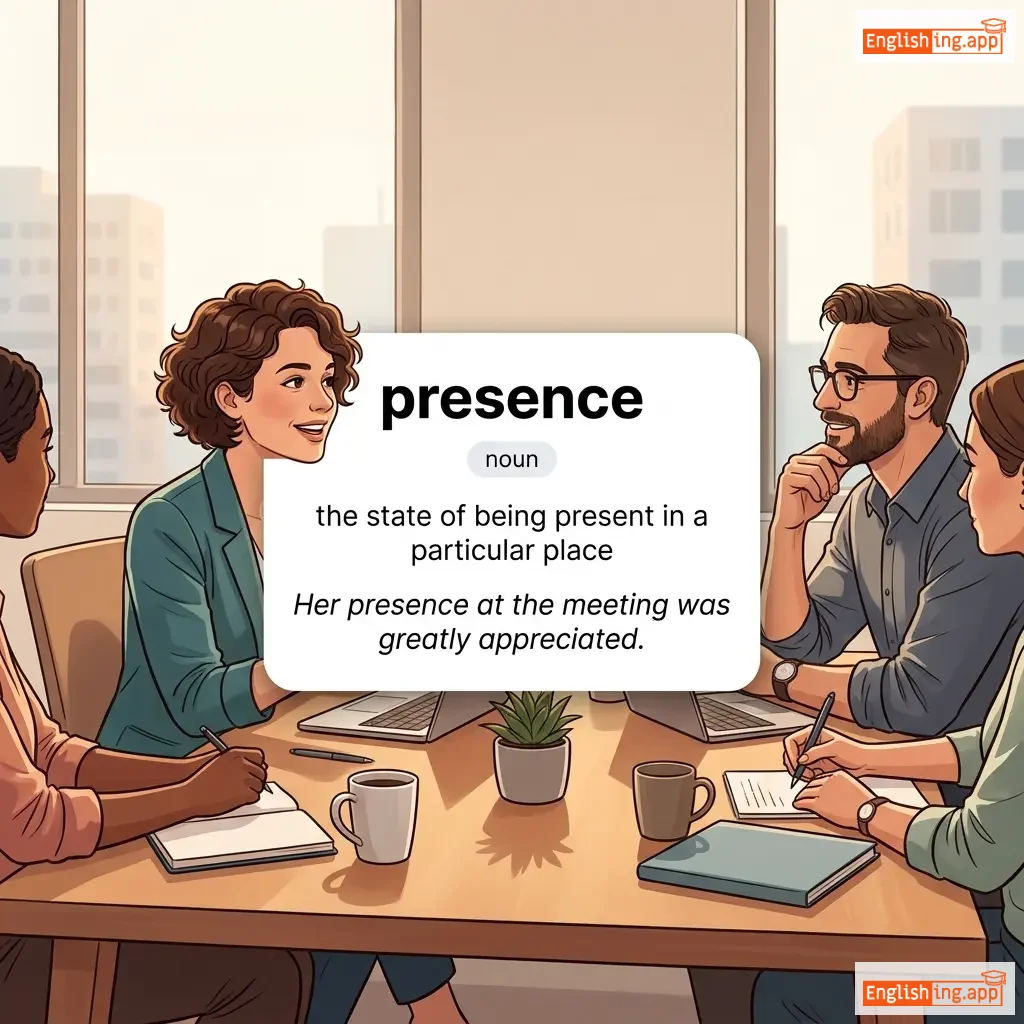
presence definition card — visual illustration of the meaning
noun
/ˈprɛzəns/
उपस्थिति (upasthiti)

the state of being present in a particular place

"Her presence at the meeting was greatly appreciated."

"उसकी उपस्थिति बैठक में बहुत सराही गई।" (Uski upasthiti baithak mein bahut sarahee gayi.)
noun, verb, adjective
/ˈprɛzənt/
प्रस्तुत (prastut)

existing or happening now; to give something to someone in a formal way

"She presented her report to the team yesterday."

"उसने कल टीम को अपनी रिपोर्ट प्रस्तुत की।" (Usne kal team ko apni report prastut ki.)
adjective
/prɪˈzentəbl/
दिखने योग्य; स्वीकार्य; सार्वजनिक रूप से देखने के लिए उपयुक्त (dikhne yogya; svīkārya; sārbajanik rūp se dekhne ke liye upayukt)

neat and suitable for being seen in public; acceptable in appearance

"Make sure you look presentable for the job interview."

"यह सुनिश्चित करें कि आप नौकरी के साक्षात्कार के लिए दिखने योग्य दिखें।" (yah nishchit karein ki aap naukari ke sākṣātkār ke liye dikhne yogya dikhein)
presentation definition card — visual illustration of the meaning
noun
/ˌprɛzənˈteɪʃən/
प्रस्तुति (prastuti)

the act of presenting something to an audience, typically involving speaking or showing information

"The presentation on digital marketing was very informative."

"डिजिटल मार्केटिंग पर प्रस्तुति बहुत जानकारीपूर्ण थी।" (Digital marketing par prastuti bahut jankari-purn thi.)
adjective
/prɪˈsɛnʃənt/
पूर्वानुमान करने वाला (purvanuman karne wala)

Having a feeling or sense of something about to happen; predictive.

"She was presentient of the coming disaster."

"वह आने वाली आपदा का पूर्वानुमान लगा रही थी।" (Vah aane wali aapda ka purvanuman laga rahi thi.)
noun
/prɪˈsɛntɪmənt/
पूर्वाभास (purvabhas)

An intuitive feeling about the future, especially of something bad about to happen.

"He had a strong presentiment that the plan would fail."

"उसे यह मजबूत पूर्वाभास था कि योजना विफल हो जाएगी।" (Use yah majboot purvabhas tha ki yojna viphal ho jaayegi.)
adverb
/ˈprɛzntli/
अभी (abhi)

at the current moment; now

"Presently, I am working on a new project."

"अभी, मैं एक नए प्रोजेक्ट पर काम कर रहा हूँ।" (Abhi, main ek naye project par kaam kar raha hoon.)
noun
/prɪˈzɛntmənt/
प्रस्तुति (prastuti)

The act of presenting something formally or officially; a formal statement or document.

"The lawyer made a presentment of the evidence to the court."

"वकील ने अदालत में साक्ष्य की प्रस्तुति की।" (Vakil ne adalat mein sakshya ki prastuti ki.)
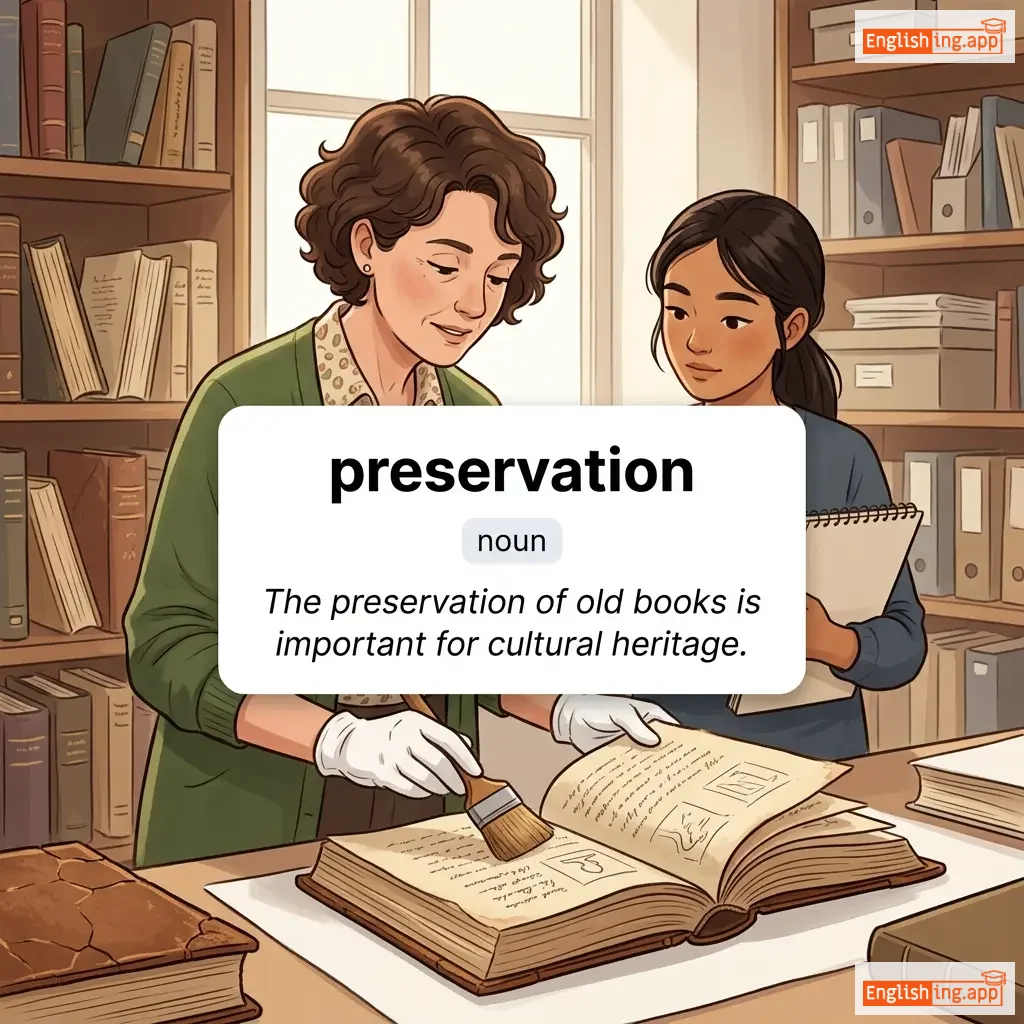
preservation definition card — visual illustration of the meaning
noun
/ˌprɛzəˈveɪʃən/
संरक्षण (sanrakshan)

The act of keeping something in its original state or protecting it from harm or decay.

"The preservation of old books is important for cultural heritage."

"पुरानी किताबों का संरक्षण सांस्कृतिक धरोहर के लिए महत्वपूर्ण है।" (Purani kitabon ka sanrakshan sanskritik dharohar ke liye mahatvapurn hai.)
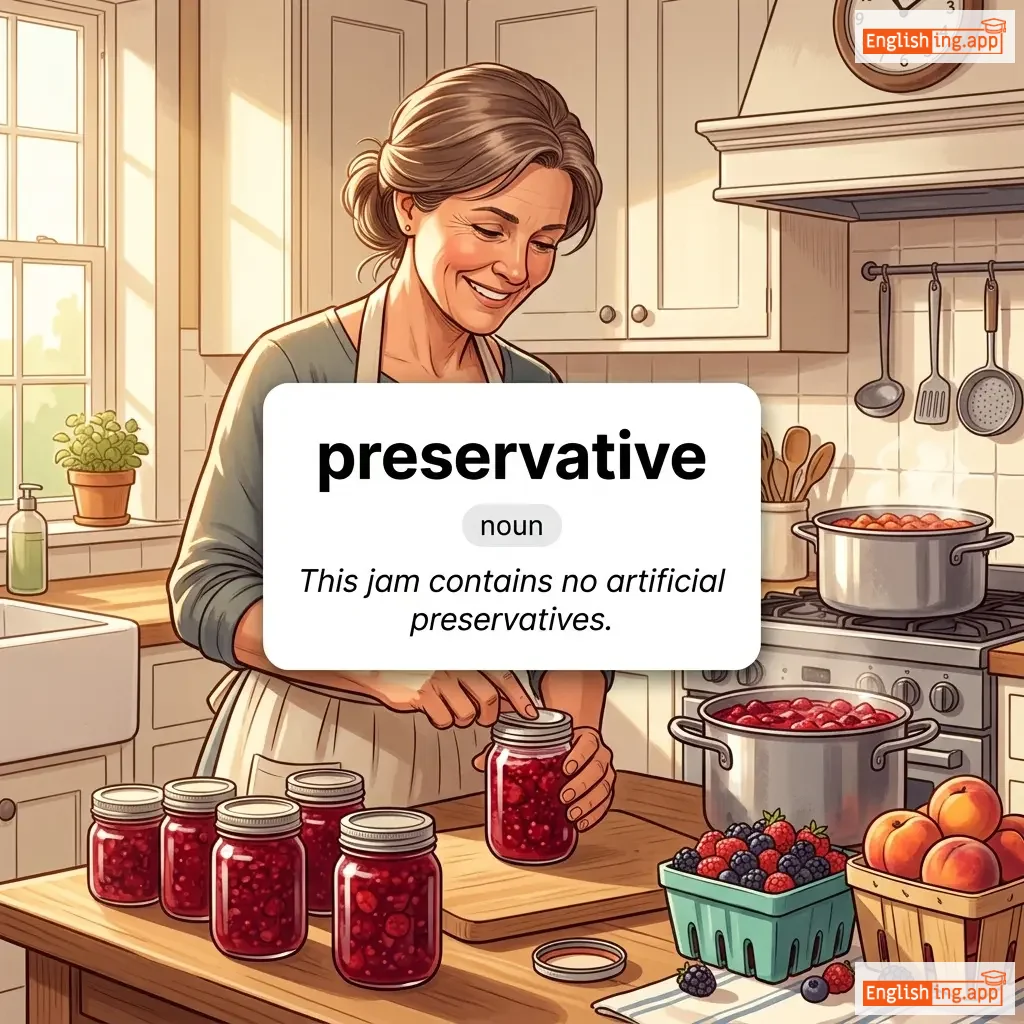
preservative definition card — visual illustration of the meaning
noun
/prɪˈzɜːrvətɪv/
संरक्षक (sanrakshak)

A substance used to prevent decay, spoilage, or deterioration in food or other materials.

"This jam contains no artificial preservatives."

"इस जैम में कोई कृत्रिम संरक्षक नहीं है।" (Is jam mein koi krtrim sanrakshak nahi hai.)
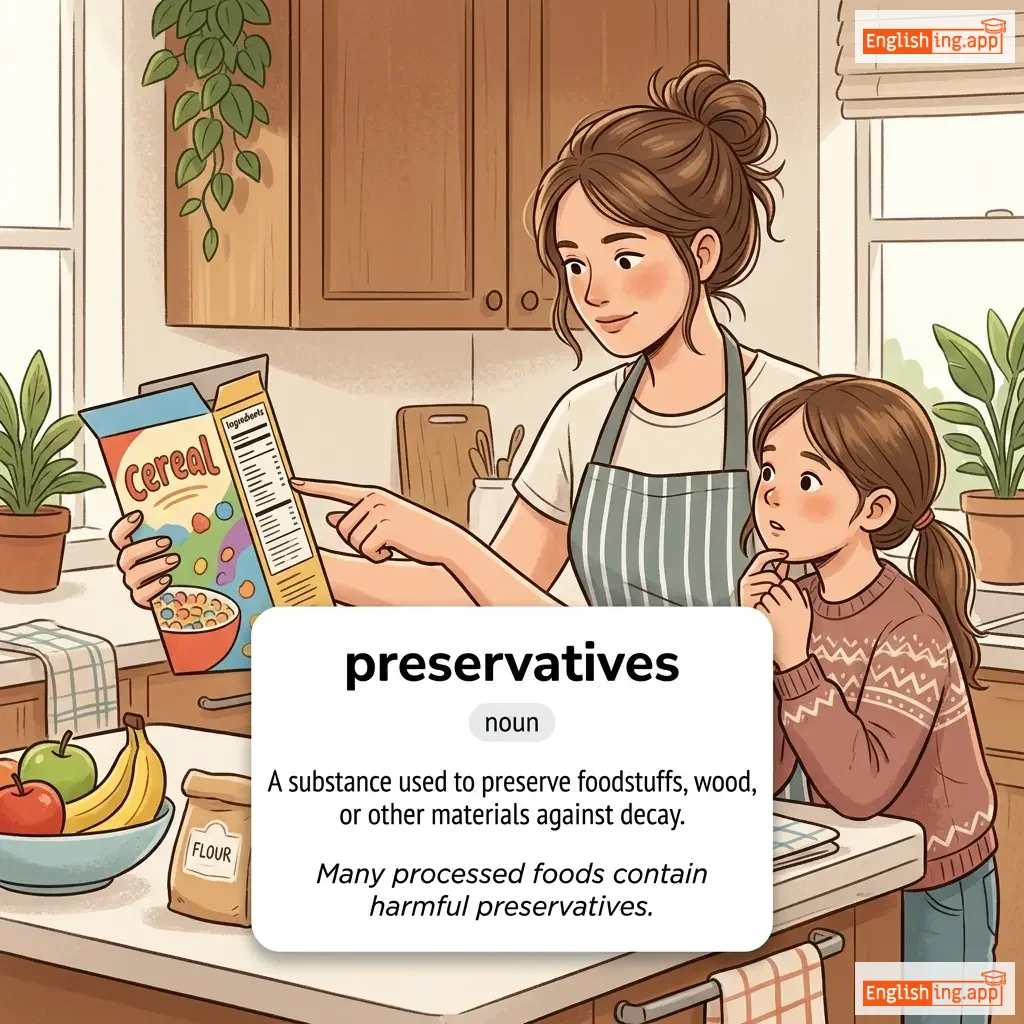
preservatives definition card — visual illustration of the meaning
noun
prɪˈzɜː.və.tɪvz
संरक्षणकारी पदार्थ (sanrakshankari padarth)

A substance used to preserve foodstuffs, wood, or other materials against decay.

"Many processed foods contain harmful preservatives."

"कई प्रसंस्कृत खाद्य पदार्थों में हानिकारक संरक्षक होते हैं।" (Kai prasanskrut khadya padarthon mein hanikarak sanrakshak hote hain.)
preserve definition card — visual illustration of the meaning
verb
/prɪˈzɜːrv/
संरक्षित करना (sanrakshit karna)

to keep something safe from harm, decay, or loss

"We must preserve our cultural heritage."

"हमें अपनी सांस्कृतिक धरोहर को संरक्षित करना चाहिए।" (Humein apni sanskritik dharohar ko sanrakshit karna chahiye.)
verb
/prɪˈzaɪd/
अध्यक्षता करना (adhyakshata karna)

to be in charge of a meeting, event, or organization

"She will preside over the meeting tomorrow."

"वह कल बैठक की अध्यक्षता करेगी।" (Wah kal baithak ki adhyakshata karegi.)
noun
/ˈprɛzɪdənsi/
राष्ट्रपति पद (rashtrapati pad)

the office or position of being a president

"He was elected to the presidency in 2020."

"उन्हें 2020 में राष्ट्रपति पद के लिए चुना गया था।" (Unhein 2020 mein rashtrapati pad ke liye chuna gaya tha.)
noun
/ˈprɛzɪdənt/
राष्ट्रपति (rashtrapati)

the elected head of a republican state

"The president addressed the nation last night."

"राष्ट्रपति ने पिछले रात राष्ट्र को संबोधित किया।" (Rashtrapati ne pichhle raat rashtr ko sambodhit kiya.)
adjective
/ˌprɛzɪˈdɛnʃəl/
राष्ट्रपति संबंधित (rashtrapati sambandhit)

relating to a president or presidency

"The presidential election is scheduled for next month."

"राष्ट्रपति चुनाव अगले महीने के लिए निर्धारित है।" (Rashtrapati chunav agle mahine ke liye nirdharit hai.)
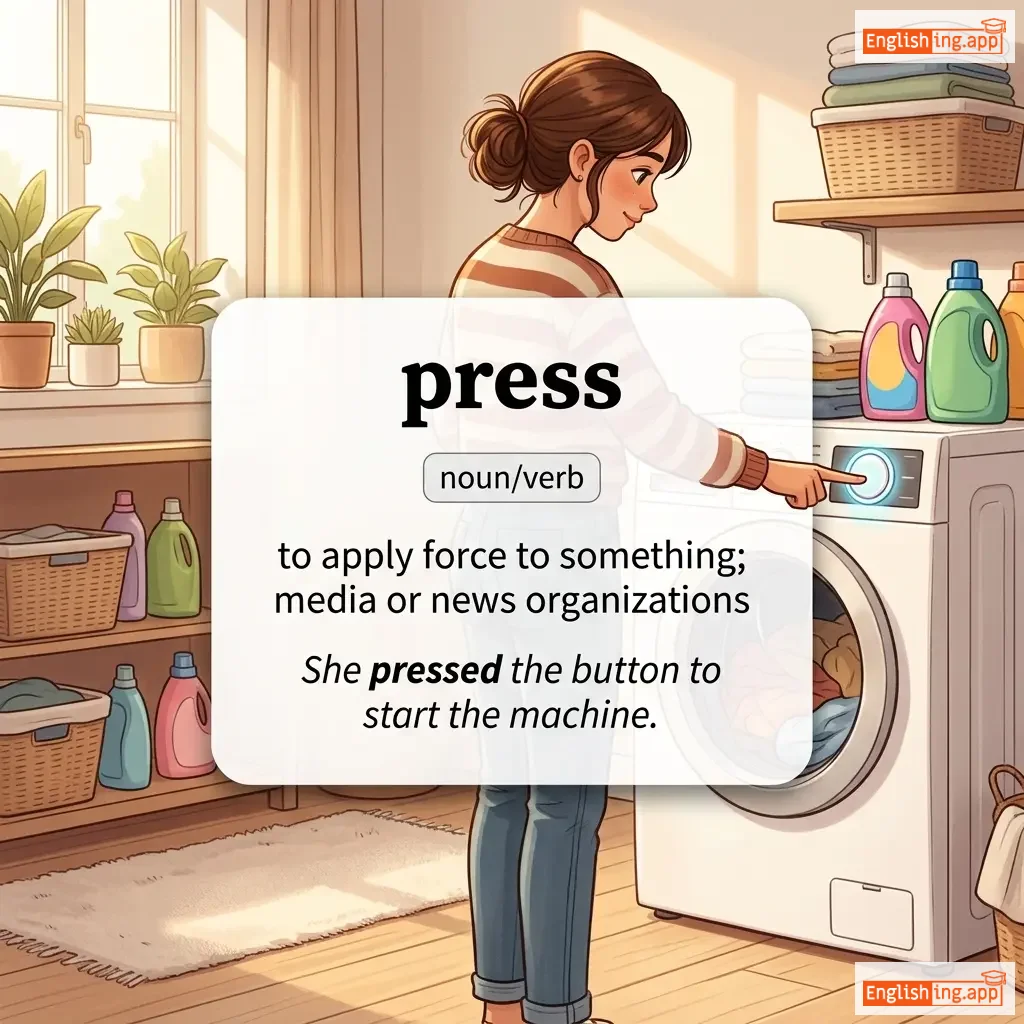
press definition card — visual illustration of the meaning
noun/verb
/prɛs/
पत्रिका / दबाना (patrika / dabana)

to apply force to something; media or news organizations

"She pressed the button to start the machine."

"उसने मशीन चालू करने के लिए बटन दबाया।" (Usne machine chalu karne ke liye button dabaya.)
adjective
/ˈprɛsɪŋ/
आपतकालीन (aapatkaaleen)

Requiring immediate attention or urgent action.

"The manager had to deal with several pressing issues at once."

"प्रबंधक को एक साथ कई आपतकालीन मुद्दों से निपटना पड़ा।" (Prabandhak ko ek saath kai aapatkaaleen muddon se nipatna pada.)
noun/verb
/ˈprɛʃər/
दबाव (dabaav)

the force applied to something or the feeling of stress or tension

"The pressure of the situation made him nervous."

"स्थिति का दबाव उसे घबराया हुआ बना रहा था।" (Sthiti ka dabaav use ghabraaya hua bana raha tha.)
noun
/ˈprɛʃər ˈkʊkər/
प्रेशर कुकर (pressure kukar)

a sealed cooking pot that uses steam pressure to cook food faster

"Using a pressure cooker reduces cooking time by more than half."

"प्रेशर कुकर का उपयोग करने से खाना पकाने का समय आधे से भी कम हो जाता है।" (pressure kukar ka upyog karne se khana pakane ka samay aadhe se bhi kam ho jata hai)
prestige definition card — visual illustration of the meaning
noun
/prɛˈstiːʒ/
सुख (sukh)

Widespread respect and admiration felt for someone or something based on their achievements or quality.

"Winning the award gave the company international prestige."

"जब उसे पुरस्कार मिला, तो वह अपनी खुशी को छुपा नहीं सकी।" (Jab use puraskar mila, to vah apni khushi ko chhupa nahi saki.)
adjective
/prɛsˈtɪdʒəs/
प्रतिष्ठित (pratishthit)

having a high reputation; respected

"Harvard University is one of the most prestigious universities in the world."

"हार्वर्ड यूनिवर्सिटी दुनिया के सबसे प्रतिष्ठित विश्वविद्यालयों में से एक है।" (Harvard University duniya ke sabse pratishthit vishwavidyalayon mein se ek hai.)
adverb
/prɪˈzjuːməbli/
संभावित रूप से (sambhavit roop se)

used to convey that something is assumed to be true though not known for certain

"Presumably, he forgot to send the email."

"संभवत: उसने ईमेल भेजना भूल गया।" (Sambhavit usne email bhejna bhool gaya.)
verb
/prɪˈzjuːm/
अनुमान लगाना (anumaan lagana)

To suppose something is true without proof; to take for granted.

"I presume she has already left for the meeting."

"मैं अनुमान लगाता हूँ कि वह पहले ही मीटिंग के लिए जा चुकी है।" (Main anumaan lagata hoon ki woh pehle hi meeting ke liye ja chuki hai.)
noun
/prɪˈzʌmpʃən/
कल्पना (kalpana)

An idea believed to be true without proof; an assumption or act of overconfidence.

"The presumption of his guilt was unfair."

"उसका दोषी होने का अनुमान अनुचित था।" (uska doshi hone ka anuman anuchit tha.)
adjective
/prɪˈzʌmptɪv/
अनुमानित (anumanit)

Based on probability or assumption rather than proof.

"She is the presumptive nominee for the party."

"वह पार्टी के लिए अनुमानित उम्मीदवार है।" (vah party ke liye anumanit ummidvaar hai.)
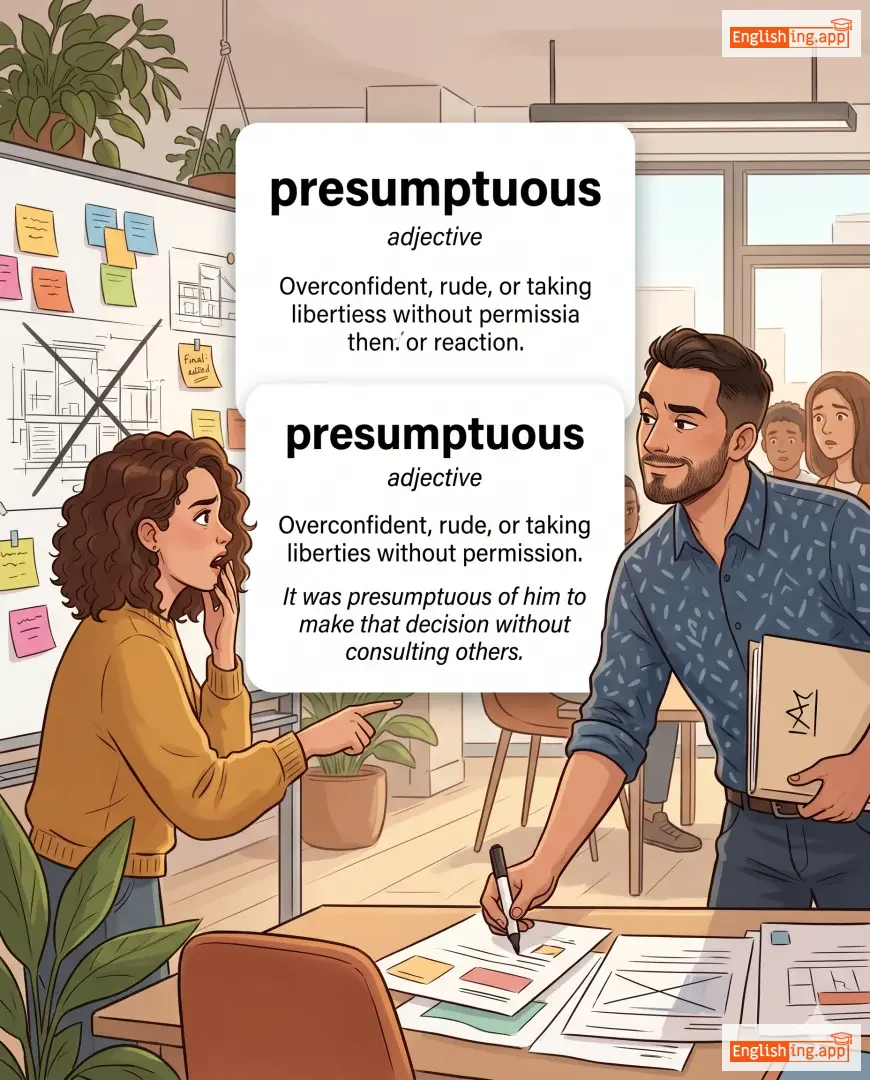
presumptuous definition card — visual illustration of the meaning
adjective
/prɪˈzʌmp.tʃu.əs/
अत्यधिक आत्मविश्वासी (atyadhik atmavishwasi)

Overconfident, rude, or taking liberties without permission.

"It was presumptuous of him to make that decision without consulting others."

"उसका बिना किसी से सलाह लिए वह निर्णय लेना अत्यधिक आत्मविश्वासपूर्ण था।" (uska bina kisi se salah liye vah nirnay lena atyadhik atmavishwaspoornt tha.)
noun
/prɪˈtens/
बना हुआ दिखावा (pretens)

an attempt to make something that is not the case appear true

"He made no pretence of being interested in the conversation."

"उसने बातचीत में रुचि रखने का कोई बनावटी दिखावा नहीं किया।" (usne baatcheet mein ruchi rakhne ka koi banavati dikhawa nahi kiya.)
verb
/prɪˈtɛnd/
ढोंग करना (dhong karna)

To act as if something is true when it is not.

"The children pretended to be superheroes."

"बच्चों ने सुपरहीरो बनने का ढोंग किया।" (bachchon ne superhero banne ka dhong kiya.)
noun
/ˈpriː.tɛns/ or /prɪˈtɛns/
नकली, बहाना (nakli, bahana)

A false appearance or claim; an act of pretending.

"His kindness was only a pretense to gain trust."

"उसकी दयालुता केवल विश्वास हासिल करने के लिए एक बहाना था।" (uski dayaulat keval vishwas hasil karne ke liye ek bahana tha.)
noun
/prɪˈtɛnʃən/
दावा, भ्रामक दिखावा (daava, bhraamak dikhawa)

A claim or assertion to something, often without justification; an attempt to impress by showing greater importance or talent than is actually possessed.

"His pretension to be an expert was quickly exposed."

"उसका विशेषज्ञ होने का दावा जल्दी ही उजागर हो गया।" (uska visheshagya hone ka daava jaldi hi ujagar ho gaya.)
adjective
/prɪˈtɛnʃəs/
ढोंगी (dhongi)

Attempting to impress by affecting greater importance, talent, culture, etc., than is actually possessed.

"The restaurant was stylish but far too pretentious for my taste."

"रेस्टोरेंट स्टाइलिश था, लेकिन मेरे स्वाद के लिए वह बहुत ढोंगी था।" (restaurant stylish tha, lekin mere swaad ke liye vah bahut dhongi tha.)
adjective
/ˌpriːtərˈnætʃərəl/
अलौकिक (aloukik)

Beyond what is normal or natural; extraordinary or supernatural.

"She had a preternatural ability to remain calm in any crisis."

"वह किसी भी संकट में शांत रहने की असाधारण क्षमता रखती थी।" (vah kisi bhi sankat mein shaant rehne ki asadharan kshamata rakhti thi.)
noun
/ˈpriːtɛkst/
बहाना, झूठा कारण (bahana, jhootha kaaran)

A false reason given to hide the real purpose or motive.

"He went out on the pretext of buying groceries."

"वह किराने का सामान खरीदने के बहाने बाहर गया।" (vah kiraane ka samaan kharidne ke bahaane baahar gaya.)
adjective
/ˈprɪti/
सुंदर (sundar)

Attractive in a delicate way without being truly beautiful.

"She looked pretty in her new dress."

"वह अपनी नई ड्रेस में सुंदर लग रही थी।" (Vah apni nai dress mein sundar lag rahi thi.)
verb
/prɪˈveɪl/
विजयी होना (vijayi hona)

To prove more powerful or superior; to be widespread or common.

"Justice will always prevail over injustice."

"न्याय हमेशा अन्याय पर विजयी होगा।" (nyay hamesha anyay par vijayi hoga.)
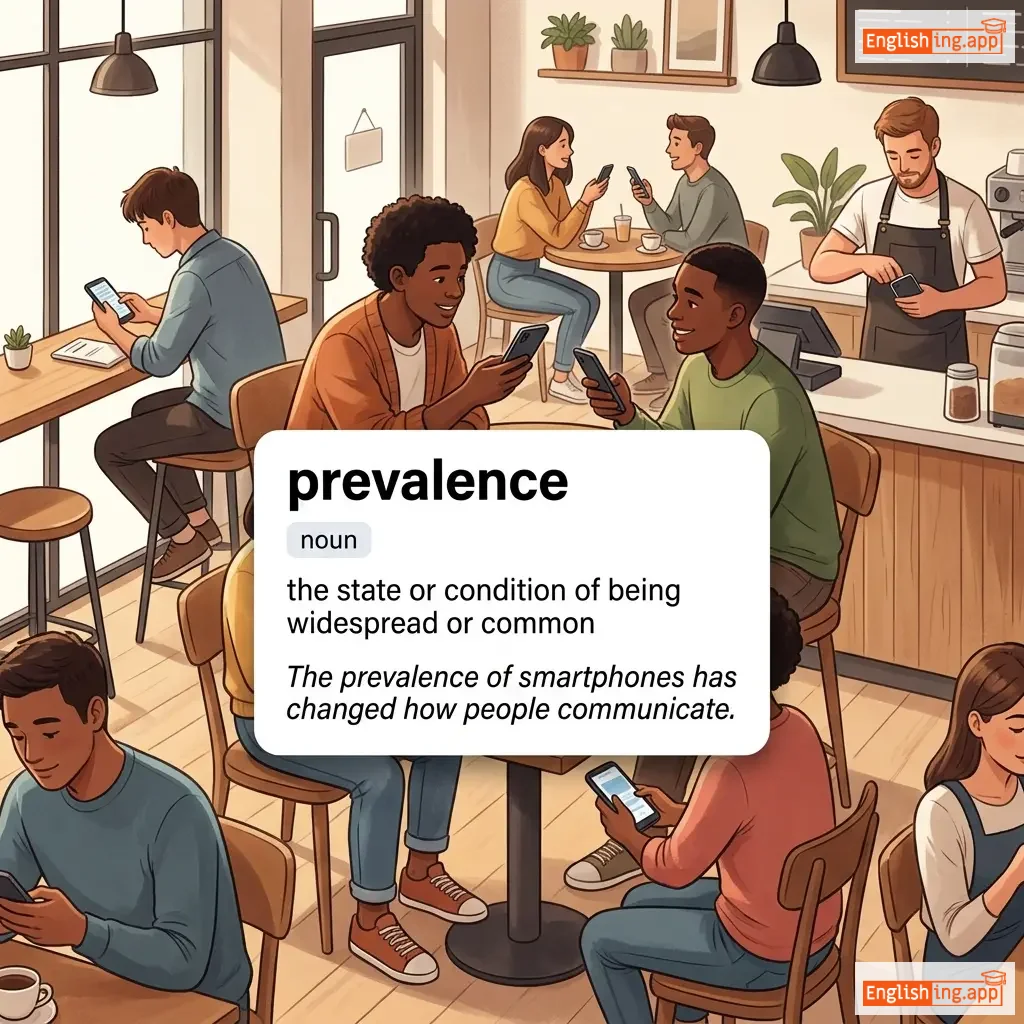
prevalence definition card — visual illustration of the meaning
noun
/ˈprɛvələns/
प्रचलन (prachalan)

the state or condition of being widespread or common

"The prevalence of smartphones has changed how people communicate."

"स्मार्टफोन्स का प्रचलन ने लोगों के संवाद करने के तरीके को बदल दिया है।" (smartphones ka prachalan ne logon ke samvaad karne ke tareeke ko badal diya hai.)