वोकैबुलरीज

इंग्लिश वोकैबुलरी डिस्कवर, लर्न और मास्टर करें

verb
/ˈpoʊ.lə.raɪz/
विभाजित करना, मतभेद उत्पन्न करना (vibhajit karna, matbhed utpann karna)

to divide or cause to divide into two sharply contrasting groups or sets of opinions or beliefs

"The controversial decision polarized public opinion."

"विवादास्पद निर्णय ने सार्वजनिक राय को दो विपरीत विचारों के बीच विभाजित कर दिया।" (Vivadaspad nirnay ne sarvajanik rai ko do vipreet vicharon ke beech vibhajit kar diya.)
adjective
/ˈpoʊləraɪzd/
विभाजित (vibhajit)

divided into two sharply contrasting groups or opinions

"The debate polarized the community on the issue of climate change."

"विवाद ने जलवायु परिवर्तन के मुद्दे पर समुदाय को विभाजित कर दिया।" (Vivaad ne jalvayu parivartan ke mudde par samudaay ko vibhajit kar diya.)
noun
/poʊl/
स्तंभ (stambh)

a long, slender, vertical object or structure, typically made of wood, metal, or another material

"They placed the flag on top of the pole."

"उन्होंने झंडे को पोल के ऊपर रखा।" (Unhone jhande ko pol ke upar rakha.)
noun
/pəˈlɛmɪk/
प्रतिकूल हमला (pratikul hamla)

a strong verbal or written attack on someone or something

"The article was a fierce polemic against the government's policies."

"लेख सरकार की नीतियों के खिलाफ एक कड़ा प्रतिकूल हमला था।" (lekh sarkar ki neetiyon ke khilaf ek kda pratikul hamla tha.)
adjective
/pəˈlɛmɪkəl/
विवादास्पद (vivaadaspad)

relating to or involving strongly critical or controversial writing or speech

"She wrote a polemical article challenging traditional beliefs."

"उसने पारंपरिक विश्वासों को चुनौती देने वाला एक विवादास्पद लेख लिखा।" (Usne paaramparik vishwason ko chunauti dene wala ek vivaadaspad lekh likha.)
noun
/pəˈlɛmɪks/
विवाद (vivaad)

the art or practice of engaging in controversial debate or dispute

"The conference was full of polemics on economic reforms."

"सम्मेलन आर्थिक सुधारों पर विवाद से भरा हुआ था।" (Sammelan aarthik sudharon par vivaad se bhara hua tha.)
noun
/ˈpoʊl.stɑːr/
ध्रुव तारा (dhruv tara)

a bright star that appears to stay in the same position in the sky and is used for navigation

"Sailors used the polestar to navigate across the ocean."

"नाविकों ने समुद्र पार करने के लिए पोलस्टार का उपयोग किया।" (naavikon ne samudra paar karne ke liye polstaar ka upyog kiya.)
noun
/pəˈliːs/
पुलिस (police)

a body of officers representing the civil authority of government

"The police arrived quickly to investigate the scene."

"पुलिस जल्दी से मौके पर पहुंची जांच करने के लिए।" (Police jaldi se moqe par pahunchi jaanch karne ke liye.)
noun
/pəˈliːsmən/
पुलिसकर्मी (poliskarmi)

a man whose job is to enforce the law and keep public order

"The policeman directed the traffic at the intersection."

"पुलिसकर्मी ने चौराहे पर ट्रैफिक का मार्गदर्शन किया।" (Poliskarmi ne chauraha par traffic ka margdarshan kiya.)
policy definition card — visual illustration of the meaning
noun
/ˈpɑːləsi/
नीति (niti)

a course or principle of action adopted or proposed by an organization or individual

"The company revised its privacy policy last month."

"कंपनी ने अपनी गोपनीयता नीति पिछले महीने संशोधित की।" (Kampani ne apni gopniyata niti pichle mahine sanshodhit ki.)
polish definition card — visual illustration of the meaning
verb
/ˈpɑːlɪʃ/
पॉलिश करना (polish karna)

to make smooth and shiny by rubbing; to improve or refine

"She needs to polish her shoes before the interview."

"उसे इंटरव्यू से पहले अपने जूते पॉलिश करने होंगे।" (Use interview se pehle apne jute polish karne honge.)
adjective
/ˈpɒlɪʃt/
परिष्कृत, परिष्कृत और शानदार (parishkrit, parishkrit aur shandaar)

refined, sophisticated, and elegant in appearance or behavior

"She gave a polished performance at the recital."

"उसने आयोजन में एक परिष्कृत प्रदर्शन दिया।" (Usne aayojan mein ek parishkrit pradarshan diya.)
adjective
/pəˈlaɪt/
खुशी (khushi)

Showing good manners and respect towards others.

"He was very polite to the elderly woman."

"उसे पुरस्कार मिलने पर अपनी खुशी छिपाना नहीं आया।" (Use puraskar milne par apni khushi chhupana nahi aaya.)
adverb
/pəˈlaɪt.li/
विनम्रता से; (vinmrata se)

in a respectful and considerate manner; courteously; with good manners

"She politely declined the invitation because she had other commitments."

"वह विनम्रता से निमंत्रण को अस्वीकार करती है क्योंकि उसके पास अन्य प्रतिबद्धताएँ हैं।" (vah vinmrata se nimantran ko asweekar karti hai kyunki uske paas anya pratibaddhataayein hain.)
adjective
/ˈpɒlɪtɪk/
चतुर, समझदार (chatur, samajhdar)

shrewd, prudent, or tactful in practical matters

"It was politic of him to remain silent during the argument."

"विवाद के दौरान चुप रहना उसकी समझदारी थी।" (Vivad ke dauran chup rehna uski samajhdari thi.)
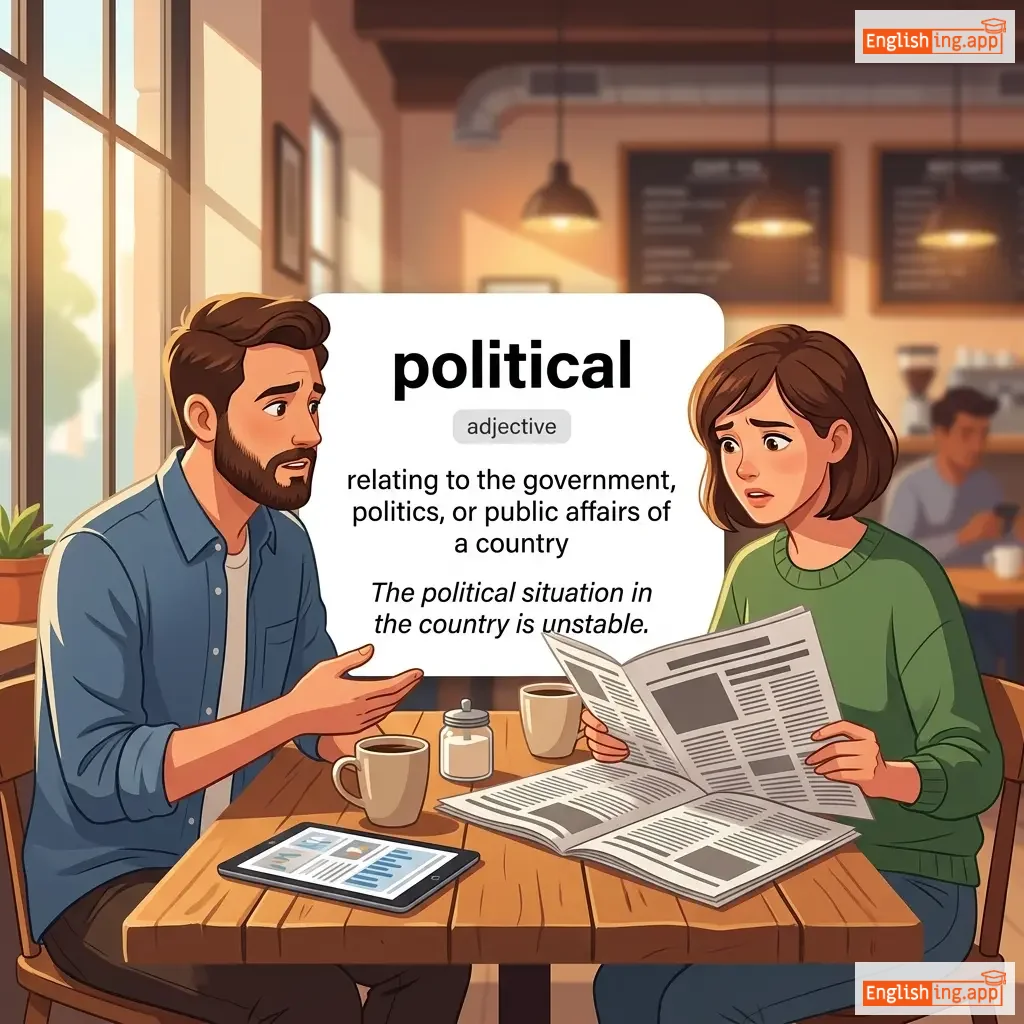
political definition card — visual illustration of the meaning
adjective
/pəˈlɪtɪkəl/
राजनीतिक (raajneetik)

relating to the government, politics, or public affairs of a country

"The political situation in the country is unstable."

"देश में राजनीतिक स्थिति अस्थिर है।" (Desh mein raajnaitik sthiti asthir hai.)
adverb
/pəˈlɪtɪkəli/
राजनीतिक रूप से (rajnitik roop se)

in a way that relates to politics or government

"The country is politically divided between two major parties."

"देश दो प्रमुख दलों के बीच राजनीतिक रूप से विभाजित है।" (Desh do pramukh dalon ke beech rajnitik roop se vibhajit hai.)
noun
/pəˈlɪtɪʃən/
राजनीतिज्ञ (raajneetijñ)

a person who is involved in politics, especially as a profession

"The politician promised to improve the economy."

"राजनीतिज्ञ ने अर्थव्यवस्था में सुधार का वादा किया।" (Raajneetijñ ne arthvyavastha mein sudhaar ka vaada kiya.)
noun
/ˈpɒlɪtɪks/
राजनीति (rajniti)

activities related to the governance of a country or area, especially the debate between parties having power

"Politics often involves making difficult decisions."

"राजनीति अक्सर कठिन निर्णय लेने से संबंधित होती है।" (Rajniti aksar kathin nirnay lene se sambandhit hoti hai.)
noun
/ˈpɒlɪti/
राजनीति, शासन व्यवस्था (raajneeti, shaasan vyavastha)

an organized society or form of government

"The ancient Greek polity had a system of city-states."

"प्राचीन ग्रीक राजनीति में नगर-राज्य व्यवस्था थी।" (Prachin Greek rajniti mein nagar-raajya vyavastha thi.)
noun/verb
/pəʊl/
मतदान (matdan)

a survey of public opinion or voting in an election

"The poll revealed that most people favored the new policy."

"सर्वेक्षण ने यह खुलासा किया कि अधिकांश लोग नई नीति का समर्थन करते थे।" (Sarvekshan ne yah khulasa kiya ki adhikansh log nayi niti ka samarthan karte the.)
noun
/ˈpɒlən/
पराग (parag)

fine powder produced by flowers, used in fertilization

"Bees collect pollen from flowers to make honey."

"मधुमक्खियाँ शहद बनाने के लिए फूलों से पराग इकट्ठा करती हैं।" (Madhumakkhiyaan shahad banane ke liye phoolon se parag ikattha karti hain.)
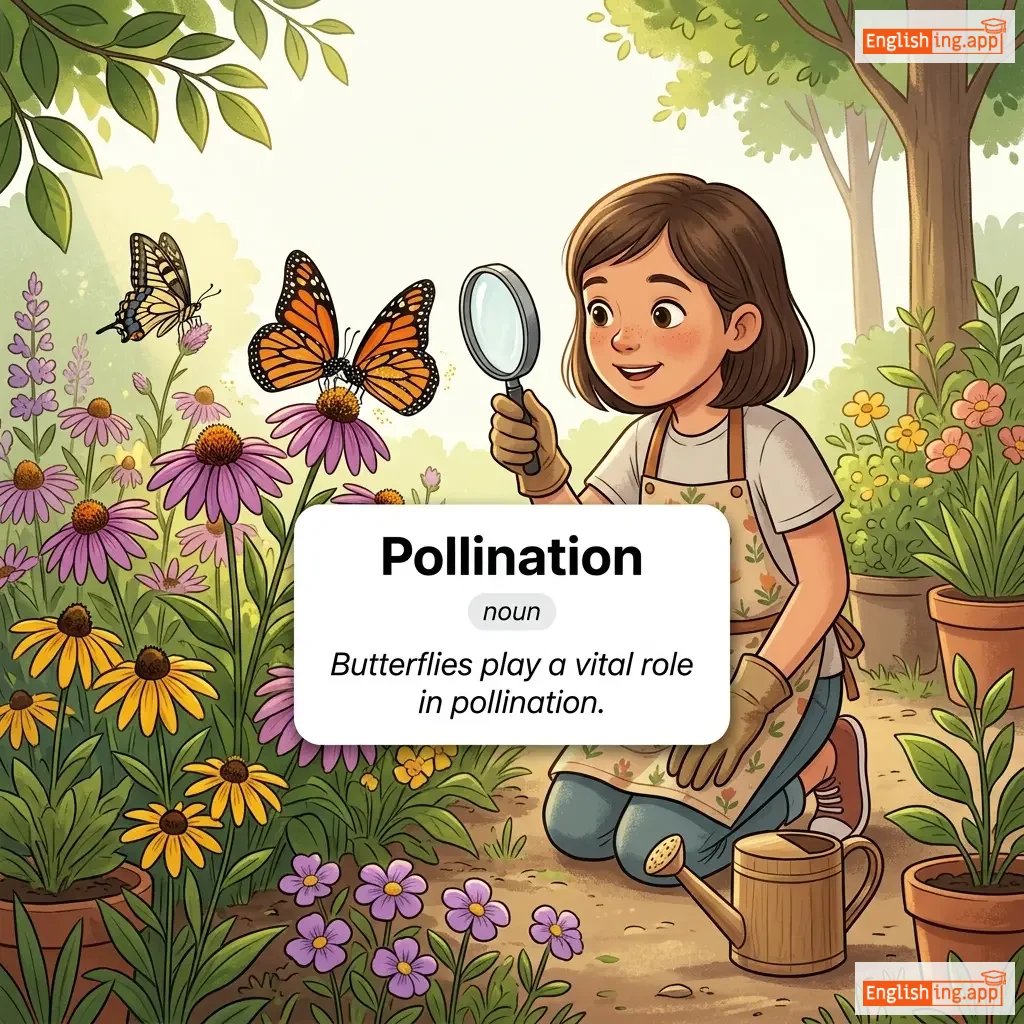
Pollination definition card — visual illustration of the meaning
noun
ˌpɒlɪˈneɪʃən
परागण (paragan)

The process by which pollen is transferred from flowers, enabling plant reproduction.

"Butterflies play a vital role in pollination."

"तितलियाँ परागण में महत्वपूर्ण भूमिका निभाती हैं।" (Titliyan paragan mein mahatvapurn bhumika nibhaati hain.)
noun
/ˈpoʊlstər/
जनमत सर्वेक्षणकर्ता (janmat surveykarnata)

a person or organization that conducts surveys to gauge public opinion

"The pollster predicted a close election outcome."

"पोल्स्टर ने एक करीबी चुनाव परिणाम की भविष्यवाणी की।" (Pollster ne ek kareebi nirvachan parinaam ki bhavishyavani ki.)
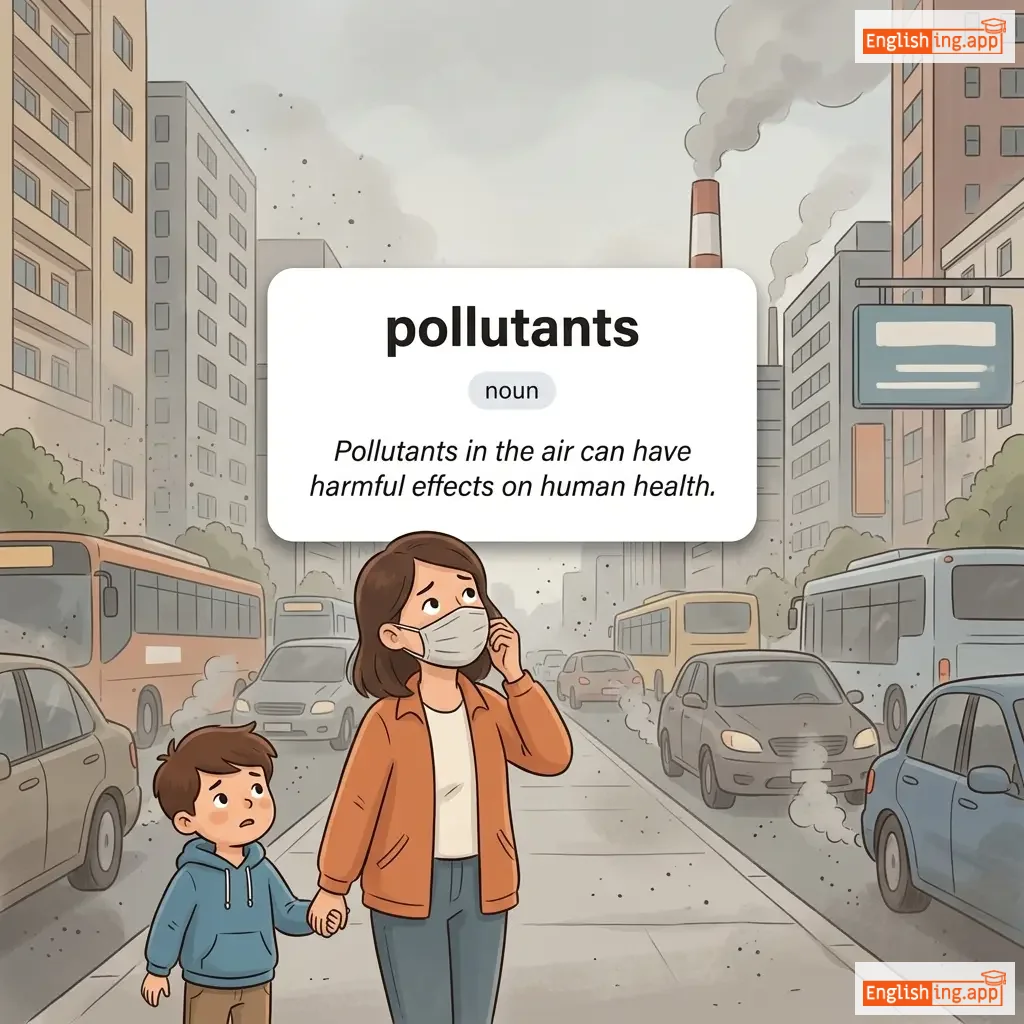
pollutants definition card — visual illustration of the meaning
noun
/pəˈluːtənts/
प्रदूषक (pradushak)

Harmful substances that contaminate the environment, including air, water, and soil, potentially causing damage to living organisms and ecosystems.

"Pollutants in the air can have harmful effects on human health."

"वायु में प्रदूषक मानव स्वास्थ्य पर हानिकारक प्रभाव डाल सकते हैं।" (Vayu mein pradushak manav swasthya par hanikarak prabhav daal sakte hain.)
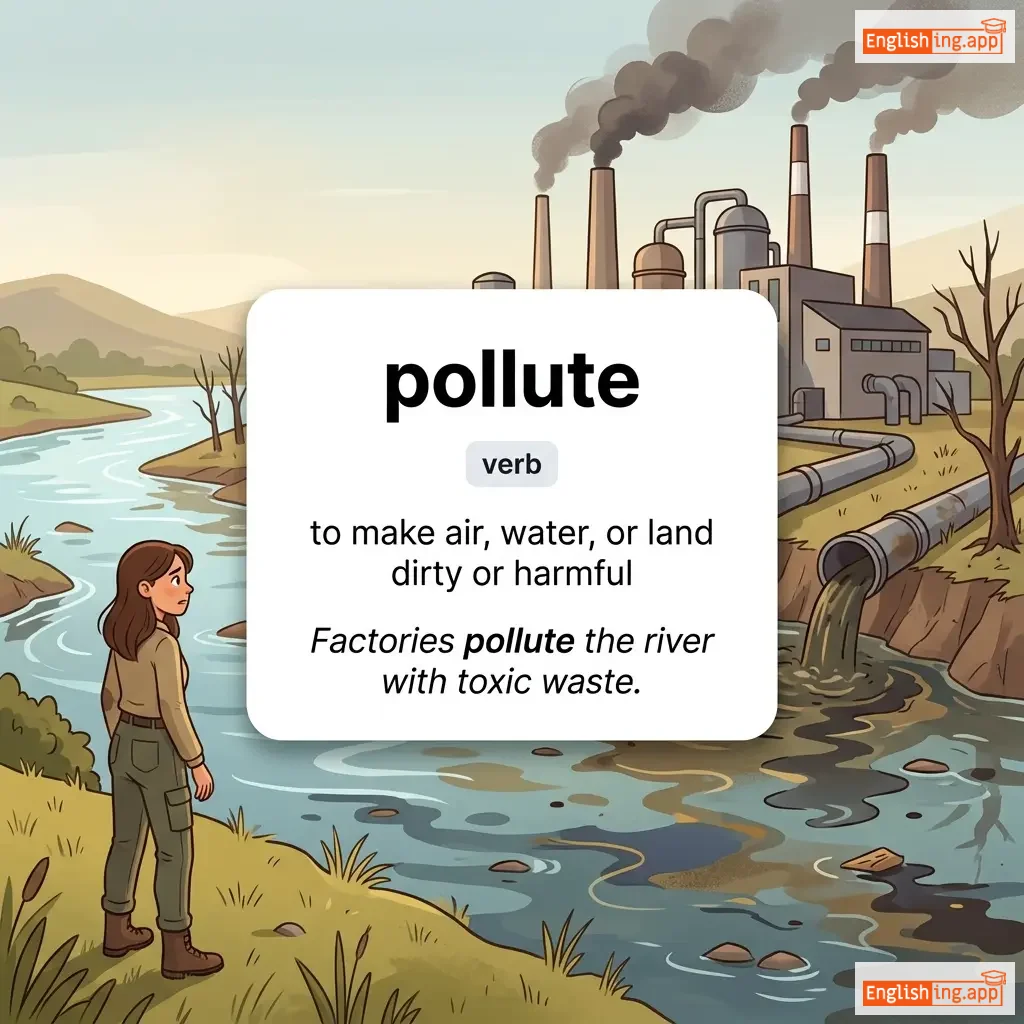
pollute definition card — visual illustration of the meaning
verb
/pəˈluːt/
प्रदूषित करना (pradushit karna)

to make air, water, or land dirty or harmful

"Factories pollute the river with toxic waste."

"फैक्ट्रियां नदी को जहरीले कचरे से प्रदूषित करती हैं।" (Factories nadi ko zahreele kachre se pradushit karti hain.)
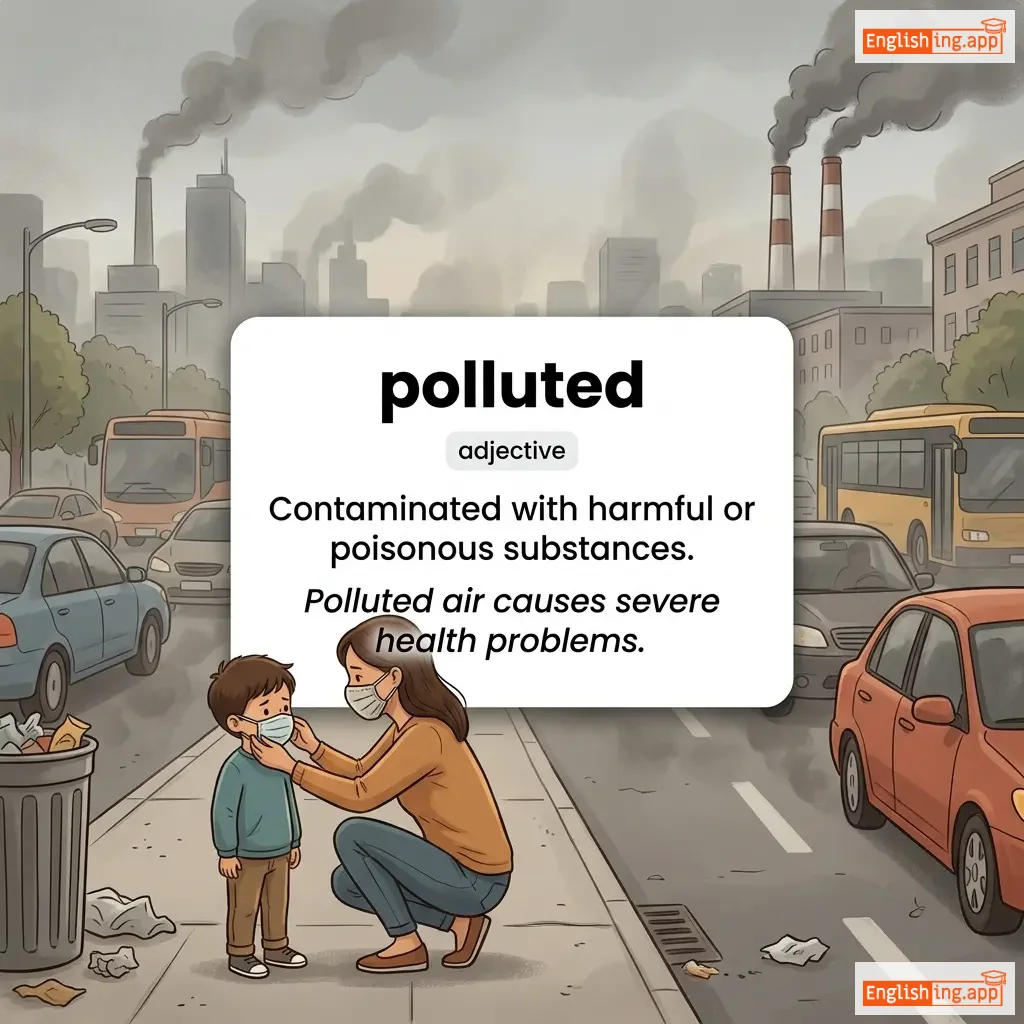
polluted definition card — visual illustration of the meaning
adjective
/pəˈluː.tɪd/
प्रदूषित (pradushit)

Contaminated with harmful or poisonous substances.

"Polluted air causes severe health problems."

"प्रदूषित हवा गंभीर स्वास्थ्य समस्याएं पैदा करती है।" (Pradushit hawa gambhir swasthya samasyaen paida karti hai.)
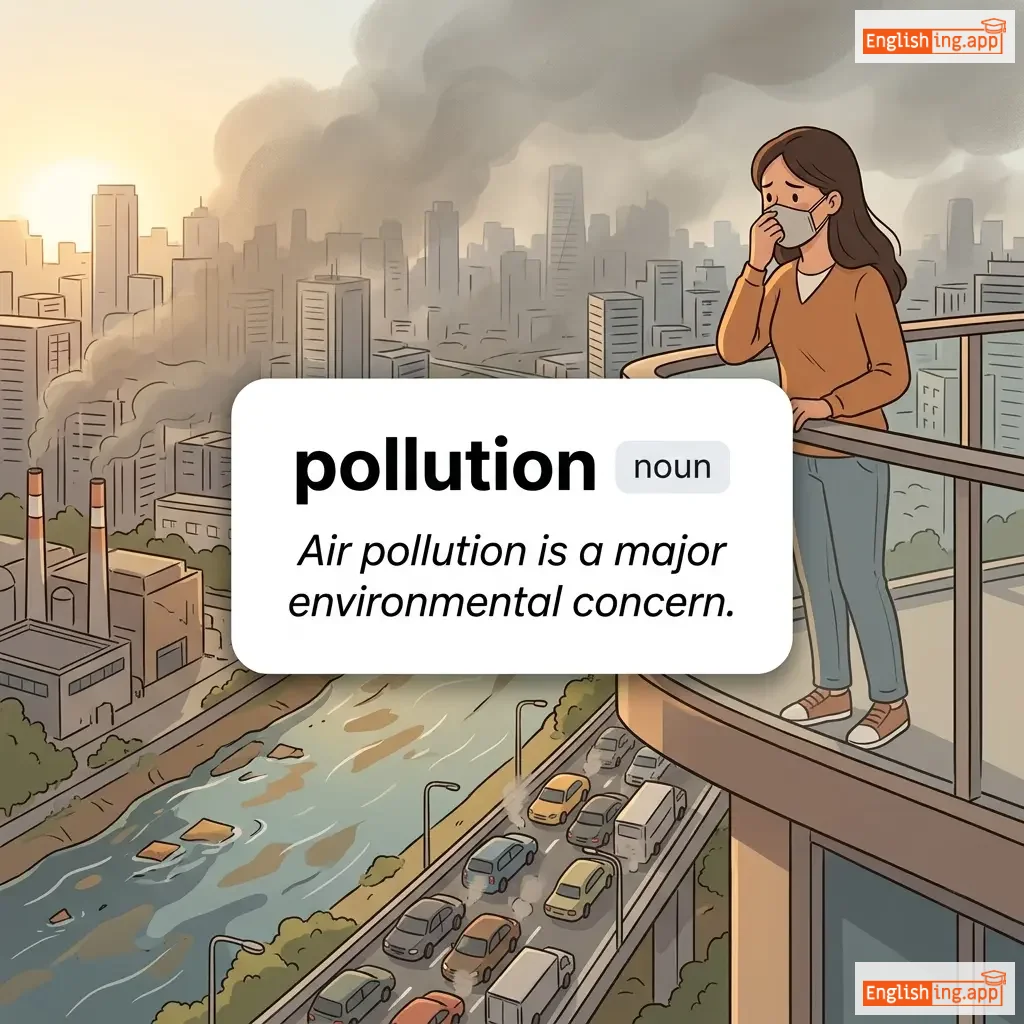
pollution definition card — visual illustration of the meaning
noun
/pəˈlʊʃən/
प्रदूषण (pradushan)

the presence of harmful substances in the environment, especially the air, water, or soil

"Air pollution is a major environmental concern."

"हवा प्रदूषण एक प्रमुख पर्यावरणीय चिंता है।" (Hawa pradushan ek pramukh paryavaranik chinta hai.)
adjective
/ˌpɒliˈæn.ɪ.ɪʃ/
अत्यधिक आशावादी (atyadhik ashaavadi)

overly or blindly optimistic

"Her pollyannaish attitude ignored the obvious problems."

"उसका अत्यधिक आशावादी दृष्टिकोण स्पष्ट समस्याओं की अनदेखी करता था।" (Uska atyadhik ashaavadi drishtikon spashṭ samasyaon ki andekhi karta tha.)
noun
/pəˈtruːn/
कायर (kayar)

a cowardly person

"He acted like a poltroon during the crisis."

"उसने संकट के दौरान एक कायर की तरह बर्ताव किया।" (Usne sankat ke dauran ek kayar ki tarah bartav kiya.)
noun
/ˈpɒliˌɑːrki/
बहुल शासकत्व (bahul shaskatv)

government by many people

"Polyarchy allows multiple parties to share power."

"पोलियार्की कई पार्टियों को सत्ता साझा करने की अनुमति देती है।" (Polyarchy kai partyon ko satta saanjha karne ki anumati deti hai.)
noun
/ˈpɒliˌkreɪsi/
बहुसंप्रभुता (bahusamprabhuta)

rule by many; government by multiple authorities

"The nation experienced a polycracy after decentralization reforms."

"देश ने विकेन्द्रीकरण सुधारों के बाद बहुसंप्रभुता का अनुभव किया।" (Desh ne viksendrikaran sudharon ke baad bahusamprabhuta ka anubhav kiya.)
noun
/ˈpɒlɪɡæmɪst/
बहुविवाह करने वाला व्यक्ति (bahuvivah karne wala vyakti)

a person who has more than one spouse at the same time

"The polygamist had three wives living in different houses."

"पॉलीगैमिस्ट के पास तीन पत्नियाँ थीं जो अलग-अलग घरों में रहती थीं।" (Polygamist ke paas teen patniyan thin jo alag-alag gharon mein rahti thin.)
noun
/ˈpɒlɪɡəmi/
बहुविवाह (bahuvivah)

the practice of having more than one spouse at the same time

"Polygamy is legal in some countries but frowned upon in others."

"कुछ देशों में पॉलिगामी कानूनी है, लेकिन कुछ देशों में इसे गलत माना जाता है।" (Kuch deshon mein polygamy kanooni hai, lekin kuch deshon mein ise galat maana jaata hai.)
noun
/ˈpɒlɪɡlɒt/
बहुभाषी व्यक्ति (bahubhashi vyakti)

a person who knows and can use several languages

"She is a polyglot, fluent in English, Spanish, and Bengali."

"वह एक बहुभाषी व्यक्ति है, जो अंग्रेजी, स्पैनिश और हिंदी में निपुण है।" (Wah ek bahubhashi vyakti hai, jo angrezi, spanish aur hindi mein nipun hai.)
noun
/ˈpɒlɪɡɒn/
बहुपक्षीय आकृति (bahupakshiya aakriti)

a flat shape with three or more straight sides

"The artist drew a colorful polygon on the canvas."

"कलाकार ने कैनवस पर रंगीन बहुपक्षी आकृति बनाई।" (Kalaakar ne canvas par rangeen bahupakshi aakriti banai.)
noun
/ˌpɒlɪˈhiːdrən/
बहुपृष्ठीय ठोस वस्तु (bahuprishthiya thos vastu)

a solid object with flat polygonal faces, straight edges, and vertices

"The mathematician studied a complex polyhedron model."

"गणितज्ञ ने एक जटिल पॉलीहेड्रन मॉडल का अध्ययन किया।" (Ganitgy ne ek jatil polyhedron model ka adhyayan kiya.)
noun
/ˈpɒl.i.mæθ/
बहुशास्त्रज्ञ (bahushastragya)

a person with knowledge of many different subjects

"Leonardo da Vinci was a true polymath, excelling in art, science, and engineering."

"लियोनार्डो दा विंची एक सच्चे बहुशास्त्रज्ञ थे, जो कला, विज्ञान और इंजीनियरिंग में उत्कृष्ट थे।" (Leonardo da Vinci ek sachche bahushastragya the, jo kala, vigyan aur engineering mein utkrsht the.)
noun
/ˌpɒl.iˈsɪl.ə.bəl/
बहु-स्वरवर्णयुक्त शब्द (bahu-swarnavarnayukt shabd)

a word with more than one syllable

"The word 'elephant' is a polysyllable because it has three syllables."

"'एलीफैंट' एक बहु-स्वरवर्णयुक्त शब्द है क्योंकि इसमें तीन स्वर होते हैं।" ('Elephant' ek bahu-swarnavarnayukt shabd hai kyonki ismein teen swar hote hain.)
noun
/ˌpɒl.iˈtek.nɪk/
पॉलिटेक्निक (politeknik)

an educational institution offering practical and technical courses

"She studied engineering at a well-known polytechnic in her city."

"उसने अपनी शहर में एक प्रसिद्ध पॉलिटेक्निक में इंजीनियरिंग की पढ़ाई की।" (Usne apni shahar mein ek prasiddh politeknik mein engineering ki padhai ki.)
noun
/ˈpɒl.iˌθi.ɪz.əm/
पॉलीथीज़म (politheezam)

the belief in or worship of multiple gods

"Ancient Greeks practiced polytheism, worshiping gods like Zeus and Athena."

"प्राचीन ग्रीकों ने पॉलीथीज़म का अभ्यास किया, ज़्यूस और एथीना जैसे देवताओं की पूजा करते थे।" (Prachin Greekon ne politheezam ka abhyas kiya, Zeus aur Athena jaise devtaon ki pooja karte the.)
noun
/ˈpɒm.ɪˌɡræn.ɪt/
अनार (anar)

a round fruit with thick red skin containing many small red seeds with juice

"The pomegranate seeds were sweet and refreshing."

"अनार के दाने मीठे और ताजे थे." (anar ke daane meethe aur taaje the.)
noun
/ˈpɒmfrɪt/
पॉम्फ्रेट मछली (pomfret machhli)

A deep-bodied marine fish with silvery scales, popular in Asian cuisine

"The restaurant serves delicious pomfret curry with rice."

"रेस्टोरेंट स्वादिष्ट पॉम्फ्रेट करी चावल के साथ परोसता है।" (restorent swadisht pomfret kari chawal ke sath parosta hai)
noun
/ˈpɒm.əl/
तलवार या सवारी के हैंडल का गोल हिस्सा (talwar ya sawari ke handle ka gol hissa)

the rounded knob on the handle of a sword or saddle

"He gripped the sword firmly by the pommel."

"उसने तलवार को मजबूती से पॉमेल से पकड़ा।" (Usne talwar ko majbooti se pommel se pakda.)
pomodoro definition card — visual illustration of the meaning
noun
/ˌpɒməˈdɔːrəʊ/
पोमोडोरो (pomodoro)

A time management technique that uses a timer to break down work into intervals.

"The Pomodoro technique improves productivity."

"पोमोडोरो तकनीक उत्पादकता में सुधार करती है।" (Pomodoro takneek utpadakta mein sudhaar karti hai.)
noun
/pɒmp/
धूमधाम, शोभा (dhoomdhaam, shobha)

ceremonial display or splendor; grandeur

"The graduation ceremony was full of pomp and circumstance."

"स्नातक समारोह धूमधाम और शोभा से भरा था।" (Snatak samaroh dhoomdhaam aur shobha se bhara tha.)
noun
/pɒmˈpɒsəti/
अहमकता, घमंड (ahankata, ghamand)

self-important behavior or exaggerated dignity

"His speech was full of pomposity and arrogance."

"उसकी स्पीच पॉम्पोसिटी और घमंड से भरी हुई थी।" (Uski speech pomposity aur ghamand se bhari hui thi.)
adjective
/ˈpɒmpəs/
अभिमानी (abhimani)

exaggeratedly self-important; ostentatious

"The manager had a pompous attitude that annoyed his team."

"मैनेजर का अभिमानी रवैया उसके टीम को परेशान कर रहा था।" (Manager ka abhimani ravaiya uske team ko pareshan kar raha tha.)
noun
/pɒnd/
तालाब (talab)

a small area of still water, smaller than a lake

"The children were feeding ducks at the pond."

"बच्चे तालाब में बतखों को खिला रहे थे।" (bachche talab mein batkhon ko khila rahe the.)
verb
/ˈpɒndər/
गंभीरता से सोचना (gambhirta se sochna)

to think about something carefully

"She pondered over the meaning of the poem."

"वह कविता के अर्थ पर गंभीरता से विचार कर रही थी।" (Vah kavita ke arth par gambhirta se vichar kar rahi thi.)