वोकैबुलरीज

इंग्लिश वोकैबुलरी डिस्कवर, लर्न और मास्टर करें

noun
/ˈfɪzɪks/
भौतिकी (bhoutiki)

the natural science that studies matter, energy, and the interactions between them

"She decided to major in physics at the university."

"उसने विश्वविद्यालय में भौतिकी में मेजर करने का फैसला किया।" (Usne vishwavidyalay mein bhoutiki mein major karne ka faisla kiya.)
noun
/ˌfɪzɪˈɑːkrəsi/
भौतिकवाद (bhautikvaad)

an economic theory that land and its natural products are the source of wealth

"Physiocracy emphasized the importance of agriculture in national wealth."

"भौतिकवाद ने राष्ट्रीय संपत्ति में कृषि के महत्व पर बल दिया।" (Bhautikvaad ne rashtriya sampatti mein krishi ke mahatva par bal diya.)
noun
/ˌfɪziˈɒnəmi/
चेहरे की संरचना अध्ययन (chehre ki sanrachna adhyayan)

the study of facial features to judge character or personality

"He believed in physiognomy and tried to read people's personalities from their faces."

"उसे चेहरे की संरचना में विश्वास था और वह लोगों के व्यक्तित्व को उनके चेहरों से पढ़ने की कोशिश करता था।" (Use chehre ki sanrachna mein vishwas tha aur vah logon ke bektitva ko unke chehron se padhne ki koshish karta tha.)
noun
/ˌfɪziˈɑːɡrəfi/
भू-विश्लेषण (bhu-vishleshan)

the study of the physical features of the earth's surface

"He specialized in physiography to understand the landscape of the region."

"उन्होंने क्षेत्र के परिदृश्य को समझने के लिए फिजियोलॉजी में विशेषज्ञता प्राप्त की।" (Unhone kshetra ke paridrishya ko samajhne ke liye physiography mein visheshagya banne ki koshish ki.)
physiological definition card — visual illustration of the meaning
adjective
/ˌfɪziəˈlɑːdʒɪkəl/
शारीरिक प्रक्रिया संबंधी (shaareek prakriya sambandhi)

relating to the functions and processes of living organisms

"The study focused on the physiological responses to stress."

"अध्यान ने तनाव के प्रति शारीरिक प्रतिक्रियाओं पर ध्यान केंद्रित किया।" (Adhyayan ne tanav ke prati shaareek pratikriyaon par dhyaan kendrit kiya.)
noun
/ˌfɪziˈɑːlədʒi/
शरीरविज्ञान (shareervigyan)

the scientific study of the functions and mechanisms in a living system

"She is majoring in human physiology at the university."

"वह विश्वविद्यालय में मानव शरीरविज्ञान में मेजर कर रही है।" (Vah vishwavidyalay mein manav shareervigyan mein major kar rahi hai.)
noun
/fɪˈziːk/
शारीरिक संरचना (shaareekik sanrachna)

the form, size, and development of a person's body

"He has an athletic physique due to years of training."

"उसे वर्षों की ट्रेनिंग के कारण एक एथलेटिक फिजीक है।" (Use varshon ki training ke kaaran ek athletic physique hai.)
phytochemicals definition card — visual illustration of the meaning
noun
/ˌfaɪ.təʊˈkem.ɪ.kəlz/
फाइटोकेमिकल्स (phytochemicals)

Natural chemical compounds produced by plants that provide health benefits beyond basic nutrition, often having antioxidant properties.

"Phytochemicals in green tea help reduce inflammation."

"हरे चाय में फाइटोकेमिकल्स सूजन को कम करने में मदद करते हैं।" (hare chai mein phytochemicals soojan ko kam karne mein madad karte hain.)
phytonutrient definition card — visual illustration of the meaning
noun
ˈfaɪ.təʊˌnjuː.tri.ənt
फाइटोन्यूट्रिएंट (phytonutrient)

Chemical compounds produced by plants that are beneficial to human health but not essential nutrients.

"Broccoli is rich in phytonutrients that enhance immunity."

"ब्रोकोली में फाइटोन्यूट्रिएंट्स होते हैं जो इम्यूनिटी को बढ़ाते हैं।" (Broccoli mein phytonutrients hote hain jo immunity ko badhate hain.)
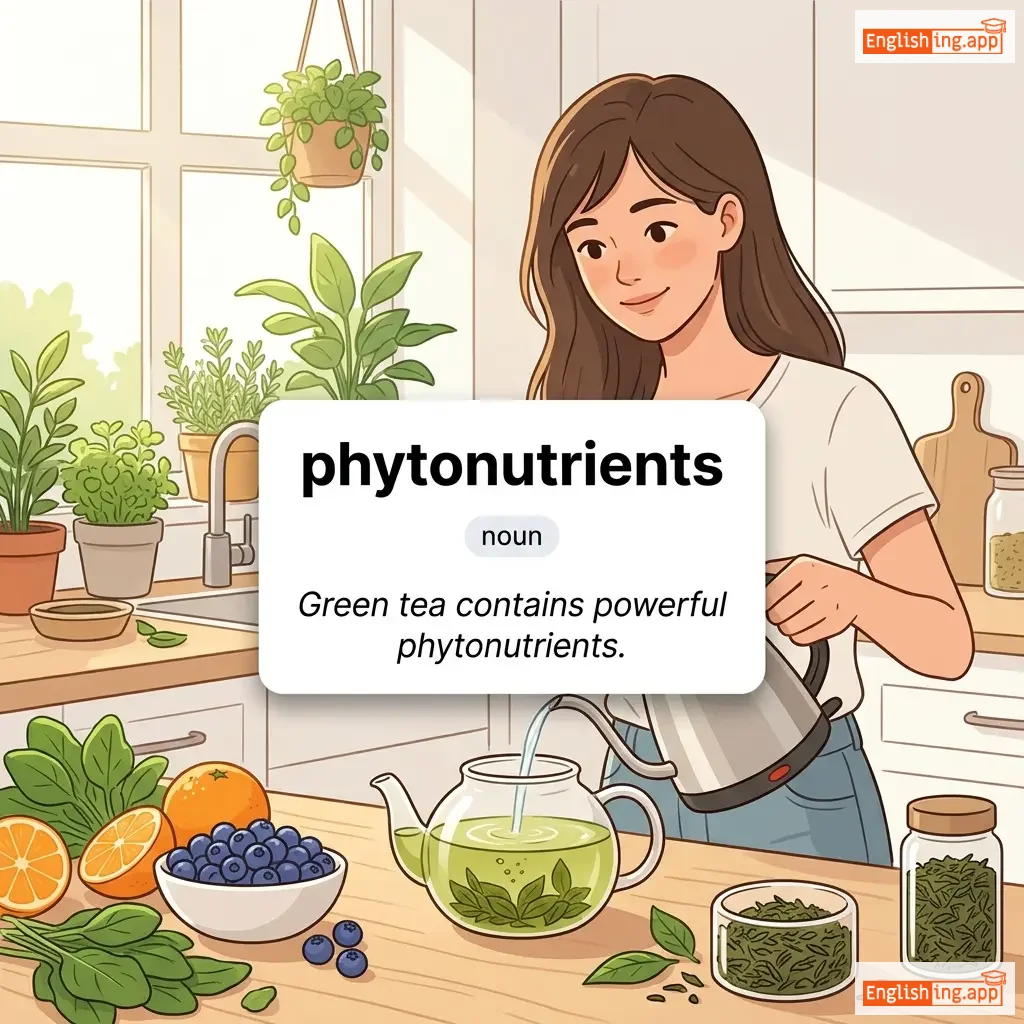
phytonutrients definition card — visual illustration of the meaning
noun
ˈfaɪ.təʊˌnjuː.tri.ənts
फाइटोन्यूट्रिएंट्स (phytonutrients)

Bioactive compounds found in plants that have health benefits beyond basic nutrition.

"Green tea contains powerful phytonutrients."

"ग्रीन चाय में शक्तिशाली फाइटोन्यूट्रिएंट्स होते हैं।" (Green chai mein shaktishali phytonutrients hote hain.)
noun
/piˈænoʊ/
पियानो (piyano)

a large musical instrument with a keyboard, played by pressing keys that cause hammers to strike strings

"She played a beautiful tune on the piano during the concert."

"उसने कंसर्ट के दौरान पियानो पर एक खूबसूरत धुन बजाई।" (Usne kansert ke dauran piyano par ek khubsurat dhun bajai)
adjective
/ˌpɪkəˈrɛsk/
दुष्ट नायक की कहानी (dusht nayak ki kahani)

relating to a style of fiction depicting the adventures of a roguish hero

"The novel is a picaresque tale of a clever vagabond."

"कहानी एक चालाक भिक्षु की पिकारेस्क यात्रा है।" (Kahani ek chalaki bhikkhu ki picaresque yatra hai.)
adjective
/ˌpɪkəˈjuːn/
तुच्छ, महत्वहीन (tuchchh, mahatvahin)

of little value or importance; trivial

"He complained about the picayune details of the contract."

"उसने अनुबंध के तुच्छ विवरणों पर शिकायत की।" (Usne anubandh ke tuchchh vivarno par shikayat ki.)
noun
/ˈpɪkəloʊ/
छोटा बांसुरी (chhota baansuri)

a small flute, higher in pitch than the regular flute

"She played a lively tune on the piccolo during the concert."

"उसने कॉन्सर्ट के दौरान पिकोलो पर एक जीवंत धुन बजाई।" (Usne concert ke dauran piccolo par ek jeevant dhun bajayi.)
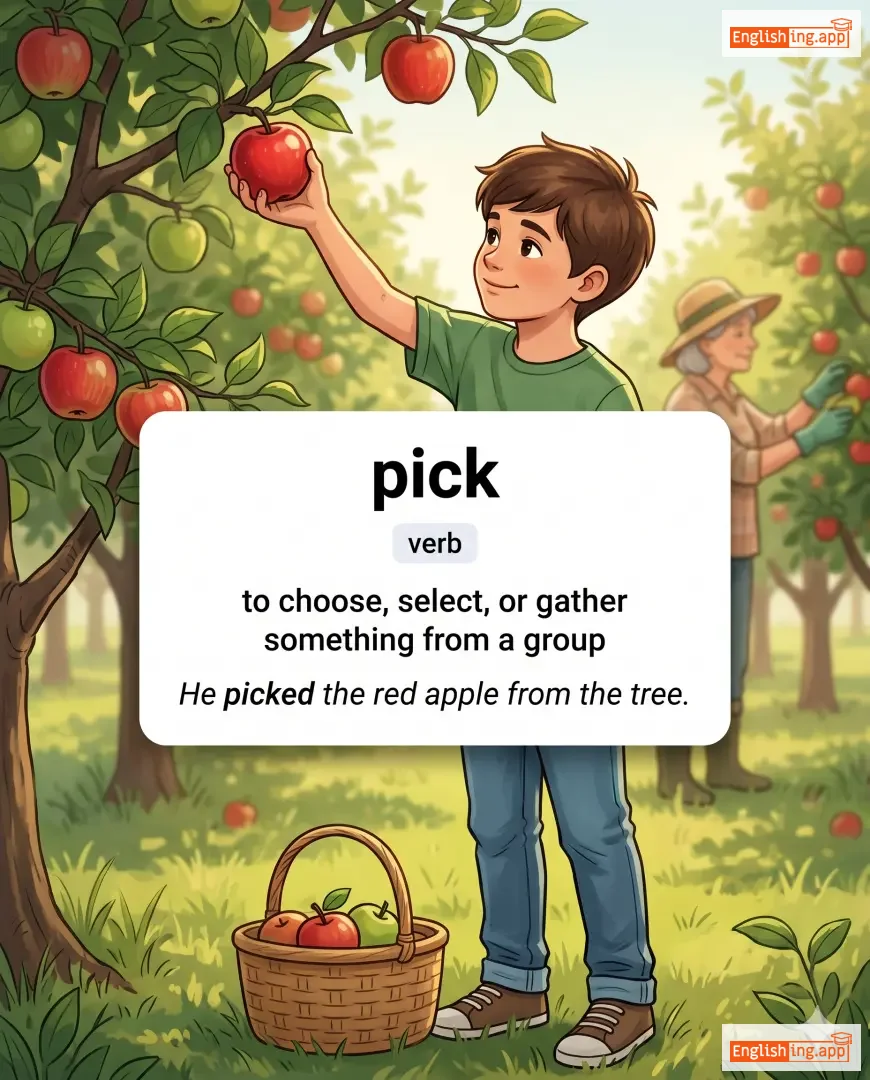
pick definition card — visual illustration of the meaning
verb
/pɪk/
चुनना (chunna)

to choose, select, or gather something from a group

"He picked the red apple from the tree."

"उसने पेड़ से लाल सेब चुना।" (Usne ped se lal seb chuna.)
phrasal verb
/pɪk ʌp/
उठाना; लेने जाना; सीख लेना (uthana; lene jana; sikh lena)

to lift something; to collect or receive someone or something; to learn or acquire gradually; to improve or increase

"She picked up the book from the floor."

"उसने फर्श से किताब उठा ली।" (usne farsh se kitab utha li)
noun
/ˈpɪk.æks/
फावड़ा (fawda)

a tool with a heavy metal head and long handle used for breaking up hard ground or rock

"The miner used a pick-axe to break through the rocky surface."

"खनिक ने चट्टानी सतह को तोड़ने के लिए एक फावड़ा का इस्तेमाल किया।" (khnik ne chattani satah ko todne ke liye ek fawda ka istemal kiya.)
noun
/ˈpɪkʌp/
खुले पिछले हिस्से वाला छोटा ट्रक; किसी चीज़ को इकट्ठा करना या सुधारना (khule pichhle hisse wala chhota truck; kisi cheez ko ikattha karna ya sudhaarna)

a small truck with an open back; the act of collecting or improving something

"The company scheduled a pickup for the returned goods."

"कंपनी ने लौटाए गए सामान के लिए एक पिकअप शेड्यूल किया।" (Kampani ne lautaye gaye samaan ke liye ek pickup scheduled kiya.)
noun
/ˈpɪktʃər/
चित्र (chitra)

a visual representation made by painting, drawing, or photography

"The picture on the wall was painted by a famous artist."

"दीवार पर चित्र एक प्रसिद्ध कलाकार द्वारा चित्रित किया गया था।" (Deewar par chitra ek prasiddh kalakar dwara chitrait kiya gaya tha.)
adjective
/ˈpɪdlɪŋ/
तुच्छ, मामूली (tuchchh, mamooli)

trivial or insignificant; very small

"He made a piddling amount of money from that deal."

"उसने उस सौदे से मामूली रकम कमाई।" (Usne us saude se mamooli rakam kamai.)
noun
/paɪ/
पाई (pai)

a baked dish typically consisting of a pastry crust and filling

"She baked an apple pie for dessert."

"उसने डेज़र्ट के लिए एक सेब पाई बनाई।" (Usne dessert ke liye ek seb pai banayi.)
adjective
/ˈpaɪbɔːld/
दो रंगों वाले धब्बों वाला (do rangon wale dhabbon wala)

having irregular patches of two colors, especially black and white

"The farmer owns a piebald horse with black and white spots."

"किसान के पास काले और सफेद धब्बों वाला एक पाइबाल्ड घोड़ा है।" (Kisan ke paas kaale aur safed dhabbon wala ek piebald ghoda hai.)
noun
/piːs/
एक हिस्सा (ek hissa)

a portion or part of something

"He gave me a piece of cake."

"उसने मुझे एक टुकड़ा केक दिया।" (Usne mujhe ek tukda cake diya.)
noun
/ˈpiːs ɡʊdz/
काटा कपड़ा (kata kapda)

textiles or fabrics sold by the yard or meter; cloth materials

"The tailor bought piece-goods from the wholesale market to make custom dresses."

"दर्जी कस्टम ड्रेसेस बनाने के लिए होलसेल मार्केट से काटा कपड़ा खरीदने गया।" (darji custom dresses banane ke liye wholesale market se kata kapda kharidne gaya.)
adjective
/ˈpiːsmiːl/
क़िस्तों में किया गया (kiston mein kiya gaya)

done or made in separate stages rather than all at once

"The construction of the new building was carried out piecemeal over several years."

"नए भवन का निर्माण कई वर्षों में क़िस्तों में किया गया था।" (Naye bhavan ka nirman kai varshon mein kiston mein kiya gaya tha.)
adjective
/paɪd/
विभिन्न रंगों वाला (vibhinn rangon wala)

having two or more different colors, typically in blotches

"The pied cat had black and white patches all over its body."

"पाइएड बिल्ली के शरीर पर काले और सफेद धब्बे थे।" (Pied billi ke sharir par kaale aur safed dhabbey the.)
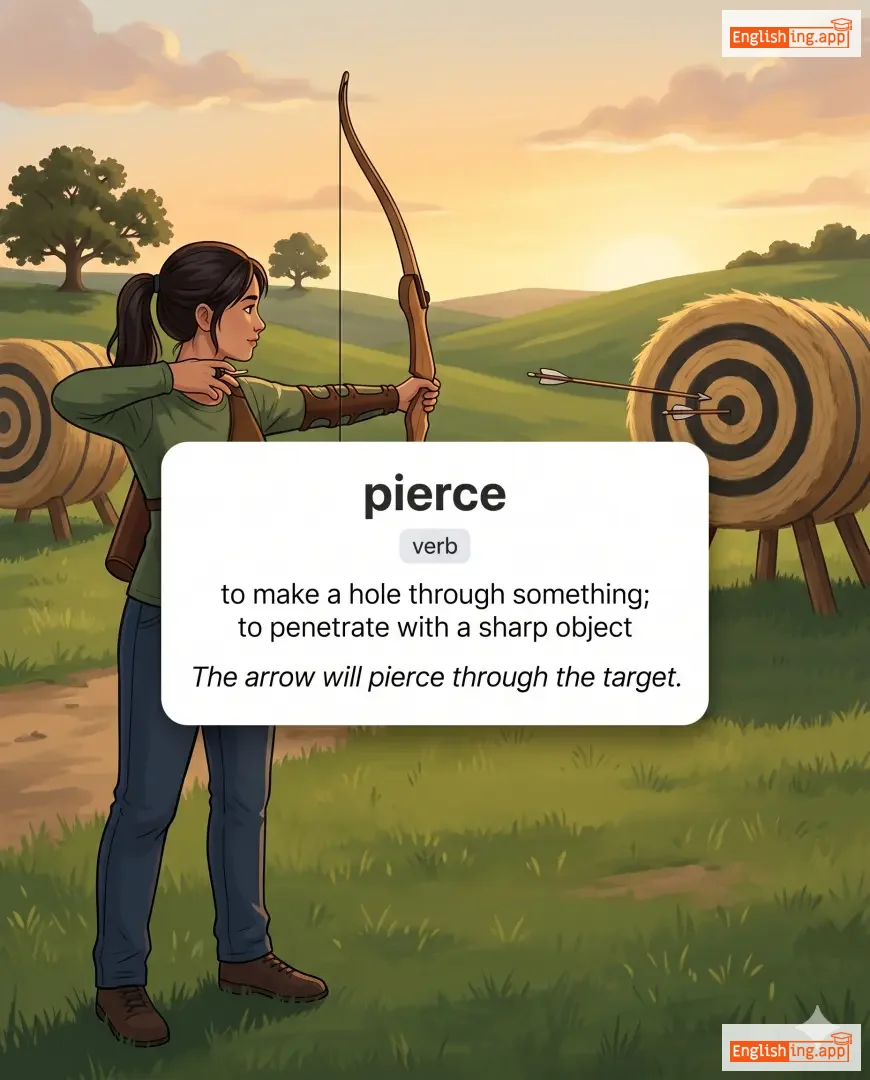
pierce definition card — visual illustration of the meaning
verb
/pɪəs/
छेदना (chedna)

to make a hole through something; to penetrate with a sharp object

"The arrow will pierce through the target."

"तीर लक्ष्य को भेदेगा।" (Teer lakshya ko bhedega.)
Piety definition card — visual illustration of the meaning
noun
/ˈpaɪəti/
धार्मिकता (dharmikta)

the quality of being religious or showing reverence for God

"Her piety was evident in the way she prayed every morning."

"उसकी धार्मिकता सुबह हर दिन प्रार्थना करने के तरीके में स्पष्ट थी।" (Uski dharmikta subah har din prarthna karne ke tareeke mein spasht thi.)
noun
/pɪɡ/
सूअर (suar)

a farm animal with a snout used for digging and a curly tail; kept for meat such as pork or bacon

"The pig rolled happily in the mud."

"सूअर ने कीचड़ में खुशी से लुड़कते हुए खेला।" (Suar ne keechar mein khushi se ludakte hue khela.)
noun
/ˈpɪdʒ.ən/
कबूतर (kabootar)

a grey and white bird with a fat body that is common in cities

"The pigeon pecked at breadcrumbs on the sidewalk."

"कबूतर फुटपाथ पर ब्रेडक्रंब खा रहा था।" (Kabootar footpath par breadcrumb kha raha tha.)
noun
/ˈpɪɡmənt/
रंगद्रव्य (rangadravya)

a natural or artificial substance used to give color to something

"The artist mixed different pigments to create the perfect shade of blue."

"कलाकार ने नीले रंग का सही शेड बनाने के लिए विभिन्न रंगद्रव्यों को मिलाया।" (Kalakar ne neeley rang ka sahi shed banane ke liye vibhinn rangadravyon ko milaya.)
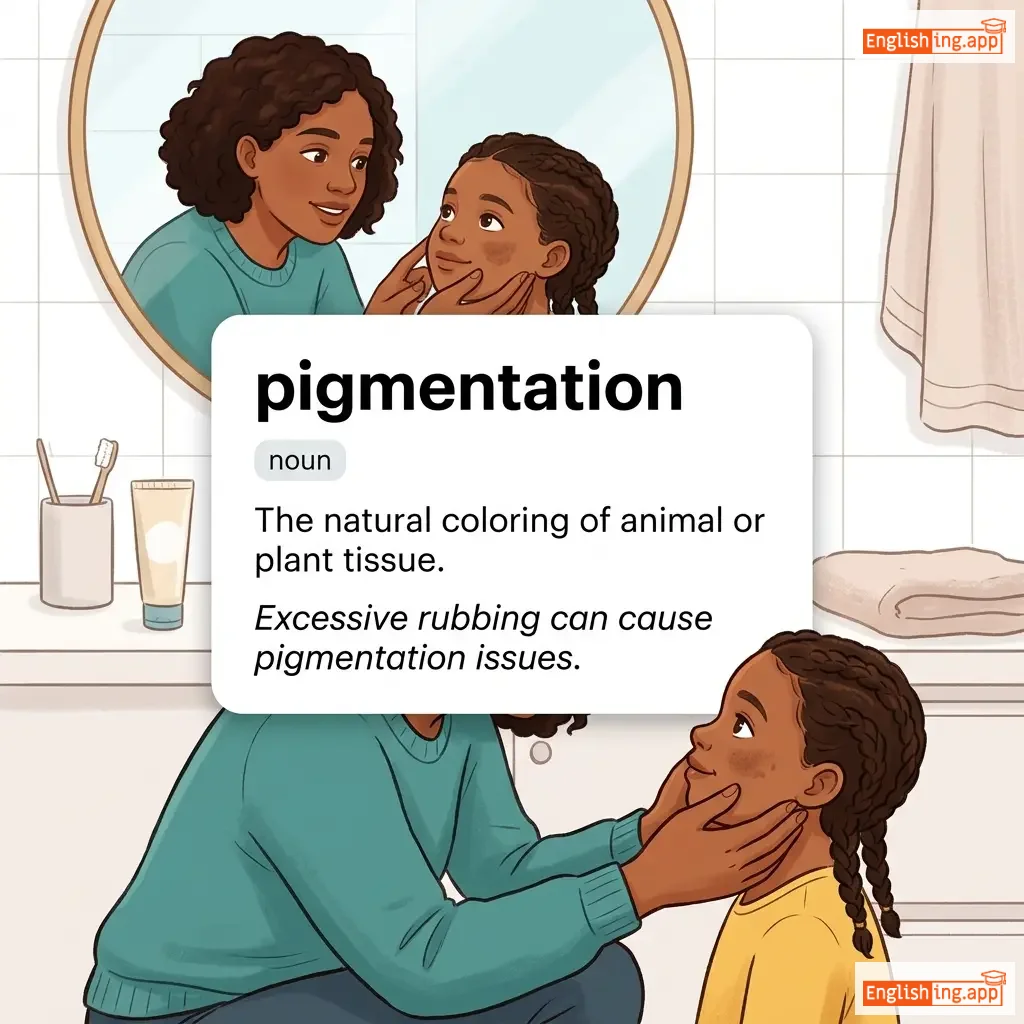
pigmentation definition card — visual illustration of the meaning
noun
/ˌpɪɡ.menˈteɪ.ʃən/
पिग्मेंटेशन (pigmentation)

The natural coloring of animal or plant tissue.

"Excessive rubbing can cause pigmentation issues."

"अत्यधिक रगड़ से पिगमेंटेशन की समस्याएं हो सकती हैं।" (Atyadhik ragad se pigmentation ki samasyaayein ho sakti hain.)
noun
/paɪl/
ढेर (dher)

a large amount of something stacked or placed in a heap

"He placed the books in a pile on the table."

"उसने किताबों को मेज़ पर ढेर में रखा।" (Usne kitabon ko mez par dher mein rakha.)
verb
/ˈpɪlfər/
चुराना (churana)

to steal things of small value or in small quantities

"The employee was caught pilfering office supplies."

"कर्मचारी को ऑफिस के सामान चुराते हुए पकड़ा गया।" (Karmachari ko office ke samaan churate hue pakda gaya.)
noun
/ˈpɪl.fər.ɪdʒ/
चोरी (pilfarej)

the theft of small amounts or items, especially from one's workplace

"The company installed cameras to prevent pilferage."

"कंपनी ने पिलफरेज रोकने के लिए कैमरे लगाए." (kampani ne pilfarej rokane ke liye kaimre lagaye.)
noun
/ˈpɪl.ɡrɪm/
यात्री; तीर्थयात्री; पर्यटक; (yatri; tirthyatri; paryatak;)

a person who journeys to a sacred place for religious reasons; a traveler

"The pilgrim walked for days to reach the holy shrine."

"यात्री पवित्र मंदिर तक पहुँचने के लिए कई दिनों तक चला।" (Yatri pavitra mandir tak pahuchne ke liye kai dino tak chala.)
noun
/pɪl/
गोली (goli)

a small round piece of medicine to be swallowed

"He took a pill to relieve his headache."

"उसने सिरदर्द को कम करने के लिए एक पिल लिया।" (Usne sirdard ko kam karne ke liye ek pil liya.)
verb
/ˈpɪlɪdʒ/
लूटपाट करना (lootpaat karna)

to rob or plunder a place, especially during war

"The invading army pillaged the village and took all valuables."

"आक्रमणकारी सेना ने गाँव को लूटपाट किया और सारी कीमती चीज़ें ले लीं।" (Aakramankari sena ne gaav ko lootpaat kiya aur saari keemti cheezein le li.)
noun
/ˈpɪlər/
स्तंभ (stambh)

a strong vertical support or mainstay of a structure or system

"The ancient temple was supported by massive stone pillars."

"प्राचीन मंदिर को विशाल पत्थर के स्तंभों द्वारा समर्थित किया गया था।" (Prachin mandir ko vishal patthar ke stambhon dwara samarthit kiya gaya tha.)
noun
/pɪˈlɑːf/
पिलाव (pilav)

a dish of rice cooked in seasoned broth, often with meat and vegetables

"We enjoyed a delicious chicken pillaw for dinner."

"हमने डिनर के लिए स्वादिष्ट चिकन पिलाव का आनंद लिया।" (hamne dinner ke liye swadisht chicken pilav ka anand liya)
noun/verb
/ˈpɪləri/
सजा देने का यंत्र (saja dene ka yantra)

a device for publicly punishing someone / to expose to public ridicule

"The corrupt official was placed in the pillory for the town to jeer at."

"दुराचारपूर्ण अधिकारी को शहर के सामने पिलोरी में रखा गया था।" (Duracharpoorn adhikari ko shahar ke samne pillory mein rakha gaya tha.)
noun
/ˈpɪloʊ/
तकिया (takiya)

a soft cushion filled with material used to support the head while sleeping or resting

"She placed her head on the soft pillow and fell asleep quickly."

"उसने सिर को मुलायम तकिए पर रखा और जल्दी से सो गई।" (Usne sir ko mulaayam takiye par rakha aur jaldi se so gayi.)
noun/verb
/ˈpaɪlət/
पायलट (pilot)

a person who operates an aircraft / to guide or lead through a trial

"She piloted the plane safely through the storm."

"उसने तूफान के बीच विमान को सुरक्षित रूप से उड़ाया।" (Usne toofan ke beech vimaan ko surakshit roop se udaaya.)
noun
/ˈpɪm.pəl/
पिंपल (pimpl)

a small, inflamed elevation of the skin; a spot on the skin, especially on the face

"She was embarrassed about the pimple on her forehead."

"वह अपनी माथे पर पिम्पल के बारे में शर्मिंदा थी।" (vah apni mathe par pimpl ke baare mein sharminda thi.)
noun
/pɪn/
पिन (pin)

a small thin piece of metal used to fasten or hold things together

"She used a pin to attach the note to the board."

"उसने बोर्ड पर नोट चिपकाने के लिए एक पिन का उपयोग किया।" (Usne board par not chipkane ke liye ek pin ka upyog kiya.)
noun
/ˈpɪnsərz/
पिन्सर्स (pinsers)

a gripping tool with two arms used for holding or pulling objects

"He used pincers to remove the hot nail from the wood."

"उसने लकड़ी से गर्म कील निकालने के लिए पिन्सर्स का उपयोग किया।" (Usne lakdi se garm keel nikaalne ke liye pinsers ka upyog kiya.)
verb
/pɪntʃ/
मसलना (masalna)

to squeeze tightly between the fingers; to take a small amount

"She pinched a bit of salt into the soup."

"उसने सूप में थोड़ा सा नमक डाला।" (Usne soup mein thoda sa namak dala.)
noun
/ˈpɪntʃərz/
पिंचर (pinchar)

a tool used for gripping or squeezing objects

"Use the pinchers to remove the hot coal safely."

"गर्म कोयला सुरक्षित रूप से हटाने के लिए पिनचर्स का उपयोग करें।" (Garm koyla surakshit roop se hatane ke liye pinchers ka upyog karein.)
verb
/paɪn/
बेहद चाहत रखना (behad chahat rakhna)

to long intensely for something or someone; to suffer from longing

"He pined for his hometown after moving abroad."

"विदेश जाने के बाद वह अपने घर के लिए बहुत तड़प रहा था।" (Videsh jane ke baad vah apne ghar ke liye bahut tadap raha tha.)
noun
/ˈpaɪn.æp.əl/
अनानास (ananas)

a large tropical fruit with a tough skin and sweet yellow flesh

"The pineapple has a crown of spiky leaves on top."

"अनानास के ऊपर कांटेदार पत्तों का मुकुट होता है।" (ananas ke upar kaantedaara patton ka mukut hota hai)