वोकैबुलरीज

इंग्लिश वोकैबुलरी डिस्कवर, लर्न और मास्टर करें

noun
/ˈɒkjʊlɪst/
नेत्र चिकित्सक (netra chikitsak)

An old-fashioned term for an eye doctor or ophthalmologist.

"The village oculist was known for treating various eye diseases."

"गांव के आक्यूलिस्ट को विभिन्न आंखों की बीमारियों का इलाज करने के लिए जाना जाता था।" (Gaon ke akyulist ko vibhinn aankhon ki bimariyon ka ilaj karne ke liye jana jata tha.)
adjective
/ɒd/
अजीब (ajeeb)

different from what is usual or expected; strange or peculiar

"He has some odd habits that surprise everyone."

"उसके पास कुछ अजीब आदतें हैं जो सभी को चौंका देती हैं।" (Uske paas kuch ajeeb aadatein hain jo sabhi ko chauka deti hain.)
noun
/ˈɒdəti/
विचित्रता (vichitrita)

Something strange or unusual.

"The bright pink building was an oddity in the small town."

"चमकीली गुलाबी इमारत छोटे शहर में एक विचित्रता थी।" (Chamakili gulabi imarat chhote sheher mein ek vichitrita thi.)
adverb
/ˈɒdli/
अजीब तरह से (ajeeb tarah se)

in a strange or unusual way; unexpectedly

"Oddly, he didn’t seem upset by the bad news."

"अजीब तरह से, वह बुरी खबर से परेशान नहीं हुआ।" (ajeeb tarah se, vah buri khabar se pareshan nahi hua)
noun
/ɒdz/
संभावना (sambhavna)

the likelihood or probability of something happening; chances for or against something

"The odds of winning the lottery are very low."

"लॉटरी जीतने के ऑड्स बहुत कम हैं।" (Lottery jeetne ke odds bahut kam hain.)
noun
/oʊd/
गानात्मक कविता (gaanatmak kavita)

a lyrical poem, often expressing praise or strong emotions

"The poet wrote an ode to the beauty of nature."

"कवि ने प्रकृति की सुंदरता पर एक ओड लिखी।" (Kavi ne prakriti ki sundarta par ek ode likhi.)
adjective
/ˈoʊdiəs/
घृणित (ghrit)

extremely unpleasant or repulsive

"The dictator was remembered for his odious crimes."

"सत्ता के शासक को उसके घृणित अपराधों के लिए याद किया गया।" (Satta ke shasak ko uske ghrinit aparadhon ke liye yaad kiya gaya.)
noun
/ˈoʊdiəm/
घृणा (ghrina)

general or widespread hatred or disgust directed toward someone as a result of their actions

"The scandal brought public odium on the corrupt minister."

"विवाद ने भ्रष्ट मंत्री पर सार्वजनिक घृणा ला दी।" (Vivaad ne bhrasht mantri par saarbhaumik ghrina la di.)
adjective
/ˌoʊdəˈrɪfərəs/
सुगंधित (sugandhit)

having or giving off a smell, especially a strong or pleasant one

"The garden was filled with odoriferous flowers."

"बग़ीचा सुगंधित फूलों से भरा हुआ था।" (Bagicha sugandhit phoolon se bhara hua tha.)
adjective
/ˈoʊdərəs/
दुर्गंधयुक्त (durgandhyukt)

having or giving off a smell, often unpleasant

"The odorous garbage had to be taken out immediately."

"दुर्गंधयुक्त कचरा तुरंत बाहर फेंकना पड़ा था।" (durgandhyukt kachra turant baahar phenkna pada tha.)
noun
/ˈoʊ.dər/
गंध (gandh)

a distinctive smell, especially an unpleasant one

"The odour of fresh bread filled the kitchen."

"ताजे ब्रेड की गंध रसोई घर में फैल गई।" (taje bread ki gandh rasoi ghar mein phail gayi.)
odyssey definition card — visual illustration of the meaning
noun
/ˈɑːdəsi/
लंबी यात्रा (lambi yatra)

a long, adventurous journey; a series of experiences

"Her career has been an odyssey of challenges and achievements."

"उसका करियर चुनौतियों और उपलब्धियों का एक लंबी यात्रा रहा है।" (uska kariyer chunautiyon aur uplabdhiyon ka ek lambi yatra raha hai.)
preposition
/ʌv/
का (ka)

expressing the relationship between a part and a whole

"The book is on the table, in front of the window."

"किताब मेज पर है, खिड़की के सामने है।" (kitaab mez par hai, khidki ke samne hai.)
adverb
/ɔːf/
बंद (band)

away from a place, position, or time; not functioning

"He turned off the light before leaving the room."

"वह कमरे से बाहर जाने से पहले बत्तियाँ बंद कर दी।" (vah kamre se baahar jaane se pehle battiyaan band kar di.)
adjective
/ˌɔːfˈkiː/
बेसुर (besur)

out of tune; not in accordance with expected standards

"The singer was slightly off-key during the performance."

"गायक प्रदर्शन के दौरान थोड़ा बेसुर था।" (gaayak pradarshan ke dauran thoda besur tha.)
noun
/ˈɔːfəl/
अंदरूनी अंग (andarooni ang)

the internal organs and entrails of an animal used as food; waste parts

"The butcher prepared sausages using pork offal."

"बटलर ने सूअर के अंदरूनी अंग का उपयोग करके सॉसेज तैयार किया।" (butler ne suar ke andarooni ang ka upyog karke sosej taiyar kiya.)
adjective
/ˈɒf.biːt/
असामान्य (asaamany)

Unusual, unconventional, or different from the norm.

"She has a very offbeat sense of humor."

"उसका हास्यबोध बहुत असामान्य है।" (uska haasyabodh bahut asaamany hai.)
noun
/əˈfens/
अपराध; आक्रमण (apraadh; aakraman)

a breach of law or rule; an annoyance or resentment

"Stealing is a serious offence punishable by law."

"चोरी एक गंभीर अपराध है जिसे कानून द्वारा दंडनीय माना जाता है।" (chori ek gambheer apraadh hai jise kaanoon dwaara dandniya maana jaata hai)
verb
/əˈfɛnd/
अपमान करना (apmaan karna)

to cause someone to feel upset, insulted, or annoyed

"She didn’t mean to offend anyone with her remarks."

"वह अपनी टिप्पणियों से किसी को ठेस पहुँचाना नहीं चाहती थी।" (Wah apni tippaniyon se kisi ko thess pahuchana nahi chahti thi.)
noun
/əˈfɛndər/
अपराधी (apradhi)

a person who commits a crime or does something wrong

"The police caught the offender quickly."

"पुलिस ने अपराधी को जल्दी पकड़ लिया।" (Police ne apradhi ko jaldi pakad liya.)
noun
/əˈfɛns/
अपराध (apraadh)

an illegal act; a crime

"The offense was committed in broad daylight."

"अपराध दिन के उजाले में किया गया था।" (apraadh din ke ujale mein kiya gaya tha.)
adjective
/əˈfɛnsɪv/
अपमानजनक (apmanjanak)

Causing hurt, anger, or annoyance; also relating to attacking in sports or war.

"His offensive remarks upset everyone at the meeting."

"उसकी अपमानजनक टिप्पणी ने बैठक में सभी को नाराज़ कर दिया।" (uski apmanjanak tipanni ne baithak mein sabhi ko naraz kar diya.)
offer definition card — visual illustration of the meaning
verb
/ˈɔːfər/
प्रस्ताव करना (prastaav karna)

to present or give something to someone

"She offered him a gift for his birthday."

"उसने उसे उसके जन्मदिन के लिए एक उपहार प्रस्तुत किया।" (Usne use uske janmadin ke liye ek uphaar prastut kiya.)
noun
/ˈɒfərɪŋ/
प्रस्ताव (prastaav)

something that is given, especially as a gift or contribution

"The company’s latest offering is an eco-friendly car."

"कंपनी का नवीनतम प्रस्ताव एक इको-फ्रेंडली कार है।" (Company ka naveenatam prastaav ek eco-friendly car hai.)
noun
/ˈɒfərtɔːri/
अर्पण (arpan)

The part of a religious service when offerings are collected; the offering itself.

"The offertory was taken during the Sunday service."

"रविवार की प्रार्थना सेवा के दौरान अर्पण एकत्रित किया गया था।" (ravivar ki prarthana seva ke dauran arpan ekatrit kiya gaya tha.)
adjective/adverb
/ˌɒfˈhænd/
बिना सोचे-समझे (bina soche-samjhe)

Without previous thought or preparation; casual and sometimes dismissive.

"She gave an offhand reply to his serious question."

"उसने उसके गंभीर सवाल का बिना सोचे-समझे जवाब दिया।" (Usne uske gambhir sawal ka bina soche-samjhe jawab diya.)
noun
/ˈɒf.ɪs/
ऑफिस (ofis)

a room or building where people work, usually at desks

"She left the office early to attend a family event."

"वह एक पारिवारिक कार्यक्रम में भाग लेने के लिए ऑफिस जल्दी छोड़ दी।" (vah ek parivarik karyakram mein bhag lene ke liye ofis jaldi chhod di.)
noun
/ˈɔːfɪsər/
अधिकारी (adhikari)

a person in a position of authority, especially in law enforcement

"The officer gave him a ticket for speeding."

"अधिकारी ने उसे स्पीडिंग के लिए टिकट दी।" (Adhikari ne use speeding ke liye ticket di.)
adjective
/əˈfɪʃəl/
आधिकारिक (adhikarik)

relating to or connected with an authority or public office

"He is the official spokesperson for the company."

"वह कंपनी के आधिकारिक प्रवक्ता हैं।" (Vah company ke adhikarik pravakta hain.)
adverb
/əˈfɪʃəli/
आधिकारिक रूप से (aadhikaarik roop se)

in a formal or authorized way

"The building was officially opened by the mayor."

"इमारत को मेयर द्वारा आधिकारिक रूप से खोला गया था।" (Imarat ko mayor dwaara aadhikaarik roop se khola gaya tha.)
verb
/əˈfɪʃieɪt/
आधिकारिक कर्तव्य निभाना (adhikarik kartavya nibhana)

To perform official duties, especially in a ceremony or as a referee.

"The priest will officiate the wedding ceremony."

"पादरी विवाह समारोह आयोजित करेंगे।" (padri vivah samaroah aayojit karenge.)
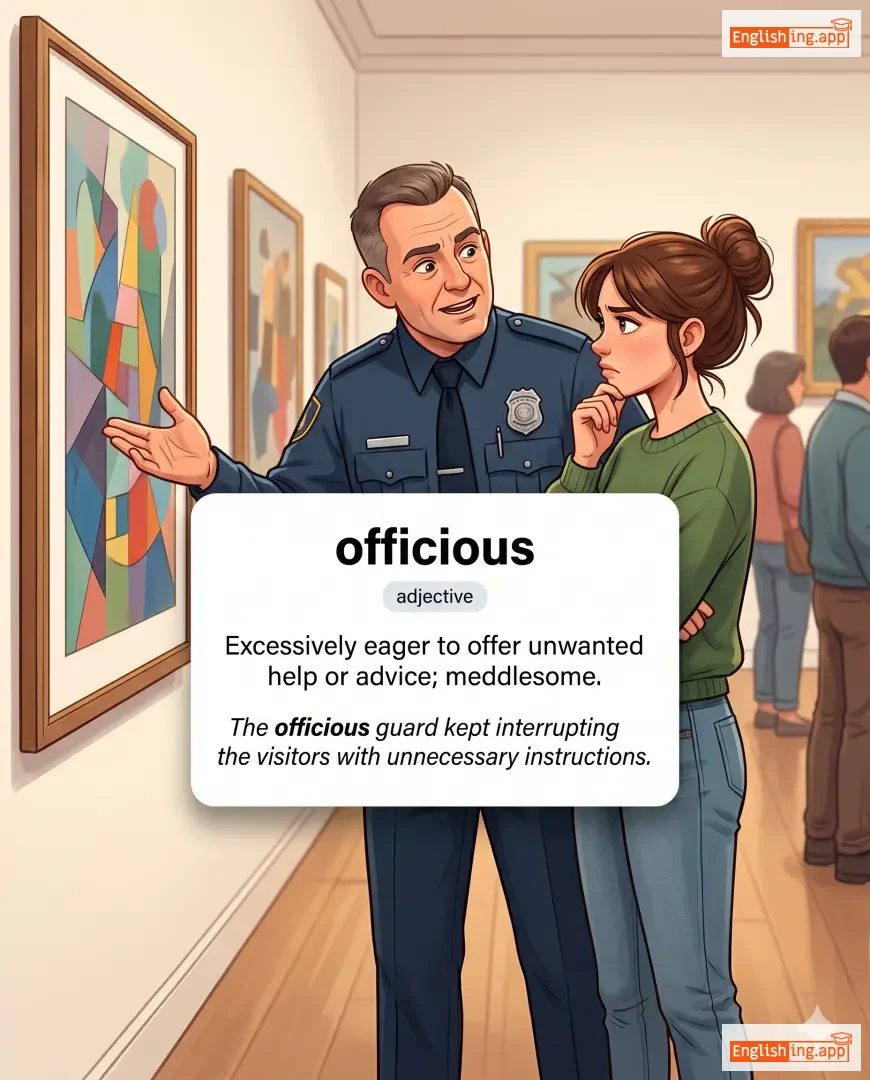
officious definition card — visual illustration of the meaning
adjective
/əˈfɪʃəs/
अत्यधिक इच्छाशक्ति (atyadhik ichhashakti)

Excessively eager to offer unwanted help or advice; meddlesome.

"The officious guard kept interrupting the visitors with unnecessary instructions."

"अत्यधिक इच्छाशक्ति वाला गार्ड आगंतुकों को अनावश्यक निर्देशों से बार-बार बाधित कर रहा था।" (atyadhik ichhashakti wala guard aagantukon ko anavashyak nirdeshon se baar-baar baadhit kar raha tha.)
adjective
/ˈɒfɪʃ/
अलहदा (alhda)

Unfriendly, distant, or reserved in manner.

"He seemed offish at the party and avoided most conversations."

"वह पार्टी में अलहदा सा लग रहा था और अधिकांश बातचीत से बच रहा था।" (Vah party mein alhda sa lag raha tha aur adhikansh baatcheet se bach raha tha.)
verb
/ˈɒfsɛt/
क्षतिपूरक (kshatipurak)

To counterbalance or compensate for something.

"The company's losses were offset by gains in other departments."

"कंपनी के नुकसान दूसरे विभागों के लाभ से ऑफसेट हो गए थे।" (Company ke nuksan doosre vibhagon ke labh se offset ho gaye the.)
noun
/ˈɒfʃuːt/
शाखा (shakha)

A branch or result that develops from something larger or more important.

"The startup was an offshoot of a major tech company."

"स्टार्टअप एक प्रमुख टेक कंपनी की शाखा थी।" (Start-up ek pramukh tech company ki shakha thi.)
noun
/ˈɒf.sprɪŋ/
संतान (santan)

a person's child or children; an animal's young

"The bird carefully fed its offspring."

"पक्षी ने अपने संतान को सावधानी से खिलाया।" (Pakshi ne apne santan ko saavdhani se khilaya.)
adverb
/ˈɔːfən/
अक्सर (aksar)

frequently, many times

"I often visit my grandparents on weekends."

"मैं अक्सर अपने दादी-दादी के घर सप्ताहांत में जाता हूँ।" (Main aksar apne dadi-dadi ke ghar saptahant mein jaata hoon.)
verb
/ˈoʊɡəl/
घूरना (ghurna)

To look at someone with obvious sexual interest.

"He kept ogling the models on the runway."

"वह रनवे पर मॉडल्स को घूरता रहा।" (Wah runway par models ko ghoorta raha.)
noun
/ˈoʊɡər/
दानव (ohgr)

A mythical monster, often depicted as large, hideous, and cruel; metaphorically, a cruel or terrifying person.

"The villagers feared the ogre who lived in the dark forest."

"गांव के लोग अंधेरे जंगल में रहने वाले ओग्रे से डरते थे." (gaanv ke log andhere jangal me rehne wale ogre se dar te the)
interjection
/oʊ/
ओह (oh)

used to express surprise, realization, or understanding

"Oh, I didn't know you were here!"

"ओह, मुझे नहीं पता था कि आप यहाँ थे!" (Oh, mujhe nahi pata tha ki aap yahaan the!)
noun
/ɔɪl/
तेल (tel)

a viscous liquid derived from plants or animals, used for cooking, lubrication, or fuel

"She added some oil to the pan to fry the vegetables."

"उसने सब्जियाँ तलने के लिए पैन में थोड़ा तेल डाला।" (Usne sabziyan talne ke liye pan mein thoda tel daala.)
noun
/ˈɔɪl.mən/
तेलवाला (telwala)

a person who works in the oil industry; someone who sells oil or petroleum products

"The oilman discovered a new oil field in the desert."

"तेलवाले ने रेगिस्तान में एक नया तेल क्षेत्र खोजा।" (telwale ne registan mein ek naya tel kshetra khoja.)
adjective
/ˈɔɪl.i/
तेलयुक्त; तेल से ढका हुआ; चिकना (telyukt; tel se dhaka hua; chikna)

covered with oil; containing oil; greasy

"Her oily skin needs special care."

"उसकी तेलयुक्त त्वचा को विशेष देखभाल की आवश्यकता है।" (uski telyukt twacha ko vishesh dekhbhal ki avashyakta hai.)
noun
/ˈɔɪntmənt/
मलहम (malham)

A smooth, oily substance applied to the skin for healing or soothing.

"The doctor prescribed an ointment for the burn on his arm."

"डॉक्टर ने उसके हाथ की जलन के लिए एक मलहम निर्धारित किया।" (Doktar ne uske hath ki jalan ke liye ek malham nirdharit kiya.)
adjective
/oʊˈkeɪ/
ठीक है (thik hai)

used to indicate agreement, approval, or understanding

"Okay, let's go to the park."

"ठीक है, चलो पार्क चलते हैं।" (Thik hai, chalo park chalte hain.)
adjective
/əʊˈkeɪ/
ठीक है (thik hai)

used to express agreement or acceptance

"It's okay to leave early today."

"आज जल्दी जाने के लिए ठीक है।" (Aaj jaldi jaane ke liye thik hai.)
adjective
/oʊld/
पुराना (purana)

having lived for a long time; not new or young

"He still drives his old car."

"वह अभी भी अपनी पुरानी कार चलाता है।" (vah abhi bhi apni purani car chalata hai.)
adjective
/ˌoʊld ˈfæʃənd/
पुराना ढंग का (purana dhang ka)

not modern; belonging to an earlier time

"He still wears an old-fashioned hat."

"वह अब भी पुराना ढंग का टोपी पहनता है।" (Vah ab bhi purana dhang ka topi pehenta hai.)
noun
/oʊliˈændər/
ओलियंडर (oliyandar)

a poisonous evergreen shrub with clusters of white, pink, or red flowers

"The beautiful oleander flowers bloomed in the garden despite their toxic nature."

"सुंदर ओलियंडर फूल बगिया में खिल रहे थे, बावजूद इसके कि उनका जहरीला स्वभाव था।" (sundar olijandar phool bagiya mein khil rahe the, bajood iske ki unka jahreela swabhav tha)
noun
/ɑːlˈfækʃən/
घ्राण (ghran)

The sense of smell; the process of detecting and perceiving odors.

"Dogs have a highly developed sense of olfaction."

"कुत्तों का घ्राण बहुत विकसित होता है।" (Kutton ka ghran bahut viksit hota hai.)