वोकैबुलरीज

इंग्लिश वोकैबुलरी डिस्कवर, लर्न और मास्टर करें

adjective
/ˈnɔːtɪkəl/
नौसैनिक (nausainik)

relating to ships, sailors, or navigation on water

"He studied nautical charts before setting sail."

"उसने पाल रखने से पहले समुद्री चार्ट का अध्ययन किया।" (Usne paal rakhne se pehle samudri chart ka adhyayan kiya.)
adjective
/ˈneɪvəl/
नौसैनिक (nausalnik)

relating to a country's navy or military ships

"The country invested heavily in naval defense."

"देश ने नौसैनिक रक्षा में भारी निवेश किया।" (Desh ne nausena raksha mein bhaari nivesh kiya.)
noun
/ˈneɪ.vəl fɔːrs/
नौसैनिक बल (nausainik bal)

the branch of a nation's armed services that conducts military operations at sea

"The naval force protected the country's coastline from enemy attacks."

"नौसैनिक बल ने देश की तटरेखा को शत्रु हमलों से बचाया" (nausainik bal ne desh ki tatrekha ko shatru hamlon se bachaya)
noun
/neɪv/
चर्च की केंद्रीय भाग (church ki kendriya bhag)

the central part of a church building intended to accommodate the congregation

"The choir sang beautifully in the church nave."

"कोरस ने चर्च के नेव में सुंदरता से गाया।" (Koras ne church ke nave mein sundarta se gaya.)
noun
/ˈneɪvəl/
नाभि (naabhi)

the small hollow or raised area in the middle of the stomach, also called the belly button

"The baby’s navel was carefully cleaned after birth."

"जन्म के बाद बच्चे की नाभि को सावधानी से साफ किया गया।" (janm ke baad bachche ki naabhi ko saavdhaani se saaf kiya gaya.)
adjective
/ˈnæv.ɪ.ɡə.bəl/
नावचलने योग्य (navchalne yogya)

Able to be sailed on or through by ships or boats.

"The river is navigable for large cargo ships."

"नदी बड़े कार्गो जहाजों के लिए नावचलने योग्य है।" (Nadi bade cargo jahajon ke liye navchalne yogya hai.)
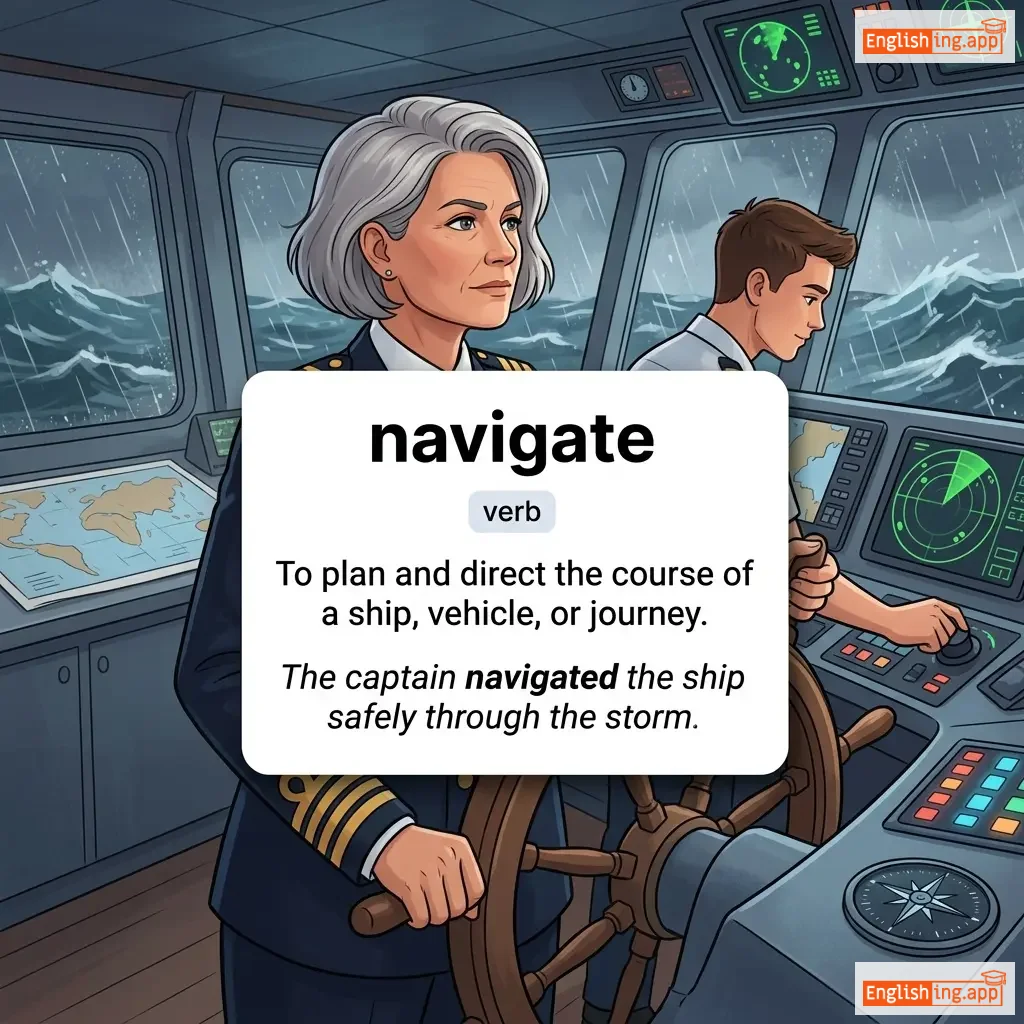
navigate definition card — visual illustration of the meaning
verb
/ˈnæv.ɪ.ɡeɪt/
मार्गदर्शन करना (margdarshan karna)

To plan and direct the course of a ship, vehicle, or journey.

"The captain navigated the ship safely through the storm."

"कप्तान ने तूफान के बीच जहाज को सुरक्षित रूप से मार्गदर्शन किया।" (Kaptan ne toofan ke beech jahaj ko surakshit roop se margdarshan kiya.)
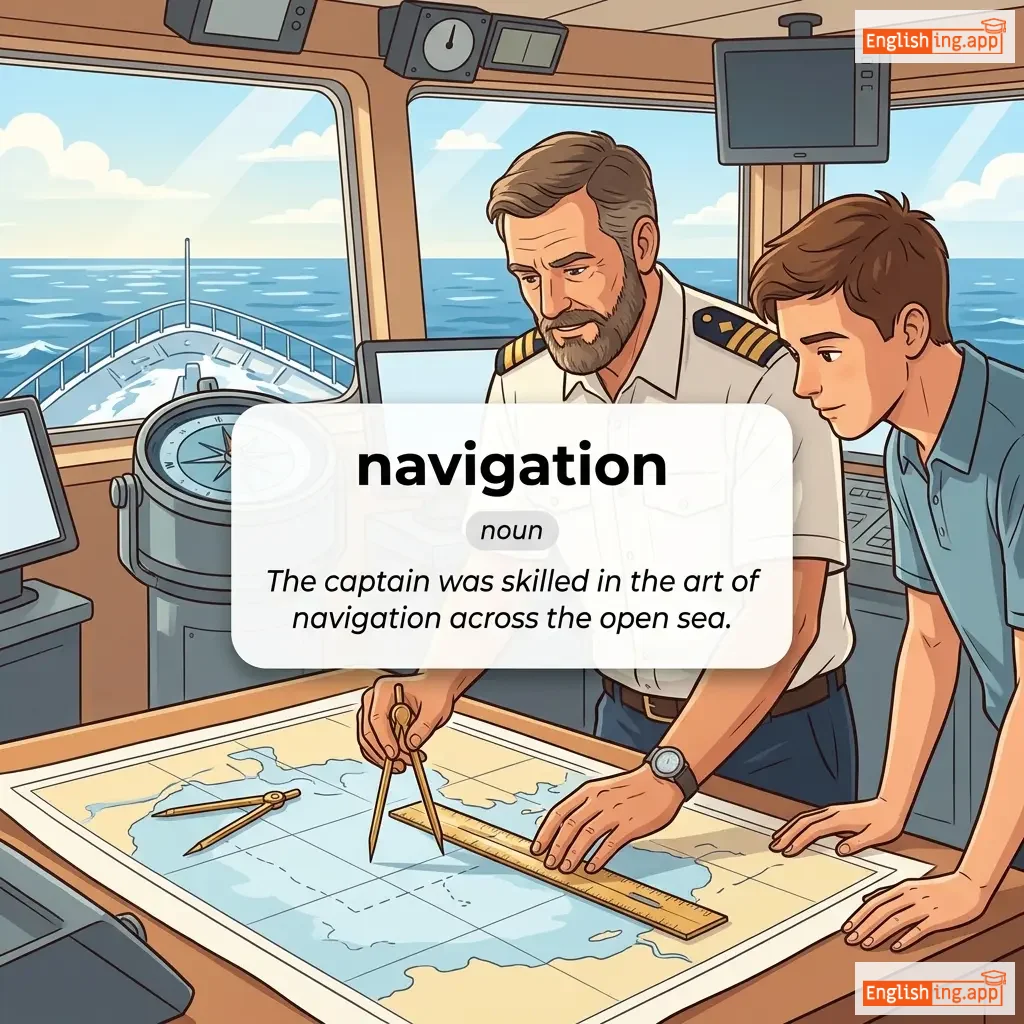
navigation definition card — visual illustration of the meaning
noun
/ˌnævɪˈɡeɪʃən/
नेविगेशन (navigation)

the process or activity of accurately determining one's position and planning and following a route

"The captain was skilled in the art of navigation across the open sea."

"कैप्टन खुले समुद्र में नेविगेशन की कला में निपुण थे।" (captain khule samudra mein navigation ki kala mein nipun the.)
noun
/ˈneɪvi/
नौसेना (nausena)

the branch of armed forces that conducts military operations at sea

"He joined the navy after graduating from college."

"उसने कॉलेज से स्नातक होने के बाद नौसेना में भर्ती हो गया।" (usne kolej se snatak hone ke baad nausena mein bharti ho gaya.)
noun
/ˈneɪˌseɪ.ɪŋ/
नकारात्मकता व्यक्त करना (nakaratmakta vyakt karna)

The act of expressing negative or pessimistic views.

"His constant naysaying discouraged the team."

"उसकी निरंतर नकारात्मकता ने टीम का मनोबल तोड़ दिया।" (Uski nirantar nakaratmakta ne team ka manobal tod diya.)
noun
/ˌɛn.biː.esˈpiː/
नॉन-ब्रेकिंग स्पेस (non breaking space)

a non-breaking space character in HTML used to prevent an automatic line break at its position

"Use   in HTML to add a space that won't break into a new line."

"HTML में पंक्ति में न टूटने वाली स्पेस जोड़ने के लिए   का उपयोग करें।" (HTML mein pankti mein na tootne wali space jodne ke liye   ka upyog karein.)
noun
/niːp/
नैप ज्वार (neap jwaar)

A tide just after the first or third quarters of the moon when the difference between high and low tide is least.

"During a neap tide, the water level change is minimal."

"नीप ज्वार के दौरान पानी का स्तर परिवर्तन न्यूनतम होता है।" (neap jwaar ke dauran paani ka sttar parivartan nyuntam hota hai.)
preposition
/nɪə(r)/
पास (paas)

At or to a short distance away; close in space, time, or relationship.

"There is a park near my house."

"मेरे घर के पास एक पार्क है।" (Mere ghar ke paas ek park hai.)
adverb
/ˈnɪərbaɪ/
नजदीक; पास में (najdeek; paas mein)

close to; not far away; in the neighborhood

"There is a grocery store nearby."

"वहाँ पास में एक किराना दुकान है।" (vahaan paas mein ek kiraana dukaan hai)
adjective
/ˈnɪəˌbaɪ/
पास (paas)

close to a particular place or person

"The nearest gas station is nearby."

"निकटतम गैस स्टेशन पास में है।" (nikatam gas station paas mein hai.)
adverb
/ˈnɪəli/
लगभग (lagbhag)

almost, but not completely

"She nearly missed the bus."

"वह लगभग बस को मिस कर गई।" (vah lagbhag bas ko mis kar gayi.)
adjective
/niːt/
सुथरा (suthra)

tidy, orderly, and well-arranged; simple and elegant

"His handwriting is very neat and easy to read."

"उसकी लिखावट बहुत सुथरी और पढ़ने में आसान है।" (Uski likhavat bahut suthri aur padhne mein aasan hai.)
adverb
/ˈniːtli/
सलीके से; सफाई से; (sallike se; safai se;)

in a tidy and orderly way; carefully and precisely

"She arranged the books neatly on the shelf."

"उसने किताबों को शेल्फ पर सलीके से रखा।" (usne kitabon ko shelf par sallike se rakha)
noun
/ˈneb.jʊ.lə/
नेबुला (nebula)

A cloud of gas and dust in outer space, sometimes visible in the night sky.

"The Orion Nebula is one of the brightest in the sky."

"ऑरियन नेबुला आकाश में सबसे चमकदार में से एक है।" (Orion nebula aakash mein sabse chamakdaar mein se ek hai.)
adjective
/ˈnɛbjələs/
धुंधला (dhundhla)

Unclear, vague, or ill-defined; resembling a cloud or haze.

"His plan for the future was still nebulous and hard to understand."

"भविष्य के लिए उसकी योजना अभी भी धुंधली और समझने में कठिन थी।" (bhavishya ke liye uski yojna abhi bhi dhundhli aur samajhne mein kathin thi.)
adverb
/ˌnɛsəˈsɛrɪli/
अनिवार्य रूप से (anivarya roop se)

as a necessary result; inevitably

"It doesn’t necessarily mean you’re wrong."

"इसका मतलब यह नहीं है कि आप गलत हैं।" (Iska matlab yeh nahin hai ki aap galat hain.)
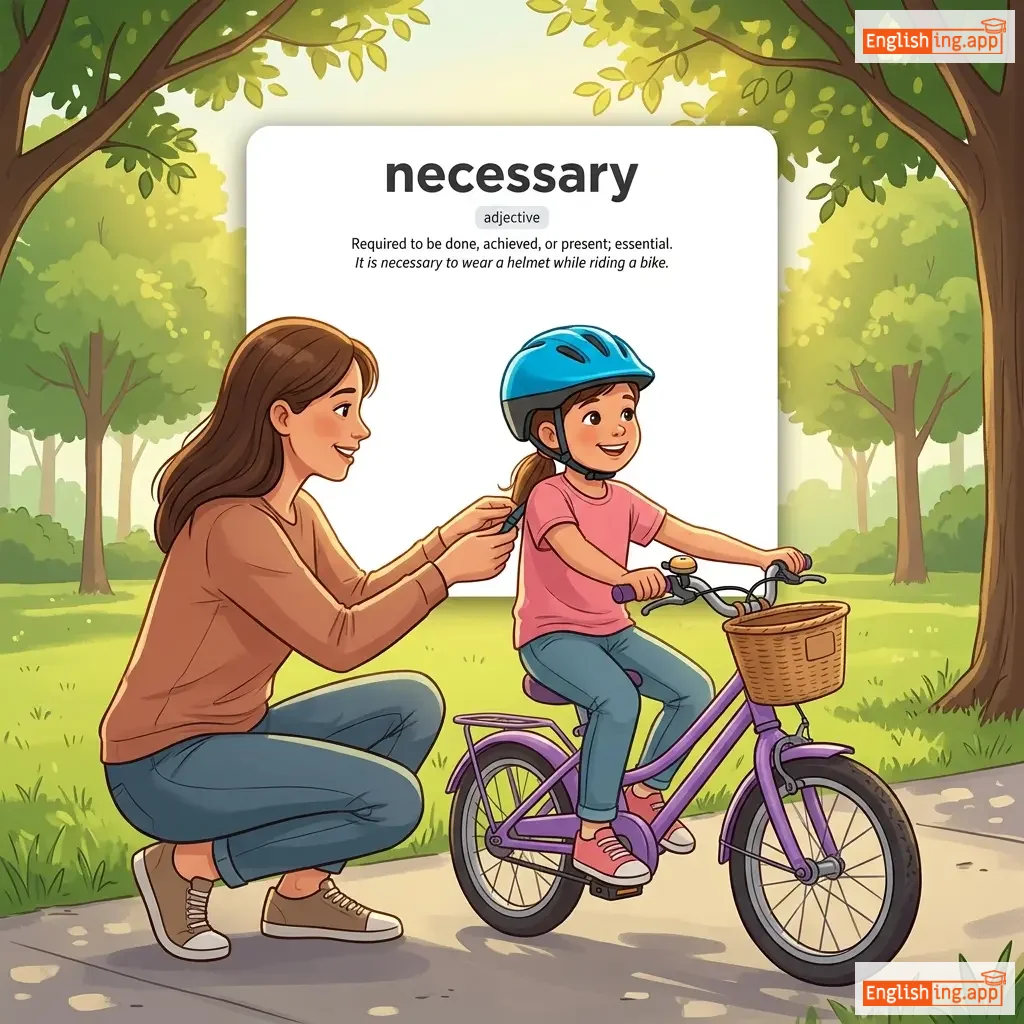
necessary definition card — visual illustration of the meaning
adjective
/ˈnɛsəsɛri/
आवश्यक (nesesari)

Required to be done, achieved, or present; essential.

"It is necessary to wear a helmet while riding a bike."

"साइकिल चलाते समय हेलमेट पहनना ज़रूरी है।" (saikil chalaate samay helmet pehnana zaruri hai)
verb
/nəˈsɛsɪteɪt/
अपरिहार्य बनाना (apariharry banana)

To make something necessary or unavoidable.

"The heavy rains necessitated the cancellation of the event."

"भारी बारिश ने कार्यक्रम के रद्द होने को अपरिहार्य बना दिया।" (bhari barish ne karyakram ke radd hone ko apariharry bana diya.)
necessity definition card — visual illustration of the meaning
noun
/nəˈsɛsəti/
आवश्यकता (avashyakta)

Something that is essential or indispensable.

"Food and water are basic necessities of life."

"खाद्य और पानी जीवन की बुनियादी आवश्यकताएँ हैं।" (khadya aur pani jeevan ki buniyadi avashyaktaayein hain.)
noun
/nɛk/
गला (gala)

the part of the body connecting the head and the shoulders

"She wore a necklace around her neck."

"उसने अपनी गर्दन में एक हार पहना था।" (usne apni gardan mein ek haar pehna tha.)
noun
/ˈnek.ləs/
हार (haar)

a piece of jewelry that is worn around the neck

"She wore a beautiful diamond necklace to the party."

"वह पार्टी में एक सुंदर हीरे की हार पहने हुए थी।" (vah party mein ek sundar heere ki haar pehene hue thi.)
noun
/ˈnɛkˌlaɪn/
गले का किनारा (gale ka kinara)

the edge of a garment around the neck, especially as cut to form a particular shape

"The dress has a beautiful V-shaped neckline."

"द्रैस में एक सुंदर वी-आकार की नेकलाइन है।" (Dres mein ek sundar V-aakar ki neckline hai.)
noun
/ˈnek.taɪ/
टाई (tai)

a strip of cloth worn around the neck under a shirt collar and tied in front

"He adjusted his necktie before the important meeting."

"उसने महत्वपूर्ण बैठक से पहले अपनी टाई ठीक की।" (Usne mahatvapurn baithak se pehle apni tai thik ki.)
noun
/nɪˈkrɒlədʒi/
शोकसूचना (shoksuchna)

An obituary notice or a list of people who have recently died.

"The newspaper published a necrology of notable figures who passed away that year."

"द न्यूज़पेपर ने उस वर्ष निधन करने वाले प्रमुख व्यक्तियों की नेक्रोलॉजी प्रकाशित की।" (da newspaper ne us varsh nidhan karne wale pramukh vyaktiyon ki nekroloji prakashit ki.)
noun
/ˈnɛkrəˌmænsər/
मृत आत्माओं से संवाद करने वाला जादूगर (nekromansar)

a person who practices necromancy; a wizard or magician who claims to communicate with the dead

"The villagers feared the old necromancer who lived at the edge of the forest."

"गांव वालों को जंगल के किनारे रहने वाले पुराने नेक्रोमैनसर से डर लगता था." (gaon vaalon ko jangal ke kinare rehne wale purane nekromansar se dar lagta tha)
noun
/ˈnɛkrəˌmænsi/
मृतकों से संपर्क करने की जादूगरी (mrutkon se sampark karne ki jadugari)

the practice of communicating with the dead, often to predict the future

"Ancient texts described rituals of necromancy performed by priests."

"प्राचीन ग्रंथों में पुरोहितों द्वारा की जाने वाली नेक्रोमांसी के अनुष्ठान का वर्णन किया गया है।" (Prachin granthon mein purohiton dwara ki jaane wali necromancy ke anushthan ka varnan kiya gaya hai)
noun
/nəˈkrɒpəlɪs/
प्राचीन कब्रिस्तान (prachin kabristan)

a large ancient cemetery with elaborate tombs

"The archaeologists discovered artifacts in the necropolis of the ancient city."

"पुरातत्ववेत्ताओं ने प्राचीन शहर के नेक्रोपोलिस में अवशेषों की खोज की।" (Puratattvavettaon ne prachin shahar ke nekropolis mein avsheshon ki khoj ki.)
noun
/nɛˈkroʊsɪs/
नेक्रोसिस (nekrosis)

the death of body tissue due to disease, injury, or lack of blood supply

"The doctor explained that the patient’s wound showed signs of necrosis."

"डॉक्टर ने समझाया कि रोगी के घाव में नेक्रोसिस के लक्षण दिखाई दिए।" (Doktor ne samjhaya ki rogi ke ghaav mein nekrosis ke lakshan dikhayi diye.)
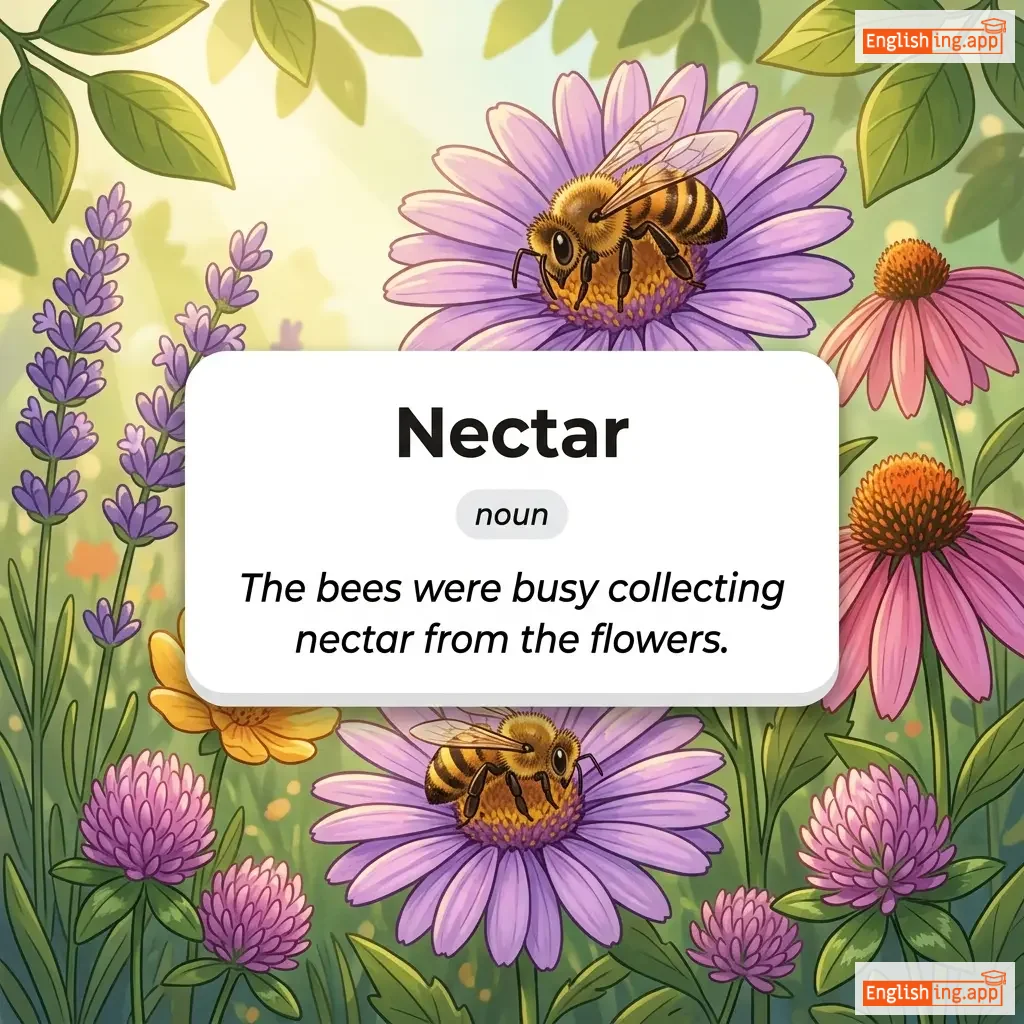
Nectar definition card — visual illustration of the meaning
noun
/ˈnɛktər/
अमृत (amrit)

a sweet liquid produced by flowers and collected by bees; in mythology, the drink of the gods

"The bees were busy collecting nectar from the flowers."

"मधुमक्खियाँ फूलों से अमृत एकत्रित करने में व्यस्त थीं।" (Madhumakkhiyan phoolon se amrit ekatrit karne mein vyast thin.)
noun
/ˈnɛktəriːn/
नेक्टरीन (आलू बादाम किस्म का फल) (nectarine)

A smooth-skinned variety of peach.

"She bought a basket of fresh nectarines from the market."

"उसने बाजार से ताजे नेक्टरीन का एक टोकरी खरीदी।" (Usne bajar se taze nectarine ka ek tokri khareedi.)
need definition card — visual illustration of the meaning
verb
/niːd/
आवश्यकता (avashyakta)

to require something or someone

"I need your help with this task."

"मुझे इस काम के लिए आपकी मदद चाहिए।" (Mujhe is kaam ke liye aapki madad chahiye.)
noun, verb
/ˈniː.dəl/
सुई (sui)

a small thin metal tool with a point used for sewing or injecting; to provoke or annoy someone

"The nurse used a sterile needle for the injection."

"नर्स ने इंजेक्शन के लिए एक निष्कलंक सुई का उपयोग किया।" (Nars ne injection ke liye ek nishkalanak sui ka upyog kiya.)
adjective
/ˈniːd.ləs/
अनावश्यक (anavashyak)

unnecessary; not required; without purpose

"The argument was needless and could have been avoided."

"तर्क अनावश्यक था और उसे टाला जा सकता था।" (tark anavashyak tha aur use tala ja sakta tha)
noun
/ˈniːdəlwɜːrk/
सिलाई, कढ़ाई (silai, kadhai)

The craft of sewing, embroidery, or knitting done with a needle.

"Her grandmother taught her the art of needlework."

"उसकी दादी ने उसे नीडलवर्क की कला सिखाई।" (Uski dadi ne use needlework ki kala sikhai.)
adjective
/ˈniːdi/
आवश्यकता मंद (avashyakta mand)

Lacking the basic necessities of life; poor.

"The charity provides food and shelter for needy families."

"चैरिटी गरीब परिवारों को भोजन और आश्रय प्रदान करती है।" (Charity gareeb parivaron ko bhojan aur aashray pradan karti hai.)
adjective
/nɪˈfɛəriəs/
दुष्ट, अपराधी, या नैतिक रूप से बुरा (dusht, aparadhi, ya naitik roop se bura)

Wicked, criminal, or morally bad.

"The police uncovered a nefarious plot to cheat investors."

"पुलिस ने निवेशकों को धोखा देने के लिए एक दुष्ट साजिश का खुलासा किया।" (Police ne niveshako ko dhokha dene ke liye ek dusht saazish ka khulasa kiya.)
negate definition card — visual illustration of the meaning
verb
/nɪˈɡeɪt/
नकारना, नष्ट करना (nakarna, nasht karna)

To cancel out or make ineffective; to deny the truth of something.

"The new evidence will negate the claims made earlier."

"नए प्रमाण पहले किए गए दावों को नकार देंगे।" (Naye praman pehle kiye gaye daavon ko nakar denge.)
noun
/nɪˈɡeɪʃən/
नकारात्मकता (nakaratmakta)

The act of denying something; the contradiction or absence of something.

"The theory is built on the negation of traditional beliefs."

"सिद्धांत पारंपरिक विश्वासों के नकारात्मकता पर आधारित है।" (Siddhant parampirik vishwason ke nakaratmakta par aadharit hai.)
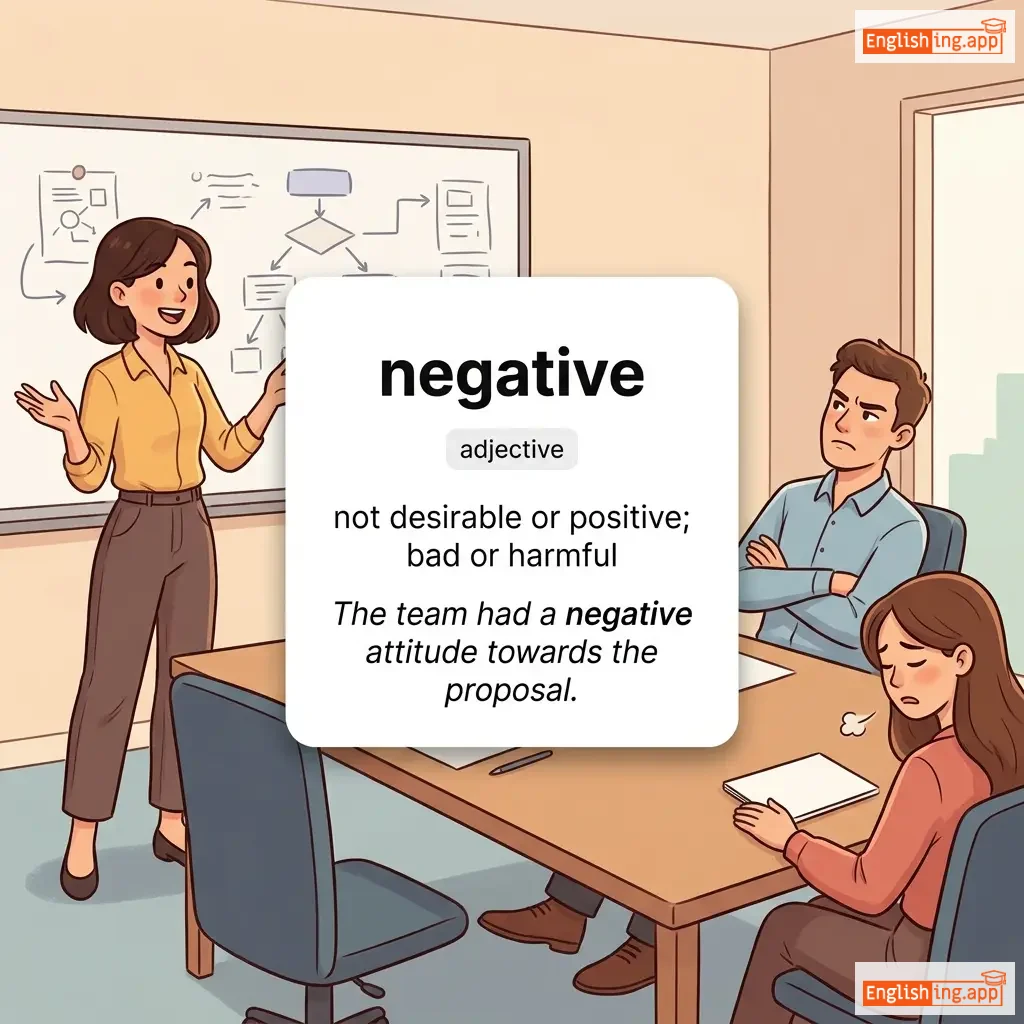
negative definition card — visual illustration of the meaning
adjective
/ˈnɛɡətɪv/
नकारात्मक (nakaratmak)

not desirable or positive; bad or harmful

"The team had a negative attitude towards the proposal."

"टीम का प्रस्ताव के प्रति नकारात्मक रुख था।" (Teem ka prastaav ke prati nakaratmak rukh tha.)
neglect definition card — visual illustration of the meaning
verb
/nɪˈɡlɛkt/
उपेक्षा करना (upeksha karna)

To fail to care for or give proper attention to something or someone.

"He neglected his studies and failed the exam."

"उसने अपनी पढ़ाई में उपेक्षा की और परीक्षा में असफल हो गया।" (Usne apni padhai mein upeksha ki aur pariksha mein asafal ho gaya.)
adjective
/nɪˈɡlɛktfʊl/
लापरवाह (laparwaha)

Failing to give proper care or attention.

"The neglectful parent left the child alone for hours."

"लापरवाह माता-पिता ने बच्चे को घंटों अकेला छोड़ दिया।" (Laparwaha mata-pita ne bachche ko ghanton akela chhod diya.)
noun
/ˌnɛɡlɪˈʒeɪ/
महिलाओं का हलका गाउन (mahilaon ka halka gown)

A woman's light dressing gown, often made of thin or silky material.

"She wore a silk negligee before going to bed."

"वह सोने से पहले रेशमी नेगलीज़े में थी।" (Vah sone se pehle reshmi neglize mein thi.)
noun
/ˈnɛɡlɪdʒəns/
लापरवाही (laparwahi)

Failure to take proper care in doing something, often resulting in damage or harm.

"The accident was caused by the driver's negligence."

"दुर्घटना चालक की लापरवाही के कारण हुई।" (Durghatna chaalak ki laparwahi ke karan hui.)
adjective
/ˈnɛɡ.lɪ.dʒənt/
लापरवाह (laparwah)

Failing to take proper care in doing something; careless.

"The company was found negligent in providing workplace safety."

"कंपनी को कार्यस्थल सुरक्षा प्रदान करते समय लापरवाही करते पाया गया।" (Company ko karyasthal suraksha pradan karte samay laparwahi karte paya gaya.)
adjective
/ˈnɛɡ.lɪ.dʒə.bəl/
निग्निजेबल (niglijebel)

So small or unimportant as to be not worth considering; insignificant.

"The cost of the error was negligible."

"त्रुटि की लागत नगण्य थी।" (Truti ki laagat niganya thi.)